https://doi.org/10.5468/ogs.2020.63.2.164 pISSN 2287-8572 · eISSN 2287-8580
Introduction
Uterine leiomyoma is the most common benign tumor of the female genital tract, affecting approximately 20–50% of all women. Although hysterectomy is an option for the surgical management of uterine leiomyomas, myomectomy is an at- tractive alternative for women who desire to preserve fertility [1,2].
Laparoscopic myomectomy (LM) was described in 1979 by Semm [3]; LM has distinct advantages over abdominal myo- mectomy, including shorter hospital stay, faster recovery, less adhesion, cosmetic advantages, and reduced blood loss [4-6].
Long-term outcomes of single-port laparoscopic myomectomy using a modified suture technique
Mina Kang, MD
1,*, Jihye Kim, MD
2,*, Tae-Joong Kim, MD, PhD
1, Jeong-Won Lee, MD, PhD
1, Byoung-Gie Kim, MD, PhD
1, Duk-Soo Bae, MD, PhD
1, Chel Hun Choi, MD, PhD
1Department of Obstetrics and Gynecology, 1Samsung Medical Center, Sungkyunkwan University School of Medicine, Seoul, 2Dankook University Hospital, Cheonan, Korea
Objective
To evaluate the long-term outcomes, including the pregnancy outcome and recurrence rate after single-port laparoscopic myomectomy (LM) using a modified suture technique with a Hem-o-lok clip (Choi’s LM) and conventional 4-port LM.
Methods
A retrospective study of patients who underwent Choi’s LM (n=55) and 4-port LM (n=102) in a single institutional hospital was conducted. Patients with <3 symptomatic myomas sized <10 cm each and operated on by a single surgeon were included. Recurrence was confirmed when a myoma measuring ≥3 cm was detected.
Results
The patients in both groups had similar demographic characteristics. Single (76.4% vs. 62.7%) and intramural (52.7% vs. 56.9%) tumors were commonly detected in both groups in the mean diameter (6.8±1.5 cm vs. 7.0±1.6 cm;
P=0.40). In Choi’s LM, 16 patients (29.1%) needed an additional port; those who were nulliparous and/or had a large
leiomyoma more frequently required an additional port (P=0.023 and 0.04, respectively). During a median follow-up period of 69 months, 17 patients (7.1% vs. 14.6%) had recurrence. The size of dominant myomas at recurrence was significantly smaller in patients who underwent Choi’s LM (3.4±0.7 cm vs. 5.7±2.4 cm; P=0.004). All 13 patients in both groups who successfully conceived had a full-term delivery. No major complications occurred during pregnancy.
Conclusion
Although an additional port was frequently used, the long-term outcomes of patients who experienced recurrence and pregnancy after Choi’s LM were acceptable. Considering its usability, Choi’s LM is feasible for the treatment of uterine leiomyoma.
Keywords: Laparoscopic myomectomy; Modified suture technique; Pregnancy; Single port; Uterine leiomyoma
Received: 2019.05.19. Revised: 2019.08.24. Accepted: 2019.09.04.
Corresponding author: Chel Hun Choi, MD, PhD
Department of Obstetrics and Gynecology, Samsung Medical Center, Sungkyunkwan University School of Medicine, 81 Irwon- ro, Gangnam-gu, Seoul 06351, Korea
E-mail: [email protected] https://orcid.org/0000-0002-0199-6669
*These authors contributed equally to this work.
Articles published in Obstet Gynecol Sci are open-access, distributed under the terms of the Creative Commons Attribution Non-Commercial License (http://creativecommons.
org/licenses/by-nc/3.0/) which permits unrestricted non-commercial use, distribution, and reproduction in any medium, provided the original work is properly cited.
Copyright © 2020 Korean Society of Obstetrics and Gynecology
On account of these merits, LM has become a recent trend for the surgical treatment of uterine leiomyoma. With the use of more advanced instruments, such as articulating for- ceps or barbed suture devices, and increase in the surgeons’
experience, surgeons are attempting to minimize the number of abdominal incisions and visible scars; single-port LM (SP-LM) has been introduced and is a rapidly evolving field with this tendency [7-11].
However, technical difficulties are associated with SP-LM when suturing uterine defects because of the collision of instruments, limited number of operating arms, and ab- sence of an assistant arm for maintaining tension. Therefore, barbed suture devices are frequently used during SP-LM pro- cedures because they are easy to use and shorten the opera- tive time [10]. Despite these advantages, the use of residual barbed suture materials has been implicated to cause bowel complications after laparoscopic gynecologic surgery [12,13].
Given that bowel complications adversely affect the patients’
quality of life, efforts are needed to find alternative suturing methods to repair the uterine defects during SP-LM.
To compensate the limitations of the barbed suture de- vices, we adopted several modified suture techniques, which included Hem-o-lok clip anchoring, continuous horizontal mattress suturing of the myometrium, and baseball suturing of the uterine serosa in SP-LM (Choi’s LM) since 2011 [14].
This retrospective study reported that Choi’s LM performed using the modified suture technique was associated with a shorter operative time and less blood loss.
Several studies reported immediate surgical outcomes and provided technical descriptions of the novel suturing tech- nique for SP-LM; in contrast, only a limited number of studies reported the long-term recurrence and pregnancy outcomes of patients who underwent SP-LM.
LM had higher recurrence rate than open myomectomy [15], and a 5-year cumulative recurrence rate of up to 52.9%
had been reported after LM [16].
After myomectomy, uterine rupture and dehiscence are among the life-threatening complications that can possibly occur during pregnancy [17]. In this study, we aimed to in- vestigate the long-term outcomes, including pregnancy out- come and recurrence rate, of patients who underwent Choi’s LM as treatment for symptomatic uterine leiomyoma and compare these outcomes with those of patients who under- went conventional multi-port LM (4-port LM).
Materials and methods
1. Study population
In October 2011, with 55 patients who underwent 2-port LM, Choi’s LM was introduced in SP-LM using a new modi- fied suture technique. This Choi’s LM procedure was per- formed by a single surgeon (CH Choi) who performed over 100 LM procedures per year at Samsung Medical Center.
Patients with <3 symptomatic leiomyoma measuring 10 cm or less on ultrasonography and were eligible for Choi’s LM.
Patients who fulfilled the inclusion criteria were selected consecutively to undergo this procedure, and data were col- lected prospectively. The decision to perform this procedure was not influenced by the patient’s history of abdominal surgery or type of leiomyoma. Before surgery, the risks were explained to the patient, including the potential need for an additional port during surgery and the risk of uterine rupture in future pregnancies. As a control, all patients who under- went conventional multi-port LM (4-port LM) from January 2008 through November 2010 were included. The inclusion criteria were the same as above.
2. Data collection
The following patient characteristics were obtained: age, body mass index (BMI), parity, symptoms resulting from myo- mas, location and type of largest myomas, and number and diameter of dominant myomas.
During the long-term follow-up, patients were evaluated via ultrasonography every 6 months for the first year and annually thereafter. Leiomyoma recurrence was confirmed when a new leiomyoma measuring 3 cm or more was de- tected on ultrasonography. Patients were also asked if they attempted to become pregnant, and all of the obstetric data were collected during the follow-up.
3. Surgical procedure
The Choi’s LM procedure was described in our previous study
[14]. Briefly, using the open Hasson technique, a 2-cm verti-
cal incision was made within the umbilicus, and an extra-
small wound retractor (Alexis; Applied Medical, Rancho
Santa Margarita, CA, USA) was inserted into the wound
opening. Once it fixed in the opening site, the retractor lat-
erally retracted the sides of the wound opening. A surgical
glove with sheaths inserted into 3 fingers was attached to the
outer ring of the retractor to maintain pneumoperitoneum.
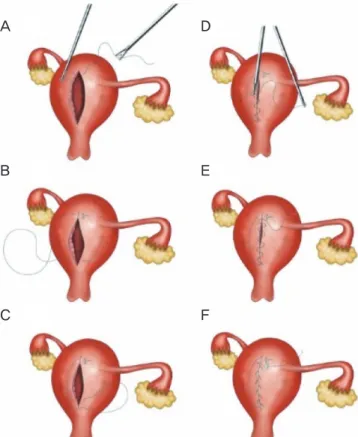
After enucleation of the leiomyoma, the uterine parenchy- mal defect was closed laparoscopically in a double layer. A 1-0 Vicryl suture (Polyglactin; Ethicon, Somerville, NJ, USA) on a large curved needle was then used to make a deep and wide bite. Before suturing, the Vicryl suture was tied with a Hem-o-lok clip, which acts as anchor on the tail of the continuous suture and was the starting point of the suture site (Fig. 1A). Basically, all sutures were completed with one continuous suture using a double layer technique. First, a horizontal mattress suture with a deep and wide bite was performed at the bottom of the defect to attach the myome- trium closely and for hemostasis (Fig. 1B and C). In the case of large myometrial defects, additional horizontal mattress sutures were performed in a continuous manner. Following the horizontal mattress suture, a baseball suture was per- formed in the opposite direction to close the myometrium and serosa tightly (Fig. 1D and E). In the baseball suture, the edges of the uterine defect were approximated with intro- flexion stitches (myometrium/serosa–serosa/myometrium direction) at 1.5-cm increments from the side of the incision and held tightly with articulating grasper to secure tension.
After completing the baseball suture, 2 Hem-o-lok clips were applied and pushed with maximal tension to secure the suture (Fig. 1F). The knot was tightly fixed immediately, decreasing the risk of knot loosening during interrupted knot typing. Up to 3 Hem-o-lok clips were used during this proce- dure.
If the surgery was difficult to perform on a single-port platform or when prolonged operation was anticipated, the surgeon decided whether to create an additional 5-mm port in the suprapubic area at any time during the surgery. To per- form a 2-port LM, a 5-mm ancillary trocar was inserted 2 fin- gerbreadths above the symphysis pubis. Lastly, the resected leiomyoma was wrapped with an endopouch and removed via the umbilical wound by cutting it into smaller pieces us- ing a knife.
4. Statistical analyses
Descriptive statistics were used to analyze categorical and continuous variables. Continuous variables were compared using the Mann-Whitney U-test or Student’s t-test. Fisher’s exact test, χ
2test, or logistic regression test was used to ana- lyze categorical variables. Recurrence rates were compared using Kaplan-Meier curve. Statistical analyses were per- formed using SPSS version 25.0 (SPSS, Chicago, IL, USA). A
P-value of ≤0.05 was considered significant, and all P-values
were 2 sided.
Results
Of 184 patients who underwent Choi’s LM and 4-port LM, 27 were excluded because of the size (>10 cm) or number (≥3) of myomas. Of 157 patients who fulfilled the inclusion criteria, 55 underwent Choi’s LM and 102 underwent 4-port LM.
Fig. 1. Single-port laparoscopic myomectomy (LM) with a modi- fied suture technique with a Hem-o-lok clip (Choi’s LM). (A) The 1-0 Vicryl suture was tied with a Hem-o-lok clip, which acts as an anchor on the tail of the continuous suture that is the starting point of the suture site. (B, C) A horizontal mattress suture with a deep and wide bite was performed at the bottom of the defect to attach the myometrium closely. (D) A baseball suture was per- formed in the opposite direction to approximate the myometrium and serosa tightly, while the grasper was used and pushed with maximal tension to cinch down on the last suture site to secure the suture. (E) The same procedures were continuously repeated. (F) The Hem-o-lok clip was used to cinch down on the suture site and secure the knot tightly.
A
B
C
D
E
F
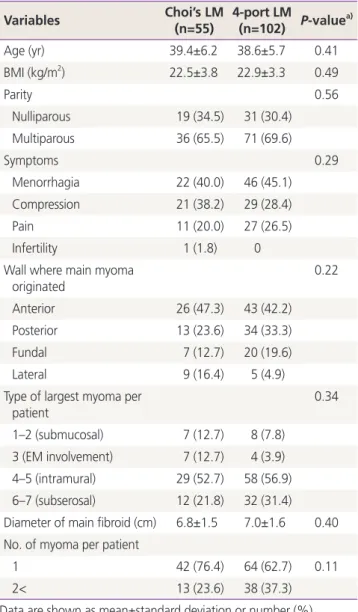
The detailed patient demographic data and characteristics of myomas are shown in Table 1. Patients’ age, BMI, parity, and symptoms related to myomas were similar in the 2 groups.
The mean age of Choi’s group was 39.4±6.2 years (range, 27–52 years), while that of the 4-port LM group was 38.6±5.7 years (range, 26–55 years) (P=0.41, respectively).
Nineteen patients (34.5%) in the Choi’s LM group and 31 (30.4%) in the 4-port LM (P=0.56) were nulliparous. The initial preoperative indications were menorrhagia (40% vs.
45.1%), compression symptoms (38.2% vs. 28.4%), and
pelvic pain (20.0% vs. 26.5%).
There was no significant difference in the characteristics of the myomas between the 2 groups. Forty-two women (76.4%) in the Choi’s LM group and 64 women (62.7%) in the 4-port LM group had a single leiomyoma (P=0.11). The most common type of leiomyoma was intramural type (3–5;
36 [65.4%] vs. 62 [60.8%]), followed by subserosal type (6–7; 12 [21.8%] vs. 32 [31.4%]) and submucosal type (1–2;
7 [12.7%] vs. 8 [7.8%]; P=0.34). For both groups, anterior wall (26 [47.3%] vs. 43 [42.2%]) was the most common lo- cation of myomas. Mean diameter of the largest leiomyoma was also similar between 2 groups (6.8±1.5 cm [range, 5.0–9.9 cm] vs. 7.0±1.6 cm [range, 5.0–9.9 cm]), as mea- sured on ultrasonography (P=0.11).
In Choi’s LM group, 16 (29.1%) patients required an addi- tional port to achieve meticulous repair of the uterine defect.
We compared the clinical factors associated with the need for an additional port. In multivariate analysis (Table 2), clini- cal factors associated with additional port insertion were di- ameter of the main fibroid and parity (P=0.04 and 0.023, re- spectively). Multiparous women did not require an additional port. Type and location of leiomyoma were not associated with the need for an additional port. However, there is a pos- sibility that the cases of patients requiring an additional port were more complicated, which can lead to longer operating time, larger blood loss, and/or longer hospital stay.
Within a median follow-up of 69 months, 17 patients (4 [7.1%] vs. 13 [14.6%]) had myoma recurrence (P=0.292) (Table 3). In Choi’s LM group, most of the patients had soli- tary-type (4 [75%]) and intramural-type myomas (4 [100%]).
In contrast, the 4-port LM group had multiple (8 [61.5%])
Table 1. Demographic data of the patients in the Choi’s laparo-scopic myomectomy (LM) and 4-port LM group
Variables Choi’s LM
(n=55)
4-port LM
(n=102) P-valuea)
Age (yr) 39.4±6.2 38.6±5.7 0.41
BMI (kg/m2) 22.5±3.8 22.9±3.3 0.49
Parity 0.56
Nulliparous 19 (34.5) 31 (30.4)
Multiparous 36 (65.5) 71 (69.6)
Symptoms 0.29
Menorrhagia 22 (40.0) 46 (45.1)
Compression 21 (38.2) 29 (28.4)
Pain 11 (20.0) 27 (26.5)
Infertility 1 (1.8) 0
Wall where main myoma
originated 0.22
Anterior 26 (47.3) 43 (42.2)
Posterior 13 (23.6) 34 (33.3)
Fundal 7 (12.7) 20 (19.6)
Lateral 9 (16.4) 5 (4.9)
Type of largest myoma per patient
0.34
1–2 (submucosal) 7 (12.7) 8 (7.8) 3 (EM involvement) 7 (12.7) 4 (3.9) 4–5 (intramural) 29 (52.7) 58 (56.9) 6–7 (subserosal) 12 (21.8) 32 (31.4) Diameter of main fibroid (cm) 6.8±1.5 7.0±1.6 0.40 No. of myoma per patient
1 42 (76.4) 64 (62.7) 0.11
2< 13 (23.6) 38 (37.3)
Data are shown as mean±standard deviation or number (%).
BMI, body mass index; EM, endometrium.
a)The P-value was determined using χ2 test, Fisher’s exact test, or Student’s t-test.
Table 2. Logistic regression results for predicting additional port insertion in Choi’s laparoscopic myomectomy
Patient characteristics OR 95% CI P-valuea)
Multiparous 0.185 0.043–0.789 0.023
Wall where main fibroids originated
Anterior - - 0.411
Posterior 0.362 0.063–2.095 0.257
Fundus 0.658 0.082–5.293 0.658
Lateral 3.469 0.630–33.463 0.282
Diameter of main fibroid 1.759 1.027–3.014 0.040 CI, confidence interval; OR, odds ratio.
a)The P-value was determined using Logistic regression test.
and more various types of myomas (P=0.25). The size of dominant myomas at recurrence was significantly smaller in Choi’s LM group (3.4±0.7 cm [range, 3.0–3.9 cm] vs.
5.7±2.4 cm [range, 3.3–11.0 cm]; P=0.004). The Kaplan- Meier curve (Fig. 2) showed similar 5-year cumulative recur- rence rate in both groups.
The pregnancy outcomes of the 2 groups are summarized in Table 4. Four patients in the Choi’s LM group and 9 in the 4-port LM group successfully conceived, and all of had full- term delivery. Three patients had 2 pregnancies during the follow-up period. Two patients in the Choi’s LM group and 1 in the 4-port LM group had a successful vaginal delivery
Table 3. Characteristics of recurrence after myomectomy
Characteristics Choi's LM (n=4) 4-port LM (n=13) P-valuea)
No. of myomas at recurrence
1 3 (75.0) 5 (38.5) 0.250
>2 1 (25.0) 8 (61.5) -
Myoma type at recurrence, according to FIGO classification
1–2 (submucosal) 0 1 (7.7) 0.430
3 (intramural, EM involved) 0 2 (15.4) -
4–5 (intramural) 4 (100.0) 6 (46.2) -
6–7 (subserosal) 0 4 (30.8) -
Myoma location at recurrence 1.000
Anterior 1 (25.0) 5 (38.5)
Posterior 1 (25.0) 4 (30.8)
Fundus 2 (50.0) 4 (30.8)
Lateral 0 0
Size of myoma at recurrence (cm) 0.004
Mean±standard deviation 3.4±0.7 5.7±2.4
Median (range) 3.3 (3–3.9) 4.8 (3.3–11)
EM, endometrium; FIGO, Federation of Gynecology and Obstetrics; LM, laparoscopic myomectomy.
a)The P-value are represented as myoma recurrence (P=0.292).
Cumulative recurrence
SP-LM 4-Port LM SP-LM censored 4-Port LM censored
0.00 25.00 50.00 75.00 100.00 125.00 Follow-up period (month)
0.00 25.00 50.00 75.00 100.00 125.00 1.0 60.0
0.8 0.6 0.4 0.2 0.0
1.0 0.8 0.6 0.4 0.2 0.0
Fig. 2. Kaplan-Meier curve showing similar cumula- tive recurrence rate (P=0.835). Probability of 5-year recurrence-free survival of patients: Choi’s LM (82.2%) vs. 4-port LM (86.0%). SP, single-port; LM, laparoscopic myomectomy.
with no serious complications. They developed the same type of myoma (pedunculated subserosal type 7) before surgery. No major complications (such as uterine rupture or dehiscence) related to LM occurred during pregnancy. No abnormal findings, other than mild adhesion, were reported during cesarean section in both groups.
Discussion
This study suggests that SP-LM using a modified suture technique (Choi’s LM) was a possible alternative in selected patients with a symptomatic leiomyoma measuring 10 cm or less and fewer than 3 leiomyomas considering the long- term outcome. Although 16 patients (29.1%) needed an ad- ditional port, the perioperative outcomes of this study were comparable to those of previous studies using barbed suture devices for SP-LM [18-20].
Patients who were nulliparous and/or had a large leio- myoma were more likely to require an additional port. This
result can be explained by the meticulous suturing of the myometrium for nulliparous women. Although cosmetic outcomes and surgical outcomes were important, meticulous suture was more important for nulliparous women who are planning to become pregnant in the future. Myomectomy is a fertility-preserving surgery for nulliparous women but may lead to uterine rupture during pregnancy. Single-layered closure of uterine wall defect and frequent use of electrocau- tery are risk factors of uterine rupture [17]. Surgeons who perform single-port myomectomy should pay special atten- tion on suturing the myometrium in nulliparous women.
Although Choi’s LM had no adverse pregnancy outcomes related with the insertion of Hem-o-lok clips in situ, the data used in this study were too insufficient.
Long-term follow-up data of our study showed that the re- currence rate was acceptable compared with that of previous studies [16,21]. Two groups had similar patient and myoma characteristics identified as risk factors: age, size of myoma, and number of myoma [16]. Peri- and postmenopausal pa- tients with single myoma had the lowest recurrence rate
Table 4. Pregnancy outcomes of patients after myomectomyCase Number Age at LM (yr) Operation to deliv-
ery time, (mon) GA at delivery (wk) Complication dur- ing pregnancy
Abnormal findings at Caesarean section Choi's LM
1-1 30 16 39.0 - -
1-2 - 84 39.0 - Adhesion
2 27 19 38.2 - -
3 32 36 NA - NFSD
4 27 55 NA - NFSD
4-port-LM
1-1 29 11 36.5 - -
1-2 - 34 38.4 - Adhesion
2-1 33 12 39.0 - Adhesion
2-2 - 41 38.6 - Adhesion
3 28 20 38.4 - -
4 34 23 38.1 - -
5 30 20 NA - NFSD
6 33 54 38.1 - -
7 32 64 NA - -
8 28 10 NA - -
9 33 18 NA - Adhesion
LM, laparoscopic myomectomy; GA, gestational age; NFSD, normal full-term vaginal delivery; NA, not available (the exact GA was not available if delivered outside).