임플랜트의 표면처리에 따른 골반응에 관한 RFA 및 조직학적 연구
이정택
*
, 허성주*
, 한종현***
, 류인철**
, 김선재***
, 김성균*
서울대학교 치과대학 치과 보철학교실**
서울대학교 치과대학 치주학교실***
연세대학교 영동세브란스병원Histomophometric and Resonance frequency analysis of bone healing around titanium implants with two different surface treatment
Abstract
Jeong-Taek Lee, Seong-Joo Heo, Chong-Hyun Han, In-Cheul Rhyu, Sun-Jae Kim, Seong-Kyun Kim
*
Dert.of Prosthodontics, College of Dentistry Seoul National University
**
Dept. of Periodontics, College of Dentistry, Seoul National University
**
Yonsei University, Yongdong Severance Hospital, Department of Dentistry
Titanium and titanium alloy are widely used as materials for dental implants because of the advantages of their mechanical properties and excellent anchorage into the jaw bone. In the clinical application of dental implant, many attempts have been made to improve bone anchorage of dental implants to reduce the treatment time and improve the success rate in areas with poor bone quality. Recent studies have shown that the existence of a certain surface roughness increase bone-to-implant contact, mainly in the earlier phases of the osseointegration.
The purposes of this study were to investigate the bone response around dental implants with two different surface treatment to evaluate the biocompatability.
In this study, ABE(Advanced Blasting and Etching) H-R8.5 implants(Warantec, Seoul, Korea) and SLA(Sandblasted, Large-grit, and Acid-etched) ITI implants(Straumann, Waldenburg, Switzerland) were placed in rabbit tibia. The resonance frequency was measured every 1 month during 3 months after implant placement. After 3 months, the bone response around implants was evaluated with histomorphometric analysis.
The results obtained was as follows
1. The histomorphometric analysis in 3 months after implant placement revealed that both H-R8.5 implants and ITI implants showed relatively even bone contact from the bottom to the top of implants. No foreignbody reaction and inflammatory cell infiltration were observed.
2. As a result of the histomorphometric analysis, bone to implant contact percentages for ITI implants and H-R8.5 implants were 74%, 72%
respectively.
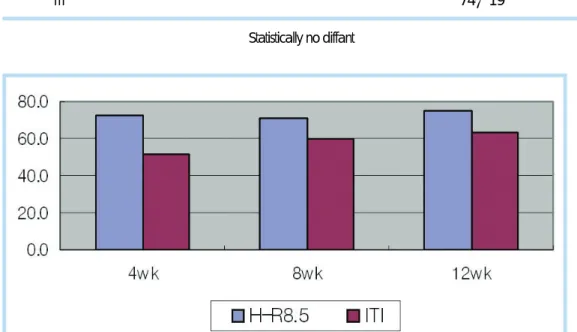
3. As a result of the RFA value measured every 1 month, H-R8.5 implants showed relatively higher RFA value than ITI implants through the observation period from the implant placement to 3 months after.
4. RFA value for H-R8.5 implants showed a tendency to decrease from 4 weeks to 8 weeks, and increase from 8 weeks to 12 weeks. For ITI implants, RFA value showed a tendency to increase with time but was relatively lower than that of H-R8.5 implants after 12 weeks
Key words : osseointegration, surface treatment, ABE, SLA, histomorphometry, RFA
This work was supported by a grant from the Korea Health 21 R&D project, Ministry of Health & Welfare, Republic of Korea
(02-PJ3-PG6-EV11-0002)
서 론
B
ranemark이 osseointegration의 개념을 발표 한 이후1)
치과용 임플랜트는 신뢰할 수 있는 치료법으로 널리 사용되고 있다. 타아타늄과 타이타늄 합금은 우수한 기계적 성질과 악골에의 고정 능 력 때문에 치과용 임플랜트의 재료로 가장 널리 사용되고 있다.2)
임플랜트의 임상적 적용에 있어서 치료기간의 단 축은 주된 관심사이며, 보다 좋은 임상적인 결과를 이끌어 내기 위해서는 더욱 빠른 창상의 치유, 예후가 불량할 것 같은 부위에서의 더 많은 골의 생성, 임플랜트 주변골의 병적인 흡수후에 예측가능한 골의 재생, 임플랜트의 식립 과 골이식의 동시 시행등이 가능해져야 한다.지난 수 십년간 많은 연구자들은 임플랜트의 골과의 결합 을 향상시킬수 있는 임플랜트 표면을 연구해왔다.
osseointegration을 향상시키는 방법은 분자생물학적 접 근과 임플랜트의 surface texture를 변화시키는 방법으로 크게 나눌수 있다. Albrektsson등은 골과의 결합에 영향 을 미치는 6가지 요인을 언급하였는데
3)
이중 surface quality는 골유착에 영향을 주는 주된 요소이며, 다양한 표면을 가진 임플랜트에서 골치유에 관한 많은 연구가 진 행되어 왔다.임플랜트의 surface roughness에서 기인하는 효과는 인 접한 골에 대한 임플랜트의 표면영역의 증가, 임플랜트의 표면에 대한 세포부착의 증가, 임플랜트의 표면에 존재하 는 골량의 증가, 임플랜트와 주변골의 기계생물학적인 반 응의 증가등을 들 수 있으며,
4)
Buser 등은 임플랜트표면 의 거칠기와 골과의 결합사이에 positive correlation이 있 음을 보여 주었다.5)
임 플 랜 트 표 면 성 상 을 변 화 시 키 는 방 법 은 크 게 subtractive methods(sandblasting, acid etching)이나 additive methods(titanium plasma spraying, HA
coating)로 나눌 수 있으며, 이들 표면처리에 따른 골의 반응도 조금씩 차이가 난다.
최근의 연구결과는 어느 정도 거친 표면은 주로 골융합 초 기단계와 골질이 좋지 않은 상황에서 bone-to-implant contact을 증가시키는 것을 보여준다.
6),7)
거친 표면은 undifferenciated cell의 migration을 촉진시키고, 새로운 골의 형성을 최대화시키는 것으로 생각된다. 이러한 환경 에 의해 더 큰 기계적 결합이 가능해지고, 임플랜트의 제 거에 더 많은 torque가 필요하게 된다.임플랜트치료의 결과에 대한 평가는 주로 임상적, 방사선 적인 방법에 의해 이루어져왔다. 방사선학적인 검사는 골 을 평가하는 주된 방법이지만 30%이하의 골흡수는 발견 할수 없으며,
8)
관찰자사이에 개인적인 차이가 많이 발생 된다.9)
하지만, Resonance Frequency Analysis(RFA) 를 이용해서 임플랜트치료의 어느 단계에서나 임플랜트의 stability의 정도를 평가하는 것이 가능해졌다.10)
RFA는 Implant Stability Quotient(ISQ)로 임플랜트의 stability를 기록하는데 1에서 100까지의 수치로 표현되 며 100은 가장 높은 임플랜트 stability를 의미한다.이 번 연 구 의 목 적 은 Advanced Blasting and Etching(ABE)으로 표면처리한 H-R8.5 임플랜트 (Warantec, Seoul, Korea)와 SLA(sandblasted, large- grit, and acid-etched)표면처리 ITI 임플랜트 (Straumann, Waldenburg, Switzerland)의 골반응을 조직형태계측학적으로 비교하고, 임플랜트의 stability를 RFA를 이용해 측정하여 비교하는 것이다.
I
연구 재료 및 방법
1. 연구재료
1) 시료준비
본 실험에는 Blasting & Etching 표면처리를 한 (주)워 랜텍 임플랜트(길이 8.5mm, 직경 4.3mm) 12개와 대조 군으로 동일한 표면처리 제품인 ITI 임플랜트(길이8mm, 직경 4.1mm) 12개를 사용하였다.
2) 실험동물
체중 3kg 내외의 가토 6마리를 이용하였으며, 실험기간 동안 각기 다른 우리에서 사육하였으며, 변화된 환경에 대한 적용기간을 2주일 갖게 한 후 실험에 사용하였고, 실험시작 전 까지는 고형사료를 먹이고 물은 마음대로 마 시게 하였다.
2. 연구방법
1) 임플랜트 식립
전신마취 후 수술부위에 국소마취 하에 가토의 장골 좌우 측에 피부 절개 후 근막 및 골막을 절개하고 노출된 골에 1마리당 우측엔 H-R8.5치수의 2개 임플랜트를, 좌측엔 ITI 임플랜트 2개를 식립하였다. 총 6마리에 H-R8.5 12 개, ITI 12개를 식립하였다. 좌우측 장골에 각각 두 개씩 의 임플랜트를 1cm 간격을 두고 매식하였으며, 원심측 시 편은 RFA를 기부측은 조직형태학적인 분석에 사용하였 다. 식립 후 3개월까지 1개월마다 RFA를 측정하였고 3개 월 후에 가토를 희생하여 조직학적 검사를 시행하였다.
2) 조직학적 검사
실험동물을 수술 후 3개월 후에 전신마취 하에 희생시킨 후 장골절편을 적출하여 10% 중성포르말린에 고정하였 다. 통법에 따라 수세 및 탈수하고 레진에 포매한 후 Exkat cutting and grinding system(Exkat Apparatus, Norderstedt, Germany)으로 절단, 연마하 여 30µm 두께의 비탈회 연마표본을 제작하였다. 제작된 표본은 multiple 염색을 시행한 후 광학현미경(Olympus, Tokyo, Japan)에서 조직을 관찰하였고, 현미경에 연결된 Image analysis system(KAPPA opto-electonics, mbh, Germany)을 이용하여 임플랜트와 골의 접촉률을 측정하 였다. 골접촉률은 골결손부에서 임플랜트와 피질골이 접 촉하는 부위의 임플랜트 전체길이를 측정한 후 골과 접촉 한 부위를 측정하여 백분율을 구하였다.
결과
1. 임플랜트와 골접촉률 측정 결과
가토의 장골에 임플랜트 식립 후 3개월 후의 조직학적인 관찰결과 H-R8.5나 ITI 모두 결손부의 기저에서 상부에 이르기까지 임플랜트와 비교적 고른 골접촉을 하고 있었 으며 이물반응이나 염증세포의 침윤은 관찰되지 않았다.
H-R8.5의 경우 임플랜트의 미세나사선 부위의 나사 안쪽 으로 골조직이 잘 형성되어 있음이 관찰되었다 (Fig. 1).
조직계측학적인 관찰결과 ITI 임플랜트의 골접촉률은 74%로, H-R8.5 임플란트의 골접촉률은 72%로 거의 비 슷한 양의 골접촉률을 보였다(Table 1).
2. RFA 측정 결과
가토의 장골에 임플란트 식립 후부터 3개월까지 1개월마
III
II
Table. 1.
Bone-to-implant contact percentages for H - R 8.5 and ITI after 12wks
Mean ±SD(%)
H - R 8.5 72±9
ITI 74±19
Statistically no diffant
Fig. 1.
Light microscopic view 12wks after implantation.(100x)(A) H-R8.5 (B) ITI
Fig. 2.
RFA for H-R8.5 and ITI after 4wks, 8wks and 12wks (Statistically no diffant)다 RFA 값 측정결과 관찰기간 내내 H-R8.5가 ITI 보다 비교적 높은 값을 보였으며, H-R8.5의 경우 RFA 값이 4 주보다 8주 후엔 약간 감소하는 경향을 보였다가 12주후 에는 4주 보다 높아지는 경향을 보였다. ITI의 경우에는 RFA 값이 시간이 지날수록 높아지는 경향을 보였으나 12 주 후에도 H-R8.5 보다 비교적 낮은 값을 보였다(Fig.
2).
고찰
타이타늄과 타이타늄 합금은 우수한 기계적 성질과 생체 적합성으로 인해 치과용 임플랜트의 재료로 가장 널리 사 용되고 있다.
2)
임플랜트가 주변골에 고정되는 정도는 임 플랜트 그 자체와 host-related factor에 따라서 결정된 다. Albrektsson등은 골과의 결합에 영향을 미치는 요인 으로 biocompatibility, design, surface quality, status of host tissue, surgical technique, loading condition 6 가지를 언급하였다.3)
임플랜트 표면적의 증가는 biomechanical bone-implant bonding을 향상시키는 것으로 보이며, 불규칙적인 임플 랜트의 표면은 임플랜트와 인접한 골세포에 영향을 주어 서 proliferation과 differentiation을 증가시킬 수 있다.
osteocalcin과 같은 골성장에 관련된 요인들도 거친 표면 에서 더 증가한다.
11)
superficial irregular layer가 세포에 의한 여러 가지 다른 growth factor의 생성에 미치는 영향 은 아직까지 확실히 밝혀져 있지 않지만, 타이타늄 표면의 화학적 조성이 동일하다는 사실을 고려하면 서로 다른 superficial topography가 세포의 행동양상을 조절한다고 볼수 있다.12)
임플랜트 주변의 골재생은 다양한 임플랜트 표면과 관련 있 다 . 표 면 의 거 칠 기 는 subtractive methods (sandblasting, acid etching)이 나 additive
methods(titanium plasma spraying, HA coating)로 얻 을 수 있다. sandblasted surface는 air와 abrasive들을 spray해서 얻을 수 있는데 abrasive로 사용되는 재료는 다양하며, 사용되는 particle의 diameter가 중요한 요소 이다.
Wennerberg등의 조직학적인 연구에서, machined surface에 비해 sandblasted surface의 the percentage of direct bone contact이 더 크다고 밝혔으며, 25-㎛
particles(Ra=1.16㎛)로 sandblasting한 임플랜트에서 250-㎛ particles(Ra=1.94㎛)로 sandblasting한 임플랜 트보다 the percentage of direct bone contact이 더 크다 고 밝혔다.
13)
Aluminum oxide(Al2
O3
)로 blasting하는 경우 aluminum ions이 임플랜트의 표면에 남아서 정상 적인 bone mineralization을 방해할 수 있다. 이런 문제 점을 해결하기위해 titanium oxide(TiO2
) particle을 sandblasting하는 재료로 사용되어 왔다. 최근에는 HA particle을 사용해서 sandblasting하는 기술이 적용되어 왔으며(RBM;Resorbable Blasting Material)14)
이런 기 술의 주된 목적은 거친 표면을 얻는것이며 HA particle이 표면에 남아있더라도 HA가 매우 생체적합성이 뛰어나고 골재생능력이 있기 때문에 아무런 문제를 일으키지 않는 다고 생각한다. blasting에 사용되는 particle에 의한 titanium의 오염, 표면의 nonhomogeneous한 처리, metallic material의 소실과 같은 문제점을 해결하기 위 해서 acid etching이 사용되어왔다.15)
sandblasted and etched surface를 얻기위해서는, 큰 diameter의 재료로 표면을 blasting하여 macrorough surface를 얻고 산용액 에서 etching을 하여 microirregularity와 더 증가된 임플 랜트의 표면적을 얻는 것이다. blasting과정에서 사용되 는 Al2
O3
가 biocompatible하고 골유착과정을 방해하지 않는다고 많은 문헌에서 보고하고 있지만 etching과정이 표면의 오염물질들을 제거하고 금속의 반응성을 높이는데 도움이 된다고 할 수 있다. 블라스팅한 후 산부식하는 방IV
법으로서 소개된 것 중 대표적인 것이 SLA 표면으로 이 런 SLA 표면은 임플랜트의 골유착을 더욱 향상시키고 하 중을 가하기까지 걸리는 골치유기간을 줄일 수 있어서 식 립 6주 후에 조기 부하가 가능하다고 보고되면서 임상에 서 사용이 증가하고 있다.
16)
본 실험에서는 SLA와 유사한 ABE(Advanced Blasting
& Etching)로 표면처리한 임플랜트와 기존의 SLA표면 을 가진 임플랜트의 골반응을 평가하였다. SLA와 ABE 임플랜트 모두에서 임플랜트 식립 3개월 후 골접촉률이 각각 74%, 72%로 비슷한 양의 골접촉률을 보였다. SLA 표면의 우수성은 여러 연구에 의해서 입증되었으며 그것 과 유사한 ABE 표면 역시 이번 연구결과를 통해서 볼 때 우수한 골치유 반응을 이끌어낼 수 있다고 생각된다.
ABE는 SLA와 비해 상대적으로 날카로운 부위가 적고 둥 글고 균일한 표면 texture를 가져서 Ra 값은 ABE가 1.44㎛, SLA가 2.0㎛으로 가장 이상적이라는 Ra값인 1.5㎛에 ABE가 더 가까운 수치를 보인다.
17)
골유착이라는 용어는 살아있는 골과 부하를 받는 임플랜 트 표면사이의 직접적인 구조적, 기능적 연결로 정의되어 왔다. 또한 임상적으로 골유착은 기능적인 부하는 받는 상 황에서 alloplastic material이 임상적으로 무증상을 보이 면서 견고하게 고정되고 유지되는 과정이라고 정의되어왔 다. 일차적 안정(primary stability)는 임플랜트의 식립시 에 일어나며 primary bone contact의 정도와 관련이 있 다.
16)
일차적 안정은 임플랜트의 길이, geometry, 표면적 에 의해 영향을 받으며 bone-to-implant contact area에 의해서도 영향을 받는다. 또 다른 요인으로는 cortical bone과 trabecular bone의 비율, 식립기술을 들수 있다.이차적 안정(secondary stability)은 woven과 lamellar bone으로 이루어지는 secondary bone contact의 결과이 다. 치유기간 동안 primary bone contact이 감소함에 따 라 secondary bone contact이 증가한다.
16)
치유가 된 골 에서 primary and secondary stability는 전통적으로 임플랜트를 tapping하는 임상적 방법에 의해서 이루어져왔 다. 이러한 방법이 임상적인 technique으로 널리사용되고 있지만 이러한 방법의 유효성에는 많은 의문이 있으며 임 플랜트의 stability를 측정할 수 있는 정량적인 방법이 확 실히 필요하다.
solid medium내에 있는 어떤 물체의 stability를 기술하 는데 이용되는 정량적인 방법은 vibration analysis를 통 해서 이루어진다. 임플랜트의 vibration analysis는 2가지 categories로 나누어진다: transient excitation and continuous excitation.
18)
manual percussion이 transient excitation의 가장 간단한 형태이다. 치아의 mobility를 측정하기 위해서 개발된 Periotest 역시 transient excitation 기구이다. 임플랜트에 periotest를 적용할 때에는 아주 좁은 범위내의 수치만을 보여주기 때 문에 임플랜트의 stability를 측정하기에는 sensitivity가 부족하다. RFA는 continuous excitation을 이용한 방법 으로 임플랜트의 골유착과 stability를 임상적으로 측정할 수 있는 noninvasive한 방법이다. 초기의 in vitro 연구는 interfacial stiffness의 변화를 측정할 수 있음을 보여준 다. 임상적으로 RF value는 골치유동안의 임플랜트 stability의 변화와 상관관계를 보여준다.19)
최근의 조직형 태계측학적 연구결과는 RF value가 bone-implant contact의 level과 관련이 있음을 보여준다.20)
이러한 여 러 연구 결과들은 임플랜트 식립후 골치유와 골융합에서 의 변화를 평가하는데 RFA의 사용을 지지해준다.치유기간동안 골의 dynamic nature의 결과로 시간에 따 라 임플랜트주위에 변화가 일어난다. 이러한 healing 기 간동안과 나중에 기능중에 stability가 필요하다. 초기에 initial stability는 임플랜트의 식립시 발생된다. 이것은 주로 임플랜트의 골에 대한 press-fit에 의한 결과이며 이 것을 primary bone contact이라고 한다. primary stability에 영향을 주는 것으로 생각되는 요인중 하나가 임 플 랜 트 의 길 이 이 다 . secondary stability는
osteoconductive titanium surface에 대한 bone의 modeling과 remodeling의 결과이다. 치유과정동안 woven bone은 lamellar bone이 되고 secondary bone contact이 증가하면서 primary bone contact은 감소하게 된다. Barewall등은 primary bone contact으로부터 secondary bone contact으로 stability의 level의 변화를 사람에서 10주까지 관찰하였는데 bone quality에 상관없 이 10주후에 ISQ values가 증가하였지만 통계적으로 유 의성있게 증가하지는 않았다고 하였다.
21)
특히 type 1 bone에서는 큰 변화가 관찰되지 않았다고 하였고 반면에 type 2,3 bone에서는 0-3주와 3-10주사이에 implant의 stability가 유의성 있게 증가하였다고 하였다. 또한 interfacial stiffness의 가장 낮은 수치는 3주에 관찰되었 으며, type 4 bone에서 가장 뚜렷하였다. type 2,3 bone 의 치유양상은 type 4 bone보다 type 1 bone과 유사한 양상을 보였다. 6주후에 RA value는 10주때와 다르지 않 았고, type 4 bone에서도 다른 bone type을 따라잡는 결 과를 보여주었다. 하지만 occlusal loading의 영향은 앞으 로 더 연구되어져야 할 것이다.이번 연구에서 가토의 장골에 임플랜트 식립 후부터 3개 월까지 1개월마다 RFA값을 측정하며 시간에 따른 임플 랜트의 stability의 변화를 관찰한 결과 H-R8.5가 ITI보 다 관찰기간 내내 비교적 높은 값을 보였는데 이것은 표면 의 microstructure에 의 한 것 이 라 기 보 다 는 macrostructure의 차이에 기인한 것으로 보인다. 특히 4 주에서의 RFA값이 차이가 가장 크게 나온 것이 이러한 사실을 뒷받침하며 H-R8.5의 초기고정이 ITI보다 뛰어나 다는 것을 보여준다.
결론
임플랜트의 표면처리에 따른 골반응을 알아보기 위해 가 토의 장골에 임플랜트를 식립후 RFA 및 조직형태계측분 석을 하여 다음과 같은 결론을 얻었다.
1. 가토의 장골에 임플랜트를 식립 후 3개월 후의 조직학 적인 관찰결과 H-R8.5나 ITI 모두 결손부의 기저에서 상부에 이르기까지 임플랜트와 비교적 고른 골접촉을 하고 있었으며 이물반응이나 염증세포의 침윤은 관찰 되지 않았다.
2. 조직계측학적인 관찰결과 ITI 임플랜트의 골접촉률은 74%, H-R8.5 임플랜트의 골접촉률은 72%로 비슷한 양의 골접촉률을 보였으며 통계적으로 유의한 차이가 없었다(p > 0.05).
3. 임플랜트 식립 후부터 3개월까지 1개월마다 RFA값 측 정결과 관찰기간내내 H-R8.5임플 랜트가 ITI보다 비 교적 높은 값을 보였으나 통계적으로 유의한 차이가 없 었다(p > 0.05).
4. H-R8.5 임플랜트의 경우 RFA값이 4주보다 8주후엔 약간 감소하는 경향을 보였다가 12 주후에는 4주보다 높아지는 경향을 보였으며, ITI의 경우에는 RFA값이 시간이 지날수록 높아지는 경향을 보였으나 12주후에 도 H-R8.5보다 비교적 낮은 값을 보였다.
V
참고문헌
1. Branemark PI, Hansson BO, Adell R, Breine U, Lindstrom U, Hellen O, Oman A. Osseointegrated implants in the treatment of the edentulous jaw. Experience from a 10 year period. Scand J Plast Reconstr Surg 1977;16(suppl. 1):7-127.
2. Meffert RM, Langer B, Fritz ME. Dental implants : A review. J Periodontol 1992;63:859-870
3. Albreksson T, Branemark PI, Hansson HA, Lindstrom J.
Osseointegrated titanium implants. Acta Orthp Scand 1981;52:155- 170
4. Cooper LF. A role of surface topography in creating and maintaining bone at titanium endosseous implants J Prosth Dent.
2000;84:522-34
5. Buser D, Schenk RK, Steinemann S. Influence of surface characteristics on bone integration of titanium implants. A histomorphometric study in miniature pigs. J Biomed Mater Res.
1991;25:889-902
6. Buser D, Nydegger T, Hirt HP, Cochran DL. Removal torque values of titanium implants int the maxilla of miniature pigs. Int J Oral Maxillofac Implants. 1998;13:611-619
7. Lazzara RJ, Testori T, Trisi P, Porter SS. A human histologic analysis of Osseotite and machined surfaces using implants with 2 opposing surfaces. Int J Periodontics Restorative Dent 1999;19:117- 129
8. Wong SP, Saha S. The assessment of in vivo bone condition in humans by impact response measurement. J Biomechanics 1983;16:849-856
9. Elias JJ, Brunski JB, Scarton HA. A dynamic model testing technique for noninvasive assessment of bone-dental implant interfaces. Int J Oral Maxillofac Implants. 1996;11:728-734 10. Meredith N,Alleyne D, Cawley P. Quantitative determinantion of
the stability of the implant tissue interface using resonance frequency analysis. Clin Oral Impl Res 1996;7:261-267
11. Marinho VC, Celletti R, Bracchetti G. Sandblasted and Acid-etched Dental Implants: A Histologic study in Rats. Int J Oral Maxillofac Implants. 2003;18:75-81
12. Brunette DM, Ratkay J, Chehroudi B. Behavior of Osteoblasts on micromachined surfaces. In: Davies JE(ed) The bone-Biomaterial interface. Toronto : University of Toronto Press, 1991:170-180 13. Wennerberg A, Albrektsson T, Andersson B. Bone tissue response
to commercially pure titanium implants blasted with fine and coarse particles of aluminium oxide. Int J Oral Maxillofac Implants.
1996;11:38-45
14. Nakashima Y, Hayashi K. Hydroxyapatite coating on titanium arc sprayed titanium implants. J Biomed Res. 1997;35(3):287-298 15. Cochran DL, Schenk RK, Lussi A, Higginbotton FL, Buser D,
Bone response to unloaded and loaded titanium implants with a sandblasted and acid-etched surface: A Histomorphometric study in canine mandible. J Biomed Mater Res. 1998;40:1-11
16. Buser D, Nydegger T, Oxland T, Cochran DL, Schenk RK.
Interface shear strength of titanium with sandblasted and acid- etched surface: A Biomechanical study in the maxilla of miniature pigs. J Biomed Mater Res. 1999;45:75-83
17. Hansson S, Norton M. The relation between surface roughness and interfacial shear strength for bone-anchored implants. A mathematical model. J Biomech. 1999;32:829-836
18. Huang HM, Pan L, Lee SY, Chiu LL. Assessing the implant/bone interface by using natural frequency analysis. Oral Surg Oral Med Oral Pathol Oral Radiol Endod 2000;90:285-291
19. Meredith N. Assessment of implant stability as a prognostic determinant. Int J Prosthodont. 1998;11(5):491-501
20. Rasmusson L, Meredith N, Cho IH, Sennerby L. The influence of simultaneous versus delayed placement on the stability of titanium implants in onlay bone grafts. Int J Oral Maxillofac Implants.
1999;28:24-231
21. Barewal RM, Oates TW, Meredith N, Cochran DL. Resonance frequency measurement of implant stability in vivo on implants with a sandblasted and acid-etched surface. Int J Maxillofac implants. 2003;18:641-651
교신저자 :
Seong-Joo Heo
주소 :