• 검색 결과가 없습니다.

성균관대학교 삼성서울병원 재활의학교실

N/A
N/A
Protected

Academic year: 2021

Share "성균관대학교 삼성서울병원 재활의학교실"

Copied!
10
0
0

로드 중.... (전체 텍스트 보기)

전체 글

(1)

접수일 : 2014 년 9 월 15 일 , 게재승인일 : 2014 년 11 월 15 일 책임저자 : 김상준 , 서울시 강남구 일원동 50

󰂕 135-710, 성균관대학교 삼성서울병원 재활의학교실

Tel: 02-3410-6069, Fax: 02-3410-0052 E-mail: [email protected]

요추 신경근병증 환자에서 추간판 탈출 정도와 임상 증상 및 이학적 이상 소견과의 정량적 분석

성균관대학교 삼성서울병원 재활의학교실

박종욱ㆍ황지혜ㆍ권정이ㆍ김상준

Quantitative Analysis of Disc Herniation Related to the Clinical Symptoms and Physical Findings in Patients with Lumbar Radiculopathy

Jong Wook Park, M.D., Ji Hye Hwang, M.D., Ph.D., Jeong-Yi Kwon, M.D., Ph.D. and Sang Jun Kim, M.D., Ph.D.

Department of Physical Medicine and Rehabilitation, Samsung Medical Center, Seoul, Korea

Objective: To identify the relationship of the quantitative size of disc herniation and canal compromise with the clin- ical symptoms and physical findings. Method: Twenty-four patients, who were diagnosed as having a single-level lum- bar radiculopathy caused by intervertebral disc herniation, were retrospectively evaluated for this study. The clinical symptoms included the presence of accompanying back pain and pain intensity expressed as a numeric rating scale score and physical examinations consisted of Dejerine’s tri- ad, straight-leg raise (SLR) test, slump test, Kemp’s test, and evaluation of motor and sensory involvement. The size of disc herniation and canal compromise (%) were calcu- lated by the quantitative image analysis of T2-weighted axial images. Results: The size of disc herniation showed a sig- nificant correlation with the SLR test (p<.001) and motor power grade (p=.002). The canal compromise also showed a significant correlation with the SLR test (p<.001) and mo- tor power grade (p=.002). Other variables did not show any correlation with the size of disc herniation and canal com- promise. Conclusion: Quantitative size of disc herniation and canal compromise were correlated with motor weak- ness and SLR angles in patients with lumbar radiculopathy.

(Clinical Pain 2014;13:84-93)

Key Words: Lumbar radiculopathy, Disc herniation, Canal com- promise, Straight-leg raise test, Motor weakness

INTRODUCTION

Lumbar intervertebral disc herniation is a common dis- order, and it can cause clinical symptoms including radicul- opathy, depending on the nerve root involvement. There are specific clinical symptoms suggestive of lumbar disc herniation, such as radiating pain, decreased sensation, and motor weakness. Many physical examinations are usually performed in the clinics to diagnose disc herniation, and computed tomography (CT) or magnetic resonance imaging (MRI) is performed to confirm the diagnosis.

Clinical information and physical examinations are im- portant for diagnosing herniated discs. Sciatica has high sensitivity and specificity, but its positive predictive value is low.

1

The straight-leg raise (SLR) test shows high sensi- tivity with widely varying specificity in detecting lumbar disc herniation

2-4

and nerve compression.

5,6

According to a systemic review, the SLR test showed a sensitivity of 0.91 but a specificity of 0.26, thus yielding a pooled diagnostic odds ratio of 3.74.

7

The slump test showed 100% sensi- tivity and 83% specificity in diagnosing mid-lumbar radi- culopathy,

8

but its sensitivity and specificity in diagnosing lumbosacral radiculopathy has not yet been investigated.

Kemp’s test is performed for establishing the diagnosis of lumbar disc herniation or spinal stenosis, and it was pos- itive in 53% of patients with disc herniation.

9

Motor and dermatomal sensory tests are always performed to delineate the level of disc involvement and to measure the severity.

Motor and sensory tests have shown a greater than 70%

positive predictive value in diagnosing lower lumbar disc herniation, but they have limited value in cases of disc protrusion.

10

Herniated intervertebral discs can be classified into sev-

eral categories according to the severity of the herniation

expressed as semi-quantitative indices; bulging, focal pro-

trusion, extrusion, and sequestration. Disc extrusion and se-

(2)

questration tend to compress the nerve root, thus inducing greater weakness and sensory changes compared to disc bulging or protrusion.

11,12

A migrated herniated nucleus pulposus is an important risk factor for motor deficits in lumbar disc herniation, which can be improved by surgical treatment.

13,14

A previous study also demonstrated that pa- tients treated with surgery had larger disc herniation areas than patients in the nonoperative group.

15

However, with respect to the natural course of the injury, the further the herniated disc migrates, the greater the decrease in size of the herniation because of lack of the nutritional supply.

16

Therefore, it will be useful to know the severity of lumbar disc herniation for assessing the natural progression and for decision making regarding the treatment, although radio- logic and clinical diagnoses do not generally overlap.

17,18

The direction of disc herniation can be classified into central, paramedian, lateral, and far lateral types. The direc- tion of herniation is important with respect to symptom development.

19,20

Paramedian disc herniation can affect the nerve root as the herniated disc descends in the lateral re- cess, just before the nerve root enters the neural foramen.

Conversely, far lateral herniation can affect the nerve root as the nerve root exits the neural foramen, and central her- niation can affect any part of the cauda equine depending on the level. Therefore, symptoms can be different for her- niation at the same level, depending on the direction of herniation.

Magnetic resonance imaging (MRI), CT, and disco- graphy can demonstrate the severity and direction of disc herniation. However, MRI and CT are expensive tests, and discography is an invasive procedure, and hence these imaging techniques are performed only in selected cases.

If we can identify the relationship of the severity of disc herniation with clinical symptoms, physical findings, or a combination of both, it will assist in predicting the natural course of disc herniation and in selecting the appropriate treatment before imaging studies are performed. According to several studies, clinical symptoms and physical findings might predict nerve root compression on MRI through mul- tivariate logistic regression analysis.

4,11,21

Contrary to nerve root compression, it is generally accepted that the severity of disc herniation expressed as semi-quantitative indices is not related to the clinical symptoms and physical findings, and there are many asymptomatic people who have lumbar disc protrusion and extrusion.

22

Considering that the quanti-

tative analysis of spinal canal compromise can predict the surgical trend,

15

clinical symptoms and physical findings can be related to the quantitative canal compromise rather than to the semi-quantitative indices of disc herniation.

However, there has been no study to identify the relation- ship of the quantitative canal compromise with the clinical symptoms and physical findings.

Therefore, the aim of this study was to identify the rela- tionship of the quantitative canal compromise with the clin- ical symptoms and physical findings.

PATIENTS AND METHODS

This is a retrospective cross-sectional study performed through a chart review. Among the patients who visited the outpatient department of the spine center at the Now Hospital from December 2009 to December 2010, 24 pa- tients, who were diagnosed as having a single-level lumbar radiculopathy caused by intervertebral disc herniation, were selected. The diagnosis of lumbar radiculopathy was based on clinical symptoms, electromyography (EMG), and MRI findings. Clinical symptoms included motor weakness, sen- sory disturbance including paresthesia and hypesthesia, or unilateral radiation to unilateral lower extremities with or without low back pain. Lumbar radiculopathy was diag- nosed when there were clinical symptoms to a myotomal or dermatomal level or the involved level confirmed by EMG matched the level of disc herniation on MRI. Axial MRI image is done with 4 mm thick slices. The involved level confirmed by EMG was determined when the sensory nerve conduction study was normal and abnormal sponta- neous activities were observed in the muscles based on the myotomal chart used in a previous article.

23

The inclusion criteria were as follows: 1) radiating pain that started within the last three month; 2) a single-level of disc herniation without spinal stenosis or facet joint hy- pertrophy on MRI; 3) no previous history of lumbar sur- gery; 4) no history of interventional procedure including epidural steroid injections after the symptom onset. Patients who did not meet any of these criteria were excluded from our study.

The clinical symptoms were categorized based on the

presence of accompanying back pain, and pain intensity

was expressed as a numeric rating scale (NRS) score (0 to

10 points). Physical examinations were performed by an

(3)

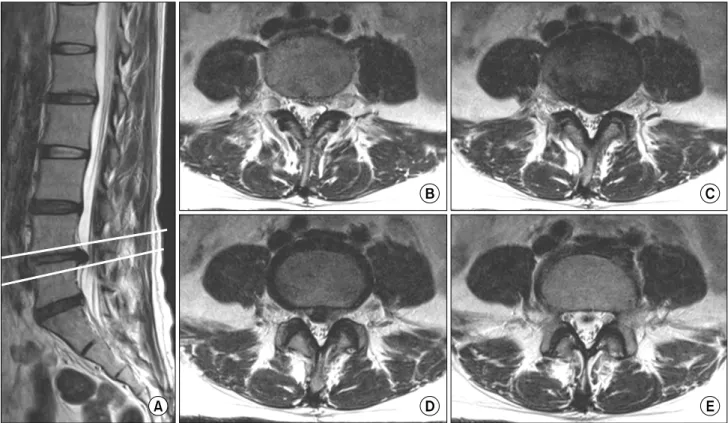
Fig. 1. Based on the sagittal view (A), several T2-weighted axial images were selected starting from the image cut (B) just above the upper margin of herniated disc material to the image cut (E) just below the lower margin, (C), (D) selected axial images between upper and lower margin of herniated disc.

expert physician who had an experience of examining more than 10,000 cases with lumbar radiculopathy. The physical examinations consisted of the following: 1) Dejerine’s tri- ad; 2) SLR test; 3) Slump test; 4) Kemp’s test; 5) Evaluation of motor involvement; and 6) Evaluation of sen- sory involvement. The Dejerine’s triad was positive when the pain became worse during coughing, sneezing, or Valsalva maneuver. The Kemp’s test was considered to be positive when the pain radiated down to the side towards which the patient was bending, which meant there was lumbar intervertebral disc involvement.

9

The slump test was performed with the patient seated and the knee ex- tended with the neck in flexion, and this test was regarded as positive when the patient complained of pain.

8

The SLR test was performed in a supine position, with the knee ex- tended in the same manner as performed in a previous study.

2

Motor involvement was evaluated based on the muscle power corresponding to the myotomal level same as the level of disc herniation, and it was graded on a 0∼5 scale based on the Medical Research Council War

Memorandum. Sensory involvement was scored as 0 or 1, based on the presence of hypesthesia or paresthesia in the corresponding dermatome.

Lumbar MRI findings were interpreted and analyzed by an experienced radiologist who had interpreted more than 5,000 MRI findings of patients with disc herniation. For preventing bias, the radiologist was blinded to the in- formation about clinical symptoms and physical findings.

The severity of disc herniation was classified as bulging, protrusion, extrusion, or sequestration according to the scoring criteria used in a previous study,

24

and the direction of the herniation was classified as central and lateral. This classification has already shown substantial intra- and in- ter-reader agreement in a previous study.

25

The size of the disc herniation was calculated by the

quantitative image analysis. Based on the sagittal view,

several T2-weighted axial images were selected starting

from the image cut just above the upper margin of herni-

ated disc material to the image cut just below the lower

margin (Fig. 1). These axial cuts were captured as “.tiff”

(4)

Fig. 2. The size of canal cross-section area (A) and disc herniation area (B) in axial cuts were measured through the polygon selection of the NIH ImageJ software (dotted lines). The canal compromise (%) was calculated by dividing the disc herniation area by the canal cross-sectional area.

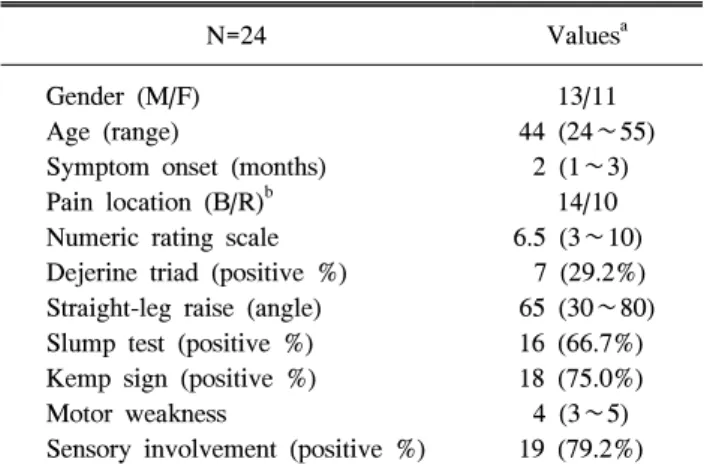
Table 1. Clinical Symptoms and Physical Findings of the Patients with Lumbar Herniated Intervertebral Disc

N=24 Values

a

Gender (M/F) 13/11

Age (range) 44 (24∼55)

Symptom onset (months) 2 (1∼3)

Pain location (B/R)

b

14/10

Numeric rating scale 6.5 (3∼10)

Dejerine triad (positive %) 7 (29.2%) Straight-leg raise (angle) 65 (30∼80) Slump test (positive %) 16 (66.7%) Kemp sign (positive %) 18 (75.0%)

Motor weakness 4 (3∼5)

Sensory involvement (positive %) 19 (79.2%)

a

Values: Values are the number of patients or median (minimum value∼maximum value).

b

Pain location (B/R): Pain site is clas- sified into pain radiating to lower leg with low back pain (B) or without low back pain (R).

figure files. The size of disc herniation area and canal cross-section area in each cut were measured through the polygon selection of the NIH ImageJ software (version 1.47 for 32-bit Windows) and summated (Fig. 2). Then, the canal compromise (%) was calculated as the total size of disc herniation divided by the total canal cross-section area and multiplied by 100. The method for measurements was described in detail in a previous article.

15

To determine the correlation between the severity and size of disc herniation, clinical symptoms and physical findings, Spearman correlation tests were performed using SPSS, version 12.0 (SPSS Inc., Illinois). To check the dif- ference of the severity and size of disc herniation according to the gender, Mann-Whitney U test was conducted. p-val- ues less than 0.05 were considered significant.

RESULTS

The median age of 24 patients (13 men and 11 women) was 44 years, and the median time interval from symptom onset to physical examination was 2 months. Fourteen pa- tients complained of radiating pain to the lower extremity without back pain, and 10 patients complained of radiating pain to the lower extremity with back pain. The pain start- ed at a median value of 65 degrees during the SLR test.

Data about demography and physical findings are presented

in Table 1.

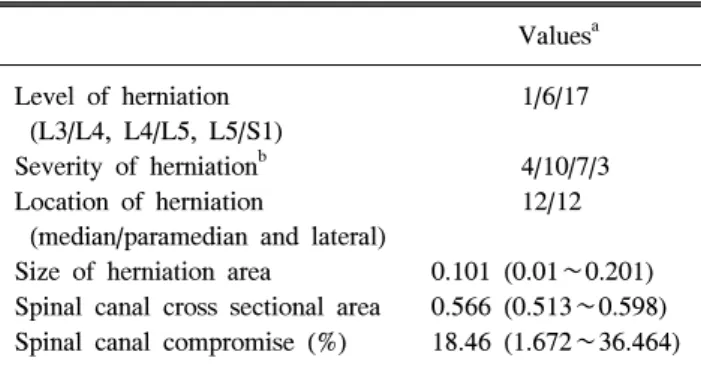
Magnetic resonance images showed L5/S1 disc hernia-

tion in 17 patients, L4/L5 disc herniation in 6 patients, and

L3/L4 disc herniation in 1 patient. Twelve patients (50%)

had central disc herniation, and 12 (50%) had lateral

herniation. Disc bulging occurred in 4 patients, disc pro-

trusion in 10 patients, disc extrusion in 7 patients, and disc

(5)

Table 2. Characteristics of Disc Herniation in Lumbar Spine Magnetic Resonance Imaging Study

Values

a

Level of herniation

(L3/L4, L4/L5, L5/S1)

1/6/17

Severity of herniation

b

4/10/7/3

Location of herniation

(median/paramedian and lateral)

12/12 Size of herniation area 0.101 (0.01∼0.201) Spinal canal cross sectional area 0.566 (0.513∼0.598) Spinal canal compromise (%) 18.46 (1.672∼36.464)

a
Values: Values are the number of patients or median (minimum value∼maximum value).

b

Severity of herniation: Severity is classified as disc bulging, protrusion, extrusion, and sequestra- tion in the order.

Fig. 3. Distribution of patients with or without back pain was presented according to the severity of disc herniation (A). Presence of accompanying back pain did not have any relation to the severity of disc herniation. The numeric rating scale was not correlated with the severity of herniation either (B). Bars mean one standard deviation.

sequestration in 3 patients (Table 2).

There were no significant differences in sex, age, and symptom onset according to the level of the herniated disc although there was only one case of L3/L4 disc herniation.

The findings of physical examination including NRS, Dejerine’s triad, SLR, slump test, Kemp’s test, motor weakness, and sensory involvement were not significantly different between the levels of herniated discs.

No significant differences in the baseline patient charac- teristics (sex, age, and symptom onset) were found between the severities of the disc herniation. In terms of correlation between symptoms and severity of disc herniation, pres- ence of accompanying back pain did not have any relation

with the severity of disc herniation (p=.638). The NRS score was not correlated with the severity of disc herniation (p=.528, Fig. 3).

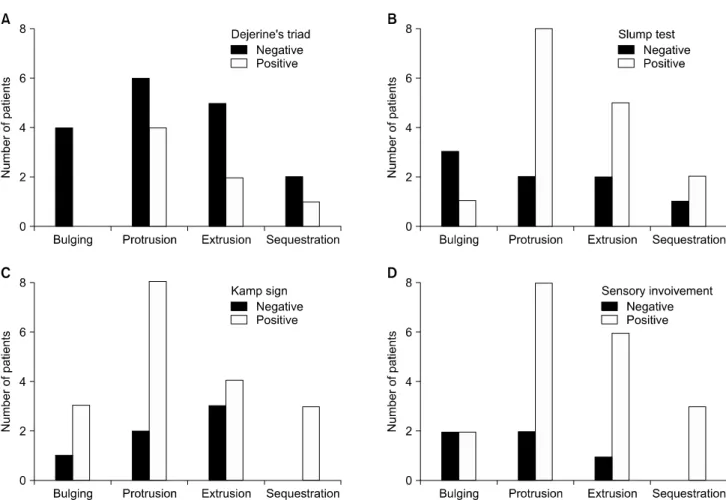
The number of patients who showed a positive Dejerine’s triad, slump test, and Kemp’s test was not sig- nificantly different between the severities of disc herniation (p=.536, p=.360, and p=.973, respectively). Sensory in- volvement showed no correlation with the severities of disc herniation (p=.127). All of the data are presented in Fig. 4.

The median angle at which the patients started to feel the pain or discomfort during the SLR test was lower in cases of disc protrusion (70, min. 60; max. 80), disc ex- trusion (50, min. 50; max. 80), and disc sequestration (40, min. 30; max. 60) than in cases of disc bulging (80, min.

80; max. 80), but this difference was not significant (p=.195). Three patients had grade 3 motor power, 12 pa- tients had grade 4 motor power, and 9 patients had grade 5 motor power. Among the 3 patients who had grade 3 mo- tor power, 2 patients had disc protrusion and 1 patient had disc extrusion. Grade 4 motor power was observed in 5 pa- tients with disc protrusion, 4 patients with disc extrusion, and 3 patients with disc sequestration. However, there was no significant correlation between motor weakness and the severity of disc herniation in the Spearman correlation analysis (p=.053). Direction of the herniation did not show any correlation with motor weakness.

The median size of disc herniation calculated by ImageJ

program was 0.101, and the spinal canal compromise by

the disc herniation was 18.46% (Table 2). The size of disc

(6)

Fig. 4. Distributions of patients according to the results of Dejerine’s triad (A), slump test (B), Kemp’s test (C), and sensory involve- ment (D) were presented. None of the result was correlated with the severity of disc herniation.

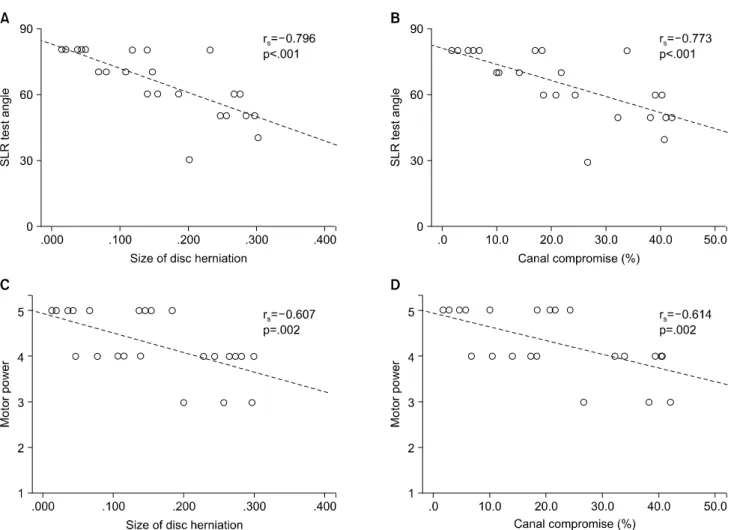
herniation showed significant correlation with the SLR test (r

s

=−0.796, p<.001) and motor power grade (r

s

=−0.607, p=.002). According to coefficients, the results showed high correlation with SLR test and moderate correlation with motor power grade.

26

The canal compromise (%), also showed a significant correlation with the SLR test (r

s

=−

0.773, p<.001) and motor power grade (r

s

=−0.614, p=.002). The strength of correlation was also high with SLR test and moderate with motor power grade.

26

The cor- relations are presented in Fig. 5. The size of the disc her- niation and canal compromise were not affected by age, sex, level of disc herniation, and symptom onset when the Spearman correlation or Mann-Whitney U tests were conducted. The size of the disc herniation and canal com- promise were not different between men and women (p=.051, respectively).

When we divided the patients according to the direction of the disc herniation, no correlation between canal com-

promise and NRS score was found in patients with central direction of the disc herniation (p=.432), while there was significant correlation between canal compromise and NRS score in patients with lateral direction of the disc herniation (p=.019).

A significant correlation was found between severity of disc herniation and the size of the disc herniation and canal compromise (r

s

=0.897, p=.002 and r

s

=0.888, p=.002) (Fig. 6).

The correlation coefficient showed high correlation in both results.

26

DISCUSSION

We found that quantitative canal compromise and size

of disc herniation were correlated with motor weakness and

SLR angles in patients with single-level lumbar radiculo-

pathy. This correlation was not affected by age, sex, level

of disc herniation, and symptom onset. However, the

(7)

Fig. 5. The quantitative size of disc herniation and canal compromise (%) showed significant correlation with the straight-leg raising (SLR) test (A, B) and motor power grade (C, D).

Fig. 6. The relation of the severity of disc herniation to the herniated size (A) and canal compromise (B) were presented. There

were significant correlations between the severity of disc herniation and the herniated size and between the severity of disc herniation

and the canal compromise.

(8)

semi-quantitative indices (bulging, protrusion, extrusion, and sequestration) of disc herniation usually used in the clinics were not related to motor weakness and SLR angles.

Suzuki et al.

13

demonstrated that percent occupancy of herniated lumbar disc did not cause motor deficit, which was contradictory to our results. They used motor weak- ness as binary data, and the presence or absence of severe motor deficit as the criteria for grade 3 motor power rather than using the motor power grade itself. When we used motor weakness as binary data similar to that in the pre- vious study

13

and investigated the correlation, we found that there was no correlation between motor deficit and ca- nal compromise, which was in agreement with their results.

Our study included only 3 patients who showed grade 3 motor power, which resulted in statistical insignificance.

Carlisle et al.

15

demonstrated the close correlation between canal compromise and need for surgical treatment to re- solve motor weakness, which is consistent with our results.

We found that there was no correlation between pain sites and degree of disc herniation. Pople et al.

27

demon- strated that patients with a marked predominance of leg pain over back pain had a high probability of disc extrusion. All of the patients in our study had radiating pain, and they were divided according to the presence of back pain, while the previous study divided the patients ac- cording to the major pain site, low back pain, or sciatica.

In our study, 5 patients with disc extrusion had accompany- ing low back pain, while only 2 patients with disc extrusion did not have low back pain, which made this correlation insignificant. All the intervertebral discs in these 5 patients who had disc extrusion and accompanying low back pain were severely degenerated. Burke et al.

28

found that pa- tients with degenerated discs which cause back pain had significantly elevated interleukin-6 (IL-6) and IL-8 levels compared to those in patients with sciatica and suggested that degenerated disc which cause back pain differ at a cel- lular and molecular level from those which cause sciatica.

Although we did not investigate the inflammatory media- tors, we thought that sciatica was thought to come out through compression of nerve root or inflammation by her- niated disc materials, while back pain caused by herniated disc might come from the degenerated changes of the her- niated disc and increased production of inflammatory medi- ators, such as IL-6 and IL-8.

There was no correlation between size of disc herniation

and symptom onset in our study, which was contradictory to the result in the study by Carragee,

28

in which the size of disc herniation was related to symptom onset. This dis- crepancy might be because that they divided the symptom onset into only two categories (less than 6 months vs more than 6 months), while we used symptom onset as a con- tinuous variable and selected those patients who had onset of symptoms within less than 3 months, and this period was shorter. Benoist reviewed several articles and proposed in his review article that morphologic changes of herniated discs were usually observable after 6 months.

16

Our study demonstrated that the SLR test was a factor related to the size of disc herniation. This was also proved by a previous study

29

in which a positive SLR test was as- sociated with both larger disc herniation and smaller canal size. Two previous studies demonstrated that SLR re- striction and degree of sciatica were related to the linear measurement of disc herniation, but not to the semi-quanti- tative degree of disc herniation, which also supports our results.

22,30

This correlation can be explained by the in-vivo study which demonstrated that during the SLR test, the limitation of nerve root movement occurred by mechanical loading of periradicular adhesive tissue or inflammatory stimulus.

31

The average age of our patients was greater than the typ- ical age at which lumbosacral radiculopathy develops due to a herniated disc, although we excluded the cases with spinal stenosis or degenerative changes. Considering that the clinical features representative of disc herniation in- clude highly restricted positive SLR test results that gradu- ally decrease with increasing age,

32

our results might have demonstrated fewer characteristics of disc herniation. This is the limitation of our study and further studies in younger patients are necessary to confirm our findings.

We found that there was no correlation between canal compromise and NRS score in patients with central direc- tion of the disc herniation, while there was a significant correlation between canal compromise and NRS score in patients with lateral direction of the disc herniation.

Thelander et al.

30

reported that the size of disc herniation

was related to the severity of sciatica symptoms irre-

spective of the direction of herniation through several in-

dices, which was contradictory to our results. This differ-

ence might be due to the fact that we divided the direction

of disc herniation into central, and lateral, while Thelander

(9)

et al.

30

classified the direction of the disc herniation into central, paramedian, and lateral. Another difference is that we used NRS as the index of severity of sciatica while they rated the severity of sciatica as continuous, intermittent pain, or no pain.

The natural progression of the herniated disc could not be checked because this was a retrospective cross-sectional study and follow up MRIs were not performed. A pro- spective study to investigate the natural progression of the herniated discs must be conducted to confirm the correla- tion between the natural progression and motor weakness and SLR angles.

We limited the inclusion criteria to single-level disc her- niation and the presence of radiating pain, which resulted in a small sample size, one of the weak points of this study.

However, if we had not limited the inclusion criteria to sin- gle-level disc herniation and had included cases with mul- ti-level disc herniation in our study, we would not have been able to determine the level of the herniated disc that caused clinical symptoms and physical findings. Although we determined the involved level through myotomal and dermatomal levels and EMG findings, SLR test results and motor weakness could have been affected by herniated discs at other levels if we had included cases with mul- ti-level disc herniation.

REFERENCES

1. Deyo RA, Rainville J, Kent DL. What can the history and physical examination tell us about low back pain? JAMA 1992; 268: 760-765

2. Majlesi J, Togay H, Unalan H, Toprak S. The sensitivity and specificity of the Slump and the Straight Leg Raising tests in patients with lumbar disc herniation. J Cin Rheumatol 2008; 14: 87-91

3. Poiraudeau S, Foltz V, Drape JL, Fermanian J, Lefèvre- Colau MM, Mayoux-Benhamou MA, et al. Value of the bell test and the hyperextension test for diagnosis in scia- tica associated with disc herniation: comparison with Lase- gue's sign and the crossed Lasegue's sign. Rheumatology (Oxford) 2001; 40: 460-466

4. Vroomen PC, de Krom MC, Wilmink JT, Kester AD, Knottnerus JA. Diagnostic value of history and physical ex- amination in patients suspected of lumbosacral nerve root compression. J Neurol Neurosurg Psychiatry 2002; 72:

630-634

5. Mens JM, Pool-Goudzwaard A, Beekmans RE, Tijhuis MT.

Relation between subjective and objective scores on the ac- tive straight leg raising test. Spine 2010; 35: 336-339 6. van der Windt DA, Simons E, Riphagen II, Ammendolia

C, Verhagen AP, Laslett M, et al. Physical examination for lumbar radiculopathy due to disc herniation in patients with low-back pain. Cochrane Database Syst Rev 2010: Issue 2, Art. No : CD007431

7. Devillé WL, van der Windt DA, Dzaferagic A, Bezemer PD, Bouter LM. The test of Lasegue: systematic review of the accuracy in diagnosing herniated discs. Spine 2000; 25:

1140-1147

8. Trainor K, Pinnington MA. Reliability and diagnostic val- idity of the slump knee bend neurodynamic test for up- per/mid lumbar nerve root compression: a pilot study.

Physiotherapy 2011; 97: 59-64

9. Visser LH, Nijssen PG, Tijssen CC, van Middendorp JJ, Schieving J. Sciatica-like symptoms and the sacroiliac joint: clinical features and differential diagnosis. Eur Spine J 2013; 22: 1657-1664

10. Jensen OH. The level-diagnosis of a lower lumbar disc her- niation: the value of sensibility and motor testing. Clin Rheumatol 1987; 6: 564-569

11. Beattie PF, Meyers SP, Stratford P, Millard RW, Hollenberg GM. Associations between patient report of symptoms and anatomic impairment visible on lumbar magnetic resonance imaging. Spine 2000; 25: 819-828 12. Porchet F, Wietlisbach V, Burnand B, Daeppen K,

Villemure JG, Vader JP. Relationship between severity of lumbar disc disease and disability scores in sciatica patients.

Neurosurgery 2002; 50: 1253-1259

13. Suzuki A, Matsumura A, Konishi S, Terai H, Tsujio T, Dozono S, et al. Risk factor analysis for motor deficit and delayed recovery associated with L4/5 lumbar disc herniation. J Spinal Disord Tech 2011; 24: 1-5

14. Sharma H, Lee SW, Cole AA. The management of weak- ness caused by lumbar and lumbosacral nerve root compression. J Bone Joint Surg Br 2012; 94: 1442-1447 15. Carlisle E, Luna M, Tsou PM, Wang JC. Percent spinal ca- nal compromise on MRI utilized for predicting the need for surgical treatment in single-level lumbar intervertebral disc herniation. Spine J 2005; 5: 608-614

16. Benoist M. The natural history of lumbar disc herniation and radiculopathy. Joint Bone Spine 2002; 69: 155-160 17. Buirski G, Silberstein M. The symptomatic lumbar disc in

patients with low-back pain. Magnetic resonance imaging appearances in both a symptomatic and control population.

Spine 1993; 18: 1808-1811

18. van Rijn JC, Klemetso N, Reitsma JB, Majoie CB,

Hulsmans FJ, Peul WC, et al. Symptomatic and asympto-

matic abnormalities in patients with lumbosacral radicular

(10)

syndrome: Clinical examination compared with MRI. Clin Neurol Neurosurg 2006; 108: 553-557

19. Yussen PS, Swartz JD. The acute lumbar disc herniation:

imaging diagnosis. Semin Ultrasound CT MR 1993; 14:

389-398

20. Porchet F, Fankhauser H, de Tribolet N. Extreme lateral lumbar disc herniation: clinical presentation in 178 patients.

Acta Neurochir (Wien) 1994; 127: 203-209

21. Coster S, de Bruijn SF, Tavy DL. Diagnostic value of his- tory, physical examination and needle electromyography in diagnosing lumbosacral radiculopathy. J Neurol 2010; 257:

332-337

22. Karppinen J, Malmivaara A, Tervonen O, Paakko E, Kurunlahti M, Syrjala P, et al. Severity of symptoms and signs in relation to magnetic resonance imaging findings among sciatic patients. Spine 2001; 26: E149-154 23. Yaar I. The logical choice of muscles for the needle-EMG

evaluation of lumbosacral radiculopathy. J Electromyogr Kinesiol 2006; 16: 205-213

24. Fardon DF. Nomenclature and classification of lumbar disc pathology. Spine 2001; 26: 461-462

25. Pfirrmann CW, Metzdorf A, Zanetti M, Hodler J, Boos N.

Magnetic resonance classification of lumbar intervertebral disc degeneration. Spine 2001; 26: 1873-1878

26. Mukaka MM. Statics corner: A guide to appropriate use of correlation coefficient in medical research. Malawi Medical

Journal 2012; 24: 69-71

27. Pople IK, Griffith HB. Prediction of an extruded fragment in lumbar disc patients from clinical presentations. Spine 1994; 19: 156-158

28. Burke JG, Watson RW, McCormack D, Dowling FE, Walsh MG, Fitzpatrick JM. Intervertebral discs which cause low back pain secrete high levels of proinflammatory mediators. J Bone Joint Surg Br 2002; 84: 196-201 29. Carragee EJ, Kim DH. A prospective analysis of magnetic

resonance imaging findings in patients with sciatica and lum- bar disc herniation. Correlation of outcomes with disc frag- ment and canal morphology. Spine 1997; 22: 1650-1660 30. Thelander U, Fagerlund M, Friberg S, Larsson S.

Describing the size of lumbar disc herniations using com- puted tomography. A comparison of different size index calculations and their relation to sciatica. Spine 1994; 19:

1979-1984

31. Kobayashi S, Takeno K, Yayama T, Awara K, Miyazaki T, Guerrero A, et al. Pathomechanisms of sciatica in lum- bar disc herniation: effect of periradicular adhesive tissue on electrophysiological values by an intraoperative straight leg raising test. Spine 2010; 35: 2004-2014

32. Jonsson B, Stromqvist B. Influence of age on symptoms and signs in lumbar disc herniation. Eur Spine J 1995; 4:

202-205

수치

Fig.  1.  Based  on  the  sagittal  view  (A),  several  T2-weighted  axial  images  were  selected  starting  from  the  image  cut  (B)  just  above  the  upper  margin  of  herniated  disc  material  to  the  image  cut  (E)  just  below  the  lower  ma
Table  1.  Clinical  Symptoms  and  Physical  Findings  of  the  Patients  with  Lumbar  Herniated  Intervertebral  Disc
Table  2.  Characteristics  of  Disc  Herniation  in  Lumbar  Spine  Magnetic  Resonance  Imaging  Study
Fig.  4.  Distributions  of  patients  according  to  the  results  of  Dejerine’s  triad  (A),  slump  test  (B),  Kemp’s  test  (C),  and  sensory  involve- involve-ment  (D)  were  presented
+2

참조

관련 문서

Characteristics of Fuel Cell Charge Transport Resistance.. 차원석

(1.1 points) According to the passage, which of the following is NOT mentioned as the nature of pain.. ① Pain is not tied to any referent in

The purpose of this study is to examine whether internet addiction is related with ADHD (Attention Deficit Hyperactivity Disorder) that is characterized

Percutaneous endoscopic cervical discectomy (PECD) is an effective minimally invasivesurgery for soft cervical disc herniation in properly selected cases..

[r]

[r]

Fifth, It is necessary to establish an information network related to Taekwondo tourism information. Until now, the reason why Taekwondo does not receive

(4)the spiral ganglion (5)the auditory nerve fibres.. The Basilar Membrane is a Mechanical Analyzer of Sound Frequency The Basilar Membrane is a Mechanical Analyzer of