• 검색 결과가 없습니다.

Acid- and Acid/Heat-Coagulated Cheese - Cheeses Made without Chymosin : A Review

N/A
N/A
Protected

Academic year: 2021

Share "Acid- and Acid/Heat-Coagulated Cheese - Cheeses Made without Chymosin : A Review"

Copied!
4
0
0

로드 중.... (전체 텍스트 보기)

전체 글

(1)

J. Milk Sci. Biotechnol.

Vol. 33. No. 4, pp. 277~280(2015)

277

Acid- and Acid/Heat-Coagulated Cheese - Cheeses Made without Chymosin : A Review

Won-Jae Lee

1

and Mee-Ryung Lee

2*

1

Dept. of Animal Bioscience (Institute of Agriculture and Life Science), Gyeongsang National University, Jinju 52828, Korea

2

Dept. of Food and Nutrition, Daegu University, Gyeongsan 38453, Korea

Abstract

Acid- and acid/heat-coagulated cheese are cheeses made from direct acid- or acid/heat coagulation, consumed fresh without aging and have a soft texture. Despite of its short shelf-life, acid- and acid/heat-coagulated cheese are widely produced in all over the world due to their relatively easy manufacturing step and their popularity among consumers. Nowadays, acid- and acid/heat-coagulated cheese are used a lot as an ingredient of various foods as well. Therefore, understanding the characteristics of acid- and acid/heat-coagulated cheese is necessary to have more challenged application in food industries.

Keywords: coagulations, cheeses, direct acidifications, acid/heat coagulation, unaged

* Corresponding author: Mee-Ryung Lee, Dept. of Food and Nutrition, Daegu University, Gyeongsan 38453, Korea. Tel: +82-53-850- 6837, Fax: +82-53-850-6839, E-mail: [email protected]

INTRODUCTION

Acid-coagulated cheeses refer to cheeses made with no or minimal amount of rennet (Chandan, 1991). Rennet is added as a choice of cheese makers as little as 0.5 mL/1,000 L (i.e., approximately 2 ppm). During acid-coagulation, milk is coagulated by either direct acidification with various acids or by the additions of starter culture. Typical types of acid- and acid/heat- coagulated cheese can be Cottage cheese, Quarg, Fromage frais (skim), Queso Blanco, Ricotta, Paneer, Mascarpone, cream cheese, and Neufchatel (Lucey, 2011).

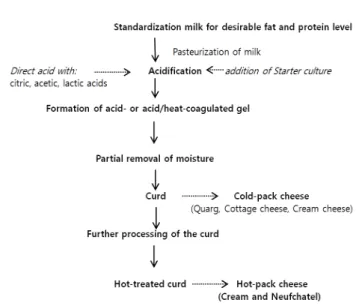
Major manufacturing steps for acid-coagulated cheese are described in Fig. 1. These cheeses are not yoghurt as draining of whey is done during cheese making (for Cottage cheese, draining of whey is done after cutting).

Unlike many other cheeses (in most cheeses, coagulation of milk is mainly occurred due to chymosin activity), coagulation is induced through direct acidification in acid coagulated cheese (Farkye 2004a, 2004b). In this review, two major types of acid -coagulated cheese, Cottage cheese and cream cheese are to be

Table 1. Typical Manufacturing Parameters for the Production of Cottage Cheese

Processing Stage Short Set Medium Set Long Set Level of starter addition (%) 2 -5 1 -3 0.5 -1

Time before cutting (h) 5 8 13 -16

Incubation temperature ( ℃) 30 -33 27 21 -24

Fig. 1. Simplified processing steps for the manufacture of acid-

and acid/heat-coagulated cheeses.

(2)

Journal of Milk Science & Biotechnology 제33권 제4호(2015) 278

mainly discussed. Also various types of acid/heat-coagulated cheese are to be covered.

Cottage Cheese

Cottage cheese, is also called Pot cheese (as Cottage cheese was originally sold in a pot), is very popular in United States and Europe. Nearly 5% of whole cheese sale are composed of Cottage cheese in U. S. Cottage cheese has a very mild acidic flavor (sometimes recognized as bland flavor) as curd is washed before draining to remove acidity produced during manufacture (Drake, 2007). There is no pressing step during Cottage cheese making so approximately 80% of moisture content is retained as most of whey is still remained in the curds (Fig. 2). Cottage cheese seems to be lumpy and creamy but meaty and smooth texture is a desirable body (Guinee et al., 1993). Cottage cheese is believed to have an origination from cottages, i.e., left-over milk after butter-making was used to make Cottage cheese in farm’s cottages.

Fig. 2. General composition of acid- and acid/heat-coagulated cheeses (approximation from various sources).

Table 2. Comparison of Major Manufacturing Variables in Acid-Coagulated Cheese

Ways of Removal of Moisture Curd-Washing Dressing Cold-Pack Hot-Pack Body (Texture)

Cottage Cutting/syneresis Yes Yes ○ Smooth/meaty

Quarg Stirring/centrifugation No Yes ○ Smooth/soft

Cream Stirring/centrifugation No Yes ○ ○ Spreadable

Neufchatel Stirring/centrifugation No Yes ○ Less smooth &

grainer than cream cheese Cottage cheese is usually made from skimmed milk after pas- teurization (Hindrichs, 2004). Creamed Cottage cheese (~15%

of pasteurized cream is added after curd-washing) has slightly higher fat content (~3%, Fig. 2) compared to normal (or low fat) Cottage cheese (Hubbard et al., 2015).

There are three processing methods in Cottage cheese making based on the set-time before cutting, named as short, medium and long set (Table 2); the longer the set time is, the higher the incubation temperature is, and the more starter culture is added. This is probably due to the purpose of reaching similar level of acid development as pH of most Cottage cheese is in the range of 4.8-5.0 (Fig. 2), regardless of the manufacturing conditions (i.e., different set-time). Lactococcus lactis subsp.

lactis and Lc. lactis subsp. cremos are most commonly used starter cultures (i.e., non-gas producing mesophiles). (Lucey, 2002;

Lucey and Singh, 2002; Jelen and Renz-Schauen, 1992).

After draining, ‘dressing’ is applied to the curd. The term

‘dressing’ in acid-coagulated cheese manufacturing means that adding stabilizers such as guar gums, xanthan gums and/or carrageenans. Cottage cheese normally has shelf-life less than 1 mo (Johnson and Lucey, 2006).

Cottage cheese is also made with direct acidification with hydrochloric, lactic and other acids, but the using the acids is less frequent compared to the use of starter culture (Lucey et al., 2003).

Cream Cheese

Cream cheese is deeply loved by consumers and produced in

all over the world. Due to its popularity, cream cheese has various

nominations; Rahmfrischkäse (German), Neufchatel and Baker’s

cheese (U.S.), Suisse, Bondard, and Gournay (France). Cream

cheese is especially popular in United States as more than 300,000

tones are produced every year. To be named as cream cheese,

the fat content should be no less than 33% and moisture content

should be no more than 55% (Schulz-Collins and Senge, 2004).

(3)

Acid- and Acid/Heat-Coagulated Cheese - Cheeses Made Without Chymosin : A Review 279

It is also easy to find in the label like ‘double’ or ‘single’

as cream cheese is classified based on the amount of fat. Single cream cheese is made from milk with 3 -3.5% fat and double cream cheese is made from milk with 8 -14% fat.

There are two manufacturing methods in cream cheese making, cold-pack type and hot-pack type. In cold-pack type cream cheese, stabilizers and salts are added to cold curd (10 -12℃) while in hot-pack type cream cheese, curd is heated up to 65 - 70 ℃ after mixing with stabilizers and salt.

Cream cheese has a mild, salty and acidic flavor and the texture is smooth and spreadable. Cream cheese has a lot of food applications as an ingredient; cheese cakes, frostings, dips, toppings, sweet & savory dishes and desserts.

Acid/Heat-Coagulated Cheese

Ricotta, Queso Blanco and Mascarpone cheeses are typical type of acid/heat-coagulated cheese and either acid or heat is adopted for coagulation. Acid/heat-coagulated cheeses are usually made without starter inoculation. These cheeses are acidified with acidulants such as lactic acid, when milk is still hot (80℃) after pasteurization at 80 -85℃. Starter can be added only for the purpose of flavor development in Queso Blanco cheeses (Torres and Chandan, 1981a, 1981b).

Unlike acid-coagulated cheese, Acid/heat-coagulated cheese, such as Ricotta and Queso Blanco, has a pressing step during cheese making and this is why moisture content is lower com- pared to that of acid-coagulated cheese (Fig. 2).

CONCLUSIONS

Acid- and acid/heat-coagulated cheese are widely consumed in all over the world due to their unique mild flavor and soft texture. Acid- and acid/heat-coagulated cheese are consumed without ripening. Acid- and acid/heat-coagulated cheese have a diverse use in foods, i.e., consumed as it is or consumed as an ingredient of various foods. For acid-coagulated cheeses, acidifi- cation of milk with starter is more common during cheese making while direct acidification of milk with various acids, such as citric acids, is mostly used in acid/heat-coagulated cheeses. Acid- and acid/heat-coagulated cheese seems to have lots of potentials in South Korea’s cheese market as acid- and acid/heat-coagulated cheese does not have any flavors from aging since they are eaten as fresh. However, low Ca content

in acid- and acid/heat-coagulated cheese (less than 100 mg/100 g of cheese) could be a possible adverseness for the popularity in Korea’s cheese market.

REFERENCES

1. Chandan, R. C. 1991. Cheeses made by direct acidifi- cation. In: R. K. Robinson and A. Y. Tamime (eds.) Feta and related varieties, pp.229-252. Chicester: Ellis Horwood.

2. Drake, M. A. 2007. Invited review: Sensory analysis of dairy foods J. Dairy Sci. 90:4925-4937.

3. Farkye, N. Y. 2004a. Acid- and acid/rennet-curd cheeses.

Part B: Cottage cheeses. In: P. F. Fox., P. L. H. McSweeney., T. M. Cogan and T. P. Guinee (eds.) Cheese: Chemistry, physics and microbiology, Vol. 2: Major cheese groups, 3rd ed., pp. 329-341. London: Elsevier Academic Press.

4. Farkye, N. Y. 2004b. Acid- and acid/rennet-curd cheeses.

Part C: Acid/heat-coagulated cheeses. In: P. F. Fox., P. L.

H. McSweeney., T. M. Cogan and T. P. Guinee (eds.) Cheese: Chemistry, physics and microbiology, Vol. 2: Major cheese groups, 3rd ed., pp. 343-348. London: Elsevier Academic Press.

5. Fox, P. F., Guinee, T. P., Cogan, T. M. and McSweeney, P. L. H. 2000. Fundamentals of cheese science. Gaithersburg, MD: Aspen Publishers.

6. Guinee, T. P., Pudja, P. D. and Farkye, N. Y. 1993. Fresh acid-curd cheese varieties. In: P. F. Fox (ed.) Cheese:

Chemistry, physics and microbiology - Vol. 1: General aspects, 2nd ed., pp. 363-419. London: Chapman & Hall.

7. Hindrichs, J. 2004. Mediterranean milk and milk products.

Eur. J. Nutr. 43(supplement 1):L/12-I/17.

8. Hubbard, E. M., Jervis, S. M. and Drake, M. A. 2015. The effect of extrinsic attributes on liking of cottage cheese. J.

Dairy Sci. 99:183-193.

9. Jelen, P. and Renz-Schauen, A. 1992. Quarg. In: Y. H. Hui (ed.) Encyclopedia of food science and technology, Vol. 4, pp. 2225-2232. New York: John Wiley & Sons.

10. Johnson, M. E. and Lucey, J. A. 2006. Major technological advances and trends in cheese. J. Dairy Sci. 89:1174-1178.

11. Lucey, J. A. 2002. ADSA Foundation scholar award; For- mation and physical properties of milk protein gels. J. Dairy Sci. 85:281-294.

12. Lucey, J. A. 2011, Acid- and acid/heat-coagulated cheese.

In P. L. H. McSweeney (eds) Encyclopedia of dairy science.

(4)

Journal of Milk Science & Biotechnology 제33권 제4호(2015) 280

Vol. I. 2nd ed., pp. 698-705. London: Elsevier Academic Press.

13. Lucey, J. A. and Singh, H. 2002. Acid coagulation of milk.

In: P. F. Fox and P. L. H. McSweeney (eds.) Advanced dairy chemistry, Vol. 2: Proteins, 2nd ed., pp. 997-1021.

New York: Kluwer Publishers.

14. Lucey, J. A., Johnson, M. E. and Horne, D. S. 2003. Invited review: Perspectives on the basis of the rheology and texture properties of cheese. J. Dairy Sci. 86:2725-2743.

15. Schulz-Collins, D. and Senge, B. 2004. Acid- and acid/

rennet-curd cheeses. Part A: Quark, cream cheese and related varieties. In: P. F. Fox, T. M. Cogan and T. P. Guinee

(eds.) Cheese: Chemistry, physics and microbiology, Vol.

2: Major cheese groups, 3rd ed., pp. 301-328. London:

Elsevier Academic Press.

16. Torres, T. and Chandan, R. C. 1981a. Flavor and texture development in Latin American white cheese. J. Dairy Sci.

64:2161-2169.

17. Torres, T. and Chandan, R. C. 1981b. Latin American white cheese - a review. J. Dairy Sci. 64:552-557.

Received 15 December, 2015

Revised 22 December, 2015

Accepted 25 December, 2015

수치

Fig. 1.  Simplified  processing  steps  for  the  manufacture  of  acid-  and  acid/heat-coagulated  cheeses.
Fig. 2.  General  composition  of  acid-  and  acid/heat-coagulated  cheeses  (approximation  from  various  sources).

참조

관련 문서

Changes of lactic acid bacteria numbers and photodiode during fermentation mode and storage mode in S kimchi · · ·40..

- A novel lactic acid bacterium for the production of high purity l-lactic acid, Lactobacillus paracasei subspL. helveticus - Production of Lactic Acid from Water Hyacinth

In this study, a titanium surface was modified with acrylic acid (AA) using a plasma treatment and immobilized with bioactive arginine- glycine-aspartic acid (RGD) peptide,

Currently, the method of radioactive strontium( 90 Sr) analysis uses the nitric acid method and resin method.. The act of nitric acid method and

– High T operation (~150 C) can enhance prospects of higher power level applications.. Direct Formic

Therefore, as a recovery method during exercise, it is more effective for recovery of exercise fatigue and prevention of body acidification due to high

phenylalanine, carnosine, ornitine contents were significantly higher in carrot than in parsnip, while α-aminoadipic acid, leucine, tyrosine, γ-amino-n-butyric

이 스케일억 제제들로는 Acrylic acid-hydroxypropyl acrylate copolymer, Styrene sulfonic acid-maleic acid copolymer, Acrylic acid-sulfonic acid copolymer