Objectives: This study assessed the technical feasibility and aimed to determine the factors influencing intention to use Elec- tronic Medical Records (EMRs) at Marie Stopes International, Myanmar (MSI-M). Methods: A cross-sectional survey was conducted among 112 participants who were working at the clinics and head office of MSI-M. Demographic information, type of office, technical feasibility, information communication technology knowledge, computer usage, and user acceptance towards the proposed system were obtained from the participants. Results: The results indicated low health information technology usage and network availability at MSI-M clinics. Positive perception of EMRs was found among the staff mem- bers of MSI-M, which was reflected by positive responses regarding perceived usefulness (average score of 4.15), perceived ease of use (average score of 4.03), and intention to use (average score of 4.10) on a 5-point Likert scale. Statistically, staff from the head office expressed less desire to implement an EMR system (odds ratio = 0.07; 95% confidence interval, 0.01–
0.97), especially when they do not perceive the usefulness of the system (odds ratio = 5.05; 95% confidence interval, 2.39–
10.69). Conclusions: Since health information technology usage and network availability were low in MSI-M, it is important to strengthen the information and communication technology infrastructure and introduce a policy for capacity building at MSI-M. Adequate training and strong leadership support are recommended for the successful initial implementation and sustainability of an EMR system at MSI-M.
Keywords: Electronic Medical Records, Myanmar, Non-Governmental Organization, Feasibility Study
Submitted: March 17, 2020 Revised: July 11, 2020 Accepted: July 20, 2020 Corresponding Author Wirichada Pan-ngum
Department of Tropical Hygiene, Faculty of Tropical Medicine, Mahidol University, 420/6 Ratchawithi Road, Rajvithi, Bangkok 10400, Thailand.
Tel: +66-2306-9188, E-mail: [email protected] (https://orcid.org/0000-0002-9839-5359)
*These two authors contributed equally to this work.
User Acceptance of Electronic Medical Record System: Implementation at Marie Stopes
International, Myanmar
Win Min Thit1,*, Sai Wai Yan Myint Thu1,*, Jaranit Kaewkungwal1,2, Ngamphol Soonthornworasiri1, Nawanan Theera-Ampornpunt3, Boonchai Kijsanayotin4, Saranath Lawpoolsri1,2, Sid Naing5, Wirichada Pan-ngum1,6
1Department of Tropical Hygiene (Biomedical and Health Informatics), Faculty of Tropical Medicine, Mahidol University, Thailand
2Center of Excellence for Biomedical and Public Health Informatics (BIOPHICS), Faculty of Tropical Medicine, Mahidol University, Thailand
3Faculty of Medicine, Ramathibodi Hospital, Mahidol University, Thailand
4Health Systems Research Institute, Ministry of Public Health, Nonthaburi, Thailand
5Marie Stopes International Myanmar (MSI-M), Yangon, Myanmar
6Mahidol-Oxford Tropical Medicine Research Unit, Faculty of Tropical Medicine, Mahidol University, Bangkok, Thailand Healthc Inform Res. 2020 July;26(3):185-192.
https://doi.org/10.4258/hir.2020.26.3.185 pISSN 2093-3681 • eISSN 2093-369X
This is an Open Access article distributed under the terms of the Creative Commons Attribution Non-Commercial License (http://creativecommons.org/licenses/by-nc/4.0/) which permits unrestricted non-commercial use, distribution, and reproduction in any medium, provided the original work is properly cited.
ⓒ 2020 The Korean Society of Medical Informatics
I. Introduction
Electronic Medical Record (EMR) systems have been rapidly implemented in the hospitals and clinics of high-income countries [1,2]. An EMR has been defined as “an electronic record of health-related information on an individual that can be created, gathered, managed, and consulted by autho- rized clinicians and staff within one healthcare organization”
[3]. Implementation of an EMR system enables healthcare providers to improve the quality of care [4], provide positive financial return [5], easily read documentation in real time [5], save storage space [6], reduce medical errors [4], and analyze patients’ information effectively [7]. On the other hand, changing from a paper-based system to an electronic system has been challenging in both developed and develop- ing countries due to several obstacles, such as the high cost of initial implementation [8], technical concerns [8], resis- tance to change [8], sustainability of the Electronic Health Record (EHR) system [9], and confidentiality of patient data [9].
In Myanmar, the use of paper-based medical records is a common practice in the hospitals and clinics. Thus, health- care service providers cannot track patients over time, and targeted overall quality of care cannot be achieved. The introduction of EMR systems could help to improve the ef- ficiency and quality of care in developing countries [10].
Marie Stopes International, a UK-based international non- governmental organization (INGO), is one of the largest international family planning organizations in the world [11].
It has been working in Myanmar to provide health services since 1998, and it has 25 clinics across the country. Keep- ing patient records in the paper-based format is common in Marie Stopes International Myanmar (MSI-M) clinics. In addition, patient information is collected and kept in three places: the clinic record card, the registration record at the clinic, and the clinic record booklet, which is given to the patient.
The use of EMR systems is vital to improve patient care, and yet it is not a common practice in hospitals/clinics in Myanmar. In addition, little is known about whether it is feasible within the current resource context to implement an EMR system in an INGO providing healthcare in Myanmar because no study has been conducted in the sector. In prin- ciple, information technology is used to enhance employee performance, and yet the benefits derived from the technol- ogy are often lost due to users’ unwillingness to accept and use the information system. Thus, the objectives of this study were the following: (1) to assess the technical feasibility of
implementing a new EMR system, and (2) to examine the factors that may influence the intention to use EMRs in the MSI-M clinics based on the technology acceptance model (TAM), with an extension to consider various demographic characteristics, including age, education, position held, com- puter usage, and information communications technology (ICT) knowledge. Knowledge gained from this study on the readiness of the proposed system from the organizational level down to the individual level will be a key to the fu- ture organization’s strategic planning and decision-making regarding the initial implementation of an EMR system in MSI-M clinics.
II. Methods
1. Study Population
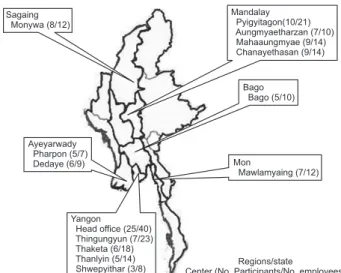
A cross-sectional survey was conducted in the head office and another 13 out of 25 MSI-M clinics from the Yangon region, Mandalay region, Sagaing region, Bago region, and Mon state. Figure 1 shows the locations of all study sites, the number of people participating in this study and number of people working at each site. For example, 40 individuals were employed in the head office at the time of data collection, while 25 of them were interviewed in this study. Potential participants were the staff working in the head office and se- lected clinics, including medical doctors, nurses, midwives, lab technicians, cashiers/receptionists/accountants (CRAs), sexual and reproductive health promoters (SRHP), and pro- gram staff members.
2. Theoretical Framework
The proposed theoretical framework comprises technical
Sagaing Monywa (8/12)
Ayeyarwady Pharpon (5/7) Dedaye (6/9)
Bago Bago (5/10)
Mon
Mawlamyaing (7/12) Mandalay
Pyigyitagon(10/21) Aungmyaetharzan (7/10) Mahaaungmyae (9/14) Chanayethasan (9/14)
Yangon
Head office (25/40) Thingungyun (7/23) Thaketa (6/18) Thanlyin (5/14)
Shwepyithar (3/8) Regions/state
Center (No. Participants/No. employees)
Figure 1. Locations where questionnaire survey was conducted.
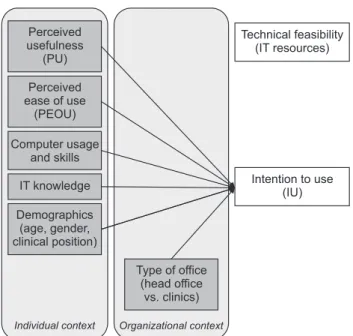
feasibility and user acceptance of the proposed system as shown in Figure 2. To determine technical feasibility, the staff computer usage, technology availability, and network availability at the MSI-M clinic/offices were assessed through a questionnaire survey adapted from a previous national survey in Thailand [12]. User acceptance of the EMR system was assessed based on the TAM introduced by Davis [13].
3. Questionnaire
The structured questionnaire comprised information at two levels, the organization and the individual. At the organiza- tion level, there were 8 questions on technological availabil- ity and network availability at work, such as the availability of computer systems, type of software, Internet availability, service providers, means of accessing the Internet, number of people working at the clinic/office, and number of people routinely using computers. The information on the technol- ogy and network availability of the clinic was obtained from one appropriate position, such as the supervisor/doctor of the respective clinic.
At the individual level, there were four sections including (A) individual demographic, (B) user acceptance (perceived usefulness [PU] and perceived ease of use [PEOU]), (C) ICT knowledge, and (D) computer usage. The survey questions were initially developed in English, and the translation-back- translation method was used.
1) Section A: Demographic information
The demographic information included age, gender, educa- tion, position held at the MSI-M, work experience in health- care, and work experience in the MSI-M clinic/office.
2) Section B: User acceptance
Based on the TAM model [13], three main components were assessed, namely, PU, PEOU, and intention to use (IU). Four items were used to assess PEOU, 7 items were used to assess the PU, and the rest were for IU assessment. Respondents were asked to indicate their agreement with each item on a 5-point numerical scale, ranging from 1 (meaning strongly disagree) to 5 (meaning strongly agree).
3) Section C: Information communications technology knowledge
Basic ICT knowledge was assessed using ten true/false state- ments guided by the European Computer Driving License (ECDL) basic IT sample test and by a study of computer literacy in US university freshmen [12]. The statements were related to basic knowledge, such as operating systems, soft- ware, viruses, printers, networks, the Internet, and so forth.
Three choices were given as an answer to each statement, i.e., True, False, and Not Know. Only a correct answer was given a score of one. The average score was used as a cut-off for two groups, i.e., low and high knowledge levels.
4) Section D: Computer usage
The participants’ experience of computer usage was assessed based on 5 questions, including how long they have been us- ing it, how often they use it, what kind of computer they use, what kind of activities they do with computers, and what kind of training and experience with computers they have previously. In addition to participants’ experience, a set of 10 activities were given to the participants to rate the frequency of performing such activities from 0 (never perform this task) to 3 (always use a computer). The 10 activities could further be classified into three categories: (1) providing care and reporting usage (these activities comprised recording a patient’s general and specific data, retrieving the patient clinical record, and generating a mandatory report), (2) administrative usage (these included writing official letters, analyzing data, and preparing presentation slides), and (3) communication usage (communicating with colleagues, searching for information associated with office tasks, and searching for information associated with personal interest) [12].
Figure 2. Adapted theoretical TAM (technology acceptance mod- el) model.
Perceived ease of use
(PEOU) Perceived usefulness
(PU)
Computer usage and skills IT knowledge
Demographics (age, gender, clinical position)
Individual context
Type of office (head office
vs. clinics) Organizational context
Intention to use (IU) Technical feasibility
(IT resources)
4. Statistical Analysis
The number and percentage of samples were used to de- scribe count/frequency data while mean and standard devia- tion (SD) or median and range, depending on data distribu- tion, were used to describe the demographics of the sampled population and the scores of each section. An independent t-test was conducted to compare these characteristics by type of office and by site, respectively. Pearson correlation test was conducted to explore the relationships between user acceptance variables, including PU, PEOU, IU, and exter- nal factors, including computer usage and ICT knowledge scores. To assess the factors influencing the IU the new sys- tem, logistic regression was applied. The outcome in terms of the IU was made binary based on the mean score being the cut-off value. The analyses were performed using SPSS software version 19 (IBM SPSS, Armonk, NY, USA).
5. Ethical Considerations
Ethics approval for this research was received from both the Mahidol University Ethical Committee and the MSI- M Internal Committee, together with a permission letter to conduct the survey from the country director of MSI-M (IRB No. MUTM 2013-073-01). All participants volunteered to participate and were not paid for interviews.
III. Results
1. Demographics Information
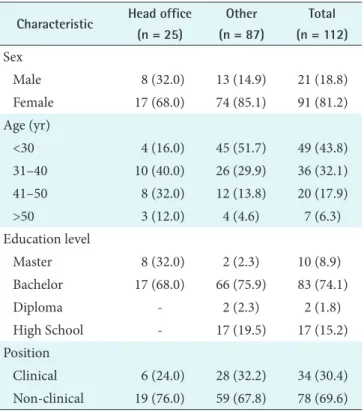
The general characteristics of the respondents working at MSI-M are presented in Table 1. Of all participants, 81.2%
were female and 18.8% were male. The mean age of the par- ticipants was 35.06 ± 9.5 years, with the youngest age of 22 and oldest age of 63. Regarding education level, the majority of the respondents had graduated with a bachelor’s degree (74.1%). Most of the participants were non-clinical staff members (69.6%), including CRAs, SRHPs, counsellors, supervisors, managers, and administrators. In response to the working experience in healthcare, the majority (50.9%) of the participants had been working in healthcare for more than 6 years, followed by 4–6 years representing 28.6%. As for working at the respective clinics or head office, 38.4% of the survey respondents had worked at the clinic/office for more than 6 years, 33% for 4–6 years, and 1–3 years repre- sented 18.8% (data not shown).
2. Technical Feasibility
As for the technical feasibility assessment, at the time of the survey, all surveyed MSI-M clinics and head office were
equipped with computers. However, the number of avail- able computers ranged from 1 to 36 per site depending on the size of the clinic and office. A server was installed only at the head office. The total number of personnel work- ing at the surveyed clinics and office was 212, of which 89 had routinely used a computer. Microsoft Office was used by staff members at all clinics. Approximately 27% of the respondents stated that analytical tools like SPSS had been installed, and 22.3% had both Internet service and an email system installed. Methods of Internet access by the partici- pants varied; the majority, 45.5% used Internet cafés, 20.5%
only accessed the Internet at home, and 22.3% accessed the Internet from their office using an asymmetric digital sub- scriber line (ADSL) or a paid Internet service provider (ISP), such as Red Link. On the other hand, 2.7% stated that they had never accessed the Internet.
3. Computer Usage
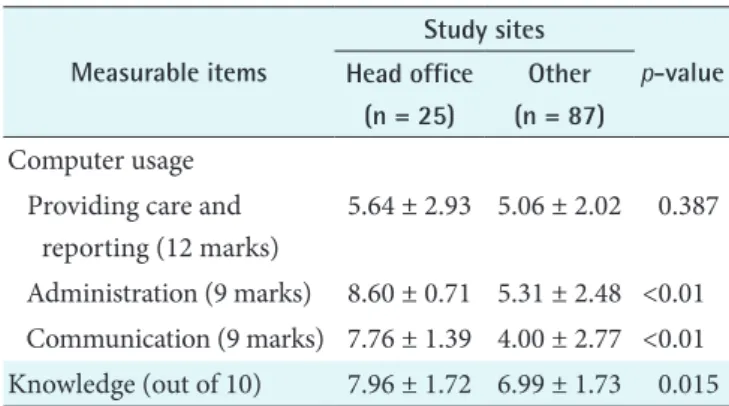
Table 2 represents the mean score on computer usage at the clinics in the head office and MSI-M clinics. Ten activities regarding computer usage were categorized into three groups including four activities related to care providing and report- ing, three activities on administration, and three activities on communication. The score was used to measure the frequen- cy of the activities. Computer usage in terms of providing Table 1. Demographics description
Characteristic Head office (n = 25)
Other (n = 87)
Total (n = 112) Sex
Male 8 (32.0) 13 (14.9) 21 (18.8)
Female 17 (68.0) 74 (85.1) 91 (81.2) Age (yr)
<30 4 (16.0) 45 (51.7) 49 (43.8) 31–40 10 (40.0) 26 (29.9) 36 (32.1)
41–50 8 (32.0) 12 (13.8) 20 (17.9)
>50 3 (12.0) 4 (4.6) 7 (6.3)
Education level
Master 8 (32.0) 2 (2.3) 10 (8.9)
Bachelor 17 (68.0) 66 (75.9) 83 (74.1)
Diploma - 2 (2.3) 2 (1.8)
High School - 17 (19.5) 17 (15.2)
Position
Clinical 6 (24.0) 28 (32.2) 34 (30.4) Non-clinical 19 (76.0) 59 (67.8) 78 (69.6) Values are presented as number (%).
care and reporting was relatively low in every regional clinic.
A high level of computer usage in all components, i.e., pro- viding care and reporting, administration and communica- tion, was found in the head office compared to other regions or state. Using an independent t-test, the computer usage of the head office and the clinics differed significantly in terms of administration usage (p < 0.01) and communication usage (p < 0.01).
4. Information Communications Technology Knowledge As seen in Table 2, there was significantly better knowledge among the head office staff compared to the rest (p = 0.015).
Overall, the mean score on knowledge of the staff at the head office was the highest, and the clinics in the Ayeyarwady re- gion had a relatively lower score on IT knowledge compared to the rest (Table 3). There were significant differences in ICT knowledge between different regions/states (Table 3) and between different job descriptions (data not shown).
5. User Acceptance Measures
The mean and SD of PEOU, PU, and IU of the clinics and the head office were shown in Table 4. Independent t-test results showed the scores for all items measured differed among the study sites. There were significant differences in
all scores between the head office and the clinics, where all scores were lower among the staff working at the head office.
There were significant differences in IU between different geographic regions (Table 5) and different job descriptions (data not shown). The staff members working in the Yangon, Mandalay, and Ayeyarwady regions had relatively high IU scores compared with other regions or states. The staff work- ing in the head office and management administration staffs were more reluctant to use the proposed system compared to other regions and job descriptions.
As presented in Table 6, there were significant positive re- lationships between PU and PEOU (r = 0.701, p < 0.01), PU and IU (r = 0.846, p < 0.01), and PEOU and IU (r = 0.627, p < 0.01). The results of the final logistic regression after backward stepwise selection using the likelihood-ratio statis- tic as the criteria for removing variables are shown in Table 7.
In the final model, the LR statistic was 35.048. According to the final model, the factors influencing the IU the proposed system were PU (odds ratio [OR] = 5.05, p < 0.01), and being head office staff (OR = 0.07, p < 0.05). Not surprisingly, the perception of usefulness significantly influenced the desire to use EMR (more than 5 times) in our study. On the other hand, the staff from the head office expressed much less de- sire to implement an EMR system. In fact, they were more than 10 times less likely to express desire to implement such a system in comparison with staff from the other offices.
Table 2. Computer usage and IT knowledge scores from the head office and the MSI-M clinics
Measurable items
Study sites
p-value Head office
(n = 25)
Other (n = 87) Computer usage
Providing care and reporting (12 marks)
5.64 ± 2.93 5.06 ± 2.02 0.387
Administration (9 marks) 8.60 ± 0.71 5.31 ± 2.48 <0.01 Communication (9 marks) 7.76 ± 1.39 4.00 ± 2.77 <0.01 Knowledge (out of 10) 7.96 ± 1.72 6.99 ± 1.73 0.015 Values are presented as mean ± standard deviation.
Table 3. ICT knowledge in head office, regions, and state Total
(n = 109)
Head office (n = 25)
Mandalay (n = 33)
Sagaing (n = 7)
Bago (n = 5)
Ayeyarwady (n = 11)
Yangon (n = 21)
Mon
(n = 7) p-valuea Knowledge score 7.21 ± 1.76 7.96 ± 1.71 7.45 ± 1.56 7.43 ± 1.13 7.00 ± 2.55 4.91 ± 1.22 7.43 ± 1.13 6.29 ± 1.11 <0.001 Values are presented as mean ± standard deviation.
ICT: information communications technology.
Measurement scale: Right Answer = 1, Wrong Answer = 0, Not Know = 0.
aANOVA test.
Table 4. Results on user acceptance from the head office and the MSI-M clinics
User acceptance measures
Study sites
p-value Head office
(n = 25)
Other (n = 87) Perceived ease of use (PEOU) 3.77 ± 0.60 4.26 ± 0.46 <0.01 Perceived usefulness (PU) 3.68 ± 0.97 4.22 ± 0.58 0.012 Intention to use (IU) 3.82 ± 0.41 4.09 ± 0.48 0.014 Values are presented as mean ± standard deviation.
MSI-M: Marie Stopes International Myanmar.
IV. Discussion
The survey showed that all the clinics were currently equipped with at least one computer, whereas a server was available only at the head office. Limited ICT availability was in line with the current Myanmar ICT infrastructure.
According to the International Telecommunication Union, Myanmar ranked 135th out of 176 nations in the Network Readiness Index 2017, indicating the low ICT development of the country [14]. Concerns about the lack of infrastruc- ture for stable power supply and Internet access in Myanmar and other lower income countries in the region have been reported previously by Lewis et al. [15].
EMR system deployment increases the quality of health- care services [16] as well as physicians’ satisfaction [17].
However, implementing such systems is never easy while taking into account baseline data, such as who will be the users, their ICT knowledge, and their acceptance towards the system. Low level of computer usage was found in both the head office and other clinics because every center uses a paper-based record system. This can be explained by the participants’ satisfaction with the paper-based record system in terms of familiarity, flexibility, and portability as reported
in a previous study in Myanmar [18]. The high level of com- puter usage in the head office compared with other regions or states may be attributed to the higher number of staff members working at the head office (see Figure 1) compared with the other clinics. A previous study also found that the number of staff members was a significant factor associated with high technology use in the clinics [19].
Doctors, managers, and administrators had high levels of ICT knowledge owing to the nature of their jobs in the organization. A significant difference in knowledge level between different regions/states was mainly due to one re- gion, Ayeyarwady, because staff working in that region had a significantly lower knowledge level compared with those of all the other regions/states (data not shown). Differences in knowledge level pose a challenge for implementing an EMR system in MSI-M. The majority of the respondents have had some computer-related training, but very few people had an IT background. Because a lack of skilled manpower was identified as a common barrier in implementation of EMR systems in developing countries [20,21], more computer training will help improve ICT knowledge and facilitate the future implementation of an EMR system.
The positive responses on PU (average score = 4.15 out Table 5. User acceptance score in head office, regions, and state
Total (n = 111)
Head office (n = 25)
Mandalay (n = 34)
Sagaing (n = 8)
Bago (n = 5)
Ayeyarwady (n = 11)
Yangon (n = 21)
Mon
(n = 7) p-valuea PEOU 4.03 ± 0.47 3.82 ± 0.41 4.19 ± 0.37 3.94 ± 0.45 3.65 ± 0.28 4.07 ± 0.58 4.08 ± 0.54 4.11 ± 0.65 0.046 PU 4.15 ± 0.53 3.77 ± 0.59 4.29 ± 0.43 4.09 ± 0.49 4.03 ± 0.27 4.30 ± 0.42 4.35 ± 0.52 4.20 ± 0.54 0.002 IU 4.10 ± 0.72 3.68 ± 0.96 4.31 ± 0.54 4.00 ± 0.53 4.00 ± 0.35 4.23 ± 0.64 4.26 ± 0.64 4.07 ± 0.73 0.034 Values are presented as mean ± standard deviation.
PU: perceived usefulness, PEOU: perceived ease of use, IU: intention to use.
Measurement scale: 1 = Strongly Disagree, 2 = Disagree, 3 = Neutral, 4 = Agree, 5 = Strongly Agree.
aANOVA test.
Table 6. Correlation matrix between user acceptance and external factors
Variable PU PEOU IU Usage Knowledge
PU 1
PEOU 0.701** 1
IU 0.846** 0.627** 1
Usage -0.074 0.044 -0.055 1
Knowledge 0.059 0.082 0.131 0.185 1
PU: perceived usefulness, PEOU: perceived ease of use, IU: in- tention to use.
**p < 0.01 for Pearson correlation test.
Table 7. Results of the logistic regression
Independent variables OR 95% CI p-value Perceived usefulness (PU) 5.050 (2.386–10.689) <0.01 ICT knowledge 2.196 (0.976–4.942) 0.057 Head officea 0.066 (0.005–0.966) 0.047 Clinical positionb 5.838 (0.649–52.548) 0.116 OR: odds ratio, CI: confidence interval, ICT: information com- munications technology.
aWhere non-head office was treated as the baseline, i.e., OR = 1.
bWhere non-clinical position was treated as the baseline, i.e., OR = 1.
of 5), PEOU (average score = 4.03 out of 5), and IU (aver- age score = 4.10 out of 5) reflect a positive perception of the EMR system. The lowest score in users’ PEOU indicated the users’ unfamiliarity with the EMR system. Results of a cor- relation analysis revealed significant positive relationships between PU, PEOU, and IU of EMRs (Table 4), which is con- sistent with several studies on EHR acceptance [13,22-24].
User acceptance varied from one region to another, and the head office score was the lowest in all three aspects, whereas the regions of Yangon, Mandalay, and Ayeyarwady had high IU scores. The lowest user acceptance scores and relatively lower IU of EMR among the head office staff were due to the fact that they were not working in the clinical fields where the real benefit of using EMR to process real-time patient data analytically would be. The additional qualitative study in the same population suggested that one main perceived challenge around the proposed system raised by clinicians and head office staff was the sustainability of the proposed EMR under the current situation in Myanmar [9]. Moreover, being the largest among all MSI-M offices in Myanmar, the head office could also face organizational resistance to change compared with the other smaller MSI-M regional clinics [25].
Interestingly, the high IU score among the staff at the Ay- eyarwady regional clinic despite their low IT knowledge can be explained by their increased demand for efficiency of clinical practice at their clinics because they had the low- est number of staff members (Figure 1) among all MSI-M clinics in Myanmar. This concept is supported by a previous study at a UK hospital in which they found that increased pharmacist efficiency at the hospital was achieved after implementation of an electronic prescribing system at the hospital [26]. Similar to a recent study among dental profes- sionals in Myanmar [18], the participants in this study had a high level of IU the proposed system although they had a low level of health IT usage. The limitation of this study was that it included only 13 out of 25 regional clinics in Myanmar due to limitations of budget and time to travel to all regional clinics in Myanmar. Therefore, generalization of the results should be considered carefully since the study did not cover all of the MSI-M clinics in Myanmar. In addition, only 30.4% of the surveyed subjects in our study were clini- cal staff members who would be the major users of EMRs at MSI-M.
The success of health IT relies on end-user’ acceptance and IU the proposed IT. Given the high IU the EMR system at the clinics, the vision of deploying an EMR system in MSI- M to improve patient care and achieve more effective data
management is not far-fetched. Realizing this vision will require major effort to overcome the users’ concerns and other prevailing factors, such as the current technology in- frastructure of the country and potential user’s familiarity with the technology. In addition, a strong leadership role in mandating the clinics to deploy such system and training the employees is essential. Involving users at all level in the ini- tial implementation stage can increase the acceptance of the EMR system.
Conflict of Interest
No potential conflict of interest relevant to this article was reported.
Acknowledgments
The authors would like to thank the study participants at MSI-M and all staff from the Department of Tropical Hy- giene for their support. The study was funded by the Faculty of Tropical Medicine, Mahidol University and the Wellcome- Trust Major Overseas Programme in South East Asia (No.
106698/Z/14/Z).
ORCID
Win Min Thit (http://orcid.org/0000-0002-2362-5068) Sai Wai Yan Myint Thu (http://orcid.org/0000-0002-7174-7481) Jaranit Kaewkungwal (http://orcid.org/0000-0001-7916-8460) Ngamphol Soonthornworasiri (http://orcid.org/0000-0003-1031-7979) Nawanan Theera-Ampornpunt (http://orcid.org/0000-0002-3322-4145) Boonchai Kijsanayotin (http://orcid.org/0000-0001-8932-1086) Saranath Lawpoolsri (http://orcid.org/0000-0003-4841-7924) Sid Naing (http://orcid.org/0000-0003-1638-1410)
Wirichada Pan-ngum (http://orcid.org/0000-0002-9839-5359)
References
1. Kruse CS, Kothman K, Anerobi K, Abanaka L. Adoption factors of the electronic health record: a systematic re- view. JMIR Med Inform 2016;4(2):e19.
2. Organisation for Economic Cooperation and Develop- ment. Health at a Glance: Europe 2018: State of Health in the EU Cycle. Paris, France: Organisation for Eco- nomic Cooperation and Development; 2018.
3. Hoyt RE, Sutton M, Yoshihashi A. Medical informatics:
practical guide for the healthcare professional. Pensaco- la (FL): University of West Florida; 2009.
4. Aldosari, B. Patients' safety in the era of EMR/EHR automation. Informatics in Medicine Unlocked 2017;9:
230-3.
5. Cook-Moine C, Cramer L. Financial savings from an electronic medical record in a small group practice.
Chicago (IL): Healthcare Information and Management Systems Society Inc.; 2018.
6. Alpert JS. The electronic medical record in 2016: Ad- vantages and disadvantages. Digit Med 2016;2(2):48-51.
7. Evans RS. Electronic health records: then, now, and in the future. Yearb Med Inform 2016;Suppl 1(Suppl 1):
S48-61.
8. Kruse CS, Kristof C, Jones B, Mitchell E, Martinez A.
Barriers to electronic health record adoption: a system- atic literature review. J Med Syst 2016;40(12):252.
9. Thit WM, Kaewkungwal J, Soonthornworasiri N, Theera-Ampornpunt N, Kijsanayotin B, Lawpoolsri S, et al. Electronic medical records in Myanmar: user per- ceptions at Marie Stopes International Clinics in Myan- mar. Southeast Asian J Trop Med Public Health 2016;
47(4):799-809.
10. Watkinson-Powell A, Lee A. Benefits of an electronic medical records system in rural Nepal. JNMA J Nepal Med Assoc 2012;52(188):196-200.
11. Marie Stopes International. Where in the world, Myan- mar [Internet]. London, UK: Marie Stopes International;
c2020 [cited at 2020 Jul 25]. Available from: http://www.
mariestopes.org/where-in-the-world#myanmar.
12. Kijsanayotin B, Speedie S. Are health centers in Thai- land ready for health information technology? A na- tional survey. AMIA Annu Symp Proc 2006;2006:424-8.
13. Davis FD. Perceived usefulness, perceived ease of use, and user acceptance of information technology. MIS Q 1989;13(3):319-340.
14. Htun KS. An investigation of ICT development in Myan- mar. Electron J Inf Syst Dev Ctries 2019;85(2):e12068.
15. Lewis T, Synowiec C, Lagomarsino G, Schweitzer J. E- health in low- and middle-income countries: findings from the Center for Health Market Innovations. Bull World Health Organ 2012;90(5):332-40.
16. Ayaad O, Alloubani A, ALhajaa EA, Farhan M, Abuseif S, Al Hroub A, et al. The role of electronic medical records
in improving the quality of health care services: Com- parative study. Int J Med Inform 2019;127:63-7.
17. Gidwani R, Nguyen C, Kofoed A, Carragee C, Rydel T, Nelligan I, et al. Impact of scribes on physician satisfac- tion, patient satisfaction, and charting efficiency: a ran- domized controlled trial. Ann Fam Med 2017;15(5):427- 33.
18. Thu SW, Kijsanayotin B, Kaewkungwal J, Soonthorn- worasiri N, Pan-Ngum W. Satisfaction with paper-based dental records and perception of electronic dental re- cords among dental professionals in Myanmar. Healthc Inform Res 2017;23(4):304-13.
19. van der Zande MM, Gorter RC, Aartman IH, Wismeijer D. Adoption and use of digital technologies among gen- eral dental practitioners in the Netherlands. PLoS One 2015;10(3):e0120725.
20. Afrizal SH, Hidayanto AN, Handayani PW, Budiharsana M, Eryando T. Narrative review for exploring barriers to readiness of electronic health record implementation in primary health care. Healthc Inform Res 2019;25(3):141- 52.
21. Muinga N, Magare S, Monda J, English M, Fraser H, Powell J, et al. Digital health systems in Kenyan Public Hospitals: a mixed-methods survey. BMC Med Inform Decis Mak 2020;20(1):2.
22. San AN, Yee CJ. The modified technology acceptance model for private clinical physicians: a case study in Ma- laysia, Penang. Int J Acad Res Bus Soc Sci 2013;3(2):380- 403.
23. Dünnebeil S, Sunyaev A, Blohm I, Leimeister JM, Krc- mar H. Determinants of physicians' technology accep- tance for e-health in ambulatory care. Int J Med Inform 2012;81(11):746-60.
24. Aggelidis VP, Chatzoglou PD. Using a modified tech- nology acceptance model in hospitals. Int J Med Inform 2009;78(2):115-26.
25. Lorenzi NM, Riley RT. Organizational issues = change.
Int J Med Inform 2003;69(2-3):197-203.
26. Bevan A, Patel N. An electronic prescription alerting system-improving the discharge medicines process.
Arch Dis Child 2016;101(9):e2.