Vol. 71, No. 3, March 2021, pp. 242∼248 http://dx.doi.org/10.3938/NPSM.71.242
Compression Modulus and Symmetry Energy of Nuclear Matter with KIDS Density Functional
Hana Gil
Center for Extreme Nuclear Matter, Korea University, Seoul 02841, Korea
Chang Ho Hyun
∗Center for Extreme Nuclear Matter, Korea University, Seoul 02841, Korea Department of Physics Education, Daegu University, Gyeongsan 38453, Korea (Received 6 January 2021 : revised 16 February 2021 : accepted 16 February 2021)
The equation of state of dense nuclear matter is explored using the KIDS (Korea-IBS-Daegu- Sungkyunkwan) density functional. The equation-of-state parameters, which are coefficients of the energy density expanded in powers of (ρ− ρ0)/3ρ0where ρ is the nuclear matter density and ρ0 is its density at saturation, are constrained by using both nuclear data and the mass-radius relation of a neutron star, as determined from modern astronomy data. We find that a combination of both types of data can significantly reduce the uncertainties in the equation-of-state parameters that are determined experimentally. We verify that the newly constrained parameters reproduce with high accuracy the basic properties of spherical magic nuclei. Neutron drip lines, on the other hand, show a non-negligible dependence in the uncertainty of the nuclear symmetry energy.
Keywords: Nuclear matter, Density functional theory, Neutron star
I. Introduction
The era of precision observation of the neutron star, and the multi-messenger astronomy-astrophysics has been opened. One of the most fundamental questions in the neutron star physics is what is the correct equa- tion of state (EoS) of nuclear matter at densities below and above the saturation density (ρ0). Equation of state is determined by the relation between the energy of a particle and its pressure which is gradient of energy with respect to density. Basic properties of the neutron star such as mass, size, density profile, tidal deformability, species of particles, and their fractions are determined directly by the EoS. Neutron star cooling is critically dependent on the fraction of particles, so the EoS also plays an essential role in the thermal evolution of neutron stars.
∗E-mail: [email protected]
Energy of a particle in nuclear matter is conventionally expanded around the saturation density in terms of x = (ρ− ρ0)/3ρ0 as
E(ρ, δ) = E(ρ) + S(ρ)δ2+ O(δ4), (1) E(ρ) = EB+1
2K0x2+1
6Q0x3+ O(x4), (2) S(ρ) = J + Lx +1
2Ksymx2+1
6Qsymx3+ O(x4).(3) Neutron-proton asymmetry is accounted by δ = (ρn− ρp)/ρ where ρn and ρp are the density of the neutron and the proton, respectively. Most of the nuclear struc- ture models fit their model parameters to the nuclear data, and the constants and coefficients in Eqs.(2, 3) which determine the EoS of nuclear matter are obtained as results of the fitting. Among the constants and coeffi- cients in Eqs.(2,3), saturation density ρ0and the binding energy EB are determined highly model-independently, and the values are converged to ρ0 = 0.16 fm−3 and EB = 16 MeV. On the other hand, compression mod- ulus K0 that characterizes the stiffness of EoS in the
This is an Open Access article distributed under the terms of the Creative Commons Attribution Non-Commercial License (http://creativecommons.org/licenses/by-nc/3.0) which permits unrestricted non-commercial use, distribution, and reproduction in any medium, provided the original work is properly cited.
symmetric nuclear matter is uncertain much more than ρ0 and EB. For example, collection of 240 Skyrme force models shows that the models predict the K0value in the range 200− 400 MeV [1]. Experimentally constrained range is reduced to 200− 260 MeV, but it is still un- certain much more than ρ0 and EB. Since the density at the center of a canonical neutron star, a star of mass 1.4M⊙ is in the range (2− 3)ρ0, role of K0 in the neu- tron star matter might be non-negligible and therefore it is needed to reduce the uncertainty of K0 in order to have more exact EoS of the neutron star matter. Situa- tion is no better than K0 for the symmetry energy S(ρ) in Eq. (3). Ranges of J, and L constrained from exper- iments are 30− 35 MeV and 40 − 76 MeV, respectively [1]. For Ksym experimental access is still very limited, and the value is guessed from relations with L or 3J− L [2]. Properties of neutron rich systems (δ≃ 1) are sensi- tive to the behavior of the symmetry energy. J, L and Ksym being siginificantly uncertain, large uncertainty in the EoS of neutron stars is unavoidable.
Goal of this work is to reduce the uncertainty of K0, J and L so that we have more reliable EoS for the neutron star matter at densities up to (2− 3)ρ0below which nu- cleons may be the dominant constituents of the matter.
It has been shown that if the energy density of nuclear matter is expanded in powers of the Fermi momentum of the nucleon, 7 terms are sufficient for the correct descrip- tion of EoS at densities relevant to nuclei and the center of neutron stars [3–5]. Higher order terms added to the basic 7 terms give vanishing contribution up to ρ≃ 3ρ0, and their effects are marginal at densities higher than 3ρ0. Following this observation, we describe the EoS of infinite nuclear matter with 7 density-dependent terms.
Parameters of the KIDS functional are determined in two steps. In the first step, seven parameters in the nu- clear matter functional are fixed to the values of ρ0, EB, K0, J, L, Ksym, and Qsym. After the 7 nuclear mat- ter parameters are determined, the model is applied to nuclei. In the second step, energy per particle (E/A) and the charge radii (Rc) of spherical magic nuclei40Ca,
48Ca and 208Pb are reproduced by adjusting two addi- tional parameters that account for the gradient of density and spin-orbit interactions in nuclei [6]. At this stage the number of model parameters is increased to 9, but we don’t need to introduce additional parameters any
more. Steps 1 and 2 are repeated by varying K0, J, L and Ksym values (ρ0, EB, Qsym kept unchanged), and χ2 values are calculated for E/A and Rc of 40Ca, 48Ca and 208Pb for a given set of (K0, J, L, Ksym). We find that nuclear data are most accurately reproduced in the range K0= 230−250 MeV. In the application to the neu- tron star, we select two sets of (J, L, Ksym) that give the smallest χ2 values for a given K0 value. Solving TOV equations, we obtain the mass and radius of the neu- tron star. Comparison with neutron star data provides us the ranges of K0, J and L that are most consistent with both nuclear data and astronomical observation. As a result, we obtain K0, J and L constrained in ranges K0∼ 230 − 250 MeV, J ∼ 31 − 33 MeV and L ∼ 55 − 65 MeV.
In Section II, we introduce the model and the strategy of investigation. Neutron star properties are considered, and reduced ranges of the EoS parameters are obtained in Section III. Parameters that are consistent with the neutron star observation are applied to calculating the properties of nuclei in Section IV. We summarize the work in Section V.
II. Model and Fitting
KIDS (Korea-IBS-Daegu-Sungkyunkwan) density functional theory provides nuclear energy density functional based on rules for systematic expansion of the energy of a nucleon in nuclear matter. In the homogeneous infinite matter, energy per particle is expanded in terms of the Fermi momentum as
E(ρ, δ) = T +∑
k=0
(αk+ βkδ2)ρ1+k/3, (4)
whereT is the kinetic energy, and the terms in the sum- mation denote the potential energy originating from the strong interaction. In the cold nuclear matter kF ∝ ρ1/3, so expansion in powers of ρ1/3is equivalent to the expan- sion in terms of the Fermi momentum. It’s been shown that 3 αk’s and 4 βk’s are suffcient for a correct descrip- tion of the EoS of nuclear matter at densities well below and above the saturation density [5].
By transforming the KIDS functional to the Skyrme- type potential, one can obtain the single-particle po- tential of the nucleon in nuclei. In addition to αk
and βk, two parameters accounting for the momentum- dependent and spin-orbit interactions are introduced in the single-particle potential for the nucleon in nuclei. We have 9 free parameters altogether. Determination of the 9 parameters is divided into two steps: At first, we as- sume specific values of the 7 EoS parameters ρ0, EB, K0, J , L, Ksym and Qsym, and determine 3 αk’s and 4 βk’s to reproduce these values. In the second step, we fit the parameters in the momentum-dependent and spin-orbit interactions (ζ and W0 in [5]) to E/A (energy per nu- cleon) and Rc (charge radius) of 40Ca, 48Ca and208Pb.
Agreement to the 6 nuclear data is measured by the χ26 defined by
χ26≡
∑6 n=1
(Oexpn − Ocalcn
Onexp
)2
. (5)
Among the 7 EoS parameters, we fix ρ0, EB, Qsym
to 0.16 fm−3, 16.0 MeV and 650 MeV, respectively, and investigate the dependence on the 4 EoS parameters K0, J , L, and Ksym. In order to avoid too large parameter space, 4 EoS parameters are restricted to the ranges al- lowed by either experiments or other theories. For K0, the range is chosen as 220− 260 MeV, and the interval is divided into 10 MeV, i.e. 220, 230, 240, 250 and 260 MeV. Ranges of J and L are 30− 34 MeV and 40 − 70 MeV, respectively, and the interval is assumed 1 MeV for both J and L. As for Ksym we consider Kτ
Kτ ≡ Ksym− (
6 + Q0
K0
)
L, (6)
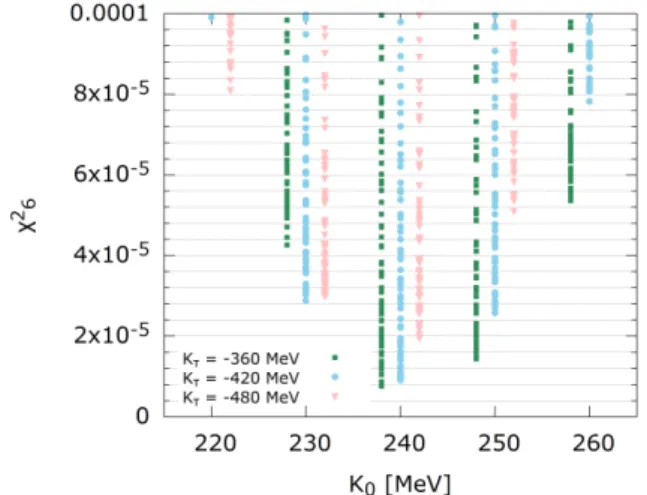
and assume three values−360, −420 and −480 MeV for Kτ. Total number of the combinations of (K0, J, L, Kτ) is 5×5×30×3 = 2250, and the resulting χ26ranges from 7.5× 10⁻⁶ to 3.2× 10⁻⁴. Among the 2250 results, we plot the results of χ26 less than 10−4 for each K0 value in Fig.1. The results are comparable with the SLy4 and the GSkI models which give χ26 values 2.24× 10⁻⁴ and 6.9× 10⁻⁵, respectively.
There are several notable features in Fig. 1. First, minimal χ26is likely to be located in the range K0= 230− 250 MeV. This range is consistent with, and narrower than the one from experiment K0 = 200− 260 MeV.
Second, for larger K0values, smaller χ26is obtained with larger Kτ values (smaller in magnitude) and vice versa.
Third, dependence on Kτ is relatively weak in the range
Fig. 1. (Color online) χ26 less than 10−4 for K0 = 220, 230, 240, 250 and 260 MeV.
K0= 230−250 MeV. Interestingly this range agrees with the range of minimum χ26. Since the nuclei in the fitting are not so asymmetric i.e. δ2 ≪ 1, and the densities relevant to the 6 data may be ρ0 and nearby, i.e. |(ρ − ρ0)/3ρ0| ≪ 1, it should be natural and reasonable to have weak dependence on Kτ.
From the result of fitting to the nuclear data, one can guess that true K0 value may be located in K0 = 230− 250 MeV. However, it is premature to draw a definite conclusion because density of nuclei is identi- cally close to ρ0, so the information about the density dependence of the EoS one can obtain from the nuclear data might be limited. In addition, asymmetry δ of48Ca and 208Pb are 0.17 and 0.21, respectively, so they are not large enough to magnify the effect of the symmetry energy. Neutron stars provide environment with more wider density range and the large neutron-proton asym- metry. Not abandoning the possibility of small or large K0 value, we include K0 = 220 and 260 MeV in the consideration of the neutron star. For each K0 value, we select (J, L, Kτ) that give the two smallest χ26 val- ues. Equation of state parameters thus determined are summarized in Tab.1. Ranges of J and L in Tab.1 are 30−34 MeV and 40−70 MeV, respectively. These ranges are similar to the experimental ranges in Ref. [1].
III. Neutron star
In 1990’s measurement of both mass and radius of a neutron was scarce, so the mass observation played
Table 1. EoS parameters (J, L, Kτ) giving the two small- est χ26 values for each K0 value.
K0 (J, L Kτ) χ2(×10−5)
220 (33, 50,−480) 9.45
(34, 63,−480) 8.61
230 (33, 66,−420) 3.04
(33, 52,−480) 3.01
240 (32, 68,−360) 0.75
(32, 58,−420) 0.89
250 (30, 41,−360) 1.50
(31, 58,−360) 1.43
260 (30, 47,−360) 5.55
(31, 63,−360) 6.03
a dominant role in constraining the nuclear EoS at high densities. Maximum mass was known to be about 1.5M⊙. However masses close to or larger than 2M⊙ have begun to be reported in the 21st century, and now the general consensus is that the maximum mass of the neutron star may be 2M⊙ or more. In the core of 2M⊙ neutron star, density is large enough that the nucleons are overlapping to each other. It is likely that non-nucleonic state will emerge and exist in the core of 2M⊙ neutron stars, so the EoS at the core is hard to determine accurately because of large uncertainties from various sources.
On the other hand, density at the center of a 1.4M⊙ neutron star does not exceed 3ρ0 regardless of the stiff- ness of EoS. At densities smaller than 3ρ0, uncertainty due to the non-nucleonic degrees of freedom can exist, but their effects are not significant or critical. For exam- ple, mass and radius of neutron stars with Λ hyperons were calculated with EoSs over a wide range of stiffness for the nucleon-nucleon (N N ), nucleon-Lambda (N Λ) and Lambda-Lambda (ΛΛ) interactions [7]. Maximum mass and the mass-radius curves depend on the N Λ and ΛΛ interactions critically, but the mass-radius relation of the canonical neutron star is seldom affected by the existence of Λ hyperons and the stiffness of their inter- actions with N and Λ. Therefore 1.4M⊙ neutron star provides a good laboratory in which we can study the EoS of nucleonic matter at densities higher than ρ0.
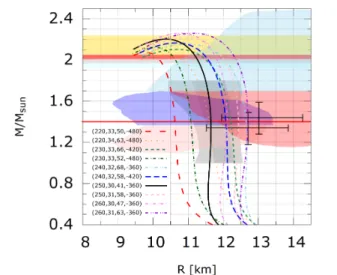
Now more ample and exact data of mass and radius of neutron stars whose mass is close to 1.4M⊙are avail- able. We collect the state-of-the-art data of the neutron star in Fig. 2. Horizontal bands around 2M⊙exhibit the data of large masses [8–10]. Gray zone represents the
Fig. 2. (Color online) Neutron star mass and radius re- lations with K0, J, L and Kτ selected in Tab. 1.
range obtained from the low mass X-ray binary (LMXB) data [11], error bars denote the analysis of a soft X- ray source observed in the NICER project [12,13], and the red and the blue regions in the shape of wings cor- respond to the result of GW170817 (lower small wings) [14] and GW190425 (upper large wings) [15]. In the case of NICER two analyses were performed independently for a single object, so the two results are shown in the figure. A red horizontal line is drawn at mass 1.4M⊙ for reference. Observation data span broadly on the mass- radius plane, but there is a narrow band in which all the data overalp. For the mass 1.4M⊙, the overlapping region restricts the radius in the range 11.8− 12.5 km.
Ten candidates for the EoS parameters (K0, J, L, Kτ) also show widely spread behavior. At first compared to the LMXB data at the canonical mass (red line), 4 EoSs are incompatible: 2 soft EoSs corresponding to (K0, J, L, Kτ) = (220, 33, 50, −480), (230, 33, 52, −480), and 2 stiff EoSs with (K0, J, L, Kτ)
= (240, 32, 68, −360), (260, 31, 63, −360). It is notable that K0 and Kτ are small simultaneously for the 2 soft EoSs, and they are large simultaneously for the 2 stiff EoSs. On the other hand, we have 4 EoSs that fall into the common range of LMXB, NICER and GW for M = 1.4M⊙: (K0, J, L, Kτ) = (230, 33, 66,−420), (240, 32, 58, −420), (250, 31, 58, −360), and (260, 30, 47,−360). There are several interesting features. First, the smallest K0 and Kτ values, 220 MeV and−480 MeV are ruled out. This provides lower
Table 2. Binding energy per nucleon in MeV for (K0, J, L, Kτ) values satsifying the neutron star mass-radius observation. Set A, B, C and D correspond to (230, 33, 66,−420), (240, 32, 58, −420), (250, 31, 58, −360), and (260, 30, 47,−360), respectively. Numbers in parenthesis denote the difference from experiment in %.
16O 40Ca 48Ca 90Zr 132Sn 208Pb
Exp. 7.976 8.551 8.667 8.710 8.355 7.868
A 7.946 (0.38) 8.564 (−0.16) 8.680 (−0.15) 8.681 (0.33) 8.378 (−0.28) 7.871 (−0.04) B 7.940 (0.45) 8.555 (−0.04) 8.673 (−0.07) 8.676 (0.39) 8.377 (−0.26) 7.869 (−0.01) C 7.935 (0.51) 8.546 (0.06) 8.667 (−0.01) 8.678 (0.37) 8.375 (−0.24) 7.868 (0) D 7.933 (0.54) 8.538 (0.15) 8.653 (0.17) 8.674 (0.42) 8.374 (−0.22) 7.867 (0.02)
bounds of these parameters. Second, similar to the 2 soft and 2 stiff EoSs incompatible with the LMXB data, smaller K0 values are grouped with smaller Kτ values, and vice versa. On the other hand, J and L values are small when K0 and Kτ are large. This means J and L contribute to EoS oppositely to K0and Kτ: If J and L soften the EoS, K0 and Kτ make it stiff. As a result, EoS is adjusted to remain in ranges consistent with data. Most essential aspect of the result is the range of each EoS parameters. If the consistency with neutron star observation is accounted, acceptable ranges could be specified as
K0∼ 230 − 260, J ∼ 30 − 33, L ∼ 45 − 65 (7) all in the unit of MeV. On the other hand, if we take into account the consistency with the nuclear data in addition to the nuclear star observation, K0= 260 MeV could be excluded because χ26 is much larger than the other K0
values. Then we obtain narrower ranges
K0∼ 230 − 250, J ∼ 31 − 33, L ∼ 55 − 65. (8) The ranges are reduced significantly compared to those constrained from experiment [1], and thus they are ex- pected to give EoSs less uncertain from sub to supra saturation densities. Compared to a recent work [16]
in which K0 is fixed to 240 MeV and symmetry energy parameters are fit to 13 nuclear data, J is slightly larger in this work, and L and Kτ ranges are almost identical.
With the newly constrained ranges of the EoS parame- ters, we can test the extreme properties of nuclei such as the neutron skin thickness or the position of the neutron drip line. Consideration about the finite nuclei follows in the next section.
IV. Nuclear property
Ranges of the EoS parameters in Eq. (7) are deter- mined using 6 nuclear data of 40,48Ca, 208Pb, and the neutron star mass and radius. Since we are aiming at a unified description of both nuclear matter and nuclei, it is mandatory to check the predictive power of our ap- proach for the nuclear properties. Top prior quantity among numerous nuclear properties might be the bind- ing energy.
Table2shows the binding energy per nucleon for stan- dard spherical magic nuclei. Numbers in the parenthe- ses denote the difference from experiment in units of %.
Energies of 40,48Ca and 208Pb are used in fitting the 2 Skyrme force parameters that are coefficients of the grandient and spin-orbit interactions, so it is natural to have good agreement with these data. Energies of16O,
90Zr and 132Sn are, on the other hand, predictions of the model. Predictions agree well with experiment, giv- ing difference from experiment at the order of 0.5% or less. Another positive aspect of the result is that the predicted energy values are independent of the EoS pa- rameters (K0, J, L, Ksym). This means that the 4 EoS parameter sets have equal predictive power for the bind- ing energy of magic spherical nuclei.
One main goal of the work is to have reliable predic- tions about the objects in extreme conditions in which density is much larger or smaller than the saturation density, or proton-neutron asymmetry approaches to 1.
Neutron stars are good laboratory to explore these ef- fects, but nuclei close to the neutron drip line also pro- vide a unique test ground. In Fig. 3, we show the result of two neutron separation energy S2n of O, Ca, Zr, Sn and Pb isotopes calculated with EoS parameter sets A, B, C, D in Tab. 2. Experimental data are denoted with
Fig. 3. (Color online) Two neutron separation energies for the O, Ca, Sn and Pb isotopic chains for the four sets of (K0, J, L, Kτ) in Tab. 2.
red squares. In order to account for the pairing corre- lation consistently in the neutron rich limit, we use the Hartree-Fock-Bogolyubov theory.
All the isotopes are assumed spherical, and pairing force is incorporated in the contact interaction form
Vpair= t′0 (
1− ρ 2ρ0
)
δ(⃗r1− ⃗r2). (9) Parameters in the pairing force are fit to the mean neu- tron gap of120Sn, 1.392 MeV.
Agreement to the experiment is not as good as the en- ergies of the magic nuclei in Tab. 2. More investigation is necessary for a better reproduction of the data. For example, the disagreement can originate from the way to treat the pairing force. Non-spherical shape of the iso- topes could contribute to the discrepancy. Nevertheless, there are a few points that are worthy to be discussed.
For the oxigen, results of the 4 EoS parameter sets agree to each other fairly well, but there are sizable differences from experiment at N = 8 and N = 10. Position of the neutron drip line is predicted identically at N = 22.
For the calcium, agreement to experiement is reasonable for N less than 30, but it becomes worse for N > 30.
For N between 30 and 40, however, the 4 EoS sets pre- dict similar results, and for N > 40, predictions are di- vided into two branches. Sets with Kτ=−420 MeV give S2n larger than those of Kτ =−360 MeV sets. Conse- quently neutron drip lines differ significantly, N = 54 for Kτ =−360 MeV and N = 62 for Kτ =−420 MeV. For the zirconium, agreement to experiment becomes worse for N > 40. Four EoS parameter sets agree to each other well for N less than 82, but the prediction splits into two groups for N > 82. Similar behavior is observed for the tin isotopes. For the lead, the same thing happens at
another magic number N = 184. Neutron drip of the Pb isotopes spreads over a huge range of the neutron number, from N = 186 to N = 220.
V. Summary
This work was motivated by the observation that the EoS of nuclear matter which is crucial in understanding the properties of extremely neutron-rich nuclei and the neutron star is not determined precisely enough yet. By reducing the uncertainty in the EoS parameters K0, J, L, and Ksym, it may be feasible to have more exact knowl- edge about the state of matter at extreme conditions.
KIDS density functional provides a framework adequate for this analysis. Four EoS parameters are determined to best reproduce the binding energy and the charge radius of 40,48Ca and 208Pb, and the radius of 1.4M⊙ neutron stars determined from modern astronomy. As a result we obtain the ranges K0∼ 230−250 MeV, J ∼ 31−33 MeV, and L∼ 55 − 65 MeV. As for Kτ, we used three values
−360, −420 and −480 MeV, and find that −480 MeV makes the EoS too soft to satisfy the neutron star obser- vation. Ranges of J and L are consistent with the ranges in a recent work [16] in which K0 is fixed to 240 MeV and the nuclear data used in the fitting are chosen differ- ently from this work. EoS parameters thus determined are applied to calculating the properties of nuclei. As for the binding energies of spherical magic nuclei16O,90Zr and 132Sn, all the 4 EoS parameter sets consistent with the neutron star data give results agreeing to nuclear data within the errors less than 0.5%. Two-neutron sep- aration energy, on the other hand, shows non-negligible discrepancy with experiment, so it needs more study to understand the origin of the discrepancy and make the theoretical prediction better.
From the analysis of this work, it has been shown that the uncertainties of J and L are reduced to the ranges
±1 MeV and ±5 MeV, respectively.
Then a subsequent question follows: Are these uncer- tainties narrow enough? or How accurately we should determine the symmetry energy parameters?
The result of two-neutron separation energy shows that the neutron drip line can be sensitive to Kτ.
Kτ is determined by both Ksym and L (Eq. (6)). So called the CSkP (consistent Skyrme parameterization) ranges of K0 and Q0 are given as 200≤ K0≤ 240 MeV and−420 ≤ Q0≤ −360 [1]. Employing these ranges we can approximate Eq. (6) as
Kτ ≃ Ksym− (4 − 4.5)L. (10) If L is determined with errors ±5 MeV, we have about 40− 45 MeV uncertainty in Kτ. This uncertainty is sim- ilar in magnitude to the interval of Kτ determined in this work −420 − −360 MeV. For a better decision of Kτ, it might be necessary to constrain L in regions nar- rower than ±5 MeV. Aside from the uncetainty of the EoS parameters, it is important to have more correct de- scription of the exotic nuclei. There are many things to consider, e.g. refined treatment of the pairing force, the effect of deformation, and etc. Some of these subjects are under way.
ACKNOWLEDGEMENTS
This work was supported by the Daegu University Re- search Grant 2018.
REFERENCES
[1] M. Dutra et al., Phys. Rev. C 85, 035201 (2012).
[2] C. Mondal et al., Phys. Rev. C 96, 021302 (2017).
[3] P. Papakonstantinou, T.-S. Park, Y. Lim, C. H.
Hyun, PPhys. Rev. C 97, 014312 (2018).
[4] H. Gil, P. Papakonstantinou, C. H. Hyun, Y. Oh, Phys. Rev. C 99, 064319 (2019).
[5] H. Gil et al., Phys. Rev. C 100, 014312 (2019).
[6] H. Gil et al., Acta Phys. Polon. B 48, 305 (2017).
[7] Y. Lim, C. H. Hyun, K. Kwak, C.-H. Lee, Int.J.Mod.Phys.E 24, 12 (2015).
[8] P. B. Demorest et al., Nature (London) 467, 1081 (2010).
[9] J. Antoniadis et al., Science 340 (2013).
[10] H. T. Cromartie et al., Nature Astronomy 4 (2020).
[11] A. W. Steiner, J. M. Lattimer, E. F. Brown, Astro- phys. J. 722, 33 (2010).
[12] T. E. Riley et al., Astrophys. J. 887, L21 (2019).
[13] M. C. Miller et al., Astrophys. J. 887, L24 (2019).
[14] B. P. Abbott et al. (The LIGO Scientific Collabora- tion and the Virgo Collaboration), Phys. Rev. Lett.
121, 161101 (2018).
[15] B. P. Abbott et al., Astrophys. J. 892, L3 (2020).
[16] Hana Gil, Young-Min Kim, Panagiota Papakon- stantinou, and Chang Ho Hyun, arXiv:2010.13354 [nucl-th].