9
Surgical Invasiveness is Important for Determining Severity of Postoperative Pain after Oral & Maxillofacial Surgery
Teo Jeon Shin, Yunki Park, Kwang-Suk Seo, Hyo Jo Han, and Hyun Jeong Kim
Department of Dental Anesthesiology and Dental Research Institute, School of Dentistry, Seoul National University Seoul, Republic of Korea
Abstract
구강악안면 수술의 침습도 및 술 후 통증의 정도와의 상관성
서울대학교 치의학대학원 치과마취과학교실
신터전․박윤기․서광석․한효조․김현정
배경: 술 후 통증은 술 후 합병증의 발생가능성을 증가시키며 생체기능의 회복을 방해한다. 술 후 통증을 효과적으로 조절하기 위해선 통증의 정도를 객관적으로 평가하는 것이 필요하다. 술 후 통증은 수술의 침습도와 관련이 높을 가능성이 많다. 본 연구에서는 수술 침습도의 정도와 술 후 통증의 정도 사이의 상관관계를 확인하고자 한다.
방법: 총 153명의 환자를 수술의 침습도에 따라 4개의 그룹으로 나누었다(그룹 1: 악성종양 수술 (malignancy surgery), 그룹 2: 양악수술(bimaxillary surgery), 그룹 3: 양성 종양수술(benign cancer surgery) 그룹 4: 임플란트 & 골절 수술(implant & frature)) 수술이 끝나갈 무렵 fentanyl 700 μg, ketorolac 1,500 mg (총 용적 120 ml)가 포함된 자가통증조절장치를 정맥로에 연결하였다. 술 후 통증의 정도는 시각통증등급(visual analogue scale)을 이용하여 측정하였고 자가통증조절장치의 총 사용시간, 투여된 진통제의 양, bolus 투여 총 횟수를 측정하였다.
결과: 술 후 시각통증등급은 술 후 1일부터 3일까지 그룹 1, 2 군에서 유의하게 높았다. 또한 시각통증등급 3점 이상의 통증을 호소하는 환자의 비율 역시 그룹 1, 2 군에서 유의하게 높았다.
진통제 총 투여용량 및 자가로 주입한 진통제의 양 역시 그룹 1, 2군에서 3, 4 군에 비해 유의하게 높은 것을 확인하였다.
결론: 본 연구결과 외과적 수술의 침습도가 술 후 통증의 정도를 결정하는데 있어 중요한 요소임 을 확인하였다. (JKDSA 2011; 11: 9~15)
핵심용어: Pain, postoperative; Oral Surgical Procedure; Patient Controlled Analgesia
Received: June 3, 2011, Revised: June 17, 2011 Accepted: June 17, 2011
Corresponding author: Hyun Jeong Kim, Department of Dental Anesthesiology and Dental Research Institute, Seoul National University School of Dentistry
28 Yeongeon-dong, Jongno-gu, Seoul 110-768, Korea Tel: +82-2-2072-3042, Fax: +82-2-766-9427 E-mail: [email protected]
* Teo Jeon Shin and Yunki Park equally contributed to this study.
INTRODUCTION
Pain is defined as “an unpleasant sensory and emo- tional experience associated with actual or potential tissue damage or described in terms of such damage”
(Fordyce, 1995). The fact that most patients suffered from postoperative pain regardless of the type of surgery
is of concern. Postoperative pain increases the inci- dence of pulmonary complication (DALRYMPLE et al, 1973) and delay postoperative surgical recovery (Kehlet, 1999). Early intervention of postoperative pain can reduce the incidence of postoperative morbidity and mortality (Ballantyne et al, 1998; Kehlet and Holte, 2001; Rodgers et al, 2000). In this sense, post- operative pain should be considered before the surgery and properly controlled perioperatively to improve patient safety and surgical quality.
An objective assessment of pain severity is a pre- requisite for pain control. Of importance is it to evaluate surgical invasiveness objectively, allowing us to control postoperative pain effectively. Clinically, we experienced that patients subject to invasive oral &
maxillofacial surgery frequently suffered from post- operative pain, requiring more analgesics for pain control. Considering postoperative pain is acute and inflammatory pain, it seems that surgical invasiveness and the extent of surgical stimuli is an important determinant of the intensity of postoperative pain.
Less invasive surgery is reported to show excellent feature of functional recovery as compared to the conventional open surgery types, which may be attri- buted to lesser degree of postoperative pain (Kitano and Shiraishi, 2005; Miccoli et al, 2001; Walther et al, 1999). These reports suggest the significance of invasiveness of the surgery in determining the level of postoperative pain. However, little data is available whether surgical intensity closely relates to postope- rative pain intensity, especially in the field of oral &
maxillofacial surgery to date. Therefore, we hypo- thesized that the difference in postoperative pain severity may exist according to the degree of surgical invasiveness. In the present study, we showed that the degree of surgical stimuli can affect the intensity of postoperative pain by analyzing the dose of analgesics and the frequency of rescue therapy injected through patient controlled anesthesia (PCA) between surgical types and evaluating the pain more objectively.
MATERIAL AND METHODS
After the approval of IRB and written informed consent, 153 patients undergoing Oral & Maxillofacial Surgery were recruited. This study was prospectively performed from April to November in 2007.
Preoperatively, we get permission for pain control with intravenous PCA from all patients scheduled to oral & maxillofacial surgery. If the patients deny permitting the use of PCA, the patients was excluded from the study. In addition to patient’s refusal to use PCA, exclusion criteria were as follows: 1) Patients under the age of 15 yr; 2) Patients experiencing side effects from the use of analgesics (NSAID, opioids.
etc); 3) Patients difficult to manipulate PCA device;
4) Patients who had a history of psychotic disease and drug addiction.
The patients enrolled in our study were classified into 4 groups according to the type of surgery: Group 1, surgery for malignant oral cancer requiring recon- struction of the defect; Group 2, orthognathic surgery (bimaxillary surgery only); Group 3, benign cancer surgery; Group 4, simple implant surgery and facial bone fracture. Group 1 and 2 was considered to be more invasive than Group 3 and 4.
The same type of PCA device (Accumate 1000, Acemedical, Seoul, Republic of Korea) was used throughout the experimental period. PCA prescription was also standardized as 700 μg fentanil and 150 mg ketolorac was diluted to 120 ml normal saline and connected to the PCA device. Basal infusion rate was set to 1.0 ml/h, bolus dose set to 1 ml and lock- out time set to 15 min. PCA was connected to the intravenous line after patients were transferred to the post anesthesia care unit (PACU).
The severity of postoperative pain was measured using VAS score. The measurement of pain was first assessed at 1 h and repeated every 12 h after the start of PCA. As surrogate measures of postoperative pain intensity, demand number defined as the fre- quency of bolus injection, total infusion time and dose of analgesics through PCA were also recorded.
Table 1. Demographic Data
Group 1 Group 2 Group 3 Group 4
Age (yr) Height (cm) Weight (kg)
Anesthesia time (min)
55.6 ± 14.2*
160.5 ± 6.8 60.5 ± 9.9 520 ± 256‡
22.9 ± 3.7† 167.8 ± 9.3 59.2 ± 10.6 551 ± 144‡
41.7 ± 14.8 160.7 ± 19.4 63.6 ± 10.5 268 ± 167
40.8 ± 17.5 164.5 ± 7.2 63.3 ± 10.3
246 ± 108 Values are expressed as mean ± SD. Group 1: Malignancy Group 2: bimaillary surgery Group 3: benign neoplasm Group 4: implant & fracture.
*P < 0.01 vs Group 2, 3 and 4; †P < 0.01 vs Group 1, 3, and 4; ‡P < 0.01 vs Group 3 and 4.
Fig. 1. Pain severity assessed by VAS score after surgery. Data represents mean ± SEM.
Group 1: Malignancy Group 2: bimaillary surgery Group 3: benign neoplasm Group 4:
implant & fracture. *P < 0.01 Group 1 vs Group 4; #P < 0.05 vs Group 3 and 4.
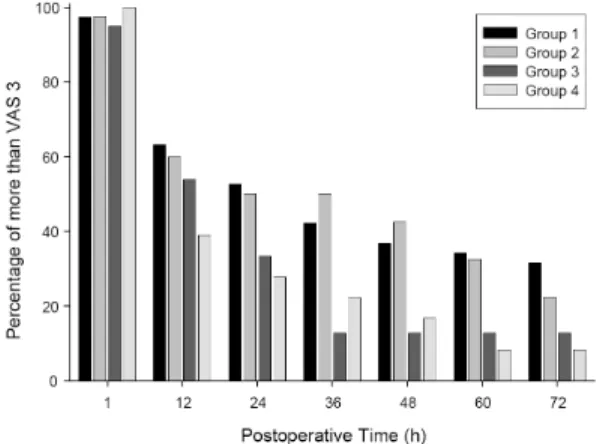
Fig. 2. Time-Courseof a proportion of patients repor- ting postoperative pain greater than VAS 3.
Data represents total percentage. Group 1:
Malignancy Group 2: bimaillary surgery Group 3: benign neoplasm Group 4: implant
& fracture. * P < 0.05 compared Group 1 &
2 and 3 & 4.
1. Statistical analysis
The difference of categorical and dichomotous outcomes were compared using chi – square. Conti- nuous outcomes between groups were compared by ANOVA with post – hoc Bonferroni correction. A P value < 0.05 was considered as significant. Statistical analysis was performed using Origin 7.0 software (OriginLab Corporation, Northampton, MA)
RESULTS
The demographic data is present in Table 1. There were no significant differences of height and weight
among groups (P > 0.05, Table 1). The mean age is significantly lower in Group 2 (P < 0.01, Table 1), higher in Group 1 compared to other groups (P <
0.01, Table 1) and total anesthesia time was significantly higher in group 1, 2 compared to group 3, 4 (P < 0.01, Table 1).
We observed the change of VAS score during post- operative period up to 72 h. As shown in Figure 1, VAS score gradually decreased after the operation in all groups. The patients in Group 1 reported a significantly higher level of postoperative pain (P <
0.05, Fig. 1). At 12 h after surgery and thereafter,
Table 2. The Characteristics of Patient Controlled Anesthesia
Group 1 Group 2 Group 3 Group 4
Total Time (min) Total Volume (ml) Total Demand (number)
116.2 ± 47.2*
135.9 ± 59.4† 29.4 ± 35.6‡
81.5 ± 17.1 94.9 ± 27.4 22.2 ± 36.8‡
78.3 ± 30.1 85.2 ± 36.1 11 ± 13.8
75.6 ± 23.8 80.8 ± 24.5 9.5 ± 10.6 Values are expressed as mean ± SD. Group 1: Malignancy Group 2: bimaillary surgery Group 3: benign neoplasm Group 4: implant & fracture.
*P < 0.01 vs Group 2, 3 and 4; †P < 0.01 vs Group 1, 3, and 4; ‡P < 0.01 vs Group 3 and 4.
there was significant difference of VAS score between Group 1 & 2 and group 3 & 4 (P < 0.05, Fig. 1).
We selected the criteria of less than 3 in the VAS scale to be pain-tolerable state because most patients who were less than 3 in the VAS scale considered that pain at the surgical site was well managed and was in acceptable range in our study. We calculated the incidence of patients reporting pain more than VAS 3 in each group at predetermined time after surgery. As shown in Fig. 2, the incidence of more than VAS 3 was not significantly different between groups until 24 h after surgery. However, there were significant differences of incidence of more than VAS 3 between Group 1 & 2 and Group 3 & 4 after 36 h of postoperative period (P < 0.05, Fig. 2). Interes- tingly, Group 2 showed the highest incidence of patients describing the pain more than VAS 3 at 36 and 48 h after the surgery while Group 1 showed the highest incidence throughout observational period except postoperative 2 days.
To examine whether the intensity of surgical pain is associated with the requirement of analgesics, total infused time, volume and demand number were measured. In Group 1, total infused time and volume was significantly greater compared with other groups (P < 0.01, Table 2). Meanwhile, total demand number did not differ between Group 1 and 2.
Significant difference of total demand number was also observed between Group 1 & 2 and Group 3 &
4 (P < 0.01, Table 2).
DISCUSSION
In this study, we showed that the degree of sur- gical invasion could affect postoperative pain intensity.
Consistent with our hypothesis, surgical invasiveness was important in determining the grade of postope- rative pain.
The classification of surgery types used in this study was based on our clinical experience. In many cases, operations requiring extensive surgical explo- ration, especially in cases of malignant cancer surgery and bimaxillary surgery, are likely to accompany greater requirement of analgesics. Clinically, in such cases, many patients suffer from postoperative pain although high dose of analgesics are administered.
Meanwhile, many patients were tolerable to surgical pain at minor surgery (implant, surgical extraction etc), even in the absence of analgesics. However, no definitive evidence has been documented with respect to the association of surgical type (major versus minor surgery) with postoperative pain intensity. Our results suggest that depending on the degree of surgical invasion, intensity of postoperative pain could be differed. Surgical tissue injury activates peripheral nociceptors. Upon activation of nociceptors, generated action potential propagates into the central nervous system. Surgical pain can be finally experienced through modulation of pain information relayed from nociceptors at surgical sites in the central nervous system. From the perspective of pain processing, it is reasonable that the extent of surgical invasion could relate to postoperative pain intensity. As shown in
Figure 2, clear-cut difference of surgical pain accor- ding to invasiveness was observed suggesting that severe pain likely develops after surgery with greater extent of invasion during postoperative period. In addition, surgical classification according to surgical invasiness used in our study makes sense.
From our result, it is thought that surgical invasi- veness of malignancy surgery may be similar with that of bimaxillary surgery. However, requirement of analgesics in bimaxillary surgery was not comparable to that of malignancy surgery as shown in Table 2. It can be explained that this discrepancy could be an effect of difference of pain sensitivity with age.
Compared with malignancy surgery, the patients who undergo bimaxillary surgery tend to be younger because orthognatic surgery is usually for esthetic purposes. In our study, the mean age in Group 2 was 22.9 yr, much younger than Group 1. This result suggests that younger patients are more sensitive to postoperative pain. The fact that the frequency of bolus injection in bimaxillary surgery number almost equals to that in malignancy surgery supports the idea of greater sensitivity of pain in young patients. In accordance with our results, elderly patients describe lower pain susceptibility than younger patients (Bisgaard et al, 2001; Thomas et al, 1998). Elderly patients require lesser amount of opioids for postoperative pain control than younger patients (Macintyre and Jarvis, 1996). However, there are several reports showing little difference of pain sensitivity between ages (Gagliese et al, 2000; Morin et al, 2000). The effect of ages on pain susceptibility has not been clearly established. The interpretation of our result may be performed with caution. Never- theless, our study shed light to the idea that the extent of surgical invasion in bimaxillary surgery may be severe than would expected.
Postoperative pain is a major factor of increasing postoperative morbidity. Postoperative pain accom- panies the surge of surgical stress which could be detrimental to patients. Thus, numerous studies have been performed to seek out the effective strategy of
pain control. Effective pain control depends on how exactly pain intensity and characteristics are evaluated.
Quantification of pain according to the extent of sur- gical invasion would allow a comprehensive approach for pain control based on expected pain intensity.
Several studies have been focused to reveal postope- rative pain characteristics in 3rd molar extraction (Al-Khateeb and Alnahar, 2008), orthognathic surgery (Neal and Kiyak, 1991), periapical surgery (Penarrocha et al, 2006), dental implant surgery (González-Santana H, 2005). However, to our best knowledge, compa- rative study with respect to pain difference between types of surgery has not been performed. Unlike other studies, we assessed pain intensity by measuring pain behavior with regard to PCA manipulation in addition to measurement of VAS score. Patient controlled anes- thesia provides self administered rescue therapy. The patients can respond to surgical pain through PCA by either injecting additional analgesics or not. The patient response to PCA can be used as surrogate measure of the degree of surgical pain. If total amount of analgesics delivered via PCA and the frequency of bolus injection is high, it represents severe pain. In line with our idea, total requirement of analgesics via PCA increases with the intensity of preoperative pain (Slappendel et al, 1999). In our study, total dose of analgesics administered by PCA increased in the following order (Group 4 < Group 3
< Group 2 < Group 1) and the frequency of bolus injection was the same. This result was almost com- parable with self reported pain scale (VAS score) during postoperative period. Thus, our results suggest that the extent of surgical invasion is a major deter- minant of the intensity of postoperative pain.
However, our study has several limitations. First, to clearly demonstrate the association the extent of surgical invasion and pain intensity, postoperative pain is measured with no analgesics administered. For example, Al-Khateeb et al did not prescribe analgesics to the patients and track off clinical course of pain intensity after 3rd molar extraction (Al-Khateeb and Alnahar, 2008). In our study, it is almost impossible
to use methodological approach as addressed above. In case of highly invasive surgery, the patients inevitably suffer from postoperative pain and serious compli- cations are likely to develop without pain control, which is unethical. Instead, patient controlled ane- sthesia with same protocols was performed to all subjects in our study. The reliability of our results may not be hindered because all experiment was carried out under the same circumstances. However, it is likely that the relation between surgical invasive- ness and pain may be underestimated.
Second, pain perception composes very complex process which involves different levels of neuraxial structures. Pain information is also processed within the subcortical area in the central nervous system important for modulation of mood and affection.
Besides surgical intensity, the emotional status is known to determine pain susceptibility (Kain et al, 2000; Scott et al, 1983; Turk and Okifuji, 1996). In our study, emotional status was not well matched pre- operatively. Preoperative anxiety can affect postope- rative pain response (Kain et al, 2000). The higher levels of preoperative anxiety and depression contri- bute to develop higher postoperative pain (Ozalp et al, 2003). Thus, perception of postoperative pain could be influenced by psychological factors such as preoperative anxiety and depression. However, it is virtually impossible to match the level of emotional status objectively between groups. Therefore, psycho- logical factor other than surgical stimuli may bias our results. Further studies need to be performed to reveal how closely psychological factor affects the relation between surgical intensity and pain intensity.
Third, interindividual variability of pain sensitivity must be considered to interpret our result. As shown in Table 1, wide range of the number of bolus injection was observed, suggesting that pain suscep- tibility between the subjects is substantial. Substantial differences of pain sensitivity have been reported in several studies (Craig and Weiss, 1971; Papageorgiou et al, 1996; Spanos et al, 1984). In our study, some subjects who underwent oral cancer surgery reported
mild pain immediately after operation. Meanwhile, other subjects reported continuous severe pain after simple implant surgery despite the administration of large amount of analgesics. This indicates that pain susceptibility may have effect in determining pain intensity irrespective of the extent of surgical stimuli.
Thus, interindividual variability of pain sensitivity must be taken into consideration for postoperative pain control.
In conclusion, our study suggests that the extent of surgical stimuli may be closely associated with the intensity of postoperative pain although several limi- tations do exist. We need preoperative careful consi- deration of the extent of surgical invasion, in which the requirement of analgesics is based on for effective postoperative pain control.
REFERENCES
Al-Khateeb TH, Alnahar A: Pain Experience After Simple Tooth Extraction. J Oral Maxillofac Surg 2008; 66: 911-7.
Ballantyne J, Carr D, DeFerranti S, Suarez T, Lau J, Chalmers T, et al: The comparative effects of post- operative analgesic therapies on pulmonary outcome:
cumulative meta-analyses of randomized, controlled trials. Anesth Analg 1998; 86: 598-612.
Bisgaard T, Klarskov B, Rosenberg J, Kehlet H:
Characteristics and prediction of early pain after laparoscopic cholecystectomy. Pain 2001; 90: 261-9.
Craig K, Weiss S: Vicarious influences on pain-threshold determinations. J Pers Soc Psychol 1971; 19: 53-9.
Dalrymple DG, Parbrook GD, Steel DF: factors predi- sposing to postoperative pain and pulmonary compli- cations: A Study of Female Patients undergoing Elective Cholecystectomy. Br J Anaesth 1973; 45:
589-98.
Fordyce W: Back pain in the workplace: management of disability in nonspecific conditions: a report of the task force on pain in the workplace of the Inter- national Association for the Study of Pain, IASP Press. 1995.
Gagliese L, Jackson M, Ritvo P, Wowk A, Katz J: Age Is Not an Impediment to Effective Use of Patient- controlled Analgesia by Surgical Patients. Anesthe- siology 2000; 93: 601-10.
González-Santana H P-DM, Guarinos-Carbó J, Balaguer- Martínez J: Pain and inflammation in 41 patients following the placement of 131 dental implants. Med Oral Patol Oral Cir Bucal 2005; 10: 258-63.
Kain Z, Sevarino F, Alexander G, Pincus S, Mayes L:
Preoperative anxiety and postoperative pain in women undergoing hysterectomy. A repeated-measures design.
J Psychosom Res 2000; 49: 417-22.
Kehlet H: Acute pain control and accelerated postope- rative surgical recovery. Surg Clin North Am 1999;
79: 431-43.
Kehlet H, Holte K: Effect of postoperative analgesia on surgical outcome. Br J Anaesth 2001; 87: 62-72.
Kitano S, Shiraishi N: Minimally invasive surgery for gastric tumors. Surg Clin North Am 2005; 85: 151-64.
Macintyre P, Jarvis D: Age is the best predictor of postoperative morphine requirements. Pain 1996; 64:
357-64.
Miccoli P, Berti P, Raffaelli M, Materazzi G, Baldacci S, Rossi G, et al: Comparison between minimally invasive video-assisted thyroidectomy and conven- tional thyroidectomy: A prospective randomized study.
Surgery 2001; 130: 1039-43.
Morin C, Lund J, Villarroel T, Clokie C, Feine J:
Differences between the sexes in post-surgical pain.
Pain 2000; 85: 79-85.
Neal C, Kiyak H: Patient perceptions of pain, pare- sthesia, and swelling after orthognathic surgery. Int J Adult Orthodon Orthognath Surg 1991; 6: 169-81.
Ozalp G, Sarioglu R, Tuncel G, Aslan K, Kadiogullari N: Preoperative emotional states in patients with breast cancer and postoperative pain. Acta Anaesthe- siologica Scandinavica 2003; 47: 26-9.
Papageorgiou A, Croft P, Thomas E, Ferry S, Jayson M, Silman A: Influence of previous pain experience on
the episode incidence of low back pain: results from the South Manchester Back Pain Study. Pain 1996;
66: 181-5.
Penarrocha M, Garcia B, Marti E, Balaguer J: Pain and inflammation after periapical surgery in 60 patients. J Oral Maxillofac Surg 2006; 64: 429-33.
Rodgers A, Walker N, Schug S, McKee A, Kehlet H, Van Zundert A, et al: Reduction of postoperative mortality and morbidity with epidural or spinal anaesthesia: results from overview of randomised trials. BMJ 2000; 321: 1493.
Scott L, Clum G, Peoples J: Preoperative predictors of postoperative pain. Pain 1983; 15: 283.
Slappendel R, Weber EWG, Bugter MLT, Dirksen R:
The Intensity of Preoperative Pain Is Directly Correlated with the Amount of Morphine Needed for Postoperative Analgesia. Anesth Analg 1999; 88:
146-8.
Spanos N, McNeil C, Gwynn M, Stam H: Effects of suggestion and distraction on reported pain in subjects high and low on hypnotic susceptibility. J Abnorm Psychol 1984; 93: 277-84.
Thomas T, Robinson C, Champion D, McKell M, Pell M: Prediction and assessment of the severity of post- operative pain and of satisfaction with management.
Pain 1998; 75: 177-85.
Turk D, Okifuji A: Perception of traumatic onset, compensation status, and physical findings: impact on pain severity, emotional distress, and disability in chronic pain patients. J Behav Med 1996; 19: 435-53.
Walther T, Falk V, Metz S, Diegeler A, Battellini R, Autschbach R, et al: Pain and quality of life after minimally invasive versus conventional cardiac surgery.
Ann Thorac Surg 1999; 1643-7.