© Copyright The Korean Academy of Asthma, Allergy and Clinical Immunology • The Korean Academy of Pediatric Allergy and Respiratory Disease
230 http://e-aair.org INTRODUCTION
Chronic cough, defined as a cough lasting more than 8 weeks, is common.1 The most common causes of chronic cough are asthma, gastroesophageal reflux disease, and postnasal drip syndrome,2 and the accuracy of diagnosis is assessed by the re- sponse to specific treatment in most cases. Assessing the effec- tiveness of management is also required for a subgroup of chronic coughers in whom a diagnosis cannot be made even af- ter thorough and systematic investigation.3 Thus, assessment of
cough using validated cough severity outcome tools is impor- tant in the management of and research into chronic cough. A
Reliability and Validity of a Korean Version of the Leicester Cough Questionnaire
Jae-Woo Kwon,
1Ji-Yong Moon,
2Sae-Hoon Kim,
3,4Woo-Jung Song,
4Min-Hye Kim,
5Min-Gyu Kang,
4Kyung-Hwan Lim,
6So-Hee Lee,
4Sang Min Lee,
7Jin Young Lee,
8Hyouk-Soo Kwon,
9Kyung-Mook Kim,
10Sang-Heon Kim,
2Sang-Hoon Kim,
11Jae-Won Jeong,
12Cheol-Woo Kim,
13Sang-Heon Cho,
4Byung-Jae Lee
8* on the behalf of Work Group for Chronic Cough, the Korean Academy of Asthma, Allergy and Clinical Immunology
1Department of Internal Medicine, Kangwon National University Hospital, Chuncheon, Korea
2Department of Internal Medicine, Hanyang University College of Medicine, Seoul, Korea
3Department of Internal Medicine, Seoul National University Bundang Hospital, Seongnam, Korea
4Department of Internal Medicine, Seoul National University College of Medicine, Seoul, Korea
5Department of Internal Medicine, Ewha Womans University College of Medicine, Seoul, Korea
6Department of Internal Medicine, Armed Forces Capital Hospital, Seongnam, Korea
7Department of Internal Medicine, Gachon University Gil Medical Center, Gachon University, Incheon, Korea
8Division of Allergy, Department of Medicine, Samsung Medical Center, Sungkyunkwan University School of Medicine, Seoul, Korea
9Department of Internal Medicine, Asan Medical Center, University of Ulsan College of Medicine, Seoul, Korea
10Department of Internal Medicine, Pogunhan Mom Hospital, Seoul, Korea
11Department of Internal Medicine, Eulji University School of Medicine, Seoul, Korea
12Department of Internal Medicine, Inje University College of Medicine, Goyang, Korea
13Department of Internal Medicine, Inha University College of Medicine, Incheon, Korea
This is an Open Access article distributed under the terms of the Creative Commons Attribution Non-Commercial License (http://creativecommons.org/licenses/by-nc/3.0/) which permits unrestricted non-commercial use, distribution, and reproduction in any medium, provided the original work is properly cited.
Purpose: There are no specific tools for measurement of the severity of chronic cough in Korea. We developed a Korean version of the Leicester Cough Questionnaire (LCQ) and tested its scaling and clinical properties. Methods: The LCQ was adapted for Korean conditions following a for- ward-backward translation procedure. All patients referred to chronic cough clinics at 5 university hospitals between May 2011 and October 2013 completed 2 questionnaires, the LCQ and the Short-Form 36 (SF-36), upon presentation and completed the LCQ and the Global Rating of Change (GRC) upon follow-up visits after 2 or 4 weeks. Concurrent validation, internal consistency, repeatability, and responsiveness were determined. Re- sults: For the concurrent validation, the correlation coefficients (n=202 patients) between the LCQ and SF-36 varied between 0.42 and 0.58. The in- ternal consistency of the LCQ (n=207) was high for each of the domains with a Cronbach’s alpha coefficient of 0.82-0.94. The repeatability of the LCQ in patients with no change in cough (n=23) was high, with intra-class correlation coefficients of 0.66-0.81. Patients who reported an improve- ment in cough (n=30) on follow-up visits demonstrated significant improvement in each of the domains of the LCQ. Conclusions: The Korean ver- sion of the LCQ is a valid and reliable questionnaire for measurement of the severity of cough in patients with chronic cough.
Key Words: Cough; questionnaires; quality of life; chronic disease
Correspondence to: Byung-Jae Lee, MD, PhD, Division of Allergy, Department of Medicine, Samsung Medical Center, Sungkyunkwan University School of Medicine, 81 Irwon-ro, Gangnam-gu, Seoul 135-710, Korea.
Tel: +82-2-3410-3427; Fax: +82-2-3410-3849; E-mail: [email protected] Received: July 8, 2014; Revised: September 4, 2014;
Accepted: September 24, 2014
•There are no financial or other issues that might lead to conflict of interest.
Original Article
Allergy Asthma Immunol Res. 2015 May;7(3):230-233.
http://dx.doi.org/10.4168/aair.2015.7.3.230 pISSN 2092-7355 • eISSN 2092-7363
Reliability and Validity of LCQ-K
Allergy Asthma Immunol Res. 2015 May;7(3):230-233. http://dx.doi.org/10.4168/aair.2015.7.3.230 AAIR
http://e-aair.org 231 few tools, including cough specific quality-of-life question-
naires, have been recommended.3 However, there are no spe- cific tools for measurement of chronic cough in the Korean population.
The Leicester Cough Questionnaire (LCQ), a widely used cough-specific quality-of-life questionnaire, has been shown to be repeatable and responsive, and correlates with cough fre- quency in chronic cough.3,4 This study was conducted to devel- op a Korean version of the LCQ and determine its reliability, va- lidity, and responsiveness.
Since there are no well validated outcome measures in chron- ic cough, we could not explore the relationship between the Ko- rean version of the LCQ and other objective markers of cough severity. Thus we evaluated the relationship between the Kore- an LCQ and subjective measurements of cough severity such as cough visual analogue scale (VAS) and cough symptom score, and the relationship between the Korean LCQ and Short-Form 36 (SF-36) which is a measurement of generic quality of life but not specific for cough. These methods have been used in devel- opment and validations in other languages of the LCQ.4,5
MATERIALS AND METHODS Patients
Patients with chronic cough were enrolled from five university hospitals (Hanyang University Guri Hospital, Samsung Medical Center, Seoul National University Hospital, Seoul National Uni- versity Bundang Hospital, and Kangwon National University Hospital) between May 2011 and October 2013. Chronic cough was defined as a cough lasting more than 8 weeks. Patients aged <15 or ≥70 years old were excluded. Enrolled patients completed two questionnaires, the LCQ and the SF-36 upon presentation and completed the LCQ and the Global Rating of Change (GRC) upon follow-up visits after 2-4 weeks. Patients were graded using a 100-mm linear VAS of cough severity from
“no cough” to “worst cough” and cough symptom score at each visit. The study protocol was approved by the Institutional Re- view Board of each participating hospital, and informed con- sent was obtained from all patients.
Leicester Cough Questionnaire
The LCQ is a cough-specific quality-of-life questionnaire con- taining 19 items divided into 3 domains (physical, psychologi- cal, and social). A 7-point Likert scale is used to evaluate the re- sponses for each item, and domain scores range from 1 to 7.
Thus the total score is 3-21; a higher score indicates a better quality of life. The LCQ was adapted for Korean conditions fol- lowing a forward-backward translation procedure, with inde- pendent translations and counter-translations. The Korean ver- sion was tested in 3 patients with cough for the suitability of wording and phrasing.
Short-Form 36 (SF-36)
SF-36 is a generic quality-of-life questionnaire which is a well- tested and validated generic health status measure. The time scale over which the symptoms or events being questioned in SF-36 was adjusted to 2 weeks to be consistent with the LCQ in this study. SF-36 contains 36 items divided into 8 scales (physi- cal functioning, role-physical, bodily pain, general health, vital- ity, social functioning, role-emotional, and mental health) and 2 dimensions (physical health and mental health).6 Scores of each LCQ domains (physical, psychological and social) were compared to SF-36 physical health dimension score, SF-36 mental health dimension score, and SF-36 social functioning scale score, respectively.
Other measurements
The cough symptom score is a numeric cough score consist- ing of two questions regarding subjective cough severity during the day and the evening.7,8 Scores for each question range from 0 to 5, and thus the cough symptom score ranges from 0 (no cough at all) to 10 (maximum cough). The GRC assessment was performed to evaluate self-perceived changes in disease control since the first visit. Responses were scored from +7 (a very great deal better) to -7 (a very great deal worse) and classi- fied as unchanged (-1, 0, +1), small change (-3, -2, +2, +3), mod- erate change (-5, -4, +5, +4) and large change (-7, -6, +7, +6).9 Scores of +4, +5, +6, and +7 were considered to represent clini- cally significant improvement.10
Validation
Concurrent validity
Concurrent validity is the assessment of an instrument against other standards; it was assessed by correlating the LCQ scores with SF-36, the cough symptom score, and VAS. A correlation coefficient ≥0.4 is generally regarded as a moderate correlation and >0.75 as a strong correlation.
Internal consistency
Internal reliability of each domain was assessed by determin- ing Cronbach’s alpha coefficients, which indicate the extent to which items are related. Internal reliability is generally accept- able if Cronbach’s alpha coefficient is greater than 0.7.
Test-retest reliability
The repeatability of the LCQ was assessed in those patients in- dicating no change (-1, 0, +1) on the GRC upon follow-up visits over 2-4 weeks. Assuming no difference in the average between the test and retest and the standard deviation of the total score is identical at each time point, 14 people were required with 0.75 as the lower limit for high agreement and 95% confidence interval (CI) in the expectation of a 0.9 intra-class correlation coefficient (ICC).5 An ICC ≥0.4 is generally regarded as a mod- erate correlation and >0.75 as a strong correlation.
Kwon et al.
Allergy Asthma Immunol Res. 2015 May;7(3):230-233. http://dx.doi.org/10.4168/aair.2015.7.3.230 Volume 7, Number 3, May 2015
232 http://e-aair.org Responsiveness
The responsiveness of the LCQ was assessed in those patients indicating clinical improvements (+4, +5, +6, and +7) on the GRC upon follow-up visits over 2-4 weeks.
Statistical analysis
Patients’ characteristics are presented as means (standard de- viation) for continuous variables and as relative frequencies for categorical variables. Spearman’s correlation coefficients be- tween LCQ scores and SF-36 scores were calculated for concur- rent validity since 2 of the 3 LCQ domains did not follow a nor- mal distribution. Internal consistency was tested by determining Cronbach’s alpha coefficients for the 3 domains and the total LCQ. Repeatability was assessed by calculating the ICCs. Re- sponsiveness was assessed using a paired t test of the LCQ scores at baseline and after clinical improvement. Statistical analysis was performed using SAS version 9.3 (SAS Institute, Cary, NC, USA).
RESULTS Patients
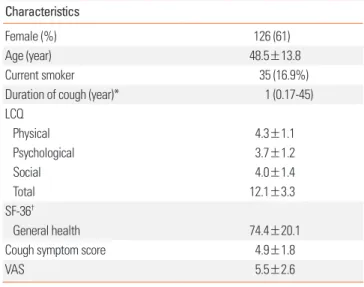
In total, 207 patients were enrolled. The SF-36 data were in- complete for 5 patients. Patients’ characteristics are shown in Table 1.
Concurrent validity
The correlation coefficients of the concurrent validity, deter- mined in 202 patients, are shown in Table 2. The correlation co- efficients between the LCQ and SF-36 varied between 0.42 and 0.58. The LCQ scores were also well correlated with the VAS and the cough symptom scores.
Internal consistency
The Cronbach’s alpha coefficients for the physical, psycholog- ical, social domains, and the total questionnaire were 0.82, 0.88, 0.89, and 0.94, respectively. A Cronbach’s alpha coefficient >0.7 is generally accepted as good.
Test-retest reliability
The repeatability of the LCQ in patients with no change in cough (n=23) was high, with ICCs of 0.66-0.81 (Table 3).
Responsiveness
Patients who reported an improvement in cough (n=30) on follow-up visits demonstrated significant improvement in each of the domains of the LCQ (Table 4). There was a significant dif- ference in the LCQ total score for clinically improved patients (P=0.0003) and the mean difference in the LCQ total score be- fore and after improvements was 3.37 (95% CI: 1.71-5.03).
DISCUSSION
The Korean version of the LCQ correlated well with patients’
Table 1. Clinical and demographic characteristics of the patients (N=207) Characteristics
Female (%) 126 (61)
Age (year) 48.5±13.8
Current smoker 35 (16.9%)
Duration of cough (year)* 1 (0.17-45)
LCQ
Physical 4.3±1.1
Psychological 3.7±1.2
Social 4.0±1.4
Total 12.1±3.3
SF-36†
General health 74.4±20.1
Cough symptom score 4.9±1.8
VAS 5.5±2.6
Mean±standard deviation.
LCQ, leicester cough questionnaire.
*Median (range); †n=202.
Table 2. Concurrent validity of Korean LCQ
LCQ
Physical Psychological Social Total
VAS -0.56 -0.51 -0.54 -0.58
Cough symptom score -0.61 -0.60 -0.61 -0.66
SF-36 physical health 0.58
SF-36 mental health 0.44
SF-36 social functioning 0.42
SF-36 total 0.55
Spearman’s correlation coefficients between LCQ and SF-36 scores. P<0.0001 in all outcomes.
LCQ, leicester cough questionnaire.
Table 3. Repeatability of Korean LCQ
LCQ domain Intra-class correlation coefficient 95% CI
Physical 0.71 0.44-0.86
Psychological 0.66 0.36-0.84
Social 0.81 0.61-0.91
Total 0.75 0.51-0.88
LCQ, leicester cough questionnaire.
Table 4. Responsiveness of Korean LCQ
LCQ domain Improvement score 95% CI P
Physical 0.92 0.44-1.39 0.0005
Psychological 1.29 0.64-1.93 0.0004
Social 1.17 0.57-1.77 0.0005
Total 3.37 1.71-5.03 0.0003
LCQ, leicester cough questionnaire.
Reliability and Validity of LCQ-K
Allergy Asthma Immunol Res. 2015 May;7(3):230-233. http://dx.doi.org/10.4168/aair.2015.7.3.230 AAIR
http://e-aair.org 233 perception as represented by the VAS and cough symptom
scores, and less well with SF-36. The Korean LCQ showed a high internal consistency and appeared to be acceptably re- peatable and responsive to change.
Evaluating the severity of cough is important in its clinical management. However, the evaluation of cough using validat- ed methods remains challenging for clinicians and research- ers.11 Three methods are used to assess cough severity; cough monitors used to objectively measure cough frequency, cough- specific quality-of-life questionnaires, and subjective assess- ments of cough severity, such as VAS.11 No current objective monitoring devices for chronic cough to guide clinicians and researchers are at present available, and the correlations be- tween VAS and objective cough measurements or quality-of- life scores are inconsistent.11 Thus cough-specific quality-of-life questionnaires are usually recommended to assess cough se- verity.7,11 The LCQ is a widely used cough-specific quality-of- life questionnaire and has been shown to be repeatable and responsive, and correlates with cough frequency in chronic cough.3,4,7,12,13 The LCQ has been validated in English, Dutch and at least one other language.4,5,14
The Korean version of the LCQ correlated moderately with SF-36, which is expected since SF-36 is a measurement of ge- neric quality of life, not specific for cough, and there could be many other components in general quality of life than cough.
For the Korean LCQ, the correlation coefficients between the LCQ and SF-36 varied between 0.42 and 0.58. These results were similar with the findings of previous studies. In the devel- opments of LCQ, Birring et al. showed moderate relationship between LCQ total score and SF-36 total score (r=0.46) and correlations between LCQ and SF36 domains were physical/
role limitation due to physical problems (r=0.46), psychologi- cal/mental health (r =0.59), and social/social functioning (r=0.46).4 In the validation of Dutch version LCQ, the correla- tion coefficients between the LCQ (total and domain scores) and the SF-36 scale scores varied between 0.22 and 0.61.5
The Korean LCQ and patients’ perception as represented by the VAS and cough symptom scores were significantly correlat- ed. Furthermore, the Korean LCQ showed an acceptably high in- ternal consistency and appeared to be highly repeatable and re- sponsive to change. Thus the Korean version of the LCQ can be used to evaluate the results of interventions in the management of chronic cough, and represents a useful parameter for evalua- tion of chronic cough in the clinic and for research purposes.
REFERENCES
1. Pratter MR, Brightling CE, Boulet LP, Irwin RS. An empiric integra- tive approach to the management of cough: ACCP evidence-based clinical practice guidelines. Chest 2006;129:222S-231S.
2. Morice AH. Epidemiology of cough. Pulm Pharmacol Ther 2002;
15:253-9.
3. Morice AH, Fontana GA, Belvisi MG, Birring SS, Chung KF, Dicpin- igaitis PV, et al. ERS guidelines on the assessment of cough. Eur Respir J 2007;29:1256-76.
4. Birring SS, Prudon B, Carr AJ, Singh SJ, Morgan MD, Pavord ID. De- velopment of a symptom specific health status measure for pa- tients with chronic cough: Leicester Cough Questionnaire (LCQ).
Thorax 2003;58:339-43.
5. Huisman AN, Wu MZ, Uil SM, van den Berg JW. Reliability and va- lidity of a Dutch version of the Leicester Cough Questionnaire.
Cough 2007;3:3.
6. Kalantar-Zadeh K, Kopple JD, Block G, Humphreys MH. Associa- tion among SF36 quality of life measures and nutrition, hospital- ization, and mortality in hemodialysis. J Am Soc Nephrol 2001;12:
2797-806.
7. Marsden PA, Smith JA, Kelsall AA, Owen E, Naylor JR, Webster D, et al. A comparison of objective and subjective measures of cough in asthma. J Allergy Clin Immunol 2008;122:903-7.
8. Hsu JY, Stone RA, Logan-Sinclair RB, Worsdell M, Busst CM, Chung KF. Coughing frequency in patients with persistent cough: assess- ment using a 24 hour ambulatory recorder. Eur Respir J 1994;7:
1246-53.
9. Juniper EF, Guyatt GH, Willan A, Griffith LE. Determining a mini- mal important change in a disease-specific Quality of Life Ques- tionnaire. J Clin Epidemiol 1994;47:81-7.
10. Kocks JW, Tuinenga MG, Uil SM, van den Berg JW, Ståhl E, van der Molen T. Health status measurement in COPD: the minimal clini- cally important difference of the clinical COPD questionnaire.
Respir Res 2006;7:62.
11. Leconte S, Ferrant D, Dory V, Degryse J. Validated methods of cough assessment: a systematic review of the literature. Respiration 2011;81:161-74.
12. Decalmer SC, Webster D, Kelsall AA, McGuinness K, Woodcock AA, Smith JA. Chronic cough: how do cough reflex sensitivity and subjective assessments correlate with objective cough counts dur- ing ambulatory monitoring? Thorax 2007;62:329-34.
13. Birring SS, Matos S, Patel RB, Prudon B, Evans DH, Pavord ID.
Cough frequency, cough sensitivity and health status in patients with chronic cough. Respir Med 2006;100:1105-9.
14. Kalpaklioglu AF, Kara T, Kurtipek E, Kocyigit P, Ekici A, Ekici M.
Evaluation and impact of chronic cough: comparison of specific vs generic quality-of-life questionnaires. Ann Allergy Asthma Immu- nol 2005;94:581-5.