Seizure Frequencies and Number of Anti-epileptic Drugs as Risk Factors for Sudden Unexpected Death in Epilepsy
The purpose of this study was to investigate the association between clinical variables and sudden unexpected death in epilepsy (SUDEP) and identify risk factors for SUDEP. SUDEP is one of the most frequent causes of death in patients with epilepsy. Previous studies have reported possible risk factors associated with SUDEP, but there need to be elucidated yet.
The cases were 26 patients with SUDEP and three control patients were included for each case, matched for age, sex, and date of initial clinical visit. All demographic and clinical characteristics, including age, sex, disease duration, classification of epilepsy, age at seizure onset, kind and number of antiepileptic drugs, were compared between cases and controls. Seizure frequency was higher in SUDEP cases than in controls (P = 0.035).
Univariate analysis using conditional logistic regression showed that higher seizure frequency (odds ratio [OR] = 3.1, P = 0.021) and the number of antiepileptic drugs (AEDs) (OR = 2.0, P = 0.009) were significantly associated with SUDEP. Only the number of AEDs remained significant in multivariate analysis (OR = 1.8, P = 0.026). Frequent seizures and multi-drug therapy were associated with SUDEP. This may suggest that the severity of epilepsy is associated with SUDEP, regardless of the type of AED used.
Keywords: Sudden Unexpected Death in Epilepsy; Polytherapy; Risk Factors Han Uk Ryu,1* Jin Pyo Hong,3*
Su-Hyun Han,1 Eun Ju Choi,1 Ji Hyun Song,2 Sang-Ahm Lee,1 and Joong Koo Kang1
1Department of Neurology, 2Department of Clinical Epidemiology and Biostatistics, and 3Department of Psychiatry, University of Ulsan College of Medicine, Asan Medical Center, Seoul, Korea
*Han Uk Ryu and Jin Pyo Hong contributed equally to this work.
Received: 3 November 2014 Accepted: 3 February 2015 Address for Correspondence:
Joong Koo Kang, MD
Department of Neurology, University of Ulsan College of Medicine, Asan Medical Center, 88 Olympic-ro 43 gil, Songpa-gu, Seoul 138-736, Korea
Tel: +82.2-3010-3448, Fax: +82.2-474-4691 E-mail: [email protected]
Funding: This study was supported by a grant of the Korean Health Technology R&D Project, Ministry of Health & Welfare, Republic of Korea (HI12C0035).
http://dx.doi.org/10.3346/jkms.2015.30.6.788 • J Korean Med Sci 2015; 30: 788-792
INTRODUCTION
Sudden unexpected death in epilepsy (SUDEP) is the most com- mon direct epilepsy-related cause of death in patients with epi- lepsy (1). Although in most patients with epilepsy, seizures are controlled well with medical treatment of conventional and new antiepileptic drugs (AEDs), SUDEP does occur in some patients with epilepsy. The pathophysiologic mechanism of SUDEP may include paroxysmal autonomic dysfunction such as cardiac problems or respiratory distress (2-4), but there is no clearly established consensus while the physiological mecha- nism remains unclear. Without established explanations for SUDEP, the analysis of possible risk factors becomes important to predict and reduce the risk of SUDEP. Despite all efforts to identify risk factors from descriptive epidemiologic studies, iden- tifying factors that predict SUDEP is still challenging.
Many previous studies have reported that early onset, male gender, duration of epilepsy, polytherapy, nocturnal seizures, and generalized tonic clonic seizures (GTCS) are among the significant risk factors for SUDEP (5-12); however, these studies were performed in western populations and there are few data
if Asian patients with epilepsy have the same risk factors for SU- DEP as western patients with epilepsy. The purpose of this study was to explore the association between patient characteristics and SUDEP in patients with epilepsy in Korea, focusing mainly on risk factors that have been identified by previous investigators.
MATERIALS AND METHODS Subjects and study design
The subjects in this study were patients who were registered and treated for epilepsy at Asan Medical Center, University of Ulsan College of Medicine, Korea, the tertiary hospital in Korea, between 1993 and 2011. A total of 35,638 patients with epilepsy were enrolled. Epilepsy was defined as a history of two or more unprovoked seizures or a single seizure with evidence of epi- leptiform activity recorded by electroencephalogram or struc- tural lesions documented by brain imaging. Medical records of patients were reviewed in detail and information on the cause of death was collected from the National Statistics Office data- base, which is matched to the hospital records using the unique national identification number of each patient.
Inclusion criteria
Cases were individuals who had died, had a diagnosis of epilep- sy registered on the death certificate and were treated for epi- lepsy at our center in the study period, and met the criteria for SUDEP. SUDEP was defined according to Leestma et al. (13) using the following criteria: 1) Patient has the disease of epilep- sy, 2) unexpected death occurred while the patient was in a rea- sonable state of health, 3) death was sudden, 4) death occurred during normal activities and benign circumstances, 5) there was no evidence of an obvious medical cause of death, and 6) death did not occur as a result of direct insult of status epilepti- cus or seizure. SUDEP is typically classified as definite if an au- topsy has been performed and probable if no autopsy has been performed (14). In Asian countries such as Korea, cultural cus- toms and habits mean that is not common to perform an au- topsy, so all SUDEP patients in the present study were classed as probable SUDEP. To ensure that we only included cases with identifiable clinical course over a long period, we excluded cas- es that were followed for less than 5 yr. We also excluded cases aged < 5 yr or > 70 yr, because unexpected death in these age groups may have many differential causes (Fig. 1). All included subjects were receiving AED stationary at least more than 1 yr.
Forty-six patients met the SUDEP criteria and were considered for inclusion in the study.
Eleven were excluded due to short duration of follow up (< 5 yr) and a further nine were excluded due to age (Fig. 1). Finally, 26 SUDEP patients were included as cases in this study. Control subjects were living epilepsy patients matched for age, sex, and initial date of enrollment at our medical center. Three control participants were included for each case. For all subjects, de- mographic and clinical characteristics were extracted from the medical records, including age, age at seizure onset, disease du- ration, sex, family history of epilepsy, the presence or absence of psychiatric problems (depression or anxiety), seizure frequen- cy during the recent 1 yr (≤ 1 per month, > 1 per month), the classification of epilepsy (generalized idiopathic, symptomatic partial, cryptogenic partial, undetermined). And further infor- mation were collected including the presence or absence of aura, the presence or absence of seizure associated lesions on MR
images (focal cortical dysplasia, epilepsy associated tumor, poly- microgyria, medial temporal sclerosis), the number of AEDs, and the type of AEDs used.
Statistical analysis
Demographic and clinical characteristics were compared be- tween cases and controls using an independent t-test for con- tinuous variables and a chi-square test for categorical variables.
Univariate logistic regression analysis was used to identify de- mographic and clinical characteristics associated with SUDEP.
Characteristics that were significant in the univariate analysis were entered into a multivariate regression analysis to identify those that were independently associated with SUDEP. All sta- tistical analyses were performed using SPSS (version 21.0; SPSS Inc., Chicago, IL, USA), with statistical significance defined as an alpha level < 0.05. Data are reported as mean ± standard de- viation or No. (%).
Ethics statement
The study protocol was reviewed by the institutional review board of Asan Medical Center (2012-0365). Informed consent was waived by the board because of the observational nature of this study.
RESULTS
Subject characteristics
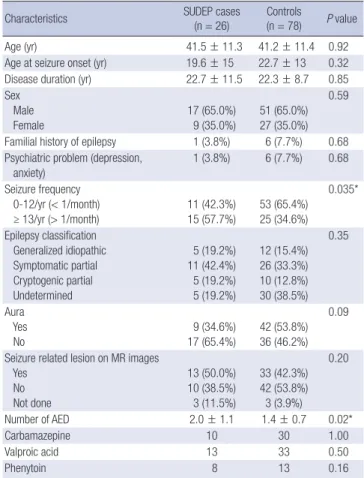
Twenty-six SUDEP cases and 78 controls were included in the study. General characteristics of the cases and controls are shown in Table 1. The age of SUDEP cases and controls was 41.5 ± 11.3 yr and 41.2 ± 11.4 yr, respectively. The age at seizure onset was 19.6 ± 15 yr and 22.7 ± 13 yr, respectively, and disease duration was 22.7 ± 11.5 yr and 22.3 ± 8.7 yr, respectively. Male gender was more predominant (65%) and familial history of epilepsy was about 5 percent in both groups. Psychiatric problems like depression or anxiety were evaluated because of worse effects on quality of life (QOL) (15) and occupied 5% in both groups.
These characteristics were similar in the two groups.
Seizure frequency was < 1 per month in 11 of the 26 SUDEP cases (42.3%) and > 1 per month in 15 of the 26 SUDEP cases (57.7%). Seizure frequency was < 1 per month in 53 of the 78 con- trols (65.4%) and > 1 per month in 25 of the 78 controls (34.6%).
This was statistically different between two groups (P = 0.035).
The number of AEDs used was also more in SUDEP cases com- pared with controls (2.0 ± 1.1 vs. 1.4 ± 0.7, P = 0.02).
Epilepsy was classified as idiopathic generalized epilepsy in 5 of the 26 SUDEP cases (19.2%), symptomatic partial epilepsy in 11 of the 26 SUDEP cases (42.3%), cryptogenic partial epilep- sy in 5 of the 26 SUDEP cases (19.2%) and undetermined in 5 of the 26 SUDEP cases (19.2%). Epilepsy was classified as idiopath- ic generalized epilepsy in 12 of the 78 controls (15.4%), symp- 46 SUDEP PATIENTS
INCLUSION CASES 26 SUDEP CASES 78 CONTROL CASES
Exclusion ≤ F/U 5 yr 11 patients Exclusion ≤ 5 yr, ≥ 70 yr
9 patients
Fig. 1. Included Sudden unexpected death in epilepsy (SUDEP) cases F/U, follow up.
tomatic partial epilepsy in 26 of the 78 controls (33.3%), crypto- genic partial epilepsy in 10 of the 78 controls (12.8%), and un- determined in 30 of the 78 controls (38.5%). Epilepsy classifica- tion was not significantly different between two groups.
Seizure-related lesions were observed in 10 of the 23 SUDEP cases with magnetic resonance images (50%) and 33 of the 75 controls with magnetic resonance images (42.3%). The propor- tion of patients with seizure-related lesions was similar in the two groups.
Risk factors for SUDEP
The univariate analysis using conditional logistic regression show- ed that seizure frequency (odds ratio: 3.1; P = 0.021) and num- ber of AEDs (odds ratio: 2.0; P = 0.009)were significantly associ- ated with SUDEP (Table 2). Only the number of AEDs remained significant in multivariate analysis (odds ratio: 1.83; P = 0.026;
Table 3). No individual AED was significantly associated with SUDEP (Table 2).
DISCUSSION
The main findings of the present study were that epilepsy pati- ents who died from SUDEP had a significantly higher frequency
of seizures and used significantly more AEDs than living epilep- sy patients, suggesting that seizures were more severe in epilep- sy patients who died from SUDEP. Consistent with previous studies, a higher seizure frequency and polytherapy were sig- nificantly associated with SUDEP in univariate analysis, and only polytherapy remained associated with SUDEP in multi- variate analysis (11, 16, 17). Although higher number of AEDs were the variable most strongly associated with SUDEP in this study, it is controversial whether polytherapy should be avoid- ed to reduce risk of SUDEP, because the association is not nec- essarily causal, but results and polytherapy may simply be a mar- ker of severe epilepsy (14). Our findings suggest that disease se- verity, as represented by uncontrolled seizures and polythera- py, may be an important risk factor for SUDEP.
The number of AEDs used ranged from one to four and many patients were treated with valproic acid, carbamazepine or phe- nytoin. Although the mechanism and pathophysiology of SUDEP is not clearly understood, unstable cardiac function has been postulated as a cause (5, 18). Several studies have proposed that AEDs harm cardiac function by arrhythmia or QT prolongation, which may then cause SUDEP (19-21). We found no associa- tion between the type of AED used (carbamazepine, valproic acid, phenytoin) and SUDEP, which supports previous studies Table 1. Demographic and clinical characteristics of study subjects
Characteristics SUDEP cases
(n = 26) Controls
(n = 78) P value
Age (yr) 41.5 ± 11.3 41.2 ± 11.4 0.92
Age at seizure onset (yr) 19.6 ± 15 22.7 ± 13 0.32 Disease duration (yr) 22.7 ± 11.5 22.3 ± 8.7 0.85 Sex
Male Female
17 (65.0%) 9 (35.0%)
51 (65.0%) 27 (35.0%)
0.59
Familial history of epilepsy 1 (3.8%) 6 (7.7%) 0.68 Psychiatric problem (depression,
anxiety)
1 (3.8%) 6 (7.7%) 0.68 Seizure frequency
0-12/yr (< 1/month) ≥ 13/yr (> 1/month)
11 (42.3%) 15 (57.7%)
53 (65.4%) 25 (34.6%)
0.035*
Epilepsy classification Generalized idiopathic Symptomatic partial Cryptogenic partial Undetermined
5 (19.2%) 11 (42.4%) 5 (19.2%) 5 (19.2%)
12 (15.4%) 26 (33.3%) 10 (12.8%) 30 (38.5%)
0.35
Aura Yes No
9 (34.6%) 17 (65.4%)
42 (53.8%) 36 (46.2%)
0.09
Seizure related lesion on MR images Yes
No Not done
13 (50.0%) 10 (38.5%) 3 (11.5%)
33 (42.3%) 42 (53.8%) 3 (3.9%)
0.20
Number of AED 2.0 ± 1.1 1.4 ± 0.7 0.02*
Carbamazepine 10 30 1.00
Valproic acid 13 33 0.50
Phenytoin 8 13 0.16
Data are mean ± standard deviation or No. (%). *P < 0.05. SUDEP, sudden unex- pected death in epilepsy; MR, magnetic resonance; AED, antiepileptic drug.
Table 2. Odds ratio of sudden unexpected death according to clinical and epilepsy characteristics
Characteristics Odds ratio 95% CI P value
Age at seizure onset (yr) 0.9 0.9-1.0 0.08
Duration of disease (yr) 1.0 0.9-1.1 0.79
Aura 2.7 0.9-7.8 0.08
Family history of epilepsy 0.5 0.1-4.2 0.52
Psychiatric problems (depression, anxiety) 0.5 0.1-4.2 0.50 Epilepsy classification
Generalized idiopathic Symptomatic partial Cryptogenic partial Undetermined
Reference 1.1 1.4 0.4
0.3-4.0 0.3-7.1 0.1-1.7
0.91 0.68 0.19 Seizure frequency
0-12/yr (< 1/month)
≥ 13/yr (> 1/month) Reference
3.1 1.2-8.2 0.021*
Seizure related lesion on MR images 1.9 0.7-5.3 0.23
Number of AEDs 2.0 1.2-3.3 0.009*
Type of AED Carbamazepine Valproic acid
1 0.7
0.4-2.5 0.3-1.8
1.00 0.5
Phenytoin 0.5 0.2-1.3 0.13
*P < 0.05. CI, confidence interval; MR, magnetic resonance; AED, antiepileptic drug.
Table 3. Results of univariate and multivariate regression analysis for sudden unex- pected death
Characteristic Univariate analysis Multivariate analysis Odds ratio 95% CI P value Odds ratio 95% CI P value Seizure frequency 3.1 1.2-8.2 0.021 2.5 0.9-7.0 0.07 Number of AEDs 2.0 1.2-3.3 0.009 1.8 1.1-3.1 0.026 CI, confidence interval; AED, antiepileptic drug.
and suggests that individual drugs were not likely to cause SU- DEP (21, 22).
There are controversies as to whether or not epilepsy classifi- cation is associated with SUDEP (10, 11, 13, 17). In the present study, we did not find any association between epilepsy type and SUDEP. This may be partially due to the relatively high pro- portion of patients with undetermined epilepsy in the present study and other supportive data such as brain magnetic reso- nance images and electroencephalogram that were normal.
Seizure frequency is a well-known risk factor for SUDEP, but recent studies reported that seizure frequency of GTCS is much more important than for patients with any other type of seizure (1, 8). However in our study, because many of the included pa- tients lived alone and could not remember or describe the se- miology, it was difficult to discriminate whether the type of sei- zures was GTCS or not in all included patients.
This study has several limitations. First, it was retrospective and may involve selection bias. In several patients it was not pos- sible to determine the type of epilepsy, and data on the presence of nocturnal seizures and the time of SUDEP were not available due to the paucity of medical records or the unknown history.
Second, we included patient with epilepsy who were followed up for at least 5 yr because of stable clinical condition and com- pliance of medication. However, by including more patients with confirmed diagnosis of epilepsy may gain stronger power.
Third, we studied patients who were treated at the Asan Medi- cal Center as early as1993, and many patients were treated with conventional AEDs such as valproate, carbamazepine and phe- nytoin. Small numbers of patients were treated with new AEDs such as lamotrigine, topiramate, oxcarbamazepine and leveti- racetam, and our data therefore provide limited information on the association between new AEDs and SUDEP. Additional co- hort studies of patients treated with new AEDs are necessary to evaluate the relation between new AEDs and SUDEP. Finally as seizure frequency and number of AED may have high interac- tion, careful interpretation is needed in our result.
In conclusion, we found that a higher frequency of seizures and the number of AEDs were associated with SUDEP, which may suggest that the severity of epilepsy is associated with SUDEP, regardless the type of AED used.
DISCLOSURE
The authors have no financial conflicts of interest.
AUTHOR CONTRIBUTION
Conception & design of the study: Kang JK, Hong JP. Collecting data: Choi EJ, Han SH, Hong JP. Analysis of the data: Ryu HU, Song JH. Writing the draft and paper: Ryu HU, Kang JK, Hong JP. Agree with manuscript results and conclusions: Ryu HU, Han
SH, Choi EJ, Song JH, Lee SA, Hong JP, Kang JK. Review and ap- proval of final manuscript: all authors.
ORCID
Han Uk Ryu http://orcid.org/0000-0001-7147-3735 Joong Koo Kang http://orcid.org/0000-0003-0941-3824 Sang-Ahm Lee http://orcid.org/0000-0002-6743-0545 Su-Hyun Han http://orcid.org/0000-0002-3084-6985 Ji Hyun Song http://orcid.org/0000-0002-5592-2411 Eun Ju Choi http://orcid.org/0000-0002-6804-5972 Jin Pyo Hong http://orcid.org/0000-0001-5384-2605 REFERENCES
1. Tomson T, Walczak T, Sillanpaa M, Sander JW. Sudden unexpected death in epilepsy: a review of incidence and risk factors. Epilepsia 2005; 46: 54- 61.
2. Schraeder PL, Lathers CM. Paroxysmal autonomic dysfunction, epilep- togenic activity and sudden death. Epilepsy Res 1989; 3: 55-62.
3. Nashef L, Walker F, Allen P, Sander JW, Shorvon SD, Fish DR. Apnoea and bradycardia during epileptic seizures: relation to sudden death in epilepsy. J Neurol Neurosurg Psychiatry 1996; 60: 297-300.
4. Johnston SC, Horn JK, Valente J, Simon RP. The role of hypoventilation in a sheep model of epileptic sudden death. Ann Neurol 1995; 37: 531-7.
5. Bardai A, Lamberts RJ, Blom MT, Spanjaart AM, Berdowski J, van der Staal SR, Brouwer HJ, Koster RW, Sander JW, Thijs RD, et al. Epilepsy is a risk factor for sudden cardiac arrest in the general population. PLoS One 2012; 7: e42749.
6. Beal E. Epilepsy: risk factors for sudden unexpected death in epilepsy- combined analysis from case-control studies. Nat Rev Neurol 2011; 7:
188.
7. Hesdorffer DC, Tomson T, Benn E, Sander JW, Nilsson L, Langan Y, Wal- czak TS, Beghi E, Brodie MJ, Hauser A, et al.; ILAE Commission on Epi- demiology; Subcommission on Mortality. Combined analysis of risk factors for SUDEP. Epilepsia 2011; 52: 1150-9.
8. Hesdorffer DC, Tomson T, Benn E, Sander JW, Nilsson L, Langan Y, Walczak TS, Beghi E, Brodie MJ, Hauser WA. Do antiepileptic drugs or generalized tonic–clonic seizure frequency increase SUDEP risk? A com- bined analysis. Epilepsia 2012; 53: 249-52.
9. Lamberts RJ, Thijs RD, Laffan A, Langan Y, Sander JW. Sudden unex- pected death in epilepsy: people with nocturnal seizures may be at high- est risk. Epilepsia 2012; 53: 253-7.
10. Nilsson L, Ahlbom A, Farahmand BY, Asberg M, Tomson T. Risk factors for suicide in epilepsy: a case control study. Epilepsia 2002; 43: 644-51.
11. Nilsson L, Farahmand BY, Persson PG, Thiblin I, Tomson T. Risk factors for sudden unexpected death in epilepsy: a case-control study. Lancet 1999; 353: 888-93.
12. Opeskin K, Berkovic SF. Risk factors for sudden unexpected death in epi- lepsy: a controlled prospective study based on coroners cases. Seizure 2003;
12: 456-64.
13. Leestma JE, Walczak T, Hughes JR, Kalelkar MB, Teas SS. A prospective study on sudden unexpected death in epilepsy. Ann Neurol 1989; 26: 195-
203.
14. Shorvon S, Tomson T. Sudden unexpected death in epilepsy. Lancet 2011;
378: 2028-38.
15. Kwon OY, Park SP. Depression and anxiety in people with epilepsy. J Clin Neurol 2014; 10: 175-88.
16. Tennis P, Cole TB, Annegers JF, Leestma JE, McNutt M, Rajput A. Co- hort study of incidence of sudden unexplained death in persons with sei- zure disorder treated with antiepileptic drugs in Saskatchewan, Canada.
Epilepsia 1995; 36: 29-36.
17. Walczak TS, Leppik IE, D’Amelio M, Rarick J, So E, Ahman P, Ruggles K, Cascino GD, Annegers JF, Hauser WA. Incidence and risk factors in sud- den unexpected death in epilepsy: a prospective cohort study. Neurology 2001; 56: 519-25.
18. Feldman AE, Gidal BE. QTc prolongation by antiepileptic drugs and the
risk of torsade de pointes in patients with epilepsy. Epilepsy Behav 2013;
26: 421-6.
19. Tomson T, Kennebäck G. Arrhythmia, heart rate variability, and anti- epileptic drugs. Epilepsia 1997; 38: S48-51.
20. Saetre E, Abdelnoor M, Amlie JP, Tossebro M, Perucca E, Taubøll E, An- finsen OG, Isojärvi J, Gjerstad L. Cardiac function and antiepileptic drug treatment in the elderly: a comparison between lamotrigine and sustain- ed-release carbamazepine. Epilepsia 2009; 50: 1841-9.
21. Danielsson BR, Lansdell K, Patmore L, Tomson T. Effects of the antiepi- leptic drugs lamotrigine, topiramate and gabapentin on hERG potassi- um currents. Epilepsy Res 2005; 63: 17-25.
22. Walczak T. Do antiepileptic drugs play a role in sudden unexpected death in epilepsy? Drug Saf 2003; 26: 673-83.