Copyright © 2019 by The Korean Orthopaedic Association
“This is an Open Access article distributed under the terms of the Creative Commons Attribution Non-Commercial License (http://creativecommons.org/licenses/by-nc/4.0/) which permits unrestricted non-commercial use, distribution, and reproduction in any medium, provided the original work is properly cited.”
The Journal of the Korean Orthopaedic Association Volume 54 Number 5 2019 Received July 5, 2018 Revised October 23, 2018 Accepted December 14, 2018 Correspondence to: Man-Jun Park, M.D.
Department of Orthopedic Surgery, Busan Medical Center, 359 Worldcup-daero, Yeonje-gu, Busan 47527, Korea
TEL: +82-51-607-2550 FAX: +82-51-607-2551 E-mail: [email protected] ORCID: https://orcid.org/0000-0003-1713-6142
슬관절 인공관절 전치환술 후 일회 주사 내전근관 차단술 및 경피성 Buprenorphine 병합 요법과 도관 삽입 지속적
내전근관 차단술의 임상결과 비교
허정욱 • 박만준 • 고영철 • 하동준 • 박준형 • 이우명
부산의료원 정형외과
Comparison of the Clinical Outcomes of a Single Injection Adductor Canal Block with the Concomitant Use of Transdermal Buprenorphine
and Continuous Adductor Canal Block after Total Knee Arthroplasty
Jung-Wook Huh, M.D., Man-Jun Park, M.D. , Young-Chul Ko, M.D., Dong-Jun Ha, M.D., Joon-Hyung Park, M.D., and Woo-Myung Lee, M.D.
Department of Orthopedic Surgery, Busan Medical Center, Busan, Korea
Purpose: To compare the clinical outcomes of single injection adductor canal block (SACB), continuous adductor canal block (CACB), and the
concomitant use of transdermal buprenorphine after total knee arthroplasty (TKA).Materials and Methods: A total of 125 patients who underwent TKA were divided into three groups and the clinical results were retrospecitively
compared. Group I was comprised of patients with pain controlled by SACB (n=41). Group II consisted of patients with pain controlled by both SACB and transdermal buprenorphine (10 mg/h) (n=44). Group III contained patients with pain controlled by CACB (n=40). The visual analogue scale (VAS) was used as the pain control indicator and the patients were measured on a VAS for resting on the bed (VAS-Rest) at 12 hours, 24 hours, and 48 hours after surgery. The VAS while doing continuous passive motion (VAS-CPM) on the first and second postoperative day was also measured. In addition, the total amount of medications used (Butopahn, Tridol, and Ketorac) for the intravenous patient controlled analgesia (PCA) was counted for 48 hours after surgery. As the indicator of the functional recovery outcome, the incidence of nausea and vomiting was observed for 48 hours after surgery. The maximum knee joint flexion range and maximum walking distance on the first and second postoperative day, and the total length of stay at the hospital were compared.Results:
The VAS-Rest was similar in the three groups at 12 hours after surgery, but at 24 hours and 48 hours after surgery, group II and III a lower VAS- CPM and total amount of medications used for PCA than group I (p<0.05). The three groups showed a low incidence of nausea and vomiting, maximum knee joint flexion range, and similar walking distance and total length of stay at the hospital.Conclusion: The combination of SACB and transdermal buprenorphine has great pain control effect initially. On the other hand, it is not associated
with catheter complications and it is convenient to use and safety toward the renal function. Therefore, the concomitant use of SACB and transdermal buprenorphine can be an effective pain control method after TKA.Key words: total knee replacement, postoperative pain, single injection adductor canal block, continuous adductor canal block, transdermal
buprenorphine patch서 론
슬관절 인공관절 전치환술(total knee arthroplasty, TKA) 후 통증 조절의 수단으로서 대퇴신경 차단술(femoral nerve block, FNB)은 효과적인 방법으로 보고되고 있으나,1) 대퇴사두근의 근력 약화 를 야기하는 단점이 있다.2) 이에 반해 내전근관 차단술(adductor canal block, ACB)은 대퇴사두근의 근력을 보존하면서 진통 효과 및 기능 회복에 있어서는 FNB와 비슷한 결과를 보인다.2) 그리고 약물을 일회 주사로 투여하는 방법(single injection adductor canal block, SACB)과, 카테터를 이용하여 지속적으로 투여하는 방법 (continuous adductor canal block, CACB)이 있다. 말초신경 차단 술 후 24시간 뒤에는 진통 효과가 현저히 떨어지는 것으로 알려 져 있어3) CACB가 SACB보다 더 효과적일 것이라 예상할 수 있 으나, CACB는 카테터 위치 이동 및 감염 등의 문제가 발생할 수 있다.4-8) 경피성 buprenorphine은 피부에 부착된 후 약 7일간 혈중 buprenorphine 농도를 높은 상태로 유지할 수 있기 때문에 지속적 인 통증 조절이 가능하지만, 지효성(slow-acting)으로서 최대 효 과가 발현될 때까지 부착 후 48시간 정도 소요되어 술 후 급성 통 증 조절에는 적합하지 않다는 연구도 있다.9-11) 이와 같이 TKA 후 통증을 충분히 조절하기 위해서는 다양한 형태의 통증 조절 방법 을 사용하되 각각의 장단점도 함께 고려해야 한다. 본 연구에서 는 SACB, CACB, 그리고 SACB 및 경피성 buprenorphine 병합 사 용을 통한 통증 조절 및 기능 개선 결과를 비교하여 SACB 및 경 피성 buprenorphine 병합 사용이 추가적인 합병증 없이 통증 조절 에도 우수한 결과를 보일 것으로 가정하였다.
대상 및 방법
본 연구는 2015년 6월부터 2017년 9월까지 부산의료원에서 Kell- gren-Lawrence 등급(K-L grade) 3단계 이상의 일차성 슬관절 퇴
행성 관절염으로 척추마취하 편측 TKA를 시행 받은 133명의 환 자들을 대상으로, TKA 술 후 SACB 단독 시행군을 I군, SACB와 경피성 buprenorphine 병합 사용군을 II군, CACB 단독 시행군을 III군으로 분류하였다. 류마티스 관절염, 만성 통증, 척추 및 고관 절 질환, 양측 수술 및 재치환술 환자, 척추마취의 실패로 전신마 취하 수술을 시행한 환자, 내전근관 차단술이 실패한 환자 등 8명 이 대상에서 제외되었다. 모든 환자가 수술 종료 후 30분 내에 한 명의 마취과 전문의에 의해 ACB를 시행 받았고, 정맥주사 patient controlled analgesia (PCA, 부토판 주 2 mg [butorphanol tartrate;
Myungmoon Pharm., Seoul, Korea], 4 ampoule; 트리돌 주 50 mg [tramadol hydrochloride; Yuhan Corp., Seoul, Korea], 4 ampoule;
케토락 주 30 mg [ketorolac tromethamine; Hanmi Pharm., Seoul, Korea], 2 ampoule; 총 용량 100 ml, 주입속도 0.05 ml/h, bolus 0.2 mg, lockout 8분)를 사용하기 시작하여 술 후 48시간째 제거하였 다. ACB 시 대퇴부 내측의 해부학적 접근을 위해 초음파(LOGIQ e;
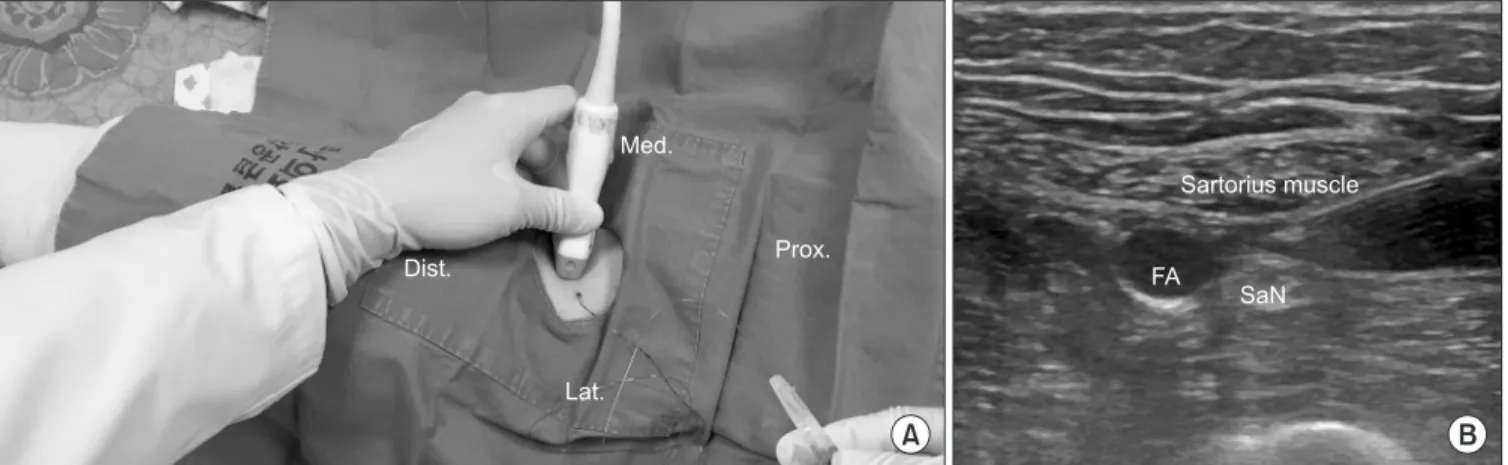
GE healthcare, Boston, MA, USA)를 이용하였으며, 22 G 척수마 취용 바늘을 외측에서 내측으로 삽입하여 대퇴동맥 및 복재신경 의 외측에 위치시킨 후 0.75% ropivacaine 10 ml 및 1% lidocaine 10 ml로 조성된 혼합 마취제를 대퇴동맥 주위로 주입하였다. CACB 시 경막외 마취용 카테터를 처음 약물 주입 시 사용하였던 바늘 을 통해 삽입하여 같은 위치에 거치시킨 후, 0.2% ropivacaine 20 ml를 수술 당일 오후 10시, 그리고 술 후 1일째 오전 8시부터 6시 간 간격으로 술 후 2일째 오후 2시까지 지속적 투여하였다(Fig.
1). 경피용 buprenorphine 병합 사용군의 경우 모든 환자에게 10 mg/h buprenorphine patch (Norpharma A/S, Horsholm, Denmark) 를 사용하였으며, patch의 최대 효과 발현이 이틀 소요되는 점9,10) 을 감안하여 수술 24시간 전부터 상위 흉추 높이의 등 부위에 부 착하였다. 술 후 통증의 정도는 visual analogue scale (VAS) 점수 를 사용하였다. 침상 안정 상태에서의 VAS (VAS-Rest)는 술 후 12, 24, 48시간에 측정하였고, 지속적 수동 운동(continuous passive
Figure 1. Adductor canal block. (A) Adductor canal block using ultrasonography; place the epidural catheter after the adductor canal block. (B) Place the needle near the saphenous nerve (SaN). Dist., distal; lat., lateral; med., medial; prox., proximal; FA, femoral artery.
motion, CPM) 중 VAS (VAS-CPM)는 술 후 24시간 및 48시간째 측정하였으며, 48시간 동안 PCA 약물이 투여된 총량을 측정하였 다. 오심 및 구토 증상 호소 시 항구토제(metoclopramide, 5 mg)를 정맥주사하였으며, 술 후 48시간 동안 항구토제 총 투여 횟수를 기록하였다. 그리고 술 후 24시간 및 48시간째 CPM 시 슬관절의 최대 굴곡 각도와 최대 보행 거리를 측정하고, 총 재원 기간을 기 록하여 비교하였다. 실험의 통계분석을 위해 IBM SPSS Statistics 22.0 프로그램(IBM Corp., Armonk, NY, USA)을 이용하였다. 첫째, 대상자의 일반적인 특성을 파악하기 위해 빈도분석 및 교차분석 을 통해 빈도와 백분율을 산출하였다. 둘째, 각 군 간 임상결과의 차이를 검증하기 위해 세 군 간의 일원배치분산분석(ANOVA)을 실시하였고, 두 군 간의 t-test를 실시하였다. 검정력 분석(power analysis)에서 효과크기 0.25, 유의수준 0.05 기준 power는 0.69로 각 군의 표본 수는 중간(0.5) 이상으로 충분함이 확인되었다.
결 과
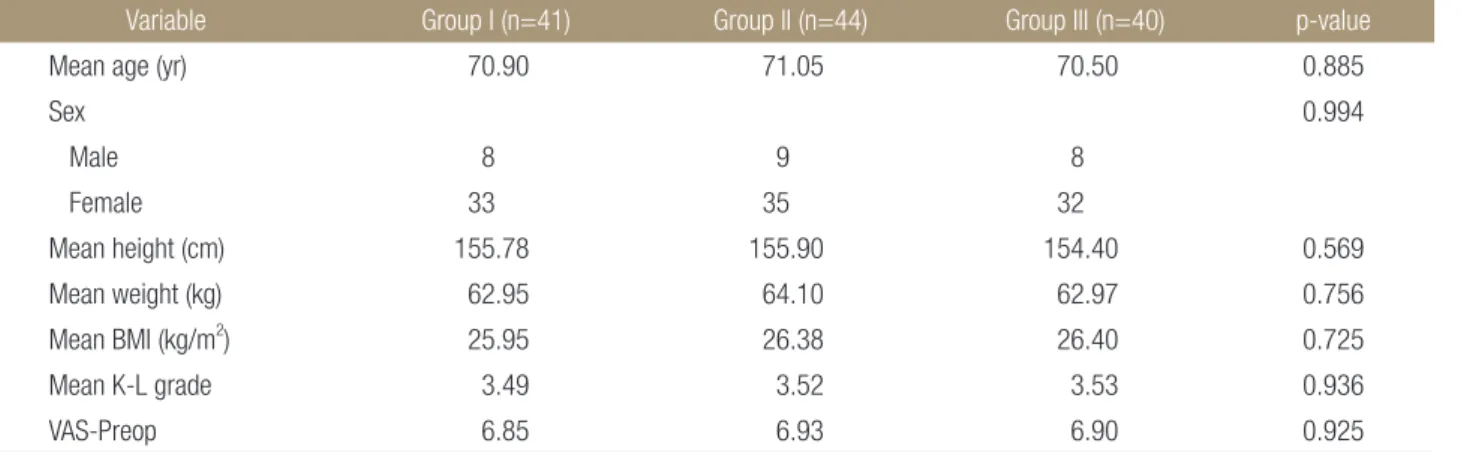
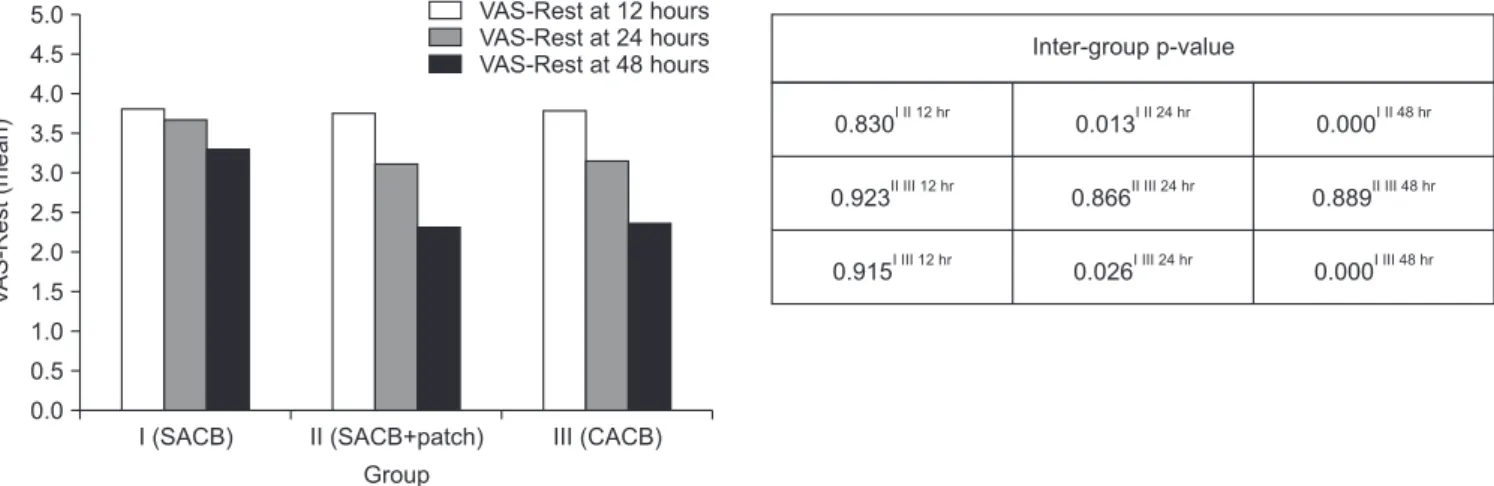
본 연구의 대상자는 평균 연령이 70.82세(61-86세)로 남자가 25 명, 여자가 100명이었다. 세 군 간의 연령, 성별, 체질량지수, 술 전 K-L grade 및 술 전 VAS 등에서 서로 유의한 차이는 보이지 않았 다(Table 1). 평균 VAS-Rest는 술 후 12시간째 I군 3.80, II군 3.75, III군 3.78로 유의한 차이가 없었으나, 술 후 24시간 및 48시간째 평균 VAS-Rest와 술 후 24시간 및 48시간째 평균 VAS-CPM 모 두 II, III군이 I군보다 유의한 수준에서 더 낮았고, 술 후 48시간 동안 평균 PCA 사용량도 II, III군이 I군보다 유의한 수준에서 더 적었다(Table 2, 3). 이 때 II군과 III군 간 비교 시 평균 VAS-Rest와 VAS-CPM은 II군이 더 낮고 평균 PCA 사용량은 III군이 더 적었 으나 모든 시점에서 두 군 간의 유의한 수준의 차이는 없었다(Fig.
2-4). 술 후 48시간 동안 평균 오심 및 구토 증세의 빈도, 술 후 24 시간 및 48시간째 최대 슬관절 굴곡 범위와 최대 자가 보행 거리, 총 재원 기간 등의 기능 개선 지표에서는 세 군에서 모두 유의한 수준의 차이는 없었다(Table 4).
Table 1. Patients Demographics
Variable Group I (n=41) Group II (n=44) Group III (n=40) p-value
Mean age (yr) 70.90 71.05 70.50 0.885
Sex 0.994
Male 8 9 8
Female 33 35 32
Mean height (cm) 155.78 155.90 154.40 0.569
Mean weight (kg) 62.95 64.10 62.97 0.756
Mean BMI (kg/m2) 25.95 26.38 26.40 0.725
Mean K-L grade 3.49 3.52 3.53 0.936
VAS-Preop 6.85 6.93 6.90 0.925
Group I, single injection adductor canal block group; Group II, single injection adductor canal block with transdermal buprenorphine patch group;
Group III, continuous adductor canal block group; BMI, body mass index; K–L, Kellgren–Lawrence; VAS-Preop, preoperative visual analog scale.
Table 2. VAS-Rest Score (Mean)
Hours post-op Group I
(n=41)
Group II (n=44)
Group III
(n=40) p-value
12 hours 3.80 3.75 3.78 0.978
24 hours 3.66 3.11 3.15 0.023
48 hours 3.29 2.32 2.35 0.000
VAS-Rest, visual analogue scale for resting on the bed; hours post-op, hours of the post-operative; Group I, single injection adductor canal block group; Group II, single injection adductor canal block with transdermal buprenorphine patch group; Group III, continuous adductor canal block group.
Table 3. VAS-CPM Score (Mean), PCA Consumption for Post-Operative 48 Hours (Mean)
Variable Group I (n=41)
Group II (n=44)
Group III
(n=40) p-value
VAS-CPM, POD1 4.41 3.73 3.85 0.020 VAS-CPM, POD2 4.12 2.89 2.95 0.000 PCA consumption (ml) 96.44 79.94 76.21 0.000 VAS-CPM, visual analogue scale while doing continuous passive motion;PCA, patient controlled analgesia; POD, postoperative day; Group I, single injection adductor canal block group; Group II, single injection adductor canal block with transdermal buprenorphine patch group;
Group III, continuous adductor canal block group.
Figure 2. Mean VAS-Rest and inter-group p-value. The mean VAS-Rest of the II and III groups was lower than that of the I group at every time except for the postoperation period till 12 hours. On the other hand, no significant difference was observed at any point when comparing the VAS-Rest between the II and III groups. VAS-Rest, visual analogue scale for resting on the bed; Group I, single injection adductor canal block (SACB) group;
Group II, SACB with transdermal buprenorphine patch group; Group III, continuous adductor canal block (CACB) group.
Figure 3. Mean VAS-CPM and inter-group p-value. The mean of VAS-CPM was similar in II and III groups, which were both estimated at 24 hours and 48 hours after the operation. On the other hand, both were significantly lower than group I. VAS-CPM, visual analogue scale while doing continuous passive motion; Group I, single injection adductor canal block (SACB) group; Group II, SACB with transdermal buprenorphine patch group; Group III, continuous adductor canal block (CACB) group; POD, post-operative day.
5.0 4.5 4.0 3.5 3.0 2.5 2.0 1.5 1.0 0.5
VAS-CPM(mean)
0.0
Inter-group p-value
I (SACB) II (SACB+patch) III (CACB) POD1 POD2 POD1 POD2 POD1 POD2
Group
Figure 4. Mean patient controlled analgesia (PCA) consumption for postoperative 48 hours and inter-group p-value. The mean of PCA consumption was similar in the II and III groups. On the other hand, both were significantly lower than group I.
Group I, single injection adductor canal block (SACB) group; Group II, SACB with transdermal buprenorphine patch group;
Group III, continuous adductor canal block (CACB) group.
100 95 90 85 80 75 70 65 60 55 PCAconsumption(ml) forpostoperative48hours(mean)
50
Inter-group p-value
I (SACB) II (SACB+patch) III (CACB) Group
고 찰
본 연구를 통해 SACB 및 경피성 buprenorphine 병합 사용은 CACB만큼의 통증 조절의 효과가 있음이 확인되었으며, 이를 통 해 SACB 단독 사용과 CACB의 단점을 극복할 수 있을 것이다.
TKA 후 이틀 동안은 통증이 특히 심할 수 있고,12) SACB와 CACB 간 약물 투여 방법의 차이가 통증 조절의 지속성 및 효과에 영향 을 미칠 수 있을 것이다. TKA 후 ACB를 시행한 환자들을 대상으 로 SACB와 CACB의 임상결과를 비교한 연구에서 Lee 등13)은 두 군 간의 술 후 24시간, 48시간째 통증 조절 효과가 의미 있는 차이 는 없었으며 오히려 CACB군에서 opioid 총 사용량이 제일 많았 다고 보고하였고, Shah 등14)은 CACB군이 더 나은 통증 조절 효과 를 보였다고 보고하였다. 본 연구에서는 CACB 시행군이 SACB 단독 시행군보다 통증 조절 효과가 더 좋은 것으로 나타났는데, 이는 SACB 단독 시행군에서 술 후 하루가 지나면서 신경 차단 술의 진통 효과가 떨어지는 양상을 보일 수 있기 때문으로 생각 된다.3) 그러나 SACB에 경피성 buprenorphine을 병합 사용한 군 은 CACB 시행군과 비슷한 통증 조절 결과를 나타내었는데, 이는 buprenorphine patch의 다음과 같은 기능에 의한 것으로 추론해 볼 수 있다.
첫 번째로 경피성 buprenorphine은 피부에 부착된 patch로부터 지속적으로 유리되어 48시간 후 최대 혈장 농도에 이르며, 약 1주 일간 진통 작용이 가능하다.9,10) 본 연구에서 수술 24시간 전 부착 된 patch는 술 후 24시간부터 ACB를 보완하여 효과적이고 지속 적인 통증 조절을 가능하게 하였을 것으로 생각된다.
두 번째로 경피성 buprenorphine은 전신적인 통증 조절이 가능 하다. 슬관절의 전외측부는 대퇴신경 및 폐쇄신경에 의해 신경지 배를 받고 후방은 좌골신경에 의해 신경지배를 받으므로, TKA 후 ACB로는 슬관절 전체의 통증 조절이 어려울 수 있다.15,16) 그러 나 opioid patch는 경구용 진통제에 비해 전신적인 통증 조절 효과
가 뒤떨어지지 않으며, 골관절염 및 퇴행성 척추 질환 등의 만성 통증은 물론, 다양한 형태의 수술 후 급성 통증 조절에도 우수한 결과가 보고되고 있다.9,17,18) 본 연구에서도 경피성 buprenorphine 의 전신적 통증 조절 기능이 ACB의 해부학적 한계를 보완하여 양호한 진통 효과에 기여하였을 것으로 생각된다. 한편 CACB는 카테터 관련 문제와 장비 및 약제 관련 비용 문제가 복합되어 임 상에서 그 효용성이 다소 떨어질 수 있다.4-7,19) 그러나 SACB는 카 테터로 인한 문제가 없고, buprenorphine patch는 1주일에 한번만 교환해도 되는 편의성과 신 기능에 대한 안정성이 있어,14) 실제 임상에서는 SACB 및 경피성 buprenorphine 병합 사용이 더 범용 성이 있을 것이라 생각된다. 본 연구에서 각 군 간의 관절 가동 범 위 및 보행 능력, 총 재원 기간 등은 유의한 차이가 없었으며, 이 는 기존 연구들에서도 비슷한 결과를 보여,13,14,20) 기능 회복에는 큰 영향을 미치지 않는 것으로 생각된다.
본 연구의 제한점으로, SACB를 시행한 군에서 placebo 카테 터를 거치하지 않았고, 경피성 patch 제재를 사용하지 않은 군에 서 placebo patch를 부착하지 않는 등 맹검 시험이 이루어지지 못 하였다. 그리고 CACB 시행군에서 카테터를 통한 약물 주사와 infusion pump를 통한 약물 주사 방법에 따른 실험이 이루어지지 않았고, buprenorphine patch를 10 mg/h 단일 용량만 사용하여 여 러 용량에 따른 임상결과를 분석하지 못하였다. 후향적으로 진행 되어 불충분한 환자의 자료는 연구 대상에서 제외되어 연구 결 과에 영향을 미칠 수 있는 변수로 작용하였을 가능성을 배제하 기 어렵다는 점이며, 연구 대상으로 한 환자 수의 제한으로 power 값이 0.69로 낮아 더 많은 수의 환자를 대상으로 연구를 진행하면 더 정확한 결과를 도출할 수 있을 것이라 생각한다.
결 론
SACB 및 경피성 buprenorphine 병합 사용은 슬관절 전체의 지속 Table 4. Nausea and Vomiting, Functional Recovery Outcome
Varible Group I (n=41) Group II (n=44) Group III (n=40) p-value
Nausea & vomiting 0.59 0.82 0.60 0.576
Maximal flexion (degree)
POD1 65.24 64.09 66.78 0.560
POD2 86.78 85.89 89.80 0.292
Maximal ambulation (meter)
POD1 6.37 6.30 6.28 0.997
POD2 16.34 16.14 15.93 0.984
Length of stay 16.20 16.84 16.53 0.383
Group I, single injection adductor canal block group; Group II, single injection adductor canal block with transdermal buprenorphine patch group;
Group III, continuous adductor canal block group; POD, post-operative day.
적인 통증 조절이 가능하여 CACB와 비슷한 수준의 진통 효과를 얻을 수 있다. 그리고 SACB는 CACB에 비해 카테터 유지로 인한 문제가 없고, buprenorphine patch는 사용의 편의성 및 신 기능에 대한 안전성이 있기 때문에 SACB 및 경피성 buprenorphine 병합 사용은 환자들에게 유용한 TKA 술 후 통증 조절 방법이 될 수 있 을 것으로 생각된다.
CONFLICTS OF INTEREST
The authors have nothing to disclose.
REFERENCES
1. Paul JE, Arya A, Hurlburt L, et al. Femoral nerve block im- proves analgesia outcomes after total knee arthroplasty: a meta-analysis of randomized controlled trials. Anesthesiolo- gy. 2010;113:1144-62.
2. Jæger P, Zaric D, Fomsgaard JS, et al. Adductor canal block versus femoral nerve block for analgesia after total knee ar- throplasty: a randomized, double-blind study. Reg Anesth Pain Med. 2013;38:526-32.
3. Association of Anaesthetists of Great Britain and Ireland, Griffiths R, Alper J, et al. Management of proximal femoral fractures 2011: Association of Anaesthetists of Great Britain and Ireland. Anaesthesia. 2012;67:85-98.
4. Ilfeld BM. Continuous peripheral nerve blocks: a review of the published evidence. Anesth Analg. 2011;113:904-25.
5. Marhofer D, Marhofer P, Triffterer L, Leonhardt M, Weber M, Zeitlinger M. Dislocation rates of perineural catheters: a volunteer study. Br J Anaesth. 2013;111:800-6.
6. Jenkins CR, Karmakar MK. An unusual complication of in- terscalene brachial plexus catheterization: delayed catheter migration. Br J Anaesth. 2005;95:535-7.
7. Cuvillon P, Ripart J, Lalourcey L, et al. The continuous femo- ral nerve block catheter for postoperative analgesia: bacterial colonization, infectious rate and adverse effects. Anesth An- alg. 2001;93:1045-9.
8. Seo SS, Kim OG, Seo JH, Kim DH, Kim YG, Park BY. Com- parison of the effect of continuous femoral nerve block and adductor canal block after primary total knee arthroplasty.
Clin Orthop Surg. 2017;9:303-9.
9. Plosker GL. Buprenorphine 5, 10 and 20 mg/h transdermal patch: a review of its use in the management of chronic non-malignant pain. Drugs. 2011;71:2491-509.
10. Kapil RP, Cipriano A, Friedman K, et al. Once-weekly trans- dermal buprenorphine application results in sustained and consistent steady-state plasma levels. J Pain Symptom Man- age. 2013;46:65-75.
11. Grond S, Radbruch L, Lehmann KA. Clinical pharmacoki- netics of transdermal opioids: focus on transdermal fentanyl.
Clin Pharmacokinet. 2000;38:59-89.
12. Andersen LØ, Gaarn-Larsen L, Kristensen BB, Husted H, Otte KS, Kehlet H. Subacute pain and function after fast- track hip and knee arthroplasty. Anaesthesia. 2009;64:508-13.
13. Lee S, Rooban N, Vaghadia H, Sawka AN, Tang R. A ran- domized non-inferiority trial of adductor canal block for analgesia after total knee arthroplasty: single injection versus catheter technique. J Arthroplasty. 2018;33:1045-51.
14. Shah NA, Jain NP, Panchal KA. Adductor canal blockade following total knee arthroplasty-continuous or single shot technique? Role in postoperative analgesia, ambulation abil- ity and early functional recovery: a randomized controlled trial. J Arthroplasty. 2015;30:1476-81.
15. Greengrass RA, Klein SM, D'Ercole FJ, Gleason DG, Shimer CL, Steele SM. Lumbar plexus and sciatic nerve block for knee arthroplasty: comparison of ropivacaine and bupiva- caine. Can J Anaesth. 1998;45:1094-6.
16. Serpell MG, Millar FA, Thomson MF. Comparison of lumbar plexus block versus conventional opioid analgesia after total knee replacement. Anaesthesia. 1991;46:275-7.
17. Karlsson M, Berggren AC. Efficacy and safety of low-dose transdermal buprenorphine patches (5, 10, and 20 microg/
h) versus prolonged-release tramadol tablets (75, 100, 150, and 200 mg) in patients with chronic osteoarthritis pain: a 12-week, randomized, open-label, controlled, parallel-group noninferiority study. Clin Ther. 2009;31:503-13.
18. Kumar S, Chaudhary AK, Singh PK, et al. Transdermal buprenorphine patches for postoperative pain control in ab- dominal surgery. J Clin Diagn Res. 2016;10:UC05-8.
19. Sisak K, Lloyd J, Fiddian N. Multi-ligament instability after early dislocation of a primary total knee replacement: case report. Knee. 2011;18:59-61.
20. Chan EY, Fransen M, Sathappan S, Chua NH, Chan YH, Chua N. Comparing the analgesia effects of single-injection and continuous femoral nerve blocks with patient con- trolled analgesia after total knee arthroplasty. J Arthroplasty.
2013;28:608-13.
슬관절 인공관절 전치환술 후 일회 주사 내전근관 차단술 및 경피성 Buprenorphine 병합 요법과 도관 삽입 지속적
내전근관 차단술의 임상결과 비교
허정욱 • 박만준 • 고영철 • 하동준 • 박준형 • 이우명
부산의료원 정형외과
목적: 슬관절 인공관절 전치환술(total knee arthroplasty, TKA) 시행 후 일회 주사 내전근관 차단술(single injection adductor canal block, SACB), 지속적 내전근관 차단술(continuous adductor canal block, CACB), 그리고 경피성 buprenorphine 병합 사용을 통한 임상결과를 비교하였다.
대상 및 방법: TKA 후 통증 조절을 시행한 125명의 환자들을 대상으로 SACB를 단독 시행한 I군(41명), SACB 및 경피성 buprenorphine 10 mg/h를 병합 사용한 II군(44명), CACB를 시행한 III군(40명)으로 분류하여 임상결과를 후향적으로 비교하였다.
통증 조절 지표로 visual analogue scale (VAS)을 사용하였으며, 술 후 12시간, 24시간, 48시간째 침상 안정 상태에서의 VAS (VAS- Rest)와 술 후 24시간 및 48시간째 continuous passive motion (CPM) 중 VAS (VAS-CPM), 그리고 술 후 48시간 동안 정맥주사 patient controlled analgesia (PCA)를 위한 약물(부토판, 트리돌, 케토락)의 사용량을 측정하였다. 기능 개선 지표로 술 후 48시간 동 안 오심 및 구토 증상 횟수, 술 후 24시간 및 48시간째 최대 슬관절 굴곡 범위와 최대 자가 보행 거리, 그리고 총 재원 기간을 기록하 여 비교하였다.
결과: VAS-Rest는 술 후 12시간째는 유의한 차이가 없었으나 술 후 24시간 및 48시간째와 VAS-CPM, PCA 총 사용량에서 II, III군 이 I군보다 유의하게(p<0.05) 더 낮은 결과를 나타내었다. 그리고 오심 및 구토 증상 횟수, 최대 슬관절 굴곡 범위와 자가 보행 거리, 총 재원 기간은 세 군 간의 유의한 차이를 보이지 않았다.
결론: SACB 및 경피성 buprenorphine 병합 사용은 초기 통증 조절에 우수한 결과를 보였으며, 카테터로 인한 문제가 없고, 사용의 편의성 및 신 기능에 대한 안전성이 있기 때문에 TKA 후 유용한 통증 조절 방법이 될 수 있다.
색인단어: 슬관절 인공관절 전치환술, 수술 후 통증, 일회 주사 내전근관 차단술, 지속적 내전근관 차단술, 경피성 buprenorphine patch
접수일 2018년 7월 5일 수정일 2018년 10월 23일 게재확정일 2018년 12월 14일 책임저자 박만준
47527, 부산시 연제구 월드컵대로 359, 부산의료원 정형외과
TEL 051-607-2550, FAX 051-607-2551, E-mail [email protected], ORCID https://orcid.org/0000-0003-1713-6142
Copyright © 2019 by The Korean Orthopaedic Association
“This is an Open Access article distributed under the terms of the Creative Commons Attribution Non-Commercial License (http://creativecommons.org/licenses/by-nc/4.0/) which permits unrestricted non-commercial use, distribution, and reproduction in any medium, provided the original work is properly cited.”