ISSN 2234-3806 • eISSN 2234-3814
http://dx.doi.org/10.3343/alm.2015.35.5.557 www.annlabmed.org 557
Ann Lab Med 2015;35:557-560
http://dx.doi.org/10.3343/alm.2015.35.5.557
Letter to the Editor
General Laboratory Medicine
Phenotypic Variability of a Terminal 7q Deletion/8q Duplication in Korean Siblings
Yoojin Kwun, M.D.1, Eul-Ju Seo, M.D.2,3, Han-Wook Yoo, M.D.1,3, Byong Sop Lee, M.D.1, Ki-Soo Kim, M.D.1, and Ellen Ai-Rhan Kim, M.D.1
Department of Pediatrics1, Division of Neonatology, Asan Medical Center Children’s Hospital, University of Ulsan College of Medicine; Department of Laboratory Medicine2, Asan Medical Center, University of Ulsan College of Medicine; Medical Genetics Center3, Asan Medical Center Children’s Hospital, University of Ulsan College of Medicine, Seoul, Korea
Dear Editor
Genomic structural variants often display variable expressivity and penetrance. Variable expressivity can occur even within a single family, complicating genetic counseling [1]. For example, 1q21.1 structural variants are associated with variable pheno- types, including microcephaly, congenital heart malformations, autistic spectrum disorders, and developmental delay [1]. The main challenge is to link rare changes in large copy number de- tected by microarrays to a broad spectrum of phenotypic conse- quences and determine their clinical significance. The rationale of comparing our case with the previously reported cases is to explain why the subtle phenotypic differences occur from the same copy number variants.
A 31-year-old mother was a healthy, G3P1-0-1-1 multiparous woman. Her first child was normal. The second female child (patient 1) was delivered vaginally at 38 weeks and 5 days ges- tation from non-consanguineous parents. Her head circumfer- ence, weight, and height at birth were 30 cm (<3rd percentile), 2,360g ( <3rd percentile), and 44 cm ( <3rd percentile), re- spectively, indicative of intrauterine growth restriction. Pertinent abnormalities included sacral dysgenesis, an imperforate anus, an atrial septal defect, and lipomyelomeningocele (Fig. 1A, B).
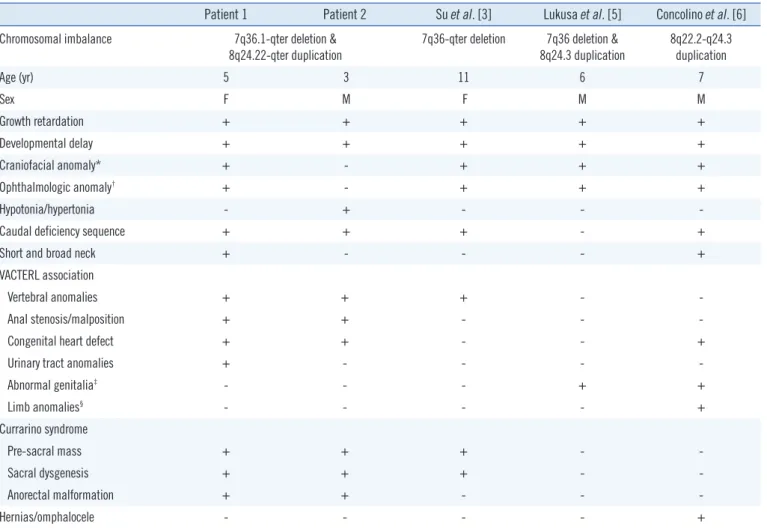
Small eyes with poor fixation, ptosis, chorioretinal atrophy, and coloboma were accompanied by a duplicated kidney with hy- droureteronephrosis on the right side (Table 1). Patient 1 under- went a sigmoid colostomy on day 5 and Pena operation at 4 months for an imperforate anus. The lipomyelomeningocele was repaired at 2 months of age, followed by the resection of a newly developing pre-sacral cystic mass at 19 months. This was con- firmed as mature teratoma by biopsy. Her growth was delayed at the age of three years. The Bayley Scales of Infant Develop- ment (BSID) (II) at 2 yr of age showed mental and motor devel- opmental ages of 6-7 months and 7 months, respectively.
Three years later, the mother became pregnant and under- went cordocentesis at 19.6 weeks because of the genetic ab- normality in the previous child. She gave birth to a boy (patient 2) with a gestational age of 38 weeks and 5 days by vaginal de- livery. The head circumference, weight, and height at birth were 34 cm (50-75th percentile), 2,635g (10-25th percentile), and 44 cm (<3rd percentile), respectively. Pertinent abnormalities included an atrial septal defect, pelvic mass, sacral dysgenesis, stenosis of the rectum and sigmoid colon, and a tethered cord (Table 1, Fig. 1C, D). Patient 2 underwent removal of the sacral mass, confirmed as mature teratoma by biopsy, and lipomyelo-
Received: October 9, 2014 Revision received: January 9, 2015 Accepted: June 9, 2015
Corresponding author: Ellen Ai-Rhan Kim
Department of Pediatrics, Division of Neonatology, Asan Medical Center Children’s Hospital, University of Ulsan College of Medicine,
88 Olympic-ro 43-gil, Songpa-gu, Seoul 138-736, Korea Tel: +82-2-3010-3382, Fax: +82-2-3010-6978 E-mail: [email protected]
© The Korean Society for Laboratory Medicine.
This is an Open Access article distributed under the terms of the Creative Commons Attribution Non-Commercial License (http://creativecommons.org/licenses/by-nc/3.0) which permits unrestricted non-commercial use, distribution, and reproduction in any medium, provided the original work is properly cited.
Kwun Y, et al.
7q Deletion/8q duplication in Korean siblings
558 www.annlabmed.org http://dx.doi.org/10.3343/alm.2015.35.5.557 Fig. 1. Radiologic findings and genetic studies. (A, B) Magnetic resonance imaging (MRI) showing lipomyelomeningocele in patient 1; (C, D) MRI findings showing a pre-sacral mass in patient 2; (E, F) Array-comparative genomic hybridization analysis of patient 1 revealing (E) deletion of 7q36.1q36.3 and (F) gain of 8q24.22q24.3. (G, H) FISH. The BAC clone RP11-354K9 on 7q36.3 was labeled by SpectrumRed (Abbott Molecular, Abbot Park, IL, USA) and RP11-91F24 on 8q24.3 by SpectrumGreen (Abbott Molecular). The solid triangle and arrow indicate normal 7 and der(7)t(7;8), respectively. The hollow triangle and arrowhead indicate normal 8 and der(8)t(7;8), respectively. (G) FISH and karyogram of chromosome 7 and 8 for patient 1 showing der(7)t(7;8); (H) FISH and karyogram of chromosome 7 and 8 for the mother with t(7;8)(q36.1;q24.22).
Abbreviation: Mb, megabase.
A B C D
E
G
F
H
2.5 2.0 1.5 1.0 0.5 0 -0.5 -1.0 -1.5 -2.0 -2.5
2.5 2.0 1.5 1.0 0.5 0 -0.5 -1.0 -1.5 -2.0 -2.5 25 Mb
0 50 Mb 75 Mb 100 Mb 125 Mb 150 Mb 0 25 Mb 50 Mb 75 Mb 100 Mb 125 Mb
Kwun Y, et al.
7q Deletion/8q duplication in Korean siblings
http://dx.doi.org/10.3343/alm.2015.35.5.557 www.annlabmed.org 559
meningocele repair at 13 months of age. His growth was de- layed at the age of 3 yr. BSID (II) at 2 yr showed a mental and motor developmental age of 6 months.
Patient 1’s karyotype exhibited an apparently normal 46, XX.
However, array-comparative genomic hybridization (CGH) using a high-resolution NimbleGen CGH 135K array (Roche Nimble- Gen, Madison, WI, USA) showed a 9.7-Mb terminal 7q deletion and a 12.0-Mb terminal 8q gain (Fig. 1E, F). FISH studies using the BAC clone RP11-354K9 on 7q36.3, and RP11-91F24 on 8q24.3, showed der(7)t(7;8)(q36.1;q24.22) in patient 1 (Fig.
1G), and a balanced translocation, t(7;8)(q36.1;q24.22) in the
mother (Fig. 1H). This resulted in cytogenetic nomenclature of 46,XX,der(7)t(7;8)(q36.1;q24.22)mat.ish der(7)t(7;8)(RP11- 354K9-,RP11-91F24+).arr[hg19]7q36.1q36.3 (149,479,066- 159,128,663)×1, 8q24.22q24.3(134,220,817-146,304,022) ×3 in patient 1. Patient 2 showed identical abnormal FISH results.
In our patients, the deleted region, 7q36.1-qter, contained 11 morbid OMIM genes (KCNH2, NOS3, ASB10, PRKAG2, DPP6, PAXIP1, SHH, LMBR1, MNX1, DNAJB6, WDR60). The dupli- cated region, 8q24.22-qter, contained 5 morbid OMIM genes (NDRG1, ZFAT1, KCNK9, TRAPPC9, PLEC1). The large changes in copy number encompassing many functional genes may
Table 1. Clinical features of 7q-ter deletion and/or 8q-ter duplication
Patient 1 Patient 2 Su et al. [3] Lukusa et al. [5] Concolino et al. [6]
Chromosomal imbalance 7q36.1-qter deletion &
8q24.22-qter duplication
7q36-qter deletion 7q36 deletion &
8q24.3 duplication
8q22.2-q24.3 duplication
Age (yr) 5 3 11 6 7
Sex F M F M M
Growth retardation + + + + +
Developmental delay + + + + +
Craniofacial anomaly* + - + + +
Ophthalmologic anomaly† + - + + +
Hypotonia/hypertonia - + - - -
Caudal deficiency sequence + + + - +
Short and broad neck + - - - +
VACTERL association
Vertebral anomalies + + + - -
Anal stenosis/malposition + + - - -
Congenital heart defect + + - - +
Urinary tract anomalies + - - - -
Abnormal genitalia‡ - - - + +
Limb anomalies§ - - - - +
Currarino syndrome
Pre-sacral mass + + + - -
Sacral dysgenesis + + + - -
Anorectal malformation + + - - -
Hernias/omphalocele - - - - +
*Microcephaly, holoprosencephaly, under-developed small mandible, abnormally shaped ears (low set, too large, hypoplastic, rounded, curled, over-folded, or abnormally rotated), hearing impairment, triangular facial appearance, prominent forehead, cleft lip/palate, micro/retrognathia. Abnormal shape of the nose (small flat nose, depressed nasal bridge, bulbous nasal tip, single nostril, choanal narrowing), single central incisor, and abnormal mouth (small, large, thick lower lip); †Optic nerve atrophy, microphthalmia, colobomata, microcornea, anophthalmia, degeneration of the papillae, mottled retina, iris atrophy, cataract, esotropia, nystagmus, hypermetropia, deeply set eyes, or exophthalmia. Abnormalities of the palpebral fissures (blepharoptosis/phimosis, ptosis, epicanthus, or obliquity), and hypertelorism/hypotelorism; ‡Males (micropenis, cryptorchidism, hypospadias, chordae, bifid preputium or scrotum, and small scrotum); fe- males (absence of labia majora and minora, prominent labia, and uterus trilocularis septum with vagina septa); §Abnormal palm or sole creases, overriding toes, syn/brachydactyly, oligodactyly, brachymetaphalangy, clinodactyly, thumb malposition, adactyly, radioulnarsynostosis, hypoplastic nails, and equinovarus deformity.
Abbreviations: F, female; M, male; VACTERL; vertebral defects, anal atresia, cardiac defects, tracheoesophageal fistula, renal anomalies, and limb abnormalities.
Kwun Y, et al.
7q Deletion/8q duplication in Korean siblings
560 www.annlabmed.org http://dx.doi.org/10.3343/alm.2015.35.5.557 have contributed to the phenotypic variability by changing the
expression of dosage-sensitive genes, modifying gene regula- tion, exposing recessive alleles, and other mechanisms [2].
Both patients had phenotypic expressions of VACTERL (verte- bral defects, anal atresia, cardiac defects, tracheoesophageal fistula, renal anomalies, and limb abnormalities) association and the Currarino syndrome showing subtle differences in severity (Table 1). These are associated with mutations in motor neuron and pancreas homeobox1 (MNX1) [3]. The pre-sacral mass (Fig. 1C, D) and sacral dysgenesis are suggestive of a ventral midline defect involving SHH and HLXB9 deletion [3]. In our patients, the atrial septal defect may be caused by 8q24.22-qter duplication near the critical region for cardiac septum formation [4]. The limb anomalies, abnormal genitalia, and hernia/ompha- locele, known features of 7q36-qter deletion [5], or 8q22.2- q24.2 duplication [6], were not observed (Table 1).
There were several remarks to point out on the different phe- notypes between the two siblings. PAXIP1 deletion may affect PAX2 function, contributing to coloboma and the renal anomaly seen in patient 1 [7]. The chromosomal deletion involving SHH with low penetrant variations may have caused the different oc- ular phenotypes in our two siblings [8]. Copy number variations (deletion or duplication) involving the imprinted domains in the vicinity of another imprinted gene, PEG1/MEST on 7q31-34 may restrict the placental growth [9] and contribute to the intra- uterine growth restriction seen in patient 1. The epigenetic or genetic interactions along the locus between 7q-ter deletion and 8q-ter duplication may have caused changes in the regulation of imprinting domains. Collectively, the clinical significance may be involved with silenced imprinting domain caused by 7q36.1- q36.3 deletion involving PAXIP1 related PAX2 function and MNX1 [3, 5, 7, 9], with unbalanced duplications of 8q24.3 in- cluding KCNK9 [10].
This case adds to the literature that deletion at 7q36.1-qter,
and duplication at 8q24.22-qter, may result in variable pheno- types from the same changes in copy number.
Authors’ Disclosures of Potential Conflicts of Interest
No potential conflicts of interest relevant to this article were re- ported.
REFERENCES
1. Weischenfeldt J, Symmons O, Spitz F, Korbel JO. Phenotypic impact of genomic structural variation: insights from and for human disease. Nat Rev Genet 2013;14:125-38.
2. Xu Y, Zhang L, Shi T, Zhou Y, Cai H, Lan X, et al. Copy number varia- tions of MICAL-L2 shaping gene expression contribute to different phe- notypes of cattle. Mamm Genome 2013;24:508-16.
3. Su PH, Chen JY, Chen SJ, Tsao TF, Lai YJ. Sacral dysgenesis associated with terminal deletion of chromosome 7 (q36-qter). Pediatr Neonatol 2008;49:189-92.
4. Ergun MA, Balci S, Konaç E, Kan D, Menevse S, Bartsch O. Trisomy of 8q22.3 approximately q23-qter following an unbalanced 1;8 transloca- tion in a boy with multiple anomalies. Turk J Pediatr 2004;46:384-7.
5. Lukusa T, Vermeesch JR, Fryns JP. De novo deletion 7q36 resulting from a distal 7q/8q translocation: phenotypic expression and compari- son to the literature. Genet Couns 2005;16:1-15.
6. Concolino D, Iembo MA, Moricca MT, Rapsomaniki M, Marotta R, Galesi O, et al. A de novo 8q22.2-24.3 duplication in a patient with mild phe- notype. Eur J Med Genet 2012;55:67-70.
7. Patel SR, Ranghini E, Dressler GR. Mechanisms of gene activation and repression by Pax proteins in the developing kidney. Pediatr Nephrol 2014;29:589-95.
8. Bakrania P, Ugur Iseri SA, Wyatt AW, Bunyan DJ, Lam WW, Salt A, et al.
Sonic hedgehog mutations are an uncommon cause of developmental eye anomalies. Am J Med Genet Part A 2010;152A:1310-3.
9. Frost JM and Moore GE. The importance of imprinting in the human placenta. PLoS Genet 2010;6:e1001015.
10. Barel O, Shalev SA, Ofir R, Cohen A, Zlotogora J, Shorer Z, et al. Mater- nally inherited Birk Barel mental retardation dysmorphism syndrome caused by a mutation in the genomically imprinted potassium channel KCNK9. Am J Hum Genet 2008;83:193-9.