• 검색 결과가 없습니다.

Atrial Septal Defect Closure: Comparison of Vertical Axillary Minithoracotomy and Median Sternotomy

N/A
N/A
Protected

Academic year: 2021

Share "Atrial Septal Defect Closure: Comparison of Vertical Axillary Minithoracotomy and Median Sternotomy"

Copied!
6
0
0

로드 중.... (전체 텍스트 보기)

전체 글

(1)

http://dx.doi.org/10.5090/kjtcs.2013.46.5.340 ISSN: 2233-601X (Print) ISSN: 2093-6516 (Online)

1

Department of Cardiolovascular Surgery, Taksim Germany Hospital,

2

Department of Cardiology, Adana State Hospital,

3

Department of Anestesia, Taksim German Hospital,

4

Department of Cardiovascular Surgery, Adana Public Hospital

Received: December 3, 2012, Revised: January 26, 2013, Accepted: March 29, 2013

Corresponding author: Şerafettin Demir, Department of Cardiology, Adana State Hospital, 01270, Adana, Turkey (Tel) 90-533-627-1991 (Fax) 90-533-627-1991 (E-mail) [email protected]

C

The Korean Society for Thoracic and Cardiovascular Surgery. 2013. All right reserved.

CC

This is an open access article distributed under the terms of the Creative Commons Attribution Non-Commercial License (http://creative- commons.org/licenses/by-nc/3.0) which permits unrestricted non-commercial use, distribution, and reproduction in any medium, provided the original work is properly cited.

Atrial Septal Defect Closure: Comparison of Vertical Axillary Minithoracotomy and Median Sternotomy

Huseyin Hakan Poyrazoglu, M.D. 1 , Mustafa Kemal Avsar, M.D. 1 , Şerafettin Demir, M.D. 2 , Zeynep Karakaya, M.D. 2 , Tayfun Güler, M.D. 3 , Funda Tor, M.D. 4

Background: This study aims to evaluate whether or not the method of right vertical axillary minithoracotomy (RVAM) is preferable to and as reliable as conventional sternotomy surgery, and also assesses its cosmetic results. Methods: Thirty-three patients (7 males, 26 females) with atrial septal defect were admitted to the Cardiovascular Surgery Clinic of Cukurova University from December 2005 until January 2010. The patients’ ages ranged from 3 to 22. Patients who underwent vertical axillary minithracotomy were assigned to group I, and those undergoing conventional sternotomy, to group II. Group I and group II were compared with regard to the pre- operative, perioperative and postoperative variables. Group I included 12 females and 4 males with an average age of 16.5±9.7. Group II comprised 14 female and 3 male patients with an average age of 18.5±9.8 showing similar features and pathologies. The cases were in Class I–II according to the New York Heart Association (NYHA) Classification, and patients with other cardiac and systemic problems were not included in the study. The ratio of the systemic blood flow to the pulmonary blood flow (Qp/Qs) was 1.8±0.2. The average pulmonary artery pressure was 35±10 mmHg. Following the diagnosis, performing elective surgery was planned. Results: No sig- nificant difference was detected in the average time of the patients’ extraportal circulation, cross-clamp and surgery (p>0.05). In the early postoperative period of the cases, the duration of mechanical ventilator support, the drain- age volume in the first 24 hours, and the hospitalization time in the intensive care unit were similar (p>0.05).

Postoperative pains were evaluated together with narcotic analgesics taken intravenously or orally. While 7 cases (43.7%) in group I needed postoperative analgesics, 12 cases (70.6%) in group II needed them. No mortality or major morbidity has occurred in the patients. The incision style and sizes in all of the patients undergoing RVAM were preserved as they were at the beginning. Furthermore, the patients of group I were mobilized more quickly than the patients of group II. The patients of group I were quite pleased with the psychological and cosmetic results. No residual defects have been found in the early postoperative period and after the end of the follow-up periods. All of the patients achieved functional capacity per NYHA. No deformation of breast growth has been de- tected during 18 months of follow-up for the group I patients, who underwent RVAM. Conclusion: To conclude, the repair of atrial septal defect by RVAM, apart from the limited working zone for the surgeon in these patholo- gies as compared to sternotomymay be considered in terms of the outcomes, and early and late complications.

And this has accounted for less need of analgesics and better cosmetic results in recent years.

Key words: 1. Minithoracotomy 2. Sternotomy

3. Atrial heart septal defects

(2)

Table 1. Demographic features of the patients undergoing surgery for atrial septal defect

Average age Female/male Group I

Group II

16.5±9.7 18.5±9.8

12/4 14/3 INTRODUCTION

Atrial septal defect (ASD) closure presents a normal life expectancy and quality of life to children and young adults [1]. Median sternotomy is the surgery technique applied in the treatment of congenital lesions. However, this method causes trouble due to poor cosmetic results and sternot- omy-related complications. Minimally invasive interventions have been preferred in recent years [2-6] in children and young adults, particularly females. In the postoperative period of minimally invasive interventions, less pain is observed and the hospitalization period is shorter [3,7]. The purpose of our study is to evaluate whether or not the right vertical axillary minithoracotomy (RVAM) technique is preferable to conven- tional sternotomy surgery in 33 patients who presented to our institution with secundum ASD. We also evaluated the con- sistency of results and the quality of cosmetic outcomes.

METHODS

Thirty-three patients (7 males, 26 females) with ASD were admitted to the Cardiovascular Surgery Clinic of Cukurova University from December 2005 until January 2010. The pa- tients’ ages ranged from 3 to 22. Surgery was performed with vertical axillary minithracotomy for the patients in group I and it was performed with conventional sternotomy for those in group II. Undergoing differentoperations with different ap- proaches, the group I and group II patients were compared with regard to preoperative, peroperative, and postoperative variables. Group I included 12 females and 4 males with an average age of 16.5±9.7. Group II comprised 14 female and 3 male patients at an average age of 18.5±9.8 showing sim- ilar features and pathologies. The cases were in Class I–II ac- cording to the New York Heart Association (NYHA) Classification and patients with other cardiac and systemic problems were not included in the study. The ratio of the systemic blood flow to the pulmonary blood flow was (Qp/Qs) 1.8±0.2. The average rate of pulmonary artery pres- sure was 35±10 mmHg. Following the diagnosis, surgey was planned under elective conditions. All of the patients and their relatives were informed about the probability of median sternotomy as needed during the operation, and they signed

their consent prior to the surgery. All of the patients of both of groups were prepared for the surgery with the same anaes- thetic evaluation and application (such as electrocardiography and monitoring of arterial blood pressure, monitoring of the left and right cardiac cavities’ pressures with a Swan-Ganze catheter, and urinary follow-up with a Foley catheter). Factors such as age, gender, and the presence of other diseases not only constituted the preoperative variables (Table 1) but also affected the decision of the surgeon about whether or not to apply a minimally invasive intervention through a limited incision. In selecting the patients, the hematologic values, the presence of other diseases, and the eligibility of the physical structure for an easy RVAM application were concerned.

Patients with the Fossa ovalis type of ASD were included in group I. Within our study, the patients of the group I under- went the surgery via RVAM and direct aortic canulation while the group II patients underwent surgery by conventional sternotomy. Extracorporeal circulation (ECC) was started once activated clotting time exceeded 400 seconds after the canula- tion for all the patients. Arterial canulation through the as- cending aorta, bicaval venous canulation, and right upper pul- monary vein canulation were applied to all of the patients.

Aortic arterial canulation, bicaval venous canulation, and right upper pulmonary vein canulation were performed with stand- ard manipulations through the limited minithoracotomy.

Except for the thoracic retractor for RVAM, the same materi- als were used in the ECC and surgery for all of the cases.

For the myocardial protection of the patients of both groups,

systemic mild hypothermia at 32

o

C, cold blood cardioplegia,

and outer cold saline administration were applied. After more

or less equalizing all of the preoperative parameters, the pa-

tients of both groups had surgery through the sternal incision

or minithoracotomy with suitable surgery techniques for their

existing cardiac lesions. A limited length RVAM (range, 8 to

15 cm) was applied in group I and median sternotomy in-

(3)

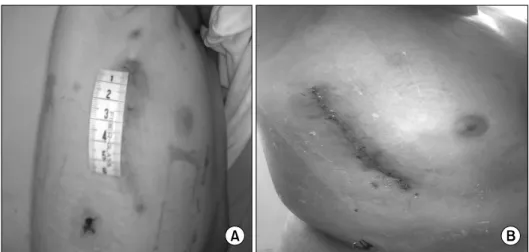
Fig. 1. (A, B) The postoperative im- age of a patient undergoing the right vertical axillary minithoracotomy.

Table 2. Features of the patients undergoing surgery for ASD

Variable Value

ASD type Fossa ovalis Posterior inferior Sinus venosus Qp/Qs

Average PAP (mmHg) Surgeric repair Direct closure Patched closure

11 14 8 1.8±0.2

35±10

10 23

Qp/Qs: the ratio of the systemic blood flow to the pulmonary blood flow.

ASD, atrial septal defect; PAP, pulmonary artery pressure.

cisions were used for all of the patients of group II. The RVAM incision was placed at the fourth or fifth intercostal spaces (Fig. 1). In both of the groups, standard canulation methods were applied for the ECC. Within this study, ECC time, cross clamp (CC) time and duration of surgery were considered the perioperative variables (Table 2). The post- operative variables were the mechanical ventilation times, hospitalization time in the intensive care unit (ICU), overall hospitalization time, mediastinal drainage volume in the first 24 hours, and volumes of transfused blood and blood prod- ucts (Table 3). The ECC time, CC time, duration of surgery, and mechanical ventilation time were measured in minutes, the postoperative ICU hospitalization time was measured in hours, the inpatient time was measured in days, the media- stinal drainage volume in mL/m

2

/day (in the first 24 hours),

and volume of transfused blood and blood products in mL/m

2

. In the statistical analysis, for the comparison of varia- bles complying with the normal distribution, the Student t-test and chi-square test were applied, and to compare variables without a normal distribution, the Mann-Whitney U and Fisher’s exact tests were used. Values± were given as the average standard error. Values with p<0.05 were accepted as statistically significant.

RESULTS

In comparing the average duration of the patients’ ECC, their CC of time, and the duration of the surgery (p>0.05), no significant difference was detected between the two groups. In the early postoperative period of the cases, the du- ration of mechanical ventilator support, the drainage amount in the first 24 hours, and the hospitalization time in the in- tensive care unit were similar in the two groups (p>0.05).

The dosages of analgesics used were determined according to the need of the patients. Postoperative pain was evaluated to- gether with narcotic analgesics taken intravenously or orally.

While 7 cases (43.7%) in group I needed postoperative an-

algesics, 12 cases (70.6%) in group II needed them. The first

24 hours of postoperative follow-up of the cases is shown in

Table 2. No mortality or major morbidity was found in the

patients. The incision style and sizes in all of the patients un-

dergoing RVAM were preserved as they were at the

beginning. No residual defects were found in the early post-

operative period and at the end of the follow-up period. All

(4)

Table 3. Peroperative and postoperative variables

Mean CC time (min)

Mean CPB time (min)

Mean operation time (min)

Mean ICU time (hr)

Mean hospitalization duration (day)

Mean mechanical

ventilation time (min)

Mean drainage in first 24 hours (mcc/m

2

)

Mean transfusion of blood and blood products

(mL/m

2

)

Analgesia requirment

(%)

Group I Group II p-value

11.3±1.3 10.8±1.2

NS

17.3±2.8 16.9±2.6

NS

168±17.5 150±12.8 0.078

23±2.5 24±3.2 NS

5.4±1.4 7.7±1.8 NS

135±49 144±15.3

NS

135±49 143±31 NS

189±52 177±72 NS

43.7 70.6

<0.05 CC, cross clamp; CPB, cardiopulmonary bypass; ICU, intensive care unit; NS, non-spesific.

of the patients achieved a functional capacity as per NYHA.

No deformation of breast growth was detected at 18 months’

follow-up for the group I patients, who underwent RVAM.

DISCUSSION

Median sternotomy has been the gold standard in the repair of congential cardiac defects since Gibon closed an ostium secundum type ASD in 1953 [8]. However, the use of mini- mally invasive operations in the treatment of children and non-complicated young adults has been growing, and this technique has become the preferred method for the pediatric population and young adults.

In terms of cosmetic results, RVAM is superior to median sternotomy and right posterolateral thoracotomy [9]. In the re- pair of small cardiac congenital defects like ASD, drawbacks of median sternotomy is include the length of the incision in the median sternotomy, postoperative pain, non-ideal cosmetic results, and possible complications of the sternotomy (medias- tinitis, osteomyelitis, etc.) [10]. The major advantage of mini- mally invasive cardiac surgery is avoiding sternotomy. Lan- caster et al. [11] repoted that the surgical scar was larger than the patient or surgeon expected in 58% of median ster- notomy patients who were following at 1 and 5 months postoperatively. Experience with minimally invasive thoracic and cardiac surgery has shown that the surgical method has more reliable outcomes, minimizes surgical complications, provides rapid and functional healing, shortens the hospital- ization time, and accordingly reduces the cost. Within these series, morbidity and mortality have not been observed.

Outcomes have been almost perfect [11].

Most surgeons have preferred anterolateral thoracotomy in the closure of ASD [12]. The advantage of this approach is

the field of vision. Its disadvantage is the dissection of large muscle zones and soft tissues, and accordingly, it may cause the deformation of muscles, decrease in the sensitivity of papilla, poor development of the breast and pectoral muscles and cosmetic problems [13].

There are certain advantages and disadvantages of the use

of RVAM as the incision for a minimally invasive approach

as compared to the application of ministernotomy or sub-

xiphoid approaches within our study. Either the minister-

notomy or subxiphoid approach provides direct access to the

heart from front, which is the angle from which surgeons

most often approach the heart. RVAM approaches the heart

from a different point of view, and all of the anatomic struc-

tures in the mediastinum are perceived in a different

orientation. However, the difference in orientation can be

coped with after having only a bit of experience. As com-

pared to the incisions that allow for front access to the me-

diastinum, one of the other advantages is the lower possibility

of adhesion between the reverse side of the sternum and me-

diastinal structures in subsequent mediastinal surgeries. ECC

times and CC times showed no detectable differences be-

tween the two groups that we included in our study because

the same techniques were applied in the repair of existing

pathology except for location of the incision. Because of the

fact that these cardiac defects were applied with minitho-

racotomy from a restricted space, surgery may last longer in

the minithoractomy [14]. The study by Liu et al. [14] has

demonstrated that the duration of surgery of the patients

whose ASD is closed with minithoracotomy is longer, but

their hospitalization time is shorter. Even though it was not a

statistically significant difference in the minithoracotomy cas-

es when we compared with conventional sternotomy, the du-

ration of surgery was found to be longer time and no need

(5)

arose for additional interventions. Similarly, in comparing the two operation types, no difference in the intensive care unit hospitalization time, drainage volume, or blood transfusion volume was detected. If and when the appropriate intercostal space is used during the RVAM (typically intercostal space 4 or 5), the access to the aorta and the canulation of the aorta is easily ensured. In case a higher or lower intercostal space were needed, the angle of vision can be enlarged by separat- ing the rib in the middle from the costacondral joint. The canulation of the aorta from the minithoracotomy incision can prevent the need for another incision and additional complica- tions that may stem from the femoral artery. By applying aorta-bicaval canulation, we have avoided femoral artery and vein canulation in such cases. This has not caused any re- strictions in the working field or visual field. Mishra et al.

[15] reported that, in their experience, this method provides maximum security and requires less drainage,a lower trans- fusion volume, and less re-exploration and stated that it short- ens the intensive care unit stay and offers early recovery as well. In case of before having a thoracic surgery operation, in which the right hemithorax adhesion has developed, the ac- cess to the mediastinum and the cannulation from this point through mini thoracotomy are quite challenging. Therefore, in selecting the cases, patients should be examined thoroughly for these anatomic changes and a plan for surgery should be arranged in accordance with these changes.

One of the most feared and serious complications in con- ventional median sternotomy is an infection of the sternum.

A particularly deep sternum infection produces mediastinitis, which causes a high rate of morbidity and mortality [16]. On the other hand, in a minimally invasive intervention, the in- cidence of postoperative mediastinitis is quite low and scar site pain is minimized. No incisional or pleural infections were found in the patients undergoing sternotomy or thor- acotomy in our study. In spite of the fact that greater pleural pain is expected with thoracotomy, Salzer et al. [17] noted that post-thoracotomy costal fractures do not cause the de- formation of costovertebral joints or the exacerbation of chest drainage. In our study, resection and division of the rib were not needed. Due to the small incision, 1-2 pericostal sutures have been adequate to stabilize the thoracic wall. In the 70.6% of the cases with a RVAM, analgesics were not need-

ed, and as compared to sternotomy cases, the use of an- algesics was significantly lower (p<0.05). Because we pre- served the latissimus dorsi and serratus anterior muscles, our patients did not experience any pain or limitation in arm movement. Furthermore, the thoracotomy patients did not face any restrictions in their position when lying down or in their daily activites (such as riding in a car or lifting a weight). In comparison with right posterolateral thoracotomy, Baeza and Foster [18], who applied the right vertical axillary thor- acotomy for the first time, have revealed that this technique has functional and cosmetic advantages.

To conclude, repair of ASD with RVAM technique, apart from the limited working zone for the surgeon as compared to sternotomy, has a number of advantages including the reli- ability of surgical outcomes, similar early and late complica- tions, less need for analgesics, and better cosmetic results years later. Additionally, when thinking an early recovery and avoiding sternum immobilization and sternum infections, we are of the opinion that RVAM is a reliable alternative to sternotomy.

CONFLICT OF INTEREST

No potential conflict of interest relevant to this article was reported.

REFERENCES

1. Park PW, Roh JR, Kim CW, Suh KP, Lee Y. Secundum type atrial septal defect. Korean J Thorac Cardiovasc Surg 1981;14:241-6.

2. Burke RP. Minimally invasive techniques for congenital heart surgery. Semin Thorac Cardiovasc Surg 1997;9:337-44.

3. Massetti M, Babatasi G, Rossi A, et al. Operation for atrial septal defect through a right anterolateral thoracotalomy:

current outcome. Ann Thorac Surg 1996;62:1100-3.

4. Rosengart TK, Stark JF. Repair of atrial septal defect throu- gh a right thoracotomy. Ann Thorac Surg 1993;55:1138-40.

5. Cremer JT, Boning A, Anssar MB, et al. Different ap- proaches for minimally invasive closure of atrial septal defects. Ann Thorac Surg 1999;67:1648-52.

6. Black MD, Freedom RM. Minimally invasive repair of atrial septal defects. Ann Thorac Surg 1998;65:765-7.

7. Chang CH, Lin PJ, Chu JJ, et al. Surgical closure of atrial

septal defect: minimally invasive cardiac surgery or median

(6)

sternotomy? Surg Endosc 1998;12:820-4.

8. Abdel-Rahman U, Wimmer-Greinecker G, Matheis G, et al.

Correction of simple congenital heart defects in infants and children through a minithoracotomy. Ann Thorac Surg 2001;72:1645-9.

9. Yang X, Wang D, Wu Q. Repair of atrial septal defect through a minimal right vertical infra-axillary thoracotomy in a beating heart. Ann Thorac Surg 2001;71:2053-4.

10. Nicholson IA, Bichell DP, Bacha EA, del Nido PJ. Minimal sternotomy approach for congenital heart operations. Ann Thorac Surg 2001;71:469-72.

11. Lancaster LL, Mavroudis C, Rees AH, Slater AD, Ganzel BL, Gray LA Jr. Surgical approach to atrial septal defect in the female. Right thoracotomy versus sternotomy. Am Surg 1990;56:218-21.

12. Grinda JM, Folliguet TA, Dervanian P, Mace L, Legault B, Neveux JY. Right anterolateral thoracotomy for repair of at- rial septal defect. Ann Thorac Surg 1996;62:175-8.

13. Cherup LL, Siewers RD, Futrell JW. Breast and pectoral

muscle maldevelopment after anterolateral and posterolateral thoracotomies in children. Ann Thorac Surg 1986;41:492-7.

14. Liu YL, Zhang HJ, Sun HS, Li SJ, Su JW, Yu CT. Correc- tion of cardiac defects through a right thoracotomy in child- ren. J Thorac Cardiovasc Surg 1998;116:359-61.

15. Mishra YK, Malhotra R, Mehta Y, Sharma KK, Kasliwal RR, Trehan N. Minimally invasive mitral valve surgery thro- ugh right anterolateral minithoracotomy. Ann Thorac Surg 1999;68:1520-4.

16. Kluytmans JA, Mouton JW, Ijzerman EP, et al. Nasal car- riage of Staphylococcus aureus as a major risk factor for wound infections after cardiac surgery. J Infect Dis 1995;

171:216-9.

17. Salzer GM, Klingler P, Klingler A, Unger A. Pain treatment after thoracotomy: is it a special problem? Ann Thorac Surg 1997;63:1411-4.

18. Baeza OR, Foster ED. Vertical axillary thoracotomy: a func-

tional and cosmetically appealing incision. Ann Thorac Surg

1976;22:287-8.

수치

Table 1. Demographic features of the patients undergoing surgery  for atrial septal defect
Fig. 1. (A, B) The postoperative im- im-age of a patient undergoing the right  vertical axillary minithoracotomy.
Table 3. Peroperative and postoperative variables Mean  CC  time  (min) Mean  CPB time  (min) Mean  operation  time  (min) Mean  ICU time  (hr) Mean  hospitalization duration  (day) Mean  mechanical ventilation  time  (min) Mean  drainage in  first  24 hou

참조

관련 문서

Therefore, this study aims to identify the relations between gastroesophageal reflux disease and body mass index, and waist measurement as indexes of obesity.. For the

The purpose of this study is to analyze the situations of violating the right to learn and violence in student-athletes from an ethnographic view and

Therefore, this study aims to reveal the educational value of modern early childhood learners' emotional cultivation and to present a method of art

This study, made up of 6 chapters in all, aims to handle the details and problems of the spouse inheritance system under existing law, as well as to review the draft of

This study aims to identify whether socioeconomic level of parents affects obesity of adolescents and whether the relations between adolescent's obesity

This study aims to analyze the process and the features of corporate e-Learning as a form of informal learning. For this purpose, the concept of

This study aims to analyse the relations between stress and eating habits of adolescents as it was assumed that adolescents need lots of nutrients and eating habits

The purpose of this study is to present the background, necessity and purpose of the study in Chapter 1, and the second part of the theoretical study is related to the