• 검색 결과가 없습니다.

Copyright (C) 2003 NuriMedia Co., Ltd.

N/A
N/A
Protected

Academic year: 2021

Share "Copyright (C) 2003 NuriMedia Co., Ltd."

Copied!
8
0
0

로드 중.... (전체 텍스트 보기)

전체 글

(1)

CONTENTS

Ⅰ. INTRODUCTION

Ⅱ. MATERIALS AND METHODS

Ⅲ. RESULTS

Ⅳ. DISCUSSION

Ⅴ. CONCLUSIONS REFERENCES KOREAN ABSTRACT

Ⅰ. INTRODUCTION

Menstrual cyclicity is a major biological process for women during their reproductive years, which is associated with significant changes in hormonal status and behavior. A number of authors have suggested that the menstrual cycle is a modulating factor in sensory response.

Phase-related fluctuation in experimentally- induced pain have been demonstrated in many studies. Procacci et al. 1) found low threshold values for radiant heat during the luteal phase with a subsequent steady rise which reached peak toward the end of menstruation. Using signal detection methods with radiant heat, Goolkasian 2,3) noted enhanced discriminability during the luteal phase

* 본 연구는 보건복지부 보건의료기술연구개발사업(관리번호 HMP-00-CH-11-0010)의 연구비 지원에 의해서 이루어졌음
but no phase differences in the willingness to report pain. Hapidou and de Catanzaro 4) , employing the cold pressor task, found a significantly lower pain threshold during the luteal as compared to the follicular phase.

However, using the aversion to electric-shock technique, Tedford et al. 5) obtained cyclical effects in the opposite direction from these investigators, with the maximum sensitivity during menstruation and lowest sensitivity in the luteal phase. Likewise, Giamberardino et al. 6) , who measured pain thresholds for electrocutaneous pulses applied to the skin at the abdomen and limbs, found that the highest threshold values always occurred during the luteal phase. And other authors reported no changes across the menstrual cycle 7-9) . Many investigators have examined changes in experimentally-induced pain across the menstrual cycle, however, the pattern of results still varies considerably across studies.

As with the studies of pain, those of taste didn't show consistent results as to the menstrual changes in taste function. Some studies have reported on cyclic variations of taste sensitivity. Schiffman 10) reported that olfactory and taste threshold vary over the menstrual cycle, with increased acuity at

Pain Threshold & Taste Threshold Variations across the Menstrual Cycle

Young-Hee Byun, D.D.S.,M.S.D., Sun-Ju Koo, D.D.S.,M.S.D., Jae-Kap Choi, D.D.S.,M.S.D.,Ph.D.

Department of Oral Medicine, School of Dentistry, Kyungpook National University Taegu, Korea

(2)

midcycle. Than et al. 11) found that the sensitivity to sucrose increased during preovulation and decreased during postovulation in women. However, there are only a few studies which examined cyclic variations in taste sensitivity.

The present study was performed to investigate the variation of pain sensitivity and taste sensitivity across the menstrual cycle.

Ⅱ. MATERIALS AND METHODS 1. Subjects

Eleven healthy women (mean age : 23.2 years, range of age : 20 to 27 years) participated in this study. Subjects were recruited from the dental students at Kyungpook National University and the students in the dental hygienist course at Taegu Health College. All subjects had normal and regular menstrual cycles (from 28 to 30 days) and none of the subjects reported a facial pain problem, chronic headaches, or other painful conditions of the head.

All women, as part of a health and demographic information questionnaire, reported the date of her most recent menses and the length of her cycle.

Date of the most recent menses was used to schedule the experimental sessions. Each subject participated in three experimental sessions, one during the menstrual phase, one during the follicular phase, and one during luteal phase. Menstrual phase included a period of 1-7 days following the onset of menstruation. Follicular phase included a period of 8-14 days and luteal phase included a period of 15-21 days following the onset of menstruation. The experimental sessions were repeated for two successive menstrual cycles.

All subjects were asked to abstain from any food for at least two hours prior to the experimental sessions. And they were asked to refrain from using any analgesic drugs while they were being tested.

2. Apparatus

During each of the experimental sessions, data

were collected from each subject using the following apparatus and materials.

1) Algometer (Electronic Algometer Type I, Somedic Production, Stockholm, Sweden) The apparatus consists of a metal plunger with a rubber tip 1 cm in diameter attached to a pressure-sensitive strain gauge situated at the tip, which is connected to a power supply. Pressure was applied to the right anterior temporalis muscle and constantly increased at a rate of 30 kPa/sec until the subject first feels pressure change to pain. The subjects were instructed to push the stop button at the moment she first felt pain. The individual pressure pain threshold was defined by the mean of two trials.

2) lectrogustometer (Electrogustometer Model EG- IIB, Nagashima Medical Instrument Co., Japan) The apparatus applies constant current circuit between two electrodes. It allows gradual change of the current from 3 μA to 320 μA(from -8dB to 32dB). The electrodes comprise a negative electrode (diameter 2cm, length 10cm, pipe-shaped) applied to the subject's hand and a positive electrode which is a stainless steel rod with a flat circular area about 0.5 cm diameter for making contact with the tongue.

The examination was performed by placing the positive electrode on the tip of the tongue, first without the current, followed by a trial test to familiarize the subject with the taste sensation. The current intensity was reduced to -8dB and subsequently increased by 2 dB each time until there was a change in the taste evoked. The mean of two trials was used to determine the individual electrical taste threshold.

3) NaCl stimuli

Stimuli were a series of eight successive NaCl

solutions which differed by .25 log units of molar

concentration (Table 1). The molar equivalent

values for the strongest and weakest solution of the

series were as follows: 4.47×10 -2 M and 7.94×10 -4

M.

(3)

All solutions were prepared from reagent grade chemicals with double-distilled, deionized water, and used at room temperature. The subject was presented with one small cotton ball soaked in a taste solution on the front of the tongue and then rinsed with distilled water. The molar concentration was increased until the subject reported a first sensation. The mean of two trials was used to determine the individual NaCl taste threshold.

4) Experimental procedure

Before starting formal measurements for the study, subjects were given a training session to familiarize them with the procedure and instruct them in making judgements of thresholds. The subject was situated comfortably on an adjustable chair in a quiet room, with two experimenters present, one to watch the subject and apply the stimuli, the other to record measurement values. All subjects were informed that the assessments were not intended to be tests of endurance, that no suprathreshold stimuli were supposed to be given, and that they should therefore not try to bear any pain before reporting it. After a training session, formal measurements were carried out. On each experimental session, the pressure pain threshold, the electrical taste threshold and the NaCl taste threshold were sequentially obtained for each subject.

5) Statistical Analysis

Means and standard deviations of the thresholds for each stimuli were calculated for each of the three sessions. To establish statistical differences between the experimental sessions measured, repeated measures of analysis of variance (ANOVA) was utilized. The level of significance was assessed at p<0.05 for the statistical tests. When a statistical

difference was detected for the overall ANOVA (p<0.05), a post-hoc comparison test was performed to determine which paired comparisons were significant.

Ⅲ. RESULTS 1. Pressure Pain Threshold Changes

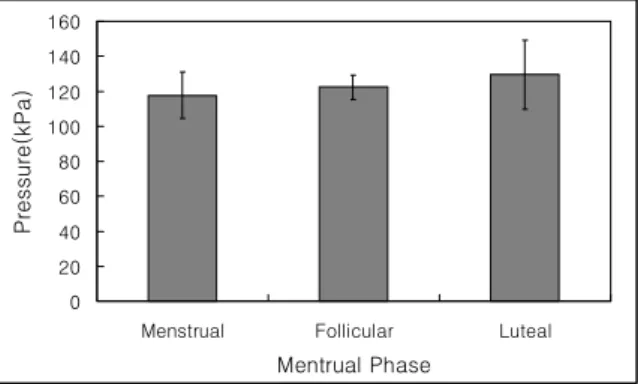
The repeated measures analysis of variance (ANOVA) for the pressure pain threshold yielded a significant phase effect, F(2,20)=4.50, p<0.05. As shown in Fig. 1, the mean(±SD) pressure pain threshold of right anterior temporalis muscle was 117.72(±13.24) kPa for the menstrual phase, 122.36 (±6.93) kPa for the follicular phase and 129.45(±

19.60) kPa for the luteal phase. A post-hoc comparison test showed a difference between menstrual and luteal phases.

2. Electrical Taste Threshold Changes

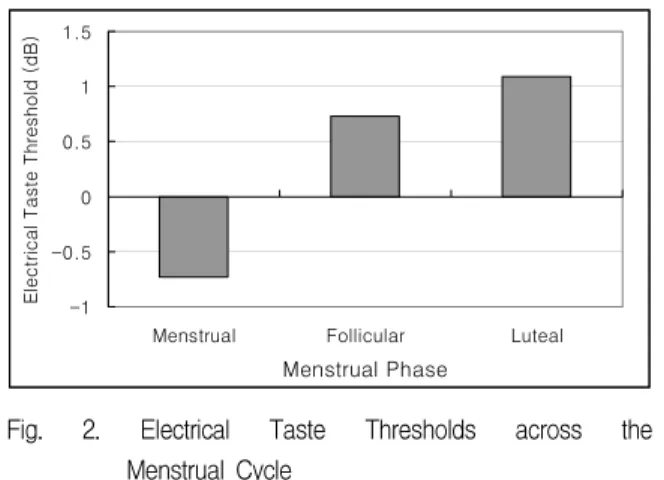
Menstrual variations of electrical taste thresholds occurred in this group of 11 women(F(2,20)=5.71, p<0.05). The mean electrical taste threshold on

Fig. 1. Pressure Pain Thresholds across the Menstrual Cycle.

0 20 40 60 80 100 120 140 160

Menstrual Follicular Luteal

Mentrual Phase

Pressure(kPa)

Table 1. Molar concentration of NaCl solutions used to measure taste threshold.

1 2 3 4 5 6 7 8

7.94×10

-4

1.41×10

-3

2.51×10

-3

4.47×10

-3

7.94×10

-3

1.41×10

-2

2.51×10

-2

4.47×10

-2

(4)

Fig. 2. Electrical Taste Thresholds across the Menstrual Cycle

-1 -0.5 0 0.5 1 1.5

Menstrual Follicular Luteal

Menstrual Phase

Elect rical Tast e Threshold (dB)

tongue tip was shown in Fig. 2. The mean(±SD) electrical taste threshold was -0.73(±1.01) dB for the menstrual phase, 0.73(±1.85) dB for the follicular phase and 1.09(±1.87) dB for the luteal phase. A post-hoc comparison test showed a difference between the menstrual and the luteal phases.

3. NaCl Taste Threshold Changes

As shown in Fig. 3, NaCl taste thresholds on tongue tip tended to higher in the follicular and luteal phases than in the menstrual phase. The mean(±SD) NaCl taste threshold on tongue tip was 2.41×10 -3 (±1.19×10 -3 ) M for the menstrual phase, 3.44×10 -3 (±3.64×10 -3 ) M for the follicular phase and 3.52×10 -3 (±1.90×10 -3 ) M for the luteal phase.

However, the difference was not significant(F(2,20)

=0.92, p=0.42).

Ⅳ. DISCUSSION

In this study, we found the phase difference for the pressure pain threshold and the electrical taste threshold: subjects had lower sensitivity during the luteal phase compared with the menstrual phase.

These findings, although the present study did not provide hormonal assays to correlate with threshold measurements, suggest that sex steroid hormone can modulate pain and taste. The lower sensitivity during the luteal phase may be due to some type of

Fig. 3. NaCl Taste Thresholds across the Menstrual Cycle

0 1 2 3 4

Menstrual Follicular Luteal

Mentrual Phase NaC l C o n c e n tr at io n (x 10

-3

M)

interaction between estrogen and progesterone.

Menstrual variations in sensitivity to noxious stimuli, as reviewed in the introduction, have been demonstrated in many studies 1-6) . Additionally, evidence from several animal studies suggests that gonadal hormones may influence responses to nociceptive stimuli. For example, Dawson-Basoa and Glintzler 17) reported that administration of 17β -estradiol and progesterone to mimic the hormonal milieu of pregnancy produced analgesia.

However, the data from this study do not elucidate the mechanisms responsible for changes in pain sensitivity across the menstrual cycle. The mechanism for analgesic effects of estrogen and progesterone has been suggested in several studies.

Trobouth et al. 18) suggested that the decreased biosynthesis of PGF2 alpha might be a basis for the ability of the progesterone system to diminish menstrual pain. Frye 19) suggested that progestins' modulation of pain might occur via GBR action.

Dawson-Basoa and Gintzler 20) reported that changes

in circulating 17 beta-estradiol and progesterone,

that occur as a natural consequence of gestation,

activated a dynorphin system in the lumbar spinal

cord. After 3 years, they demonstrated that estrogen

and progesterone activated spinal kappa-opiate

receptor analgesic mechanisms 21) . The results show

that the pattern of circulating sex steroids can be an

important determinant of the activity of central

opioid analgesic systems. On the other hand, Gordon

and Soliman 22) reported that estradiol or proge-

(5)

sterone induced the decrease in pain sensitivity, but it could not be explained by their effects on opioid receptors. The mechanism for analgesic effects of estrogen and progesterone requires further studies.

Some authors have also reported menstrual variations in sensitivity to taste and food intake. In Than's study 11) , the stable sucrose thresholds of the men suggests that ovarian hormones may be involved in the variation in sucrose thresholds of the women. Kemnitz et al. 23) demonstrated that intake of intact monkeys was lowest in the preovulatory stage of the cycle, when estrogen levels are elevated, and exogenous estradiol transiently suppressed food intake of ovariectomized monkeys in a dose-related manner. Progesterone treatment did not affect food intake when given alone, but it did attenuate the effect of estradiol when both hormones were given concurrently.

In general, estradiol is known to reduce food intake and progesterone is known to decrease the estradiol's effect. We consider that progesterone's increasing food intake may be a phenomenon attributed to the decreased taste sensitivity during the luteal phase, the findings that we found in this study.

One important aspect of these findings is that NaCl taste sensitivity did not change significantly as a function of menstrual cycle phase, although there were differences in electrical taste sensitivity.

Although null findings cannot be interpreted with the same confidence as significant findings, especially given the relatively small sample size, these data suggest that the menstrual cycle produced greater effects on electrical taste sensitivity compared with NaCl taste sensitivity.

This pattern of results is most likely related to differences in the nature of the two taste stimuli. In Alberti-fidanza's study 24) , sensitivity to sweet taste increased with an increase of estradiol, while sensitivity to bitter taste increased with an increase of progesterone. And there was no correlations between hormone levels and acid taste, and only a few correlations for salt taste were found. On the other hand, Mascarenhas et al. 25) reported that

estrogen and progesterone had a differential effect on the ingestion of the two concentrations of glucose, while progesterone markedly increased the intake of sodium chloride. The taste response is still various according to diverse taste stimuli and thus further studies are required.

The clinical relevance of the phase difference for the pressure pain threshold that we found is not clear. When we consider the fact that progesterone topically applied on the breast has been proposed and widely used in the relief of mastalgia and benign breast disease by numerous gynecologists and general practitioners, this result may be useful for our developing management of many menstrually- related pain disorders. And if our finding that pain sensitivity vary with menstrual cycle status is confirmed, clinicians assessing female patients should determine the phase of the menstrual cycle at the time of each examination and take hormonal modulation of pain factors into account when evaluating their symptom and sign.

Additionally, the findings that electrical taste threshold varied across the menstrual cycle may be useful for our understanding of the mechanisms involved in conditioned taste aversion learning as well as a wide array of hormone-dependent behavioral responses. Postmenopausal women often complain of oral discomfort including dryness, bad taste, burning sensation, and viscous saliva. This result may be useful for our developing management of menstrually-related taste disorders.

In summary, we found lower pressure pain sensitivity and lower electrical taste sensitivity during the luteal phase compared with the menstrual phase. The relatively small sample size represents a limitation of this study. Therefore, to examine generalizability of these findings and to elucidate the underlying mechanism and practical significance of these findings, further studies with larger samples are needed.

V. CONCLUSIONS

Menstrual variations of pressure pain threshold,

(6)

electrical taste threshold, and NaCl taste threshold were investigated for 11 healthy women, using Algometer, Electrogustometer, and NaCl solutions of sequential concentration. The pressure pain threshold and electrical taste threshold were increased during the luteal phase compared with those during the menstrual phase. However, there was no significant difference in NaCl taste threshold across the menstrual cycle.

REFERENCES

1. Procacci, P., Zoppi, M., Maresca, M. and Romano, S.:

Studies on the pain threshold in man. In: J.J. Bonica (Ed.), International Symposium on Pain, Advances in Neurology, New York, Raven Press, 1974, pp.

107-114.

2. Goolkasian, P.: Cyclic changes in pain perception: an ROC analysis. Percept. Psychophys., 27:499-504, 1980.

3. Goolkasian, P.: An ROC analysis of pain relations in dysmenorrheic and non-dysmenorrheic women.

Percept. Psychophys., 34:381-386, 1983.

4. Hapidou, E. G. and deCantanzaro, D.: Sensitivity to cold pressor pain in dysmenorrheic and non- dysmenorrheic women as a function of menstrual cycle phase. Pain, 34:277-283, 1988.

5. Tedford, W. H., Warren, D. D. and Flynn, W. E.:

Alteration of shock aversion thresholds during the menstrual cycle. Percept. Psychophys.. 21:193-196, 1977.

6. Giamberardino, M. A., Berkley, K. J., Iezzi, S., de Bigontina, P. and Vecchiet, L.: Pain threshold variations in somatic wall tissues as a function of menstrual cycle, segmental site and tissue depth in non-dysmenorrheic women, dysmenorrheic women and men. Pain, 71:187-197, 1997.

7. Veith, J. L., Anderson, J., Slade, S. A., Thompson, P., Laugel, G. R. and Getzlaf, S.: Plasma β-endorphin, pain thresholds and anxiety levels across the human menstrual cycle. Physio. Behav., 32:31-34, 1984.

8. Kuczmierczyk, A. R. and Adams, H. E.: Autonomic arousal and pain sensitivity in women with premenstrual syndrome at different phases of the menstrual cycle. J. Psychosom. Res., 30:421-428, 1986.

9. Amodei, N. and Nelson-Gray, R. O.: Reactions of dysmenorrheic and non-dysmenorrheic women to experimentally induced pain throughout the menstrual cycle. J. Behav. Med., 12:373-385, 1989.

10. Schiffman, S.: Changes in taste and smell with age:

psychophysical aspects. In: Ordy JM, Brizzee KR, eds. Sensory systems and communication in the elderly. New York, Raven Press, 1979, pp. 227-246.

11. Than, T. T., Delay, E. R., Maier, M. E.: Sucrose threshold variation during the menstrual cycle.

Physiol. Behav., 56:237-239, 1994.

12. Jensen, K., Andersen, H. O., Olesen, J. and Lindblom, U.: Pressure-pain threshold in human temporal region: Evaluation of a new pressure algometer. Pain, 25:313-323, 1986.

13. List, T., Helkimo, M. and Falk, G.: Reliability and validity of a pressure threshold meter (PTM) in recording tenderness in the masseter muscle and the anterior temporal muscle. J. Craniomand. Pract., 7:223-229, 1989.

14. Reid, K. I., Gracely, R. H. and Dubner, R. A.: The influence of time, facial side, and location on pressure-pain thresholds in chronic myogenous temporomandibular disorder. J. Orofacial Pain, 8:258-265, 1994.

15. Svensson, P., Arendt-Nielsen, L., Nielsen, H. and Larsen, J. K.: Effect of chronic and experimental jaw muscle on pain-thresholds and stimulus-response curves. J. Orofacial Pain, 9:347-356, 1995.

16. Kim, H. S., Chung, S. C., Kim, Y. K., and Lee, S. W.:

Pain pressure threshold in the head and neck region of episodic tension-type headache patients. J.

Orofacial Pain, 9:357-364, 1995.

17. Dawson Basoa, M. E. and Gintzler A. R.: 17-Beta- estradiol and progesterone modulate an intrinsic opioid analgesic system. Brain Res., 601:241-245, 1993.

18. Troubough, G., Guderian, A. M., Erickson, R. R., Tillson, S. A., Leong, P., Swisher, D. A. and Pharriss, B. B.: The effect of exogenous intrauterine progesterone on the amount and prostaglandin F2 alpha content of menstrual blood in dysmenorrheic women. J. Reprod. Med., 21:153-158, 1978.

19. Frye, C. A., Duncan, J. E.: Progesterone metabolites, effective at the GABA receptor complex, attenuate pain sensitivity in rats. Brain Res., 643:194-203, 1994.

20. Medina, V. M., Dawson-Basoa, M. E. and Gintzler, A.

R.: 17 beta-estradiol and progesterone positively modulate spinal cord dynorphin: relevance to the analgesia of pregnancy. Neuroendocrinology, 58:310- 315, 1993.

21. Dawson Basoa, M. E. and Gintzler A. R.: Estrogen and

progesterone activate spinal kappa-opiate receptor

(7)

analgesic mechanisms. Pain, 64:608-615, 1996.

22. Gordon, F. T. and Soliman, M. R.: The effects of estradiol and progesterone on pain sensitivity and brain opioid receptors in ovariectomized rats. Horm.

Behav., 30:244-250, 1996.

23. Kemnitz, J. W., Gibber, J. R., Lindsay, K. A. and Eisele, S. G.: Effects of ovarian hormones on eating behavior, body weight, and glucoregulation in rhesus monkeys. Horm. Behav. 23:235-250, 1989.

24. Alberti-fidanza, A., Fruttini, D. and Servili, M.:

Gustatory and food habit changes during the menstrual cycle. Int. J. Vitam. Nutr. Res., 68:149-153, 1998.

25. Mascarenhas, J. F., Borker, A. S. and Venkatesh, P.:

Differential role of ovarian hormones for taste preferences in rats. Indian J. Physiol. Pharmacol., 36:244-246, 1992.

Corresponding Author : Jae-Kap Choi, Professor,

Department of Oral Medicine, School of Dentistry,

Kyungpook National University 101, 2-Ga, Dongin-

Dong, Chung-Gu, Taegu 700-422, Korea

(8)

국문초록

월경주기에 따른 동통역치 및 미각역치의 변화

경북대학교 치과대학 구강내과학교실 변영희․구선주․최재갑

이 연구의 목적은 월경주기에 따른 동통역치와 미각역치의 변화를 평가하고자 하는 것이다.

안면부에 동통성 질환이 없고 정상 월경 주기를 가진 건강한 20대 여성 11명이 이 연구에 참여하였다. 2회의 연속적인 월경주기 동안, 월경기(menstrual phase), 여포기(follicular phase), 황체기(luteal phase)의 세 시기에서 압력통각역치, 전기미각역치, NaCl 미각역치를 각각 측정하였다. 각 역치를 월경주기의 시기별로 비교 분석하여 다음과 같은 결과를 얻었다.

압력통각역치와 전기미각역치는 월경주기의 시기에 따라 유의한 차이를 나타내었고, 황체기에서 월경기에서와

비교하여 통계적으로 유의하게 높은 역치를 나타내었다. NaCl 미각역치는 월경주기에서 통계적으로 유의한 변화

를 나타내지 않았다.

수치

Table  1.  Molar  concentration  of  NaCl  solutions  used  to  measure  taste  threshold.
Fig.  3.  NaCl  Taste  Thresholds  across  the  Menstrual  Cycle01234

참조

관련 문서

⑩VALUE RECEIVED AND CHARGE THE SAME TO ACCOUNT OF AMERICAN DREA MS CO., LTD. DRAWN UNDER THE MITUBISH BANK, LTD HEADOFFICE TOKYO, JAPAN L/C NO.. BEING UNPAID) ⑧PAY TO

The 2019 report of The Lancet Countdown on health and climate change: ensuring that the health of a child born today is not defined by a changing

•Each cycle is operated as a constant volume batch culture, in which the concentration of substrate decreases, while that of biomass increases.. VS

Enterprises concentrate limited managerial resources on the important business and they are trying to execute outsourcing in logistics function that is

3. Specially, Va type these a lot of changes were seen. Va type and Ⅶ type were shown big change after 4 months. Depilation number increases if depilation is gone or it is

Second, the level of education as individual characteristics did not significantly affect skill mismatch, which means perceptions of the match between personal skills and

Step 2 can be repeated as many times as necessary to produce the desired level of accuracy, that 

In the change of active oxygen, As a result of the active oxygen change between the two groups, there was a statistically significant difference according