The Current Status of Geography Education Research in Korea
Tae-Yeol Seo* ‧ Minsung Kim**
한국의 지리교육 연구
서태열*·김민성**
Abstract : The purpose of this study is to introduce the current status of geography education research in South Korea. This article consists of mainly two parts: 1) source of knowledge and 2) content of knowledge in geography education research. The main academic journals are introduced as the sources of knowledge. The research trends in these journals are discussed as the content of knowledge. We classified geography education research into three types based on the framework suggested by Bednarz (2000):
1) nature of geographic knowledge, learning, and curriculum, 2) teacher education in geography, and 3) strategies in the geography classroom. Relevant research regarding each category is introduced. We hope this study serves as an access point where geography educators in South Korea and other countries facilitate interactions with each other.
Key Words : geography education, source of research, content of research, research trend
요약 :이 연구의 목적은 한국의 지리교육 연구 상황을 소개하는 것이다. 이 논문은 크게 두 부분으로 이루어져
있다. 첫째, 한국의 지리교육 관련 연구가 출판되는 주요 저널을 소개하였다. 둘째, 주요 저널에 출판된 연구를 바탕으로 한국 지리교육 연구의 최신 경향을 살펴보았다. 이 논문에서는 Bednarz(2000)가 제안한 프레임워크 를 바탕으로 지리교육 연구의 주요 경향을 다음의 세 가지로 나누어 논의하였다. 1) 지리 지식, 학습, 교육과정 의 본질, 2) 지리 교사 교육, 3) 지리 수업에서의 효과적인 학습전략. 본 연구에서는 이러한 세 가지 범주에 속 하는 주요 지리교육 논문들을 소개하였다. 이 연구가 세계 여러 나라의 지리교육학자들에게 한국의 지리교육 상황을 알리고 상호 협력을 촉진하는 계기가 될 수 있기를 기대한다.
주요어 : 지리교육, 연구의 출처, 연구의 내용, 연구경향
* Professor, Department of Geography Education, College of Education, Korea University, [email protected]
** Lecturer, Department of Geography Education, College of Education, Seoul National University, [email protected]
1. Introduction
Geography education research in South Korea includes a variety of topics ranging from philosophi- cal discussions regarding paradigms in geography to empirical studies investigating the effectiveness of a
specific educational strategy. The field has developed quantitatively and qualitatively in its research. It is timely, therefore, to introduce the current status of ge- ography education research.
The purpose of this study is to present a big picture of geography education research in South Korea. The study is descriptive in nature. This article consists of
mainly two parts: 1) source of knowledge and 2) con- tent of knowledge in geography education research.
The source of knowledge section investigates the main sources of geography education research, such as academic journals. The content of knowledge part discusses the recent research trends in geography edu- cation. Articles published after 2000 were included.
We tried to introduce relevant studies as broadly as possible. Nevertheless, some studies may have not been considered because they did not fit the framework we employed or they were not published in the knowledge sources we referred to for this study.
2. Source of Knowledge in Geography Education
Journal articles constitute a critical part of knowl- edge source in all disciplines (Bednarz et al., 2003). It is informative, therefore, to investigate what journals are the main outlets of geography education research.
Academic journals provide fundamental sources of information in geography education. The following are the major journals in which geography education research in South Korea is published.
Journal of the Korean Association of Geographic and Environmental Education is the lead outlet of geogra- phy education research. This journal is specialized in geography education, thus it includes the most num- bers and various topics of geography education studies.
Hence, the review in the present study is mostly based on the articles in this journal.
Social Studies Education is the flagship publication of the Korean Social Studies Association. This jour- nal includes a wide range of studies from geography education, history education, and civics education.
Geography education is discussed in the context of social studies. The journal provides an opportunity
to compare research trends in the three social studies education fields.
Journal of the Korean Geographical Society and Jour- nal of the Korean Association of Regional Geographers provide space where research from all the sub-fields of the discipline of geography is published. Geography education also occupies a significant part in these jour- nals.
To summarize, geography education research in South Korea is mostly published in the journals de- scribed above. Topics in these journals have diversified, and the trends of research are discussed in the next sec- tion.
3. Content of Knowledge in Geography Education
This section investigates research trends in geogra- phy education. For this purpose, this study employs a framework suggested by Bednarz (2000). The re- searcher categorized geography education research into three types. First, Bednarz identified three sub-do- mains of education: 1) learning and teaching process, 2) teacher education, and 3) applied field. Then, she combined these three subdomains with the geographic perspectives because she conceptualized geography education as the synthesis of education and geography.
This definition of geography education is applicable to wider contexts because it is the general view that un- derstands the field of geography education. Therefore, we incorporated this framework. Figure 1 presents the framework which was modified from the conceptual- ization of Bednarz. The first category includes research regarding the nature of geographic knowledge, learn- ing, and curriculum. The second category is related to teacher education. Finally, the third category includes studies concerning good practices in the classroom. To
identify sub-themes under these three categories, we conducted thematic analysis. Thematic analysis is “a method for identifying, analyzing, and reporting pat- terns (themes) within data” (Braun and Clarke, 2006, 79). The discussion in this section is based on the major journals introduced above, however, a few other sources are incorporated if necessary. More specific descriptions concerning sub-themes of each category follow.
1) Nature of Geographic Knowledge, Learning, and Curriculum
(1) Paradigm in Geography and its Effects on Geography Education
The nature of geographic knowledge is defined by the paradigm in geography. A different paradigm leads to a new curriculum and educational activities.
Ryu (2002b) noted the beneficial effects of human-
istic geography on K-12 education. The researcher argued that teachers should use data students are familiar with and focus on spatial behaviors students perform frequently in their everyday lives. For exam- ple, express bus schedules may be useful in explaining interactions between cities; students encounter this information frequently and could find more interac- tions between big cities easily. Lim (2011) argued that geography education can help students establish their identity by incorporating place-based education. In Lim’s study, students were asked to find and present their own place and share its meanings with peers. This activity made students reflect on their everyday place and helped them enhance empathy towards others.
Children’s geography should be understood from the perspective of children because young children con- struct their own geography which is different from the one interpreted by adults (S.-K. Park, 2004). Later, S.- K. Park (2010) extended his discussion to cyber space.
Nature of geographic knowledge, learn-
ing, and curriculum Teacher education in geography Strategies in the geography classroom
•What is geographic learning?
• What is the nature of geographic knowledge?
• What paradigm supports the composi- tion of the geography curriculum and practices in geography education?
• How teachers construct their un- derstanding of the fundamentals of geography?
• What constitutes good geography teaching?
• How teachers are trained to promote quality instruction?
• What teaching strategies are effective in developing students’ learning?
↓ ↓ ↓
Relevant geography education research subdomains in South Korea
• Paradigm in geography and its effects on geography education
• Geography curriculum and textbooks
• Taxonomy of learning objectives
• Spatial thinking
• Territory education
• Multicultural education
• Pedagogical content knowledge and practical knowledge in pre-service education
• In-service teachers’ differences in expertise by major and experience
• Inquiry-based learning
• Use of Narratives
• Application of spatial thinking skills
• Geospatial technologies (e.g., GIS, remote sensing, augmented reality)
• Diverse instructional models and strategies
Figure 1. Three subdomains of geography education research
The upper part was modified from Bednarz (2000) and the lower panel lists relevant research in South Korea.
Cho and Kwon (2005a, 2006) argued that struc- turalism and postmodernism could provide useful perspectives to geography education. These researchers noted the limitations of humanistic geography and maintained that geography teachers should develop students’ critical awareness toward social phenom- ena. Geography education should play an important role in enhancing students’ critical global citizenship (Han, 2011). Han discussed how border regions such as the Mediterranean Sea can be employed for criti- cal citizenship education. The meaning of borders has changed over time, thus students should learn how to critically interpret the changing meaning of geogra- phy.
Finally, Cho and Kwon (2005b) sought to syn- thesize aforementioned various paradigms from the educational perspectives. Geography educators need to teach students to become a “geographical self” who is able to synthesize scientific understanding (positiv- ism), individual response (humanism), and critical awareness (structuralism and postmodernism). Cho and Kwon emphasized that the geography curriculum should employ these perspectives in a balanced man- ner.
(2) Geography Curriculum and Textbooks The geography curriculum provides a fundamental guideline for geography textbooks and teaching. The geography curriculum in South Korea has been revised several times, and when there is change, research dis- cussing the scope and sequence of the curriculum was conducted (e.g., Cho, 2004; Choi, 2004; H.-Y. Nam, 2002; Ryu, 2002a; Seo, 2002; Song, 2002, 2004; S.- J. Nam, 2002; S. Park, 2004a, 2010b). These studies analyzed the content of the curriculum and suggested strategies to improve the effectiveness of the geography curriculum.
Of several significant research topics, the widening horizons model and the reverse of the model have been
one of the widely-debated issues in the composition of the geography curriculum (S.-H. Shim, 2008). First argued by McMurry in 1899, the widening horizons model has been a major framework that guided the geography curriculum. These days, however, several geographers do not agree with the effectiveness of the model. Ryu and Kim (2009) articulated several problems the model has: 1) lack of evidence from edu- cational or psychological research, 2) young children’s higher interest in topics regarding world geography, and 3) underestimation of children’s capability. J.-Y.
Kim (2007, 2008) argued that the geography curricu- lum should not stick to the widening horizons model because elementary school students preferred topics relevant to world geography to those of local geog- raphy. These discussions have affected the scope and sequence of the geography curriculum (Choi, 2004).
Some researchers analyzed the content and/or change of the geography curriculum in other coun- tries. Jang (2004) compared the geographical skills in the curriculums of South Korea, England, and the US.
Lee (2010) examined the content and change of the geography curriculum in the state of California in the US. Analyses of the geography curriculum of China (C.-S. Kang, 2012) and England (Cho, 2012) were also conducted.
In relation to the geography curriculum, scholars have been interested in the content of the geography textbooks. Several authors reported how South Korea in the textbooks of foreign countries is described. For example, Sohn and Park (2002) examined the main topics regarding South Korea in the US geography textbooks. In addition, problems in the depiction of South Korea were also examined. Noh (2008) argued that the content explaining South Korea in the US textbooks is based on “dichotomy, negative attitude and exclusion, misconception and stereotyping, and simplification.” Yi (2004) found errors in the US ge- ography textbook. Some examples include the follow-
ing. The Korean language was introduced as a part of the Chinese language system. Incorrect statistics were used. Similar issues, however, are found in the Korean geography textbook. According to Yi (2012), geogra- phy textbooks in South Korea organized the content grounded in the perspective of Western and major countries, and furthermore, they excessively empha- sized the Korean Wave. More balanced perspectives are required in the composition of geography text- books. W. Kang (2012) extended the textbook analysis to the subject of Environment. The author analyzed the textbook from the perspective of sustainable devel- opment.
(3) Taxonomy of Learning Objectives Researchers have supported the development and implementation of the geography curriculum by creating taxonomies to identify learning objectives.
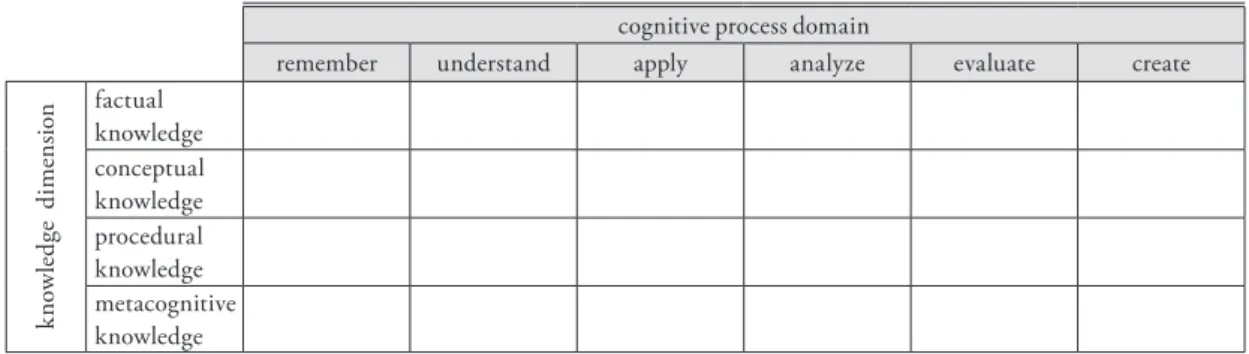
Shin and Cho (2008) introduced a revised Bloom’s taxonomy suggested by Krathwohl (2002). This tax- onomy is composed of the knowledge dimension and the cognitive process domain (Figure 2). Instructional objectives are identified by combining one knowledge dimension and one cognitive process.
K.-Y. Lee (2004) argued that the SOLO (Structure of Observed Learning Outcomes) taxonomy is useful in the design of geography lesson and test problems.
The hierarchical structure of the taxonomy (pre- structural, uni-structural, multi-structural, relational, and extended abstract stage) provides an alternative to Bloom’s taxonomy. Lee exemplified how the SOLO model can be employed in developing teaching strate- gies and geography tests.
(4) Spatial Thinking
Recently, spatial thinking has received attention in the geography education community. M. Kim (2007) introduced the definition of spatial thinking. As his study reveals, geography educators in South Korea note the National Research Council’s (2006) concep- tualization: concepts of space, tools of representation, and processes of reasoning. Spatial thinking taxono- mies suggested by Golledge (2002) and Gersmehl and Gersmehl (2006) also play a significant role in the dis- cussion regarding the nature of spatial thinking.
Cho (2005) argued that geography education is one of the most suitable subjects to develop spatial intelli- gence. The spatial perspective helps establish the iden- tity of geography education and provides insight to accomplish the purpose of geography education (Cho, 2007). In particular, Cho (2008) noted the potential of visualization. He emphasized that the visualization strategy is not confined to the simple introduction of information in the form of graphics but it should in-
cognitive process domain
remember understand apply analyze evaluate create
factual knowledge conceptual knowledge procedural knowledge metacognitive knowledge
Figure 2. Revised Bloom’s taxonomy Source: Krathwohl, 2002, 216 knowledge dimension
clude active reasoning processes such as the production of visual information. Similarly, Lee (2011a) contend- ed that graphicacy in education should emphasize not only the interpretation of graphics but also the creation of spatial representation. Shin (2009) extended the spatial thinking discussion by considering the role of gender. The researcher introduced theories concerning the origin of gender difference in spatial thinking.
(5) Territory Education
Korea’s unique situations, such as division of South and North Korea and geopolitical issues between South Korea and surrounding countries, led to the emphasis on territory education. Seo (2009) suggested an integrated territory education model that combines three perspectives of territory education, that is, educa- tion about, from, and for territory. Education about territory emphasizes the acquisition of knowledge of territory. Education from territory is related to body experience in territory. For example, one can visit a region and establish his/her feeling about and belong- ingness to the region. Finally, education for territory, the deepest level among the three perspectives, makes one becomes a part of a territory and a territory also becomes a part of the one; existential insideness is realized through education for territory. Nam (2011) added further insight by discussing territory education in the context of a globalized world. The researcher stressed that territory education should focus on en- hancing students’ critical literacy and transnational citizenship, not falling into the pitfall of narrow na- tionalism.
Marine education is a suitable sub-field of territory education (Yoon, 2006). Three sides of South Korea, except the North, are surrounded by the sea, and geopolitical issues in these seas are of interest to the public. These days, the ownership of Dokdo (a small island located in the most eastern part of South Korea) is a hot issue. Dokdo is currently inhabited by South
Korean, but the Japanese government insists that the island belongs to its territory. Because of this situation, the ownership of Dokdo has become a critical topic in territory education. Several empirical studies were conducted. For instance, Yi and Yuk (2012) found elementary students’ lack of knowledge about Dokdo.
J.-B. Shim (2008) analyzed content concerning Dokdo in Japanese textbooks and discovered biases in its description. Because students tend to respond to the Dokdo problem emotionally, however, territory educa- tion should promote students’ capability to analyze problems critically and logically (S. Park, 2010a).
(6) Multicultural Education
As foreigners from wide ranging countries migrate to South Korea, multicultural literacy has become an important component of geographic knowledge. Con- sidering that the discipline of geography deals with world regions and people there, geography education can play a critical role in multicultural education. In discussing the relationships between human society and space, Sim (2009) emphasized that multicultural education is one of the crucial sectors researchers should pay attention to. For effective multicultural education, geography teachers should be qualified to introduce relevant topics appropriately in their class (Park, 2011), and multicultural education should be- gin early from elementary school with sufficient visual information (Hong, 2011).
Research regarding multicultural education in- cludes textbook analysis. For example, Kwon and Cho (2012) compared contents of multicultural education in the UK and Korean textbooks. Park (2008) suggest- ed a lesson plan. She postulated that a variety of teach- ing strategies ranging from lecture to role play can be used in multicultural education. However, more concrete lesson plans need to be developed to facilitate effective multicultural education.
2) Teacher Education in Geography
(1) Pedagogical Content Knowledge andPractical Knowledge in Pre-service Education
Lee (2000) emphasized pedagogical content knowl- edge as an indicator of expertise of teachers. Based on Shulman’s (1986) conceptualization, Lee argued that pre-service teacher programs in the department of geography education should offer the curriculum that synthesizes geography and education explicitly, not simply expecting that teaching education and geogra- phy separately would combine automatically. Follow- ing this argument, South Korean geography educators have become aware of the importance of teacher edu- cation.
The notion of practical knowledge conceptualized by Elbaz (1981), similar to that of pedagogical con- tent knowledge, also provided a framework to teacher education. Kim (2006a) introduced the concept of practical knowledge, and this led to further discus- sions regarding this topic. Kang (2007) explored pre- service teachers’ practical knowledge. She identified components of teachers’ practical knowledge and further examined elements pre-service teachers lacked.
According to this research, the participants needed more curriculum knowledge. This finding can help the development of effective pre-service programs. In another study, Kang (2010) examined the relation- ship between pre-service teachers’ practical knowledge and their evaluation of teaching behaviors. As teach- ers’ practical knowledge developed, they identified strength and weakness of teaching in a more profes- sional fashion.
(2) In-service Teachers’ Differences in Expertise by Major and Experience In-service teachers’ teaching behaviors were also ex- amined. S. Park (2004b) compared geography lessons
delivered by geography teachers and non-geography teachers. Those who majored in geography education organized teaching content systematically and logi- cally, while non-geography-major teachers simply introduced meanings of terms without explanations relevant to the content. Furthermore, non-geography- major instructors did not use spatial representations such as maps effectively as a teaching tool. In-service teachers demonstrated critical differences in teaching according to major.
Geography teachers further develop their expertise through the experiences they gain during their in- service. Kim (2006b) compared differences in practi- cal knowledge between a novice and an experienced teacher. An experienced geography teacher showed clear principles and rules in delivering course content and managing his class, but a novice teacher was less effective in these aspects than the experience teacher.
This finding suggests that teaching experience during in-service contribute to the development of practical knowledge.
3) Strategies in the Geography Classroom
(1) Inquiry-based Learning
In relation to constructivism, geographers in South Korea have noted the benefits of inquiry-based learn- ing. Song (2010) demonstrated the effectiveness of geographic inquiry by describing the processes of why houses in Yangdong Village are located on the hill (Table 1). The researcher argued that students in the geography classroom should experience these think- ing processes. Similarly, Song and Jeong (2012) found that elementary students developed critical thinking skills and disposition when inquiry-based learning us- ing raw data was employed. Students learned how to support their reasoning with data, and furthermore, they evaluated their thinking critically. These findings suggest that inquiry-based learning is a recommend-
able strategy for geography education. Kang (2003) reported that the application of inquiry-based learning is effective in teaching topics regarding climate. In order to substantiate the power of inquiry-based learn- ing, questioning strategies are important (C.-W. Park, 2004). Open-ended questions that make students think are beneficial to promote higher-order thinking skills.
(2) Use of Narratives
Geography educators have tried to incorporate nar- ratives into geography teaching and textbooks. Cho (2011b) discussed the educational implications of narratives in geography. The researcher argued that the use of narrative develops students’ geographic imagination because it emphasizes contexts which stu- dents should imagine. In addition, the incorporation of narrative facilitates the development of geographic understanding because it requires students to criti- cally understand the contexts and the structure of the
narrative. Various types of narratives such as literature and poetry have been incorporated in the geography textbooks (Cho, 2011a). Relevant research analyzed what types of narratives were used and which type was effective in teaching geography. Empirical studies have demonstrated the effectiveness of narrative in educa- tion. For example, Park (2006) reported that the use of a narrative style text stimulated students’ interest in geography content, and moreover it helped students score higher.
(3) Application of Spatial Thinking Skills As previously discussed, spatial thinking has be- come an important component of geographic knowl- edge. Researchers have applied spatial thinking skills into the geography classroom. K.-W. Lee (2004) found that the use of spatial comparison enhanced students’
geographic learning. When climates of two regions were compared, students scored higher. D.-W. Kim (2008) argued that geography education should not Table 1. Geographic inquiry processes
Step Content
Identifying a problem Why houses in Yangdong Village are located on the hill?
Formulating a hypothesis
Yangdong Village is located on the hill to reduce flood damage.
1) Geographic conditions, particularly the drainage networks, affect the decision- making for the location.
2) The village is located in the basin where rivers meet together.
3)When it rains, the village is prone to inundation because water from rivers will be concentrated at the confluence of rivers.
4) Therefore, houses are located on a higher elevation to avoid flood.
Collecting data Data are collected through a variety of sources such as maps, interviews, and newspaper articles.
Supporting the hypothesis
Data support the hypothesis.
1) Map analysis indicates that Yangdong Village is located where rivers meet together, and furthermore the width of the river becomes narrow at the confluence point; this may cause severe flood damage.
2) Residents stated that Yangdong Village was flooded when it rained a lot.
3) Newspaper articles reported the inundation of the village when a typhoon hit the village.
4) Therefore, houses in Yandong Village are located on the hill to reduce flood damage.
Source: Song (2010)
make students memorize every detail of regions, but has to provide a framework to understand a region.
For example, spatial analogy is a strategy to use loca- tional information defined by longitude and latitude to infer relevant geographic characteristics such as climate. This spatial thinking skill, spatial analogy, can be extended to a wide range of topics in geography (Lee and Harm, 2011). Lee et al. (2007) applied the spatial thinking taxonomy suggested by Gersmehl and Gersmehl (2006) to develop a workbook-type fieldtrip guidebook. Spatial thinking skills provided a framework to organize the guidebook. To illustrate, a dramatic change in a mining town could be connected to the concept of spatial change.
Ma (2010, 2011) developed a spatial thinking test in the Korean contexts. Ma identified components of spatial thinking as spatial visualization, spatial ori- entation, spatial relation, and spatial inference. Then, the author created questions to test these components.
Considering the lack of test instruments has been a long-running problem in geographic research, this study represents a good attempt to address this prob- lem in the Korean context. Some researchers (e.g., Harm and Lee, 2009; Park, 2002) extended spatial thinking research by examining how types and com- ponents of spatial representation such as graphs affect students’ learning.
(4) Geospatial Technologies in Education Geography educators in South Korea have noted the pedagogical potential of geospatial technology such as GIS, GPS, and remote sensing imagery. Educationists have increased their recognition of the importance of these technologies.
Some researchers introduced the status of the use of geospatial technology. Kim (2002) reported the development of GIS curriculum in the UK, and Jung (2005) discussed GIS curricula from the USA perspec- tive. Jung and Kim (2006) and Kim (2010) explored
the use of GIS in South Korea.
Other researchers have incorporated diverse types of geospatial technologies into the classroom. Lee (2011b) developed teaching modules using web-based GIS such as Google Earth and AEJEE. The modules included topics such as locations of renewable energy plant, analyses of earthquake data, and scavenger hunt with GPS. In-service teachers evaluated these modules positively. Choi et al. (2011) used Google Earth mash- up contour maps to teach contents in geomorphology such as erosion basin and terrace. Students enjoyed the activities. To visualize a 2D image to a 3D figure, Kee and Park (2006) developed a strategy to use the Microsoft Excel program. Considering the obstacles of desktop GIS in K-12 settings (e.g., complexity and availability of software), these efforts may provide an alternative to desktop GIS. The use of geospatial technology led to the development of students’ spatial thinking skills. Chun (2010) reported that students in- creased the use of spatial vocabulary when GIS activi- ties were employed.
Lee et al. (2003) found that remote sensing imagery could be incorporated in high school geography class.
These authors used Landsat images to investigate land cover changes in North Korea. Remote sensing images allowed students to examine regions in North Korea which are not possible to visit.
Oh (2012) discussed the possibility of augmented reality technology as a tool for geography education.
An augmented reality system “supplements the real world with virtual (computer-generated) objects that appear to coexist in the same space as the real world”
(Azuma et al., 2001, 34). The researcher postulated that augmented reality provides students with real- world contexts, therefore, it enabled authentic instruc- tion stimulating students’ interest and developing higher-order thinking skills.
(5) Diverse Instructional Models and Strategies
This section introduces research that does not be- long to the categories discussed above. These studies, however, provide insight into good practices in the geography classroom.
Jang (2007) noted the potential of system thinking as a strategy to synthesize human and physical geog- raphy. The discipline of geography has emphasized its bridging role that combines perspectives of various fields. Jang believed that system thinking can provide a framework to complete the role.
Lim (2009) applied the cognitive apprenticeship model to teach central place theory. Students were guided through the procedures of modeling, scaffold- ing, and fading. The model facilitated interactions between teachers and students. Students enjoyed this learning experience and developed their ability to in- terpret their everyday life from a geographical perspec- tive.
Kim and Nam (2011) analyzed students’ appre- ciation of the location concept based on the theory- based view of concepts. The researchers introduced the theory-based view and demonstrated that activities de- veloped using this view helped students construct their own theory. Students understood their surroundings with their perspective.
Shim (2011) employed map puzzles to motivate students in learning place locations. The researcher argued that because students are discouraged easily in memorizing locations, educators need to use strate- gies to make students enjoy the activities. Map puzzles made the learning of location an interesting exercise.
To summarize, geography educators in South Ko- rea have considered a variety strategies to facilitate students’ geographic learning. Even though the space limit does not allow us to describe each research in detail, we believe the studies discussed above at least show that geographers in South Korea have diversified
their research topics.
4. Conclusion
This article investigated what geography educa- tors in South Korea have studied. The main academic journals were introduced as the sources of knowledge.
Also, the research trends in these journals were dis- cussed as the content of knowledge. We classified ge- ography education research into three types: 1) nature of geographic knowledge, learning, and curriculum, 2) teacher education in geography, and 3) strategies in the geography classroom. Relevant research of each category was described.
Scholars in South Korea have increased their atten- tion to geography education as a crucial subfield in the geography academic community. The quantity and quality of geography education research have increased significantly. This study aimed to present a big pic- ture of geography education research in South Korea.
Although contextual differences exist, this research may be beneficial to researchers whose interest lies in geography education across the world. Furthermore, we believe that the geography education community can develop together by interacting with each other and sharing information. We hope this study serves as an access point where geography educators in South Korea and other countries facilitate interactions with each other.
Reference
Azuma, R., Baillot, Y., Behringer, R., Feiner, S., Julier, S., and MacIntyre, B., 2001, Recent advances in augmented reality, Computer Graphics and Appli-
cations, 21(6), 34-47.
Bednarz, S., 2000, Geography education research in the journal of Geography 1988-1997, International Re- search in Geographical and Environmental Educa- tion, 9(2), 128-140.
Bednarz, S. W., Downs, R. M., and Vender, J. C., 2003, Geography education, in Gaile, G. L. and Will-, in Gaile, G. L. and Will-in Gaile, G. L. and Will-, G. L. and Will-G. L. and Will-. L. and Will-L. and Will-. and Will-and Will- mott, C. J.(eds.), Geography in America at the Dawn of the 21st Century, Oxford University Press, New York, 461-478.
Braun, V. and Clarke, V., 2006, Using thematic analysis in psychology, Qualitative Research in Psychology, 3(2), 77-101.
Cho, C.-K., 2011a, An analysis of narrative text described in geography textbooks, Journal of the Korean As- sociation of Geographic and Environmental Educa- tion, 19(1), 49-65 (in Korean).
Cho, C.-K., 2011b, Values of teaching and learning ge-, C.-K., 2011b, Values of teaching and learning ge-C.-K., 2011b, Values of teaching and learning ge-.-K., 2011b, Values of teaching and learning ge-K., 2011b, Values of teaching and learning ge-., 2011b, Values of teaching and learning ge-2011b, Values of teaching and learning ge-, Values of teaching and learning ge-Values of teaching and learning ge- ography utilizing narrative, Journal of the Korean Association of Geographic and Environmental Edu- cation, 19(2), 35-52 (in Korean).
Cho, C.-K., 2012, A study on new programme of study for geography by a revised geography national cur- revised geography national cur-revised geography national cur- riculum in England, Journal of the Korean Associa- tion of Regional Geographers, 18(2), 232-251 (in Korean).
Cho, C.-K. and Kwon, J.-H., 2005a, Radical geography and critical pedagogy of geography, Journal of the Korean Association of Geographic and Environmen- tal Education, 13(2), 197-209 (in Korean).
Cho, C.-K. and Kwon, J.-H., 2005b, A learner as geo-, C.-K. and Kwon, J.-H., 2005b, A learner as geo-C.-K. and Kwon, J.-H., 2005b, A learner as geo-.-K. and Kwon, J.-H., 2005b, A learner as geo-K. and Kwon, J.-H., 2005b, A learner as geo-. and Kwon, J.-H., 2005b, A learner as geo-and Kwon, J.-H., 2005b, A learner as geo-, J.-H., 2005b, A learner as geo-J.-H., 2005b, A learner as geo-.-H., 2005b, A learner as geo-H., 2005b, A learner as geo-., 2005b, A learner as geo-2005b, A learner as geo-, A learner as geo-A learner as geo- graphical self and geographical inquiry-based learning, Journal of the Korean Association of Geo- graphic and Environmental Education, 13(3), 333- 347 (in Korean).
Cho, C.-K. and Kwon, J.-H., 2006, The debates on post-, C.-K. and Kwon, J.-H., 2006, The debates on post-C.-K. and Kwon, J.-H., 2006, The debates on post-.-K. and Kwon, J.-H., 2006, The debates on post-K. and Kwon, J.-H., 2006, The debates on post-. and Kwon, J.-H., 2006, The debates on post-and Kwon, J.-H., 2006, The debates on post-, J.-H., 2006, The debates on post-J.-H., 2006, The debates on post-.-H., 2006, The debates on post-H., 2006, The debates on post-., 2006, The debates on post-2006, The debates on post-, The debates on post-The debates on post- modernism and geography education in the Brit- ain, Journal of the Korean Association of Geographic and Environmental Education, 14(1), 1-12 (in Ko-14(1), 1-12 (in Ko-(1), 1-12 (in Ko-1), 1-12 (in Ko-), 1-12 (in Ko-1-12 (in Ko--12 (in Ko-12 (in Ko- (in Ko-in Ko- rean).
Cho, S.-W., 2004, Separated integration of social studies curriculum in secondary school, Journal of the Ko-
rean Association of Geographic and Environmental Education, 12(2), 287-301 (in Korean).
Cho, S.-W., 2005, The role of spatial intelligence in geog-, S.-W., 2005, The role of spatial intelligence in geog-S.-W., 2005, The role of spatial intelligence in geog-.-W., 2005, The role of spatial intelligence in geog-W., 2005, The role of spatial intelligence in geog-., 2005, The role of spatial intelligence in geog-2005, The role of spatial intelligence in geog-, The role of spatial intelligence in geog-The role of spatial intelligence in geog- raphy education, Journal of the Korean Association of Geographic and Environmental Education, 13(2), 211-224 (in Korean).
Cho, S.-W., 2007, The meaning of an offer revelation op-, S.-W., 2007, The meaning of an offer revelation op-S.-W., 2007, The meaning of an offer revelation op-.-W., 2007, The meaning of an offer revelation op-W., 2007, The meaning of an offer revelation op-., 2007, The meaning of an offer revelation op-2007, The meaning of an offer revelation op-, The meaning of an offer revelation op-The meaning of an offer revelation op- portunity of spatial intelligence through geogra- phy education, Journal of the Korean Association of Geographic and Environmental Education, 15(2), 93-107 (in Korean).
Cho, S.-W., 2008, Application method of spatial intel-, S.-W., 2008, Application method of spatial intel-S.-W., 2008, Application method of spatial intel-.-W., 2008, Application method of spatial intel-W., 2008, Application method of spatial intel-., 2008, Application method of spatial intel-2008, Application method of spatial intel-, Application method of spatial intel-Application method of spatial intel- ligence in geography education, Journal of the Ko- rean Association of Geographic and Environmental Education, 16(2), 97-110 (in Korean).
Choi, W.-H., 2004, Status quo and problem of geography domain in the 7th social studies curriculum, Jour- nal of the Association of Geographic and Environ- mental Education, 12(2), 247-271 (in Korean).
Choi, J.-H., Baek, M.-H., Beom, Y.-G., and Um, J.-S., 2011, Effectiveness of landform teaching using Google Earth mash-up contour map, Journal of the Association of Geographic and Environmental Edu- cation, 19(2), 261-270 (in Korean).
Chun, B.-A., 2010, Effect of GIS-integrated lessons on spatial thinking abilities and geographical skills, Journal of the Korean Geographical Society, 45(6), 820-844.
Elbaz, F., 1981, The teacher’s “practical knowledge”: Re-, F., 1981, The teacher’s “practical knowledge”: Re-F., 1981, The teacher’s “practical knowledge”: Re-., 1981, The teacher’s “practical knowledge”: Re-1981, The teacher’s “practical knowledge”: Re-, The teacher’s “practical knowledge”: Re-The teacher’s “practical knowledge”: Re-’s “practical knowledge”: Re-s “practical knowledge”: Re- “practical knowledge”: Re-practical knowledge”: Re-”: Re-Re- port of a case study, Curriculum Inquiry, 11(4), 43- 71.
Gersmehl, P. J. and Gersmehl, C. A., 2006, Wanted: A concise list of neurologically defensible and assess- able spatial-thinking skills, Research in Geographic Education, 8, 5-38.
Golledge, R. G., 2002, The nature of geographic knowl-, R. G., 2002, The nature of geographic knowl-R. G., 2002, The nature of geographic knowl-. G., 2002, The nature of geographic knowl-G., 2002, The nature of geographic knowl-., 2002, The nature of geographic knowl-2002, The nature of geographic knowl-, The nature of geographic knowl-The nature of geographic knowl- edge, Annals of the Association of American Geogra- phers, 92(1), 1-14.
Han, H.-K., 2011, The reconstruction of contents of the subject ‘World Geography’ for fostering of critical global citizenship, Journal of the Korean Association of Geographic and Environmental Education, 19(2),
123-141 (in Korean).
Harm, K.-R. and Lee, J., 2009, The effects of component variables on students’ understanding of graphs, Journal of the Korean Association of Geographic and Environmental Education, 17(1), 17-28 (in Ko-17(1), 17-28 (in Ko-(1), 17-28 (in Ko-1), 17-28 (in Ko-), 17-28 (in Ko-17-28 (in Ko--28 (in Ko-28 (in Ko- (in Ko-in Ko- rean).
Hong, K.-D., 2011, Investigation into the future direc-, K.-D., 2011, Investigation into the future direc-K.-D., 2011, Investigation into the future direc-.-D., 2011, Investigation into the future direc-D., 2011, Investigation into the future direc-., 2011, Investigation into the future direc-2011, Investigation into the future direc-, Investigation into the future direc-Investigation into the future direc- tion of multicultural education to decrease bias against multicultural students: A case study of Kwangju∙Jeonnam Region, Journal of the Korean Association of Regional Geographers, 17(4), 381-394 (in Korean).
Jang, E.-S., 2007, The reconstitution of the geographical thinking on the basis of system thinking, Journal of the Korean Association of Geographic and Envi- ronmental Education, 15(1), 77-92 (in Korean).
Jang, Y.-J., 2004, Understanding the organization of geographical skill in the national curriculums of Korea, England, and the United States, Journal of the Korean Association of Geographic and Environ- mental Education, 12(1), 61-82 (in Korean).
Jung, I.-C., 2005, Undergraduate GIS curricula of depart-, I.-C., 2005, Undergraduate GIS curricula of depart-I.-C., 2005, Undergraduate GIS curricula of depart-.-C., 2005, Undergraduate GIS curricula of depart-C., 2005, Undergraduate GIS curricula of depart-., 2005, Undergraduate GIS curricula of depart-2005, Undergraduate GIS curricula of depart-, Undergraduate GIS curricula of depart-Undergraduate GIS curricula of depart- ment of geography in U.S., Journal of the Korean Association of Geographic and Environmental Edu- cation, 13(2), 225-234 (in Korean).
Jung, I.-C. and Kim, J., 2006, Development of GIS teach-, I.-C. and Kim, J., 2006, Development of GIS teach-I.-C. and Kim, J., 2006, Development of GIS teach-.-C. and Kim, J., 2006, Development of GIS teach-C. and Kim, J., 2006, Development of GIS teach-. and Kim, J., 2006, Development of GIS teach-and Kim, J., 2006, Development of GIS teach-, J., 2006, Development of GIS teach-J., 2006, Development of GIS teach-., 2006, Development of GIS teach-2006, Development of GIS teach-, Development of GIS teach-Development of GIS teach- ing plans in high school geography classrooms, Journal of the Korean Association of Geographic and Environmental Education, 14(3), 251-262 (in Ko-14(3), 251-262 (in Ko-(3), 251-262 (in Ko-3), 251-262 (in Ko-), 251-262 (in Ko-251-262 (in Ko--262 (in Ko-262 (in Ko- (in Ko-in Ko- rean).
Kang, C.-S., 2003, A case study of the instructional strate-, C.-S., 2003, A case study of the instructional strate-C.-S., 2003, A case study of the instructional strate-.-S., 2003, A case study of the instructional strate-S., 2003, A case study of the instructional strate-., 2003, A case study of the instructional strate-2003, A case study of the instructional strate-, A case study of the instructional strate-A case study of the instructional strate- gies for the inquiry teaching: On the contents of climate units, Journal of the Korean Association of Geographic and Environmental Education, 11(3), 79-86 (in Korean).
Kang, C.-S., 2007, Student teachers’ practical knowledge contents in geography teaching experience, Jour- nal of the Korean Association of Geographic and Environmental Education, 15(4), 323-343 (in Ko-15(4), 323-343 (in Ko-(4), 323-343 (in Ko-4), 323-343 (in Ko-), 323-343 (in Ko-323-343 (in Ko--343 (in Ko-343 (in Ko- (in Ko-in Ko- rean).
Kang, C.-S., 2010, Pre-service geography teacher’s obser-, C.-S., 2010, Pre-service geography teacher’s obser-C.-S., 2010, Pre-service geography teacher’s obser-.-S., 2010, Pre-service geography teacher’s obser-S., 2010, Pre-service geography teacher’s obser-., 2010, Pre-service geography teacher’s obser-2010, Pre-service geography teacher’s obser-, Pre-service geography teacher’s obser-Pre-service geography teacher’s obser--service geography teacher’s obser-service geography teacher’s obser-’s obser-s obser- vation and reflection on teaching for a good teach- good teach-good teach-
ing, Journal of the Korean Association of Geographic and Environmental Education, 18(1), 59-75 (in Korean).
Kang, C.-S., 2012, Chinese geography curriculum changes and the organization of geography curriculum standards, Journal of the Korean Association of Re- gional Geographers, 18(2), 217-231 (in Korean).
Kang, W., 2012, A content analysis of education for sus-, W., 2012, A content analysis of education for sus-W., 2012, A content analysis of education for sus-., 2012, A content analysis of education for sus-2012, A content analysis of education for sus-, A content analysis of education for sus-A content analysis of education for sus- tainable development in 2007 revised middle school Environment textbooks, Journal of the Ko- rean Association of Geographic and Environmental Education, 18(3), 339-354 (in Korean).
Kee, K.-D. and Park, J.-G., 2006, Teaching and learning the relief using the MS Excel program, Journal of the Korean Association of Geographic and Environ- mental Education, 14(3), 263-272 (in Korean).
Kim, D.-W., 2008, A study on location knowledge and location learning, Journal of the Korean Association of Geographic and Environmental Education, 16(2), 145-162 (in Korean).
Kim, H.-S., 2006a, A Case Study of Secondary Geography Class Based on Classroom Ecological Perspective, Ph.D. diss., Korea University, Seoul (in Korean).
Kim, H.-S., 2006b, A comparative study about the practi-, H.-S., 2006b, A comparative study about the practi-H.-S., 2006b, A comparative study about the practi-.-S., 2006b, A comparative study about the practi-S., 2006b, A comparative study about the practi-., 2006b, A comparative study about the practi-2006b, A comparative study about the practi-, A comparative study about the practi-A comparative study about the practi- cal knowledge of a novice and an experienced geography teacher in high school, Social Studies Education, 45(3), 91-113 (in Korean).
Kim, H. and Nam, S., 2011, Understanding primary school students’ conceptual change of ‘location’
through theory-based view, Journal of the Korean Association of Geographic and Environmental Edu- cation, 19(3), 399-411 (in Korean).
Kim, J.-Y., 2007, A Critical Discussion of the Widening Ho- rizons Based on Scale Preference Rate of Elementary Students, Ph.D. diss., Seoul National University, Seoul (in Korean).
Kim, J.-Y., 2008, Elementary geography contents organi-, J.-Y., 2008, Elementary geography contents organi-J.-Y., 2008, Elementary geography contents organi-.-Y., 2008, Elementary geography contents organi-Y., 2008, Elementary geography contents organi-., 2008, Elementary geography contents organi-2008, Elementary geography contents organi-, Elementary geography contents organi-Elementary geography contents organi- zation plan on scale from focus of moving beyond widening horizons: On the contents of river, Journal of the Korean Association of Geographic and Environmental Education, 16(3), 267-280 (in Ko-16(3), 267-280 (in Ko-(3), 267-280 (in Ko-3), 267-280 (in Ko-), 267-280 (in Ko-267-280 (in Ko--280 (in Ko-280 (in Ko- (in Ko-in Ko- rean).
Kim, M., 2007, Spatial thinking and the investigation of GIS for potential application in education, Journal of the Korean Association of Geographic and Envi- ronmental Education, 15(3), 233-245 (in Korean).
Kim, M., 2010, The current status of GIS in the classroom and factors to consider for increasing the use of GIS, Journal of the Korean Association of Geograph- ic and Environmental Education, 18(2), 173-184 (in Korean).
Kim, M., Bednarz, R., and Lee, S.-I., 2011, GIS education for teachers in South Korea: Who participates and why? Journal of the Korean Geographical Society, 46(3), 382-395.
Kim, Y.-H., 2002, The introduction and development of GIS curriculum in the UK geography education, Journal of the Korean Association of Regional Geog- raphers, 8(3), 380-395.
Krathwohl, D. R., 2002, A revision of Bloom’s taxonomy:
An overview, Theory into Practice, 41(4), 212-218.
Kwon, M.-Y. and Cho, C.-K., 2012, Analysis on multicul-, M.-Y. and Cho, C.-K., 2012, Analysis on multicul-M.-Y. and Cho, C.-K., 2012, Analysis on multicul-.-Y. and Cho, C.-K., 2012, Analysis on multicul-Y. and Cho, C.-K., 2012, Analysis on multicul-. and Cho, C.-K., 2012, Analysis on multicul-and Cho, C.-K., 2012, Analysis on multicul-, C.-K., 2012, Analysis on multicul-C.-K., 2012, Analysis on multicul-.-K., 2012, Analysis on multicul-K., 2012, Analysis on multicul-., 2012, Analysis on multicul-2012, Analysis on multicul-, Analysis on multicul-Analysis on multicul- tural education of geography textbooks in Korean and the UK: A case of the unit related on popula-: A case of the unit related on popula-A case of the unit related on popula- tion, Journal of the Korean Association of Geograph- ic and Environmental Education, 20(1), 33-44 (in Korean)
Lee, J., 2000, The alternative curriculum to improve ge-, J., 2000, The alternative curriculum to improve ge-J., 2000, The alternative curriculum to improve ge-., 2000, The alternative curriculum to improve ge-2000, The alternative curriculum to improve ge-, The alternative curriculum to improve ge-The alternative curriculum to improve ge- ography teacher’s professionalism, Social Studies Education, 33, 379-400 (in Korean).
Lee, J., 2011a, Revisiting graphicacy: The roles of graphi-, J., 2011a, Revisiting graphicacy: The roles of graphi-J., 2011a, Revisiting graphicacy: The roles of graphi-., 2011a, Revisiting graphicacy: The roles of graphi-2011a, Revisiting graphicacy: The roles of graphi-, Revisiting graphicacy: The roles of graphi-Revisiting graphicacy: The roles of graphi-: The roles of graphi-The roles of graphi- cacy in the digital era and tasks of geographic education, Journal of the Korean Association of Geo- graphic and Environmental Education, 19(1), 1-15 (in Korean).
Lee, J., 2011b, Designing and assessing geography teaching modules using geospatial technologies, Journal of the Korean Association of Geographic and Environ- mental Education, 19(3), 381-397 (in Korean).
Lee, J. and Harm, K.-R., 2011, Th e use of analogy in teach-, J. and Harm, K.-R., 2011, Th e use of analogy in teach-J. and Harm, K.-R., 2011, Th e use of analogy in teach-. and Harm, K.-R., 2011, Th e use of analogy in teach-and Harm, K.-R., 2011, Th e use of analogy in teach-, K.-R., 2011, Th e use of analogy in teach-K.-R., 2011, Th e use of analogy in teach-.-R., 2011, Th e use of analogy in teach-R., 2011, Th e use of analogy in teach-., 2011, Th e use of analogy in teach-2011, Th e use of analogy in teach-, Th e use of analogy in teach-The use of analogy in teach- ing and learning geography, Journal of the Korean Geographical Society, 46(4), 534-554 (in Korean).
Lee, J., Harm, K.-R., and Kim, B., 2007, Developing workbook-style fi eld trip guidebook in undergrad--style fi eld trip guidebook in undergrad-style field trip guidebook in undergrad-
uate geography, Journal of the Korean Association of Geographic and Environmental Education, 15(4), 345-361 (in Korean).
Lee, K.-W., 2004, A study on the effect of the geography instruction: Applying comparison between re-: Applying comparison between re-Applying comparison between re- gional cases, Journal of the Korean Association of Geographic and Environmental Education, 12(1), 169-183 (in Korean).
Lee, K.-Y., 2004, Applying the SOLO taxonomy to geo-, K.-Y., 2004, Applying the SOLO taxonomy to geo-K.-Y., 2004, Applying the SOLO taxonomy to geo-.-Y., 2004, Applying the SOLO taxonomy to geo-Y., 2004, Applying the SOLO taxonomy to geo-., 2004, Applying the SOLO taxonomy to geo-2004, Applying the SOLO taxonomy to geo-, Applying the SOLO taxonomy to geo-Applying the SOLO taxonomy to geo- graphical education, Journal of the Korean Associa- tion of Geographic and Environmental Education, 12(1), 15-29 (in Korean).
Lee, K.-Y., 2010, Analysis of the features and changes in the elementary geography curriculum of Califor- nia, Journal of the Korean Association of Geographic and Environmental Education, 18(3), 207-219 (in Korean).
Lee, M.-B., Choi, H.-S., Kim, N.-S., and Shin, K.-E., 2003, Planning of teaching materials for regional geography of North Korea using Landsat images in high school, Journal of the Korean Association of Geographic and Environmental Education, 11(2), 17-28 (in Korean).
Lim, E., 2009, Developing geography instructional model based on the cognitive apprenticeship and its ap- plication, Journal of the Korean Association of Geo- graphic and Environmental Education, 17(3), 225- 237 (in Korean).
Lim, E., 2011, Education of self-identity based on place, Journal of the Korean Association of Geographic and Environmental Education, 19(2), 107-121 (in Ko-19(2), 107-121 (in Ko-(2), 107-121 (in Ko-2), 107-121 (in Ko-), 107-121 (in Ko-107-121 (in Ko--121 (in Ko-121 (in Ko- (in Ko-in Ko- rean).
Ma, K.-M., 2010, Study on Development of Evaluation Items for Spatial Thinking with Geography Assessment, Ph.D. diss., Korea University, Seoul (in Korean).
Ma, K.-M., 2011, Development of evaluation items for spatial thinking with geography classroom as- sessment, Journal of the Korean Association of Geo- graphic and Environmental Education, 19(2), 69- 89 (in Korean).
Nam, H.-Y., 2002, The issues of elementary school geog-, H.-Y., 2002, The issues of elementary school geog-H.-Y., 2002, The issues of elementary school geog-.-Y., 2002, The issues of elementary school geog-Y., 2002, The issues of elementary school geog-., 2002, The issues of elementary school geog-2002, The issues of elementary school geog-, The issues of elementary school geog-The issues of elementary school geog- raphy curriculum and the quest of an alternative
plan, Journal of the Korean Association of Geograph- ic and Environmental Education, 10(1), 53-64 (in Korean).
Nam, H.-Y., 2011, Geopolitical visions and the reconcep-, H.-Y., 2011, Geopolitical visions and the reconcep-H.-Y., 2011, Geopolitical visions and the reconcep-.-Y., 2011, Geopolitical visions and the reconcep-Y., 2011, Geopolitical visions and the reconcep-., 2011, Geopolitical visions and the reconcep-2011, Geopolitical visions and the reconcep-, Geopolitical visions and the reconcep-Geopolitical visions and the reconcep- tualization of territorial education in a globalized world, Journal of the Korean Association of Geo- graphic and Environmental Education, 19(3), 371- 379 (in Korean).
Nam, S.-J., 2002, An evaluation of the development pro-, S.-J., 2002, An evaluation of the development pro-S.-J., 2002, An evaluation of the development pro-.-J., 2002, An evaluation of the development pro-J., 2002, An evaluation of the development pro-., 2002, An evaluation of the development pro-2002, An evaluation of the development pro-, An evaluation of the development pro-An evaluation of the development pro- cess of geography curriculum for primary and sec- ondary schools, Journal of the Korean Association of Geographic and Environmental Education, 10(1), 1-11 (in Korean).
National Research Council, 2006, Learning to Think Spa- tially, The National Academies Press, Washington, DC.
Noh, H., 2008, Rereading World Geography textbooks in terms of global education: An analysis of Korea in US World Geography textbooks, Journal of the Korean Geographical Society, 43(1),154-169 (in Ko-43(1),154-169 (in Ko-(1),154-169 (in Ko-1),154-169 (in Ko-),154-169 (in Ko-154-169 (in Ko--169 (in Ko-169 (in Ko- (in Ko-in Ko- rean).
Oh, J., 2012, Exploring the possibility of utilization on augmented reality technology in geography learn- ing, Journal of the Korean Association of Geographic and Environmental Education, 20(1), 79-94 (in Korean).
Park, B., 2006, A study on students’ preference and learn-, B., 2006, A study on students’ preference and learn-B., 2006, A study on students’ preference and learn-., 2006, A study on students’ preference and learn-2006, A study on students’ preference and learn-, A study on students’ preference and learn-A study on students’ preference and learn-’ preference and learn-preference and learn- ing effects by the text description methods, Jour- nal of Geography Education, 50, 63-79.
Park, C.-W., 2004, A study on the practices of teacher questioning and the effective questioning strate- gies in geography teaching, Journal of the Korean Association of Geographic and Environmental Edu- cation, 12(1), 149-168 (in Korean).
Park, H.-J., 2002, A study on learner’s graphic use quality in geography education, Journal of the Korean As- sociation of Geographic and Environmental Educa- tion, 10(3), 29-42 (in Korean).
Park, S., 2004a, Reconciliability between integrated cur-, S., 2004a, Reconciliability between integrated cur-S., 2004a, Reconciliability between integrated cur-., 2004a, Reconciliability between integrated cur-2004a, Reconciliability between integrated cur-, Reconciliability between integrated cur-Reconciliability between integrated cur- riculum and discipline-based curriculum in mid--based curriculum in mid-based curriculum in mid- dle school social studies: A survey result, Journal of the Korean Association of Geographic and Environ-
mental Education, 12(2), 273-285 (in Korean).
Park, S., 2004b, The case study of geography classes thought by non-majored teacher in the middle school, Journal of the Korean Geographical Society, 39(4), 620-632 (in Korean).
Park, S., 2010a, Th e study of the direction of territory edu-, S., 2010a, Th e study of the direction of territory edu-S., 2010a, Th e study of the direction of territory edu-., 2010a, Th e study of the direction of territory edu-2010a, Th e study of the direction of territory edu-, Th e study of the direction of territory edu-The study of the direction of territory edu- cation in deterritorialization era, Journal of the Ko- rean Association of Geographic and Environmental Education, 18(1), 23-36 (in Korean).
Park, S., 2010b, The impact of curriculum structure on textbook diversification in social studies, Journal of the Korean Association of Geographic and Envi- ronmental Education, 18(3), 251-267 (in Korean).
Park, S., 2011, The implication of critical perspective of multicultural education on geography education, Journal of the Korean Association of Geographic and Environmental Education, 19(2), 209-224 (in Ko-19(2), 209-224 (in Ko-(2), 209-224 (in Ko-2), 209-224 (in Ko-), 209-224 (in Ko-209-224 (in Ko--224 (in Ko-224 (in Ko- (in Ko-in Ko- rean).
Park, S.-H., 2008, A study on development of instruction- learning model for multicultural education in geographical education: Focused on Korean Ge-: Focused on Korean Ge-Focused on Korean Ge- ography (7th curriculum amendment), Journal of the Korean Association of Geographic and Environ- mental Education, 16(2), 163-177 (in Korean).
Park, S.-K., 2004, Children’s geography and its implica-, S.-K., 2004, Children’s geography and its implica-S.-K., 2004, Children’s geography and its implica-.-K., 2004, Children’s geography and its implica-K., 2004, Children’s geography and its implica-., 2004, Children’s geography and its implica-2004, Children’s geography and its implica-, Children’s geography and its implica-Children’s geography and its implica-’s geography and its implica-s geography and its implica- tions for elementary geography education, Journal of the Korean Association of Geographic and Envi- ronmental Education, 12(1), 1-14 (in Korean).
Park, S.-K., 2010, The meaning of children’s cyber space in geography education, Journal of the Korean Associ- ation of Geographic and Environmental Education, 18(3), 237-250 (in Korean).
Ryu, J.-M., 2002a, The direction of improving the geog-, J.-M., 2002a, The direction of improving the geog-J.-M., 2002a, The direction of improving the geog-.-M., 2002a, The direction of improving the geog-M., 2002a, The direction of improving the geog-., 2002a, The direction of improving the geog-2002a, The direction of improving the geog-, The direction of improving the geog-The direction of improving the geog- raphy curriculum in Korea, Journal of the Korean Association of Geographic and Environmental Edu- cation, 10(1), 27-40 (in Korean).
Ryu, J.-M., 2002b, Developing geography lesson plans to integrate students’ everyday experiences to classroom learning activities, Journal of the Korean Association of Geographic and Environmental Edu- cation, 10(3), 1-16 (in Korean).
Ryu, J.-M. and Kim, M., 2009, Beyond the widening
horizons model: Fostering children’s geographic imagination and global leadership, Paper present-, Paper present-Paper present- ed at the Regional Meeting of the International Geographical Union (IGU), Tsukuba, Japan.
Seo, T.-Y., 2002, ‘Knowledge’ as a component of ‘content’
in geography curriculum, Journal of the Korean As- sociation of Geographic and Environmental Educa- tion, 10(1), 13-25 (in Korean).
Seo, T.-Y., 2009, Conceptualizing territory education and approaches to the model of the territory education, Journal of the Korean Association of Geographic and Environmental Education, 17(3), 197-210 (in Ko-17(3), 197-210 (in Ko-(3), 197-210 (in Ko-3), 197-210 (in Ko-), 197-210 (in Ko-197-210 (in Ko--210 (in Ko-210 (in Ko- (in Ko-in Ko- rean).
Shim, J.-B., 2008, Territory education on Dokdo in Japan’s social studies, Journal of the Korean Association of Geographic and Environmental Education, 16(3), 179-200 (in Korean).
Shim, S.-H., 2008, The changes of geography curriculum in Korean elementary school, Journal of the Korean Association of Geographic and Environmental Edu- cation, 16(4), 347-364 (in Korean).
Shim, S.-H., 2011, Learning place location using map puzzles in primary geography, Journal of the Ko- rean Association of Geographic and Environmental Education, 19(2), 119-135 (in Korean).
Shin, J., 2009, The theoretical review on the sex differences of the spatial cognition and its implications on the perspective of geography education, Journal of the Korean Association of Geographic and Environmen- tal Education, 17(2), 125-143 (in Korean).
Shin, J.-G. and Cho, C.-K., 2008, The statement of geog-, J.-G. and Cho, C.-K., 2008, The statement of geog-J.-G. and Cho, C.-K., 2008, The statement of geog-.-G. and Cho, C.-K., 2008, The statement of geog-G. and Cho, C.-K., 2008, The statement of geog-. and Cho, C.-K., 2008, The statement of geog-and Cho, C.-K., 2008, The statement of geog-, C.-K., 2008, The statement of geog-C.-K., 2008, The statement of geog-.-K., 2008, The statement of geog-K., 2008, The statement of geog-., 2008, The statement of geog-2008, The statement of geog-, The statement of geog-The statement of geog- raphy instruction objectives and the creation of evaluation questions based on revision of Bloom’s taxonomy of educational objectives, Journal of the Korean Association of Geographic and Environmen- tal Education, 16(2), 129-144 (in Korean).
Shulman, L., 1986, Those who understand: Knowledge growth in teaching, Educational Researcher, 15(2), 4-14.
Sim, K.-T., 2009, Practice of teaching space to understand the relationships between human society and space in social studies education, Journal of the Ko-
rean Association of Geographic and Environmental Education, 17(1), 29-43 (in Korean).
Sohn, Y.-T. and Park, S., 2002, The United States depicted in Korean Social Studies textbooks and curricu- lum, and Korea depicted in U.S. World Geogra-, and Korea depicted in U.S. World Geogra-and Korea depicted in U.S. World Geogra-.S. World Geogra-S. World Geogra-. World Geogra-World Geogra- phy textbooks: Based on the secondary geography contexts in the textbooks of the two countries, Social Studies Education, 41(1), 5-35.
Song, U.-G., 2002, A logic of curricular construction for the authentic geography in elementary education, Journal of the Korean Association of Geographic and Environmental Education, 10(1), 41-51 (in Ko-10(1), 41-51 (in Ko-(1), 41-51 (in Ko-1), 41-51 (in Ko-), 41-51 (in Ko-41-51 (in Ko--51 (in Ko-51 (in Ko- (in Ko-in Ko- rean).
Song, U.-G., 2004, A refl ection and design of social stud-, U.-G., 2004, A refl ection and design of social stud-U.-G., 2004, A refl ection and design of social stud-.-G., 2004, A refl ection and design of social stud-G., 2004, A refl ection and design of social stud-., 2004, A refl ection and design of social stud-2004, A refl ection and design of social stud-, A refl ection and design of social stud-A reflection and design of social stud- ies curriculum from the perspective of geography area, Journal of the Korean Association of Geograph- ic and Environmental Education, 12(2), 229-245 (in Korean).
Song, U.-G., 2010, The construction of geographical in-, U.-G., 2010, The construction of geographical in-U.-G., 2010, The construction of geographical in-.-G., 2010, The construction of geographical in-G., 2010, The construction of geographical in-., 2010, The construction of geographical in-2010, The construction of geographical in-, The construction of geographical in-The construction of geographical in- quiry process based on the inquiry into the loca- tion of Yangdong Village, Journal of the Korean Association of Geographic and Environmental Edu- cation, 18(1), 37-58 (in Korean).
Song, U.-G. and Jeong, H.-J., 2012, Enhancing critical thinking through the manipulation of data in social studies, Journal of the Korean Association of Geographic and Environmental Education, 20(1), 1-22 (in Korean).
Yi, K.-H., 2004, Analysis of Korea in USA World Geogra-, K.-H., 2004, Analysis of Korea in USA World Geogra-K.-H., 2004, Analysis of Korea in USA World Geogra-.-H., 2004, Analysis of Korea in USA World Geogra-H., 2004, Analysis of Korea in USA World Geogra-., 2004, Analysis of Korea in USA World Geogra-2004, Analysis of Korea in USA World Geogra-, Analysis of Korea in USA World Geogra-Analysis of Korea in USA World Geogra- phy textbooks, Journal of the Korean Association of Geographic and Environmental Education, 12(3), 379-394 (in Korean).
Yi, K.-H., 2012, A critical analysis of structure and con-, K.-H., 2012, A critical analysis of structure and con-K.-H., 2012, A critical analysis of structure and con-.-H., 2012, A critical analysis of structure and con-H., 2012, A critical analysis of structure and con-., 2012, A critical analysis of structure and con-2012, A critical analysis of structure and con-, A critical analysis of structure and con-A critical analysis of structure and con- tents of geography textbook as medium of interna- tional understanding education: In the 7th grade’s Social Studies textbooks, Journal of the Korean Association of Geographic and Environmental Edu- cation, 18(3), 297-307 (in Korean).
Yi, K-H. and Yuk, H.-G., 2012, Children’s basic knowl-, K-H. and Yuk, H.-G., 2012, Children’s basic knowl-K-H. and Yuk, H.-G., 2012, Children’s basic knowl--H. and Yuk, H.-G., 2012, Children’s basic knowl-H. and Yuk, H.-G., 2012, Children’s basic knowl-. and Yuk, H.-G., 2012, Children’s basic knowl-and Yuk, H.-G., 2012, Children’s basic knowl-, H.-G., 2012, Children’s basic knowl-H.-G., 2012, Children’s basic knowl-.-G., 2012, Children’s basic knowl-G., 2012, Children’s basic knowl-., 2012, Children’s basic knowl-2012, Children’s basic knowl-, Children’s basic knowl-Children’s basic knowl-’s basic knowl-s basic knowl- edge and cognition on Tokdo-Island, Korea, Jour- nal of the Korean Association of Geographic and En- vironmental Education, 20(1), 23-32 (in Korean).
Yoon, O., 2006, The role of geography education in marine education, Journal of the Korean Geographical Soci- ety, 41(4), 491-506 (in Korean).
Correspondence: Minsung Kim, Department of Geog-: Minsung Kim, Department of Geog-Minsung Kim, Department of Geog-, Department of Geog-Department of Geog- raphy Education, College of Education, Seoul National University, Gwanak-ro 1, Gwanak-gu, Seoul (e-mail:
[email protected]; phone: 010-8551-6910)
교신: 김민성, 서울시 관악구 관악로 1 서울대학교 사범 대학 지리교육과(이메일: [email protected]; 전화:
010-8551-6910)
Recieved July 19, 2012 Revised August 12, 2012 Accepted August 14, 2012