Raising Human Capital in Three U.S. Metropolitan Areas:
Geographies of Educated Workforce Supply
from Higher Education Institutions to Information Technology Companies*
Hyungjoo Kim**
대학 인적자원 공급의 지리적 특성: 미국 3개 도시 지역의 정보통신업체를 사례로*
김형주**
Abstract:Human capital and higher education have been increasingly emphasized with the rise of a knowledge- based economy. Cities are recognized as places to attract human capital and spur economic development. Educated workforce supply is one of the critical parts to sustain IT industries, which have been leading recent economic development. This paper examines factors affecting geographies of educated workforce supply from colleges and universities to companies in U.S. metropolitan areas through questionnaire survey and interviews with IT companies and IT-related programs at colleges and universities. The results show that: (1) physical proximity between IT companies and colleges/universities enhances the degree of educated workforce supply from colleges/universities to IT companies; (2) IT companies which seek more specialized and rarer expertise recruit the workforce from colleges or universities over longer distance; (3) colleges and universities which offer a higher degree have geographically more extensive supply of educated workforce to IT companies than those which offer a lower degree; and (4) large IT companies have more geographically extensive supply of educated workforce to colleges/universities than small IT companies.
Key Words : human capital, metropolitan areas, educated workforce supply, physical proximity, colleges and universities, IT companies
요약:지식기반사회의 도래와 함께 인적 자원과 대학 교육의 중요성이 점차 강조되고 있으며, 도시지역은 이런 인적자원을 유인하 여 경제발전이 이루어지는 장소로 인식되어 왔다. 고급 인력 공급은 최근 경제 발전을 주도해온 정보기술산업의 핵심적인 요소이 다. 본 연구는 미국 대도시 지역에서 대학의 정보통신업체에 대한 인력 공급의 지리적 특성에 영향을 미치는 요소들을 설문조사와 인터뷰를 통하여 분석한다. 분석 결과에 따르면, (1) 정보통신업체와 대학간 근접성은 대학이 고급 인력을 IT업체에 공급하는 정도 를 증가시키고, (2) 필요 인력의 전문성 및 희소성의 정도가 높을수록 인력 공급의 지리적 범위가 넓어진다. (3) 더 높은 학위 수준을 제공하는 대학일수록 인력 공급의 지리적 범위가 넓어지며, (4) 규모가 큰 정보통신업체일수록 인력 공급의 지리적 범위가 넓어진다.
주요어 : 인적자원, 대도시 지역, 고급 인력 공급, 근접성, 대학, 정보통신업체
* The author gratefully acknowledges the support of National Science Foundation award 0302670.
** Associate Research Fellow, Science & Technology Policy Institute, Korea, [email protected]
1. Introduction
With the rise of a knowledge-based economy, where knowledge generation and exploitation are key to the creation of wealth (Romer, 1986), innovations have become a key to business success, and knowledge workers have become among the fastest growing groups in workforce (Drucker, 1993, 2002; Nonaka & Takeuchi, 1995).
The jobs of knowledge workers require formal and advanced schooling, and higher education institutions are increasingly recognized as important contributors to a knowledge-based economy. An educated workforce has been understood as “human capital”in the sense that it is assets that yield income and other useful outputs. Human capital includes not only formal educational endowments but also the skills, know-how, and experiential knowledge embodied in individuals (Bozeman &
Mangematin, 2004, p. 565), and education and training are the most important investment in human capital. Human capital models have been developed from the works by Becker (1962, 1964) and Schultz (1963), and their major research topics include the effects of schooling and training on average individual earnings and factors influencing earnings, education, and occupation.
Cities attract creative people and thus spur economic growth (Jacobs, 1984). What sustains the economies of cities is the productivity effects associated with human capital endowments (Lucas, 1988). Lucas (1988) contends that cities are simply a collection of factors of production and should fly apart according to traditional economic growth theory. The force behind of the central role of cities in economies is the externalities of human capital. According to
Florida (2003), creative people, among human capital, are key to economic growth and prefer cities that are innovative, diverse, and tolerant.
Cities, in human history, have always been places where human capital and creative people are concentrated.
Colleges and universities, developed from the medieval organizations of cultural conservation, preservation, and knowledge transmission, are a significant provider of human capital, which is a critical input for industrial innovation in a knowledge-based economy. Graduates from colleges and universities become qualified employees and embody technical knowledge and know-how. They are involved in industrial innovation through production processes.
Industry representatives repeatedly state that providing trained students-the result of a tight coupling between research and education-is one of the primary contributions of colleges and universities (Feller, 1999: 83). An educated labor supply is increasingly important for high technology companies, and to achieve a pool of educated labor is significant for national and regional economic growth and development.
Despite the increasing attention paid to and growing number of studies on the relationships between human capital, higher education, and industrial innovation, geographies of human capital have been one of less studied areas.
Understanding diverse extents of supply and demand of educated workforce and various factors affecting their geographies has been increasingly significant to develop human capital which is crucial to national and regional economic development. Previous research on geographies of human capital has been limited to national and/or regional investigations or comparisons by variables such as schooling
costs, individual wage, employee performance, labor mobility, and economic growth (e.g., Klaus, 2003; Murphy and Welch, 1989; Mincer and Jovanovic, 1982). The purpose of this paper is to understand diverse geographies of human capital by investigating educated workforce from colleges and universities to companies and to provide policy implications for regional human capital development.
2. Theoretical Backgrounds and Previous Studies
Theories regarding human capital and educated workforce start from neoclassical theories of economic growth. Solow (1956) views the aggregate output of a region or country as a function of workforce, capital, and technology, with technology treated as an exogenous variable. According to his theory, increase in workforce quantity and quality results in output growth. Population growth and investment in education are considered as a factor to bring economic growth, however, specific ways to grow workforce remain unexplained. While increasing investment in workforce and capital results in diminishing returns to investment, exogenously derived technological changes bring continuous economic growth by raising the productivity of workforce over time (Todaro, 1997: 88-90). Traditional neoclassical theory fails to explain the process of technological changes by regarding them as exogenous and independent although they are the primary factor to bring long-term economic growth (Todaro, 1997: 90-91). Dissatisfaction with traditional economic growth theory produced endogenous
(new) growth theory which attempts to explain technological change by focusing on the factors that raise productivity growth (Todaro, 1997: 90- 93). By assuming that investments in human capital, infrastructure, or R&D generate external economies and productivity improvements that offset the natural tendency for diminishing returns, endogenous growth theory seeks to explain the existence of increasing returns to scale and the divergent long-term growth patterns among countries (Todaro, 1997: 91-92).
Lucas (1988) and Romer (1990) developed human capital-centered models. According to the Lucas model, an individual’s human capital increases his/her own productivity and the productivity of other workers.1) The externality results in higher economic growth rates in those regions that invest more to accumulate human capital. In Romer’s model, the source of externalities is the stock of knowledge, which increases the productivity of workforce and capital over time, resulting in higher economic growth rate (Mathur, 1999). In Lucas’s and Romer’s human capital models, human capital is the most important input for production, and technological progress is the result of investments in education and research. Education is emphasized as the way through which human capital and stock of knowledge are accumulated.
It is assumed that individuals acquire education because it leads to higher wages and that different degrees of national and/or regional investment in education are reflected in persistent income differentials between their workforces (Stokey, 1991; Lucas, 1993). In the recent knowledge-based economy, where knowledge workers who need advanced education are a key to economic growth and development, the role of higher education is
increasingly significant.
This body of endogenous theory models, unlike traditional neoclassical growth theory, explains technological change as an endogenous outcome of investments in human capital. Higher education institutions are important to provide advanced education to develop qualified human capital. Thus, they suggest an active role of public policy in promoting economic growth through investments in human capital formation (Fuente & Ciccone, 2003; Todaro, 1997: 93).
However, specific ways to accumulate human capital and the stock of knowledge are not suggested in these endogenous growth models.2)
Research on national and regional innovation systems approach recently brings attention to colleges and universities. This emphasizes interactive characteristics of innovation, bringing attention to geographically-bound innovation systems (for example, see Lundvall, 1992;
Nelson, 1993; and Braczyk, Cooke, &
Heidenreich, 1998). Universities are often recognized as participants in innovation systems.
Case studies of innovation systems provide examples of successful or unsuccessful relationships between universities and companies. For example, Silicon Valley is recognized as a regional innovation system where excellent research universities are emphasized as an R&D provider and a seedbed of spin-offs (Saxenian, 1994). The regional innovation system in Ontario, Canada (Wolf &
Gertler, 1998) shows weak relationships between universities and companies, and blame the tradition of foreign ownership and reliance on imported technology. While case studies of innovation systems provide anecdotal examples of the roles played by higher education for industrial innovation, they are often confined to
briefly mention R&D contributions and spin-off functions of research universities, ignoring the contributions made by other higher education institutions.
Other research on higher education institutions focuses on the role of local universities in specific examples of regional economic growth (Felsenstein, 1996: 1566-1568). Studies have looked at the way universities affect local workforce markets (Beeson & Montgomery, 1993), new firm formation rates (Bania, Eberts, &
Fogarty, 1993), the development of the local service sector (Hedrick et al., 1990), and the effect of the human capital base on local industry investment patterns (Florax, 1992). The results from these studies generally show positive relationships between the presence of a university and economic growth in a particular region.
University impact studies estimate local economic impacts produced by colleges and universities. Most common university impact studies calculate university-induced growth by direct, indirect, and induced impacts of universities in a particular region and are sophisticated by multiplier effects (Felsenstein, 1996: 1566-1568). Accounting-type university impact studies measure various forms of direct impacts (employment, income, and sales) that universities have on the local economy relying on university expenditure and payroll data, survey evidence of staff and student spending, and the derivation of multiplier on the basis.
Input-output analysis offers a disaggregated picture of the economic effects of a university.
This line of studies does not include graduates from colleges and universities as potential human capital to local economies, nor the geographies of educated workforce supply.
3. Research Focus
This research focuses on the educated provision from higher education institutions to IT companies in U.S. metropolitan areas. The U.S higher education system is widely recognized and emulated, including for its links to high technology industries
1) Higher Education in the U.S.
According to the U.S. Department of Education, higher education is defined as “he provision of a formal instructional program whose curriculum is designed primarily for students who are beyond the compulsory age for high school. This includes programs whose purpose is academic, vocational, and continuing professional education, and excludes avocational and adult basic education programs.”3) A wide range of educational organizations are included into the category of higher education in the U.S.
Colleges and universities are remarkably diverse in their mission, ownership, scale, and scope (Noll, 1998: vii).4)
The “Carnegie Classification of Institutions of Higher Education”is “taxonomy of U.S. higher education that has been widely used to serve a variety of needs over three decades.”5) The Carnegie Classification identifies categories of colleges and universities that are relatively homogeneous with respect to their functions, characteristics of students, and faculty members.6)
“ It not only includes research-oriented universities, but also emphasizes the variety and importance of other higher education institutions which take the vast majority of the total numbers (Graham & Diamond, 1997: 53).”“Higher education”in this paper includes the entire range
of colleges and universities in Carnegie Classification-from doctorate-granting institutions, master’s colleges and universities, baccalaureate colleges to associate’s colleges (community colleges)-except specialized institutions and tribal colleges and universities.
While most research on relationships between higher education and companies focuses on
“ research universities (doctoral-degree- granting)”, this research also includes community colleges (associate’s colleges), baccalaureate colleges, and master’s colleges and universities.
They consist of more than half of higher education institutions by number and play a significant role in higher education in the U.S.
2) Information Technology (IT) companies in the U.S.
Information Technology (IT)-producing industries are defined as “industry sectors that supply goods and services that support IT- enabled business processes, internet, and e- commerce”(U.S. Department of Commerce, 1999, 2000, 2002). IT-producing industries include hardware, software/computer service, communications equipment, and communication -s services industries. “IT companies“ in this paper are defined as enterprises that produce or supply goods and services for profit in IT- producing industries.
Jobs in IT-producing industries require increasingly high levels of formal education.
These characteristics of IT-producing industries emphasize the importance of maintaining tight relationships with higher education institutions (National Research Council of the National Academies, 2003). IT-related jobs require high levels of initial formal education and training,
largely provided by colleges and universities;
Two-thirds of IT workers have at least a four-year degree, and the proportion of college-educated workers is growing (U.S. Department of Commerce, 2003b: 2). More than half of the jobs in IT-related occupations7) require an associate degree or higher (U.S. Department of Commerce, 2003a: 25).
Moreover, education and training requirements for IT-related occupations have increased over time (U.S. Department of Commerce, 2003a: 25).
The number of highly-skilled IT workers (associate’s degree and above) increased from 2.2 million in 1992 to 3.2 million in 1998. Core IT-related occupations which require the highest skills have grown most rapidly, and their share of total IT employment increased from 28% to 41%
from 1992 to 1998 (U.S. Department of Commerce, 2000: 47, Figure 5.4).
3) Metropolitan areas
Cities have been recognized as places where human capital is accumulated and the externalities of human capital exist (Lucas, 1988).
In the U.S., most of colleges and universities are located in metropolitan areas and provide higher education for students who will be future workforce in diverse industries.
A metropolitan area is defined as a core area containing a substantial population nucleus, together with adjacent communities having a high degree of economic and social integration with that core (The United States Office of Management and Budget (OMB)).
A metropolitan area in the U.S. is one of the most economically coherent regional scales at a sub-national level, which is necessary to investigate local versus non-local educated
workforce supply from colleges/universities to IT companies. Compared to metropolitan areas, the boundaries of 50 states in the U.S., which are another frequently used geographic unit of analyses, were defined through a historical and political process and as such they often do not reflect economic divisions. Tightly interconnected local economies often cross the borders of states.
For example, local economic activities centered in the Boston area are not confined within Massachusetts. Rather, economic activities spread over two counties in New Hampshire. On the other side, countries are inappropriate because they are too small. In this paper, I use metropolitan areas as the primary analysis unit to investigate educated workforce from colleges/
universities to IT companies in the U.S.
4. Research Methods
In order to analyze geographies of educated workforce from higher education institutions to IT companies,
I conducted questionnaire survey and interviews in three case study areas. I selected three metropolitan areas in the U.S. by the characteristics of the colleges and IT companies based on the typologies of Park (1996) and Markusen (1996). Seattle-Tacoma-Olympia, WA CBSA has a hub-and-spoke configuration of IT companies-dominated by one or several large, vertically integrated firms with strong, supply-side linkages. In terms of higher education in IT- related fields, it has a relatively strong higher education system including one prestigious research university, several master°Øs and baccalaureate colleges, and twenty community colleges. Portland-Vancouver-Beaverton, OR-WA
is a satellite platform industrial district dominated by large, externally owned and headquartered firms. Its higher education system in IT-related fields lacks top-class research universities while master’s and baccalaureate colleges and community colleges have been expanding IT- related programs. Champaign-Urbana, IL has only a small number of IT companies and is very much a university-dominated region.
I selected IT companies by Standard Industrial Classification (SIC) from the Namefinders list (2003). There are 3,752 IT companies in the Seattle-Tacoma-Olympia, WA CBSA; 2,298 in the Portland-Vancouver-Beaverton, OR-WA MSA;
and 248 in the Champaign-Urbana, IL MSA.
Between November 2003 and May 2004, I sent an on-line survey questionnaire to 248 IT companies randomly sampled: from the 3,752 IT companies in the Seattle-Tacoma-Olympia, WA
CBSA; from the 2,298 IT companies in the Portland-Vancouver-Beaverton, OR-WA MSA.
The survey questionnaire was also sent to 248 IT companies in the Champaign-Urbana, IL MSA. In total, 80 IT companies responded to the on-line survey questionnaire, out of the 744 IT companies that received the on-line survey questionnaire, yielding the response rate of 10.8% (Table 1).
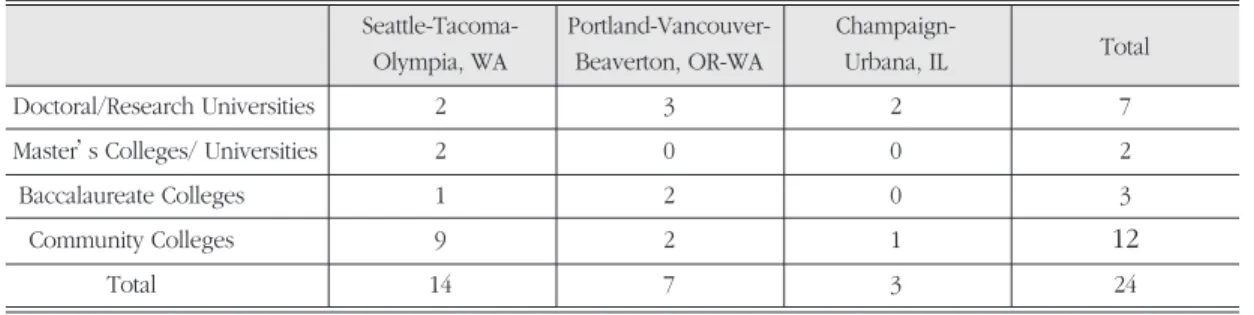
I also sent an on-line survey to the chairs and faculty members of IT-related programsviii such as Computer Science and Electrical Engineering in colleges and universities in the three metropolitan areas. Table 2 shows the numbers of responding IT-related programs in three metropolitan areas.
Three different versions of a survey questionnaire were created for: (1) IT companies;
(2) two-year community colleges; and (3) four- year colleges or universities. I posted the completed questionnaire survey on the web and sent an email with a brief introduction of the survey and a link to it to the email addresses found on-line and through phone calls.
Figure 1. Three metropolitan areas of case studies
Table 1. Respondents in three metropolitan areas
Seattle- Portland- Champaign Tacoma- Vancouver- -Urbana, IL
Total Olympia, eaverton,
WAB OR-WA
Respondents 37 29 14 80
Table 2. Number of responding IT-related programs in three metropolitan areas
Seattle-Tacoma- Portland-Vancouver- Champaign-
Total Olympia, WA Beaverton, OR-WA Urbana, IL
Doctoral/Research Universities 2 3 2 7
Master’s Colleges/ Universities 2 0 0 2
Baccalaureate Colleges 1 2 0 3
Community Colleges 9 2 1 12
Total 14 7 3 24
5. Factors Affecting Geographies of Educated Workforce Supply
IT companies have been increasingly active in recruiting educated workforce from colleges and universities. They need to find qualified workers with diverse skills and expertise for various IT- related jobs. Many graduates from IT-related programs at colleges and universities look for jobs at IT companies where they use their skills and expertise learned from colleges and universities. Educated workforce supply from higher education institutions to IT companies involves “transaction costs”(Coase, 1937;
Williamson, 1981), which include expenditures of time and money associated with searching for information regarding the possibilities of recruitment workforce and getting a job.
Transaction costs increase in accordance with the increases in the amount of time and efforts required by the transaction, and physical distance between IT companies and colleges/universities will increase the amount of time and efforts (Hipp & Gassmann, 1999; Schartinger, Rammer, Fischer, & Frohlich, 2002) that IT companies should invest in order to recruit graduates from the colleges/universities and that graduates from colleges/universities invest to find a job. Thus, geographies of educated workforce supply from colleges/universities to IT companies are influenced by physical proximity, the highest degree that a college/university offers, the degree of specialization and/or rarity of expertise that companies seek from their recruitment of workforce.
1) Physical proximity
Transaction cost theory has been used to
explain the emergence of “new industrial spaces,”where firms can minimize transaction costs by locating in spatially concentrated production networks where production is distributed horizontally (Hayter, 1997: 319).
Spatial proximity in industrial districts enables the production networks of firms to lower transaction costs associated with higher asset specificity without vertical integration.
If the physical distance between potential interaction partners is long, barriers to information gathering and communications will increase, and transaction costs will increase in accordance with increases in the amount of time and efforts required by the transaction (Hipp &
Gassmann, 1999; Schartinger, Rammer, Fischer, &
Frohlich, 2002). Physical proximity also fosters trust (Harrison, 1992) since trust requires familiarity and mutual understanding formed through repeated interactions, which are likely to be facilitated by personal contact (Nooteboom et al., 1997; Uzzi, 1997). Repeated personal contact is enhanced by physical proximity, and trust is more likely to be built through repeated contacts over short physical distances (Carney, 1998;
Harrison, 1992).
Hypothesis 1 Physical proximity affects the geographies of educated workforce supply from colleges/universities to IT companies.ix Physical proximity between IT companies and colleges/universities has a positive relationship with the degree to supply educated workforce.
⑴ IT companies
First, the survey responses from IT companies indicate that they are more likely to recruit technical workers from within the same metropolitan areas than from other geographic
areas. At the level of a vocational certificate, 24 out of 28 respondents (85.7%) recruited the largest portion of technical workers from the same metropolitan areas; at the associate degree level, 31 out of 32 respondents recruited the largest portion of technical workers from the same metropolitan areas (96.9%); at the baccalaureate degree level, 45 out of 61 respondents (73.8%) recruited the largest portion of technical workers from the same metropolitan areas; and at the master’s or professional degree level, 28 out of 43 respondents (65.1%) recruited the largest portion of technical workers from the same metropolitan areas; and at the doctoral degree level, 14 out of 27 respondents (51.9%) recruited the largest portion of technical workers from the same metropolitan areas.
Secondly, concerning student internship programs, the survey results from IT companies indicate that they are more likely to hire student interns from colleges or universities located in the same metropolitan areas than from further away. 9 out of 12 respondents (75.0%) hired interns from two-year community colleges located in the same metropolitan areas; 14 out of 23 respondents (60.9%) hired interns from four- year colleges or universities located in the same metropolitan areas.
The responding IT companies recruit the largest proportion of their technical workers and student interns from the same metropolitan areas, rather than remote geographic areas.
⑵ Two- year community colleges
According to the survey results, most of the two-year community colleges indicated that they provide educated workforce to IT companies located in close proximity to their own facility.
An average 75.5% of completers from two-year
community colleges obtain jobs in the same metropolitan areas (6 respondents), and about 98.99% of internship providers for students at community colleges are located in the same metropolitan areas (9 respondents). Strong connections between community colleges and local communities result in the geographic concentration of the educated workforce supply in local areas (in the same metropolitan areas) near community colleges.x
⑶ Four-year colleges or universities According to the survey results, the geographies of areas to which four-year colleges or universities provide graduates show mixed patterns. More than half of the total baccalaureate graduates (58.51%) take jobs within the same metropolitan areas, while only 26.20% of master’
s graduates find and take jobs in the same metropolitan areas. 25.13% of them find work in the same state, and 38.93% of them find work elsewhere in the U.S. These descriptive statistics show that physical proximity does not have a strong influence on the pattern. In case of doctoral degree holders, the majority of them work away from the colleges or universities they have graduated from. Average 39.75% of them work in the rest of the U.S.
Concerning geographies of internship providers, Table 3 shows that the largest portion of student interns from four-year colleges or universities work within the same metropolitan areas (average 71.50%) and that few student interns work outside the state where their colleges or universities are located.
The survey results show that physical proximity between IT companies and colleges/universities enhances the degree of educated workforce supply from colleges/
universities to IT companies. IT companies recruit/hire the largest proportion of their technical workers (at all degree levels) and student interns from the metropolitan areas where they are located. Community colleges, which are strongly connected to local communities, provide educated students and student interns to the same metropolitan areas.
Four-year colleges and universities provide the majority of their graduates with a baccalaureate degree and most of their student interns to the same metropolitan areas, however, they provide a much smaller proportion of graduates with a master’s and a doctoral degree to the same metropolitan areas.
2) Physical proximity and three factors related to workforce supply
⑴ Physical proximity and the degree of specialization and/or rarity of workforce expertise
It is difficult to search, access, and acquire highly specialized and/or rare expertise, and those who need the expertise are often willing to interact with them who have that expertise even over long distance. Transaction costs grow as physical distance between interaction partners
get longer, however, they benefit from the interactions with the partners that provide specialized and/or rare expertise, which often overcomes the transaction costs. If one has resources enough to afford the transaction costs, they are often willing to have long-distance interactions with partners that provide specialized and/or rare expertise. The more specialized and/or the rarer the expertise one needs, they are more likely to interact with partners over long distance. According to a survey of firms°Ø use of consultancies (Wood, 1996), large firms with more resources find specialized consultancies which can provide for their specific needs wherever they are located. They often search consultancies at national and/or international level to access and use specialized and/or rare services. They do not need to confine their search and use of consultancies in local areas if they provide highly specialized and/or rare services.
Hypothesis 2.1 Degree of specialization and/or rarity of expertise that companies seek from their recruitment of workforce affects the geographies of educated workforce supply from colleges/universities. The more specialized and/or rarer the expertise companies need, they are more likely to recruit graduates/completers Table 3. Geographies of internship providers, four-year colleges/universities
% of internship providers in each geographic area
Mean Median Minimum Maximum Total No. of IT-
relateddepartments
In the same metropolitan areas 71.50 87.50 1 99 13
In the rest of the same state 7.25 4.50 0 20 13
In the rest of the same division 0.33 0.00 0 1 13
In the rest of the U.S. 0.75 0.50 0 2 13
In foreign countries 0.00 0.00 0 0 13
from colleges or universities over long distance.
The survey results show that recruitment of technical workers with a lower degree level (an associate degree) is more concentrated in the same metropolitan areas than recruitment of technical workers with a higher degree level (a baccalaureate degree, a master’s or professional degree, and a doctoral degree) (Table 4). Given both the smaller numbers and greater specialization of graduates with higher degrees, employers search more broadly and extensively for more highly educated workers.
Greater specialization and smaller numbers of graduates with higher degrees (those with a baccalaureate degree, a master’s or professional degree, and a doctoral degree) make IT companies search them from more geographical- ly extensive areas. Geographic areas where four- year colleges or universities provide their graduates also indicate that physical proximity does not influence the patterns as the degree levels of graduates are higher. Recruiting
technical workers over long distance increases the cost of searching, but the cost is worthwhile when the technical workers have highly specialized and/or rare expertise.
⑵ Physical proximity and the highest degree level that colleges and universities offer
The highest degree that a college/university offers is an indicator of the degree of specialization and/or rarity of expertise that graduates from colleges and universities have. A college/university that offers a doctoral degree would provide more specialized and/or rarer technical workforce to IT companies than those that offers a master’s, a baccalaureate, or an associate degree. Also the highest degree level of a colleges/university is an important element of their prestige and may affect trust-building, resulting in decrease of transaction costs. It may increase companies’willingness to interact with the college/university.
Table 4. Geographic areas from which IT companies recruited technical workers
The largest portion of The largest portion of The largest portion of The largest portion of technical workers technical workers with technical workers technical workers with an associate a baccalaureate with a master’’s or with a doctoral
degree degree professional degree degree
No employees From the 43 15 33 47
same metropolitan areas 31 196.9% 45 73.8% 28 65.1% 14 51.9%
From the rest of the
01 190.0% 4 6.6% 3 7.0% 1 3.7%
same state From the rest of the
11 193.1% 2 3.3% 4 9.3% 5 18.5%
same division
From the rest of the U.S. 01 100.0% 7 11.5% 4 9.3% 3 11.1%
From foreign countries 01 100.0% 3 4.9% 4 9.3% 4 14.8%
N/A 5 4 4 6
Total 80 80 80 80
No. of responses 32 100.0% 61 100.0% 43 100.0% 27 100.0%
Hypothesis 2.2 Colleges and universities which offer a higher degree have geographically more extensive supply of educated workforce to IT companies than those which offer a lower degree.
When comparing two-year community colleges with four-year colleges or universities, we see that physical proximity affects the geographies of workplaces of students from two-year community colleges at higher degree than those from four-year colleges or universities. The survey results (Table 5) show that a higher proportion of two-year community college completers work in the same metropolitan areas (75.33%) as the community college from which they graduated than graduates from four-year colleges or universities (58.51% of graduates with a baccalaureate degree; 26.20% of graduates with a master’s degree; 8.20% of graduates with a doctoral degree; 48.25% of graduates with a
professional degree/certificate).
The survey results indicate that physical proximity affects the geographies of educated workforce supply by colleges/universities that offer varying levels of highest degrees. A higher proportion of completers from two-year community colleges worked in the same metropolitan area, than did graduates from four- year colleges/universities. Higher proportions of graduates from baccalaureate colleges worked in the same metropolitan areas than master’s and doctoral colleges/universities. Most of student interns from two-year community colleges worked within the same metropolitan areas while less proportion of student interns from four-year universities or colleges did within the same metropolitan areas. Higher proportion of graduates from baccalaureate colleges worked in physically proximate regions than those from master’s or doctoral colleges/universities.
Table 5. Geographic locations of employment, by two-year community colleges and four-year colleges/universities
Two-year
Four-year Colleges or universities Community Colleges
Average % of total Average % of Average % of total Average % of total Average % of
graduates with a total graduates with graduates with a graduates with a total completers
baccalaureate degree a master’s degree doctoral degree professional degree/certificate In the same
metropolitan 75.33 58.51 26.20 8.20 48.25
areas In the rest of
15.60 26.85 25.13 8.85 1.67
the same state In the rest of
the same 3.50 28.95 4.13 6.69 0.00
division In the rest of
5.00 47.50 38.93 39.75 0.67 the U.S.
In foreign
N/A 5.80 1.20 4.55 47.50
countries
(3) Physical proximity and size of IT companies
Large companies with more abundant resources are less affected by transaction costs, which increase with physical distance, than small companies. A survey of Austrian companies shows that large companies cooperate in innovative activities with partners from abroad more than small companies in a small and open economy (Schartinger et al., 2002). Small Swedish biotechnology companies are more bound and/or more dependent on geographically close knowledge resources than large companies. Small companies are more likely to write scientific papers in collaboration with Swedish universities than large companies (McKelvey et al., 2003). Small companies in the software industry are more dependent on regional resources, such as local skilled workforce, than large companies like Microsoft in Seattle (Gray, Golob, and Markusen, 1996). Small plants in Canada attach greater importance to closeness (physical proximity) to machinery products than large plants (Gertler, 1995).
Hypothesis 2.3 Large IT companies have more geographically extensive supply of educated workforce to colleges/universities than small IT companies.
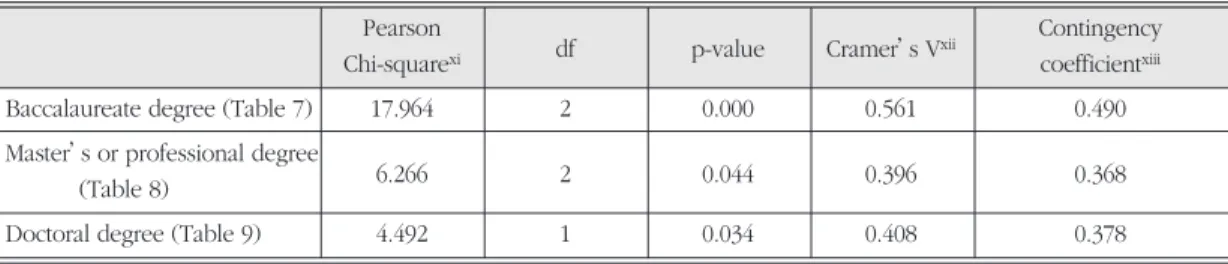
The results from contingency table analyses (Table 6) show that statistically significant relationships exist between size of IT companies
and the distance at which they interact with colleges/universities in terms of recruiting/hiring technical workers with a baccalaureate, a master’
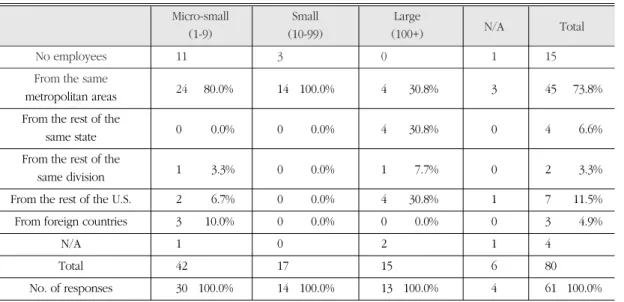
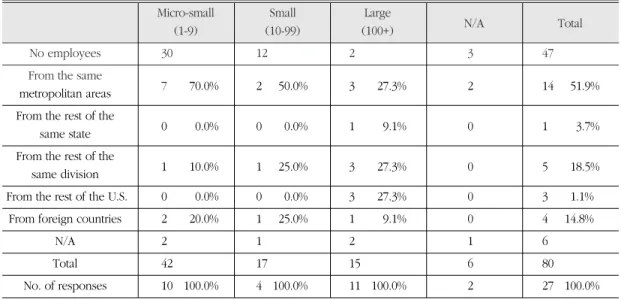
s/professional, and a doctoral degree. There are no statistically significant relationships between the recruitment and hiring of technical workers with a vocational certificate or an associate degree (confidence level = 0.05) and physical proximity. Large companies (≥ 100 employees) are more likely to recruit/hire technical workers with a baccalaureate degree (Table 7), a master’s or professional degree (Table 8), and a doctoral degree (Table 9) from colleges or universities outside of the same metropolitan areas than sm- all companies (<100 employees). Geographies of recruitment/hiring by small companies are more likely to be bound to the same metro- politan areas as the source of the workers.
Recruiting/hiring technical workers over long distance increases the cost of searching, but the cost is worthwhile when the technical workers have highly specialized and/or rare expertise (most technical workers with advanced degrees have highly specialized and/or rare expertise).
Large companies with more resources can afford higher search costs than can small companies.
Hence, large companies recruit/hire technical workers with advanced degrees over long distances while small companies are more dependent on technical workers that live in the same area.
Table 6. Contingency table analyses: geogr-aphies of recruiting/hiring technical workers
Pearson
df p-value Cramer’s Vxii Contingency
Chi-squarexi coefficientxiii
Baccalaureate degree (Table 7) 17.964 2 0.000 0.561 0.490
Master’s or professional degree
6.266 2 0.044 0.396 0.368
(Table 8)
Doctoral degree (Table 9) 4.492 1 0.034 0.408 0.378
Geographies of student internship programs are examined by asking the location of colleges and universities from which IT companies hired interns. The results from contingency table analyses (Table 10) show that a statistically significant relationship exists between size of
companies and physical proximity of the four- year colleges or universities from which they hired student interns. No relationship is found, though, between size of companies and physical proximity of two-year community colleges from which they hired student interns. Table 5-43 Table 7. Geographic areas of recruiting/hiring the largest portion of technical workers with a baccalaureate degree (No. of responding companies)
Micro-small Small Large
N/A Total
(1-9) (10-99) (100+)
No employees 11 3 0 1 15
From the same
24 180.0% 14 100.0% 43 130.8% 3 45 173.8%
metropolitan areas From the rest of the
0 100.0% 04 100.0% 43 130.8% 0 45 116.6%
same state From the rest of the
1 103.3% 04 100.0% 13 117.7% 0 25 113.3%
same division
From the rest of the U.S. 2 106.7% 04 100.0% 43 130.8% 1 75 111.5%
From foreign countries 3 110.0% 04 100.0% 03 100.0% 0 35 114.9%
N/A 1 0 2 1 4
Total 42 17 15 6 80
No. of responses 30 100.0% 14 100.0% 13 100.0% 4 61 100.0%
Table 8. Geographic areas of recruiting/hiring the largest portion of technical workers with a master’s or professional degree (No. of responding companies)
Micro-small Small Large
N/A Total
(1-9) (10-99) (100+)
No employees 22 7 2 2 33
From the same
14 173.7% 7 177.8% 42 133.3% 3 28 665.1%
metropolitan areas From the rest of the
09 110.0% 0 100.0% 32 125.0% 33 107.0%
same state From the rest of the
19 115.3% 1 111.1% 22 116.7% 0 43 109.3%
same division
From the rest of the U.S. 09 110.0% 1 111.1% 32 125.0% 0 43 109.3%
From foreign countries 49 121.1% 0 100.0% 02 100.0% 0 43 109.3%
N/A 1 1 1 1 4
Total 42 17 15 6 80
No. of responses 19 100.0% 9 100.0% 12 100.0% 3 43 100.0%
Table 9. Geographic areas of recruiting/hiring the largest portion of technical workers with a doctoral degree
Micro-small Small Large
N/A Total
(1-9) (10-99) (100+)
No employees 30 12 2 3 47
From the same
70 170.0% 2 150.0% 31 127.3% 2 14 151.9%
metropolitan areas From the rest of the
00 100.0% 0 100.0% 11 119.1% 0 17 113.7%
same state From the rest of the
1 1010.0% 1 125.0% 31 127.3% 0 57 118.5%
same division
From the rest of the U.S. 0 1000.0% 0 100.0% 31 127.3% 0 37 11.1%
From foreign countries 2 1020.0% 1 125.0% 11 109.1% 0 4 114.8%
N/A 2 1 2 1 6
Total 42 17 15 6 80
No. of responses 10 100.0% 4 100.0% 11 100.0% 2 27 100.0%
Table 10. Contingency table analysis: geographies of student interns from four-year colleges or universities Chi-square
Chi-square df p-value Cramer’s V Contingency coefficient
6.537 2 0.038 0.587 0.506
Table 11. Geographies of student interns from four-year colleges or universities, by size of companies
Micro-small Small Large
N/A Total
(1-9) (10-99) (100+)
No interns 14 3 2 2 21
From the same
6 175.0% 3 175.0% 1 114.3% 4 14 60.9%
metropolitan areas From the rest of the
1 112.5% 1 125.0% 3 142.9% 0 5 121.7%
same state From the rest of the
0 100.0% 0 100.0% 0 100.0% 0 0 100.0%
same division
From the rest of the U.S. 0 100.0% 0 100.0% 2 128.6% 0 2 108.7%
From foreign countries 1 112.5% 0 100.0% 0 100.0% 0 1 104.3%
Evenly distributed 0 100.0% 0 100.0% 1 114.3% 0 1 104.3%
In other regions 0 100.0% 0 100.0% 0 100.0% 0 0 100.0%
N/A 2 1 2 1 6
Total 42 17 15 6 80
No. of responses 8 100.0% 4 100.0% 7 100.0% 4 9 100.0%
shows that large companies hire greater proportions of student interns from outside the same metropolitan areas (6 out of 7, 85.7%) than small companies (1 out of 4, 25.0%) and micro- small companies do (2 out of 8, 25.0%). Small companies are more dependent on four-year colleges or universities within the same metropolitan areas as a source of their student interns.
In sum, large IT companies are more likely to recruit/hire technical workers with a baccalaureate or a master’s degree from colleges/universities outside of the same metropolitan areas than small companies. Large companies also hire higher proportions of student interns from outside the same metropolitan areas while small companies are more dependent on four-year universities or colleges within the same metropolitan areas.
6. Conclusions and Discussions
This research investigates geographies of educated workforce supply from colleges/universities to IT companies in three metropolitan areas in the U.S. Four hypotheses are analyzed through the survey and interviews with managers of IT companies and faculty members of IT-related programs at colleges and universities. First, the survey results show that physical proximity between IT companies and colleges/universities enhances the degree of educated workforce supply from colleges/
universities to IT companies. IT companies recruit the largest proportion of their technical workers and student interns from the metropolitan areas where they are located.
Second, the degree of specialization and/or rarity
of workforce expertise also affect geographies of educated workforce supply from higher education institutions to IT companies. The results indicate that IT companies recruit larger proportions of technical workers with a lower degree level (a vocational certificate and an associate degree) from the same metropolitan areas than technical workers with a higher degree levels (a baccalaureate degree, a master’s or professional degree, and a doctoral degree).
Both greater specialization and smaller numbers of graduates with higher degrees make employers search them from more geograp- hically extensive areas. Physical proximity has less influence the patterns to recruit technical workers and interns as the degree levels of graduates are higher. Recruiting technical workers over long distance increases the cost of searching, but the cost is worthwhile when the technical workers have highly specialized and/or rare expertise. Next, physical proximity affects the geographies of educated workforce supply from colleges/universities which grant different levels of the highest degrees to a different extent.
Community colleges, which are strongly connected to local communities, provide educated students and student interns to the same metropolitan areas. Four-year colleges and universities provide the majority of their graduates with a baccalaureate degree and most of their student interns to the same metropolitan areas, however, they provide a much smaller proportion of graduates with a master’s and a doctoral degree to the same metropolitan areas.
Finally, physical proximity affects the geographies of educated workforce supply from colleges/universities to IT companies with different sizes. Large IT companies are more likely to recruit/hire educated workforce from
colleges/universities outside of the same metropolitan areas than small IT companies.
Large companies also hire higher proportions of student interns from outside the same metropolitan areas while small companies are more dependent on colleges or universities within the same metropolitan areas.
Human capital raised from higher education has been increasingly emphasized in economic development with the rise of a knowledge-based economy, and cities have been recognized as places to attract human capital. Numerous national and regional economic development policies pursue closer links between colleges/universities and companies. Educated workforce supply is one of the primary roles of colleges and universities, and understanding its geographies has critical policy implications. It is significant for the design of economic development policies at diverse scales to recognize the degree of localization that different colleges and universities supply educated workforce to innovative companies. Further research will be necessary to explore how to raise human capital at diverse geographic scales.
The limitations of this paper would be complemented by the following research. First, considering more than half of demand for IT workers is outside from IT-producing industries (U.S. Department of Commerce, 2000), the focus of future research should be enlarged to include IT-using industries as well as IT-producing industries such as hardware, software, communication equipment and services. Second, although IT-related programs usually refer to Computer Science and/or Electrical Engineering fields, it will be important to examine other programs to educate and train IT workforce.
There is actually great diversity in the types of
degrees that workers in IT-related fields hold, and many people who did not major in Computer Science and/or Electrical Engineering, such as Physics and Applied Math majors or even non-science majors, work in IT-related occupations (U.S. Department of Commerce, 2003b: 33-35). Finally, diverse education and training programs in the fields are recently growing in addition to the formal education programs, including private institutes that provide intensive courses for various certificates, and on- line education programs for self-study in IT- related fields. Including these new programs will help to better understand diverse needs of IT companies and various interactions between them and IT-related education.
Notes
1) “ome of the benefits of a more educated workforce force will typically leak out and generate macroeconomic benefits that cannot be appropriated in the form of higher earnings by those who undertake the relevant investment. The leakages are often called externalities.”
(Fuente & Ciccone, 2003: 3)
2) Human capital is an important determinant of productivity at an individual level as well as at an aggregate level. At a microeconomic level, there is evidence that school attainment is a major determinant of individual income and workforce market status and that on-the-job training has a robust relationship with individual wages (Fuente & Ciccone, 2003: 3).
3) The term of postsecondary education is interchangeably used with higher education. (http://nces.ed.gov/ipeds/
glossary/pdf/IPEDSglossary.pdf)
4) An elite set of about 100 institutions does many things in addition to educating students. These institutions perform most of the nation’s basic research, provide a substantial amount of medical care (especially the most technically demanding services), and supply athletic entertainment to national television audiences. In most of the world, higher education institutions serve primarily an
educational purpose, leaving basic research, medical care, and athletics to other organizations.
5) http://www.carnegiefoundation.org/Classification/
CIHE2000/defNotes/Definitions.htm
6) http://www.carnegiefoundation.org/Classification/
CIHE2000/background.htm
7) Workers in IT-related occupations develop, design, manufacture, operate, maintain, and repair IT products and provide related services across all industries, including IT-producing industries (U.S. Department of Commerce, 2003a).
8) A program is defined as “a combination of courses and related activities organized for the attainment of broad educational objectives.”(http://nces.ed.gov/ipeds/
glossary/pdf/IPEDSglossary.pdf)
9) In this paper, a company is defined as a business or industrial unit at a single physical location which produces or distributes goods or performs services.
10) Data of Washington State Board of Community and Technical Colleges also show that majority of the graduates from 20 community colleges in Seattle- Tacoma-Olympia, WA CBSA (in academic year 2000- 2001) got their jobs within Seattle-Tacoma-Olympia, WA CBSA or in WA within one year of graduation. 62.04%
of total graduates worked in Seattle-Tacoma-Olympia, WA CBSA, 36.72% of them worked in the rest of WA, 0.93% of them worked elsewhere in the Division (Division 9: Pacific including Alaska, California, Hawaii, Oregon, and Washington), and 0.31% worked in the same Region (Region 4: West including Mountain and Pacific Division). None of the graduates worked outside of the West Region.
11) Chi-square (crosstabs) is a statistic used to test the hypothesis that the row and column variables are independent.
12) Cramer’s V is a measure of the strength of association between two variables when one or both are at the nominal level of measurement (SPSS tutorial).
13) Contingency coefficient also measures the strength of association between two variables. The values of Cramers’s V and contingency coefficient statistics range from 0 to 1, and low values for the test statistics indicate that the relationship between the two variables is a fairly weak one (SPSS tutorial).
REFERENCES
Bania, N., Eberts, R. W., and Fogarty, M. S., 1993, Universities and the startup of new companies:
can we generalize from Route 128 and Silicon Valley?, The Review of Economics and Statistics, 75(4), 761-766.
Becker, G., 1962, Investment in human capital: a theoretical analysis, Journal of Political Economy, 70(5), 9-49.
Becker, G., 1964, Human Capital, Columbia University Press, New York.
Beeson, P., and Montgomery, E., 1993, The effects of colleges and universities on local labor markets, The Review of Economics and Statistics, 75(4), 753-761.
Bozeman, B. and Mangematin, V., 2004, Editorial:
Editor’s introduction: building and deploying scientific and technical human capital, Research Policy, 33, 565-568.
Braczyk, H.-J., Cooke, P., and Heidenreich, M.(eds.), 1998, Regional Innovation Systems: the Role of Governances in a Globalized World, UCL Press.
Dosi, G., and Orsenigo, L., 1988, Coordination and transformation: An overview of structures, behaviours, and change in evolutionary environments, in Dosi, G.(ed.), Technical Change and Economic Theory, Pinter Publishers, London and New York, 13-37.
Drucker, P. F., 1993, Concept of the Corporation, Transaction Publishers, New Brunswick, N.J., U.S.A.
Drucker, P. F., 2002, Managing in the Next Society, Truman Talley Books, St. Martin’s Press, New York.
Feller, I., 1999, The American university system as a performer of basic and applied research, in Lewis F. K., Branscomb, M., and Florida, R.(ed.), Industrializing Knowledge: University-Industry Linkages in Japan and to United States, The MIT Press, Cambridge, Massachusetts, and London, England, 65-101.
Felsenstein, D., 1996, The university in the metropolitan arena: Impacts and public policy implications, Urban Studies, 33(9), 1565-1580.
Florax, R., 1992, The University: A Regional Booster?:
Economic Impacts of Academic Knowledge Infrastructure, Avebury, Aldershot.
Fuente, A. D. L. and Ciccone, A., 2003, Human Capital in a Global and Knowledge-based Economy, Office for Official Publications of the European Communities, Luxembourg.
Graham, H. D. and Diamond, N., 1997, The Rise of American Research Universities: Elites and Challenges in the Postwar Era, The Johns Hopkins University Press, Baltimore and London.
Harrison, B., 1992, Industrial districts: Old wine in new bottles?, Regional Studies, 26(5), 469-483.
Hayter, R., 1997, The Dynamics of Industrial Location, Wiley, Chichester.
Hedrick, D.W., Henson, S. E., and Mack, R. S., 1990, The effects of universities on local retail, service, and F.I.R.E. employment: some cross-sectional evidence, Growth and Change, 21, 9-20.
Hipp, C. and Gassmann, O., 1999, Leveraged knowledge creation: The role of technical services as external sources of knowledge, Proceedings of the Portland International Conference on Management of Engineering and Technology, July, 1999, Vol. 1.
Lucas, R. E. J., 1988, On the mechanics of economic development, Journal of Monetary Economics, 22, 3-42.
Lundvall, B.-A.(ed)., 1992, National Systems of Innovation: Towards a Theory of Innovation and Interactive Learning, Pinter Publishers, London.
Markusen, A., 1996, Sticky places in slippery space: a typology of industrial districts, Economic Geography, 72(3), 293-313.
Martin, R., and Sunley, P., 2003, Deconstructing clusters:
Chaotic concept or policy panacea?, Journal of Economic Geography, 3(1), 5-35.
Mathur, V. K., 1999, Human capital-based strategy for regional economic development, Economic Development Quarterly, 13(3), 203-216.
Mincer, J. and Jovanovic, B., 1982, Labor Mobility and Wages, NBER Working Paper No. W0357.
Murphy, K. M. and Welch, F., 1989, Wage premiums for college graduates: Recent growth and possible explanations, Educational Researcher, 18, 17-27.
National Research Council of the National Academies, 2003, Innovation in Information Technology, The National Academies Press, Washington D.C.
Nelson, R. R.(ed.), 1993, National Innovation Systems: A Comparative Analysis, Oxford University Press, New York and Oxford.
Nonaka, I. and Takeuchi, H., 1995, The Knowledge- creating Company: How Japanese Companies Create the Dynamics of Innovation, Oxford University Press, New York.
Nooteboom, B., Berger, H., and Noorderhaven, N. G., 1997, Effects of trust and governance on relational risk, Academy of Management Journal, 40(2), 308-338.
Park, S. O., 1996, Network and embeddedness in the dynamic types of new industrial districts, Progress in Human Geography, 20(4), 476-492.
Romer, P.M., 1986, Increasing returns and long-run growth, Journal of Political Economy, 94(5), 1002-1037.
Romer, P. M., 1990, Endogenous technological change, Journal of Political Economy, 98, S71-S102.
Saxenian, A., 1994, Regional Advantage: Culture and Competition in Silicon Valley and Route 128, Harvard University Press, Cambridge.
Schartinger, D., Rammer, C., Fischer, M. M., and Frohlich, J., 2002, Knowledge interactions between universities and industry in Austria:
sectoral patterns and determinants, Research Policy, 31, 303-328.
Schultz, T. W., 1963, The Economic Value of Education, Columbia University Press, New York.
Solow, R. M., 1956, A contribution to the theory of economic growth, Quarterly Journal of
Economics, 70, 65-94.
Stokey, N. L., 1991, Human Capital, Product Quality, and Growth, The Quarterly Journal of Economics, 106(2), 587-616.
Todaro, M. P., 1997, Economic Development (Sixth Edition), Addison-Wesley Publishing Company, Reading.
U.S. Department of Commerce, 1999, The Emerging Digital Economy II: Economics and Statistics Administration, Office of Policy Development.
U.S. Department of Commerce, 2000, Digital Economy 2000: Economics and Statistics Administration, Office of Policy Development.
U.S. Department of Commerce, 2002, Digital Economy 2002: Economics and Statistics Administration, Office of Policy Development.
U.S. Department of Commerce, 2003a, Digital Economy 2003: Economics and Statistics Administration, Office of Policy Development.
U.S. Department of Commerce, 2003b, Education and Training for the Information Technology Workforce.
Uzzi, B., 1997, Social structure and competition in interfirm networks: the paradox of embeddedness, Administrative Science Quarterly, 42, 35-47.
Wood, P., 1996, Business services, the management of change and regional development in the UK: A corporate client perspective, Transactions of the Institute of British Geographers, 21(4), 649-665.
Correspondence: Hyungjoo Kim, Science&Technology Policy Institute, Sindaebang2-Dang, Dongjak- Gu, Seoul, 156-714 Korea (e-mail: hjkim@stepi.
re.kr, phone: 02-3284-1782)
교신:김형주, 156-714 서울시 동작구 신대방2동 과학기 술정책연구원 (이메일: [email protected], 전화:
02-3284-1782)
Received June 7, 2005 Accepted December 23, 2005