• 검색 결과가 없습니다.

Effects of Lumbar Position Sense on Swing Chair in Healthy Adults J K S P T

N/A
N/A
Protected

Academic year: 2021

Share "Effects of Lumbar Position Sense on Swing Chair in Healthy Adults J K S P T"

Copied!
5
0
0

로드 중.... (전체 텍스트 보기)

전체 글

(1)

Effects of Lumbar Position Sense on Swing Chair in Healthy Adults

Yu-Min Ko, PT, MS

1

, Seol Park, PT, MS

1

, Yun-Jin Kim, PT

1

, Su-Bin Yun, PT

1

, Gwon-Uk Jang, PT, MS

1

, Ji-Won Park, PT, PhD

2

1

Department of Physical Therapy, Graduate School, Catholic University of Daegu,

2

Department of Physical Therapy, College of Medical Science, Catholic University of Daegu

Purpose: To recognize the change in the proprioception under conditions that activate the local muscles, this study found the difference in the proprioception on a fixed and swing chair.

Methods: Healthy adults (7 males, 13 females) in their twenties were evaluated lumbar position sense on fixed and swing chair. And the difference of the position sense between the fixed and swing chair were analyzed.

Results: The joint position senses were compared between the fixed and swing chair. As a result, there was a significant difference from all motions.

Conclusion: This study found that the improvement of proprioception using swing chair means that the local muscle is activated. Therefore, to use a swing chair, which was designed in this study, is able to replace the general chair either at work or during studies. Thus, this method is easily accessible for busy modern people who are exposed to low back pain or spinal disorders due to a pattern of inactivity.

Keywords: Swing chair, Proprioception, Low back pain

I. Introduction

Among the people living in the 21st century, inactive life patterns, which are static activity types, account for the majority of people’s work patterns rather than active life patterns.

1

Such patterns decrease the amount of physical activity. As a result, a weakness of the skeletal muscles is engendered, resulting in the development of musculoskeletal diseases. In addition, many people today work on computer desks and thus, sit in a chair for the entire day. Such position induces spinal disorders caused by the incorrect postural alignment of the chair. As a result, low back pains occur, engendering a typical musculoskeletal disease in today’s people.

2

The most scientific therapeutic exercise to treat and prevent a low back pain is the lumbar stabilization exercise of the local muscles such as the multifidus and transverse abdominis.

3,4

These local muscles are the most critical in stabilizing the lumbar and maintaining proprioception.

5

The inappropriate and insufficient activation of the local muscles produce spinal instability, which appears as a low back pain.

6,7

Therefore, treatment of a low back pain should be focused on the improvement of proprioception as well as the lumbar stabilization exercise.

In some of the current studies on lumbar stabilization exercises, they discuss therapeutic exercises which help to strengthen the local muscles.

4,8-11

For example, there are researches on therapeutic methods with an unstable surface such as the Swiss-ball or sling.

12-15

Lumbar exercise is an effective method for prevention as well as treatment.

3,4

Thus, an exercise to strengthen local muscles during a daily routine, either working or not, may be essential in the busy lives of modern people. Moreover, it is significant to develop an understanding as well as to study chairs with movable seats Received May 31, 2012 Revised June 8, 2012

Accepted June 15, 2012

Corresponding author Ji-Won Park, [email protected]

Copyright © 2012 by The Korean Society of Physical Therapy

This is an Open Access article distributed under the terms of the Creative Commons Attribution Non-Commercial License (http://creativecommons.org/licenses/by-nc/3.0/) which permits unrestricted non-commercial use, distribution, and reproduction in any medium, provided the original work is properly cited.

The J ournal of K orean S ociety of P hysical T herapy Original Article

(2)

for research purposes.

To recognize the change in the proprioception under conditions that activate the local muscles, this study found the difference in the proprioception on a fixed and swing chair.

Furthermore, we suggest that a swing chair prevents low back pain due to an inactive life pattern. Also, using a chair in one’s daily life activates the local muscles and improves the lumbar proprioception.

II. Materials and Methods

1. Subjects

Healthy adults (7 males, 13 females) in their twenties were enrolled in this study (mean age=23.0 yr, height=165.8 cm, weight=59.7 kg). They had no neurologic and orthopedic problems. The subjects voluntarily agreed to participate in the experiment after listening to the purpose and method of the study.

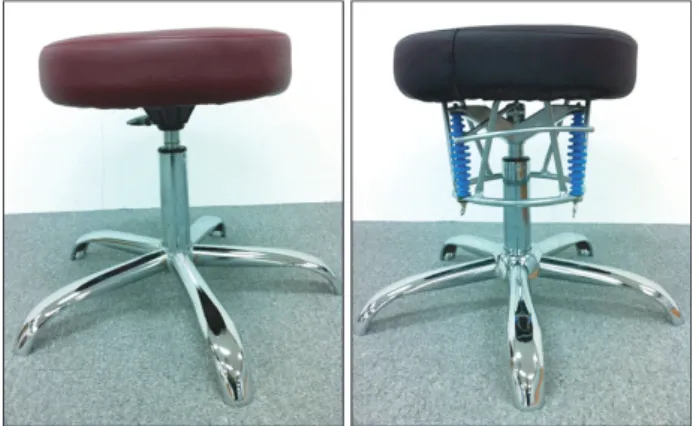
2. Experimental methods 1) Experimental equipments (1) Chairs (Figure 1)

The chairs used in this experiment were a fixed chair, which are commonly used, and a swing chair, which was specially designed. The fixed chair was a common usable chair, and it was fixed between the seat and the column. The seat on the swing chair was designed only to translate freely to 5 cm maximally and to sway any direction on a horizontal plane.

Both chairs had the same design and both seats were 40 cm in diameter. Adjusting the height of the chair was also possible.

(2) Zebris

Zebris is a device measuring the range of motion (ROM) of the spine, and it is has proven the equipment with reliability and validity.

16,17

Two sensors are used to measure the ROM of the lumbar spine, which is the angle of acceptance recognized from sensors using an ultrasonic. In this experiment, Zebris was used to measure the joint position sense, known as proprioception.

First, the subjects maintained a neutral position. Then, the examiner manually guided the subject to an arbitrary angle, and the subjects were kept at the angle for about 5 seconds to fully recognize the angle. After the subjects changed back into the neutral position, they actively moved to find the arbitrary angle. At this time, the difference between the actual and arbitrary angle was measured.

2) Experimental procedure

Subjects were equipped with Zebris with lumbar spine and they were measured in a position three times in each of the fixed and swing chair. Three times the average was used as a measurement value. First, chair height was achieved at a 90 degree angle of hip and knee, respectively. Their arms crossed over their chest while moving so that the arms did not obstruct the sensor. They were measured after sufficient explanation and practice of sitting in chairs in a sitting position. Position senses were measured in all motions including flexion/extension, right/left rotation, and right/left lateral flexion.

3. Data analysis

A paired-t test was used to compare the position sense between a fixed and swing chair. The IBM SPSS ver. 19.0 (SPSS Inc., Chicago, IL, USA) was used for statistical analysis.

p-values less than 0.05 were used to identify significant differences.

III. Results

1. The position sense according to type of chairs

The joint position senses were compared between the fixed

Figure 1. The fixed (left) and swing (right) chair.

(3)

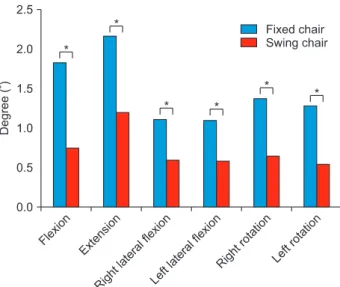
and swing chair. As a result, there was a significant difference from all motions (Figure 2).

During flexion, reposition error was 1.83±0.96 degree on a fixed chair, and 0.75±0.67 degree on a swing chair (p<0.00). During extension, reposition error was 2.17±1.05 degree on a fixed chair, and 1.20±0.94 degree on a swing chair (p<0.00). During right lateral flexion, reposition error was 1.11±0.77 degree on a fixed chair, and 0.60±0.42 degree on a swing chair (p<0.00). During left lateral flexion, reposition error was 1.10±0.54 degree on a fixed chair, and 0.58±0.44 degree on a swing chair (p<0.00). During right rotation, reposition error was 1.37±0.63 degree on a fixed chair, and 0.65±0.39 degree on a swing chair (p<0.00).

During left rotation, reposition error was 1.28±0.48 degree on a fixed chair, and 0.55±0.25 degree on a swing chair (p<0.00).

IV. Discussion

The purpose of this study was to determine whether there are any differences of the proprioception between a fixed chair and a swing chair. Moreover, while the local muscles are activated, the study demonstrated whether or not the proprioception improved. In this study, the chair with a movable seat on a fixed column was designed in order to activate the local muscles. The swing chair was produced to

move in any direction over a horizontal plane. We believed that maintaining the stability in a sitting position on a swing chair will activate the local muscles.

The result of the study reveals that proprioception was more enhanced on a swing chair compared to that of a fixed chair. Local muscles stabilize and maintain the posture of the lumbar spine.

5

These postural muscles contain a large percentage of type I fiber, which is distributed in many of the muscle spindles. Muscle spindles are typical proprioceptive receptors, thus, the improvement of proprioception means that the local muscle is activated.

Proprioception in the spine is essential in maintaining the correct postural alignment. It is also a significant sense in order to prevent low back pain or musculoskeletal disorders.

18-20

Therefore, researches on methods to improve proprioception as well as lumbar stabilization exercises have been actively studied in order to prevent and treat low back pain.

21,22

One of the ways for prevention is to use equipment such as Biodex.

23,24

Biodex is training equipment as well as a measurement of proprioception, yet, it is expensive, difficult to use, and needs the help of a skilled therapist.

Therefore, Biodex has many temporal and spatial constraints in its use. Methods of training on a movable surface are used greatly such as a sling or Swiss ball training.

12-15

Sling is expensive and needs the help of a skilled therapist. Although the Swiss ball is used for home treatment, there is a risk of falling and further, its users often fear of falling from the ball.

Proprioceptive training methods have several temporal and spatial limitations, such as having to set aside time to devote to exercise and experience limitations on the use of the equipment.

25

A swing chair, which was designed in this study, is able to replace the general chair either at work or during studies.

Thus, this method is easily accessible for busy modern people who are exposed to low back pain or spinal disorders due to a pattern of inactivity. In addition, unlike the Swiss ball, it does not include a risk of falling. Therefore, it may be an efficient way both temporally and spatially.

According to a study in Australia, the use of Swiss ball is to improve the attention of children.

26

Although it raises doubts that to work on a swing chair may adversely affect the

Figure 2. The lumbar position sense according to type of chairs.

(4)

ability to work, working on a swing chair is also expected to increase one’s attention, similar to the Swiss ball. Thus, future research will need to prove whether using a swing chair can improve attention. It has been demonstrated that the use of a swing chair improved proprioception. Thus, in order to investigate whether an improvement of proprioception is due to local muscles, EMG studies about local muscles on a swing chair is required.

Author Contributions

Research design: Park JW, Ko YM Acquisition of data: Kim YJ, Yun SB

Analysis and interpretation of data: Park S, Ko YM Drafting of the manuscript: Park S

Administrative, technical, and material support: Ko YM Research supervision: Park JW

Acknowledgements

This work (Grants No. 00047074) was supported by Business for Cooperative R&D between Industry, Academy, and Research Institute funded Korea Small and Medium Business Administration in 2011.

References

1. Andersson GB. Epidemiologic aspects on low-back pain in industry. Spine (Phila Pa 1976). 1981;6(1):53-60.

2. Bjerkeset T, Johnsen LG, Kibsgaard L et al. Surgical treatment of degenerative lumbar diseases. Tidsskr Nor Laegeforen.

2005;125(13):1817-9.

3. Luoto S, Aalto H, Taimela S et al. One-footed and externally disturbed two-footed postural control in patients with chronic low back pain and healthy control subjects. A controlled study with follow-up. Spine (Phila Pa 1976). 1998;23(19):2081-9.

4. Barr KP, Griggs M, Cadby T. Lumbar stabilization: core concepts and current literature, Part 1. Am J Phys Med Rehabil.

2005;84(6):473-80.

5. O’Sullivan P, Twomey L, Allison G. Dynamic stabilisation of the lumbar spine. Crit Rev Phys Rehabil Med. 1997;9:315-30.

6. Fordyce WE, Brockway JA, Bergman JA et al. Acute back pain: a control-group comparison of behavioral vs traditional management methods. J Behav Med. 1986;9(2):127-40.

7. Mikkelsson LO, Nupponen H, Kaprio J et al. Adolescent flexibility,

endurance strength, and physical activity as predictors of adult tension neck, low back pain, and knee injury: a 25 year follow up study. Br J Sports Med. 2006;40(2):107-13.

8. Norris CM. Spinal stabilisation. An exercise program to enhance lumbar stabilisation. Physiotherapy. 1995;81(3):138-46.

9. Sung PS. Multifidi muscles median frequency before and after spinal stabilization exercises. Arch Phys Med Rehabil. 2003;84(9):1313-8.

10. Lee HO. Activation of trunk muscles during stabilization exercises in four-point kneeling. J Korean Soc Phys Ther. 2010;22(5):33-8.

11. You YY, Kim HS. Comparing the effects on elderly women of bearing weights and lumbar stabilization using lumbar muscle exercises group vs. Individual sessions with a physical therapist. J Korean Soc Phys Ther. 2010;22(5):17-23.

12. Park SD, Kim SH. The effects of the seosorimotor training through using the sling suspension system, on lower extremity of proprioception and muscle activation with hemiplegia. J Sport Leisure Studies. 2011;46(2):1201-12.

13. Mori A. Electromyographic activity of selected trunk muscles during stabilization exercises using a gym ball. Electromyogr Clin Neurophysiol. 2004;44(1):57-64.

14. Sekendiz B, Cuğ M, Korkusuz F. Effects of Swiss-ball core strength training on strength, endurance, flexibility, and balance in sedentary women. J Strength Cond Res. 2010;24(11):3032-40.

15. Willardson JM. Core stability training: applications to sports conditioning programs. J Strength Cond Res. 2007;21(3):979-85.

16. Fölsch C, Schlögel S, Lakemeier S et al. Test-retest reliability of 3D ultrasound measurements of the thoracic spine. PM R.

2012;4(5):335-41.

17. Prushansky T, Deryi O, Jabarreen B. Reproducibility and validity of digital inclinometry for measuring cervical range of motion in normal subjects. Physiother Res Int. 2010;15(1):42-8.

18. Leinonen V, Määttä S, Taimela S et al. Impaired lumbar movement perception in association with postural stability and motor- and somatosensory-evoked potentials in lumbar spinal stenosis. Spine (Phila Pa 1976). 2002;27(9):975-83.

19. Radebold A, Cholewicki J, Polzhofer GK et al. Impaired postural control of the lumbar spine is associated with delayed muscle response times in patients with chronic idiopathic low back pain.

Spine (Phila Pa 1976). 2001;26(7):724-30.

20. Leinonen V, Kankaanpää M, Luukkonen M et al. Lumbar paraspinal muscle function, perception of lumbar position, and postural control in disc herniation-related back pain. Spine (Phila Pa 1976).

2003;28(8):842-8.

21. Richardson CA, Jull GA. Muscle control-pain control. What exercises would you prescribe? Man Ther. 1995;1(1):2-10.

22. Ma SY, Kim HD. Effect of a PNF training program on functional assessment measures and gait parameters in healthy older adults. J Korean Soc Phys Ther. 2010;22(1):39-45.

23. Akhbari B, Ebrahimi-Takamjani I, Salavati M et al. A 4-week biodex stability exercise program improved ankle musculature onset, peak latency and balance measures in functionally unstable ankles. Phys Ther Sports. 2007;8(3):117-29.

24. Salsabili H, Bahrpeyma F, Forogh B et al. Dynamic stability training

improves standing balance control in neuropathic patients with

(5)

type 2 diabetes. J Rehabil Res Dev. 2011;48(7):775-86.

25. Gstoettner M, Raschner C, Dirnberger E et al. Preoperative proprioceptive training in patients with total knee arthroplasty.

Knee. 2011;18(4):265-70.

26. Fedewa AL, Erwin HE. Stability balls and students with attention

and hyperactivity concerns: implications for on-task and in-seat

behavior. Am J Occup Ther. 2011;65(4):393-9.

수치

Figure 1. The fixed (left) and swing (right) chair.
Figure 2. The lumbar position sense according to type of chairs.

참조

관련 문서

[r]

 The Dutch physicist Pieter Zeeman showed the spectral lines emitted by atoms in a magnetic field split into multiple energy levels...  With no magnetic field to align them,

Modern Physics for Scientists and Engineers International Edition,

작곡가의 원곡이 지휘자와 연주가에 의해 새롭게 태어나듯이, 우리가 배우고 체득한 모든 이론들과 지식, 테크닉들은 우리 자신에게서 새롭게

2재화 2요소 헥셔-올린 모형에서는 어느 한 경제에서 어느 한 요소의 양이 증가하면, 그 요소를 집약적으로 사용하는 산업의 생산량은 증가하고 다른

Ross: As my lawfully wedded wife, in sickness and in health, until

다양한 번역 작품과 번역에 관한 책을 읽는 것은 단순히 다른 시대와 언어, 문화의 교류를 넘어 지구촌이 서로 이해하고 하나가

The index is calculated with the latest 5-year auction data of 400 selected Classic, Modern, and Contemporary Chinese painting artists from major auction houses..