of Cancer Prevention 2000; 5(4): 193-198
INTRODUCTION
Laboratory animal studies as well as human epide- miological studies both indicate that dietary habits play an important role in the development of cancer.
1 3)~Several phytochemicals, food substances and some drugs inhibit different stages of carcinogenesis in several models, and some of these substances are thought to retard formation of certain human cancers in high risk populations.
4 6)~Neoplasia of the colon is a leading cause of cancer death in the United states
and other developed countries.
7)Antioxidants and other plant components like lignin have been one major focus of attention. The related phenolic, ferulic acid (FA), found in the husks of rice and other grains as well as in green tea has been shown to inhibit cancer induction in the tongue by 4-nitroquinoline 1-oxide and pulmonary tumors in mice due to benz[ a ]pyrene treatment.
8 10)~It is also reported to depress TPA-promotion of skin tumori- genesis as a synthetic polymer in mice.
11)It may furthermore have been responsible for the reported The influence of ferulic acid (FA) and 3-ethyl (4-geranyloxy-3-methoxyphenyl)-2- propenoate (EGMP) on the post-initiation stages of colon carcinogenesis was investigated in male F344 rats treated with azoxymethane (AOM). FA and EGMP were given in the diet at 0.1 or 0.2% starting at week 3 after with two s.c. 15mg/kg body weight injections of AOM on days 1 and 7. Sacrifice for quantitation of aberrant crypt foci (ACF) was performed at the end of week 5. Dose-dependent decreases in numbers of ACF were noted with EGMP cases of post-initiation exposure, large size lesions feeding considered most likely to be precursor lesions also being significantly reduced.
In contrast, only feeding 0.2% FA diet had exert inhibiting effect on the incidence of ACF. No effects on body or liver weights were evident. Thus our present results suggest that EGMP may have a potential cancer chemopreventive agent in rat colon carcinogenesis model.
Key Words: Ferulic acid, 3-Ethyl (4-geranyloxy-3-methoxyphenyl)-2-propenoate (EGMP), Synthetic ferulic acid derivative, Colon carcinogenesis
Chemopreventive Effects of Ferulic Acid and
3-ethyl(4'-geranyloxy-3-methoxyphenyl)-2-propenoate (EGMP) on Colon Carcinogenesis in Rats Treated with Azoxymethane
Cheol Beom Park, Dae Joong Kim
1and Joon Sup Lee
2Catholic University Medical College, Seoul 137-701;
1Cancer Prevention Laboratory,
College of Veterinary Medicine & Research Institute of Veterinary Medicine, Chungbuk National University, Cheongju 361-763;
2College of Veterinary Medicine,
Seoul National University, Suwon 441-744, Korea
Corresponding author Cheol Beom Park, Department of Anatomy, College of Medicine, The Catholic University of Korea, 505: Banpo-dong, Seocho-gu, Seoul 137-701, Korea. Tel: 02-590-1158, Fax: 02-536-3110, E-mail: [email protected]
inhibition of skin chemical carcinogenesis by Javanica extract.
12)However, it was without effect in a rat study of the forestomach and no data are available regarding its potential modifying influence in the colon. Since it has anti-inflammatory actions as well as antioxidative properties it might be expected to exert beneficial effects in this site.
13,14)In our previous study, we showed that 3-ethyl (4-geranyloxy-3-methoxyphenyl)-2-propenoate (EGMP), a newly synthesized FA derivative, was an effective inhibitor of aberrant crypt foci (ACF) induced rat colon carcinogenesis.
15)In the present study, two compounds were then fed to rats, in order to evaluated whether each was effective inhibiting the in vivo formation of ACF.
MATERIALS AND METHODS
1) Cheimcals
The carcinogen azoxymethane (AOM) (CAS: 25843- 45-2) was obtained from Sigma (St. Louis, MO, USA).
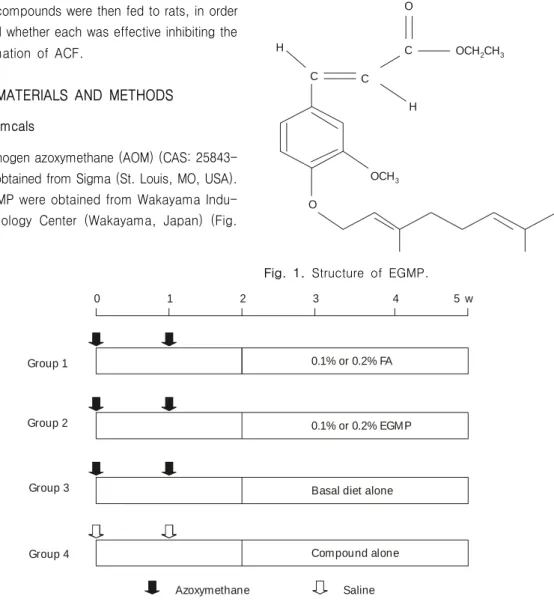
FA and EGMP were obtained from Wakayama Indu- strial Technology Center (Wakayama, Japan) (Fig.
1).
2) Animals
Male F344 rats were purchased from Charles River Japan (Atsugi, Shizuoka, Japan) at 5 weeks of age and maintained in plastic cages in an air-conditioned room under constant conditions of temperature (22±2
oC) and humidity (55±10%). The animals were allowed free access to basal diet (Oriental MF, Oriental Yeast Co., Ltd., Tokyo, Japan) and tap water and were used in the experiments after a 1 week acclimation period.
Fig. 2. Experimental protocol for rat colon carcinogenesis.
0 1 2 3 4 5 w
0.1% or 0.2% FA
0.1% or 0.2% EGMP
Basal diet alone
Compound alone Group 1
Group 2
Group 3
Group 4
Azoxymethane Saline
Fig. 1. Structure of EGMP.
O C C
C OCH2CH3 H
H
OCH3 O
3) Treatments
The experimental protocols followed are illustrated in Fig. 2. Groups 1, 2, and 3 (10 animals each) were given s.c. injections of 15 mg/kg AOM at days 1 and 7. Those in group 1 received 0.2 or 0.1% FA, Group 2 0.2 or 0.1% EGMP, while Group 3 was given basal diet. Group 4, served as the FA, EGMP, and basal diet alone control (5 animals each). All animals were killed under ether anesthesia at the end of week 5 for
analysis of lesion development. At sacrifice body and liver weights were measured.
4) Aberrant crypt foci (ACF) counting
For detection of ACF, the colons were removed, inflated with 10% formalin, cut longitudinally from the cecum to anus, folded within filter papers, fixed in buffered 10% formalin and then stained with 0.5%
methylene blue in saline according to the procedures described elsewhere.
16)The number of ACF/colon
Fig. 3. Topographic view of aberrant crypt foci (ACF) observed on the mucosa of the colon of rat treated with AOM
alone in Group 3. (A) a single aberrant crypt foci is surrounded by normal crypt. The density of the epithelial lining
and the size of the aberrant crypt foci are increased. (B, C, D) The number of the ACF is 2, 3 and 4 in each figure
respectively. They are also surrounded by normal crypts and the density of the epithelial lining and their size are
increased. Methylene blue stain. ×40.
and AC/colon were determined by examination under a microscope at a magnification of ×40. The criteria used to identify ACF topographically included: (a) in- creased size, (b) thickened epithelial cell lining, and (c) an increased pericryptal zone relative to normal crypts.
Since it has been shown that large size ACF (com- posed of 4 or more crypts) are more closely related to the occurrence of colon tumors, division was made into two categories, 1 3 crypts/focus and 4 ~ or more crypts/focus (Fig. 3).
17,18)5) Statistical analysis
The significance of differences between group means was assessed with the Dunnet's t -test. The data for tumor incidence were analyzed using the Fisher's exact probability test. The analyses were all carried out with the JMP software package on a Macintosh.
RESULTS
During the study, clinical signs of toxicity, poor condition were not observed in any groups. This was confirmed by histopathological examinations in liver, kidney, heart and lungs of rat. There were no signi-
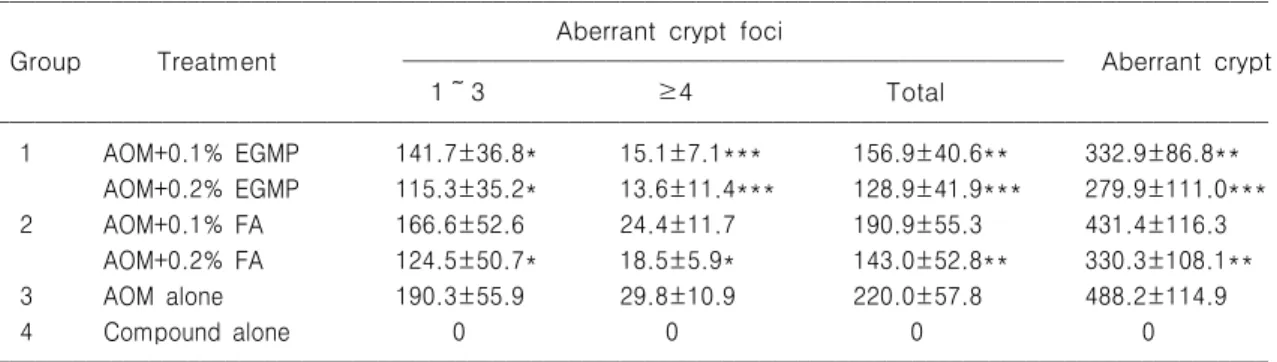
ficantly differences on the mean body weights among the groups (data not shown). The finding for ACF at the end of the study is listed in Table 1. The incidence of 1 3 crypts/ACF were 141.7±36.8 ~ (0.1% EGMP), 115.3±35.2 (0.2% EGMP) in Group 1, 166.6±52.6 (0.1% ferulic acid) 124.5±50.7 (0.2%
ferulic acid) in Group 2. The incidences of 1-3 crypts/ACF in rats of Group 1 were significantly lower than those of Group 3 (P 0.005). In contrast, < administation of 0.2% ferulic acid in the diet in Group 2 inhibited the number of 1 3 crypts/ACF. The ~ incidence of 4 or more crypts/ ACF were 15.1±7.1 (0.1% EGMP), 13.6±11.4 (0.2% EGMP) in Group 1, 24.4±11.7 (0.1% ferulic acid), and 18.5±5.9 (0.2%
ferulic acid) in Group 2. The incidences of 4 or more crypts/ACF in rats of Group 1 were significantly lower than those values of Group 3 (P 0.001). In contrast, < administation of 0.2% ferulic acid in the diet in Group 2 inhibited the number of 4 or more crypts/ACF (P 0.005). Total ACF and aberrant crypt in group 1
<
were significantly lower than that of Group 3 (P 0.01, 0.001 respec
< tively). In contrast, only feeding 0.2% FA diet in Group 2 had a inhibiting effect on the incidence of total ACF and aberrant crypt (P 0.01). No ACFs were observed in any Groups
<
animals not receiving AOM treatment.
Table 1. Aberrant crypt foci in F344 rats treated with AOM followed by EGMP and FA
ꠧꠧꠧꠧꠧꠧꠧꠧꠧꠧꠧꠧꠧꠧꠧꠧꠧꠧꠧꠧꠧꠧꠧꠧꠧꠧꠧꠧꠧꠧꠧꠧꠧꠧꠧꠧꠧꠧꠧꠧꠧꠧꠧꠧꠧꠧꠧꠧꠧꠧꠧꠧꠧꠧꠧꠧꠧꠧꠧꠧꠧꠧꠧꠧꠧꠧꠧꠧꠧꠧꠧꠧꠧꠧꠧꠧꠧꠧꠧꠧꠧꠧꠧꠧꠧꠧꠧꠧꠧꠧꠧꠧꠧꠧꠧꠧꠧꠧꠧꠧ
Aberrant crypt foci
Group Treatment ꠏꠏꠏꠏꠏꠏꠏꠏꠏꠏꠏꠏꠏꠏꠏꠏꠏꠏꠏꠏꠏꠏꠏꠏꠏꠏꠏꠏꠏꠏꠏꠏꠏꠏꠏꠏꠏꠏꠏꠏꠏꠏꠏꠏꠏꠏꠏꠏꠏꠏꠏꠏ Aberrant crypt
1 ~ 3 ≥ 4 Total
ꠏꠏꠏꠏꠏꠏꠏꠏꠏꠏꠏꠏꠏꠏꠏꠏꠏꠏꠏꠏꠏꠏꠏꠏꠏꠏꠏꠏꠏꠏꠏꠏꠏꠏꠏꠏꠏꠏꠏꠏꠏꠏꠏꠏꠏꠏꠏꠏꠏꠏꠏꠏꠏꠏꠏꠏꠏꠏꠏꠏꠏꠏꠏꠏꠏꠏꠏꠏꠏꠏꠏꠏꠏꠏꠏꠏꠏꠏꠏꠏꠏꠏꠏꠏꠏꠏꠏꠏꠏꠏꠏꠏꠏꠏꠏꠏꠏꠏꠏꠏ
1 AOM+0.1% EGMP 141.7±36.8* 15.1±7.1*** 156.9±40.6** 332.9±86.8**
AOM+0.2% EGMP 115.3±35.2* 13.6±11.4*** 128.9±41.9*** 279.9±111.0***
2 AOM+0.1% FA 166.6±52.6 24.4±11.7 190.9±55.3 431.4±116.3
AOM+0.2% FA 124.5±50.7* 18.5±5.9* 143.0±52.8** 330.3±108.1**
3 AOM alone 190.3±55.9 29.8±10.9 220.0±57.8 488.2±114.9
4 Compound alone 0 0 0 0
ꠏꠏꠏꠏꠏꠏꠏꠏꠏꠏꠏꠏꠏꠏꠏꠏꠏꠏꠏꠏꠏꠏꠏꠏꠏꠏꠏꠏꠏꠏꠏꠏꠏꠏꠏꠏꠏꠏꠏꠏꠏꠏꠏꠏꠏꠏꠏꠏꠏꠏꠏꠏꠏꠏꠏꠏꠏꠏꠏꠏꠏꠏꠏꠏꠏꠏꠏꠏꠏꠏꠏꠏꠏꠏꠏꠏꠏꠏꠏꠏꠏꠏꠏꠏꠏꠏꠏꠏꠏꠏꠏꠏꠏꠏꠏꠏꠏꠏꠏꠏ ACF: Aberrant crytp foci in the colonic mucosa, AC: Aberrant crypts in the colonic mucosa
EGMP: 3-Ethyl(4-geranyloxy-3-methoxyphenyl)-2-propenoate, FA: Ferulic acid Data are mean±SD values.
*, **, ***: Significantly different from AOM alone group at P 0.05, 0.01, and 0.001, respectively. <
DISCUSSION
The results in the present study cleary indicate that dietary feeding of EGMP effectively suppressed the occurrence of ACF induced by AOM when admi- nisted after the carcinogens treatment. The results confirm ours earlier report showing that EGMP exerts a strong inhibitory effect on colonic ACF, which are the possible precursor lesions for colorectal adenocarcinoma in rodents and humans and a reliable biological marker for screening chemopreventive agents against colorectal adenocarcinoma.
15)Our presnet findings are in agreement with previous data for the skin, lung, and the tongue in suggesting that FA derivatives might be promising candidates as chemopreventive agents.
9~11)