β
Hang-Do Lee , Choon-Ho Song
Dept. of Meridian & Acupoint, College of Oriental Medicine, Dong-Eui University Institute of Oriental Medicine, Dong-Eui University
Abstract
Objectives : The purpose of this study is to investigate anti-allergic effects of Glycyrrhizae Radix(GR) pharmacopuncture and GR extract.
Methods : In vivo, animals were gotten GR pharmacopunctures at both sides of ST36s three times for 5 days. Then, we investigated anti-DNP IgE-induced passive cutaneous anaphylaxis of Sprague Dawley rats. In vitro, we measured cell viability, β-hexosaminidase release, and the secretion of interleukin-4(IL-4) and tumor necrosis factor-alpha(TNF- ) in RBL-2H3α cells after treatment of various concentrations of GR extract.
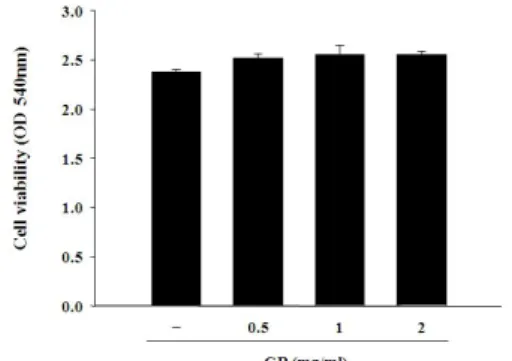
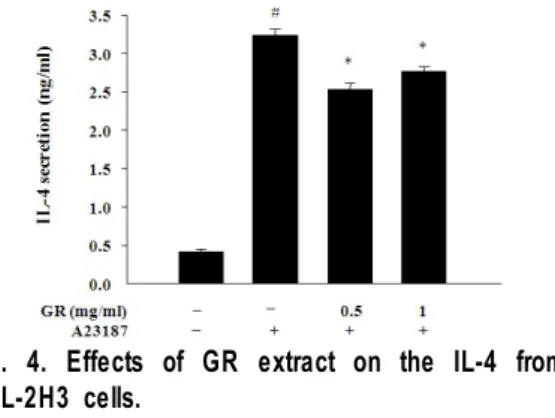
Results : In vivo, we observed inhibition of passive cutaneous anaphylaxis after GR pharmacopuncture treatments at both sides of ST36s and optional points. In vitro, GR extract treatments did not affect cell viability, but inhibitedβ-hexosaminidase release and the secretion of IL-4 and TNF- .α Conclusions : These results suggest that GR pharmacopuncture and GR extract should be beneficial in the inhibition of allergic inflammatory response.
Key words : Glycyrrhizae Radix, Pharmacopuncture, Allergy, RBL-2H3 cells
β
α
μ
β
β
β
μ
α
μ
α
α
Fig. 1. Effects of GR pharmacopuncture on passive cutaneous anaphylaxis in rats.
μ
Fig. 2. Effects of GR extract on the cell viability of RBL-2H3 cells.
β
β
Fig. 3. Effects of GR extract on the -hexosaminidaseβ release from RBL-2H3 cells.
Fig. 4. Effects of GR extract on the IL-4 from RBL-2H3 cells.
α
α
Fig. 5. Effects of GR extract on the TNF- fromα RBL-2H3 cells.
ε
α
β
β
α
α
α
α
β
β
β