INTRODUCTION
Most women with epithelial ovarian cancer (EOC) treated with current, taxane-platinum-based combination chemother- apy regimens will respond to first-line chemotherapy (1).
Nonetheless, complete clinical or pathological responses have not necessarily translated into long-term disease control or cure. Data from several first-line chemotherapy trials show that, even with the most advanced treatments, 60-70% of patients with advanced ovarian cancer will recur (2, 3).
The management of tumor recurrence remains a clinical challenge, since in the platinum-resistant population the chance of response to a secondary treatment is currently less than 20% (4). Several single chemotherapeutic agents have been used in this setting and have demonstrated modest activ- ity such as topotecan (5, 6), gemcitabine (7, 8), liposomal doxorubicin (9), vinorelbine (10), oral etoposide (11, 12), and ifosfamide (13). It cannot be overemphasized the importance of clinical trials to identify agents active in this group of resis- tant patients.
Etoposide is a semisynthetic glucosidic derivative of podo- phyllotoxin. The inhibition of DNA topoisomerase II is known to be a major mechanism of action. In refractory ovarian can-
cer, response rate (RR) with single agent etoposide have been reported to be less than 15% (14, 15).
Ifosfamide is a part of nitrogen mustard’s alkylating agents.
It has often been used as a single agent or in combination in EOC patients refractory or resistant to cisplatin (16). The RR, common to various studies, was between 12 and 25%, with a median of 20%. The progression-free survival (PFS) was between 4 and 6 months, and the overall survival (OS) bet- ween 7 and 11 months. Ifosfamide was active in patients refrac- tory to cisplatin and also in patients already treated with cyclo- phosphamide, suggesting the absence of cross-resistance (17).
Very little information is available to combination chemo- therapy as salvage treatment of EOC after more than two chemotherapy regimens. Etoposide and ifosfamide are one of the oldest drugs demonstrating clinical antitumor activi- ty and relatively worldwide spread. In various animal tumors, etoposide has shown synergy with cyclophosphamide (18).
Additionally, the combination of etoposide and ifosfamide (ETI) has also been demonstrated to be an effective regimen in solid neoplasms such as small cell lung cancer (14). In the field of EOC, several phase II studies were reported. Some indicated reasonable efficacy and another (19) showed dismal results which included only ‘‘true’’ platinum-resistant pati-
The aim of this trial was to investigate the efficacy and toxicity of combination che- motherapy with etoposide and ifosfamide (ETI) in the management of heavily pre- treated recurrent or persistent epithelial ovarian cancer (EOC). Patients with recur- rent or persistent EOC who had measurable disease and at least two prior chemo- therapy participating in this phase II trial were to receive etoposide at a dose of 100 mg/m2/day intravenously (IV) on days 1 to 3 in combination with ifosfamide 1 g/m2/ day IV on days 1 to 5, every 21 days. Thirty-seven patients were treated; about 78%
had previously received more than two separate regimens. The response rate (RR) was 18.9% and median duration of response was 7 months (range, 1-15). Treat- ment free interval prior to ETI (TFI) has significant correlation with RR rate (P=
0.034). Patients (n=6) with TFI ≥6 months had 50% of RR, while patients (n=31) with TFI <6 months had 12.9%. Median survival was 9 months at a median follow- up of 9.2 months. Grade 3 or 4 toxicities included neutropenia in 20.1% of the 139 cycles of ETI, anemia in 7.2% and thrombocytopenia in 8.6%. The ETI produces relatively low toxicity and modest activity in heavily pretreated recurrent or persis- tent EOC. This is significant in patients with TFI ≥6 months.
Key Words : Ovarian Neoplasms; Salvage Therapy; Etoposide; Ifosfamide
945
Heeseok Kang*, Tae-Joong Kim*, Chel Hun Choi, Jeong-Won Lee, Je-Ho Lee, Duk-Soo Bae, and Byoung-Gie Kim
Department of Obstetrics and Gynecology, Samsung Medical Center, Sungkyunkwan University School of Medicine, Seoul, Korea
*The two authors contributed equally to this paper.
Address for correspondence Byoung-Gie Kim, M.D.
Department of Obstetrics and Gynecology, Samsung Medical Center, Sungkyunkwan University School of Medicine, 50 Ilwon-dong, Gangnam-gu, Seoul 135-710, Korea
Tel : +82.2-3410-3513, Fax : +82.2-3410-0630 E-mail : [email protected]
DOI: 10.3346/jkms.2009.24.5.945
Phase II Study of Combination Chemotherapy with Etoposide and Ifosfamide in Patients with Heavily Pretreated Recurrent or Persistent Epithelial Ovarian Cancer
Received : 15 July 2008 Accepted : 31 October 2008
ents. However, there is no study on ETI in patients with heav- ily pretreated EOC patients.
Therefore, this phase II clinical study was designed to evalu- ate the efficacy and toxicity of 5-day regimen of ETI in pati- ents with heavily pretreated EOC patients.
MATERIALS AND METHODS
Eligibility criteria for enrollment on this study included patients with histologically confirmed EOC treated with two or more prior chemotherapy regimens after primary cytore- ductive surgery. Patients should have measurable disease on computerized tomography (CT) or magnetic resonance image (MRI) when first administration of ETI. Other eligibility cri- teria included no previous treatment with either ifosfamide or etoposide, normal end-organ function, WBC count of 3,000/
μL or higher, platelet count of 100,000/μL or higher, granu- locyte count of 1,500/μL or higher, a serum creatinine with- in institutional normal limits, hepatic enzymes (SGOT, SGPT and alkaline phosphatase) less than or equal to three times the upper level of institutional norm and bilirubin less than or equal to 1.5 times the upper level of institutional norm, and a Karnofsky performance score greater than 60%. In- formed consent was obtained according to the guidelines of our hospital Institutional Review Boards.
Patients received ifosfamide 1 g/m2/day on days 1 to 5 as an intravenous (IV) infusion in 500 mL 5% dextrose solution over 1 hr in association with adequate hydration and mesna uroprotection. Etoposide was given at a dose of 100 mg/m2/ day IV on days 1 to 3 over 1 hr. Cycles were repeated every 3 weeks and at least two courses were given to all patients, while a minimum of four courses were given to responders.
Delay of treatment was permitted if there was hematologi- cal toxicity greater than grade 3 during the previous cycle.
A 25% dose reduction of ETI was required for grade 4 throm- bocytopenia or grade 4 neutropenia with fever. Toxicity eval- uations were conducted just before next treatment cycle by performing a complete blood count, urinalysis, renal and liver function tests, and a performance status evaluation. Toxicity was defined according to WHO standard criteria. The pati- ents’ response to treatment was assessed every two cycles by imaging techniques and every cycle by CA-125. The response is confirmed by last image after ETI according to RECIST criteria. The response duration was defined from the time of partial response (PR) or complete response (CR) to the appear- ance of progressive disease. Survival was measured from the time of the initiation of ETI therapy to the time of death or to the date of the last contact. We drew a line between sen- sitive to platinum and resistant according to response showed at platinum-based first-line therapy. Treatment free interval prior to ETI (TFI) is the month(s) from the first day of last chemotherapy cycle to the first day of ETI chemotherapy.
Descriptive summary statistics were used to evaluate demo-
graphics and adverse events. Statistical analyses of frequency data were performed by means of the chi-square test. OS and response duration were measured with the Kaplan-Meier method. P value of less than 0.05 was considered as signifi- cant. The SPSS 11.0 (SPSS Inc., Chicago, IL, U.S.A.) was used for statistical analysis.
RESULTS
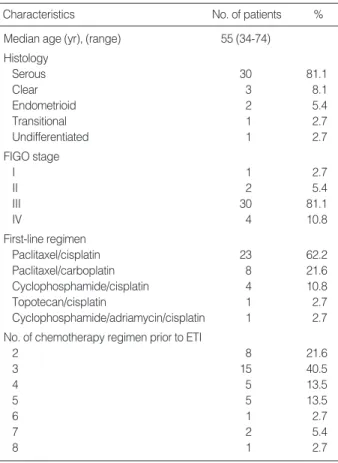
Between March 2003 and July 2007, 43 patients enrolled in this study. Six patients were excluded from the response analysis but evaluable for toxicity because four patients re- vealed unmeasurable disease on image at first ETI and two received only one course. Therefore, thirty-seven patients re- ceived at least two courses of treatment and were evaluable for response and toxicity. The characteristics of the 37 pati- ents are summarized in Table 1. The majority of the patients (81.1%) had serous type. Thirty patients (81.1%) had initial FIGO stage of III.
Of the 37 patients evaluable for response, seven (18.9%) patients showed a PR (Table 2) lasting median 7 months (range 1-15 months), another seven (18.9%) patients had SD and 23 (62.1%) progressed. There was no CR. Table 2 shows outcome according to clinical factors after ETI. Four
Characteristics No. of patients %
Median age (yr), (range) 55 (34-74) Histology
Serous 30 81.1
Clear 3 8.1
Endometrioid 2 5.4
Transitional 1 2.7
Undifferentiated 1 2.7
FIGO stage
I 1 2.7
II 2 5.4
III 30 81.1
IV 4 10.8
First-line regimen
Paclitaxel/cisplatin 23 62.2
Paclitaxel/carboplatin 8 21.6
Cyclophosphamide/cisplatin 4 10.8
Topotecan/cisplatin 1 2.7
Cyclophosphamide/adriamycin/cisplatin 1 2.7 No. of chemotherapy regimen prior to ETI
2 8 21.6
3 15 40.5
4 5 13.5
5 5 13.5
6 1 2.7
7 2 5.4
8 1 2.7
Table 1. Characteristics of patients (n=37)
ETI, etoposide and ifosfamide.
of 31 (12.9%) patients with TFI <6 months had response, while 3 of 6 patients (50%) with TFI ≥6 months had res- ponse. The RR of patients with TFI ≥6 months was about four times higher than that with TFI <6 months. As for ini- tial platinum sensitivity, 30 (81%) patients were considered clinically sensitive to platinum compounds. Most responses (6/7) were observed in initial platinum-sensitive patients.
However, there were no significant correlations between RR and platinum-sensitivity to first regimen (P=0.728), age (P=
0.623), and total number of regimen prior to ETI (P=0.601).
Only TFI had a significant correlation with RR (P=0.034).
With a median follow-up of 9.2 months, median OS for all 37 patients was 9 months (95% confidence interval: 7- 11) (Fig. 1). Seven patients with a PR had no statistical sig- nificant (P=0.07) of survival gain (Fig. 2).
A total of 139 courses of ETI regimen were administered to the study population. Table 3 shows the toxicity profile.
There was no treatment related death. The main hematolog- ical toxicity was grade 3-4 neutropenia in 28 of 139 cycles
(20.1%). There were seven episodes of febrile neutropenia, but all episodes could be managed successfully with support- ive care. A 25% dose reduction of both drugs was needed in four patients (10/139 courses; 7.2%) for a poor general con- dition. There was no severe bladder toxicity and other toxic effects were negligible.
DISCUSSION
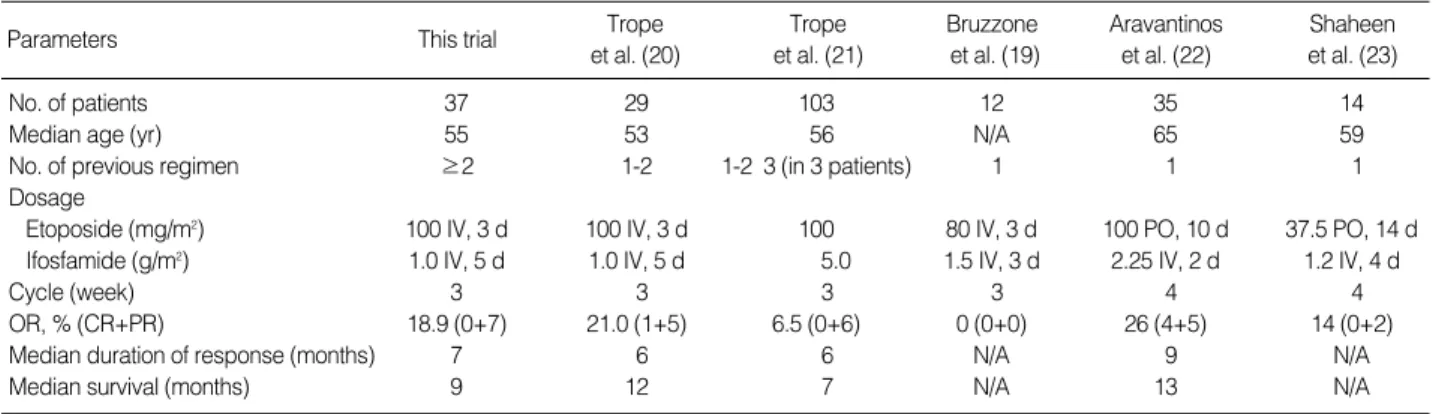
This is phase II trial that evaluated the efficacy and toxic- ity of ETI regimen for heavily pretreated patients with recur- rent or persistent EOC. Five phase II studies about ETI reg- imen in EOC have been reported to date. We summarized the characteristics of these studies including our study (Table 4). Our study was different from the previous studies due to the number of prior chemotherapy regimens given before ETI.
All of the trials used ETI as second- or third line of chemo- therapy. Three of these phase II trials used IV etoposide (19-
Parameters No. of patients
OR, No (%)
OS, months Median (95% CI)
P value* P value�
TFI prior to ETI
≥6 months 6 3 (50.0) 0.034 10 (7-13) 0.351
<6 months 31 4 (12.9) 4 (2-6)
Platinum sensitivity
Sensitive 30 6 (20.0) 0.728 11 (1-21) 0.064
Resistant 7 1 (14.3) 6 (3-9)
No. of chemotherapy regimen prior to ETI
2 8 1 (12.5) 0.601 7 (2-30) 0.599
3-8 29 6 (20.7) 2 (7-10)
Total 37 7 (18.9) 9 (7-11)
Table 2. Outcome according to clinical factors after etoposide and ifosfamide chemotherapy
*chi-square; �Log rank.
No., number; OR, objective response (CR or PR); OS, overall survival;
CI, confidence interval; TFI, Treatment-free interval.
Fig. 1. Overall survival curve of 37 patients with a median follow- up of 9.2 months.
Percent alive
1.0
0.8
0.6
0.4
0.2
0.0
0 12 24 36 48 60
Months
Median survival: 9 months
95% Confidence interval: 7-11 months
Fig. 2. Survival curves of 37 patients according to with or without response to ETI.
Percent alive
1.0
0.8
0.6
0.4
0.2
0.0
0 12 24 36 48 60
Months
Median survival: 25 vs. 9 months
responder nonresponder P=0.07
Toxicities Proportion (%) of cycles affected grade
0 1 2 3 4
Neutropenia 53.2 10.1 15.1 12.9 7.2
Anemia 26.6 48.2 16.5 4.3 2.9
Thrombocytopenia 82.0 2.9 5.0 5.0 3.6
SGOT/SGPT 95.7 2.9 0 0 0
Nausea/Vomiting 46.7 50.4 2.9 0 0
BUN/Creatinine 95.7 2.9 0 0 0
Number of patients affected grade
0 1 2 3 4
Alopecia 0 0 4 39 0
Peripheral neuropathy 8 33 2 0 0
Hematuria 43 0 0 0 0
Table 3. Toxicity of ETI regimen according to WHO criteria (n=
139 cycles)
ETI, etoposide and ifosfamide.
21), while the other two used oral etoposide (22, 23). Bruz- zone et al. (20) study resulted in no responses in 12 patients progressing or relapsing after primary cisplatin-containing combination, Trope et al. (21) obtained the following results;
in 29 patients who received cisplatin as first-line and were deemed to be platinum-resistant, used ETI regimen same dose to ours, RR was 21%, the median time to disease pro- gression was 6 months. They presumed the response to ETI was independent of prior response to first-line cisplatin-based chemotherapy, since there is no cross-resistance between ETI regimen and cisplatin. Our data (Table 2) showed similar out- comes. Therefore, there seems to be no cross-resistance bet- ween ETI and first-line cisplatin in heavily pretreated pati- ents. Contrary to this pilot study, they reported ETI had dis- mal RR (6.5%) and ETI should be abandoned later (19). They explained the reason of dismal RR of ETI could be all pati- ents in this large study had ‘‘true’’ platinum-resistant tumors.
Additionally they introduced 1-day ETI regimen and com- pare with 5-day regimen, which was considered by the pati- ents better tolerated because of the shorter hospital stay. Al- though administration dose was significantly higher in 1-day regimen due to less dose reduction, there was no difference in response between the two regimens. Another group obtained the following results; in 35 platinum resistant patients who used oral etoposide, RR was 26%, duration of response was 9 months and the median survival was 13 months (22).
Interestingly, the RR in the subgroup with TFI ≥6 months is high (50%; median duration 7 months) and statistically significant (P=0.034) compared to that of patients who had TFI <6 months though the number of patients was small.
A trend appeared that the responders had survival gain (P=
0.07) (Fig. 2). Therefore, in the selected patients treated with multiple chemotherapeutic regimens with TFI ≥6 months, further study of ETI regimen is necessary.
In our patients, ETI regimen showed 18.9% RR. This was not higher than that of single recurrence regimen despite the combination chemotherapy. Some factors may be proposed to explain. First, our group of patients had particularly unfa- vorable clinical characteristics. In 78.3% of patients, the study
regimen was given as fourth-line chemotherapy or more and the high proportion (84%) of the patients had TFI <6 months.
Second, the compromised bone-marrow reserve of these heav- ily pretreated patients did not allow the administration of the regimen as scheduled. In 31 of 139 cycles (22.3%) there were delayed administrations for more than a week for hema- tological recoveries and in 10 cycles (7.2%), 25% dose reduc- tion was needed. Last, a potential mechanism for the lack of additive or synergistic effect of adding ifosfamide to etopo- side may stem from an observation that ifosfamide adminis- tration with or before other chemotherapeutic agents may actually antagonize these agents’ activity, possibly by deplet- ing cellular glutathione (24).
Apart from effectiveness, other variables may affect the deci- sion to select a regimen in this heavily pretreated population.
For example toxicity profile, quality of life, ease of adminis- tration, cost issues, and residual toxicity from prior therapy (25). Ifosfamide is the oldest group of drugs and produces less severe hematological toxicity (17). Together with etoposide, it produces an acceptable toxicity level with grade 3 or 4 neu- tropenia most common in 20.1% of the patients in this study (Table 3). Considering 29 of the 37 (78.3%) patients who were enrolled in the current study had already been treated with 3 or more regimens before ETI, delayed schedule of 22.3% of total 139 cycles and dose reduction of 7.2% were not more than expected. Therefore ETI combination chemo- therapy could be administered in heavily pretreated patients with EOC.
According to NCCN guideline (26), patients who are con- sidered platinum-sensitive have the greatest number of poten- tial options for second-line therapy. Evidence suggests that combination chemotherapy may be superior to single-agent therapy in platinum-sensitive group (27). Options include carboplatin/paclitaxel (27), gemcitabine/carboplatin (28), or a recurrence regimen. In platinum-resistant patients, retreat- ment with a platinum compound or paclitaxel is not recom- mended. Options include treatment with a recurrence regi- men that does not contain platinum (4) or supportive care.
Several recurrence agents show similar effect as single regi-
N/A, not applicable; PO, per oral; IV, intravenous; d, day.
Trope et al. (20) This trial
Parameters Trope
et al. (21)
Bruzzone et al. (19)
Aravantinos et al. (22)
Shaheen et al. (23)
No. of patients 37 29 103 12 35 14
Median age (yr) 55 53 56 N/A 65 59
No. of previous regimen ≥2 1-2 1-2 3 (in 3 patients) 1 1 1
Dosage
Etoposide (mg/m2) 100 IV, 3 d 100 IV, 3 d 100 80 IV, 3 d 100 PO, 10 d 37.5 PO, 14 d
Ifosfamide (g/m2) 1.0 IV, 5 d 1.0 IV, 5 d 5.0 1.5 IV, 3 d 2.25 IV, 2 d 1.2 IV, 4 d
Cycle (week) 3 3 3 3 4 4
OR, % (CR+PR) 18.9 (0+7) 21.0 (1+5) 6.5 (0+6) 0 (0+0) 26 (4+5) 14 (0+2)
Median duration of response (months) 7 6 6 N/A 9 N/A
Median survival (months) 9 12 7 N/A 13 N/A
Table 4. Previous phase II trials of etoposide and ifosfamide for recurrent epithelial ovarian cancer
men: topotecan, 20% (29); gemcitabine, 19% (7, 8); vinorel- bine, 20% (30); liposomal doxorubicin, 26% (9); oral etopo- side, 27% (11, 12); and ifosfamide, 12% (16). Most patients in this study were platinum-sensitive at first line chemother- apy, therefore, received combination chemotherapy that in- cluded topotecan, cyclophosphamide, cisplatin, carboplatin, paclitaxel, docetaxel, and belotecan as 2nd or 3rd-line. They did not receive gemcitabine or liposomal doxorubicin, because medical insurance in our country did not cover these chemo- therapeutic agents.
In conclusion, ETI produces relatively low toxicity and modest activity in heavily pretreated recurrent or persistent EOC. In addition, this regimen should be further studied in the selected patients treated with multiple chemotherapeu- tic regimens and with TFI more than 6 months.
REFERENCES
1. McMeekin DS, Tillmanns T, Chaudry T, Gold M, Johnson G, Walk- er J, Mannel R. Timing isn’t everything: an analysis of when to start salvage chemotherapy in ovarian cancer. Gynecol Oncol 2004; 95:
157-64.
2. McGuire WP, Hoskins WJ, Brady MF, Kucera PR, Partridge EE, Look KY, Clarke-Pearson DL, Davidson M. Cyclophosphamide and cisplatin compared with paclitaxel and cisplatin in patients with stage III and stage IV ovarian cancer. N Engl J Med 1996; 334: 1-6.
3. Muggia FM, Braly PS, Brady MF, Sutton G, Niemann TH, Lentz SL, Alvarez RD, Kucera PR, Small JM. Phase III randomized study of cisplatin versus paclitaxel versus cisplatin and paclitaxel in pati- ents with suboptimal stage III or IV ovarian cancer: a Gynecologic Oncology Group study. J Clin Oncol 2000; 18: 106-15.
4. Markman M, Rothman R, Hakes T, Reichman B, Hoskins W, Rubin S, Jones W, Almadrones L, Lewis JL Jr. Second-line platinum ther- apy in patients with ovarian cancer previously treated with cisplatin.
J Clin Oncol 1991; 9: 389-93.
5. Bookman MA, Malmstrom H, Bolis G, Gordon A, Lissoni A, Krebs JB, Fields SZ. Topotecan for the treatment of advanced epithelial ovarian cancer: an open-label phase II study in patients treated after prior chemotherapy that contained cisplatin or carboplatin and pacli- taxel. J Clin Oncol 1998; 16: 3345-52.
6. Creemers GJ, Bolis G, Gore M, Scarfone G, Lacave AJ, Guastalla JP, Despax R, Favalli G, Kreinberg R, Van Belle S, Hudson I, Ver- weij J, Ten Bokkel Huinink WW. Topotecan, an active drug in the second-line treatment of epithelial ovarian cancer: results of a large European phase II study. J Clin Oncol 1996; 14: 3056-61.
7. Shapiro JD, Millward MJ, Rischin D, Michael M, Walcher V, Fran- cis PA, Toner GC. Activity of gemcitabine in patients with advanced ovarian cancer: responses seen following platinum and paclitaxel.
Gynecol Oncol 1996; 63: 89-93.
8. Lund B, Hansen OP, Theilade K, Hansen M, Neijt JP. Phase II study of gemcitabine (2′,2′-difluorodeoxycytidine) in previously treated ovarian cancer patients. J Natl Cancer Inst 1994; 86: 1530-3.
9. Muggia FM, Hainsworth JD, Jeffers S, Miller P, Groshen S, Tan M,
Roman L, Uziely B, Muderspach L, Garcia A, Burnett A, Greco FA, Morrow CP, Paradiso LJ, Liang LJ. Phase II study of liposomal dox- orubicin in refractory ovarian cancer: antitumor activity and toxici- ty modification by liposomal encapsulation. J Clin Oncol 1997; 15:
987-93.
10. Bajetta E, Di Leo A, Biganzoli L, Mariani L, Cappuzzo F, Di Bar- tolomeo M, Zilembo N, Artale S, Magnani E, Celio L, Buzzoni R, Carnaghi C. Phase II study of vinorelbine in patients with pretreat- ed advanced ovarian cancer: activity in platinum-resistant disease.
J Clin Oncol 1996; 14: 2546-51.
11. Hoskins PJ, Swenerton KD. Oral etoposide is active against platinum- resistant epithelial ovarian cancer. J Clin Oncol 1994; 12: 60-3.
12. Rose PG, Blessing JA, Mayer AR, Homesley HD. Prolonged oral etoposide as second-line therapy for platinum-resistant and plat- inum-sensitive ovarian carcinoma: a Gynecologic Oncology Group study. J Clin Oncol 1998; 16: 405-10.
13. Sutton GP, Blessing JA, Homesley HD, Berman ML, Malfetano J.
Phase II trial of ifosfamide and mesna in advanced ovarian carci- noma: a Gynecologic Oncology Group study. J Clin Oncol 1989; 7:
1672-6.
14. Maskens AP, Armand JP, Lacave AJ, De Jager RL, Hansen HH, Wolff JP. Phase II clinical trial of VP-16-213 in ovarian cancer.
Cancer Treat Rep 1981; 65: 329-30.
15. Hillcoat BL, Campbell JJ, Pepperell R, Quinn MA, Bishop JF, Day A. Phase II trial of VP-16-213 in advanced ovarian carcinoma. Gy- necol Oncol 1985; 22: 162-6.
16. Markman M, Hakes T, Reichman B, Lewis JL Jr, Rubin S, Jones W, Almadrones L, Pizzuto F, Hoskins W. Ifosfamide and mesna in pre- viously treated advanced epithelial ovarian cancer: activity in plat- inum-resistant disease. J Clin Oncol 1992; 10: 243-8.
17. Lissoni AA, Fei F, Rossi R, Fruscio R, Villa A, Zani G. Ifosfamide in the treatment of malignant epithelial ovarian tumors. Oncology 2003; 65 (Suppl 2): 59-62.
18. Hainsworth JD, Greco FA. Etoposide: twenty years later. Ann Oncol 1995; 6: 325-41.
19. Trope CG, Kisic J, Vergote I. Prognostic factors in platinum-resis- tant ovarian carcinoma treated with ifosfamide-etoposide. Eur J Gy- naecol Oncol 2000; 21: 255-9.
20. Bruzzone M, Campora E, Merlini L, Giudici S, Bottero G, Iskra L, Donadio M, Ferrari I, Ragni N. Ifosfamide and etoposide salvage treat- ment in advanced ovarian cancer. J Chemother 1991; 3: 332-4.
21. Trope C, Kaern J, Vergote I, Vossli S. A phase II study of etoposide combined with ifosfamide as second-line therapy in cisplatin-resis- tant ovarian carcinomas. Cancer Chemother Pharmacol 1990; 26 (Suppl): S45-7.
22. Aravantinos G, Dimopoulos MA, Kosmidis P, Bafaloukos D, Papa- dimitriou C, Kiamouris C, Pavlidis N, Sikiotis K, Papakostas P, Skar- los DV. Ifosfamide plus oral etoposide salvage chemotherapy for platinum-resistant paclitaxel-pretreated ovarian cancer. Ann Oncol 2000; 11: 607-12.
23. Shaheen M, Stender MJ, McClean JW, Look KY, Einhorn LH. Phase II study of ifosfamide plus daily oral etoposide in previously treated ovarian cancer: a Hoosier Oncology Group (HOG) study. Am J Clin Oncol 2004; 27: 229-31.
24. Vanhoefer U, Schleucher N, Klaassen U, Seeber S, Harstrick A. Ifos- famide-based drug combinations: preclinical evaluation of drug inter- actions and translation into the clinic. Semin Oncol 2000; 27: 8-13.
25. Ozols RF. Treatment of recurrent ovarian cancer: increasing options--
‘‘recurrent’’ results. J Clin Oncol 1997; 15: 2177-80.
26. NCCN Clinical Practice Guidelines in Oncology. Ovarian Cancer.
V.I 2008. Available at http://www.nccn.org/professionals/physician_
gls/PDF/ovarian.pdf [accessed on_]
27. Parmar MK, Ledermann JA, Colombo N, du Bois A, Delaloye JF, Kristensen GB, Wheeler S, Swart AM, Qian W, Torri V, Floriani I, Jayson G, Lamont A, Trope C. Paclitaxel plus platinum-based che- motherapy versus conventional platinum-based chemotherapy in women with relapsed ovarian cancer: the ICON4/AGO-OVAR-2.2 trial. Lancet 2003; 361: 2099-106.
28. Rose PG. Gemcitabine reverses platinum resistance in platinum- resistant ovarian and peritoneal carcinoma. Int J Gynecol Cancer 2005; 15 (Suppl 1): 18-22.
29. ten Bokkel Huinink W, Gore M, Carmichael J, Gordon A, Malfe- tano J, Hudson I, Broom C, Scarabelli C, Davidson N, Spanczynski M, Bolis G, Malmstrom H, Coleman R, Fields SC, Heron JF. Topote- can versus paclitaxel for the treatment of recurrent epithelial ovari- an cancer. J Clin Oncol 1997; 15: 2183-93.
30. Rothenberg ML, Liu PY, Wilczynski S, Nahhas WA, Winakur GL, Jiang CS, Moinpour CM, Lyons B, Weiss GR, Essell JH, Smith HO, Markman M, Alberts DS. Phase II trial of vinorelbine for relapsed ovarian cancer: a Southwest Oncology Group study. Gynecol Oncol 2004; 95: 506-12.