
332
©The Korean Society of Food Science and Technology
6-Shogaol
의 Toll-like receptor 2, 3, 4 agonists에 의해서 유도된
cyclooxygenase-2
발현 억제
김점지·안상일
1·이전수
1·윤새미
1·이미영·윤형선
1,*
순천향대학교 의료과학대학 의료생명공학과, 1순천향대학교 의료과학대학 임상병리학과
Suppression of the Expression of Cyclooxygenase-2 Induced
by Toll-like Receptor 2, 3, and 4 Agonists by 6-Shogaol
Jum-Ji Kim, Sang-Il Ahn1
, Jun-Su Lee1
, Sae-Mi Yun1
, Mi-Young Lee, and Hyung-Sun Youn1,*
Department of Medical Biotechnology, College of Medical Sciences, SoonChunHyang University
1
Department of Biomedical Laboratory Science, College of Medical Sciences, SoonChunHyang University
Abstract Ginger is widely used as a traditional herbal medicine. Both ginger and its extracts have been used to treat many chronic inflammatory conditions via the inhibition of nuclear factor-kappa B (NF-κB) activation, which results in the suppression of cyclooxygenase-2 (COX-2) expression. However, the mechanisms as to how ginger extracts mediate their health effects are largely unknown. Toll-like receptors (TLRs) trigger anti-microbial innate immune responses, recognizing conserved microbial structural molecules that are known as pathogen-associated molecular patterns. All TLR signaling pathways culminate in the activation of NF-κB. The activation of NF-κB leads to the induction of inflammatory gene products, including cytokines and COX-2. This study reports the biochemical evidence that 6-shogaol, an active compound in ginger, inhibits NF-κB activation and COX-2 expression induced by TLR2, TLR3, and TLR4 agonists. Furthermore, 6-shogaol inhibited NF-κB activation induced by the following downstream signaling components of the TLRs: MyD88, IKKβ, and p65. These results imply that ginger can modulate immune responses that could potentially modify the risk of many chronic inflammatory diseases.
Key words : Toll-like receptors, 6-shogaol, NF-κB, COX-2, MyD88
서
론
우리가 일상적으로 먹는 여러 식품 중에는 항암, 항염증 효과 를 가지고 있는 여러 기능성 화합물들이 포함되어 있다. 이러한 웰빙 식품중 하나인 생강(Zingiber officinale Rosecoe)은 오랫동안 한약재로 사용되어 왔다. 생강은 전통적으로 신경성 질환, 치은 염, 치통, 천식, 뇌졸증, 변비 그리고 당뇨에 효과적인 것으로 보 고되어 있다(1). 생강 추출물들은 항염증(2), 항산화(3), 항혈전(4) 그리고 항암(5) 효과를 가지고 있다고 알려져 있다. 또한 생강 추 출물은 관절염 치료를 위해서 효과적인 것으로 알려져 있다(6). 생강은 gingerols, shogaols, paradols 그리고 gingerdiols과 같은 성 분을 포함하고 있다(Fig. 1). 이것들 중에서 gingerols과 gingerols 의 가수분해산물인 shogaols이 prostaglandin(PG)과 leukotriene 합 성 효소의 효과적인 억제제로 보고되었다(7). 생강 추출물중의 하 나인 6-gingerol은 cyclooxygenase-2(COX-2) 활성을 효과적으로 억 제한다고 밝혀졌으며, 곁사슬의 길이가 활성화 결정을 위해서 중 요한 역할을 한다고 밝혀졌다(8). Toll-like receptors(TLRs)는 여러 병원균들이 숙주의 몸속에 들 어왔을 때, 병원균들이 가지고 있는 독특한 구조를 인식하여 선 천성 면역 반응을 유도하고, 뒤이어 후천성 면역 반응을 유도하 는 중요한 역할을 한다(9-12). 현재까지 최소한 열 세개의 TLRs 가 포유동물 세포 안에서 발견되었으며, 각각의 TLRs는 미생물 들이 가지고 있는 독특한 구조를 인식하는 것으로 알려져 있다(9).
TLRs는 일반적으로 MyD88(myeloid differential factor 88) 또는
TRIF(Toll/IL-1R domain-containing adaptor inducing IFN-β) 신호
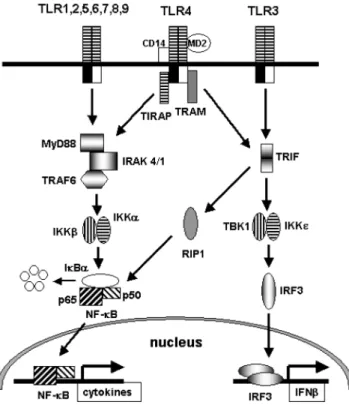
전달 체계를 가지고 있다(Fig. 2)(9). MyD88은 모든 포유동물에 서 발견되는 TLRs의 TIR(Toll/IL-1R) 도메인에 붙는 어댑터 분자 이다(9). MyD88은 IRAK-4(IL-1 receptor-associate kinase 4)를 유 도하고, IRAK-4는 IRAK-1을 인산화시킨후에 IRAK-1의 분해를 유도한다. 인산화된 IRAK-1은 TRAF6(TNF receptor-associated
factor 6)를 유도하며, TRAF6는 IKK(IκB kinase) 인산화 효소를
활성화 시킨다. 활성화된 IKK 인산화 효소는 전사 요소 NF-κB
(nuclear factor κB)를 활성화 시킨다. 이러한 MyD88 신호 전달
체계의 활성화는 NF-κB의 활성화를 유도하여 결국 cytokine이나
COX-2와 같은 염증을 유발하는 유전체들을 유도하여 암이나 질
병을 유발한다(9).
TLR3는 MyD88 대신에 TRIF를 어댑터 분자로 사용하며, TRIF
를 통한 신호 전달 체계 또한 NF-κB 활성화를 유도한다(Fig. 2)
(13). TRIF의 C-말단 부분은 RIP1(receptor interacting protein 1)
과 반응하여 늦은 NF-κB 활성화를 유도하는 것으로 알려져 있
*Corresponding author: Hyung-Sun Youn, Department of Biomedical Laboratory Science, College of Medical Sciences, Soonchunhyang Uni-versity, Asan, Chungcheongnam-do 336-745, Korea
Tel: 82-41-530-3086 Fax: 82-41-530-3085 E-mail: [email protected]
Received January 24, 2008; revised April 15, 2008; accepted April 23, 2008
으며(13), TRIF는 또한 TBK1(TANK-binding kinase 1)과 반응해 서 IRF3(IFN-regulatory factor 3)의 활성화를 유도하는 것으로 알 려져 있다(14,15). 생강에 포함되어 있는 phytochemicals중의 하나인 6-gingerol은 여러 agonists에 의해서 유도된 NF-κB활성화와 COX-2 발현을 억 제시킨다고 널리 알려져 있다(16). 하지만 또 다른 생강추출물중 의 하나이며, PG합성을 억제한다고 알려져 있는 shogaol이 NF-κB나 COX-2발현을 억제하는지에 대한 결과는 잘 알려져 있지 않다. 따라서 이번 연구를 통하여 6-shogaol이 여러 TLR agonists 에 의해서 유도된 NF-κB 활성화와 NF-κB 활성화에 의해서 유 도되는 유전자인 COX-2 발현을 억제시키는지를 알아 보았다.
재료
및
방법
재료실험에 사용한 6-shogaol은 Wako Pure Chemical Industries, Ltd.
(Osaka, Japan)로부터 구입하였다. Macrophage-activating lipopep-tide(MALP-2, 2 kDa), lipopolysaccharide(LPS) 그리고 polyriboi-nosinic polyribocytidylic acid(poly[I:C])는 Alexis Biochemical(San Diego, CA, USA), List Biological Lab(San Jose, CA, USA) 그
리고 Amersham Biosciences(Piscataway, NJ, USA) 회사로부터 각 각 구입하였다. COX-2와 actin 항체는 Santa Cruz Biotechnology
(Santa Cruz, CA, USA) 회사로부터 구입하였다. 그 밖의 다른 시
약들은 Sigma-Aldrich(St. Louis, MO USA) 회사로부터 구입하였다.
세포 배양
RAW264.7 cells(a murine monocytic cell line, ATCC TIB-71)
과 293T cells(human embryonic kidney)은 10%(v/v) FBS, 100
units/mL Penicillin, 100 mg/mL streptomycin을 포함하고 있는 Dulbecco’s modified Eagle’s medium(DMEM, Hyclone, Logan, UT, USA)에서 배양하였다. 세포들은 5% CO2/air를 포함하고 있 는 37o
C 배양기 안에서 배양하였다.
Plasmid
NF-κB발광 plasmid는 F. Mercurio(Signal Pharmaceuticals, San Diego, CA, USA)로 제공받았으며, Heat shock protein(HSP)
70-β-galactosidase plasmid는 R. Modlin(캘리포니아 주립대학교, Los
Angeles, CA, USA)으로부터 제공받았다. 트랜스펙션을 위한 모
든 DNA는 EndoFree Plasmid Maxi kit(Qiagen, Valencia, CA,
USA)을 사용하여 준비되었다.
Transfection과 발광효소 유전자 분석(luciferase reporter gene assay)
NF-κB 발광효소 유전자 분석은 선행연구에서 사용한 방법에 의
하여 분석하였다(17,18). 발광효소 plasmid와 HSP70-β-galactosidase
plasmid는 Superfect transfection 시약(Qiagen, Valencia, CA, USA)
을 사용하여 세포 안으로 transfection시켰다. 발광 효소의 활성화 는 luciferase assay system(Promega, Madison, WI, USA)을 사용 하여 측정하였다. 발광효소의 활성화는 β-galactosidase의 활성화 를 측정하여 표준화시켰다.
면역압(immunoblotting)방법
선행연구의 방법에 의하여 단백질 추출물들은 sodium dodecyl
sulfate-polyacrylamide gel electrophoresis(SDS-PAGE)에서 분리되
어 polyvinylidene difluoride membrane으로 전기영동에 의해서 이 전되었다(19,20). Membrane은 0.1% Tween 20 그리고 5% 탈지 건조된 우유를 포함하고 있는 phosphate-buffered saline을 가지고
blocking 하였다. Membrane은 1차 항체를 가지고 blotting하고,
Fig. 1. The structure of gingerdiols, gingerols, shogaols, and paradols.
Fig. 2. Toll-like receptor signaling pathways. TLRs have two
major downstream signaling pathways; MyD88- and TRIF-dependent pathways leading to the activation of NF-κB and IRF3.
horseradish peroxidase와 복합된 2차 항체에 노출시킨 다음, ECL western blot detection 시약을 사용하여 원하는 단백질을 규명하
였다.
결과
및
고찰
6-Shogaol에 의한 NF-κB 활성화와 COX-2 발현의 억제 NF-κB는 거의 모든 세포에서 발견되며, 인간의 면역반응을 위 해서 중요한 역할을 하는 전사 요소(transcription factor)이다. 많 은 종류의 미생물들이 NF-κB 활성화를 유도하며 그렇게 활성화 된 NF-κB는 여러 목표 유전자의 발현을 조절하는 것으로 알려 져 있다(21). 병원균들이 숙주안에 들어왔다면, 최초로 TLRs가 병 원균들을 인식해서 신호를 아래로 보내 NF-κB 활성화를 유도한 다. 일반적으로 NF-κB 활성화는 후천성 면역 반응을 유도하여 여러 질병으로부터 숙주를 보호하여 준다. 하지만 병원균들의 계 속된 자극에 의하여 숙주의 면역체계에 과부하가 걸린다면 NF-κB 활성화는 염증을 유도하여 오히려 여러 질병을 일으키게 된 다. 그래서 NF-κB 활성화를 미리 막을 수만 있다면 COX-2와 같 은 염증 유전자 생성물들을 줄여서 여러 질병으로부터 숙주를 보 호할 수 있게 되는 것이다. 따라서, 생강에 포함되어 있는 phytochemicals 중의 하나인 6-shogaol이 여러 TLR agonists에 의해서 유도된 NF-κB 활성화와 COX-2 발현을 억제하는지를 알아보았다. 6-Shogaol은 MALP-2(TLR2와 TLR6 agonist), poly[I:C](TLR3 agonist) 그리고 LPS (TLR4 agonist)에 의해서 유도된 NF-κB 활성화를 억제하였다(Fig.
3). 다음 실험으로 NF-κB 활성화에 의해서 조절되는 유전자인
COX-2 발현이 6-shogaol에 의해서 억제되는지 알아보았다. 이 실
험을 위해서 COX-2 발광효소 유전자 분석과 Western blotting 방 법이 사용되었다. 6-Shogaol은 MALP-2, poly[I:C] 그리고 LPS에 의해서 유도된 COX-2 발현을 억제시켰다(Fig. 4). 이러한 결과는
6-shogaol이 염증 억제제로써 중요한 역할을 할 수 있다는 것을
제시해 준다고 할 수 있겠다.
마지막으로, 6-shogaol이 TLRs의 downstream 분자에 의해서 유 도된 NF-κB 활성화를 억제하는지를 알아보았다. 실험은 TLRs의
downstream 분자인 MyD88, IKKβ, 또는 p65를 과발현시켜서
NF-κB 발광효소 유전자 분석에 의해서 알아보았다. 6-Shogaol은
MyD88, IKKβ 또는 p65에 의해서 유도된 NF-κB 활성화를 억제
시켰다(Fig. 5). 이러한 결과는 6-shogaol의 분자학적인 타깃이 적 어도 하나 이상은 IKKβ 보다 아래에 놓여 있다는 것을 제시한 다고 할 수 있겠다. 앞으로의 연구에서는 kinase 분석이나
elec-trophoretic mobility shift assay(EMSA)를 이용하여 6-shogaol이 어
떻게 NF-κB 활성화나 COX-2발현을 억제하는지 정확한 분자학 적인 타깃이 밝혀질 것이다.
TLRs는 pathogen associated molecular patterns(PAMPs)를 최초
로 인식한 후에 signaling components를 활성화 시킨다. TLRs는
TIR domain에 최초의 어댑터분자인 MyD88를 homophilic
interac-Fig. 3. 6-Shogaol suppressed the NF-κB activation induced by MALP-2, poly[I:C], or LPS. RAW264.7 cells were transfected with
NF-κB luciferase reporter plasmid and pre-treated with 6-shogaol (20, 30µM) for 1 hr and then treated with MALP-2 (5 ng/mL) (A), poly[I:C] (5µg/mL) (B), or LPS (5 ng/mL) (C) for additional 6 hr.
Cell lysates were prepared and luciferase and β-galactosidase
enzyme activities were measured as described in “Materials and Methods”. Relative luciferase activity (RLA) was normalized with
β-galactosidase activity. Values are mean±SEM (n=3). **,
Signifi-cantly different from MALP-2 alone, p<0.01. #, signifiSignifi-cantly different from poly[I:C] alone, p<0.05. +, significantly different from LPS alone, p<0.05. Veh, vehicle; Shol, 6-shogaol.
Fig. 4. 6-Shogaol suppressed the COX-2 expression induced by MALP-2, poly[I:C] or LPS. A) RAW264.7 cells were transfected
with COX-2 luciferase reporter plasmid and pre-treated with 6-shogaol (20, 30µM) for 1 hr and then treated with MALP-2 (5 ng/ mL), poly[I:C] (5µg/mL), or LPS (5 ng/mL) for an additional 6 hr. Cell lysates were prepared and luciferase and β-galactosidase enzyme activities were measured as described in “Materials and Methods”. RLA was normalized with β-galactosidase activity. Values are mean±SEM (n=3). **, Significantly different from MALP-2 alone, p<0.01. #, Significantly different from poly[I:C] alone, p<0.05. ++, Significantly different from LPS alone, p<0.01. B) RAW264.7 cells were pretreated with 6-shogaol (20, 30 mM) for 1 hr and then further stimulated with MALP-2 (5 ng/mL), poly[I:C] (5 mg/mL), or LPS (5 ng/mL) for 6 hrs. Cell lysates were analyzed for COX-2 and actin protein by immunoblots. Veh, vehicle; Shol, 6-shogaol.
tion에 의해서 모은다(22). 이러한 interaction은 downstream 신호
연쇄반응을 이끌어 NF-κB 활성화를 유도한다. NF-κB 활성화는 두 개의 kinases(IKKα와 IKKβ)에 의해서 유발되는 IκBα의 phos 인산화 분해를 요구한다. 유전학적인 연구에 의하면 IKKα 보다
IKKβ가 TLR signaling pathways 안에서 NF-κB 활성화를 위해서
중요한 역할을 하는 것으로 알려져 있다(23). 반면에 IKKα는 NF-κB 활성화를 종결시키는데 보다 더 중요한 역할을 하는 것으로 알려져 있다(24). NF-κB는 Rel-homology domains(RHDs)을 포함 하는 dimeric transcription factor이다. 모두 다섯 종류의 NF-κB
families[RelA(p65), RelB, C-Rel, p105(NF-κB1; p50의 전구물질), p100(NF-κB2; p52의 전구물질]이 포유동물세포안에서 발견된다
고 알려져 있다. NF-κB는 homo- 또는 hetero-dimers를 형성해서 존재한다(22). TLRs signaling에서 가장 종종 활성화되는 NF-κB 는 p65와 p50으로 구성된 heterodimer이다(25). 이렇게 TLRs를 시 작으로 IKK kinases를 통해 NF-κB 활성화를 유도하는 신호전달 체계를 ‘canonical pathway’라고 부르며, 이러한 pathway를 통해
cytokines이 유도된다(Fig. 2). 염증 연구에서 중요한 업적중 하나는 1971년 Vane이 아스피린 과 그 것에 연관된 약들이 PG 합성을 억제하여 항염증 효과를 가지고 있다는 것을 발견한 것이다(26). 이러한 발견은 자연적으 로 만들어지는 많은 물질들이 PG 합성을 위한 억제제로써 뿐만 아니라 항염증 성질을 가지고 있는지 탐구하도록 많은 연구자들 을 자극하였다. Kiuchi 등(27)은 Zingiberaceae family에 속해있는 식물 추출물이 in vitro 상태에서 PG 합성을 억제한다는 것을 처
음으로 발견하였다. 생강이나 비스테로이드계 항염증약물(NSAID) 에 의한 PG 합성의 억제는 COX에 의한 arachidonic acid 대사의 억제에 기인한다. COX는 적어도 두 개의 isoforms인 COX-1과
COX-2로 존재한다(28). COX-1은 거의 모든 세포나 조직에서 항 상 발현되며, 신장에서 위장관세포보호와 전해질 항상성과 같은 중요한 생리적 과정을 조절하는 것으로 알려져 있다. 반면 COX-2는 모든 조직에서 거의 발견되지 않으며, COX-2의 발현은 염증 을 유발하는 요소에 의해서 커다랗게 증가되는 것으로 알려져 있 다(28). NSAID에 의한 독성효과 중에서 많은 것은 COX-1의 억 제에 기인한 반면, 치료효과는 COX-2의 억제에 기인한다고 알려 져 있다(29). 이러한 사실은 많은 제약회사들에게 NSAID의 개발 에 있어서 COX-2 억제제를 개발하도록 유도하였다. 현재까지 많 은 COX-2 억제제가 개발되었다. 특히 많은 phytochemicals이 여 러 agonists에 의해서 유도된 COX-2 발현을 억제하는 것이 밝혀 졌다(30-32). 하지만 생강 추출물과 COX-2에 대한 연구는 적은 수의 논문만이 발표되었고, 그러한 연구들 중 대부분은 gingerols 에 한정되어 있다. 이번 연구를 통해서 또 다른 생강추출물인 6-shogaol이 여러 TLR agonists에 의해서 유도된 NF-κB 활성화와 COX-2 발현을 억제 시키는 것을 밝혀내었다. 이번 연구는 6-shogaol이 선천성 면역반응을 위해서 중요한 역할을 하는 TLR signaling pathways 를 조절하여 NF-κB 활성화와 COX-2 발현을 억제시킨다는 것을 밝힌 최초의 연구라 할 수 있다. 이러한 발견은 식품들에 포함되 어 있는 phytochemicals이 TLRs에 의해서 조절되는 염증반응이나 또는 뒤이어 발생하는 만성적인 질병들을 조절할 수 있다는 중 요한 가능성을 제시해 준다고 할 수 있다.
요
약
선천성 면역은 병원성균의 침입에 대항하기 위한 숙주의 최초 방어체계라 할 수 있다. 이러한 선천성 면역반응은 병원균들이 가지고 있는 독특한 구조를 인식하는 TLRs에 의해서 조절되어 진다고 알려져 있다. 숙주에 침입한 여러 병원성균들이 TLRs를 자극하며 이렇게 자극된 신호들은 아래로 전달되어 전사요소 NF-κB의 활성화를 유도하고 결국 COX-2와 같은 염증 유발인자를 유도하여 암이나 질병을 유발하게 된다. 우리는 이번 연구를 통 하여 생강 추출물중의 하나인 6-shogaol이 어떻게 NF-κB 활성화 나 COX-2 발현을 조절하여 항염증 효과를 가지고 있는지를 알 아보았다. 6-shogaol은 TLR2, TLR3, TLR4 agonists에 의해서 유 도된 NF-κB 활성화와 COX-2 발현을 억제하였다. 이러한 결과는 6-shogaol이 여러 병원균들로부터 유도되는 염증반응이나 만성적 인 질병들을 조절할 수 있다는 중요한 결과를 보여주는 것이라 할 수 있다.감사의
글
이 논문은 2007년도 정부재원(교육인적자원부 학술연구조성사 업비)으로 한국학술진흥재단(KRF-2007-331-F00061)과 한국환경기 술진흥원(The Eco-Technopia 21 project to Lee, M.Y.)의 지원을 받아 연구되었음.문
헌
1. Afzal M, Al-Hadidi D, Menon M, Pesek J, Dhami MS. Ginger: An ethnomedical, chemical and pharmacological review. Drug
Fig. 5. 6-Shogaol inhibits the activation of NF-κB induced by the overexpression of MyD88, IKKβ, or p65. 293T cells were
co-transfected with NF-κB-luciferase reporter plasmid and an expression plasmid for MyD88, IKKβ, or p65. pcDNA was used as a vector control for MyD88, IKKβ and p65. After 24 hrs, cells were treated with 6-shogaol (20, 30µM) for 6 hr. RLA was determined by normalization with β-galactosidase activity. Values are mean± SEM (n=3). *, Significantly different from MyD88 plus vehicle, p<0.05. ++, Significantly different from IKKβ plus vehicle, p<0.01. #, Significantly different from p65 plus vehicle, p<0.05. Veh, vehicle; Shol, 6-shogaol.
Metab. Drug Interact. 18: 159-190 (2001)
2. Chang CP, Chang JY, Wang FY, Chang JG. The effect of Chinese medicinal herb Zingiberis rhizoma extract on cytokine secretion by human peripheral blood mononuclear cells. J. Ethnopharmacol. 48: 13-19 (1995)
3. Ippoushi K, Azuma K, Ito H, Horie H, Higashio H. [6]-Gingerol inhibits nitric oxide synthesis in activated J774.1 mouse macroph-ages and prevents peroxynitrite-induced oxidation and nitration reactions. Life Sci. 73: 3427-3437 (2003)
4. Thomson M, Al-Qattan KK, Al-Sawan SM, Alnaqeeb MA, Khan I, Ali M. The use of ginger (Zingiber officinale Rosc.) as a potential anti-inflammatory and antithrombotic agent. Prostag. Leukotr. Ess. 67: 475-478 (2002)
5. Surh YJ. Anti-tumor promoting potential of selected spice ingre-dients with antioxidative and anti-inflammatory activities: A short review. Food Chem. Toxicol. 40: 1091-1097 (2002)
6. Altman RD, Marcussen KC. Effects of a ginger extract on knee pain in patients with osteoarthritis. Arthritis Rheum. 44: 2531-2538 (2001)
7. Kiuchi F, Iwakami S, Shibuya M, Hanaoka F, Sankawa U. Inhibi-tion of prostaglandin and leukotriene biosynthesis by gingerols and diarylheptanoids. Chem. Pharm. Bull. 40: 387-391 (1992) 8. Tjendraputra E, Tran VH, Liu-Brennan D, Roufogalis BD, Duke
CC. Effect of ginger constituents and synthetic analogues on cyclooxygenase-2 enzyme in intact cells. Bioorg. Chem. 29: 156-163 (2001)
9. Takeda K, Akira S. Toll-like receptors in innate immunity. Int. Immunol. 17: 1-14 (2005)
10. Medzhitov R. Toll-like receptors and innate immunity. Nat. Rev. Immunol. 1: 135-145 (2001)
11. O'Neill LA. TLRs: Professor Mechnikov, sit on your hat. Trends Immunol. 25: 687-693 (2004)
12. Vogel SN, Fitzgerald KA, Fenton MJ. TLRs: Differential adapter utilization by toll-like receptors mediates TLR-specific patterns of gene expression. Mol. Interv. 3: 466-477 (2003)
13. Meylan E, Burns K, Hofmann K, Blancheteau V, Martinon F, Kelliher M, Tschopp J. RIP1 is an essential mediator of Toll-like receptor 3-induced NF-kappa B activation. Nat. Immunol. 5: 503-507 (2004)
14. Sato S, Sugiyama M, Yamamoto M, Watanabe Y, Kawai T, Takeda K, Akira S. Toll/IL-1 receptor domain-containing adaptor inducing IFN-beta (TRIF) associates with TNF receptor-associ-ated factor 6 and TANK-binding kinase 1, and activates two dis-tinct transcription factors, NF-kappa B and IFN-regulatory factor-3, in the Toll-like receptor signaling. J. Immunol. 171: 4304-4310 (2003)
15. Fitzgerald KA, McWhirter SM, Faia KL, Rowe DC, Latz E, Golenbock DT, Coyle AJ, Liao SM, Maniatis T. IKKepsilon and TBK1 are essential components of the IRF3 signaling pathway. Nat. Immunol. 4: 491-496 (2003)
16. Kim SO, Chun KS, Kundu JK, Surh YJ. Inhibitory effects of [6]-gingerol on PMA-induced COX-2 expression and activation of
NF-kappaB and p38 MAPK in mouse skin. Biofactors 21: 27-31 (2004)
17. Youn HS, Saitoh SI, Miyake K, Hwang DH. Inhibition of homodimerization of Toll-like receptor 4 by curcumin. Biochem. Pharmacol. 72: 62-69 (2006)
18. Youn HS, Lee JY, Fitzgerald KA, Young HA, Akira S, Hwang DH. Specific inhibition of MyD88-independent signaling path-ways of TLR3 and TLR4 by resveratrol: Molecular targets are TBK1 and RIP1 in TRIF complex. J. Immunol. 175: 3339-3346 (2005)
19. Youn HS, Lee JY, Saitoh SI, Miyake K, Kang KW, Choi YJ, Hwang DH. Suppression of MyD88- and TRIF-dependent signal-ing pathways of Toll-like receptor by (-)-epigallocatechin-3-gal-late, a polyphenol component of green tea. Biochem. Pharmacol. 72: 850-859 (2006)
20. Youn HS, Lee JY, Saitoh SI, Miyake K, Hwang DH. Auranofin, as an anti-rheumatic gold compound, suppresses LPS-induced homodimerization of TLR4. Biochem. Bioph. Res. Co. 350: 866-871 (2006)
21. Pahl HL. Activators and target genes of Rel/NF-kappaB transcrip-tion factors. Oncogene 18: 6853-6866 (1999)
22. Kawai T, Akira S. Signaling to NF-kappaB by Toll-like receptors. Trends Mol. Med. 13: 460-469 (2007)
23. Karin M, Greten FR. NF-kappaB: Linking inflammation and immunity to cancer development and progression. Nat. Rev. Immunol. 5: 749-759 (2005)
24. Li Q, Lu Q, Bottero V, Estepa G, Morrison L, Mercurio F, Verma IM. Enhanced NF-kappaB activation and cellular function in macrophages lacking IkappaB kinase 1 (IKK1). P. Natl. Acad. Sci. USA 102: 12425-12430 (2005)
25. Hayden MS, West AP, Ghosh S. NF-kappaB and the immune response. Oncogene 25: 6758-6780 (2006)
26. Vane JR. Inhibition of prostaglandin synthesis as a mechanism of action for aspirin-like drugs. Nat. New Biol. 231: 232-235 (1971) 27. Kiuchi F, Shibuya M, Sankawa U. Inhibitors of prostaglandin
biosynthesis from ginger. Chem. Pharm. Bull. 30: 754-757 (1982) 28. Vane JR, Bakhle YS, Botting RM. Cyclooxygenases 1 and 2.
Annu. Rev. Pharmacol. Toxicol. 38: 97-120 (1998)
29. Grzanna R, Lindmark L, Frondoza CG. Ginger--An herbal medic-inal product with broad anti-inflammatory actions. J. Med. Food. 8: 125-132 (2005)
30. Surh YJ, Chun KS, Cha HH, Han SS, Keum YS, Park KK, Lee SS. Molecular mechanisms underlying chemopreventive activities of anti-inflammatory phytochemicals: Down-regulation of COX-2 and iNOS through suppression of NF-kappa B activation. Mutat. Res. 480-481: 243-268 (2001)
31. Surh YJ. Cancer chemoprevention with dietary phytochemicals. Nat. Rev. Cancer 3: 768-780 (2003)
32. Khanna D, Sethi G, Ahn KS, Pandey MK, Kunnumakkara AB, Sung B, Aggarwal A, Aggarwal BB. Natural products as a gold mine for arthritis treatment. Curr. Opin. Pharmacol. 7: 344-351 (2007)
![Fig. 3. 6-Shogaol suppressed the NF- κB activation induced by MALP-2, poly[I:C], or LPS](https://thumb-ap.123doks.com/thumbv2/123dokinfo/5129347.88914/3.892.70.430.110.502/fig-shogaol-suppressed-activation-induced-malp-poly-lps.webp)

