Prevalence, Clinical Characteristics, and Management of
Functional Constipation at Pediatric Gastroenterology Clinics
The purpose of this study was to investigate the prevalence, clinical characteristics, and management of functional constipation at pediatric gastroenterology clinics. A prospective survey using the Rome III criteria was distributed to a group of parents of children with a constipation history and its control group in May 2008. The mean prevalence of constipation was 6.4%, which was similar to those in other countries. Statistically significant variables for children without constipation were that more children had a body mass index of below the 10th percentile even though they received more mother’s care and ate balanced meals compared to the constipation group. Meanwhile, the constipation group frequently showed a history of constipation in infancy, picky-eating, lack of exercise, and retentive posturing. When analyzed with the Rome III criteria, the children showed greater than 60% rate of hard stools, painful stools, a history of large fecal mass in rectum, and its disappearance of constipation symptoms after passing a large stool. Our study found different approaches amongst pediatric gastroenterologists like rectal examinations, disimpaction, or drug treatment. Several factors addressed in our study can provide better guidelines for clinicians treating constipation and its future research.
Key Words: Constipation; Child; Prevalence; Rome III Criteria Soo Hee Chang,1 Kie Young Park,2
Sung Kil Kang,3 Ki Soo Kang,4 So Young Na,5 Hye Ran Yang,6 Ji Hyun Uhm,7 and Eell Ryoo8
1Department of Pediatrics, Bundang Jesaeng General Hospital, Seongnam; 2Department of Pediatrics, GangNeung Asan Hospital, University of Ulsan College of Medicine, Gangneung; 3Department of Pediatrics, Inha University College of Medicine, Incheon; 4Department of Pediatrics, Jeju National University College of Medicine, Jeju; 5Department of Pediatrics, Dongguk University Ilsan Hospital, Goyang; 6Department of Pediatrics, College of Medicine Seoul National University, Seoul;
7Department of Pediatrics, College of Medicine, Eulji University, Seoul; 8Department of Pediatrics, Gachon University Gil Hospital, Incheon, Korea
Received: 21 January 2013 Accepted: 28 June 2013 Address for Correspondence:
Eell Ryoo, MD
Division of Gastroenterology, Hepatology and Nutrition, Department of Pediatrics, Gachon University Gil Hospital, 21 Namdong-daero 774beon-gil, Namdong-gu, Incheon 405-760, Korea
Tel: +82.32-460-3931, Fax: +82.32-460-3224 E-mail: [email protected]
This study was not supported by any financial institutes.
http://dx.doi.org/10.3346/jkms.2013.28.9.1356 • J Korean Med Sci 2013; 28: 1356-1361 Pediatrics
INTRODUCTION
A chronic constipation is one of the most common functional gastrointestinal complaints in pediatric outpatient clinics. The prevalence of childhood constipation in the general population ranges widely from 0.7% to 29.6% internationally (1). About 3%
of outpatient visits at general pediatric clinics were about con- stipation compared to 25% of the visits at pediatric gastroenter- ology clinics (2-5). In the Republic of Korea (ROK), functional constipation in children has also long been suspected to be as prevalent as elsewhere. However, thus far, no systematic studies of the prevalence of pediatric functional constipation have been performed except a preliminary study (6).
The etiology of functional constipation has only been specu- lated due to its complex nature. One of the leading hypotheses is of stool withholding after experiences of painful or fearful defecation (7, 8). Another is general public misconceptions or dissatisfaction on the constipation management which might
have contributed to a reluctance to seek a professional care, only using home remedy, and incompliance with a treatment regimen (9-11). Even though constipation can be resolved us- ing multidisciplinary approaches, currently there have been no consistent treatment guidelines in Korea (12).
In this multi-institutional study, our goals were to estimate the prevalence of chronic constipation at pediatric gastroenter- ology clinics, to investigate clinical characteristics associated with constipation, and to collect data on the treatment practices from pediatric gastroenterologists.
MATERIALS AND METHODS Subjects
The Korean Society of Pediatric Gastroenterology, Hepatology, and Nutrition (KSPGHAN) Academy Committee conducted this study prospectively in May, 2008. Its members, pediatric gastroenterologists (n = 61) were recruited for this survey. There
were 16 responses out of 61 pediatric gastroenterologists: 14 of them were affiliated with a university hospital, one from a gen- eral hospital, and a private practitioner. The respondents were from various areas in Korea (seven in Seoul, two in Incheon, two in Seongnam and one in Goyang of Gyeonggi-do, one in Gangneung of Gangwon-do, one in Daegu, one in Busan, and one in Jeju Special Self-Governing Province). Among the 16 participants, three clinics were excluded: two were due to a lack of the Rome III criteria specific data, and the third one used its own diagnostic criteria for constipation.
The study group subjects were children of minimum12 months of age, who visited one of the 13 pediatric gastroenterology clin- ics due to prolonged constipation longer than 2 months and met the Rome III criteria for constipation. For the control group, age-matched children with no history of constipation were se- lected. All subjects had no physical disease affecting the consti- pation. Parents or caretakers of children were asked to complete a questionnaire prepared by the KSPGHAN academy committee.
Definition of functional constipation
Functional constipation in a child has been defined by the Rome III criteria (13) as having two or more of the following features occurring at least once a week for the duration of at least 2 mon- ths before diagnosis: two or fewer stools per week, either hard stools or painful stools, a passage of very large stool, stool reten- tion “once a week” or more often, a history of large fecal mass in rectum, and/or soiling “once a week” or more often.
Materials
The questionnaire to the parents or caretakers consisted of two sections. The first section included questions on age, gender, weight and height, presence of diseases, age at the onset of con- stipation, types of feeding in infancy, types of caretakers, age when potty training was started, meal/liquid intakes, siblings, a family history of constipations, and diet or parents’ input on possible causes for the constipation. The second section was the Rome III questionnaire adopted from the Rome Founda- tion (at http://www.romecriteria.org/pdfs/pediatricq.pdf). It was consisted of the followings: frequency of bowel movements (BMs) (≤ 2/week, 3-6/week, 1/day, 2-3/day, > 3/day, unknown), stool consistency (very hard, hard, soft, loose, unknown), dura- tion of hard stools (< 1 month, 1 month, 2 months, > 3 months), pain with BMs for the last 2 months (yes or no), urgency, strain- ing, mucus in stools, incomplete BMs, a history of large stools obstructing the toilet for the last 2 months, frequency of reten- tive posturing with BMs (never, 1-3/month, once/week, several times/week, daily), history of large stools in the lower abdomen (yes or no), number of soiled underwear (never, less than once/
month, 1-3/month, 1/week, several times/week, daily, unknown), the amount of underwear soiling (stained, less than a whole stool, large amount of stool), and the duration of soiling (< 1 mon-
th, 1 month, 2 months, 4-11 months, over 1 yr). In a separate questionnaire, pediatric gastroenterologists reported on a digi- tal rectal examination as an initial diagnostic tool, disimpaction as an initial treatment technique, types of drug treatments, and duration of treatments and its follow-up.
Statistical analyses
The collected data were calculated in percentage from the mul- tiple-choice questionnaire. Not all the responders completed all the questions on the survey so that the percentage of the re- sponders was also calculated for each question. The prevalence of constipation was calculated with the data on constipated children out of all patients at those pediatric gastroenterology clinics during the study period. Children’s body mass index (BMI) was calculated for those over 2 yr of age because of the availability of reference data for Korean children. Descriptive statistics for the clinical variables were compiled and analyzed using the independent sample t-test for numeric variables and Fisher’s exact test for other variables. A P value < 0.05 was con- sidered to indicate a statistical significance. All statistical analy- ses were performed with the SPSS software, version 19.0 (SPSS, Chicago, IL, USA).
Ethics statement
The study protocol was approved by the Institutional Review Board of Bundang Jesaeng General Hospital (IRB registration number PD 13-01). Informed consents were obtained from the parents of children in the study.
RESULTS
Prevalence of chronic constipation at pediatric gastroenterology clinics
The prevalence of functional constipation at pediatric gastroen- terology clinics in secondary or tertiary care hospitals range from 1.8% to 13.9% (mean of 6.4% ± 3.5%, mean age of 60 months, male: female ratio of 1.06:1). Of the total 4,383 patients that vis- ited the 13 clinics, 283 reported to have childhood functional constipation based on the Rome III criteria.
Clinical characteristics
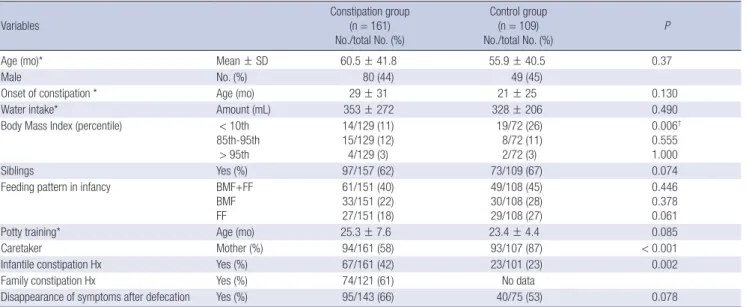
The constipation group (n = 161, 80 males; mean age of 60.5 ± 41.8 months, age range of 1-17 yr) was compared to the control group without constipation (n = 109, 49 males; mean age of 55.9 ± 40.5 months, age range of 1-14 yr). 43% of constipated children were under 48 months of age with a majority between 37 and 47 months (20%). There were no significant differences between the two groups in terms of the variables such as meal frequency, water intake, overweight or obesity, feeding patterns during infancy, age at the start of potty training, and disappear- ance of symptoms after defecation (Table 1). The significant
differences were that more children in the control group were cared for directly by their mothers and had a BMI of below the 10th percentile as compared to the constipation group. The con- stipation group had a significantly greater frequency of infantile constipation history than the control group (P = 0.002; Table 1).
The control group ate more balanced meals than the constipa- tion group. Significantly more children in the constipation group were reported to be picky eaters (P = 0.027), lacked exercise (P = 0.017), and displayed retentive posturing (P < 0.001) than the control group (Table 2).
Rome III criteria for functional constipation
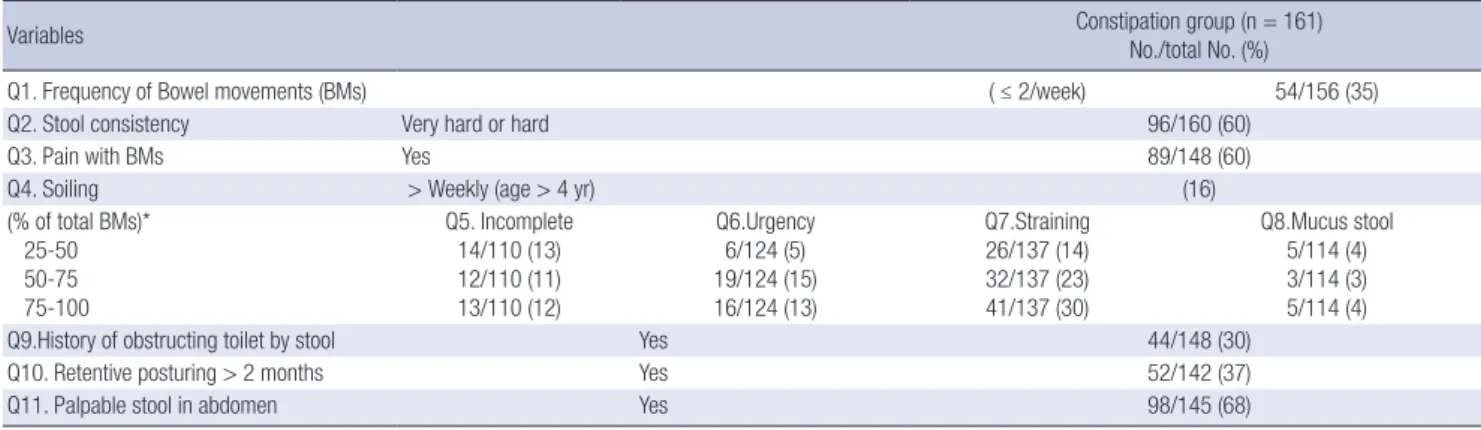
When analyzed with the Rome III criteria, most common com- plaints were hard stool consistency (60%), painful BM (60%), and a history of large stools in the lower abdomen (68%) com- pared to the rest of retentive posturing (37%), frequency of BMs
less than 2 per day (35%), and weekly soiling (16%). The fre- quency of straining with BMs was more frequent than urgency or incomplete BM (Table 3). 63% of constipated children had soiling experiences for a long duration of over 2 months.
Management for constipation by pediatric gastroenterologists
Many pediatric gastroenterologists performed a digital rectal examination (occasionally, 50%; always, 31%; mostly, 13%; nev- er, 6%) and disimpaction (mostly, 44%; occasionally, 44%; al- ways, 13%; never, 0%) at the initial examinations of constipated children.
The most commonly prescribed medications were osmotic laxatives, such as lactulose (94%) or polyethylene glycol (PEG, 63%). They all recommended more intakes of fruits and vegeta- bles, while only 25% of the gastroenterologists referred their pa- Table 1. Clinical characteristics of the constipation and control groups
Variables Constipation group
(n = 161) No./total No. (%)
Control group (n = 109) No./total No. (%)
P
Age (mo)* Mean ± SD 60.5 ± 41.8 55.9 ± 40.5 0.37
Male No. (%) 80 (44) 49 (45)
Onset of constipation * Age (mo) 29 ± 31 21 ± 25 0.130
Water intake* Amount (mL) 353 ± 272 328 ± 206 0.490
Body Mass Index (percentile) < 10th 85th-95th
> 95th
14/129 (11) 15/129 (12) 4/129 (3)
19/72 (26) 8/72 (11) 2/72 (3)
0.006† 0.555 1.000
Siblings Yes (%) 97/157 (62) 73/109 (67) 0.074
Feeding pattern in infancy BMF+FF
BMF FF
61/151 (40) 33/151 (22) 27/151 (18)
49/108 (45) 30/108 (28) 29/108 (27)
0.446 0.378 0.061
Potty training* Age (mo) 25.3 ± 7.6 23.4 ± 4.4 0.085
Caretaker Mother (%) 94/161 (58) 93/107 (87) < 0.001
Infantile constipation Hx Yes (%) 67/161 (42) 23/101 (23) 0.002
Family constipation Hx Yes (%) 74/121 (61) No data
Disappearance of symptoms after defecation Yes (%) 95/143 (66) 40/75 (53) 0.078
*Numeric variables was analyzed by Independent t-test; other variables were analyzed by Fisher’s exact test unless indicated otherwise; BMF, breast milk feeding; FF, formula milk feeding; Hx, history; P < 0.05 indicates significance.
Table 2. Clinical characteristics of the constipation and control groups
Variables Constipation group (n = 161)
No./total No. (%) Control group (n = 109)
No./total No. (%) P
Diet pattern Balanced meal
Sufficient meal Sufficient, balanced Picky, enough Balanced, small meal Picky, small meal
86/157 (55) 105/157 (69) 60/157 (38) 26/157 (17) 26/157 (17) 26/157 (17)
77/106 (73) 80/106 (75) 60/106 (57) 20/106 (19) 17/106 (16) 9/106 (8)
0.007 0.133 0.006 0.112 0.867 0.065 Parental inputs of causes of constipation Small meal
Low water intake Lack of vegetables Picky eater Lack of exercise No stools outside home Retentive posturing
53/152 (35) 56/152 (37) 42/152 (28) 41/152 (27) 34/152 (22) 45/152 (30) 59/152 (39)
22/75 (29) 35/75 (47) 24/75 (32) 10/75 (13) 7/75 (9) 14/75 (19)
8/75 (11)
0.455 0.195 0.536 0.027 0.017 0.107
< 0.001 Variables were analyzed by Fisher’s exact test unless indicated; P < 0.05 indicates significance.
tients to a dietitian (Table 4). Their treatment durations were 2-3 months (40% of physicians), 4-6 months (27%), and 7-12 months (33%). Follow-up periods were 2-3 months (29%), 4-6 months (36%), 7-12 months (36%), or 24 months (7%), respec- tively.
DISCUSSION
Functional constipation in children has been suspected to be as prevalent in the Republic of Korea as elsewhere. Physicians have experienced difficulties with managing constipated chil- dren due to inaccurate reports, recurrences, and general reluc- tance toward a visit to a gastroenterologist. Our study is the first multi-institutional study from pediatric gastroenterology clinics in ROK where constipated children were seen with a primary care physician’s referral. The results showed that the prevalence of constipation meeting the Rome III criteria (6.4%) was similar but lower than those in other countries that we have reviewed.
The worldwide prevalence for constipation in pediatric popula- tion varies widely in 0.3% to 29.6%, depending on the constipa- tion criteria or types of subjects (1). In primary care pediatric clinics, the prevalence rate was reported from 3% to 5% (2, 3). In the US, the prevalence rate using the Iowa criteria in primary care clinics was 22.6% (4). The prevalence of constipation is es-
timated to be 25% of patients at pediatric gastroenterology clin- ics (2-5). In the Netherlands, 45% prevalence rate of BM disor- ders was reported from a pediatric gastroenterology clinic (2).
In the ROK, one study of the first graders and sixth graders in an elementary school in Gwangju reported 15.4% prevalence rate of constipation using the BM criterion of less than twice per week (6). This variance in prevalence might be due to diet dif- ferences or subject selection criteria, age, the duration of study and/or the definition of constipation (1-6).
Efforts have been made to streamline the criteria through the continuous revisions of the Rome III criteria, the constipation criteria of the committee of the North American Society for Pe- diatric Gastroenterology, Hepatology, and Nutrition (NASP- GHAN), the Paris Consensus on Childhood Constipation Termi- nology Group (PACCT) Criteria, the Loening-Baucke criteria, and the Iowa criteria (1-6, 13, 14). Besides the differences in cri- teria among the studies, parent’s reports might have been a fac- tor for differences in prevalence rates as the studies have to rely on parents’ recall of their child’s constipation history. One bene- fit of using the Rome III criteria for functional constipation is that its criteria are inclusive of not only the strict BM frequency criterion but also accompanying symptoms of constipation. In an US study of constipation using the Iowa criteria, 18.3% in constipated children showed fecal soiling (4). A Korean study re- ported that 45.5% of constipated children had stool retention and 26.4% of them had pain with BMs based on the criterion of defecation frequency (less than twice per week) (6). Another study reported that 54% of constipated children soiled, 47.6%
had large stools, and 31.7% had BMs less than twice per week based on the Loening–Baucke criteria for the patients who un- derwent more than 1 month of treatment (15). In our study us- ing the Rome III criteria, the accompanying symptoms of consti- pation were more frequently reported than the infrequent BMs.
As for clinical characteristics of constipation, several factors have to be considered. First, its etiology in children has not been fully understood. Many primary care physicians hypothesized the withholding of stools after an experience of painful BMs as Table 3. The Rome III criteria for children with functional constipation
Variables Constipation group (n = 161)
No./total No. (%)
Q1. Frequency of Bowel movements (BMs) ( ≤ 2/week) 54/156 (35)
Q2. Stool consistency Very hard or hard 96/160 (60)
Q3. Pain with BMs Yes 89/148 (60)
Q4. Soiling > Weekly (age > 4 yr) (16)
(% of total BMs)*
25-50 50-75 75-100
Q5. Incomplete 14/110 (13) 12/110 (11) 13/110 (12)
Q6.Urgency 6/124 (5) 19/124 (15) 16/124 (13)
Q7.Straining 26/137 (14) 32/137 (23) 41/137 (30)
Q8.Mucus stool 5/114 (4) 3/114 (3) 5/114 (4)
Q9.History of obstructing toilet by stool Yes 44/148 (30)
Q10. Retentive posturing > 2 months Yes 52/142 (37)
Q11. Palpable stool in abdomen Yes 98/145 (68)
*Frequency > 25% of total bowel movements (BMs) was considered as constipation; variables were analyzed by Fisher's exact test unless indicated otherwise.
Table 4. Management of constipation by pediatric gastroenterologists
Maintenance treatments No. (%) of physicians (n = 16) Osmotic laxatives
Lactulose (mean, 1.9 ± 0.7 mL/kg/day) PEG 3350/4000 (mean, 0.6 ± 0.3 g/kg/day) Magnesium oxide (mean, 0.04 ± 0.03 g/kg/day)
15 (94) 11 (63) 7 (44)
Stimulant laxatives 2 (13)
Probiotics 6 (38)
Special milk formula for constipation Commercial formula increasing bowel transit
Extensive hydrolyzed protein formula 6 (38) 3 (19)
Prune juice 7 (44)
Referral patient to a dietician 4 (25)
the main pathophysiology of constipation (7, 8, 12). Various factors were assumed to affect constipation such as low fiber intake, anorexia, or lack of exercise and/or low body weight per height (16). Other variables included gender, family history, water intake, siblings, feeding patterns, age of toilet training, and obesity (2-4, 8, 16, 17). No definite causation between those suggested factors and constipation was established based on our data. Even for the obesity (17), our study did not find any differences in rates of obesity between the constipation group and its control group. An interesting finding was that more chil- dren in the control group showed a BMI of below the 10th per- centile which suggested a failure to thrive even with more bal- anced meals. Thus, this point requires further studies.
Many primary care physicians have considered low fiber or fluid intake as a main cause of constipation, in addition to stool withholding (12). In our study, parents have less considered stool withholding as a key cause for constipation than physi- cians, unlike western countries. A bigger roadblock to a consti- pation treatment seems to come from the fact that physicians as well as caretakers have several misconceptions for constipa- tion etiology and have been dissatisfied with previous constipa- tion managements, which leads to general reluctance to seek a professional care, to use home remedy, and not to continue with a treatment regimen (9-11, 18). Only 26% of constipated Korean students have sought a professional care for constipa- tion (6) and similar 25% of constipated children reported using a home remedy (18). Therefore, a proper public education should be a priority to clarify misconceptions for constipation and its management.
Currently, there are no Korean guidelines for treating consti- pation in children other than a few evidence-based guidelines adopted from western countries (19-21). The NASPGHAN con- stipation guidelines emphasized the importance of taking a thorough history and physical examination, and using the dis- impaction method as an initial treatment (19). At clinics, some primary care physicians (31%-51%) reported to have conducted a rectal examination for some patients (20%) as a diagnostic tool for constipation (12, 20). All physicians recommended more fi- ber intake but only some referred patients to a dietitian (12).
Some physicians (20%) also reported to always use disimpac- tion as for an initial treatment for constipation (12). In our study, 31% of the pediatric gastroenterologists have always performed a rectal examination and 13% always performed disimpaction as an initial treatment for constipation. The majority of the pri- mary care physicians (85%) referred patients to specialists after a treatment failure (20). Many of them were not familiar with the guidelines for constipation in children and there were gaps between guidelines and actual practices amongst physicians (12, 20, 21).
There has been a growing trend of drug treatment for consti- pation in Korea. Lactulose and PEG have been the drugs of
choice for childhood constipation (18-22). The majority of phy- sicians tried first to educate patients that drinking more water could soften hard stools, and only 19% of physicians have al- ways offered a drug treatment (12). Constipation in infants and toddler was relieved at a rate of 25% with a diet change and 92%
with the lactulose drug. Despite 2 months of treatments, 40% of constipated children remained symptomatic (22). Constipated children presented with a pelvic floor dyssynergia pattern were help ed with a biofeedback therapy including a multidiscipli- nary approach of education, behavior modification, drug treat- ment and follow-up (23). The treatment duration increased for patients with a history of repeated failures (15). Early treatment and sufficient treatment time as well as follow-up should be emphasized for a successful treatment (18). In our study, the durations of treatment and follow-up varied depending on the physician. The frequent failures to comply with a treatment reg- imen and subsequent recurrences of constipation in children could have caused unexpected psychological stress on parents and physicians, low self-esteem in children, and family con- flicts in addition to an economic burden to public health (10, 20, 24). Therefore, proper professional as well as family educa- tions are an integral part of childhood constipation manage- ment (10).
Our study was the first collaborative study of constipation with the help from Korean pediatric gastroenterology clinics, but it came with some limitations. Firstly, the subject selection was not randomized for the purpose of determining prevalence, and the subjects’ age distribution was uneven, having a pre- dominantly larger toddler age group. Secondly, the survey was not anonymous and the pediatric gastroenterologists were prac- ticing mainly in university-affiliated hospitals of variable sizes in Seoul metropolitan area. This might have affected the sam- pling of patients. Therefore, a caution is recommended when interpreting and applying our results to the general Korean pe- diatric population. Lastly, the survey response rate was low that could have added uncertainty in our results. The accounting factors could include a short research period, limited treatment time at the clinic, the lengthy questionnaire, difficulty providing sufficient responses to each question, recurrence of similar an- swers, and dependence on memory.
In conclusion, our study showed an internationally similar prevalence rate of 6.4% for chronic functional constipation in Korean pediatric gastroenterology clinics. For this study, the Rome III criteria were used to factor in characteristics of consti- pation. We hope to provide clinicians with guidelines for better management to ensure consistent treatment and further re- search of chronic constipation.
ACKNOWLEDGMENTS
The authors are grateful to the Korean Society of Pediatric Gas-
troenterology, Hepatology, and Nutrition (KSPGHAN) mem- bers involved in data acquisition and drafting of the manuscript for important intellectual content. We would like to thank Jae Sung Ko, MD, and Ju Young Chang, MD from Seoul National University Hospital, Je Woo Kim, MD from Yonsei Woori Chil- dren’s Clinic, Jae Hong Park, MD from Pusan National Univer- sity Hospital, Ki Sup Chung, MD from Severance Children’s Hospital, Byung-Ho Choe, MD from Kyungpook National Uni- versity Hospital, Yon Ho Choe, MD from Samsung Medical Center, and Jae Joon Han, MD from Korea University Hospital.
The authors thank the children and their parents or caretakers for participation.
DISCLOSURE
The authors have no conflicts of interest to disclose.
REFERENCES
1. Van den Berg MM, Benninga MA, Di Lorenzo C. Epidemiology of child- hood constipation: a systematic review. Am J Gastroenterol 2006; 101:
2401-9.
2. Benninga MA, Voskuijl WP, Taminiau JA. Childhood constipation: is there new light in the tunnel? J Pediatr Gastroenterol Nutr 2004; 39: 448- 64.
3. Rasquin-Weber A, Hyman PE, Cucchiara S, Fleisher DR, Hyams JS, Mil- la PJ, Staiano A. Childhood functional gastrointestinal disorders. Gut 1999; 45: II60-8.
4. Loening-Baucke V. Prevalence rates for constipation and faecal and uri- nary incontinence. Arch Dis Child 2007; 92: 486-9.
5. Di Lorenzo C. Childhood constipation: finally some hard data about hard stools! J Pediatr 2000; 136: 4-7.
6. Cho SJ, Ahn YJ, Kim EY, Rho YI, Yang ES, Park YB, Moon KR. The preva- lence and associated factors of constipation in the school-aged children.
Korean J Pediatr Gastroenterol Nutr 2002; 5: 26-32.
7. Partin JC, Hamill SK, Fischel JE, Partin JS. Painful defecation and fecal soiling in children. Pediatrics 1992; 89: 1007-9.
8. Blum NJ, Taubman B, Nemeth N. During toilet training, constipation occurs before stool toileting refusal. Pediatrics 2004; 113: e520-2.
9. Müller-Lissner SA, Kamm MA, Scarpignato C, Wald A. Myths and mis- conceptions about chronic constipation. Am J Gastroenterol 2005; 100:
232-42.
10. Hambleton S, Oldam A, Sheils S. User satisfaction with a constipation
service: a comparative audit. Paediatr Nurs 2006; 18: 23-6.
11. Borowitz SM, Cox DJ, Kovatchev B, Ritterband LM, Sheen J, Sutphen J.
Treatment of childhood constipation by primary care physicians: effica- cy and predictors of outcome. Pediatrics 2005; 115: 873-7.
12. Burgers R, Bonanno E, Madarena E, Graziano F, Pensabene L, Gardner W, Mousa H, Benninga MA, Di Lorenzo C. The care of constipated chil- dren in primary care in different countries. Acta Paediatr 2012; 101: 677- 80.
13. The Rome Foundation. Rome III diagnostic questionnaires for the pedi- atric functional GI disorders. Available at http://www.romecriteria.org/
pdfs/pediatricq.pdf [accessed on 1 April 2008].
14. Boccia G, Manguso F, Coccorullo P, Masi P, Pensabene L, Staiano A. Func- tional defecation disorders in children: PACCT criteria versus Rome II criteria. J Pediatr 2007; 151: 394-8.e1.
15. Ahn YJ, Park JO. Clinical outcome and long term follow-up of chronic functional constipation in children. Korean J Pediatr Gastroenterol Nutr 2006; 9: 200-9.
16. Roma E, Adamidis D, Nikolara R, Constantopoulos A, Messaritakis J.
Diet and chronic constipation in children: the role of fiber. J Pediatr Gas- troenterol Nutr 1999; 28: 169-74.
17. Pecora P, Suraci C, Antonelli M, De Maria S, Marrocco W. Constipation and obesity: a statistical analysis. Boll Soc Ital Biol Sper 1981; 57: 2384-8.
18. Kim HS, Hong YR, We JH, Park JH. Factors contributing to treatment out- come of functional constipation in children. Korean J Pediatr Gastroen- terol Nutr 2010; 13: 36-43.
19. Constipation Guideline Committee of the North American Society for Pediatric Gastroenterology, Hepatology and Nutrition. Evaluation and treatment of constipation in infants and children: recommendations of the North American Society for Pediatric Gastroenterology, Hepatology and Nutrition. J Pediatr Gastroenterol Nutr 2006; 43: e1-13.
20. Whitlock-Morales A, McKeand C, DiFilippo M, Elitsur Y. Diagnosis and treatment of constipation in children: a survey of primary care physicians in West Virginia. W V Med J 2007; 103: 14-6.
21. Tabbers MM, Boluyt N, Berger MY, Benninga MA. Clinical practice: di- agnosis and treatment of functional constipation. Eur J Pediatr 2011;
170: 955-63.
22. Loening-Baucke V. Prevalence, symptoms and outcome of constipation in infants and toddlers. J Pediatr 2005; 146: 359-63.
23. Park KY, Chang SH, Kim KM. Assessment of the effectiveness of biofeed- back therapy in children with pelvic floor dyssynergia. Korean J Pediatr Gastroenterol Nutr 2007; 10: 51-9.
24. Choung RS, Shah ND, Chitkara D, Branda ME, Van Tilburg MA, White- head WE, Katusic SK, Locke GR 3rd, Talley NJ. Direct medical costs of constipation from childhood to early adulthood: a population-based birth cohort study. J Pediatr Gastroenterol Nutr 2011; 52: 47-54.