493 https://doi.org/10.9713/kcer.2020.58.3.493
PISSN 0304-128X, EISSN 2233-9558
단 신
Operating Pressure Conditions for Non-Explosion Hazards in Plants Handling Propane Gas
Jae-Young Choi and Sang-Hoon Byeon†
Department of Health and Safety Convergence Science, Graduate School, Korea University, 145 Anam-ro, Seongbuk-gu, Seoul, 02841, Korea
(Received 3 March 2020; Received in revised form 17 March 2020; accepted 13 April 2020)
Abstract − Hazardous area classification is designed to prevent chemical plant explosions in advance. Generally, the duration of the explosive atmosphere is used for zone type classification. Herein, IEC code, a quantitative zone type classification methodology, was used to achieve Zone 2 NE, which indicates a practical non-explosion condition. This study analyzed the operating pressure of a vessel handling propane to achieve Zone 2 NE by applying the IEC code via MATLAB. The resulting zone type and hazardous area grades were compared with the results from other design standards, namely API and EI codes. According to the IEC code, the operating pressure of vessels handling propane should be between 101325-116560.59 Pa. In contrast, the zone type classification criteria used by API and EI codes are abstract. Therefore, since these codes could interpret excessively explosive atmospheres, care is required while using them for hazardous area classification design.
Key words: Explosive atmosphere, Hazardous area classification, IEC 60079-10-1, Process safety, Zone 2 NE
1. Introduction
Hazardous area classification is designed to prevent chemical plant explosions in advance. Such a design results in the partitioning of the explosion-proof zone, wherein suitable explosion-proof equipment is purchased and installed [1]. The hazardous area classification design allows the classification of the zone types based on the duration for which the explosive atmosphere lasts when there is a leak in the facility handling the flammable materials; in addition, it allows classification into the “gas group” and “temperature class” based on the ignition energy that leads to the explosion. The global engineering standards applied for the design of hazardous area classification include API RP 505, EI 15, and IEC 60079-10-1 [2]. The choice of the code to be applied from among these three engineering standards is based either on the characteristics of the country where the chemical plant is constructed or the preference of its owner. However, the engineering standards mentioned above apply different methodologies to define a hazardous area [3]. Therefore, even in facilities that handle the same flammable materials, the zone type and the explosion-proof radii are different for each standard, because they apply different design criteria. The primary difference between the three standards is that the IEC code classification allows for Zone 2 NE [4], which indicates a class that is negligible under normal conditions, despite a leak in the facility that handles flammable materials; therefore, this class is
considered as non-explosion proof. One study introduced the concept of Zone 2 NE that exists only in the IEC code, but no study was conducted on process conditions to satisfy this [5]. In addition, a study was conducted to analyze the hazardous area extent by applying IEC code to methane as a target material, but the IEC code applied to this study was not the latest version currently in use, but the 1.0 edition in 2008 [6]. And, there was a study comparing IEC code edition 1.0 and 2.0, but no comparison was made with other global engineering standards, API and EI codes [7]. We analyzed the pressure conditions for Zone 2 NE, based on the IEC code specifications, in a vessel that handles propane, which is a widely used gas in the industry. Then, the explosion-proof radii obtained through API and EI codes were compared based on the same process conditions.
2. Background
In the case of the API and EI codes, the methodology used to classify zone types is not presented through a quantitative approach [8]. Therefore, subjective evaluation by the engineer estimates cases that fall into the following categories and applies the area types.
1) Zone 0: This classification represents a condition wherein the process equipment is expected to leak for more than 1000 hours per year as a continuous grade of release, which means that it is always exposed to an explosive atmosphere, depending on the ventilation conditions. In general, the fluid inside the storage tank can be considered to be in this zone.
2) Zone 1: This classification represents the condition wherein the process equipment is expected to leak for 10-1000 hours per year as a primary grade of release; in this case, an explosive atmosphere is
†To whom correspondence should be addressed.
E-mail: [email protected]
This is an Open-Access article distributed under the terms of the Creative Com- mons Attribution Non-Commercial License (http://creativecommons.org/licenses/by- nc/3.0) which permits unrestricted non-commercial use, distribution, and reproduc- tion in any medium, provided the original work is properly cited.
maintained in consideration of the ambient ventilation conditions under normal operating conditions. In general, the empty space between the upper surface and the liquid level inside the storage tank can be considered to be in this zone.
3) Zone 2: This classification represents the condition wherein the process equipment is expected to leak 1-10 hours per year as a secondary grade of release. However, this condition might only last under abnormal operating conditions, despite the formation of an explosive atmosphere, depending on the ambient ventilation conditions.
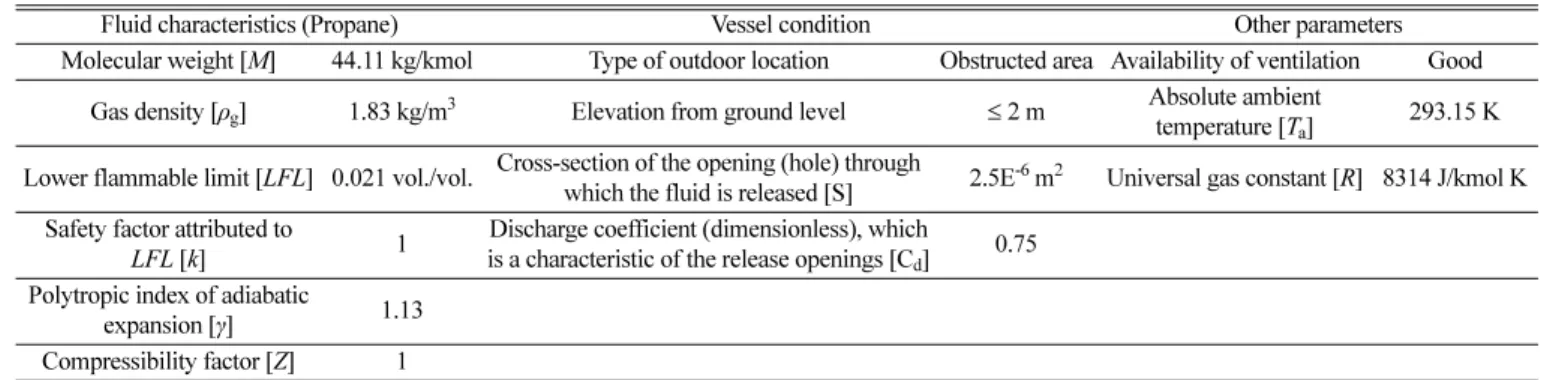
A disadvantage of the zone type classification by the API and EI codes is that their criteria are ambiguous and therefore not suitable for an objective judgement by the design engineers. However, the IEC code allows for an additional zone type with NE rating. Furthermore, unlike the other codes, the IEC code uses a quantitative methodology for selecting an explosive atmosphere. This study investigated the Zone 2 NE under pressure conditions based on the following equipment and fixed variables (Table 1).
3. Methodology and Results
The IEC code determines the final zone type by combining the grade of release, effectiveness of ventilation, and availability of ventilation for the leak sources, which are described in Table 2 [9].
The secondary grade of release is selected because a leak should not occur in the process equipment under normal operating conditions [10]. Moreover, the availability of ventilation is considered as “good”
because the process equipment placed under outdoor atmospheric
conditions is affected by natural wind. Therefore, to achieve the Zone 2 NE grade, the overall effectiveness of the ventilation must be under a high dilution condition.
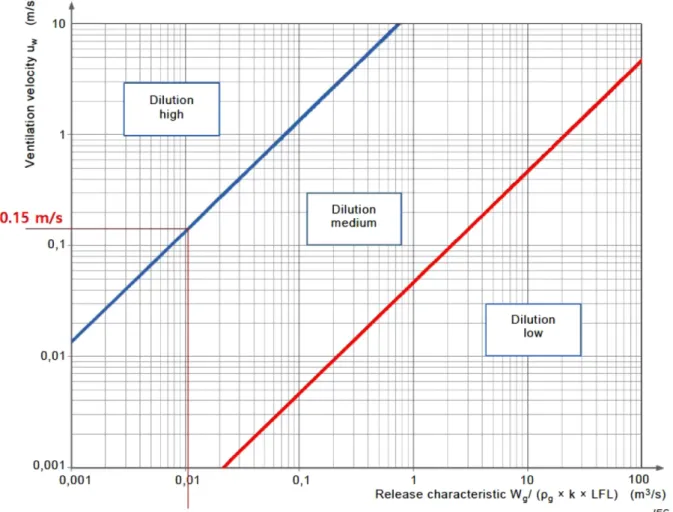
The effectiveness of ventilation as introduced in the IEC code can be determined from Fig. 1, which shows a plot between the release characteristics and ventilation velocity. The high, medium, and low dilution conditions are classified according to the area where the release characteristics meet the ventilation velocity. Table 3 shows the application of ventilation velocity using the IEC code.
In this study, the ventilation velocity was chosen to be 0.15 m/s because the facility handling the heavier-than-air gas exists at the ground level of the obstructed area. Generally, when a facility handling a heavier-than-air gas exists at the ground level of an obstructed area, effective ventilation can be achieved by selecting a high dilution condition only if it is less than the release characteristic value, which is the point of intersection of the X-axis with the red line in Fig. 1.
In a Korean study [11], the equation of the section that divides the high and medium dilution plots in Fig. 1 is presented as Equation (1).
[Ventilation velocity] = × [Release characteristic] (1)
By substituting the ventilation velocity as 0.15 m/s, it is possible to satisfy the high dilution condition for the effectiveness of the ventilation when the release characteristic is 0.01125 m3/s or less.
The release characteristic is a newly introduced parameter in the IEC code and is calculated as shown in Equation (2).
[Release characteristic] = (2)
40 ---3
Wg
ρg×k×LFL --- which the fluid is released [S]
Safety factor attributed to
LFL [k] 1 Discharge coefficient (dimensionless), which
is a characteristic of the release openings [Cd] 0.75 Polytropic index of adiabatic
expansion [γ] 1.13
Compressibility factor [Z] 1
Table 2. Zone classification based on grade of release and effectiveness of ventilation
Grade of release
Effectiveness of ventilation
High dilution Medium dilution Low dilution
Availability of ventilation
Good Fair Poor Good Fair Poor Good, fair, or poor
Continuous Non-hazardous (Zone 0 NE)
Zone 2 (Zone 0 NE)
Zone 1
(Zone 0 NE) Zone 0 Zone 0 + Zone 2
Zone 0
+ Zone 1 Zone 0
Primary Non-hazardous (Zone 1 NE)
Zone 2 (Zone 1 NE)
Zone 2
(Zone 1 NE) Zone 1 Zone 1 + Zone 2
Zone 1
+ Zone 2 Zone 1 or Zone 0 Secondary Non-hazardous
(Zone 2 NE)
Non-hazardous
(Zone 2 NE) Zone 2 Zone 2 Zone 2 Zone 2 Zone 1 and even Zone 0
By substituting the values of ρg, k, and LFL introduced in Table 1, it is possible to satisfy the conditions required to achieve Zone 2 NE when Wg is less than 0.000433 m3/s.
Here, Wg represents the mass release rate of the gas [kg/s], Pa
represents the atmospheric pressure (101325 [Pa]), and T represents the absolute temperature of the fluid, gas or liquid [K]. To determine the gas release, the formula for sonic release (Eq. (3)) is applied if the pressure of the facility is higher than 191504.25 Pa, which is 1.89 times the atmospheric pressure. Otherwise, the formula for subsonic release (Eq. (4)) is applied.
(3)
(4)
When sonic release occurs in the vessel handling propane, which has been investigated in this study, the condition is expressed as shown in Eq. (5).
85543.15 [Pa] > P (5)
However, this contradicts the precondition for sonic release according to which the operating pressure must exceed 191504.25 Pa. Therefore, the vessel handling propane release is considered to have a subsonic leak rather than a sonic leak.
The subsonic release that occurs in the vessel handling propane is determined using the following formula:
0.000433 > 0.75·(2.5×10−6) ·P ·
(6)
Wg Cd×S P γ M
Z R× ×T ---
× 2
γ 1+ ---
⎝ ⎠
⎛ ⎞(γ 1+ )/ γ 1(– )
×
×
×
=
Wg Cd×S P M
Z R× ×T --- 2γ
γ 1– --- 1 Pa
---P
⎝ ⎠⎛ ⎞(γ 1+ )/γ
– Pa
---P
⎝ ⎠⎛ ⎞1/γ
×
×
×
×
= 44.11
8314 293.15⋅ --- 2.26
0.13--- 1 101325 ---P
⎝ ⎠
⎛ ⎞
0.131.13 ---
⎝ – ⎠
⎜ ⎟
⎛ ⎞
⋅ ⋅ 101325
---P
⎝ ⎠
⎛ ⎞
1.131 ---
⋅ Fig. 1. Chart for assessing the degree of dilution.
Table 3. Indicative outdoor ventilation velocities
Type of outdoor locations Unobstructed areas Obstructed areas
Elevation from ground level ≤ 2 m >2 m up to 5 m >5 m ≤ 2 m >2 m up to 5 m >5 m
Indicative ventilation velocities for estimating the dilution of lighter-than-air gas/vapor releases
0.5 m/s 1 m/s 2 m/s 0.5 m/s 0.5 m/s 1 m/s
Indicative ventilation velocities for estimating the dilution of heavier-than-air gas/vapor releases
0.3 m/s 0.6 m/s 1 m/s 0.15 m/s 0.3 m/s 1 m/s
Indicative ventilation velocities for estimating the liquid pool evaporation rate at any elevation
>0.25 m/s >0.1 m/s
The solution of Eq. (6) by MATLAB: it is observed that Zone 2 NE is achieved when the operating pressure of the vessel handling propane gas is lower than 116560 Pa.
Similarly, the following results were obtained by applying the API and EI codes for hazardous area classification design under the same pressure, i.e., in the range of 101325-116560.59 Pa, using the same process equipment:
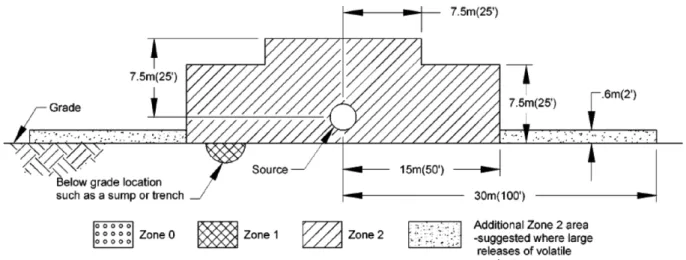
3-1. API RP 505—Direct example approach [3]: Zone 2, 15 m API code requires the explosion-proof radii to be applied considering only the relative air density of the flammable material handled by the facility. Propane is heavier-than-air gas (Relative air density: 1.55), so according to Fig. 2 of API code, the explosion-proof radii of 15 m is applied.
3-2. EI 15—Point-source approach [13]: Zone 2, 4 m EI code applied the explosion-proof radii through a technique called point source approach. This method classifies flammable materials handled by the facility into four fluid categories, A, B, C, G (i), and G (ii), and the hole sizes of 1, 2, 5, and 10 mm according to the characteristics of the facility. The operating pressure is also classified into four categories of 5, 10, 50, and 100 bara. That is, the explosion-
IEC code, is applied to the nearest value of 2 bara of EI code. By substituting these parameters into Table 4 introduced in EI code, a hazardous area extent of 4 m can be obtained. R1 and R2 are radii according to the shape of the hazardous area zone formation. In this case, 4 m is the final explosion-proof radii because R1 and R2 both have the same value.
In summary, vessels handling the same propane under pressure conditions of 101325-116560.59 Pa are non-hazardous when applying IEC code, Zone 2 explosion-proof radii of 15 m when applying API code, and 4 m when applying EI code.
4. Discussion
This study calculated the pressure conditions required to apply Zone 2 NE of the IEC code to a vessel handling propane gas. The results show that the required pressure range is 101325-116560.59 Pa; this indicates that according to the IEC code, the vessel handling propane that operates in this pressure range does not produce an explosive atmosphere. However, if different engineering standards, namely the API and EI codes, are applied under the same conditions, the explosion-proof radii are 15 and 4 m in Zone 2, IIA, and T1, respectively. This is because, unlike the IEC code, the API and EI codes
Fig. 2. Typical figure for hazardous area classification by API RP 505.
Table 4. Hazardous area extent table of EI 15
Fluid category Release pressure [bara]
Hazardous radius R1 [m] Hazardous radius R2 [m]
Release hole diameter Release hole diameter
1 mm 2 mm 5 mm 10 mm 1 mm 2 mm 5 mm 10 mm
A
5 2 4 8 14 2 4 16 40
10 2.5 4 9 16 2.5 4.5 20 50
50 2.5 5 11 20 3 5.5 20 50
100 2.5 5 11 22 3 6 20 50
use abstract criteria for the zone type classification which are based on the duration of the explosive atmospheres and may be interpreted as excessively explosive atmospheres. Therefore, when the hazardous area classification is designed using either the API or EI code, care must be taken against selecting an incorrect explosion hazard location when the operating pressure of the vessel handling propane is in the range of 101325-116560.59 Pa, which is the result of this study.
Acknowledgment
This study did not receive any grants from funding agencies in the public, commercial, or not-for-profit sectors.
References
1. Guidry, P. E., Anderson, R. P., Clement, G. and Westveer, S., “Hot Surface Ignition Temperatures: Their Impact on Electrical Area Classification Plans,” IEEE IND APPL MAG, 24, 31-38(2018).
2. Shrivastava, V., Mohan, G., Feinstein, N. and Bhatia, N., “An Innovative Approach to Hazardous Area Classification - Three Dimensional (3D) Modeling of Hazardous Areas,” Proc. of Pet.
Chem. Ind. Tech. Conf. PCIC, 1-9(2016).
3. Bozek, A., “Application of IEC 60079-10-1 Edition 2.0 for Haz- ardous Area Classification,” IEEE Trans Ind Appl, 54, 1881- 1889(2018).
4. Jespen, T., Zone Classification-Natural Gas, ATEX-Explosive Atmospheres. Springer Series in Reliability Engineering, Springer, cham, pp. 93-105 (2016).
5. Tommasini, R., Pons, E. and Palamara, F., “Area Classification
for Explosive Atmospheres: Comparison Between European and North American Approaches,” IEEE Trans Ind Appl, 50, 3128- 3134(2014).
6. Miranda, J. T., Camacho, E. M., Formoso, J. A. F. and García, J.
D. R., “Comparative Study of Methodologies Based on Standard UNE 60079/10/1 and Computational Fluid Dynamics (CFD) to Determine Zonal Reach of Gas-generated Atex Explosive Atmo- spheres,” J. Loss Prev Process Ind., 26, 839-850(2013).
7. Jung, Y. J. and Lee, C. J., “A Study on Gas Explosion Hazard- ous Ranges for International Electrotechnical Commission Tech- nical Standards,” J. Korean Soc. Saf. Journal, 33, 39-45(2018).
8. Bishop, D. N., Jagger, D. M. and Propst, J. E., “New Area Clas- sification Guidelines, in: Record of Conference Papers,” IEEE Industry Applications Society 45th Annual Petroleum and Chemi- cal Industry Conference (Cat. No. 98CH36234), 9-19(2013).
9. IEC, IEC 60079-10-1 : Classification of areas – Explosive gas atmo- spheres., International Electrotechnical Commission (2015) https://
webstore.iec.ch
10. Zohdirad, H., Ebadi, T., Givehchi, S. and Meysami, H., “Grid-based Individual Risk Calculation in the Classification of Hazardous Area with a Risk-based Approach,” J Loss Prev Process Ind, 43, 98-105(2016).
11. Kim, J. H., Lee, M. K., Kil, S. H., Kim, Y. G. and Ko, Y. K., “Area Classification of Hazardous Gas Facility According to KGS GC101 Code,” J. Korean Inst. Gas., 23, 46-64(2019).
12. Hahn, B. H. and Valentine, D. T., Essential MATLAB for Engi- neers and Scientists, Academic Press, New York(2017).
13. Givehchi, S., Zohdirad, H. and Ebadi, T., “Utilization of Regres- sion Technique to Develop a Predictive Model for Hazard Radius From Release of Typical Methane-rich Natural Gas,” J. Loss Prev. Process Ind., 44, 24-30(2016).