- 702 -
Studies on the major nutritional components of commercial dried lavers ( Porphyra yezoensis ) cultivated in Korea
Ki-Woong Kim1, Jae-Ho Hwang2, Myung-Joo Oh3, Min-Yong Kim4, Myeong-Rak Choi5,6, Wook-Min Park1*
1
Department of Marine Bio Food Science, Chonnam National University, Yeosu 550-749, Korea
2Department of Aqualife Science, Chonnam National University, Yeosu 550-749, Korea
3
Department of Aqualife Medicine, Chonnam National University, Yeosu 550-749, Korea
4
Department of Refrigeration and Air Conditioning Engineering, Chonnam National University, Yeosu 550-749, Korea
5Department of Biotechnology, Chonnam National University, Yeosu 550-749, Korea
6
Department of Biomedical Electronic and Engineering, Chonnam National University, Yeosu 550-749, Korea
시판 건조김의 주요 영양성분
김기웅1․황재호2․오명주3․김민용4․최명락5,6․박욱민1*
1전남대학교 해양바이오식품학과, 2양식생물학전공, 3수산생명의학과, 4냉동공조공학과, 5생명산업공학과,
6대학원 바이오전자메디컬협동과정
Abstract
This study was conducted to provide basic date on the proximate composition and amino acid, fatty acid, sugar, and mineral contents of commercial dried lavers cultivated in Korea (in Seocheon, Wando, Goheung and Busan).
The moisture, crude ash, crude fat, crude protein, and carbohydrate content ranges of the dried lavers were 5.67~7.43%, 8.01~8.95%, 1.54~2.25%, 37.77~39.98%, and 43.83~46.24%, respectively. The total amino acid, free amino acid, and essential amino acid concentrations were highest (25,982.15 mg/100 g, 4,545.44 mg/100 g, and 9,048.28 mg/100 g) in the dried lavers cultivated from Wando. The compositions of the fatty acids in four dried lavers were 16.30~22.15%
saturated fatty acids, 6.04~7.73% monounsaturated fatty acids, and 70.33~76.03% polyunsaturated fatty acids. The sugar contents per 100 g of dried lavers were 3,678.84~4,052.52 mg of galactose, 2,112.30~2,473.86 mg of fructose, 1,103.74~1,648.39 mg of mannose, 361.67~590.21 mg of glucose, 8.63~10.38 mg of ribose, and 21.43~48.32 mg of xylose. The mineral concentrations in the dried lavers cultivated from Wando and Busan were low (Cu < Mn
< Zn < Fe < Ca < Mg < Na < K), as were those in the dried lavers cultivated from Seocheon and Goheung (Cu < Mn < Zn < Fe < Mg < Ca < Na < K).
Key words:laver, fatty acid, amino acid, component sugar, mineral
서 론
1)
김(Porphyra yezoensis)은 식물분류학상 홍조식물문의 원시홍조강, 김목, 김과에 속하는 해조류로 미역 및 다시마 와 함께 국내에서 대표적으로 알려져 있는 해조류 중 하나 이며, 우리나라 외에도 일본, 중국, 대만 등 일부 아시아 국가에서 양식되고 있다(1). 우리나라 천해양식어업 생산
*Corresponding author. E-mail:[email protected] Phone:82-61-659-6684, Fax:82-61-659-6689
량은 2010년 기준 137만 톤이고 이 중에서 해조류의 비중이 64%이상으로 가장 높았으며, 주요 해조류 중에서 김은 23 만 톤으로 비중이 26%로 차지하고 있다(2). 김에서 탄수화 물은 약 40%, 그리고 단백질은 약 30~40%를 함유하고 있어 이 두 가지 성분만으로 전체의 70~80%를 차지하고 있다. 탄수화물에는 당질과 섬유가 있으며, 그 중에는 만난 (manna), 크실란(xylan)이라고 부르는 골격을 이루는 난용 성 섬유가 약 2% 함유되어 있다. 또한 당질은 골격다당의 내측에 분포하여 바다 속에서 외적을 방지하고, 이온을 흡
수·농축하는 역할을 하는 수용성의 다당류이며 그 미끈미 끈한 성분은 폴피란(porphyran)으로서 약 30%를 차지하고 있다. 이 두가지 성분이 식이섬유(dietary fiber)를 구성하고 있다. 한편 지질은 약 2%로 소량이지만, 무기질은 풍부하여 전체의 약 10%를 차지하고 있다. 무기질은 우리들의 체내 에서 중요한 영양소이며, 김에는 육상 야채에 비하여 건강 에 필수적인 칼슘, 마그네슘, 철분, 아연, 망간 등이 균형 있게 들어 있다(3). 지금까지 김에 대한 일반성분(4-6), 아미 노산(7-9), 지방산 조성(10-12), 당류(13-15), 무기질 함량 (16-18)과 제품가공 및 저장 중의 품질변화(19-21), 조미 김의 품질특성(22-24)에 대한 연구는 보고되어 있다. 그러 나 김은 같은 품종이라도 양식 지역, 수확 시기, 해황 등에 따라 영양성분의 차이가 심한 것으로 알려져 있는데 이는 일부 지역에 대한 특정 성분만 보고될 뿐 산지별 시판 건조 김에 대한 일반성분, 아미노산, 지방산, 구성당 및 무기질 함량에 대한 종합적 주요 영양성분 분석의 연구는 미흡한 실정이다.
따라서 본 연구에서는 전남지역의 주요 김 생산지 중에 완도를 기준으로 남해안에서 가장 먼 부산과 서해안에서는 부산과 지리적으로 비슷하게 위치한 서천 및 전남지역의 비교대상으로 고흥을 선정하였으며, 이들 지역에서 채취하 여 시판되는 건조김의 일반성분, 구성․유리 아미노산, 지 방산, 구성당 및 무기질 성분을 분석하여 기초 자료로서 활용하고자 하였다.
재료 및 방법
실험재료
본 연구에 사용된 시료는 2011년 5~6월경에 충남 서천 의 수산물특화시장, 전남 완도의 수산시장, 고흥의 녹동수 산시장 및 경남 부산의 자갈치시장내 건어물 판매장에서 일반김 중에서 고급 품질의 중품으로 김밥김인 건조김을 구입하여 분쇄기(Cyclotec 1093 Sample Mill, Foss Tecator AB, Hoganas, Sweden)로 분쇄한 후 50 mesh체에 걸러 통과 한 분말을 밀봉하여 냉장실에 보관하면서 실험용 재료에 사용하였다. 분석에 사용된 chloroform, methanol, ethanol, 무수 Na2SO4, NaOH 시약은 덕산약품공업사(Ansan, Korea), HCl, HNO3, HClO4 시약은 Junsei Chemical Co.(Tokyo, Japan) 및 14% BF3-methanol, 표준품 시약은 Sigma-Aldrich Co.(St. Louis, MO, USA)에서 구입하였다.
일반성분
일반 성분은 식품공전(25)에 따라 수분은 상압가열건조 법, 조단백질은 세미마이크로 킬달법, 조지방은 에테르추 출법 및 조회분은 회화법으로 분석하였고, 탄수화물은 100 에서 수분, 조단백질, 조지방 및 회분량을 제외한 값으로 나타내었다.
지방산
지방산 분석은 Folch 등(26)의 방법에 따라 시료 5 g에 chloroform 10 mL와 methanol 20 mL를 가하고 2분간 균질 화한 다음 chloroform 10 mL를 더 가한 후 30초간 균질화 하였다. 여과 후 30분간 방치한 후 상층을 제거하고 무수 Na2SO4를 가하여 탈수한 다음 rotary vacuum evaporator (V-805, BUCHI Co., Essen, Germany)로 감압․농축하여 얻어진 지질을 Wangaarden(27)의 방법에 따라 14%
BF3-methanol 용액을 사용하는 methylation을 하였다. Gas Chromatography(GC-10A, Shimadzu Co., Kyoto, Japan)로 분석하였다. Column은 SP™-2560 capillary column(100 mm length×0.25 mm i.d.×0.25 μm film thickness)을 사용하였고, column 온도는 140℃에서 10분간 유지한 후 240℃까지 4℃
/min로 승온하였다. Injection 및 detector 온도는 260℃로 하였고, flow rate는 0.6 mL/min(split ratio=80:1), flame ionization detector로 검출하였다.
아미노산
구성 아미노산의 분석은 Shin 등(28)의 방법에 따라 ampoule에 분쇄한 시료 0.5 g과 6 N HCl 3 mL를 취하여 탈기하고 heating block에서 120℃, 24시간 가수분해한 다음 여액을 rotary vacuum evaporator로 감압·농축하여 산을 완 전히 증발시킨 후, sodium loading buffer로 10 mL로 정용시 킨 용액 1 mL를 취하여 0.2 μm membrane filter(Advantec, Toyo Roshi Kaisha, Ltd., Tokyo, Japan)로 여과한 다음 아미 노산 자동분석기(S433-H, Sykam, Eresing, Germany)로 분석 하였다. Column은 cation separation column(LCA K06/Na, 4.6×150 mm)을 사용하였고, buffer 용액(pH 3.45∼10.85)의 flow rate는 0.45 mL/min, reagent의 flow rate는 0.25 mL/min, column 온도는 57∼74℃, fluorescence detector(Ex=440 nm, Em=570 nm)로 검출하였다.
유리 아미노산의 분석은 시료 2 g에 ethanol 20 mL을 가한 후 homogenizer(AM-8, Nihonseiki Kaisha Ltd., Tokyo, Japan)로 10분 동안 교반하여 3,000 rpm에서 20분간 원심분 리하였고, 잔사에 다시 75% ethanol 10 mL를 첨가하여 homogenizer(AM-8, Nihonseiki Kaisha Ltd.)로 10분 동안 교반한 후 3,000 rpm에서 20분간 원심분리하였다. 상층액 을 합하여 rotary vacuum evaporator로 감압·농축하여 증류 수로 용해시킨 후 0.2 μm membrane filter로 여과시켜 아미 노산 자동분석기로 분석하였다. Column은 cation separation column(LCA K07/Li, 4.6×150 mm)을 사용하였고, buffer 용액(pH 2.90∼7.95)의 flow rate는 0.45 mL/min, reagent의 flow rate는 0.25 mL/min, column 온도는 37∼74℃, fluorescence detector(Ex=440 nm, Em=570 nm)로 검출하였다.
구성당
구성당 분석은 Chaplin과 Kennedy(29)의 방법을 약간 변
형하여 ampoule에 분쇄한 시료 0.2 g과 2 N HCl 5 mL를 가하여 시험관 내부의 공기를 질소(N2) gas로 치환하여 heating block에서 110℃, 6시간 가수분해한 다음 2 N NaOH 를 가하여 시료를 중화한 후 4,500 rpm에서 20분간 원심분 리한 후에 상등액을 0.45 μm membrane filter(Advantec, Toyo Roshi kaisha, Ltd.)로 여과하여 Table 1의 분석 조건에 따라 HPLC(Prominence HPLC, Shimadzu Co.)로 분석하였다.
Table 1. HPLC operating conditions for component sugar Condition
Column Shim-pack ISA-07/S2504(250×4.0 mm) Mobile phase A: Potassium borate(pH 8)
B: Potassium borate(pH 9) Flow rate
0.5 mL/min[0→15 min: B(0 → 20%), 30 min: B(20
→ 50%), 45 min: B(50 → 90%), 50 min: B(90 → 100%), 65 min: B(100 → 100%), 90 min: B(100 → 0%)]
Oven temperature 65°C
Reagent 1% arginine in 3% boric acid Reagent temperature 150°C
Detector Fluorescence detector Ex=320 nm, Em=430 nm
무기질
무기질 분석은 Jung 등(30)의 방법에 따라 teflon 분해용 기에 시료 0.5 g, 65% HNO37 mL 및 60% HClO41 mL를 취하여 Microwave Digestion System(MLS1200, Milestone, Bergamo, Italy)로 습식 분해시킨 후 유도결합플라즈마분광 광도계(ICP-OES, PerkinElmer Optima 7300DV, Connecticut, Sheltons, USA)로 분석하였으며, 분석조건으로 plasma flow rate는 15 L/min, sample flow rate는 1.5 L/min의 조건으로 Ca(317.9 nm), K(766.5 nm), Zn(206.2 nm), Mg(285.2 nm), Mn(257.6 nm), Na(589.6 nm), Fe(238.2 nm), Cu(317.9 nm)를 정량하였다.
통계처리
모든 실험은 3회 반복하여 결과를 평균치와 표준편차로 표시하였으며, 유의성 검정은 SPSS 통계프로그램(Satistical Package for the Social Science, 20.0, SPSS Inc., Chicago, IL, USA)을 이용하여 p<0.05 수준에서 Duncan's multiple range test로 검정하였다.
결과 및 고찰
일반성분
시판 건조김의 일반성분 조성은 Table 2와 같다. 수분 함량은 5.67~7.43%, 조회분 함량은 8.01~8.95%, 조지방 함량은 1.54~2.25%, 조단백질 함량은 37.77~39.98% 및
탄수화물 함량은 43.83~46.24%으로 산지에 따라 유의적 차이를 나타냈다(p<0.05). Lee 등(19)은 김의 품질등급이 높을수록 단백질 함량은 높은 반면 탄수화물이 적게 함유되 어 있는 것으로 보고하여 완도와 고흥 김이 높은 품질등급 에 해당되는 반면 Mok 등(17)은 완도 김보다 부산 김의 단백질 함량이 높게 함유되어 있다는 연구와는 일치하지 않았다. Seo와 Jung(22)은 일반 김의 수분 함량이 7.5%, 회분이 8.7%, 조지방은 0.7%, 조단백질이 35.0%, 탄수화물 은 48.1%를 함유한다고 보고한 연구 결과와 유사하게 나타 냈다. 한편 Kim 등(6)은 시판 김의 수분 함량이 12.1%, 회분 이 15.9%, 조지방이 4.2%, 조단백질이 32.1%, 당질이 35.7%
로 보고 하였고 본 연구 결과보다 수분, 회분 및 조지방 함량이 다소 높게 나타냈는데 이는 일반성분 조성이 채취 장소와 시기에 따라 차이를 나타낸다고 하였다(31).
Table 2. Proximate compositions of commercial dried lavers (Unit : g/100 g) Area Moisture Crude Ash Crude fat Crude protein Carbohydrate Seocheon 7.43±0.051)a 8.01±0.06d 2.16±0.03b 37.77±0.05d 44.62±0.04b
Wando 5.67±0.04c 8.25±0.04c 2.25±0.04a 39.98±0.06a 43.85±0.04c Goheung 6.24±0.03b 8.95±0.03a 1.54±0.05c 39.44±0.04b 43.83±0.03c Busan 5.72±0.04c 8.53±0.05b 1.58±0.06c 37.93±0.03c 46.24±0.09a
1)Values are mean±SD (n=3).
a∼dMeans with different letters in the same column are significantly different at p<0.05 by Duncan's multiple range test.
아미노산
시판 건조김의 구성아미노산 함량은 Table 3과 같다. 건 조김 100 g 당 완도가 25,982.15 mg, 부산이 23,847.35 mg, 고흥이 21,499.83 mg, 서천이 20,190.80 mg의 순으로 산지 에 따라 유의적 차이를 나타냈다(p<0.05). 그리고 동물 체내 에서 합성되지 않으므로 음식물로부터 섭취해야만 하는 필수아미노산은 건조김 100 g 당 완도가 9,048.28 mg, 부산 이 8,003.11 mg, 고흥이 7,178.65 mg, 서천이 7,156.80 mg의 순으로 산지에 따라 유의적 차이를 나타냈으며(p<0.05), 총 아미노산에 대한 필수아미노산의 비율은 33.39~35.45%로 나타냈다. 완도, 고흥 및 부산에서 주요 구성아미노산은 alanine, glutamic acid, aspatic acid, leucine, glycine의 순으 로, 서천에서는 glutamic acid, alanine, aspatic acid, leucine, glycine의 순으로 낮게 나타냈다. Lee 등(8)은 주요 아미노 산 성분에서 장흥, 서천 및 해남 김이 완도, 고흥 및 부산의 김 연구결과와는 일치하는 반면에 서천의 김은 연구결과와 일치하지 않았다. 일반적으로 해조 단백질의 구성아미노산 은 alanine, aspartic acid, glycine, proline과 같은 중성 및 산성 아미노산이 많으며 아미노산 함량의 차이는 같은 품종 이라도 계절, 생육장소, 해황 등에 따라 변동이 심한 것으로 알려져 있다(32,33).
유리아미노산은 기호성에 영향을 미치는 중요한 요소로 서 식품의 풍미를 예측하는 하나의 중요한 요소가 될 수 있다고 보고되어 있고, glutamic acid, aspartic acid, alanine, glycine 등은 식품의 향기와 맛을 부여한다고 알려져 있다 (34,35). 시판 건조김의 유리아미노산 함량은 Table 4와 같 다. 건조김 100 g 당 완도가 4,545.44 mg, 3,526.64 mg, 고흥 이 3,103.19 mg, 서천이 2,871.62 mg의 순으로 산지에 따라 유의적 차이를 나타냈다(p<0.05). Park 등(9)과 Yoshie 등 (10)은 마른 김에서 100 g 당 5,147~6,139 mg과 6,886~
9,262 mg으로 보고한 연구결과에 비해 유리아미노산 함량 이 낮았다. 완도, 고흥 및 부산의 김에서 주요 유리아미노산 은 alanine, taurine, glutamic acid의 순으로, 서천의 김에서는 taurine, alanine, glutamic acid의 순으로 낮게 나타냈다. 그리 고 주요 유리아미노산인 alanine, taurine, glutamic acid는 유리아미노산의 총량에 83~86%를 차지하였고, Park 등(9) 은 주요 유리아미노산이 총량의 73~80%로 보고한 연구결 과보다 약간 높게 나타냈다. 유리아미노산 중의 alanine,
Table 3. Total amino acid contents in commercial dried lavers (Unit : mg/100 g)
Amino acid Area
Seocheon Wando Goheung Busan
Threonine 1,167.94±14.761)d2) 1,519.81±7.72a 1,236.74±5.49c 1,349.25±6.83b Valine 1,339.77±8.74c 1,615.78±5.06a 1,320.73±6.74d 1,485.33±6.57b Methionine 214.67±4.87b 294.36±6.27a 85.18±3.97d 105.43±4.07c Isoleucine 796.81±6.48c 991.44±7.37a 767.58±7.36d 882.84±7.48b Leucine 1,639.00±5.74d 2,088.28±6.79a 1,719.48±8.04c 1,908.80±8.69b Phenylalanine 863.24±5.87c 1,076.57±11.20a 876.94±5.84c 971.50±6.56b Lysine 1,135.35±4.92d 1,462.03±8.55a 1,172.01±8.30c 1,299.95±8.35b Total EAA3) 7,156.80±25.85c 9,048.28±5.64a 7,178.65±23.26c 8,003.11±7.39b Aspatic acid 1,883.54±12.73d 2,542.31±10.14a 2,065.00±50.69c 2,326.82±4.54b Serine 1,006.88±6.76c 1,353.96±6.09a 1,192.60±58.43b 1,235.48±5.22b Glutamic acid 2,436.10±5.53c 3,050.50±8.45a 2,437.34±4.48c 2,684.41±6.95b Proline 1,166.20±5.90c 1,376.23±5.92a 1,164.86±4.96c 1,328.65±6.05b Glycine 1,379.01±8.58c 1,706.97±6.68a 1,354.78±5.39d 1,492.48±6.79b Alanine 2,238.72±8.10d 3,100.00±4.69a 2,763.68±6.16c 3,051.34±8.78b Cystine 36.19±3.13b 91.99±3.79a 12.64±1.09d 20.38±2.83c Histidine 437.81±6.08d 493.84±6.99b 461.40±8.33c 543.99±6.06a Tyrosine 355.58±5.83c 587.24±9.02a 375.79±4.87b 383.77±7.30b Ammonia 1,030.41±5.47d 1,131.03±6.51c 1,404.96±10.60b 1,552.82±8.35a Arginine 1,063.56±5.96d 1,499.81±7.58a 1,088.12±7.22c 1,224.10±7.50b Total AA4) 20,190.80±30.45d 25,982.15±27.90a 21,499.83±36.32c 23,847.35±26.42b
1)Values are mean±SD (n=3).
2)a∼dMeans with different letters in the same row are significantly different at p<0.05 by Duncan's multiple range test.
3)Total EAA : Total essential amino acid
4)Total AA : Total amino acid
glutamic acid는 단맛과 감칠맛에 관여하며, taurine은 인체 내에서 혈중 콜레스테롤 저하, 간기능 강화, 혈압강하 등 다양한 생리활성의 보고가 있다(36-39).
Table 4. Free amino acid contents in commercial dried lavers (Unit : mg/100 g)
Amino acid Area
Seocheon Wando Goheung Busan
Phosphoserine 60.14±1.701)a 54.60±1.85b 57.59±1.15b 38.35±1.84c Taurine 971.83±13.53b 1,184.34±10.13a 985.39±13.88b 1,197.28±15.02a Phosphoethanolamine 5.60±0.39a 5.74±0.55a 4.03±0.46b 4.42±0.29b Aspartic acid 33.55±3.05c 147.80±9.43a 20.68±2.52d 81.04±2.41b Threonine 20.99±1.34b 35.27±2.37a 24.53±0.73b 33.39±3.10a serine 5.44±0.31c 16.23±0.81a 2.86±0.16d 10.81±1.70b Asparagine 56.08±3.62b 77.79±0.85a 46.69±1.66c 39.93±1.53d Glutamic acid 687.69±10.58b 785.55±11.48a 535.64±12.84c 516.57±8.90c Proline 27.99±1.51a 15.06±0.58b 15.50±0.90b 13.55±0.72b Glycine 10.51±1.71b 11.14±0.77ab 13.06±1.46a 9.22±0.81b Alanine 733.95±7.52d 1,937.89±8.32a 1,133.03±13.25c1,345.11±7.44b Citrulline 15.90±2.17c 20.42±1.26b 71.00±2.67a 12.85±1.02c α-aminobutyric acid 2.25±0.11ab 2.41±0.34a 1.99±0.09b 2.00±0.10b Valine 30.61±3.60a 31.16±4.34a 28.96±3.20a 26.40±2.28a Methionine 3.67±0.27b 4.11±0.19a 0.97±0.08d 3.08±0.08c Isoleucine 20.49±2.17a 23.20±1.97a 15.65±0.68b 20.22±2.03a Leucine 34.49±2.61a 33.94±2.62a 24.72±3.26b 27.98±3.75b Tyrosine 14.34±2.00a 14.87±0.49a 10.34±1.22b 13.69±0.86a phenylalanine 18.29±3.11a 18.57±2.50a 16.20±1.87a 16.90±2.02a β-alanine 2.16±.20a 1.22±0.16b 1.40±0.14b 1.29±0.02b β-aminoisobutyric acid 1.80±0.10d 3.50±0.23b 2.81±0.20c 5.07±0.25a γ-amino-n-butyric acid 44.73±4.53a 31.66±5.10b 35.08±2.71b 49.37±4.64a Histidine 5.43±0.22b 7.30±0.28a 4.18±0.08c 5.26±0.25b Ornitine 1.87±0.18b 1.52±0.07b 4.51±0.48a 1.46±0.09b Lysine 19.10±2.81a 16.58±3.98a 15.44±2.70a 15.69±3.47a Ethanolamine 17.64±1.79a 18.19±1.31a 15.15±1.97a 18.16±2.76a Arginine 25.10±4.01b 45.41±4.74a 15.81±2.65c 17.56±3.28c Total 2,871.62±12.74d4,545.44±17.20a3,103.19±25.62c3,526.64±22.72b
1)Values are mean±SD (n=3).
a∼dMeans with different letters in the same row are significantly different at p<0.05 by Duncan's multiple range test.
지방산
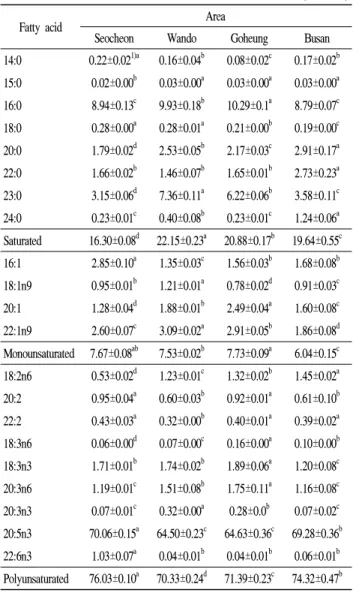
시판 건조김의 지방산 조성은 Table 5와 같다. 건조김에 서 주요 지방산은 cis-5,8,11,14,17-eicosapentaenoic acid (20:5n3)가 64.50~70.06%, palmitic acid(16:0)가 8.79~
10.29%, tricosanoic acid(23:0)가 3.15~7.36%, erucic acid (22:1n9)가 1.86~3.09%로서 전체 지방산의 78.30~90.80%
를 차지하였으며, 포화지방산보다 불포화지방산이 상대적 으로 함량비가 약 4배정도 높았으며, 또한 고도불포화지방 산이 70% 이상 차지하였다. 건조김의 주요 지방산 중에서 가장 많이 차지하는 20:5n3은 서천, 부산, 고흥 및 완도 순으로, 16:0은 고흥, 완도, 서천 및 부산 순으로, 23:0은 완도, 고흥, 부산 및 서천 순으로 산지에 따라 유의적 차이를 나타냈다(p<0.05). Lee 등(19)은 건조김의 지방산 중에서 가장 많이 차지하는 성분은 20:5n3이었고 그 다음으로 16:0 인 연구보고와 유사한 경향을 보였으며, 또한 산지별, 등급 별 건조김의 지방산 조성에서 불포화산이 전체의 61.85~76.94%를 차지하였고, 특히 등급이 높을수록 20:5n3 과 polyene산의 함량비가 50.81%와 62.93%로 높은 반면에 포화산과 monoene산의 함량비는 29.42%와 7.65%으로 낮 다고 하였다.
Table 5. Fatty acid compositions in commercial dried lavers (Unit : %)
Fatty acid Area
Seocheon Wando Goheung Busan
14:0 0.22±0.021)a 0.16±0.04b 0.08±0.02c 0.17±0.02b 15:0 0.02±0.00b 0.03±0.00a 0.03±0.00a 0.03±0.00a 16:0 8.94±0.13c 9.93±0.18b 10.29±0.1a 8.79±0.07c 18:0 0.28±0.00a 0.28±0.01a 0.21±0.00b 0.19±0.00c 20:0 1.79±0.02d 2.53±0.05b 2.17±0.03c 2.91±0.17a 22:0 1.66±0.02b 1.46±0.07b 1.65±0.01b 2.73±0.23a 23:0 3.15±0.06d 7.36±0.11a 6.22±0.06b 3.58±0.11c 24:0 0.23±0.01c 0.40±0.08b 0.23±0.01c 1.24±0.06a Saturated 16.30±0.08d 22.15±0.23a 20.88±0.17b 19.64±0.55c 16:1 2.85±0.10a 1.35±0.03c 1.56±0.03b 1.68±0.08b 18:1n9 0.95±0.01b 1.21±0.01a 0.78±0.02d 0.91±0.03c 20:1 1.28±0.04d 1.88±0.01b 2.49±0.04a 1.60±0.08c 22:1n9 2.60±0.07c 3.09±0.02a 2.91±0.05b 1.86±0.08d Monounsaturated 7.67±0.08ab 7.53±0.02b 7.73±0.09a 6.04±0.15c 18:2n6 0.53±0.02d 1.23±0.01c 1.32±0.02b 1.45±0.02a 20:2 0.95±0.04a 0.60±0.03b 0.92±0.01a 0.61±0.10b 22:2 0.43±0.03a 0.32±0.00b 0.40±0.01a 0.39±0.02a 18:3n6 0.06±0.00d 0.07±0.00c 0.16±0.00a 0.10±0.00b 18:3n3 1.71±0.01b 1.74±0.02b 1.89±0.06a 1.20±0.08c 20:3n6 1.19±0.01c 1.51±0.08b 1.75±0.11a 1.16±0.08c 20:3n3 0.07±0.01c 0.32±0.00a 0.28±0.0b 0.07±0.02c 20:5n3 70.06±0.15a 64.50±0.23c 64.63±0.36c 69.28±0.36b 22:6n3 1.03±0.07a 0.04±0.01b 0.04±0.01b 0.06±0.01b Polyunsaturated 76.03±0.10a 70.33±0.24d 71.39±0.23c 74.32±0.47b
1)Values are mean±SD (n=3).
a∼dMeans with different letters in the same row are significantly different at p<0.05 by Duncan's multiple range test.
구성당
시판 건조김의 구성당 함량은 Table 6과 같다. 표준품은 maltose, lactose, rhamnose, ribose, mannose, fructose, galactose, xylose 및 glucose를 사용하였으나, ribose, mannose, fructose, galactose, xylose, glucose만 검출되었다.
구성당 함량은 건조김 100 g 당 galactose가 3,678.84~
4,052.52 mg, fructose가 2,112.30~2,473.86 mg, mannose가 1,103.74~1,648.39 mg, glucose가 361.67~590.21 mg의 순 으로 낮았으며 산지에 따라 유의적 차이를 나타냈고 (p<0.05), ribose와 xylose는 미량 검출되었다. Park(13)은 유리당으로 galactose, glucose 및 inositol을 동정하였으며 저장 초기의 galactose와 glucose 함량은 30.1 mg/100 g, 9.4 mg/100 g을 함유한다고 보고한 하였으며, Park 등(14)은 유리당 분석에서 fucose, galactose, glucose 및 mannose만 검출되었고 본 연구의 구성당 분석에서는 ribose, fructose, xylose도 검출되었으며 유리당 함량 중에 galactose가 가장 높았으며 그 다음으로 glucose, mannose의 순으로 낮았는데 이는 본 연구 결과와는 일치하지 않았다.
Table 6. Component sugar contents in commercial dried lavers (Unit : mg/100 g)
sugar Area
Seocheon Wando Goheung Busan
Ribose 10.38±0.541)a 9.29±0.31b 8.63±0.23b 9.05±0.19b Mannose 1,103.74±5.11d 1,494.06±6.51c 1,521.98±9.64b 1,648.39±8.65a Fructose 2,112.30±13.50d 2,402.63±10.24b 2,473.86±12.71a 2,356.27±11.47c Galactose 4,052.52±18.45a 3,678.84±24.61d 3,859.40±17.49b 3,736.36±17.51c Xylose 21.43±0.56d 48.32±0.53b 55.27±0.59a 23.49±0.45c Glucose 361.67±5.44c 458.65±6.84b 371.65±6.76c 590.21±3.51a
1)Values are mean±SD (n=3).
a∼dMeans with different letters in the same row are significantly different at p<0.05 by Duncan's multiple range test.
무기질
시판 건조김의 무기질 함량은 Table 7과 같다. 건조김에 서 주요 무기질은 K, Na, Mg, Ca이었고 Fe, Zn, Mn, Cu는 미량 검출되었다. 건조김의 K 함량은 100 g 당 고흥이 1,862 mg, 완도가 1,708 mg, 서천이 1,555 mg, 부산이 1,525 mg의 순으로, Na 함량은 부산이 593.10 mg, 서천이 515.23 mg, 완도가 501.28 mg, 고흥이 444.39 mg의 순으로, Mg 함량은 고흥이 409.69 mg, 서천이 390.72 mg, 부산이 352.83 mg, 완도가 330.94 mg의 순으로, Ca 함량은 부산이 417.66 mg, 완도가 379.75 mg, 고흥이 274.25 mg, 서천이 252.28 mg의 순으로 산지에 따라 유의적 차이를 나타냈다(p<0.05). Mok 등(17)은 완도, 부산 김의 무기질 함량은 K, Na, Mg, Ca, Fe, Zn, Mn, Cu 순으로, 고흥 김의 무기질 함량은 K, Na, Ca, Mg, Fe, Zn, Mn, Cu 순으로 낮았다는 보고와 일치하였
고, Han 등(18)의 완도 김의 무기질 함량 순서가 본 연구결 과와 유사하게 나타냈다. 따라서 시판 건조김의 주요 영양 성분인 지방산, 구성․유리아미노산, 구성당 및 무기질은 같은 품종일지라도 생산지역에 따라 성분함량의 차이를 보였으며 그 함량의 차이는 생산지역에 따른 차이도 있겠지 만 김 제조 중에 가공용수, 가공시간, 세척 횟수에 따라 성분이 일부 용출되었기 때문인 것으로 사료된다.
Table 7. Mineral contents in commercial dried lavers (Unit : mg/100 g)
Mineral Area
Seocheon Wando Goheung Busan
Ca 252.28±6.371)d 379.75±9.59b 274.25±6.93c 417.66±10.54a Fe 15.22±0.46a 13.53±0.41b 8.21±0.25d 10.52±0.32c K 1,555.00±15.55c 1,708.00±17.08b 1,862.00±18.62a 1,525.00±15.25c Mg 390.72±5.99b 330.94±5.07d 409.69±6.28a 352.83±5.41c Cu 0.51±0.04c 0.79±0.05b 0.52±0.04c 0.88±0.05a Mn 1.90±0.07b 2.67±0.10a 1.60±0.06c 1.32±0.05d Zn 3.25±0.15b 4.94±0.23a 2.21±0.10d 2.53±0.12c Na 515.23±6.49b 501.28±6.32b 444.39±3.52c 593.10±7.47a
1)Values are mean±SD (n=3).
a∼dMeans with different letters in the same row are significantly different at p<0.05 by Duncan's multiple range test.
요 약
시판 건조김의 일반성분, 아미노산, 지방산, 구성당 및 무기질 함량을 분석한 결과는 다음과 같다. 수분 함량은 5.67~7.43%, 조회분 함량은 8.01~8.95%, 조지방 함량은 1.54~2.25%, 조단백질 함량은 37.77~39.98% 및 탄수화물 함량은 43.83~46.24%으로 산지에 따라 유의적인 차이를 나타냈다. 구성아미노산 함량은 건조김 100 g 당 완도가 25,982.15 mg, 부산이 23,847.35 mg, 고흥이 21,499.83 mg, 서천이 20,190.80 mg의 순으로, 필수아미노산은 건조김 100 g 당 완도가 9048.28 mg, 부산이 8003.11 mg, 고흥이 7178.65 mg, 서천이 7156.80 mg의 순으로, 유리아미노산 함량은 건조김 100 g 당 완도가 4,545.44 mg, 부산이 3,526.64 mg, 고흥이 3,103.19 mg, 서천이 2,871.62 mg의 순으로 산지에 따라 유의적 차이를 나타냈다. 주요 지방산 조성은 20:5n3가 64.50~70.06%, 16:0가 8.79~10.29%, 23:0 가 3.15~7.36%, 22:1n9가 1.86~3.09%으로 산지에 따라 유의적 차이를 보였고 전체 지방산의 78.30~90.80%를 차 지하였다. 구성당은 건조김 100 g 당 galactose가 3,678.84~
4,052.52 mg, fructose가 2,112.30~2,473.86 mg, mannose가 1,103.74~1,648.39 mg, glucose가 361.67~590.21 mg의 순 으로 산지에 따라 유의적 차이를 나타냈다. 무기질 함량은
완도 및 부산 김이 K, Na, Mg, Ca, Fe, Zn, Mn, Cu 순으로, 고흥 및 서천의 김은 K, Na, Ca, Mg, Fe, Zn, Mn, Cu 순으로 산지에 따라 유의적 차이를 보였다.
감사의 글
이 논문에 도움을 주신 전남대학교 여수캠퍼스 공동실험 실습관 직원분들께 감사드립니다.
References
1. Cho SM, Kim BM, Han KJ, Seo HY, Han Y, Yang EH, Kim DS (2009) Current status of the domestic processed laver market and manufacturers. Food Sci Indust, 42, 57-70.
2. Korea Statistical Information Service (KOSIS) (2010) Fishery Production Statistics, KOSIS (http://kosis.kr) 3. Park CK, Kang TJ, Kim KS (2000) The nutritional and
functional constituents of laver. Bull Fish Soc Inst Yosu Nat’l Univ, 9, 133-137
4. Lee DS, Pyeun JH, Cho DM, Kim HR, Kim DS (1995) Trace components and functional saccharides in seaweed.
Changes in proximate composition and trace elements according to the harvest season and places. Bull Korean Fish Soc, 28, 49-59
5. Lee KH, Ryuk JH, Jung WJ (1990) Quality changes of dried lavers during processing and storage. 3. Changes in pigments, trypsin indigestible substrates (TIS) and dietary fiber content during roasting and storage. Bull Korean Fish Soc, 23, 280-288
6. Kim SJ, Ma SJ, Jang YS (2005) Extraction and quality characteristics of porphyran from laver (Porphyra yezoensis) waste. Korean J Food Culture, 20, 446-450 7. Hong SP, Koo JK, Jo KS, Kim DS (1997) Physicochemical characteristics of water or alcohol soluble extracts from laver Porphyra yezoensis. J Korean Soc Food Sci Nutr, 26, 10-16
8. Lee HJ, Choi JI, Choi SJ (2012) Physiological activities and amino acid compositions of Korean dried layer Porphyraproducts. Korean J Fish Aquat Sci, 45, 409-413 9. Park CK, Park CH, Park JN (2001) Extractive nitrogenous constituents of dried Laver,Porphyra yezoensis. J Korean Fish Soc, 34, 397-402
10. Yoshie Y, Suzuki T, Shirai T, Hirano T (1993) Free amino acids and fatty acid composition of various culture
locations and prices. Nippon Suisan Gakkaishi, 59, 1769-1775
11. Ha BS (1977) A comparative study on fatty acid composition of marine benthic algae. Bull Korean Fish Soc, 10, 199-204
12. Chung YH, Lee EH, Oh KS, Cha YJ, Ahn CB, Lee TH (1985) Lipid components of dried laver (Cultured Porphyra tenera and P. suborbiculata) produced at Wan-do in Korea. Bull Korean Fish Soc, 18, 433-438 13. Park YH (1973) Changes in Sugars composition of dried lavers during storage. Korean J Food Sci Technol, 5, 235-239
14. Park WM, Kang DS, Bae TJ (2014) Studies on organic acid, vitamin and free sugar contents of commercial dried lavers (Porphyra yezoensis) cultivated in Korea. J Korean Soc Food Sci Nutr, 43, 172-177
15. Kim DS, Lee DS, Cho DM, Kim HR, Pyeun JH (1995) Trace components and functional saccharides in marine algae. 2. Dietary fiber contents and distribution of the algal polysaccharides. J Korean Fish Soc, 28, 270-278 16. Lee JH, Sung NJ (1980) The content of minerals in algae.
J Korean Soc Food Nutr, 9, 51-58
17. Mok JS, Lee TS, Son KT, Song KC, Kwon JY, Lee KJ, Kim JH (2011) Proximate composition and mineral content of laver Porphyra yezoensis from the korean coast. Korean J Fish Aquat Sci, 44, 554-559
18. Han JS, Lee YJ, Yoon MR (2003) Changes of chromaticity and mineral contents of laver dishes using various cooking methods. J East Asian Soc Dietary Life, 13, 326-333
19. Lee KH, Song SH, Jeong IH (1987) 1. Quality evaluation of different grades of dried lavers and its changes storage.
Quality changes of dried lavers during processing and storage. Bull Korean Fish Soc, 20, 408-418
20. Jo KS, Do JR, Koo JG (1998) Pretreatment conditions of Porphyra yezoensis, Undaria pinnatifida and Laminaria religiosa for functional alage-tea. J Korean Soc Food Sci Nutr, 27, 275-280
21. Jo KS, Kim JH, Sin HS (1995) Effect of storage conditions on the oxidative stability of lipid in roasted and roasted-seasoned laver (Porphyra tenera). Korean J Food Soc Technol, 27, 902-908
22. Seo HY, Jung BM (2007) Comparative study of food components and sensory properties of commonPorphyra yezoensis and functionalPorphyra yezoensis. J Korean Soc Food Sci Nutr, 36, 1314-1319
23. Jeon YS, Park SJ, Choi MK, Kang MH (2008) Oxidation
stability of lavers made with garlic-salt and their characteristics during storage. J Korean Soc Food Sci Nutr, 37, 83-89
24. Park WM, Kim KW, Kang DS, Bae TJ (2014) Studies on anion, element, chromaticity and antioxidant activities of commercial dried lavers (Porphyra yezoensis) cultivated in Korea. J Korean Soc Food Sci Nutr, 43, 323-327
25. Korean Food Standards Codex (2012) General test method. Korea Food and Drug Administration.
Cheongwon, Korea, p 10-1-1, 10-1-6, 10-1-7, 10-1-42 26. Folch J, Lees M, Sloane-Stanley GH (1957) A simple method for the isolation and purification of total lipids from animol tissues, J Biol Chem, 226, 497-509 27. Wungaarden DV (1967) Modified rapid preparation fatty
acid esters from liquid for gas chromatographic analysis.
Anal Chem, 39, 848-850
28. Shin TS, Zheng X, Do YW, Jeon SI, Woo HC, Kim NG (2011) Chemical properties of sea tangle (Saccharina japonica) cultured in the different depths of seawater.
Clean Technol, 17, 395-405
29. Chaplin MF, Kennedy JF (1994) Carbohydrate analysis:
A practical approach, 2nd ed., Oxford University Press, Oxford, New York, USA, p 74-76
30. Jung BM, Han KA, Shin TS (2011) Food components of different parts of Cheonnyuncho (Opuntia humifusa) harvested from Yeosu, Jeonnam in Korea. Korean Soc Food Sci Nutr, 40, 1271-1278
31. Noda H (1971) Biochemical studies on marine algae-Ⅱ.
Relation between quality and chemical composition of Asakusanori. Bull Japan Soc Sci Fish, 37, 30-34 32. Park YH, Jang DS, Kim SB (1997) Processing of the
sea food. Hyungsul Press, Seoul, Korea, p 166-168 33. Noda H (1993) Chemistry of marine algae. In science
of marine algae. Oishi K.(ed.) Asakura-Shoten, Tokyo, Japan, p 14-29
34. Watanabe K, Sato Y (1974) Meat flavor. Japan J Zootech Sci, 45, 113-128
35. Ruiz-Capillas C, Moral A (2001) Changes in free amino acids during chilled storage of hake (Merluccius merluccius, L.) in controlled atmospheres and their use as a quality control index. Eur Food Res Technol, 212, 302-307
36. Choi MJ, Seo JN (2006) The effect of dietary taurine supplementation on plasma and liver lipid concentrations in rats. J East Asian Soc Dietary Life, 16, 121-127 37. Chung EJ, Um YS, Nam HW, Park TS (2003) Changes
in lipid peroxidation level and antioxidant enzyme activities of rats supplemented with dietary cholesterol and/or taurine. J Korean Soc Food Sci Nutr, 32, 1310-1317
38. Hong JW, Kim IH, Kwon OS, Kim JH, Lee JH, Min BJ, Lee WB, Lim MH, Choi SJ, Kim ES, Jeong YH (2003) Effects of taurine supplementation on growth
performance, backfat thickness and cholesterol and taurine concentrations in finishing pigs. J Korean Soc Food Sci Nutr, 32, 598-602
39. Lee HM, Paik IY, Park TS (2003) Effects of dietary supplementation of taurine, carnitine or glutamine on endurance exercise performance and fatigue parameters in athletes. Korean J Nutr, 36, 711-719
(접수 2014년 5월 7일 수정 2014년 8월 5일 채택 2014년 9월 10일)