• 검색 결과가 없습니다.

대한비과학회

N/A
N/A
Protected

Academic year: 2021

Share "대한비과학회"

Copied!
5
0
0

로드 중.... (전체 텍스트 보기)

전체 글

(1)

- 66

The Effects of Adenoidectomy on Nasal Airway Resistance and Nasal Geometry

Chan Hee Park, M.D. 1 , Bon Seok Koo, M.D. 1 , A Young Kim, M.D. 1 , Yong De Jin, M.D. 2 , Yong Won Lee, M.D. 1 and Ki Sang Rha, M.D. 1

ABSTRACT

The primary objective of this study was to determine whether adenoid hypertrophy and subsequent adenoidectomy affect pediatric nasal airway resistance and nasal geometry. The secondary objective was to evaluate the relationships between the degree of adenoid hypertrophy and nasal airway resistance or nasal geometry. Fifty-one children, aged 5 to 10 years, selected for adenoidectomy due to chronic nasal obstruction and mouth breathing were enrolled. The size of adenoid was evaluated by cephalometric radiograph. Nasal airway resistance and nasal geometry were evaluated by active anterior rhinomanometry and acoustic rhinometry respectively. These measurements were repeated 3 months after operation. The size of adenoid was found well correlated to preoperative nasal airway resistance but was not to preoperative nasal geometry. Nasal geometry was not changed after operation. However, nasal airway resistance was reduced significantly at 3 months after operation and the size of adenoid was found well correlated to postoperative changes of nasal airway resis tances.

KEY WORDS :Adenoidectomy・Nasal airway resistance・Acoustic rhinometry.

INTRODUCTION

Nasal obstruction is the most common symptom in the otolaryngological field and may be caused by in- flammatory diseases such as infectious rhinosinusitis and allergic rhinitis, by structural deformities such as septal deviation, by congenital diseases such as choanal atresia and by malignant or benign tumors. Unlike in adults, adenoid hypertrophy is common in children and it may be an important cause of symptoms such as nasal obstruction, snoring, and mouth breathing. 1)2)

However there is a controversy about whether nasal resistance, an objective measures in the evaluation of nasal obstruction, increases in patients with adenoid

hypertrophy. Fielder reported that there was a signi- ficant correlation between the preoperative nasal re- sistance and the weight of the adenoid removed at operation. 2) Juliusson et al., also stated that rhinoma- nometry can be a useful method for the selection of children for adenoidectomy. 3) On the other hand, Parker et al., reported that the relationship between the nasal resistance and the size of the adenoid was not strong enough for rhinomanometry to be of use in sele- ction of children for adenoidectomy. 4)

It is suspected that nasal obstruction in patients with adenoid hypertrophy is usually caused by the mass effect of the adenoid tissue located in the nasopharynx.

However, there is also a possibility that adenoid hyper- trophy decreases the airflow passing through the nasal cavity, which may cause chronic congestion of the nasal mucosa causing decrease of the cross-sectional area and volume.

In this study, we wish to study the correlation bet- ween the degree of adenoid hypertrophy evaluated be- fore surgery and objective measures for evaluation of nasal obstruction such as nasal resistance, minimum cross-sectional area or nasal volume. We also wish to analyze the changes of such measures after surgery.

1

Department of Otolaryngology-Head and Neck Surgery, College of Medicine, Chungnam National University, Daejeon, Korea,

2

Department of Otolaryngology, Yanbian University, College of Medicine, Yanji, China

Address correspondences and reprint requests to Ki Sang Rha, M.D., Department of Otolaryngology-Head and Neck Surgery, College of Medicine, Chungnam National University, 640 Dae- sa-dong, Jung-gu, Daejeon 301-721, Korea

Tel:82-2-42-220-7698, Fax:82-42-253-4059 E-mail:[email protected]

Accepted for publication on August 12, 2004

(2)

MATERIALS AND METHODS

Fifty-one children, between the ages of 5 and 10, selected for adenoidectomy due to nasal obstruction and mouth breathing, were enrolled. There were 31 male and 20 female patients. Patients with diseases that may affect nasal resistance such as allergic rhinitis, infectious rhinosinusitis, nasal polyp, or nasal septal deviation have been excluded.

In order to evaluate the degree of adenoid hyper- trophy, a simple skull lateral view was taken and the adenoid/nasopharynx diameter ratio (A/N ratio) was obtained according to the method of Fujioka et al. 5) (Fig. 1). The A/N ratio was above 0.5 in all patients.

In order to evaluate subjective symptoms such as nasal obstruction and mouth breathing, a questionnaire was drawn up where 0 represented no symptoms, 1 represented symptoms that come occasionally, 2 for symptoms that come often and 3 for symptoms that always exist.

The nasal resistance and nasal geometry were mea- sured using the RHIN 2000 Acoustic rhinometer-Rh- inomanometer (RhinoMetrics, Denmark). An active anterior rhinomanometry was carried out and the nasal resistance was measured at 150Pa pressure point. The minimum cross sectional area and volume of the nasal cavity was measured by an acoustic rhinometry. It was measured before and 15 min after nasal spray of topical decongestants (0.5% phenylephrine).

An adenoidectomy was performed under endoscopic vision using a microdebrider through a transoral app- roach.

Three months after surgery, subjective symptoms were reevaluated and the active anterior rhinomano- metry and acoustic rhinometry was carried out for com- parison with measurements obtained before surgery.

The statistical evaluation of the data was performed by means of a paired t-test and Pearson correlation through use of the SPSS statistics program, version 10.0. It was considered significant when the p-value was <0.05.

RESULTS

Correlation between the degree of adenoid hy- pertrophy and preoperative nasal resistance or nasal geometry

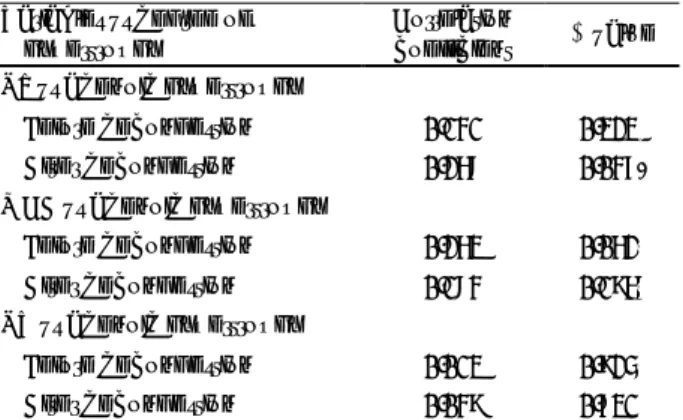
There was no statistically significant correlation bet- ween the degree of adenoid hypertrophy and preope- rative nasal resistance, minimal cross sectional area, or volume measured before application of topical decon- gestant. However, there was a significant correlation between the degree of adenoid hypertrophy and pre- operative nasal resistance measured after application of topical decongestant (Table 1).

Changes of subjective symptoms after surgery

Symptom score of nasal obstruction significantly decreased from 2.21±1.06 before surgery to 0.13±

0.48 three months after surgery and symptom score of mouth breathing also significantly decreased from 2.62

±0.84 before surgery to 0.25±0.65 three months after surgery (Fig. 2).

Table 1. Correlation between the degree of adenoid hyper- trophy and preoperative nasal resistance or nasal geometry Variables vs degree of

hypertrophy Correlation

coefficient p value NR vs adenoid hypertrophy

Before decongestion 0.171* 0.229*

After decongestion 0.304* 0.030*

MCA vs adenoid hypertrophy

Before decongestion 0.015* 0.916*

After decongestion 0.080* 0.576*

NV vs adenoid hypertrophy

Before decongestion 0.059* 0.683*

After decongestion 0.030* 0.832*

NR:nasal resistance, MCA:minimum cross-sectional area, NV:nasal volume, *:p<0.05

Fig. 1. A:Adenoidal measurement. “A” represents distance from A’, point of maximal convexity, along inferior margin of adenoid shadow to line B, drawn along straight part of anterior margin of bisiocciput. B:Nasopharyngeal measurement. “N”

is distance between C, posterior superior edge of hard palate, and D, anteroinferior edge of sphenobasioccipital synchon- drosis.

A B

A1

A

B

c N D

(3)

Changes in cross sectional area and volume of the nasal cavity after surgery

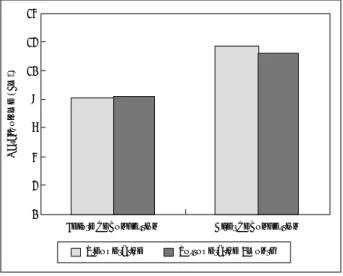
The cross sectional area or volume of the nasal cavity was not changed significantly after surgery in both untreated and decongested nose states (Fig. 3, 4).

Changes of nasal resistance after surgery

Nasal resistance before decongestion decreased from 0.76±0.39 Pa・s/cm 3 before surgery to 0.60±0.27 Pa・s/cm 3 three months after surgery but did not show any statistical significance. Nasal resistance in decon- gested state decreased from 0.44±0.19 Pa・s/cm 3 be- fore surgery to 0.38±0.18 Pa・s/cm 3 three months after surgery, showing a statistically significant decrease (Fig. 5).

The correlation of the degree of adenoid hyper- trophy with the postoperative changes of nasal resistance

There was no significant correlation between the degree of adenoid hypertrophy and the degree of pos- toperative changes of nasal resistance measured in un- treated state, however, there was a statistically signifi- cant correlation between the degree of adenoid hyper- trophy and the degree of postoperative changes of nasal resistance measured in decongested state (Table 2).

DISCUSSION

In order to be able to breath well through the nose, not only does the nasal cavity need to be opened but the

Fig. 2. Postoperative changes of symptom score. *:p<0.05.

*

Nasal obstruction 3 *

2.5 2 1.5 1 0.5

0

Mouth breathing

Symptom score

Preoperative Postoperative 3month

Before decongestion 1.2

1 0.8 0.6 0.4 0.2

0

After decongestion

Minimum cross-sectional area (cm2)

Preoperative Postoperative 3month Before decongestion

* 0.8

0.7 0.6 0.5 0.4 0.3 0.2 0.1 0

After decongestion

Nasal resistance (Pa*s/cm3)

Preoperative Postoperative 3month Before decongestion

14 12 10 8 6 4 2 0

After decongestion

Nasal volume (cm3)

Preoperative Postoperative 3month

Fig. 3. Postoperative changes of minimum cross-sectional area.

Fig. 4. Postoperative changes of nasal volume.

Fig. 5. Postoperative changes of nasal resistance. *:p<0.05.

(4)

nasopharynx should be as well. One of the commonest causes of nasal obstruction in children is adenoid hy- pertrophy. 1)2) Maurizi et al., reported that nasal sym- ptoms improved in 92.3% of patients 6 months after an adenoidectomy and the mucociliary transport function has also improved. 6) In the present study, nasal obstru- ction and mouth breathing symptoms showed signifi- cant improvement and the nasal resistance also showed significant decrease after surgery.

The size of the nasopharyngeal airway and the ade- noids may be assessed by clinical inspection. Posterior rhinoscopy and nasopharyngral fiberscopy are used for clinical evaluation of the adenoid size. However, it is difficult to carry out in children, time-consuming, sub- jective, and inconclusive. 1)7) Therefore there may be unsatisfied patients after surgery.

On the other hand, cephalometry using a simple skull lateral view is known to be an objective measure in evaluating the size of the adenoid. 1)5)8) The rhinomano- metry has also been used as a measure to decide whe- ther an adenoidectomy should be carried out or not.

Fielder reported that there was a significant correlation between the preoperative nasal resistance and the weight of the adenoid removed at operation and that measuring the nasal resistance could be a useful mea- sure in evaluating the adenoid size. 2) Juliusson et al., stated that nasal resistance measured by active anterior rhinomanometry could be an important method in choosing patients that need an adenoidectomy. 3) Søren- son et al., also stated that the size of the adenoid tissue measured by a cephalometry and nasal resistance had a significant correlation and that cephalometric radio-

graph and rhinomanometry may be a useful measure in deciding the indications for an adenoidectomy. 7) How- ever, Parker et al., reported that the relationship bet- ween the nasal resistance and the size of the adenoid was not strong enough for rhinomanometry to be of routine use in selection of children for adenoidectomy. 4)

In the present study, there was a significant correl- ation between the nasal resistance measured after de- congestion and the size of the adenoid tissue measured by a cephalometry. There was also a significant correl- ation between the degree of changes of nasal resistance after surgery and the degree of adenoid hypertrophy.

Therefore we believe that measuring the nasal resist- ance along with a cephalometry could be a useful mea- sure in evaluating the size of the adenoid and deciding whether surgery should be carried out or not.

It has been suggested that adenoid hypertrophy decreases the airflow passing through the nasal cavity, which may cause chronic congestion of the nasal mu- cosa causing decrease of the cross-sectional area and volume. Kim et al., reported that the minimum cross sectional area and volume of the nasal cavity were increased significantly after tonsillectomy and adenoi- dectomy. 9)

However, in the present study, there was no signifi- cant correlation between the preoperative cross se- ctional area or volume of the nasal cavity and the degree of adenoid hypertrophy, and there was no significant change of the cross sectional area or volume of the nasal cavity, measured in both untreated and decon- gested nose, after surgery. On the other hand, there was a significant correlation between the preoperative nasal resistance in decongested states and the degree of adenoid hypertrophy, and there was also a significant correlation between the degree of postoperative changes of nasal resistance measured in decongested state and the degree of adenoid hypertrophy. Thus, the present findings suggest that the mechanism of nasal obstru- ction is mostly due to the mass effect of the adenoid located in the nasopharynx.

CONCLUSION

There was a significant correlation between the preoperative nasal resistance measured in decongested state and the degree of adenoid hypertrophy measured by a cephalometry, however, there was no significant

Table 2. Correlation between the degree of adenoid hyper- trophy and postoperative changes of nasal resistance or nasal geometry evaluated at 3 months after operation

Variables vs degree of

hypertrophy Correlation

coefficient p value NR vs adenoid hypertrophy

Before decongestion 0.141 0.323*

After decongestion 0.268 0.047*

MCA vs adenoid hypertrophy

Before decongestion 0.263 0.062*

After decongestion 0.184 0.196*

NV vs adenoid hypertrophy

Before decongestion 0.013 0.925*

After decongestion 0.049 0.731*

NR:nasal resistance, MCA:minimum cross-sectional area, NV:

nasal volume, *:p<0.05

(5)

correlation between the preoperative cross sectional area and volume of the nasal cavity and the degree of adenoid hypertrophy.

There was significant improvement of symptoms such as nasal obstruction and mouth breathing after adenoidectomy. The nasal resistance in decongested state also significantly decreased and the degree of nasal resistance decrease showed a significant corre- lation with the degree of adenoid hypertrophy mea- sured before surgery.

Thus, it is presumed that the affect of adenoid hy- pertrophy on nasal resistance is mostly due to the mass effect of the adenoid located in the posterior portion of the nasal cavity. We believe that measuring the nasal resistance after decongestion of the nasal mucosa along with a cephalometry could be an important measure in evaluating the size of the adenoid and deciding whether surgery should be carried out or not.

REFERENCES

1) Crysdale WS, Cole P, Emetry P. Cephalometric radiographs, nasal

airway resistance, and the effect of adenoidectomy. J Otolaryngol 1985;14:92-4.

2) Fielder CP. The effect of adenoidectomy on nasal resistance to air- flow. Acta Otolaryngol 1985;100:444-9.

3) Juliusson S, Bende M. Rhinomanometry at selection for adenoide - ctomy. Rhinology 1987;25:63-7.

4) Parker AJ, Maw AR, Powell JE. Rhinomanometry in the selection for adenoidectomy and its relation to preoperative radiology. Int J Pediatr Otorhinolaryngol 1989;17:155-61.

5) Fujioka M, Young LW, Girdany BR, Radiographic evaluation of adenoidal size in children: Adenoidal-nasopharyngeal ratio. AJR 1979;133:401-4.

6) Maurizi M, Paludetti G, Ottaviani F, Almadori G, Falcetti S. Mu- cociliary function and nasal resistance evaluation before and after adenoidectomy. Int J Pediatr Otorhinolaryngol 1986;11:295-300.

7) Sørensen H, Solow B, Greve E. Assessment of the nasopharyngeal airway. A rhinomanometric and radiographic study in children with adenoids. Acta Otolaryngol 1980;89:227-32.

8) Wormal PJ, Prescott CAJ. Adenoids: Comparison of radiological assessment methods with clinical and endoscopic findings. J La- ryngol Otol 1992;106:342-4.

9) Kim YK, Kang JH, Yoo YS. The change of the cross sectional area

and the volume of the nasal cavity and the nasopharynx after ton-

sillectomy and adenoidectomy. Kor J Otolaryngol 1995;38:105-9.

수치

Fig. 1. A:Adenoidal measurement. “A” represents distance  from A’, point of maximal convexity, along inferior margin of  adenoid shadow to line B, drawn along straight part of anterior  margin of bisiocciput
Fig. 4. Postoperative changes of nasal volume.
Table 2. Correlation between the degree of adenoid hyper- hyper-trophy and postoperative changes of nasal resistance or nasal  geometry evaluated at 3 months after operation

참조

관련 문서

1 John Owen, Justification by Faith Alone, in The Works of John Owen, ed. John Bolt, trans. Scott Clark, &#34;Do This and Live: Christ's Active Obedience as the

Effects of Meditation Program Using Neurofeedback on EEG Changes and Self-Efficacy of Office Workers..

- The standard enthalpy of an overall reaction is the sum of the standard enthalpies of the individual reactions into which a reaction may be divided - - The individual steps

The clinical outcomes were assessed by measuring the Korea shoulder society (KSS) score, Mayo elbow performance (MEP) score and the postoperative complications.

Postoperative Postoperative Postoperative Postoperative Magnetic Magnetic Magnetic Magnetic resonance resonance resonance image resonance image image image shows

The name of Iwon ~III, a royal music organization of Dang llf, was also used to indicate Jangagwon, but despite the order not to use the old name of Iwon in

-Cost of carriers and immobilization -Changes in properties(selectivity) -Mass transfer limitations.. -Activity

Table 4.16 Fuel consumption changes data according to change of electric load · · · ·41 Table 4.17 Fuel consumption changes according to change of electric load · · · ·42