Original Article
Comparative study of neoadjuvant chemotherapy before radical hysterectomy and radical surgery alone
in stage IB2-IIA bulky cervical cancer
Yun-Hyun Cho, Dae-Yeon Kim, Jong-Hyeok Kim, Yong-Man Kim, Young-Tak Kim, Joo-Hyun Nam
Department of Obstetrics and Gynecology, University of Ulsan College of Medicine, Asan Medical Center, Seoul, Korea
Objective: To compare the efficacy of neoadjuvant chemotherapy with paclitaxel plus platinum followed by radical hysterectomy with radical surgery alone in patients with stage IB2-IIA bulky cervical cancer.
Methods: From November 1999 to September 2007, stage IB2-IIA cervical cancers with tumor diameter >4 cm, as measured by MRI, were managed with two cycles of preoperative paclitaxel and platinum. As a control group, we selected 35 patients treated with radical surgery alone.
Results: There were no significant between group differences in age, tumor size, FIGO stage, level of SCC Ag, histopathologic type and grade. Operating time, estimated blood loss, the number of lymph nodes yielded and the rate of complications were similar in the two groups. In surgical specimens, lymph-vascular space invasion (LVSI), nodal metastasis and parametrial involvement did not differ significantly between the two groups. In the neoadjuvant group, pathologic tumor size was significantly smaller and fewer patients had deep cervical invasion. Radiotherapy, alone and in the form of concurrent chemoradiation, was administered to more patients treated with radical surgery alone (82.9% vs. 52.9%, p=0.006). No recurrence was observed in patients who could avoid adjuvant radiotherapy owing to improved risk factors after neoadjuvant chemotherapy. There were no significant differences in 5-year disease free and overall survival.
Conclusion: As neoadjuvant chemotherapy would improve pathologic prognostic factors, adjuvant radiotherapy can be avoided, without worsening the prognosis, in patients with locally advanced bulky cervical cancer. Neoadjuvant chemotherapy would be improving the quality of life after radical hysterectomy in patients with bulky cervical cancer.
Key Words: Locally advanced cervical cancer, Neoadjuvant chemotherapy, Radical hysterectomy
Received December 8, 2008, Revised January 29, 2009, Accepted January 29, 2009
Address reprint requests to Joo-Hyun Nam
Department of Obstetrics and Gynecology, University of Ulsan College of Medicine, Asan Medical Center, 388-1, Pungnap-dong, Songpa-gu, Seoul 138-736, Korea
Tel: 82-2-3010-3633, Fax: 82-2-476-7331 E-mail: [email protected]
INTRODUCTION
Cervical cancer is the most prevalent gynecological malig- nancy in many developing countries.1 Surgery is the most ef- fective therapeutic method in patients with invasive cancer confined to the cervix. The 5-year survival rate after surgery for patients with stage IB1 disease exceeds 90%, but is only 60-70% in patients with tumors >4 cm in size.2-4 Neoad- juvant chemotherapy has been administered to patients with locally advanced cervical cancer to improve outcome.5,6 Among the main advantages of neoadjuvant chemotherapy are the potential elimination of micrometastases, shrinkage of
the primary tumor to achieve radical operability and the surgi- cal down-staging of patients.7,8 Despite its high response rates,6,7,9-12 neoadjuvant chemotherapy for cervical cancer still remains controversial. While an Italian trial and a meta-analy- sis has demonstrated that neoadjuvant cisplatin-based che- motherapy followed by radical surgery affords survival bene- fits in patients with stage IB2-IIB cervical cancer,13,14 a recent phase III GOG trial failed to demonstrate any survival benefit.15 The discrepancies in these results may be due to a variety of clinical and biological factors, and the use of differ- ent chemotherapeutic regimens based on cisplatin.15-18 Seve- ral new drug regimens may have more activity in cervical cancer. We therefore tested the efficacy of paclitaxel plus plat- inum neoadjuvant chemotherapy in patients with stage IB2 to IIA cervical cancer of size >4 cm, as evaluated by MRI, on pathologic prognostic factor and long-term survival.
MATERIALS AND METHODS
All patients with stage IB2 or IIA cervical cancers with tumor
Table 1. Patient characteristics at baseline Neoadjuvant chemotherapy (%)
(N=51)
Primary surgery (%)
(N=35) p-value
Age (yr) 47.8±10.8 44.8±9.7 0.203
Tumor size (cm)* 4.8±0.8 5.0±1.0 0.317
SCC Ag (ng/ml) 6.4±8.9 7.1±6.6 0.711
FIGO stage 0.829
Stage IB2 29 (56.9) 19 (54.3)
Stage IIA 22 (43.1) 16 (45.7)
Histology 0.389
Squamous 46 (90.2) 34 (97.1)
Adenocarcinoma 3 (5.9) 1 (2.9) Adenosquamous 2 (3.9)
Grade 0.598
Grade 1 4 (7.8) 5 (14.3)
Grade 2 25 (49.0) 14 (40.0)
Grade 3 17 (33.3) 14 (40.0)
NS 5 (9.8) 2 (5.7)
SCC: squamous cell carcinoma, NS: not stated
*The longest diameter measured by MRI
Table 2. Tumor response relative to pretreatment variables (n=42) Variables Responder (%)
(N=35) Non-responder (%)
(N=7) p-value
Age (yr) 47.4±9.9 46.0±8.7 0.736
Initial tumor size 0.077
≤5 cm 31 (88.6) 4 (57.1)
>5 cm 4 (11.4) 3 (42.9)
SCC Ag (ng/ml) 5.8±8.6 9.3±12.5 0.506
Histological type 0.569
Squamous cell
carcinoma 30 (85.7) 7 (100) Non-squamous 5 (14.3) 0 (0) cell carcinoma
Stage 0.099
IB2 23 (65.7) 2 (28.6)
IIA 12 (34.3) 5 (71.4)
Grade 0.648
Grade 1 3 (8.6) 0 (0)
Grade 2 16 (45.7) 4 (57.1)
Grade 3 12 (34.3) 2 (28.6)
NS 4 (11.4) 1 (14.3)
SCC: squamous cell carcinoma, NS: not stated size >4 cm on MRI treated with paclitaxel plus platinum be-
tween November 1, 1999 and September 30, 2007 were retro- spectively reviewed. All patients had primary, previously un- treated, histologically confirmed cervical cancer. Patients treated with other chemotherapy regimens were excluded.
The patients with para-aortic lymph node metastasis or si- multaneous other malignancies after primary surgery were al- so excluded. During the same period, the control group con- sisted of patients with tumor size >4 cm who underwent rad- ical surgery alone, which was defined as the primary surgery (PS) group. Clinical staging procedures including pelvic ex- amination, chest X-ray, cystoscopy, rectosigmoidoscopy, and intravenous pyelogram were performed in all patients. The patients underwent MRI to evaluate tumor size during the ini- tial diagnostic procedure and just before surgery after 2 cycles of neadjuvant chemotherapy.
Neoadjuvant chemotherapy consisted of 2 cycles of intra- venous paclitaxel 135 mg/m2 and cisplatin 75 mg/m2 or carbo- platin AUC 5 3-week intervals interval. All patients underwent type III radical hysterectomy with systematic pelvic lymphade- nectomy plus, if indicated, para-aortic lymphadenectomy, within 3 weeks of completion of the second chemotherapy cycle. Postoperative concurrent chemoradiation or radio- therapy alone was administered to high risk patients, defined as those with at least one major risk factor, including positive nodes, parametrial involvement and positive surgical margin, or two or more minor risk factors, including tumor size, depth of invasion and lymph-vascular space invasion (LVSI).
Tumor response was evaluated for tumor size measured by MRI at the initial diagnostic procedure and just before surgery after neadjuvant chemotherapy according to the Response Evaluation Criteria In Solid Tumors (RECIST).19 Only 42 pa- tients who took pre- and post-chemotherapy MRI were as- sessed for tumor response. Complete response (CR) was de- fined as the complete disappearance of the tumor in the cer- vix, partial response (PR) as a ≥30% decrease of longest di- ameter (LD), progressive disease (PD) as a ≥20% increase of LD, and stable disease (SD) as a decrease or increase less than PR or PD. Patients who achieved CR or PR were defined as responders, whereas those who achieved PD or SD were de- fined as non-responders.
SPSS ver. 12.0 was used for statistical analysis. Categorical variables were compared using the Chi-square and Fisher’s exact tests. Mean, median, and standard deviations were cal- culated for continuous variables, which were compared using the t test. Survival time was calculated from the date of the ne- oadjuvant chemotherapy was started. The survival rate was calculated by the Kaplan-Meier method and compared using the log-rank test. Statistical significance was defined as p
<0.05.
RESULTS
In this study, 51 patients received neoadjuvant chemo-
therapy (NAC) followed by radical hysterectomy and 35 un- derwent immediate radical hysterectomy. The two groups were similar in age at diagnosis, tumor size, level of squamous cell carcinoma (SCC) Ag, FIGO stage, and histological type and grade (Table 1).
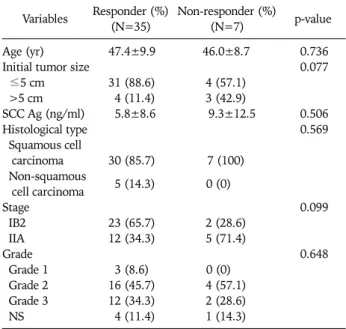
There were no life-threatening complications following che- motherapy. All patients successfully underwent radical hys- terectomy and complete nodal dissection. After NAC, CR was observed in 3 of 42 (7.1%) patients, PR in 32 (76.2%) pa- tients, and SD in 7 (16.7%) patients, making the overall re-
Table 3. Comparison of surgical-pathologic outcomes Neoadjuvant chemotherapy (%)
(N=51)
Primary surgery (%)
(N=35)
p-value
Type of radical hysterectomy 0.012
Abdominal radical 39 (76.5) 34 (97.1) hysterectomy
Laparoscopic radical 12 (23.5) 1 (2.9) hysterectomy
Operating time (min) 279.3±60.0 275.0±59.0 0.741 Estimated blood loss (ml) 783.3±730.3 648.6±391.4 0.322 Intraoperative transfusion 45 (88.2) 25 (71.4) 0.088 Postoperative hemoglobin 2.0±1.5 2.9±1.5 0.009 change
Node count 41.7±14.6 38.7±11.6 0.310
Pathologic findings
Tumor size (cm) 2.2±1.4 5.4±1.3 <0.001 Deep cervical invasion 33 (63.7) 32 (91.4) 0.005 Lymph node metastasis 18 (35.3) 17 (48.6) 0.266 Lymphovascular 22 (43.1) 20 (57.1) 0.273 space invasion
Parametrial involvement 15 (29.4) 10 (28.6) 1.000 Positive surgical margin 2 (3.9) 0 0.512
Table 5. Comparison of clinical courses Variables
Neoadjuvant chemotherapy (%)
(N=51)
Primary surgery (%)
(N=35)
p-value
Adjuvant therapy 0.016
None 11 (21.6) 3 (8.6)
Chemotherapy alone 13 (25.5) 3 (8.6)
RT alone 8 (15.7) 4 (11.4)
CCRT 19 (37.3) 25 (71.4)
Adjuvant radiation
(RT+CCRT) 27 (52.9) 29 (82.9) 0.006
Recurrence 3 (5.9) 4 (11.4) 0.435
Local 0 0
Distant 3 (5.9) 4 (11.4)
Death of disease 3 (5.9) 3 (8.6) 0.684
Median follow-up
(months) 48.5 (1-86) 32 (1-112) 0.243 RT: radiation therapy, CCRT: concurrent chemoradiation
Table 4. Comparison of complications Variables
Neoadjuvant chemotherapy (%)
(N=51)
Primary surgery (%)
(N=35) p-value Intra-operative complications 2 (3.9) 0 0.512
Injury of ureter 1 0
Injury of great vessel 1 0
Post-operative complications 16 (31.4) 11 (31.4) 1.000 Acute renal failure 1 (2.0) 1 (2.9)
Bladder dysfunction 5 (9.8) 6 (17.1) Ureter stricture 3 (5.9) 2 (5.7) Ureterovaginal fistula 1 (2.0) 0 Wound infection/dehiscence 2 (3.9) 1 (2.9) Vaginal stump dehiscence 1 (2.0) 1 (2.9)
Ileus 2 (3.9) 0
Deep vein thrombosis 1 (2.0) 0
sponse rate after NAC 83.3% (35/42). There were no sig- nificant differences in age, level of SCC Ag, and histological type and grade between responders and non-responders (Table 2). The patients with larger than 5 cm sized tumor or FIGO stage IIA showed poorer response, but there were no significant differences (p=0.077, p=0.099, respectively).
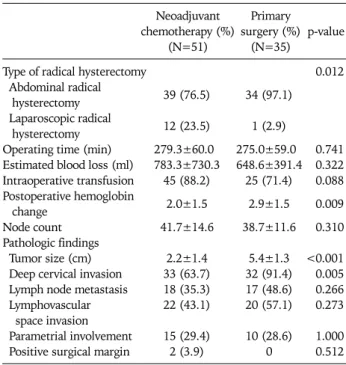
When we compared operative and pathologic data after radi- cal hysterectomy in the two groups, we found no significant dif- ferences in operating time, estimated blood loss and the num- ber of lymph nodes (Table 3). More patients in NAC group re- quired blood transfusions and the postoperative change in he- moglobin was significantly lower (p=0.009). Nodal meta- stasis were observed in 35.3% (18/51) of the patients in NAC group, compared with 48.6% (17/35) in the primary surgery
(PS) group; LVSI was observed in 43.1% and 57.2%, re- spectively, and parametrial involvement in 29.4% and 28.6%, respectively. However, tumor size was much smaller and cer- vical invasion was more superficial in NAC group. Despite that laparoscopic radical hysterectomy was mainly performed in the NAC group (23.5% vs. 2.9%, p=0.012), there were similar complication rates between the two groups (Table 4).
Postoperative adjuvant therapy was administered to 40 pa- tients (78.4%) of the NAC group and to 32 (91.4%) of PS group (p=0.142). Fewer patients treated with NAC received ad- juvant radiotherapy, either alone or as concurrent chemo- radiation (52.9% vs. 82.9%, p=0.006) (Table 5).
The median follow-up time for NAC group was 48.5 months, during which three recurrences (5.9%) and three tumor-re- lated deaths were recorded. All three patients had only distant metastases. However, there was no recurrence in the patients without adjuvant radiotherapy owing to improved pathologic risk factors after NAC. In PS group, the median follow-up time was 32 months, during which four recurrences (11.4%) and three tumor-related deaths were observed. All four patients also had only distant metastases.
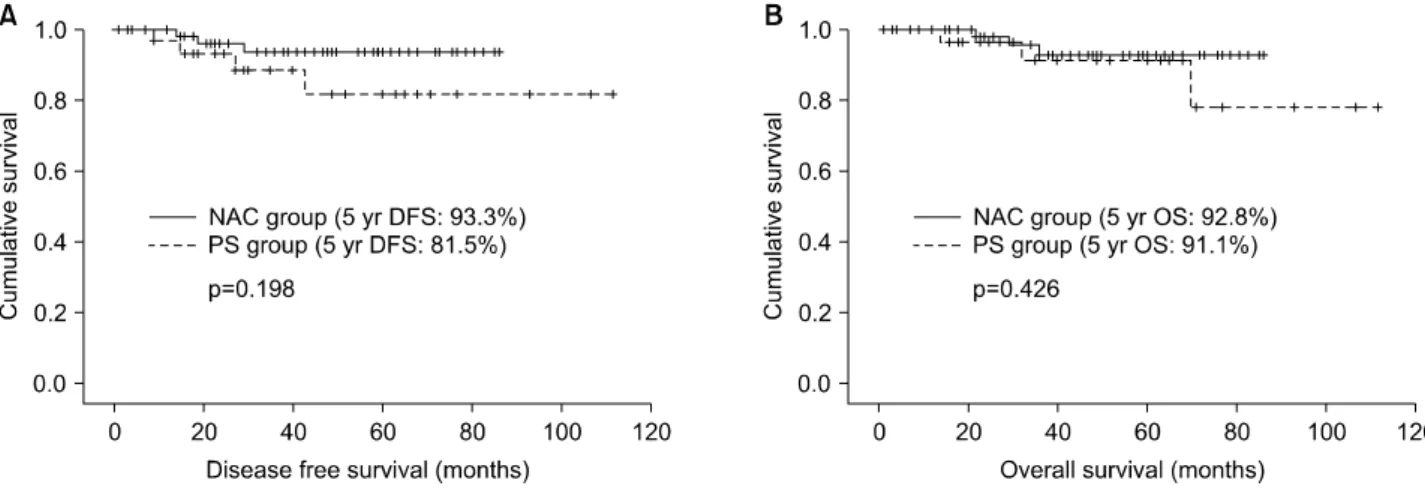
The 5-year disease-free survival rates in NAC and PS groups were 93.3% and 81.5%, respectively (p=0.198), and the 5-year overall survival rates were 92.8% and 91.1%, re- spectively (p=0.426) (Fig. 1). In addition, there were no dif- ferences in survival rate among the three groups (responders vs. non-responder vs. primary surgery patients) (Fig. 2).
DISCUSSION
Prognostic factors for the recurrence of cervical cancer are pathologic findings of parametrial involvement, lymph node metastasis and positive surgical margins,20,21 in addition to tu- mor size and depth of invasion.22 Larger tumors frequently have higher rates of lymph node metastasis as well as local, re-
Fig. 1. (A) Disease-free survival and (B) overall survival rates in the neoadjuvant chemotherapy and primary surgery groups.
NAC: neoadjuvant chemotherapy, PS: primary surgery.
Fig. 2. (A) Disease-free survival and (B) overall survival rates in responder, nonresponder and primary surgery groups.
PS: primary surgery.
gional, and distant failure, and patients with larger tumors have lower survival rates.20, 23 Neoadjuvant chemotherapy has shown a high response rate, 53-94%, with complete patho- logical response rates of 10-13.8%.8,11,24-26 We observed a complete response of 7.1% (3/42), along with significant re- ductions in tumor size and depth of invasion after NAC com- pared with the PS group. These results suggest that NAC im- proved operability in patients with bulky cervical cancer by decreasing tumor size. However, chemotherapy-induced tu- mor necrosis may result in dense fibrosis and adhesions, which make surgical planes difficult to be maintained.27 This study showed that a higher proportion of patients in the NAC group required blood transfusions. It is inferred that more blood loss may be attributed to tumor necrosis and dense fib- rosis after chemotherapy. The postoperative hemoglobin de- crease in the NAC group was significantly lower, suggesting that this may have been due to prevention of anticipated blood loss as well as the propensity and variable criteria of the anes- thesiologist and/or surgeon. However, more patients success-
fully underwent laparoscopic radical hysterectomy without conversion into laparotomy. Laparoscopic radical surgery can be undertaken without increase of complication rates in pa- tients with bulky tumors.
While a lower rate of nodal metastasis rate has been reported in patients with locally advanced stage IB-IIB tumors after NAC than in those treated with PS (7-25% vs. 30-34%),7,28,29 the NAC group had no beneficial effect on lymph node meta- stasis in this study. LVSI and parametrial involvement were also similar in the two groups. Although NAC was less effec- tive in reducing lymph node metastases, LVSI, and para- metrial involvement, it was more effective in reducing the size of tumor and the depth of invasion. Therefore, two cycles or doses of chemotherapy might be insufficient for reducing the number of lymph nodes metastases or LVSI. On the other hand, these findings suggest that NAC might be ineffective in the management of high-risk patients with lymph node metastasis. It is important to select appropriate patients who would benefit most from NAC prior to surgery. Patients with
age of younger than 35 years and adeno- or adenosquamous carcinoma have been reported to be associated with resistance to NAC,30 however, we found that age and histological type were not associated with poor prognosis, and tumors with larger than 5 cm or FIGO stage IIA had represented rather lower response. Neoadjuvant chemotherapy should be con- sidered in treating younger patients with bulky tumor without anticipating poor response.
Of the patients who received neoadjuvant chemotherapy, 63-81% were treated postoperative concurrent chemora- diation.18,31 In this study, a significantly lower proportion of patients treated with NAC received postoperative radiation (52.9% vs. 82.9%) than those undergoing PS. Despite this dif- ference, the disease-free and overall survival rates in the two groups were not statistically different, although the NAC group had a tendency of higher 5-year disease-free survival rate than the PS group. Also, no recurrence was observed in patients who avoided adjuvant radiotherapy owing to changed pathologic risk factors after NAC. However, as there were no differences among responders and nonresponders of the NAC group and PS group, we postulate that rather good survival rate of the nonresponder group may be attributed to post- operative concurrent chemoradiation. As the present study additionally showed that responders of the NAC group with lower postoperative radiation rates had similar survival rate to the PS group, our results highlights that no accentuation of survival may occur in the responder group even if adjuvant ra- diotherapy is not added owing to changed pathologic prog- nostic factors after NAC.
These findings suggest that NAC might be a good treatment option in sexually active, premenopausal women with locally advanced bulky cervical cancer affording better quality of life, by allowing them to avoid postoperative adjuvant radio- therapy. This approach may provide conservation of ovarian and sexual function in these patients without worsening the prognosis.
The limitations of our study were its retrospective design, the small number of patients, and limited long-term fol- low-up. However, our findings indicate that NAC has an effect on pathologic prognostic factors, allowing patients with lo- cally advanced bulky cervical cancer to avoid adjuvant radio- therapy without worsening their prognosis.
REFERENCES
1. Parkin DM, Pisani P, Ferlay J. Estimates of the worldwide in- cidence of 25 major cancers in 1990. Int J Cancer 1999; 80:
827-41.
2. Alvarez RD, Soong SJ, Kinney WK, Reid GC, Schray MF, Podratz KC, et al. Identification of prognostic factors and risk groups in patients found to have nodal metastasis at the time of radical hysterectomy for early-stage squamous carcinoma of the cervix. Gynecol Oncol 1989; 35: 130-5.
3. Perez CA, Grigsby PW, Nene SM, Camel HM, Galakatos A, Kao MS, et al. Effect of tumor size on the prognosis of carcinoma of the uterine cervix treated with irradiation alone. Cancer 1992;
69: 2796-806.
4. Thoms WW Jr, Eifel PJ, Smith TL, Morris M, Delclos L, Wharton JT, et al. Bulky endocervical carcinoma: a 23-year experience. Int J Radiat Oncol Biol Phys 1992; 23: 491-9.
5. Kim DS, Moon H, Kim KT, Hwang YY, Cho SH, Kim SR.
Two-year survival: preoperative adjuvant chemotherapy in the treatment of cervical cancer stages Ib and II with bulky tumor.
Gynecol Oncol 1989; 33: 225-30.
6. Friedlander ML, Atkinson K, Coppleson JV, Elliot P, Green D, Houghton R, et al. The integration of chemotherapy into the management of locally advanced cervical cancer: a pilot study.
Gynecol Oncol 1984; 19: 1-7.
7. Sardi J, Sananes C, Giaroli A, Bayo J, Rueda NG, Vighi S, et al.
Results of a prospective randomized trial with neoadjuvant che- motherapy in stage IB, bulky, squamous carcinoma of the cervix. Gynecol Oncol 1993; 49: 156-65.
8. Hwang YY, Moon H, Cho SH, Kim KT, Moon YJ, Kim SR, et al.
Ten-year survival of patients with locally advanced, stage ib-iib cervical cancer after neoadjuvant chemotherapy and radical hysterectomy. Gynecol Oncol 2001; 82: 88-93.
9. Scarabelli C, Zarrelli A, Gallo A, Visentin MC. Multimodal treatment with neoadjuvant intraarterial chemotherapy and radical surgery in patients with stage IIIB-IVA cervical cancer: a preliminary study. Cancer 1995; 76: 1019-26.
10. Park SY, Kim BG, Kim JH, Lee JH, Lee ED, Lee KH, et al. Phase I/II study of neoadjuvant intraarterial chemotherapy with mito- mycin-C, vincristine, and cisplatin in patients with stage IIb bulky cervical carcinoma. Cancer 1995; 76: 814-23.
11. Giaroli A, Sananes C, Sardi JE, Maya AG, Bastardas ML, Snaidas L, et al. Lymph node metastases in carcinoma of the cervix ute- ri: Response to neoadjuvant chemotherapy and its impact on survival. Gynecol Oncol 1990; 39: 34-9.
12. Yamakawa Y, Fujimura M, Hidaka T, Hori S, Saito S. Neoadju- vant intraarterial infusion chemotherapy in patients with stage IB2-IIIB cervical cancer. Gynecol Oncol 2000; 77: 264-70.
13. Benedetti-Panici P, Greggi S, Colombo A, Amoroso M, Sman- iotto D, Giannarelli D, et al. Neoadjuvant chemotherapy and radical surgery versus exclusive radiotherapy in locally ad- vanced squamous cell cervical cancer: results from the Italian multicenter randomized study. J Clin Oncol 2002; 20: 179-88.
14. Neoadjuvant Chemotherapy for Locally Advanced Cervical Cancer Meta-analysis Collaboration. Neoadjuvant chemotherapy for lo- cally advanced cervical cancer: a systematic review and meta-analy- sis of individual patient data from 21 randomised trials. Eur J Cancer 2003; 39: 2470-86.
15. Eddy GL, Bundy BN, Creasman WT, Spirtos NM, Mannel RS, Hannigan E, et al. Treatment of ("bulky") stage IB cervical cancer with or without neoadjuvant vincristine and cisplatin prior to radical hysterectomy and pelvic/para-aortic lymphadenectomy:
A phase III trial of the gynecologic oncology group. Gynecol Oncol 2007; 106: 362-9.
16. Kim DS, Moon H, Hwang YY, Cho SH. Preoperative adjuvant chemotherapy in the treatment of cervical cancer stage Ib, IIa, and IIb with bulky tumor. Gynecol Oncol 1988; 29: 321-32.
17. Weiner SA, Aristizabal S, Alberts DS, Surwit EA, Deatherage- Deuser K. A phase II trial of mitomycin, vincristine, bleomycin, and cisplatin (MOBP) as neoadjuvant therapy in high-risk cer- vical carcinoma. Gynecol Oncol 1988; 30: 1-6.
18. Behtash N, Nazari Z, Ayatollahi H, Modarres M, Ghaemmaghami F, Mousavi A. Neoadjuvant chemotherapy and radical surgery compared to radical surgery alone in bulky stage IB-IIA cervical cancer. Eur J Surg Oncol 2006; 32: 1226-30.
19. Therasse P, Arbuck SG, Eisenhauer EA, Wanders J, Kaplan RS, Rubinstein L, et al. New guidelines to evaluate the response to treatment in solid tumors. European Organization for Research
and Treatment of Cancer, National Cancer Institute of the United States, National Cancer Institute of Canada. J Natl Cancer Inst 2000; 92: 205-16.
20. Piver MS, Chung WS. Prognostic significance of cervical lesion size and pelvic node metastases in cervical carcinoma. Obstet Gynecol 1975; 46: 507-10.
21. Fuller AF, Elliott N, Kosloff C, Lewis JL. Lymph node meta- stases from carcinoma of the cervix, stages IB and IIA: impli- cations for prognosis and treatment. Gynecologic Oncology 1982; 13: 165-74.
22. Mohar A, Frias-Mendivil M. Epidemiology of cervical cancer.
Cancer Invest 2000; 18: 584-90.
23. Delgado G, Bundy BN, Fowler WC Jr, Stehman FB, Sevin B, Creasman WT, et al. A prospective surgical pathological study of stage I squamous carcinoma of the cervix: a Gynecologic Oncology Group Study. Gynecol Oncol 1989; 35: 314-20.
24. Modarress M, Maghami FQ, Golnavaz M, Behtash N, Mousavi A, Khalili GR. Comparative study of chemoradiation and neo- adjuvant chemotherapy effects before radical hysterectomy in stage IB-IIB bulky cervical cancer and with tumor diameter greater than 4 cm. Int J Gynecol Cancer 2005; 15: 483-8.
25. Kigawa J, Minagawa Y, Ishihara H, Itamochi H, Kanamori Y, Terakawa N. The role of neoadjuvant intraarterial infusion che- motherapy with cisplatin and bleomycin for locally advanced cervical cancer. Am J Clin Oncol 1996; 19: 255-9.
26. Namkoong SE, Park JS, Kim JW, Bae SN, Han GT, Lee JM, et al.
Comparative study of the patients with locally advanced stages
I and II cervical cancer treated by radical surgery with and with- out preoperative adjuvant chemotherapy. Gynecol Oncol 1995;
59: 136-42.
27. Paladini D, Raspagliesi F, Fontanelli R, Ntousias V. Radical sur- gery after induction chemotherapy in locally advanced cervical cancer: a feasibility study. Int J Gynecol Cancer 1995; 5: 296- 300.
28. Panici PB, Scambia G, Baiocchi G, Greggi S, Ragusa G, Gallo A, et al. Neoadjuvant chemotherapy and radical surgery in locally advanced cervical cancer: prognostic factors for response and survival. Cancer 1991; 67: 372-9.
29. Eddy GL, Manetta A, Alvarez RD, Williams L, Creasman WT.
Neoadjuvant chemotherapy with vincristine and cisplatin fol- lowed by radical hysterectomy and pelvic lymphadenectomy for FIGO stage IB bulky cervical cancer: a Gynecologic Oncology Group pilot study. Gynecol Oncol 1995; 57: 412-6.
30. Huang HJ, Chang TC, Hong JH, Tseng CJ, Chou HH, Huang KG, et al. Prognostic value of age and histologic type in neo- adjuvant chemotherapy plus radical surgery for bulky (>/=4 cm) stage IB and IIA cervical carcinoma. Int J Gynecol Cancer 2003; 13: 204-11.
31. Duenas-Gonzalez A, Lopez-Graniel C, Gonzalez-Enciso A, Cetina L, Rivera L, Mariscal I, et al. A phase II study of multi- modality treatment for locally advanced cervical cancer: neoad- juvant carboplatin and paclitaxel followed by radical hyster- ectomy and adjuvant cisplatin chemoradiation. Ann Oncol 2003; 14: 1278-84.