www.jkfas.org known as an effective method in reducing swelling and has been used routinely.2) Rucinkski et al.3) reported that eleva- tion is the most appropriate treatment protocol to minimize swelling in the rehabilitation phase after ankle sprains.
However, Tsang et al.2) reported that elevation could not effectively decrease ankle volume for a prolonged period in patients with acute ankle sprains. Leg elevation effect did not last over 5 minutes when limbs were returned to a gravity- dependent position. Moreover, leg elevation results in patient discomfort during the postoperative period and restriction on the bed. Postoperative early rehabilitation is also recom- mended after an ankle fracture operation.4,5) It means that
INTRODUCTION
Ankle fracture is a common sports injury, and its incidence is reported as 10.2% of all bone injuries.1) Swelling of the lower leg and ankle is an inevitable physiologic problem af- ter ankle fracture and postoperative period. Leg elevation is
This is an Open Access article distributed under the terms of the Creative Commons Attribution Non-Commercial License (http://creativecommons.org/licenses/CC
by-nc/4.0) which permits unrestricted non-commercial use, distribution, and reproduction in any medium, provided the original work is properly cited.
Copyright 2020 Korean Foot and Ankle Society. All rights reserved.ⓒ
Purpose: Leg elevation is known as an effective method for reducing leg swelling, and it has been routinely used in medical practice.
However, the effect of swelling reduction in relation to the degree of elevation height is not known. This study evaluated the swelling of the leg after acute ankle fracture operations at two different elevation heights and the elevated leg heights were compared.
Materials and Methods: A total of 66 patients with postoperative acute ankle fractures were classified into two groups depending on the presence of different leg elevation heights: high-elevated (HE, case) and low-elevated groups (LE, control). We checked leg swelling, pain, subjective satisfaction for the elevation device, and the American Orthopedic Foot and Ankle Society (AOFAS) score, and we ret- rospectively compared them between both the groups.
Results: Leg swelling and pain were reduced in both groups. However, they did not show any significant differences between both the groups (p>0.05). Nineteen patients in the HE group replied with uncomfortable, while no patients in LE group did so. The AOFAS score at 1 year postoperatively did not show any significant differences between both the groups (p=0.46).
Conclusion: High elevation of the leg after ankle fractures did not show a significant difference from low elevation in regard to leg swell- ing, pain, and function. Furthermore, high leg elevation resulted in discomfort during the postoperative period. Thus, low elevation with a pillow is enough for acute ankle fracture patients with little discomfort and satisfactory swelling reduction.
Key Words: Ankle fracture, Leg elevation, Swelling
급성 발목 골절 환자의 술 후 부종 감소에 대한 하지 거상의 효과
서동교, 강현욱, 안득숙*, 송재석†
강릉아산병원 정형외과, *간호부, †가톨릭관동대학교 의과대학 예방의학교실
Effect of Leg Elevation Height on Reduced Swelling of Patients of Postoperative Acute Ankle Fractures
Dong-Kyo Seo, Hyun Wook Kang, Deug Suk Ahn*, Jae-Seok Song
†Departments of Orthopedic Surgery and *Nursing, Gangneung Asan Hospital, †Department of Preventive Medicine & Public Health, Catholic Kwandong University College of Medicine, Gangneung, Korea
Received February 1, 2020 Revised March 6, 2020 Accepted March 6, 2020 Corresponding Author: Jae-Seok Song
Department of Preventive Medicine & Public Health, Catholic Kwandong University College of Medicine, 24 Beomil-ro 579beon-gil, Gangneung 25601, Korea Tel: 82-33-649-7469, Fax: 82-33-641-1074, E-mail: [email protected] ORCID: https://orcid.org/0000-0001-5583-182X
Financial support: None.
Conflict of interest: None.
patients cannot maintain an elevated leg position during the postoperative period, and its effect can be negated easily. So, keeping patients on the bed with the high-elevation device would be not so effective.
Thus, we hypothesized that low-elevation of the lower leg would have results similar to those of high-elevation. Fur- thermore, low-elevation would make patients more comfort- able. We compared leg swelling, pain, subjective satisfaction for elevation device, functional score in patients with two different elevated height.
MATERIALS AND METHODS
1. Patients selection
The Institutional Review Board of the Gangneung Asan Hospital approved this study. A total of 66 patients who un- derwent the operation of acute ankle fracture from March 2014 to December 2015 were reviewed retrospectively. Inclu- sion criteria were Arbeitsgemeinschaft für Osteosynthesefra- gen/Orthopaedic Trauma Association (AO/OTA) classifica- tion types 43 (distal tibia/fibula fractures) and 44 (malleolar fractures). Exclusion criteria were fractures combined with an open wound, proximal and shaft tibiofibular fractures, neurovascular injury, compartment syndrome, and amputa- tion. Patients with a history of atherosclerosis, chronic sys- temic disease (e.g., renal, pulmonary, or heart failure), dia- betes mellitus, postoperative hospitalization period less than 2 weeks, follow-up period less than one year, voluntary ces-
sation of elevation or change of method were also excluded.
In the selection of patients, we included distal tibiofibular and malleolar fractures. Moreover, systemic diseases that can influence whole body circulation were also excluded. The operative method was confined to open reduction and inter- nal fixation.
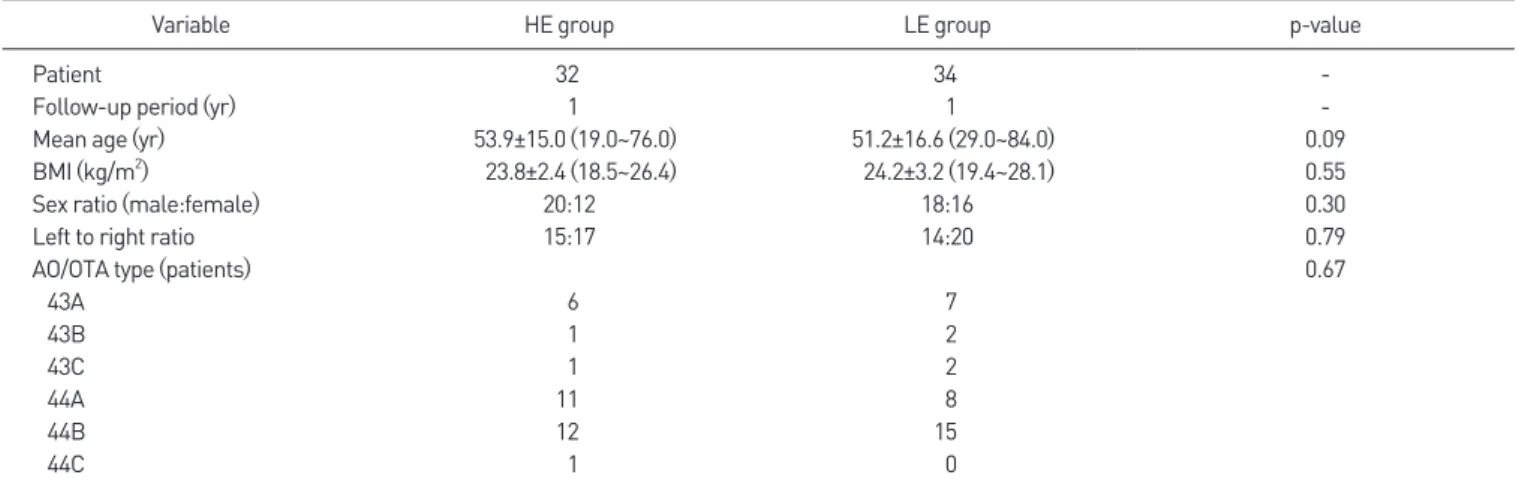
Patients were classified into two groups, which were 32 patients for high-elevated group (HE group) and 34 patients for low-elevated group (LE group) depending on the height of leg elevation. Detailed demographic values of two groups were described in Table 1.
2. Operative method
The operation was performed within 2 weeks after initial injury after excessive swelling and bullae were resolved. All operations were performed under regional spinal anesthesia with the application of a pneumatic tourniquet. All patients were treated with open reduction and internal fixation using plate and screw. There were no cases of external fixation, intramedullary nailing, and minimally invasive percutaneous plate osteosynthesis. Operative drainage was not used in all patients. After skin suture, sterile dressing and short leg splint were applied.
3. Rehabilitation and leg elevation
Short leg splint was applied for 2 weeks on non-weight- bearing state. Leg elevation with cushion was performed from March 2014 to December 2014. Due to patients com-
Table 1. Demographic Parameters and Distribution of Fractures in Two Groups
Variable HE group LE group p-value
Patient 32 34 -
Follow-up period (yr) 1 1 -
Mean age (yr) 53.9±15.0 (19.0~76.0) 51.2±16.6 (29.0~84.0) 0.09
BMI (kg/m2) 23.8±2.4 (18.5~26.4) 24.2±3.2 (19.4~28.1) 0.55
Sex ratio (male:female) 20:12 18:16 0.30
Left to right ratio 15:17 14:20 0.79
AO/OTA type (patients) 0.67
43A 6 7
43B 1 2
43C 1 2
44A 11 8
44B 12 15
44C 1 0
Values are presented as number only or mean±standard deviation (range).
HE: high-elevated, LE: low-elevated, -: not available, BMI: body mass index, AO/OTA: Arbeitsgemeinschaft für Osteosynthesefragen/Orthopaedic Trauma Association.
www.jkfas.org plain of discomfort by the height of cushion elevator, we
substituted it with pillow elevator from January 2015 to De- cember 2015. Postoperative patient control was done by the orthopedic surgeon and specially educated nurses during hospitalization.
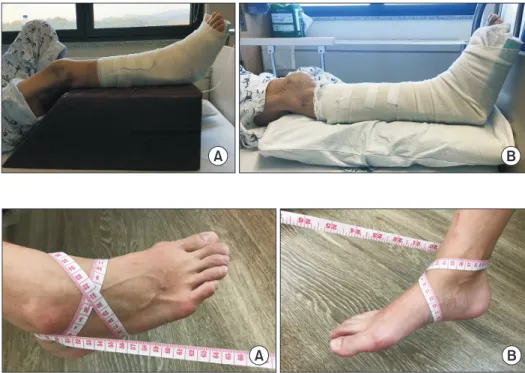
Non-weightbearing ambulation with a wheelchair was allowed from the postoperative day (POD) 2. Patients were managed to lie on the bed with leg elevation except for wheelchair or 2 crutches ambulation time. High leg elevation with cushion elevator (Fig. 1A) was set for the HE group until POD 2 weeks. The LE group was allowed to lie down with the operated leg on the pillow, same duration with HE group (Fig.
1B). Used cushion elevator and pillow was the same for each group, and height was 30 and 10 cm, respectively.
At 2 weeks postoperatively, the splint was removed, and short leg cast was applied for 4 weeks on non-weightbearing state. All patients were discharged at POD 2 weeks. The non- weightbearing state was maintained until 6 weeks postopera- tively. At POD 6 weeks, the cast was removed and controlled ankle motion walking boot (Rebound® Air Walker; Össur, Foothill Ranch, CA, USA) was applied. Tolerable toe-touch weightbearing walk with walker and crutch was initiated from 6 weeks postoperatively.
4. Measurement
We checked leg swelling, leg pain, discomfort on eleva- tion, and functional score. The swelling was measured at two points: (1) ankle and (2) calf. Ankle swelling was estimated with the figure-of-eight method, which was reported by Esterson (Fig. 2).6) The method is very easy, convenient, and reliable.6-9) Calf circumference was measured at the widest circumference in a sitting position with the hip, knee, and ankle flexed 90 degrees using a nonelastic flexible plastic ruler not compressing the subcutaneous tissue.
The swelling was measured on the injured leg at 4 days, 2 weeks, 6 weeks, and 1 year postoperatively. Two values (ankle and calf) were gathered at one time. Two orthopedic surgeons who were not involved in the operation performed the measurement twice. Pain scores were measured simulta- neously with swelling by visual analogue scale (VAS). Subjec- tive satisfaction on elevation height was measured at POD 2 weeks using four degrees of answers for the questions: very comfortable, a little comfortable, a little uncomfortable, and very uncomfortable. The functional score was measured us- ing the American Orthopaedic Foot and Ankle Society (AO- FAS) score at 1 year postoperatively.
5. Statistics
We compared the demographic values and functional
A B
Figure 1. (A) Elevated leg with cushion eleva- tor (30 cm-height) and (B) pillow elevator (10 cm-height) on the bed.
Figure 2. Figure-of-eight method. Flexible tape runs through from the tip of lateral mal- leolus, tuberosity of navicular, base of fifth metatarsal bone, tip of medial malleolus, and then returns to tip of lateral malleolus. (A) Medial side; (B) lateral side.
A B
score using Mann–Whitney test or chi-squared test. The in- traclass correlation coefficient (ICC) as suggested by Shrout and Fleiss9) was used to evaluate interobserver and intrao- bserver reliability of swelling measurement.7) The values ranged from 0 (not correlated at all) to 1 (completely agree).
The mean values of the swelling were used for statistics when the reliability showed high agreement (ICC>0.8). Leg swell- ing and pain were compared between groups using repeated measures analysis of variance. A p-value of less than 0.05 was set for statistical significance. All statis tical analyses were performed using the Statistical Package for the Social Sci- ences (ver. 21.0; IBM Corp., Armonk, NY, USA).
RESULTS
All demographic parameters did not show any differences between the two groups (p>0.05; Table 1). Ankle swelling gradually diminished with time from POD 4 days to 1 year
in both groups, and it was statistically significant (p<0.001).
However, the difference between both groups regarding time was not significant (p=0.92; Table 2, Fig. 3A). Calf swell- ing showed the same pattern (p=0.21; Table 2, Fig. 3B). VAS significantly decreased from POD 4 days to 6 weeks in both groups (p<0.001); however, did not show any difference between groups (p=0.28; Table 2, Fig. 3C). About subjective satisfaction on leg elevation, nineteen patients in HE group Figure 3. Change of swelling in the ankle (A), calf (B), and visual analogue scale (VAS) (C) in both groups. All parameters were checked four times at 4-day, 2-week, 6-week, and one-year postoperatively. HE: high-elevated, LE: low-elevated.
58 56 54 52 50 48 46 44
Ankleswelling(cm)
4 days 2 weeks 6 weeks 1-year
40 35 30 25 20 15 10 5 0
Calfswelling(cm)
7 6 5 4 3 2 1 0
VAS
A B C
4 days 2 weeks 6 weeks 1-year 4 days 2 weeks 6 weeks 1-year HE group
LE group
HE group LE group
HE group LE group Table 2. Comparison of Ankle and Calf Swelling and VAS in Both Groups
Variable Postoperative day
p-value
4-day 2-week 6-week 1-year
Ankle swelling (cm) 0.92
HE 55.0±3.7 (47~61) 53.2±3.8 (46~60) 53.2±4.0 (46~62) 50.5±4.0 (42~58)
LE 55.7±3.9 (48~63) 53.9±3.6 (47~61) 53.2±3.4 (47~60) 51.1±3.4 (44~58)
Calf swelling (cm) 0.21
HE 34.3±3.8 (26~42) 32.5±3.5 (25~40) 32.2±3.4 (24~39.5) 31.2±3.3 (23~38)
LE 36.2±4.3 (28~52) 34.5±4.5 (26~51) 34.2±4.6 (25~52) 32.7±4.5 (24~51)
VAS 0.28
HE 4.5±1.8 (2~8) 2.8±1.6 (0~6) 1.9±1.2 (0~5) 0.3±0.4 (0~1)
LE 4.8±1.7 (2~8) 2.3±0.9 (1~4) 1.4±0.7 (1~3) 0.2±0.4 (0~1)
Values are presented as mean±standard deviation (range).
VAS: visual analogue scale, HE: high-elevated, LE: low-elevated.
Table 3. Comparison of Subjective Satisfaction about Elevation Height in Both Groups
Subjective satisfaction HE group LE group p-value
Very comfortable 6 9 < 0.001
A little comfortable 7 25
A little uncomfortable 14 0
Very uncomfortable 5 0
Total patients 32 34
Values are presented as number.
HE: high-elevated, LE: low-elevated.
www.jkfas.org replied with a little uncomfortable or very uncomfortable,
while all patients in LE group replied with very comfortable or a little comfortable (Table 3). Finally, the mean AOFAS score was 80.0±8.8 in the HE group and 78.0±11.2 in the LE group, which did not show any significant differences be- tween groups (p=0.46).
DISCUSSION
Leg swelling after an ankle fracture and its operation is a natural process of local inflammation. An effort to reduce the swelling is necessary because it can be the cause of pain, skin blister, wound dehiscence, and focal skin necrosis. Leg elevation is one of the methods to reduce swelling, and its effectiveness is already reported.3,10) The effect has been proved in a short-term period but is doubtful in the mid- or long-term because the common protocol of postoperative rehabilitation is performed in gravity-dependent positions.
These exercises and resistance from gravity increase leg swelling.10,11) This effect was demonstrated in the uninjured ankles.10) Sims10) reported significant differences in leg volume in their subjects comparing seated and elevated leg position for 20 minutes. This report shows not only the effectiveness of leg elevation in decreasing swelling but also the reduction of swelling in gravity-dependent rehabilitation. Increased ankle volume after the dependent position was also report- ed.12) Thus, we thought elevation height is not a critical fac- tor for swelling reduction. So, we compared the effect of leg elevation after acute ankle fracture operation in two different height.
As a result, ankle and calf swelling diminished postopera- tively in both groups. However, the difference between the two groups was not significant. The HE group did not show superior swelling reduction over the LE group. It means two different elevation height showed similar effective swelling reduction. We believe this result was relevant to postopera- tive patient movement and early rehabilitation. From POD 2, patients were allowed to move with a wheelchair or 2 crutches. The operative leg was in gravity-dependent posi- tion whenever they move with wheelchair or 2 crutches. Leg elevation could not be maintained for full time during the hospitalization period. Moreover, postoperative rehabilita- tion exercise was done in an upright, gravity-dependent
position also after discharge. Tsang et al.2) reported that leg elevation and intermittent compression were negated by gravity-dependent position. Swelling in the HE group would have been reduced more than that in the LE group dur- ing leg elevation. However, it would have been negated by the gravity-dependent position described above. The effect of leg elevation on swelling reduction is well known, but it means that the gravity-dependent position also reverses its result.10,12) Thus, high leg elevation did not make differences on leg swelling reduction in the postoperative period and made patients uncomfortable.
There are some limitations to our study. First, this is a ret- rograde study. Second, leg elevated time is not the same in all patients. We could not control the time which patients el- evate their leg in the hospital nor after discharge. Third, the number of patients was relatively small. We hope to investi- gate in a large group prospectively in the future study.
CONCLUSION
In conclusion, high elevation of the leg after ankle frac- tures did not show a significant difference from low elevation in regard to leg swelling, pain, and function. Furthermore, high leg elevation resulted discomfort in the postoperative period. So, the low elevation with pillow is enough for acute ankle fracture patients with little discomfort and satisfying swelling reduction.
ORCID
Dong-Kyo Seo, https://orcid.org/0000-0002-5071-6870 Hyun Wook Kang, https://orcid.org/0000-0002-4427-2185 Deug Suk Ahn, https://orcid.org/0000-0002-2714-7219
REFERENCES
1. Elsoe R, Ostgaard SE, Larsen P. Population-based epidemiology of 9767 ankle fractures. Foot Ankle Surg. 2018;24:34-9. doi: 10.1016/
j.fas.2016.11.002.
2. Tsang KK, Hertel J, Denegar CR. Volume decreases after elevation and intermittent compression of postacute ankle sprains are negated by gravity-dependent positioning. J Athl Train. 2003;38:320-4.
3. Rucinkski TJ, Hooker DN, Prentice WE, Shields EW, Cote-Murray DJ. The effects of intermittent compression on edema in postacute ankle sprains. J Orthop Sports Phys Ther. 1991;14:65-9. doi: 10.2519/
jospt.1991.14.2.65.
4. Dehghan N, McKee MD, Jenkinson RJ, Schemitsch EH, Stas V, Nauth A, et al. Early weightbearing and range of motion versus non-weight- bearing and immobilization after open reduction and internal fixation of unstable ankle fractures: a randomized controlled trial. J Orthop Trauma. 2016;30:345-52.
5. Jansen H, Jordan M, Frey S, Hölscher-Doht S, Meffert R, Heintel T.
Active controlled motion in early rehabilitation improves outcome after ankle fractures: a randomized controlled trial. Clin Rehabil.
2018;32:312-8. doi: 10.1177/0269215517724192.
6. Esterson PS. Measurement of ankle joint swelling using a fig- ure of 8*. J Orthop Sports Phys Ther. 1979;1:51-2. doi: 10.2519/
jospt.1979.1.1.51.
7. Donner A, Donald A. Analysis of data arising from a stratified design with the cluster as unit of randomization. Stat Med. 1987;6:43-52.
doi: 10.1002/sim.4780060106.
8. Petersen EJ, Irish SM, Lyons CL, Miklaski SF, Bryan JM, Henderson NE, et al. Reliability of water volumetry and the figure of eight method on subjects with ankle joint swelling. J Orthop Sports Phys Ther.
1999;29:609-15. doi: 10.2519/jospt.1999.29.10.609.
9. Shrout PE, Fleiss JL. Intraclass correlations: uses in assessing rater reliability. Psychol Bull. 1979;86:420-8. doi: 10.1037//0033- 2909.86.2.420.
10. Sims D. Effects of positioning on ankle edema. J Orthop Sports Phys Ther. 1986;8:30-3. doi: 10.2519/jospt.1986.8.1.30.
11. Cloughley WB, Mawdsley RH. Effect of running on volume of the foot and ankle. J Orthop Sports Phys Ther. 1995;22:151-4. doi: 10.2519/
jospt.1995.22.4.151.
12. McCulloch J, Boyd VB. The effects of whirlpool and the dependent position on lower extremity volume. J Orthop Sports Phys Ther.
1992;16:169-73. doi: 10.2519/jospt.1992.16.4.169.