Journal of the Korean Chemical Society 2012, Vol. 56, No. 6
Printed in the Republic of Korea
http://dx.doi.org/10.5012/jkcs.2012.56.6.716
-716-
Fe(HSO
4)
3as an Efficient Catalyst for Diazotization and Diazo Coupling Reactions
Mohammad Rahimizadeh*, Hossein Eshghi, Ali Shiri, Zohreh Ghadamyari, Maryam M. Matin†, Fatemeh Oroojalian‡, and Parvaneh Pordeli†
Department of Chemistry, Faculty of Science, Ferdowsi University of Mashhad, Mashhad, Iran.
*E-mail: [email protected]; [email protected]
†Department of Biology, Faculty of Science, Ferdowsi University of Mashhad, Mashhad, Iran
‡Department of Life Science Engineering, Faculty of New Sciences and Technologies, University of Tehran, Tehran, Iran
(Received June 16, 2012; Accepted October 4, 2012)
ABSTRACT. Diazo coupling reactions of aromatic amines with 2-naphthol in a green, efficient and easy procedure is described. Ferric hydrogensulfate catalyses this reaction in water at room temperature and short reaction time with high yields.
The antibacterial activities of the synthesized compounds against four pathogenic bacteria are also investigated.
Key words: Diazotization, Fe(HSO4)3, 2-Naphthol
INTRODUCTION
Diazo coupling reactions is one of the most important class of organic reactions which is currently performed with mineral acids as catalysts.1,2 Azo dyes are generally synthesized in two steps: the diazotization of aromatic pri- mary amines followed by the coupling reaction between diazonium salts and phenols or aromatic amines.3 The for- mation of diazotizing reagent starts with protonation of nitrous acid under strongly acidic conditions and azo cou- pling carried out at low temperature in the presence of nucleophilic coupling components. The reactivity of a nucleophilic substrate increases with increasing basicity of phenolates and amines.4,5 The main limitation of such syn- thetic processes is their environmental incompatibility.
The acidic and basic effluents from the laboratory and industry cause permanent damage to the environment and disturb the ecological balance.6,7
Many azo compounds, besides their uses as dyes, showed antibacterial and antifungal activities.8-10 Recently, a series of diaryl–azo derivatives were synthesized and introduced as potent antifungal agents.11
In recent years, much attention has been directed toward the application of solid acids in organic synthesis.12 Herein, we report a novel simple synthetic method for azo dyes in water as solvent at room temperature in the presence of ferric hydrogensulfate (FHS) as catalyst. We applied green chemistry to the synthesis of azo dyes and found that the reaction occurred in a very short time with high yields.
FHS is low-cost, widely available and is largely used in a variety of lewis acid-catalyzed reactions.13-19
EXPERIMENTAL SECTION General Procedure
To a stirred mixture of NaNO2 (2 mmol, 0.14 g) and sil- ica gel (1 g), a suspension of an appropriate aromatic amine (2 mmol) and FHS (10 mol%, 0.03 g) in water (5 ml) was added. After the mixture was stirred a bit of time, 2- naphthol (2 mmol, 0.29 g) was added. The progress of the reaction was monitored by TLC using chloroform: meth- anol as eluent (9:1). After the completion of the reaction, the mixture was filtered and the residue was washed with hot water. The solid was heated in ethanol, filtered and the filtrate was recrystallized in ethanol.
1-(2-(4-Ethylphenyl)diazenyl)naphthalen-2-ol: (Table 1, entry 6): Yield = 91%; m.p. = 121−123 ºC; 1H NMR (CDCl3, 100 MHz, δ / ppm) 1.41 (t, 3H, −CH3, J = 8.5 Hz), 2.54 (q, 2H, −CH2, J = 8.5 Hz), 6.85 (d, 2H, aromatic, J = 7.5 Hz), 7.22 (d, 2H, aromatic, J = 7.5 Hz), 7.31−7.83 (m, 5H, aro- matic), 8.61 (d, 1H, aromatic, J = 7.5 Hz), 16.12 (br s, 1H,
−OH, D2O exchangeable); IR (KBr disc, cm−1) 3300 (OH stretching), 3050 (C−H stretching of aromatic ring), 2958 (C−H stretching of aliphatic ring), 1508 (N=N stretching).
Antibacterial Assay
Microbial strains: Staphylococus aureus (PTCC 1431), Bacillus cereus (PTCC 1247), Pseudomonas aeruginosa
2012, Vol. 56, No. 6
Fe(HSO4)3 as an Efficient Catalyst for Diazotization and Diazo Coupling Reactions 717
(PTCC 1047), and Escherichia coli (PTCC 1399) were recovered from long-term storage at 85oC in 15% glyc- erol. Bacteria were refreshed in Tripticase Soy Broth (Merck, Darmstadt, Germany) at 37oC and inoculated on Tripticase Soy (Merck, Darmstadt, Germany) plates in order to check their purity.
Determination of minimum inhibitory concentration (MIC): The in vitro antibacterial activity of the synthe- sized diazo compounds were determined using the broth microdilution method according to the Clinical and Lab- oratory Standards Institute (CLSI) recommended MIC protocol with modifications.25,26 Sterile 96-well micro- plates were used for the assay (0.34 ml volume, Orange Scientific). Bacterial strains were cultured overnight at 37oC in Muller Hinton Broth (MHB, Oxoid). Stock solu- tions of the compounds and standard (chloramphenicol) were prepared in 5.0% (v/v) DMSO. Dilution series, using MHB, were prepared from 5 mg/ml to 10 µg/ml. 70 µl of each diluted solution were transferred into 96-well microtitre plates, followed by adding 70 µl of MHB and inoculating 70 µl of the standardized microorganism suspensions con- taining 108 colony according to McFarland turbidity stan- dards (cfu/ml). A well, consisting of MHB 5.0% (v/v) DMSO and microorganisms, was the growth control and a well, containing MHB, 5.0% (v/v) DMSO and the test oil was the sterility control. The microorganism growth inhi- bition was evaluated by measuring absorbance at 630 nm by using an ELISA reader (Statfax-2100, Awareness Tech- nology Inc., USA). Chloramphenicol was used as an anti- bacterial standard against all pathogens. Experiments were performed in triplicate and the averages were reported.
RESULTS AND DISCUSSION
In the present study, a novel method for the nitration of phenol by NaNO2 and FHS is described. This nitration occurred probably through a nitrosonium ion producing first the nitrosophenol which then oxidized to nitrophe- nol. In order to prove this proposal, the reaction was per- formed with o-phenylenediamine. As expected the benzo[d]
[1,2,3]triazole was obtained in high yield. Therefore, we supposed that the reagent provide nitrozonium ion inter- mediate which conduct the diazotization reactions. These observations led us to explore the potential of various sub- stituted anilines to be diazotized and coupled with 2-naph- thol under green and mild reaction conditions (Scheme 1).
In this work, we have used 2-naphthol as a model aro- matic molecule. The study of its behavior can give more
reliable information about the reactions of this class of compounds than studies on phenols and other aromatic compounds. Moreover, silica was used as an inert sub- strate to enhance the water solubility of 2-naphthol to enable a relatively homogeneous mixture.
In order to ascertain the optimum conditions, several reactions were carried out on aniline as the model sub- strate by varying the amount of the catalyst and finally the best result was obtained with 10 mol% of the catalyst.
Having established the reaction condition, to a mixture of equimolar sodium nitrite and silica gel in a little water, a mixture of various substituted anilines and FHS were added. The mixture was stirred for a few seconds and after that 2-naphthol was added and the mixture was stirred at room temperature. The results of the completion of the reaction were summarized in Table 1.
As it can be seen from the data in Table 1, variety of aniline derivatives was screened and the corresponding diazo compounds were obtained in good to excellent yields. Aromatic compounds having electron donating group (entries 2,3,6,7) readily underwent diazotization coupling reaction in excellent yields. Also, deactivated aromatic compounds underwent the reaction in good yields (entries 4,5) with a relatively longer time. The steric effect of ortho-substituents in comparing with para-sub- Scheme 1.
Table 1. Diazo coupling reaction of aniline derivatives with 2- naphtol in the presence of FHS.
Entry R Time
(min) Yielda
(%)
mp (ºC)
mp (ºC)Lit.
1 H 10 90 134−135 133−13420
2 4-CH3 5 92 133−135 132−13420
3 4- CH3O 3 97 136−138 136−13720
4 4-F 10 90 143−145 146−14820
5 4-Cl 12 86 164−166 165−16620
6 4-CH3CH2 5 91 121−123 −
7 4-CH3CH2O 3 96 133−134 133−13421
8 2-CH3 10 93 132−133 131−13222
9 3-CH3 10 90 140−141 141−14222
10 2-CH3CH2O 12 87 142−143 142−14322 11 2-CH3-3-CH3 10 88 130−131 125−13023 12 2-CH3O-5-Cl 15 90 202−204 202−20323 13 4-H2N-C6H4 20 80 301−302 300−30224
aisolated yield
718 Mohammad Rahimizadeh, Hossein Eshghi, Ali Shiri, Zohreh Ghadamyari, Maryam M. Matin, Fatemeh Oroojalian, and Parvaneh Pordeli
Journal of the Korean Chemical Society
stituents has relatively a bit influence on the reaction time and yields (entries 8, 10−12). It is pertinent to mention that 3-nitro and 4-nitro aniline were rather failed in diazoti- zation coupling reaction. Notably, 2-naphthol underwent smooth and regioselective diazotization reaction with aniline-like derivatives whereas the other aromatic com- pounds like phenols, toluene, benzonitrile and bromoben- zene did not obtain the desired products. The structures of all the synthesized azo compounds were well character- ized by 1H NMR, FT-IR and also melting points were compared with those of the authentic samples in literatures.
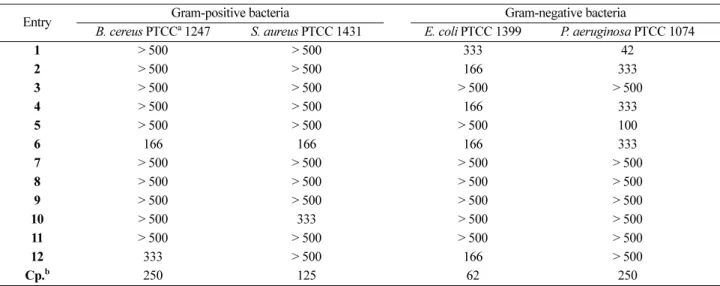
The antibacterial activities of the synthesized azo com- pounds against four pathogenic bacteria (S. aureus, B.
cereus, P. aeruginosa, and E. coli) were also investigated in vitro using the broth microdilution method according to standard method.25,26 Chloramphenicol was used as an antibacterial standard against all pathogens.
As shown in Table 2, the minimum inhibitory concen- tration (MIC) values of azo compounds were evaluated.
Among all screened compounds, entries 1 and 5 exhibited a good antibacterial activity against the P. aeruginosa whereas entry 6 showed a good antibacterial activity against S. aureus and B. cereus. The other synthesized compounds did not show any significant antibacterial activities.
In summary, we have developed a highly efficient green method for the synthesis of azoic dyes catalyzed by eco- friendly catalyst with high yields. This method totally avoids the use of strong protic acids or toxic solvents through the reaction. The resulting diazonium salts react rapidly with 2-naphthol to produce azo dyes in good yields.
Our new method has some advantages over traditional
methods which includes mild reaction conditions at room temperature, short reaction time and an easy work-up pro- cedure.
Acknowledgments. The authors gratefully acknowledge Ferdowsi University of Mashhad for partial support of this project.
REFERENCES
1. Zollinger, H. Azo and Diazo Chemistry, Aliphatic and Aromatic Compounds; Interscience Publishers: London, England, 1961.
2. Saunders, K. H.; R. Allen, L. M. Aromatic Diazo Com- pounds; 3rd Ed.; Edward Arnold Publishers: London, England, 1985.
3. Jin, J.; Wen, Z.; Wang, Y.; Matsuura, T.; Meng, J. Synth.
Commun. 2000, 30, 829.
4. Dabbagh, H. A.; Teimouri, A.; Najafi, A. Appl. Catal., B 2007, 76, 24.
5. Zollinger, H. Color Chemistry, 3rd ed.; Verlag, Switzer- land, 2003; p 165.
6. Clark, J. H. Chemistry of waste minimization; Chapman and Hall: London, England, 1995.
7. Bahulayan, D.; John, L.; Lalithambika, M. Synth. Commun.
2003, 33, 863.
8. Novak, P.; Lycka, A.; Cisarova, I.; Buchta, V.; Silva, L.;
Kolarova, L.; Ruzicka, A.; Holecek, J. Appl. Organomet.
Chem. 2005, 19, 500.
9. Jarrahpour, A. A.; Motamedifar, M.; Pakshir, K.; Hadi, N.; Zarei, M. Molecules 2004, 9, 815.
10. Kurtoglu, N. J. Serb. Chem. Soc. 2009, 74, 917.
11. Xu, H.; Zeng, X. Bioorg. Med. Chem. Lett. 2010, 20, 4193.
12. Okahara, T. Chem. Rev. 2002, 102, 3641.
Table 2. Minimum inhibitory concentration (MIC = µg/ml) values of the synthesized compounds
Entry Gram-positive bacteria Gram-negative bacteria
B. cereus PTCCa 1247 S. aureus PTCC 1431 E. coli PTCC 1399 P. aeruginosa PTCC 1074
1 > 500 > 500 333 42
2 > 500 > 500 166 333
3 > 500 > 500 > 500 > 500
4 > 500 > 500 166 333
5 > 500 > 500 > 500 100
6 166 166 166 333
7 > 500 > 500 > 500 > 500
8 > 500 > 500 > 500 > 500
9 > 500 > 500 > 500 > 500
10 > 500 333 > 500 > 500
11 > 500 > 500 > 500 > 500
12 333 > 500 166 > 500
Cp.b 250 125 62 250
aPersian Type Culture Collection (PTCC).
bChloramphenicol.
2012, Vol. 56, No. 6
Fe(HSO4)3 as an Efficient Catalyst for Diazotization and Diazo Coupling Reactions 719
13. Eshghi, H.; Bakavoli, M.; Moradi, H. Chin. Chem. Lett.
2008, 19, 1423.
14. Bakavoli, M.; Rahimizadeh, M.; Eshghi, H.; Shiri, A.;
Ebrahimpour, Z.; Takjoo, R. Bull. Korean Chem. Soc. 2010, 31, 949.
15. Rahimizadeh, M.; Bakhtiarpoor, Z.; Eshghi, H.; Pordel, M.; Rajabzadeh, G. Monat. Chem. 2009, 140, 1465.
16. Rahimizadeh, M.; Bakavoli, M.; Shiri, A.; Eshghi, H. Bull.
Korean Chem. Soc. 2009, 30, 1699.
17. Rahimizadeh, M.; Bakavoli, M.; Shiri, A.; Eshghi, H.;
Saberi, S. J. Chem. Res. 2008, 704.
18. Bakavoli, M.; Rahimizadeh, M.; Shiri, A.; Eshghi, H.; Vaziri- Mehr, S.; Pordeli, P.; Nikpour, M. Heterocycl. Commun.
2011, 17, 49.
19. Eshghi, H.; Rahimizadeh, M.; Saberi, S. Catal. Commun.
2008, 9, 2460.
20. Yamada, T.; Tanaka, N.; Morisawa, T.; Nishikuri, M.; Kaji, A. Bull. Chem. Soc. Jpn. 1970, 43, 908.
21. Koch, L.; Milligan, R.; Zuckerman, S. Ind. Eng. Chem.
1944, 16, 755.
22. Smyth, R. B.; McKeown, G. G. J. Chromatogr. 1961, 5, 395.
23. Zaugg, H. E. J. Am. Chem. Soc. 1945, 67, 1861.
24. Rowe, F. M. J. Soc. Dyes Colour 1924, 40, 218.
25. Clinical and Laboratory Standards Institute, Methods for the Antimicrobial Susceptibility Testing of Anaerobic Bac- teria; Approved Standard-Eighth Edition Approved Stan- dard M11-A8, 2012, Villanova, PA, USA.
26. Oroojalian, F.; Kasra-Kermanshahi, R.; Azizi, M.; Bassami, M. R. Food Chem. 2010, 120, 765.