Assessment of the Influence of Physical Impairments on Activities in Persons With Stroke
Young-keun Woo, Ph.D., P.T.
Dept. of Physical Therapy, College of Alternative Medicine, Jeonju University
Abstract
5)The aim of this study was to analyze the relationship between physical impairments and daily activities on the basis of the outcome measurements in stroke patients. Seventy-six stroke patients participated in this study. Two physical therapists evaluated 3 clinical common measurements, i.e., the Fugl-Meyer Assessment (FMA), the Berg Balance Scale (BBS), and the Functional Independence Measure (FIM). Multiple regression analysis was used, as the dependent variables were the BBS and FIM; the independent variables were post-stroke duration, FMA of Upper Extremity (FMU), and FMA of Lower Extremity (FML). In the regression equation of the BBS, the coefficient of determination (R2) was .383, and the FML was found to be the most important variable for determining the BBS score. In the regression equation of the FIM, R2 was .531, and the FML was found to be the most important variable for determining the FIM. These results suggest that there is a need to determine the function of activities on the basis of the physical impairments of stroke patients. More variable measurement tools on the levels of body function and structure, as well as activity limitations are required.
Key Words: Berg balance scale; Fugl-Meyer assessment; Functional Independence Measures;
International classification of functioning, disability, and health; Stroke.
Introduction
Outcome measure is an important component in determining rehabilitative effectiveness (van der Putten et al, 1999). In accordance with those of the patients, professionals consider improvement of re- habilitation outcomes and goal setting to be im- portant for outcome measure (Soberg et al, 2008).
Selecting outcome measures in stroke patients is a difficult process due to the variability in etiologies, symptoms, severity, and the possibility of sponta- neous recovery after stroke (Barak and Duncan, 2006). Incorporation of a health and disability frame- work for clinical outcome measures in stroke survi- vors such as that of the International Classification of Functioning, Disability, and Health (ICF) can be applied (Barak and Duncan, 2006). The ICF presents a multidimensional perspective on function and may
be applied both in the analysis of disability and in the setting of rehabilitation goals (Soberg, 2008). It could provide a common language for the explanation of human function through outcomes measured at 3 levels, namely, body structure or function, activities, and participants. Therefore, multidisciplinary respon- sibility and coordination within interventions is nec- essary for clinicians (Steiner et al, 2002). The ICF check-list is the most efficient of tools but evalua- tion requires much time due to the high number of categories and list components.
Clinical measures provide a simple and convenient method for identifying problems and reducing the time spent in clinics. Recently, a few studies have suggested that classification of popular outcome measures tools using ICF would be useful in stroke rehabilitation (Barak and Duncan, 2006; Salter et al, 2005). In these studies, the Fugl-Meyer Assessment Corresponding author: Young-keun Woo [email protected]
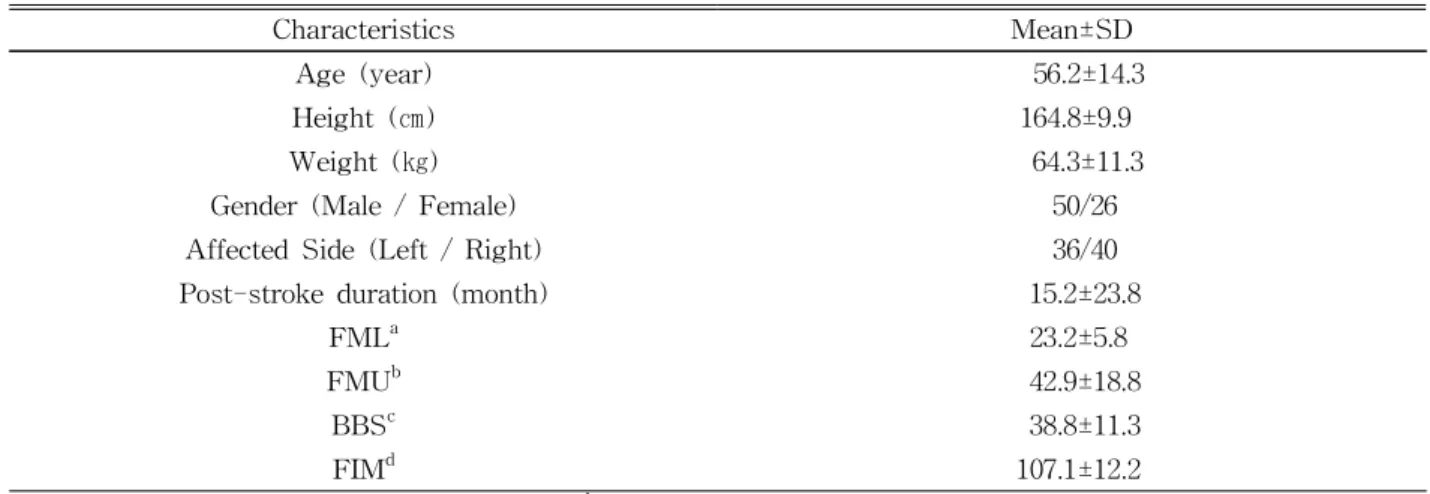
Characteristics Mean±SD
Age (year) 56.2±14.3
Height (㎝) 164.8±9.9
Weight (㎏) 64.3±11.3
Gender (Male / Female) 50/26
Affected Side (Left / Right) 36/40
Post-stroke duration (month) 15.2±23.8
FMLa 23.2±5.8
FMUb 42.9±18.8
BBSc 38.8±11.3
FIMd 107.1±12.2
aFugl-Meyer Assessment of Lower Extremity, bFugl-Meyer Assessment of Upper Extremity, cBerg Balance Scale,
dFunctional Independence Measure.
Table 1. General characteristics of the participants of this study (N=76) (FMA) was used to assess the motor function of
body structure (impairments), Functional Independence Measure (FIM) was applied for daily life activities on the activities level, and the Berg Balance Scale (BBS) was applied for balancing ability on the activities level. The FMA is based on Brunnstrom's stages of recovery, which are assumed and divided into a few domains in detail. This assessment includes an eval- uation of muscle tone, range of motion, tendon re- flexes, and the performance of voluntary movements of the affected arm (Fugl-Meyer et al, 1975). The BBS is used to assess the balance of elderly in- dividuals and monitors change over time, and is used in stroke rehabilitation (Carr and Shepherd, 2010). In addition, the FIM is a widely used measurement tool for the severity of disability in daily life for neuro- logic patients. It was designed to assess the degree of assistance required by a person with disability to perform daily activities.
Soberg et al (2008) concluded that most patient goals focus on activities and participation, but phys- ical therapists mainly focus on body structure and function. Therefore, the aim of this study was to an- alyze the relationship between the outcome measures of physical impairments and daily activities in stroke patients. Moreover, we aimed to propose better ideas for goals of rehabilitation in stroke patients through the physical impairments-participants relationship.
Methods Participants
Seventy-six stroke patients participated in this study. Data collection was performed in the out-/in-patient physical therapy for adult rehabilitation unit in rehabilitation hospitals located in Seoul, Korea.
The subjects' general characteristics are listed in Table 1. The following inclusion criteria were used: a medically confirmed diagnosis of stroke and the ability to communicate with evaluators. Patients were ex- cluded from the study if they had a history of any other neurologic, orthopedic, and psychological dis- orders that would affect their ambulatory or balancing ability, or any cognitive deficits that precluded support for the procedures of this study.
Clinical Measurements
To investigate the influence of impairments on activities based on outcome measures in stroke pa- tients, 3 common clinical measurements (FMA, BBS, and FIM) were evaluated by 2 physical therapists. Outcome measurements for stroke pa- tients were assessed at all 3 levels as described in the ICF (Barak and Duncan, 2006; Carr and Shepherd, 2003; Salter et al, 2005; WHO, 2001):
body functions and structures (impairments), activ- ities (limitation), and participation (restriction). The
ICF is the World Health Organization’s (WHO) framework for health and disability.
Of the clinical measurement scores in this study, the FMA was used to identify range of motion, tendon reflex, and voluntary movements of the af- fected arm and leg at the body structures and function levels of the upper and lower extremities (Fugl-Meyer et al, 1975; Salter et al, 2005). The BBS was used to identify postural control, balance, and self-care, while the FIM was used to evaluate communication and social cognition at the activity limitation level.
The FMA (upper and lower extremity) is used as an adaptation of Brunnstrom’s hemiplegia classi- fication, using an ordinal-level scoring system in which each detail is rated with a score: 0=cannot be performed, 1=can be partly performed, and 2=can be performed faultlessly. The total score ranges from 0 to 66 for the upper extremity, and from 0 to 34 for the lower extremity. In this study, we used both the upper and lower extremity sub-tests. Inter-rater reli- ability as reported in an FMA-related study with 37 stroke patients was .99, and test-retest reliability was .97 (Platz et al, 2005).
The BBS is a test commonly used to assess the performance of postural and balance control while sitting and standing in older persons and individuals with neurological disorders. The scale consists of 14 items and has a maximum possible score of 56 points. It also uses an ordinal-level scoring system in which each detail is rated: 0 being the lowest and 4 being the highest level of function. Test-retest re- liability as reported in stroke survivors was .99 (Berg et al, 1995).
The FIM assesses physical and cognitive dis- ability, which focuses on the activity of daily living.
In addition, the FIM is used to measure the patient's progress and to assess rehabilitation outcomes.
Measurement consists of 18 items (13 physical items and 5 cognitive items) and has a possible score range of 18-126 points. Higher scores indicate more independence in the activities of daily life, and the
FIM uses an ordinal-level scoring system in which each detail is rated: 1=total assistance, 2∼4=maximal to minimal assistance, 5=supervision, and 6∼7=modi- fied to complete independence. Inter-rater reliability was reported as .95, and test-retest reliability was .95 (Ottenbacher et al, 1996).
Statistical Analysis
Descriptive analysis was used to describe charac- teristics such as age, height, weight, post-stroke du- ration, FMA and BBS scores, and FIM; frequency analysis was used for gender and the affected side in paraplegia or paresis in stroke patients. Multiple re- gression analysis was used to determine relationships in outcome measures between the level of activity and body function and structure. Since the dependent vari- ables were BBS and FIM, the predictor variables were post-stroke duration, the Fugl-Meyer Assessment of Upper Extremity (FMU) score, and the Fugl-Meyer Assessment of Lower Extremity (FML) score. A sig- nificance level of α<.05 was adopted. Data analyses were performed using SPSS version 18.0.
Results
Multiple Regression Analysis for Berg Balance Scale and Functional Independence Measures
The equations to calculate the FMA score and post-stroke duration on the FIM and BBS by multi- ple regression analysis were shown in Table 2.
Table 2 showed the regression equation for calculat- ing the predicted BBS and FIM score using the FMA and post-stroke duration. In the regression equation of the BBS, the coefficient of determination (R2) was .383, the regression constant was 10.685, and the regression coefficient was 1.219 for the FML. As shown in Table 3, the FML was the most important variable for determining the BBS score. In addition, the FMU and post-stroke duration were not significant in the prediction of the BBS score (p=.37 and p=.47 respectively; α=.05). In the regression
Outcome Measures Regression equation R² p
BBSa (10.685)+(1.219×FMLc) .383 <.05
FIMb (71.086)+(1.565×FML) .531 <.05
aBerg Balance Scale, bFunctional Independence Measure, cFugl-Meyer Assessment of Lower Extremity.
Table 2. The equations for FMA and post-stroke duration on the BBS and FIM by multiple regression analysis (N=76)
BBSa Standardized
coefficient (β) p FIMb Standardized
coefficient (β) p R2=.383, F=44.76,
p<.05
R2=.531, F=81.39, p<.05
FMUc -.125 .37 FMU .113 .35
FMLd .619 <.05 FML .728 <.05
Post-stroke duration -.069 .47 Post-stroke duration .119 .15
aBerg Balance Scale, bFunctional Independence Measure, cFugl-Meyer Assessment of Upper Extremity, dFugl-Meyer Assessment of Lower Extremity.
Table 3. Output for multiple regression analyses for the prediction of the BBS score and FIM from the FMU,
FML, and post-stroke duration (N=76)
Outcome Measures Regression equation R² p
BBSa (10.590)+(1.233×FMLc) .356 <.05
FIMb (67.753)+(1.682×FML) .527 <.05
aBerg Balance Scale, bFunctional Independence Measure, cFugl-Meyer Assessment of Lower Extremity.
Table 4. The equations for FMA on the BBS and FIM within 12 months post-stroke duration by multiple re-
gression analysis (N=53)
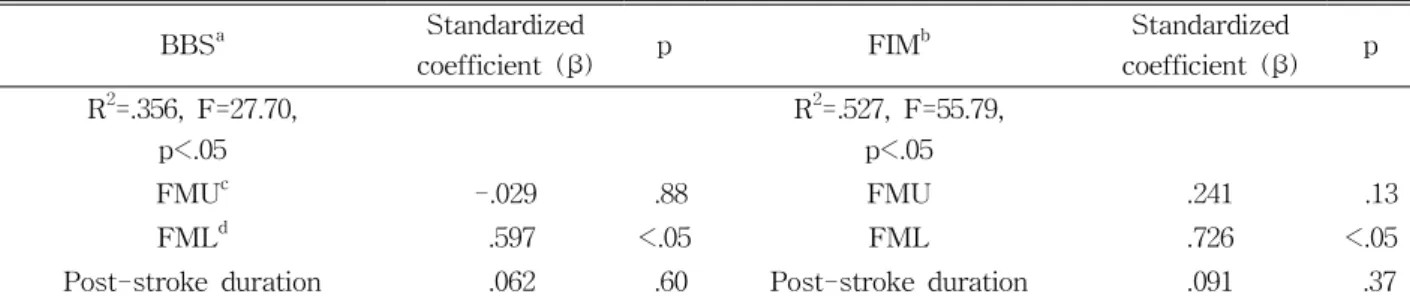
BBSa Standardized
coefficient (β) p FIMb Standardized
coefficient (β) p R2=.356, F=27.70,
p<.05
R2=.527, F=55.79, p<.05
FMUc -.029 .88 FMU .241 .13
FMLd .597 <.05 FML .726 <.05
Post-stroke duration .062 .60 Post-stroke duration .091 .37
aBerg Balance Scale, bFunctional Independence Measure, cFugl-Meyer Assessment of Upper Extremity, dFugl-Meyer Assessment of Lower Extremity.
Table 5. Output for multiple regression analyses for the prediction of the BBS score and FIM from the FMU,
FML within 12 months post-stroke (N=53)
equation of the FIM, R2 was .531, the regression constant was 71.086, and the regression coefficient was 1.565 for the FML. As shown in Table 3, the FML was the most important variable for determin- ing FIM. Furthermore, the FMU and post-stroke du-
ration were not significant in the prediction of FIM (p=.35 and p=.15 respectively; α=.05).
In Tables 4 and 5, the results of multiple re- gression analyses for post-stroke duration within 12 months were shown. In the regression equation of the
Outcome Measures Regression equation R² p
BBSa (11.481)+(1.155×FMLc) .431 <.05
FIMb (76.397)+(1.382×FML) .582 <.05
aBerg Balance Scale, bFunctional Independence Measure, cFugl-Meyer Assessment of Lower Extremity.
Table 6. The equations for the FMA on the BBS and FIM over 12 months post-stroke duration by multiple
regression analysis (N=23)
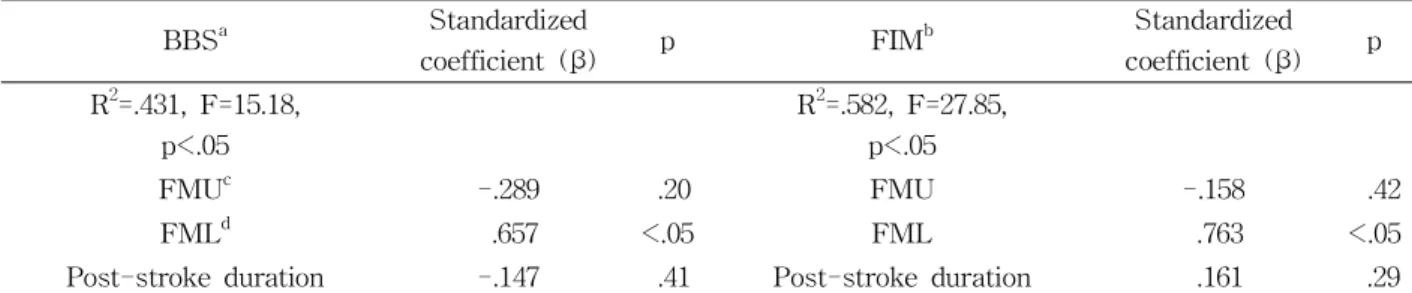
BBSa Standardized
coefficient (β) p FIMb Standardized
coefficient (β) p R2=.431, F=15.18,
p<.05
R2=.582, F=27.85, p<.05
FMUc -.289 .20 FMU -.158 .42
FMLd .657 <.05 FML .763 <.05
Post-stroke duration -.147 .41 Post-stroke duration .161 .29
aBerg Balance Scale, bFunctional Independence Measure,cFugl-Meyer Assessment of Upper Extremity, dFugl-Meyer Assessment of Lower Extremity.
Table 7. Output for multiple regression analysis for the prediction of the BBS score and FIM from the FMU
and FML over 12 months post-stroke (N=23)
BBS, R2 was .356, the regression constant was 10.590, and the regression coefficient was 1.233 for the FML.
As shown in Table 5, the FML was the most im- portant variable for determining the BBS score.
Additionally, the FMU and post-stroke duration were not significant in the prediction of the BBS score (p=.88 and p=.60 respectively; α=.05). In the regression equation of the FIM, R2 was .527, the regression con- stant was 67.753, and the regression coefficient was 1.682 for the FML. As shown in Table 5, the FML was the most important variable for determining the FIM. Furthermore, the FMU and post-stroke duration were not significant in the prediction of FIM (p=.13 and p=.37 respectively; α=.05).
In Tables 6 and 7, the results of multiple re- gression analyses for post-stroke duration over 12 months were shown. In the regression equation of the BBS, R2 was .431, the regression constant was 11.481, and the regression coefficient was 1.155 for the FML.
As shown in Table 7, the FML was the most im- portant variable for predicting the BBS score. In addi- tion, the FMU and post-stroke duration were not sig- nificant in the prediction of the BBS score (p=.20 and
p=.41 respectively; α=.05). In the regression equation of the FIM, R2 was .582, the regression constant was 76.397, and the regression coefficient was 1.382 for the FML. As shown in Table 7, the FML was the most important variable for determining the FIM.
Furthermore, the FMU and post-stroke duration were not significant in the prediction of the FIM (p=.42 and p=.29 respectively; α=.05).
Discussion
The purpose of this study was to propose ideas to predict activities on the basis of the physical abilities and daily activities of stroke patients using outcome measurement tools with common clinical assessments, including the FMA, BBS, and FIM. The results of our study revealed several significant findings. Firstly, the result of this study showed that have 38% for the prediction of the BBS score of the information by FML on physical impairments to predict activities in stroke patients. Secondly, the result of this study showed that have 53% for the prediction of the FIM
score of the information by FML on physical impair- ments to predict activities in stroke patients. These percentages in stroke patients indicate that they were not affected by post-stroke duration within and over 12 months or by the FMU score.
A fundamental issue in any clinical setting con- cerns how the levels of functional activity are meas- ured in subjects, and stroke is no exception. The BBS is widely used to assess balancing ability in stroke patients; it contains 14 components for balance evaluation. All components were required for function of the lower extremity and both static and dynamic balance, but the FML is based only on lower ex- tremities for predicting BBS scores. These results suggested that the FML is not a sufficiently pre- dictive variable for balancing ability. Beninato et al (2009) suggested that the ICF is a useful framework for selecting clinical measures relative to fall history, but multiple regression analysis of our study showed that the FMU and post-stroke duration did not sig- nificantly impact the predictions of the BBS and FIM scores. This is because the BBS is not characteristic of the motor components used during balancing ac- tivity, and other components for evaluating balance exist, such as visual and proprioceptive stimuli.
Therefore, the BBS is based on different levels of measurement of activity and impairment. Physical im- pairments should not be generalized or correlated with the levels of function calculated by 2 different levels of measurement tools.
The FIM is widely used for assessing the activity of daily living in stroke patients. Murtezani et al (2009) reported that physical impairment has an im- pact on the reintegration of stroke patients into the community. Improving the physical state means that quality of life is also improved, and stroke patients are easily reintegrated into the community. The FMA is the most common tool for evaluating phys- ical impairment in stroke patients. Following multiple regression analysis of the FMA and FIM in this study, the FML score indicated moderate predictors for the FIM scores, although the FML contains no
components for assessing cognitive status in stroke patients. Strengthening the significance of this result is the fact that the FML clarifies the FIM score if there is no cognitive information; however, the weakness of this result is that the FIM is not re- flected or explained by upper extremity physical im- pairments in stroke patients.
One reason for the lower predictor variables be- tween the FMA, FIM, and BBS is that they demon- strated that only one physical impairment measure was insufficient to clarify the activity or balancing ability of stroke patients. The main limitations to the BBS that it may not be suitable for the evaluation of active elderly persons, and no common interpretation exists for BBS scores except those of border scores for fall risk and decreased sensitivity in early-stage stroke patients (Mao et al, 2002; Nakamura et al, 1999; Wee et al, 2003). Moreover, one of the greatest limitations of FIM tools for stroke is that there might be no pre- cise scoring range for each item (Salter et al, 2005).
Selecting a combination of assessments within the ICF model may be a critical factor for improving the accu- racy of outcome measures in stroke patients. Yates et al (2002) have shown that combining measures on the basis of body function and structure may improve their sensitivity compared to applying them individually to stroke patients. In addition, the outcome measure- ments for stroke must consider the study and inter- vention types, and whether the outcome measured for focuses on activity limitation during rehabilitation. As discussed earlier, the individuals who participated in this study were measured with only 1 physical impair- ment tool and for activity of daily life or balance.
Therefore, the results cannot be generalized to the measures of daily life activity or balancing ability of stroke patients. Physical impairments may reduce par- ticipation in daily activities for community-dwelling stroke patients, ultimately affecting their quality of life.
Further studies could analyze the influence of physical impairments on activities using more variable meas- urement tools on levels of both body function and of structure, and activity limitations.
Conclusion
This study aimed to identify the outcome measures in relation with measurement of impairment and ac- tivities in stroke patients. The FMA, BBS, and FIM score of 76 stroke patients were measured by 2 phys- ical therapists. The results suggest that the FML is the most important variable for predicting the balanc- ing ability on the basis of the BBS score and daily activities on the basis of the FML in stroke patients.
However, it was not a strong clarification of the in- fluence of physical impairments on activity limitation.
Therefore, there is a need to analyze the influence of physical impairments on activities using more variable measurement tools on levels both of body function and of structure, and activity limitations.
References
Barak S, Duncan PW. Issues in selecting outcome measures to assess functional recovery after stroke. NeuroRx. 2006;3(4):505-524.
Beninato M, Portney LG, Sullivan PE. Using the inter- national classification of functioning, disability and health as a framework to examine the association between falls and clinical assessment tools in people with stroke. Phys Ther. 2009;89(8):816-825.
Berg K, Wood-Dauphinee S, Williams JI. The balance scale: Reliability assessment with elderly resi- dents and patients with an acute stroke. Scand J Rehbil Med. 1995;27(1):27-36.
Carr JH, Shepherd RB. Stroke Rehabilitation: Guidelines for exercise and training to optimize motor skill.
Seattle Butterworth Heinemann Medical Books, 2003:3-31.
Carr JH, Shepherd RB. Neurological Rehabilitation:
Optimizing motor performance. Churchill Livingstone, 2nd ed, 2010:57-74.
Fugl-Meyer AR, Jääskö L, Leyman I, et al. The post-stroke hemiplegic patient. 1. A method for evaluation of physical performance. Scand J Rehab
Med. 1975;7(1):13-31.
Mao HF, Hsueh IP, Tanq PF, et al. Analysis and comparison of the psychometric properties of three balance measures for stroke patients. Stroke.
2002;33(4):1022-1027.
Murtezani A, Hundozi H, Gashi S, et al. Factors as- sociated with reintegration to normal living after stroke. Med Arh. 2009;63(4):216-219.
Nakamura D, Holm M, Wilson A. Measures of balance and fear of falling in the elderly: A review. Physical
& Occupational Therapy in Geriatrics. 1999;15:17-32.
Ottenbacher KJ, Hsu Y, Granger CV, et al. The reli- ability of the functional independence measure: A quantitative review. Arch Phys Med Rehabil.
1996;77(12):1226-1232.
Platz T, Pinkowski C, van Wijck F, et al. Reliability and validity of arm function assessment with standardized guidelines for the Fugl-Meyer Test, Action Research Arm Test and Box and Block Test: A multicentre study. Clin Rehabil.
2005;19(4):404-411.
Salter K, Jutai JW, Teasell R, et al. Issues for se- lection of outcome measures in stroke re- habilitation: ICF activity. Disabil Rehabil.
2005;27(6):315-340.
Soberg HL, Finset A, Roise O, et al. Identification and comparison of rehabilitation goals after multiple injuries: An analysis of the patients' physi- otherapists’ and other allied professionals' re- ported goals. J Rehabil Med. 2008;40(5):340-346.
Steiner WA, Ryser L, Huber E, et al. Use of the ICF model as a clinical problem-solving tools in physical therapy and rehabilitation medicine.
Phys Ther. 2002;82(11):1098-1107.
van der Putten JJ, Hobart JC, Freeman JA, et al.
Measuring change in disability after inpatient re- habilitation: Comparison of the responsiveness of the Barthel Index and the Functional Independence Measures. J Neurol Neurosurg Psychiatry.
1999;66(4):480-484.
Wee JY, Wong H, Palepu A. Validation of the Berg balance scale as a predictor of length of stay
This article was received August 18, 2011, was reviewed August 22, 2011, and was accepted September 20, 2011.
and discharge destination in stroke rehabilitation.
Arch Phys Med Rehabil. 2003;84(5):731-735.
WHO. International Classification of Functioning, Disability and Health. World Health Organization.
2001.
Yates JS, Lai SM, Duncan PW, et al. Falls in com- munity-dwelling stroke survivors: An accumu-
lated impairments model. J Rehabil Res Dev.
2002;39(3):385-394.