ISSN 2234-3806 • eISSN 2234-3814
180 www.annlabmed.org https://doi.org/10.3343/alm.2020.40.2.180 Ann Lab Med 2020;40:180-183
https://doi.org/10.3343/alm.2020.40.2.180
Letter to the Editor
Clinical Microbiology
Whole-Genome Analysis of bla CTX-M-55 -Carrying
Escherichia coli Among Pigs, Farm Environment, and Farm Workers
Young Ah Kim , M.D.1, Hyunsoo Kim , M.D.2, Min Hyuk Choi , M.D.3,4, Young Hee Seo , B.S.3, Hyukmin Lee , M.D.3,4, and Kyungwon Lee , M.D.3,4
1Department of Laboratory Medicine, National Health Insurance Service Ilsan Hospital, Goyang, Korea; 2Department of Laboratory Medicine, National Police Hospital, Seoul, Korea; 3Research Institute of Bacterial Resistance, and 4Department of Laboratory Medicine, Yonsei University College of Medicine, Seoul, Korea
Dear Editor,
Antimicrobial resistance (AMR) is becoming increasingly prob- lematic in Korea [1], requiring urgent multi-sectional control measures. The massive use of antibiotics could further acceler- ate the spread of antibiotic-resistant bacteria among humans and animals [2]. However, the contribution to the human car- riage burden from animal reservoirs has not been fully eluci- dated. Recently, there have been attempts to apply “one health”
approach, which is a broad and flexible concept with diverse facets such as establishment of a drug-resistant superbacteria network of the environment, community, and clinical settings [3]. We investigated the molecular prevalence of cephalosporin- resistant bacteria among livestock, farm environments, and farm workers in Korea, in collaboration with the Korean Centers for Disease Control and Prevention. During the study, we collected four blaCTX-M-55-carrying Escherichia coli isolates that were highly suspected to be disseminated in one pig farm in Jeollanam-do Province, Korea, at the same time (August 10, 2017). The pur- pose of this study was to elucidate the direct spread from differ- ent reservoirs (human-animal-environment), verifying the ge- netic relatedness at the whole-genome sequence level. This
study was approved by the Institutional Review Board of Na- tional Health Insurance Service Ilsan Hospital, Goyang, Korea (NHIMC 2017-07-041). We obtained informed consent from farm workers.
The four E. coli isolates were collected from a farm worker (PJFH115, from stool), two pigs (PJFA1104 from stool and PJFA173 from an anal swab), and the pigpen fence (PJFE101) on 10, August, 2017. The strains were stored in skimmed milk at -70°C until further use. The culture and antimicrobial suscep- tibility were performed at Yonsei University College of Medicine.
DNA of freshly subcultured isolate was extracted using MG Ge- nomic DNA purification kit (MGmed, Seoul, Korea), and 8 μg of input genomic DNA was used. The entire genomes of the four CTX-M-55-producing E. coli isolates were sequenced using the PacBio RS II (Pacific Biosciences, Menlo Park, CA, USA) plat- form, and sequences were assembled by Pac Denovo with sin- gle-molecule real-time analysis software (ver. 2.3) and anno- tated by Prokka (ver. 1.12b), provided by Macrogen (Seoul, Ko- rea). The subsequent steps were based on the PacBio Sample Net-Shared Protocol, which is available at http://pacificbiosci- ences.com/. In silico multilocus sequence typing (MLST) [4],
Received: June 27, 2019
Revision received: August 23, 2019 Accepted: October 1, 2019
Corresponding author: Kyungwon Lee, M.D.
Department of Laboratory Medicine and Research Institute of Bacterial Resistance, Severance Hospital, Yonsei University College of Medicine, 50 Yonsei-ro, Seodaemun-gu, Seoul 03722, Korea
Tel: +82-2-2228-2446, Fax: +82-2-313-0956, E-mail: [email protected]
© Korean Society for Laboratory Medicine
This is an Open Access article distributed under the terms of the Creative Commons Attribution Non-Commercial License (http://creativecommons.org/licenses/by-nc/4.0) which permits unrestricted non-commercial use, distribution, and reproduction in any medium, provided the original work is properly cited.
1 / 1 CROSSMARK_logo_3_Test
2017-03-16 https://crossmark-cdn.crossref.org/widget/v2.0/logos/CROSSMARK_Color_square.svg
Kim YA, et al.
Spread of blaCTX-M-55 E. coli on a pig farm
https://doi.org/10.3343/alm.2020.40.2.180 www.annlabmed.org 181
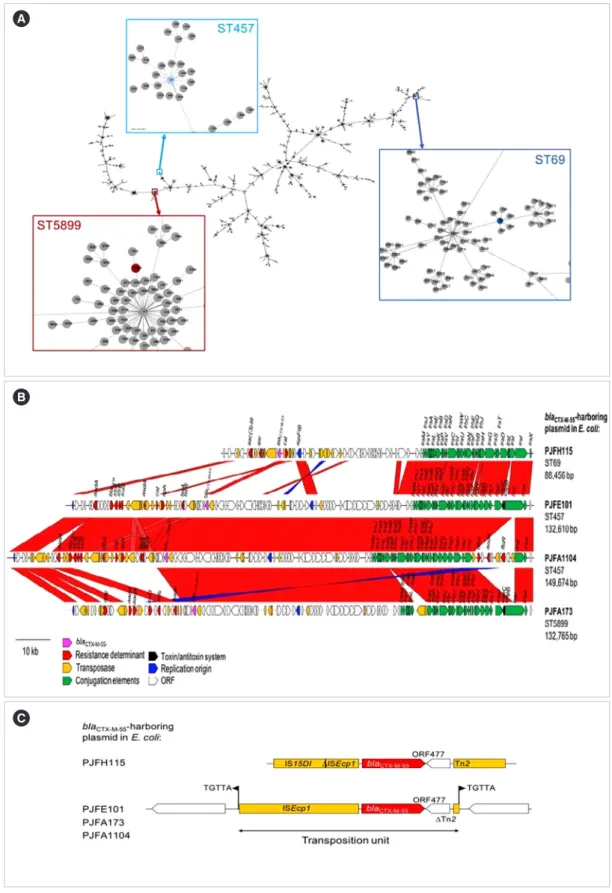
Fig. 1. Genetic relationships and plasmid structures of the four CTX-M-55-producing Esherichia coli isolates. (A) Phylogeny of the E. coli sequence types (STs). The phylogeny was constructed with E. coli MLST profiles (Phyloviz, http://online.phyloviz.net/index). The nodes indi- cating the three STs of interest are set out in colored boxes and magnified. (B, C) Features of four blaCTX-M-55 harboring plasmids in E. coli.
A
B
C
Kim YA, et al.
Spread of blaCTX-M-55 E. coli on a pig farm
182 www.annlabmed.org https://doi.org/10.3343/alm.2020.40.2.180 plasmid typing [5], and searching for acquired resistance genes
[6] were further conducted as previously reported.
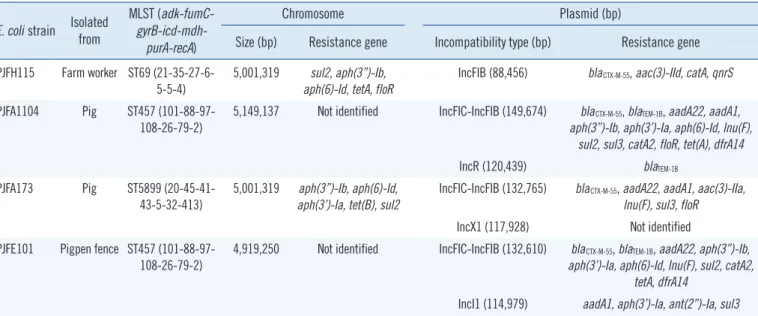
The E. coli isolates PJFH115 belonged to sequence type (ST) 69, PJFA1104 and PJFE101 belonged to the same ST457, wher- eas PJFA173 was of ST5899. The phylogeny of the E. coli MLST profile indicated that these three STs were distinct, belonging to separate clades (Fig. 1A). The chromosomes and plasmids of these isolates contained many genes related to AMR (Table 1).
In particular, the E. coli isolates from pigs (PJFA1104 and PJFA- 173) had many AMR genes for aminoglycoside, macrolide, sul- fonamide, and phenicol resistance.
All four plasmids encoding CTX-M-55 shared an IncF back- bone, including the IncFIB and IncFIC-IncFIB types, with con- jugal elements, and those of pig origin had a modified compo- nent due to insertion of DNA fragments (Fig. 1B). The only Inc- FIB plasmid in the human isolate PJFA115 shared a limited por- tion with the others, and included only four drug resistance genes, the lowest number overall. A transposon TnEc1 disrupted the open reading frame of traB in the plasmid of PJFA173. The In- cFIC-IncFIB plasmid of pig origin in PJFA173 had a more com- pact structure compared with those of the other two IncFIC-Inc- FIB plasmids (PJFE101 and PJFA1104), in terms of the size and the resistance determinants. One composite transposon comprising dfrA, aadA1, and floR interrupted the traI gene in the plasmid of PJFA1104. The plasmid in PJFA1104 was largely indistinguishable from that in PJFE101, with two exceptions of the truncated traI and insertion of three copies of IS15DIV, along with one copy of IS1 and Tn2 each downstream from aadA. Ad-
Table 1. Genomic features of the CTX-M-55-producing E. coli isolates recovered from the three interfaces at a pig farm E. coli strain Isolated
from
MLST (adk-fumC- gyrB-icd-mdh-
purA-recA)
Chromosome Plasmid (bp)
Size (bp) Resistance gene Incompatibility type (bp) Resistance gene PJFH115 Farm worker ST69 (21-35-27-6-
5-5-4) 5,001,319 sul2, aph(3’’)-Ib,
aph(6)-Id, tetA, floR IncFIB (88,456) blaCTX-M-55, aac(3)-IId, catA, qnrS PJFA1104 Pig ST457 (101-88-97-
108-26-79-2)
5,149,137 Not identified IncFIC-IncFIB (149,674) blaCTX-M-55, blaTEM-1B, aadA22, aadA1, aph(3’’)-Ib, aph(3’)-Ia, aph(6)-Id, lnu(F),
sul2, sul3, catA2, floR, tet(A), dfrA14
IncR (120,439) blaTEM-1B
PJFA173 Pig ST5899 (20-45-41- 43-5-32-413)
5,001,319 aph(3’’)-Ib, aph(6)-Id, aph(3’)-Ia, tet(B), sul2
IncFIC-IncFIB (132,765) blaCTX-M-55, aadA22, aadA1, aac(3)-IIa, lnu(F), sul3, floR IncX1 (117,928) Not identified PJFE101 Pigpen fence ST457 (101-88-97-
108-26-79-2) 4,919,250 Not identified IncFIC-IncFIB (132,610) blaCTX-M-55, blaTEM-1B, aadA22, aph(3’’)-Ib, aph(3’)-Ia, aph(6)-Id, lnu(F), sul2, catA2,
tetA, dfrA14
IncI1 (114,979) aadA1, aph(3’)-Ia, ant(2’’)-Ia, sul3 ditional plasmids were identified, including an IncI1-type (PJFE101) and IncR-type (PJFA1104) plasmids, which may have been se- parately acquired during evolution. The position of the blaCTX-M-55
gene indicated a common ancestor, with ISEcp1 upstream and ORF477 following Tn2 downstream (Fig. 1C). Continuous evolu- tion, likely involving IS15DI, is considered to account for the dis- tinct pattern in the plasmid of the human-origin PJFH115 iso- late, in which ISEcp1 was disrupted by IS15DI upstream from blaCTX-M-55, and a complete Tn2 sequence was identified down- stream of the gene. A composite transposition unit was identi- fied in the three IncFIC-IncFIB plasmids.
Our results suggest possible dissemination of an E. coli ST clone between one pig and the farm environment. However, the blaCTX-M-55 plasmid in E. coli PJFH115 from a human specimen was distinct, indicating the lack of transmission between the hu- man and pig or environment. Closely related plasmids from the National Center for Biotechnology Information database (acce- ssed August 21, 2019) were also dissimilar from each other. The closest match was a 96,497-bp plasmid in E. coli ST34 recov- ered from a swine rectal swab in Thailand in 2016, with 96%
coverage and 99.98% nucleic acid identity (GenBank acces- sion, CP041111). The most similar sequence to the other blaCTX- M-55 plasmids was an mcr-1 gene-harboring plasmid in E. coli ST457 recovered from a human rectal swab in the USA in 2016 with 92% coverage and 99.99% nucleic acid identity (GenBank accession, CP029748).
Dorado-García A, et al. [7] tried to demonstrate an epidemio- logical linkage of ESBL/AmpC genes and plasmid replicon types
Kim YA, et al.
Spread of blaCTX-M-55 E. coli on a pig farm
https://doi.org/10.3343/alm.2020.40.2.180 www.annlabmed.org 183
between livestock farms and the general population using pooled data, recovered from 35 studies in the Netherlands comprising more than 27,000 samples. In that study, isolates from people in the general population had higher similarities to those from human clinical settings, surface and sewage water, and wild birds, while similarities to livestock or food reservoirs were lower.
Compared to that study, we evaluated direct transfer to occupa- tional persons and also failed to find the evidence of the trans- mission from pig or environment to human. However, the find- ing of many plasmid-mediated resistance genes in healthy pigs highlights the need to curb antibiotic use in food-producing ani- mals to prevent the generation of resistance pool and spread of antibiotic-resistant bacteria in animals, contamination of sur- rounding environments, and changing environment microbiome [8, 9]. Prudent use of antibiotics and continued surveillance of resistant organisms in human and animal sectors are essential.
Author Contributions
Conceptualization: K. L. and Y. A. K.; Data curation: H. K. and M. H. C.; Methodology: Y. H. S.; Validation: K. L.; Writing-original draft: Y. A. K.; Writing-review & editing: K. L.
Conflicts of Interest
None declared.
Research Funding
This work was supported by the Research program funded by the Korean Centers for Disease Control and Prevention (HD17- A0081).
ORCID
Young Ah Kim https://orcid.org/0000-0002-9624-0126 Hyunsoo Kim https://orcid.org/0000-0002-2164-7677 Min Hyuk Choi https://orcid.org/0000-0001-9801-9874 Young Hee Seo https://orcid.org/0000-0003-3585-5335 Hyukmin Lee https://orcid.org/0000-0002-8523-4126 Kyungwon Lee https://orcid.org/0000-0003-3788-2134
REFERENCES
1. Lee Y, Kim YA, Song W, Lee H, Lee HS, Jang SJ, et al. Recent trends in antimicrobial resistance in intensive care units in Korea. Korean J Noso- comial Infect Control 2014;19:29-36.
2. Andersson DI and Hughes D. Microbiological effects of sublethal levels of antibiotics. Nat Rev Microbiol 2014;12:465-78.
3. Powell N, Davidson I, Yelling P, Collinson A, Pollard A, Johnson L, et al.
Developing a local antimicrobial resistance action plan: the Cornwall One Health Antimicrobial Resistance Group. J Antimicrob Chemother 2017;72:2661-5.
4. Wirth T, Falush D, Lan R, Colles F, Mensa P, Wieler LH, et al. Sex and virulence in Escherichia coli: an evolutionary perspective. Mol Microbiol 2006;60:1136-51.
5. PlasmidFinder 2.0. https://cge.cbs.dtu.dk/services/PlasmidFinder (Up- dated on Jun 2019).
6. ResFinder data sets. https://cge.cbs.dtu.dk/services/data.php (Updated on Jun 2019).
7. Dorado-García A, Smid JH, van Pelt W, Bonten MJM, Fluit AC, van den Bunt G, et al. Molecular relatedness of ESBL/AmpC-producing Esche- richia coli from humans, animals, food and the environment: a pooled analysis. J Antimicrob Chemother 2018;73:339-47.
8. Levy SB, FitzGerald GB, Macone AB. Changes in intestinal flora of farm personnel after introduction of a tetracycline-supplemented feed on a farm. N Engl J Med 1976;295:583-8.
9. Endtz HP, Ruijs GJ, Klingeren B, Jansen WH, Reyden T, Mouton RP.
Quinolone resistance in Campylobacter isolated from man and poultry following the introduction of fluoroquinolones in veterinary medicine. J Antimicrob Chemother 1991;27:199-208.