Cost of Hospitalization for Foodborne Diarrhea: A Case Study from Vietnam
Vietnam is undergoing a rapid social and economic developments resulting in speedy urbanization, changes in methods for animal production, food marketing systems, and food consumption habits. These changes will have major impacts on human exposures to food poisoning. The present case study aimed to estimate hospitalization costs of foodborne diarrhea cases in selected health facilities in Vietnam. This is a facility-based cost-of-illness study conducted in seven health facilities in Northern Vietnam. All suspect cases of foodborne diarrhea, as diagnosed by doctors, who admitted to the studied health facilities during June-August, 2013 were selected. Costs associated with hospitalization for foodborne diseases were estimated from societal perspective using retrospective approach.
We included direct and indirect costs of hospitalization of foodborne diarrhea cases.
During the study period, 87 foodborne diarrhea cases were included. On average, the costs per treatment episode and per hospitalization day for foodborne diarrhea case were US$
106.9 and US$ 33.6 respectively. Indirect cost (costs of times to patient, their relatives due to the patient’s illness) made up the largest share (51.3%). Direct medical costs accounted for 33.8%; direct non-medical costs (patient and their relatives) represented 14.9%. Cost levels and compositions varied by level of health facilities. More attentions should be paid on prevention, control of foodborne diarrhea cases in Vietnam. Ensuring safety of food depends on efforts of everyone involved in food chain continuum, from production, processing, and transport to consumption.
Keywords: Costs; Hospitalization; Foodborne Diseases; Diarrhea; Vietnam Van Minh Hoang,1 Tuan Anh Tran,2
Anh Duc Ha,3 and Viet Hung Nguyen4
1Hanoi School of Public Health & Hanoi Medical University, Hanoi; 2Center for health System Research, Hanoi Medical University, Hanoi; 3Cabinet Office, Ministry of Health, Hanoi; 4Hanoi School of Public Health & International Livestock Research Institute Vietnam, Hanoi, Vietnam
Received: 8 May 2015 Accepted: 5 October 2015 Address for Correspondence:
Van Minh Hoang, MD
Hanoi School of Public Health & Hanoi Medical University, 138 Giang Vo, Hanoi, Vietnam
Tel: +84.913392717 E-mail: [email protected]
Funding: The findings are the results of work supported by Australian Centre for International Agricultural Research (ACIAR). The views expressed in this paper are those of the authors, and no official endorsement by the Hanoi Medical University or International Livestock Research Institute Vietnam.
http://dx.doi.org/10.3346/jkms.2015.30.S2.S178 • J Korean Med Sci 2015; 30: S178-182
INTRODUCTION
Foodborne diseases comprise a broad spectrum of diseases re- sult from consumption of food containing pathogens such as bacteria, viruses, parasites or the food contaminated by poison- ous chemicals or bio-toxins (1,2). Although majority of the food- borne illness cases are mild and self-limiting, severe cases can occur in high risk groups resulting in high mortality and mor- bidity in this group. The high risk groups for foodborne diseases include infants, young children, and the elderly (3).
Food-borne disease is a common cause of diarrhea, being responsible for 33%-90% of cases (4). Disease-causing organ- isms in food are transmitted far and wide. Rapid urbanization worldwide is adding to risks, as urban dwellers eat more food prepared outside the home that may not be handled or prepared safely - including fresh foods, fish, meat, and poultry (5).
Vietnam is undergoing a rapid social and economic develop- ments resulting in speedy urbanization, changes in the meth- ods for animal production, food marketing systems, and food consumption habits. These changes will undoubtedly have ma- jor impacts on human exposures to food poisoning. The chang-
es in animal production, processing, distribution networks for meat, animal products, and the shift from wet markets to su- permarkets will impact food safety risks in Vietnam (6). Food safety is a public health priority for the Government of Viet Nam.
The World Health Organization, based on modeling approach, has estimated that the human cost of food-borne diseases, lost production from diseases and related market losses surpasses
$1billion a year (2% of GDP) (7). However, to our knowledge, empirical data on economic costs of foodborne diseases are still largely lacking in Vietnam. Therefore, the present case study aimed to estimate the costs of hospitalization for foodborne di- arrhea cases in selected health facilities in Vietnam.
MATERIALS AND METHODS Design
This is a facility-based cost-of-illness study. Cost-of-illness stud- ies analyze the total costs incurred by a society due to a specific disease or health condition (8).
Study perspective and format
Costs associated with hospitalization for foodborne diseases were estimated from the societal perspective using retrospec- tive approach.
Costs included
We included both direct and indirect costs of hospitalization of foodborne diarrhea cases: 1) Direct medical costs: This cost in- cluded the costs relating directly to the patients while undergo- ing medical care at the health facilities. They included the cost of clinical staff, imaging diagnostics, lab test, medicine, medical consumables, capital costs, overhead, and admin costs; 2) Di- rect non-medical cost: Patient and their caregiver costs of trav- els, foods, accommodation, and other related costs; 3) Indirect costs: Productivity losses of the patients and their caregivers.
Study settings
Due to the budget and time constraints, this study was conduct- ed in seven health facilities in Northern Vietnam, including one national hospital (National Hospital of Tropical Disease located in Ha Noi capital city of Vietnam), 2 provincial hospitals (Hung Yen Provincial General Hospital of Hung Yen province from the North and Nghe An Provincial General Hospital of Nghe An prov- ince from the Center of Vietnam), 2 district hospitals (Khoai Chau District Hospital from Hung Yen province and Do Luong Dis- trict Hospital from Nghe An province) and 2 commune health centers (one from Khoai Chau district and one from Do Luong district). The health facilities were purposively selected based on expert’s opinion as they expected to represent different lev- els of health system in Vietnam in terms of patient case mix and treatment standards for foodborne diarrhea cases.
Selection of cases
All suspect cases of foodborne diarrhea, as diagnosed by doc- tors, who admitted to the studied health facilities during June- August, 2013 were selected. This period was expected to have more cases of foodborne diarrhea. Most of the suspect cases had consumed raw or poorly cooked foods and then had three or more loose stools in 24 hr or three or more times vomiting in 24 hr, or diarrhea with at least one additional symptom or vom- iting with at least two additional symptoms. Additional symp- toms were abdominal pain, abdominal cramps, nausea, blood in stool, and stool in black, mucus in stool, fever, diarrhea or vom- iting. In this study, laboratory tests for confirmation were only done at national hospitals and for some cases who were treated at provincial hospitals.
Data collection
Data collected by the research team from Department of Health Economics and Center for Health System Research of Ha Noi Medical University, Ha Noi, Viet Nam. The research team mem-
bers, who had experiences in costing studies, were trained on techniques for data collection. The research team worked close- ly together with health facility staff for collecting the cost data.
Data on direct medical costs were collected from hospital bills (direct medical charges) of the patients and adjusted based on interviewing with hospital financial staff on the extent to which the direct medical charges covered the actual costs (as the health facilities in Vietnam only collected partial fees). Data on direct non-medical costs were gathered by interviewing with the pa- tients and their relatives. Productivity losses of patients and their relatives (the value of time spent when unable to work as pro- ductively because of an illness or side effect, earnings lost while traveling to health-care facilities, and productivity losses associ- ated with caregiver time) were estimated by multiplying the cost of 1 day of lost productivity by the mean number of days lost from performing productive work as a result of the illness (human capital approach).
Data management and analysis
Excel spreadsheets were used in entering and analyzing the cost data. We estimated the cost per treatment episode of food- borne disease at different health facility levels. The currency used was Vietnamese Dong, presented here in 2013 prices. For international comparison, we provide the unit costs in US dol- lars (US$) at the average exchange rate for the period of January to December 2011: 20,619.6 VND to 1 US$.
Ethics statement
Permissions to conduct this study were approved by Hanoi Med- ical University as well as Hung Yen and Nghe An Provincial Health Authorities. Informed consent was obtained from all the infor- mants.
RESULTS
Characteristics of the study respondents
During the study period, 87 foodborne diarrhea cases were in- cluded. Of which, there were 50 men (57.5%) and 37 women (42.5%). A majority of the patients were aged 16-59 yr old (83.9%).
There were five cases aged equal or less than 15 yr (5.7%) and 9 cases aged 60 yr and over (10.3%). On average, each patients spent 2.8 days at the studied health facilities for treatment (4.4 days, 3.2 days, 2.5 days, and 1 day at national, provincial, dis- trict, and commune health facilities, respectively) (Table 1).
Costs per hospitalization episode for foodborne diarrhea cases
On average, the costs per treatment episode and per hospital- ization day for foodborne diarrhea case were US$ 106.9 and US$
33.6, respectively. The costs per treatment episode and per hos- pitalization day for foodborne diarrhea case were highest at na-
Table 1. Characteristics of the study respondents
Parameters National hospital Provincial hospital District hospital Commune health center Overall
Number of patients 18 34 22 13 87 (100)
Gender Men, n (%) Women, n (%)
12 6
22 12
8 14
8 5
50 (47.5) 37 (42.5) Age
Equal or less than 15, n (%) 16-59 yr, n (%)
60 yr and over, n (%)
2 13 3
1 29 2
1 16 3
1 12 1
5 (5.7) 73 (83.9)
9 (10.3)
Average length of stay (day) 4.4 3.2 2.5 1 2.8
Table 2. Costs per hospitalization episode for foodborne diarrhea cases by health facilities
Costs National Province District Commune Overall
VND US$ VND US$ VND US$ VND US$ VND US$
Direct medical costs
Amount 1,396,174 67.7 795,391 38.6 651,339 31.6 108,241 5.2 737,786 35.8
% of total cost 32.6 32.5 37.1 33.0 33.8
Direct non-medical costs (patients and relatives)
Amount 1,286,683 62.4 250,000 12.1 230,668 11.2 20,000 1.0 446,838 21.7
% of total cost 30.0 10.2 13.1 6.1 14.9
Indirect cost (costs of times due to the patient’s illness)
Amount 1,600,000 77.6 1,400,000 67.9 875,000 42.4 200,000 9.7 1,018,750 49.4
% of total cost 37.4 57.3 49.8 60.9 51.3
Total costs per hospitalization episode
Amount 4,282,857 207.7 2,445,391 118.6 1,757,007 85.2 328,241 15.9 2,203,373.9 106.9
% of total cost 100.0 100.0 100.0 100.0 100.0
Total costs per hospitalization day (amount) 973,377 47.2 764,185 37.1 702,803 34.1 328,241 15.9 500,767 33.6 VND, Vietnamese Dong.
Table 3. Direct costs per hospitalization episode for foodborne diarrhea cases by health facilities
Cost National Province District Commune Overall
VND US$ % VND US$ % VND US$ % VND US$ % VND US$ %
Clinical staffs 475,000 23.0 34.0 280,000 13.6 35.2 179,688 8.7 27.6 28,125 1.4 26.0 240,703 11.7 30.7
Lab test 111,203 5.4 8.0 88,980 4.3 11.2 124,406 6.0 19.1 0 0.0 0.0 81,147 3.9 9.6
Medicine 415,012 20.1 29.7 276,208 13.4 34.7 197,543 9.6 30.3 53,000 2.6 49.0 235,441 11.4 35.9
Medical consumables 63,593 3.1 4.6 25,600 1.2 3.2 57,405 2.8 8.8 5,000 0.2 4.6 37,900 1.8 5.3
Capital costs 98,670 4.8 7.1 52,294 2.5 6.6 33,085 1.6 5.1 12,276 0.6 11.3 49,081 2.4 7.5
Overhead, admin costs 232,696 11.3 16.7 72,308 3.5 9.1 59,213 2.9 9.1 9,840 0.5 9.1 93,514 4.5 11.0
Total direct costs per hospitalization
episode 1,396,174 67.7 100.0 795,391 38.6 100.0 651,339 31.6 100.0 108,241 5.2 100.0 737,786 35.8 100.0 Total direct costs per hospitalization
day 317,312 15.4 248,560 12.1 260,535 12.6 108,241 5.2 233,662 11.3
VND, Vietnamese Dong.
tional hospital (US$ 207.7 and US$ 47.2, respectively) and were lowest at commune health center (US$ 15.9). The indirect cost (costs of times to the patient and their relatives due to the pati- ent’s illness) made up the largest share (51.3%). The direct med- ical costs accounted for 33.8% and the direct non-medical costs (the patient and their relatives) represented 14.9% (Table 2).
Table 3 shows the levels and compositions of the direct costs.
Overall, the medicine costs made up the largest proportions (35.9%) followed by the personnel costs (30.7%). The costs of medical consumables accounted for the smallest share (5.3%).
The direct cost compositions varied by level of health facilities.
While the personnel cost made of the largest shares at national and provincial health facilities (34.0% and 35.3%, respectively), the costs for medicine accounted for the highest proportions at district hospitals and commune health center (30.3% and 49.0%).
DISCUSSION
This pilot study has provided preliminary empirical evidence on economic burden of foodborne disease in Vietnam. We found that, on average, the costs per hospitalization episode for food- borne diarrhea case was US$ 106.9. This figure is higher than
Table 4. Total annual costs associated with hospitalization for foodborne diarrhea in Vietnam Parameters
Scenario 1 (Based on figure on the proportion of gastroenteritis specifically
attributable to foodborne transmission from Australia = 32%) (15)
Scenario 2 (Based on figure on the proportion of gastroenteritis specifically
attributable to foodborne transmission from USA = 35.5%) (16)
Population of Vietnam in 2013 (13) 90,388,000 90,388,000
Rate of diarrhea admitted to health facilities (per 100.000) (14) 210.57 210.57
Total cases of diarrhea admitted to health facilities 190,330 190,330
Total cases of diarrhea admitted to health facilities due to foodborne diseases (15,16) 60,906 67,567 Of which, number of cases treated at each level of health care facilities (17)
Number of cases treated at national hospital (4%) 2,436 2,703
Number of cases treated at provincial hospital (45%) 27,408 30,405
Number of cases treated at district hospital (36%) 21,926 24,324
Number of cases treated at commune health centers (15%) 9,136 10,135
Costs per hospitalization episode (US$)
At national hospital 208 208
At provincial hospital 119 119
At district hospital 85 85
At commune health centers 16 16
Total costs of hospitalization (US$)
At national hospital 506,023 561,370
At provincial hospital 3,250,407 3,605,921
At district hospital 1,868,327 2,072,675
At commune health centers 145,432 161,339
Total costs of hospitalization at all levels of health facilities (US$) 5,770,190 6,401,305
GDP Vietnam 2013 (Billion US$) (18) 172.73 172.73
Total annual costs associated with hospitalization for foodborne diarrhea in Vietnam as % of GDP
0.003 0.004
the cost estimates for hospitalizations of diarrheal cases due to rotavirus in Vietnam (US$ 36) (9). A study conducted in Trini- dad and Tobago in 2009 reported the cost of hospitalization for a gastro-enteritis of US$ 78, accounting for 0.53 percent of a citi- zen annual income (10). Another study done in the Netherland in 2004 found that the cost of hospitalization for a gastro-enteri- tis was US$ 74, representing around 0.27 percent of annual per capita GDP (11). In fact, the length of stay of the foodborne di- arrhea patients revealed in our study (2.8 days) was a bit longer than the figures reported by the studies from Trinidad and To- bago (2.3 days) (10), and from the Netherland (2.6 days) (11). A study from Canada reported that the average duration of hospi- tal stay for an acute gastro-enteritis case was 3.7 days (12).
In this study, as expected, the costs of hospitalization for food- borne diarrhea cases were higher at higher levels of health fa- cilities (central, provincial and district health facilities) because both average length of stay were longer and the costs per hospi- talization day (especially medical costs such as personnel and medicines costs) were higher there. In fact, the patients with more severe health conditions were more likely to be admitted to health facilities located at higher levels. Patients who were treated at higher levels of health facilities and their relatives nor- mally had to pay more for food, accommodation, and transpor- tation, etc. resulting in higher direct non-medical costs. In addi- tion, indirect cost associated with the foodborne diarrhea cases who were treated at higher level of health facilities were also higher (especially the costs to the care givers). In this study, we
found that the indirect cost (costs of times to the patient and their relatives due to the patient’s illness) made up the largest share (51.3%) and the direct non-medical costs (the patient and their relatives) represented as high as 14.9%. Similar pattern was found in a study on cost of Rotavirus in Vietnam) (9). As the di- rect non-medical costs and indirect costs are substantial to so- ciety, they should be included in future health economic stud- ies, especially economic evaluation of intervention against food- borne diseases.
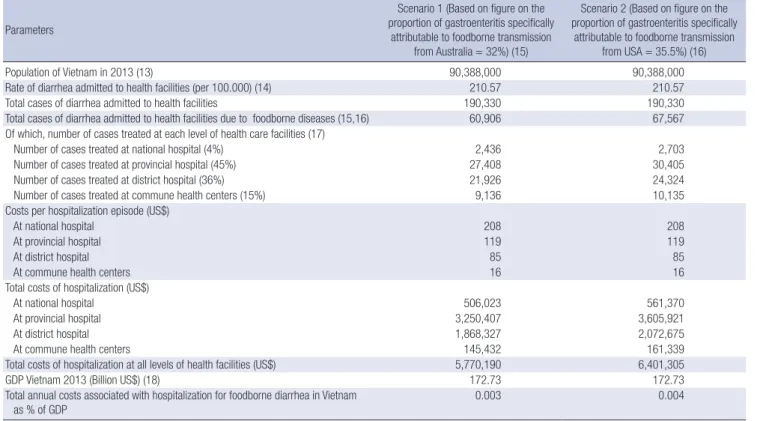
Based on the total number populations in Vietnam (13), the rate of diarrhea admitted to health facilities (14), the proportion of gastroenteritis specifically attributable to foodborne trans- mission from Australia (15) and from USA (16), pattern of health care utilization in Vietnam (17), and the figures on costs of hos- pitalization for foodborne diarrhea cases from this study, we found that the total annual costs associated with hospitaliza- tion for foodborne diarrhea cases range between 5.8-6.4 US$
millions, made up 0.003%-0.004% of GDP of Vietnam (Table 4).
It is worthwhile to note that the cost of hospitalization for food- borne diarrhea cases is only part of economic burden caused by foodborne diseases. If the costs of mortality and other mor- bidities were added, the losses due to the foodborne diseases would be much higher. More attentions should be paid on pre- vention and control of foodborne diarrhea cases in Vietnam.
Limitation of this study
This pilot study has several limitations and we considered this
study as a snapshot on the costs of hospitalization for foodborne diarrhea cases in Vietnam. Given limitations in time and bud- get as well the dearth of data, we were not able to get confirma- tion of foodborne diarrhea cases who were treated at district hospital and commune health center as laboratory tests (such as specimens for microbiologic testing) for differential diagno- ses. We could not estimate the costs by type of pathogens, by age groups and severities of diseases. We were also not able to include the costs for self-treatment (for mild and self-limiting) and outpatient cares as well as the losses due to mortality asso- ciated with foodborne diseases.
CONCLUSION
Cost of hospitalization for foodborne in Vietnam is substantial.
More attentions should be paid on prevention and control of foodborne diarrhea cases in Vietnam. Ensuring the safety of food depends on the efforts of everyone involved in the food chain continuum, from production, processing, transport to consumption. Further study on economic aspects of foodborne diarrhea cases are needed to provide further insights into the problems associated with foodborne diarrhea cases in Vietnam.
ACKNOWLEDGMENTS
We acknowledge with thanks the collaborations and support from staff of the studied hospitals. We are grateful to the sup- port from the International Livestock Research Institute Viet- nam and Hanoi School of Public Health.
DISCLOSURE
The authors have no conflicts of interest to disclose.
AUTHORS CONTRIBUTION
Study design: Hoang VM, HA AD, Nguyen VH. Data collection, analysis: Hoang VM, Tran TA. Writing: Hoang VM, Ha AD, Nguy- en VH. Approval of the final manuscript: all authors.
ORCID
Van Minh Hoang http://orcid.org/0000-0002-8484-2533 Tuan Anh Tran http://orcid.org/0000-0002-1028-2713 Anh Duc Ha http://orcid.org/0000-0002-3354-0957 Viet Hung Nguyen http://orcid.org/0000-0001-9877-0596
REFERENCES
1. World Health Organization. Initiative to estimate the global burden of foodborne diseases. Geneva: World Health Organization, 2013.
2. Linscott AJ. Food-borne illnesses. Clin Microbiol Newsl 2011; 33: 41-5.
3. Fleury MD, Stratton J, Tinga C, Charron DF, Aramini J. A descriptive anal- ysis of hospitalization due to acute gastrointestinal illness in Canada, 1995-2004. Can J Public Health 2008; 99: 489-93.
4. Flint JA, Van Duynhoven YT, Angulo FJ, DeLong SM, Braun P, Kirk M, Scallan E, Fitzgerald M, Adak GK, Sockett P, et al. Estimating the burden of acute gastroenteritis, foodborne disease, and pathogens commonly transmitted by food: an international review. Clin Infect Dis 2005; 41:
698-704.
5. World Heath Organization. Ten facts on food safety. Available at http://
www.who.int/features/factfiles/food_safety/facts/en/ [accessed on 15 June 2015].
6. Carrique-Mas JJ, Bryant JE. A review of foodborne bacterial and para- sitic zoonoses in Vietnam. Ecohealth 2013; 10: 465-89.
7. World Heath Organization. Food safety. Available at http://www.wpro.
who.int/vietnam/topics/food_safety/en/ [accessed on 15 June 2015].
8. Durand-Zaleski I. Why cost-of-illness studies are important and inform policy. Vasc Med 2008; 13: 251-3.
9. Fischer TK, Anh DD, Antil L, Cat ND, Kilgore PE, Thiem VD, Rheingans R, Tho le H, Glass RI, Bresee JS. Health care costs of diarrheal disease and estimates of the cost-effectiveness of rotavirus vaccination in Vietnam. J Infect Dis 2005; 192: 1720-6.
10. Lakhan C, Badrie N, Ramsubhag A, Sundaraneedi K, Indar L. Burden and impact of acute gastroenteritis and foodborne pathogens in Trini- dad and Tobago. J Health Popul Nutr 2013; 31: 30-42.
11. van den Brandhof WE, De Wit GA, de Wit MA, van Duynhoven YT. Costs of gastroenteritis in The Netherlands. Epidemiol Infect 2004; 132: 211-21.
12. Thomas MK, Majowicz SE, MacDougall L, Sockett PN, Kovacs SJ, Fyfe M, Edge VL, Doré K, Flint JA, Henson S, et al. Population distribution and burden of acute gastrointestinal illness in British Columbia, Cana- da. BMC Public Health 2006; 6: 307.
13. General Statistics Office. Population estimate, 2013.
14. Vietnam Ministry of Health. Health statistics year book, 2012. Hanoi:
Ministry of Health, 2012.
15. Hall G, Kirk MD, Becker N, Gregory JE, Unicomb L, Millard G, Stafford R, Lalor K; OzFoodNet Working Group. Estimating foodborne gastroen- teritis, Australia. Emerg Infect Dis 2005; 11: 1257-64.
16. Mead PS, Slutsker L, Dietz V, McCaig LF, Bresee JS, Shapiro C, Griffin PM, Tauxe RV. Food-related illness and death in the United States. Emerg Infect Dis 1999; 5: 607-25.
17. Ministry of Health. Đề án giảm quá tải bệnh viện Giai đoạn 2012-2020.
Hanoi: Ministry of Health, 2012.
18. World Bank. GDP per capita (current US$). Available at http://data.
worldbank.org/indicator/NY.GDP.PCAP.CD [accessed on 15 June 2015].