• 검색 결과가 없습니다.

Gender Difference in Catheter Ablation: Atrial Fibrillations from Mars and Venus?

N/A
N/A
Protected

Academic year: 2022

Share "Gender Difference in Catheter Ablation: Atrial Fibrillations from Mars and Venus?"

Copied!
3
0
0

로드 중.... (전체 텍스트 보기)

전체 글

(1)

619 https://e-kcj.org

The prevalence of atrial fibrillation (AF) in Korea is continuously increasing with the elderly society and the survival improvement of the patients with heart disease.

1)

In Korea, projected prevalence of AF will increase to 3.5% in 2030, even when population decline is expected, and will increase for a considerable period thereafter.

2)

From 2006 to 2015, the prescription rate of antiarrhythmic drugs increased by 81% and AF radiofrequency catheter ablation (RFCA) by 110%. The proportion of AF patients receiving active rhythm control is also increasing.

2)

Then, is there a gender difference in AF management? The prevalence of AF has been known to be higher in males than in women. However, the prevalence of female AF has been increasing steadily with aging: 0.7% in 2006 to 1.4% in 2015.

2)

AF is linked with an almost 2-fold higher risk of stroke in women compared with men through the meta-analysis of 30 cohort studies.

3)

Women are more vulnerable to left ventricular (LV) diastolic dysfunction compared to men, especially associated with hypertension.

4)

We have found that LV diastolic dysfunction is associated with reduced left atrial (LA) appendage flow and LA remodeling, and advanced atrial remodeling is related to the risk and event of stroke in patients with AF.

5)

Yu et al.

6)

recently demonstrated that LA remodeling and poor contractile function of LA appendage are more predominant in women than in men among AF patients with stroke risk.

Therefore, in women, AF occurs later than in men, but suggests rapid AF progression related to hypertension, LV diastolic dysfunction, and LA remodeling. That is the reason why more aggressive rhythm control might be required in women.

Roh et al.

7)

compared outcomes of AF catheter ablation between men and women by propensity score matching. In this study, there was no difference in the overall rhythm outcome between men and women, but the complication rate was higher in women and AF recurrence rate was higher in women under 55 years of age compared to their counter parts. It has been consistently reported that procedure related complication rates after AF ablation are higher in females than males, which might be associated with heart size and atrial wall thickness.

8)

In the study of Roh et al.,

7)

the higher number of cardiac tamponade after treatment in women than in men supports this hypothesis. The occurrence of major complications during the procedure may also contribute to a high recurrence rate because of the restriction of ablation and complete pulmonary vein isolation.

Korean Circ J. 2018 Jul;48(7):619-621 https://doi.org/10.4070/kcj.2018.0094 pISSN 1738-5520·eISSN 1738-5555

Editorial

Received: Mar 23, 2018 Accepted: Apr 10, 2018 Correspondence to Hui-Nam Pak, MD, PhD

Yonsei University Health System, 50-1, Yonsei-ro, Seodaemun-gu, Seoul 03722, Korea.

E-mail: [email protected]

Copyright © 2018. The Korean Society of Cardiology

This is an Open Access article distributed under the terms of the Creative Commons Attribution Non-Commercial License (https://

creativecommons.org/licenses/by-nc/4.0) which permits unrestricted noncommercial use, distribution, and reproduction in any medium, provided the original work is properly cited.

ORCID iDs Hee Tae Yu

https://orcid.org/0000-0002-6835-4759 Hui-Nam Pak

https://orcid.org/0000-0002-3256-3620 Conflict of Interest

The authors have no financial conflicts of interest.

Author Contributions

Conceptualization: Pak HN; Data curation:

Yu HT, Pak HN; Investigation: Yu HT, Pak HN;

Methodology: Pak HN; Project administration:

Pak HN; Software: Yu HT; Supervision: Pak HN; Writing - original draft: Pak HN; Writing - review & editing: Yu HT.

The contents of the report are the author's own views and do not necessarily reflect the views of the Korean Circulation Journal.

Hee Tae Yu , MD, PhD, and Hui-Nam Pak , MD, PhD

Division of Cardiology, Department of Internal Medicine, Yonsei University Health System, Seoul, Korea

Gender Difference in Catheter

Ablation: Atrial Fibrillations from Mars and Venus?

See the article “Gender-related Difference in Clinical Outcome of the Patient with Atrial Fibrillation

after Radiofrequency Catheter Ablation” in volume 48 page on 605.

(2)

Women are less likely to undergo rhythm-control treatment than men. Even among individuals undergoing rhythm-control, women are less likely to undergo catheter ablation.

9)

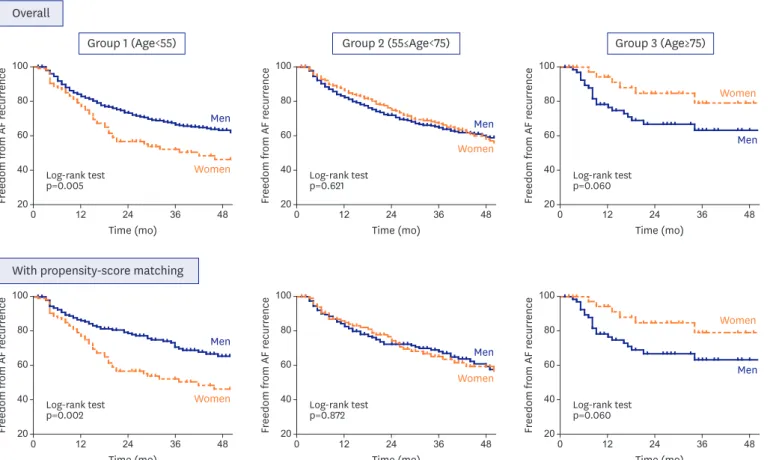
Previous studies reported higher AF recurrence rate after AF ablation among women, but, those women tended to be older and have a higher prevalence of persistent AF and a longer duration of AF before RFCA. An analysis of our single center experience (unpublished data) also showed that the recurrence rate was higher in women under 55 years of age, but lower in women than in men over 75 years of age after catheter ablation for AF (Figure 1).

If so, why is the AF ablation rhythm outcome worse in young female patients? Although Roh et al.

7)

suggested a referral bias as the main cause, the fact that gender differences are present in young women under 55 years of age, those were referred relatively early for ablation, indicates that this explanation is not enough. In contrast, Yu et al.

10)

have reported that higher parasympathetic nerve activity in young women is associated with a higher recurrence rate after AF ablation. Another explanation is the early onset AF was identified as a heritable disease, and genetic traits may affect early onset AF differently than AF in elderly patients.

In conclusion, the number of AF patients receiving catheter ablation has been steadily increasing in Korea due to the expansion of medical insurance coverage, reduction of self-pay, simplification of procedures, and development of efficient catheters and mapping systems. The number of female patients receiving AF ablation is expected to grow even more as socioeconomically gender equality increases. More systematic research on AF ablation technique, such as gender specific radiofrequency energy titration, and post-procedural

620 https://e-kcj.org https://doi.org/10.4070/kcj.2018.0094

AF Ablation in Women

Log-rank test p=0.005

0 12 24 36 48

Fr eedom fr om AF r ecurr ence

100 80 60 40

20

Time (mo)

Men

Men

Men

Men

Men

Men Women

Women

Women

Women

Women

Women Log-rank test

p=0.621

0 12 24 36 48

Fr eedom fr om AF r ecurr ence

100 80 60 40

20

Time (mo)

Log-rank test p=0.060

0 12 24 36 48

Fr eedom fr om AF r ecurr ence

100 80 60 40

20

Time (mo)

Group 1 (Age<55) Group 2 (55≤Age<75) Group 3 (Age≥75)

Overall

Log-rank test p=0.002

0 12 24 36 48

Fr eedom fr om AF r ecurr ence

100 80 60 40 20

With propensity-score matching

Time (mo)

Log-rank test p=0.872

0 12 24 36 48

Fr eedom fr om AF r ecurr ence

100 80 60 40

20

Time (mo)

Log-rank test p=0.060

0 12 24 36 48

Fr eedom fr om AF r ecurr ence

100 80 60 40

20

Time (mo)

Figure 1. Kaplan-Meier analyses for the differences on atrial fibrillation-free survival between genders in each subgroup of Age<55 (group 1), 55≤Age<75 (group 2),

and Age≥75 (group 3) among total population (upper) and propensity score matched population (lower).

(3)

management is needed for more effective and safe rhythm management for women. We will see if there is still difference in the risk of complications or rhythm outcome after AF catheter ablation even on the day when humans will come and go on Mars and Venus.

REFERENCES

1. Lee H, Kim TH, Baek YS, et al. The trends of atrial fibrillation-related hospital visit and cost, treatment pattern and mortality in Korea: 10-year nationwide sample cohort data. Korean Circ J 2017;47:56-64.

PUBMED | CROSSREF

2. Kim D, Yang PS, Jang E, et al. Current and future incidence and prevalence of atrial fibrillation in Korea.

Europace 2018;20:i232.

3. Emdin CA, Wong CX, Hsiao AJ, et al. Atrial fibrillation as risk factor for cardiovascular disease and death in women compared with men: systematic review and meta-analysis of cohort studies. BMJ 2016;532:h7013.

PUBMED | CROSSREF

4. Shim CY, Park S, Choi D, et al. Sex differences in central hemodynamics and their relationship to left ventricular diastolic function. J Am Coll Cardiol 2011;57:1226-33.

PUBMED | CROSSREF

5. Lee JS, Shim CY, Wi J, et al. Left ventricular diastolic function is closely associated with mechanical function of the left atrium in patients with paroxysmal atrial fibrillation. Circ J 2013;77:697-704.

PUBMED | CROSSREF

6. Yu HT, Lee JS, Kim TH, et al. Advanced left atrial remodeling and appendage contractile dysfunction in women than in men among the patients with atrial fibrillation: potential mechanism for stroke. J Am Heart Assoc 2016;5:e003361.

PUBMED | CROSSREF

7. Roh SY, Shim J, Lee KN, et al. Gender-related difference in clinical outcome of the patient with atrial fibrillation after radiofrequency catheter ablation. Korean Circ J 2018;48:605-18.

CROSSREF

8. Michowitz Y, Rahkovich M, Oral H, et al. Effects of sex on the incidence of cardiac tamponade after catheter ablation of atrial fibrillation: results from a worldwide survey in 34 943 atrial fibrillation ablation procedures. Circ Arrhythm Electrophysiol 2014;7:274-80.

PUBMED | CROSSREF

9. Avgil Tsadok M, Gagnon J, Joza J, et al. Temporal trends and sex differences in pulmonary vein isolation for patients with atrial fibrillation. Heart Rhythm 2015;12:1979-86.

PUBMED | CROSSREF

10. Yu HT, Yang PS, Kim TH, et al. Poor rhythm outcome of catheter ablation for early onset atrial fibrillation in women: mechanistic insight. Eur Heart J 2017;38:P2668.

CROSSREF

621 https://e-kcj.org https://doi.org/10.4070/kcj.2018.0094

AF Ablation in Women

수치

Figure 1. Kaplan-Meier analyses for the differences on atrial fibrillation-free survival between genders in each subgroup of Age&lt;55 (group 1), 55≤Age&lt;75 (group 2),  and Age≥75 (group 3) among total population (upper) and propensity score matched popu

참조

관련 문서

In addi- tion, AF catheter ablation was associated with a lower risk of cardiovascular death, admission for heart failure, and ischemic stroke/SE compared to medical therapy,

However, sinus conversion was temporary and persistent AF refractory to medical treatment aggravated symptoms of right heart failure.. To maintain sinus rhythm,

A topic of current interest is whether gender-related differences exist in the use of health care resources for managing atrial fibrillation (AF), and whether/how these differences

In this study, we found that 1) women had higher LAD index and E/E′ ratio compared to men with matched history of AF and similar number of failed AADs; 2) clinical outcome after

The prevalence of atrial fibrillation in the general population is increasing in part because of the aging population and is associated with ischemic strokes and even mortality. 4)

An increase in cardiac radiofrequency catheter ablation for treating refractory atrial fibrillation has resulted in an in- creased prevalence of complications.. Among

Purpose: New-onset postoperative atrial fibrillation (POAF) is associated with poor short- and long-term outcomes after isolated coronary artery bypass graft (CABG) surgery..

Reverse remodeling of sinus node function after catheter abla- tion of atrial fibrillation in patients with prolonged sinus pauses. Anand N, McCrindle BW, Chiu CC, Hamilton RM,