• 검색 결과가 없습니다.

The Difference of Left Atrial Volume Index : Can It Predict the Occurrence of Atrial Fibrillation after Radiofrequency Ablation of Atrial Flutter?

N/A
N/A
Protected

Academic year: 2021

Share "The Difference of Left Atrial Volume Index : Can It Predict the Occurrence of Atrial Fibrillation after Radiofrequency Ablation of Atrial Flutter?"

Copied!
9
0
0

로드 중.... (전체 텍스트 보기)

전체 글

(1)

Vol.24 No.2 p197-205, Dec. 2007

The Difference of Left Atrial Volume Index : Can It Predict the Occurrence of Atrial Fibrillation after

Radiofrequency Ablation of Atrial Flutter?

Ung Kim, Young Jo Kim, Sang Wook Kang, In Wook Song, Jung Hwan Jo, Sang Hee Lee, Geu Ru Hong, Jong Seon Park, Dong Gu Shin

Department of Internal Medicine,

College of Medicine, Yeungnam University, Daegu, Korea

-Abstract-

Background:The occurrence of atrial fibrillation after ablation of atrial flutter is clinically important. We investigated variables predicting this evolution in ablated patients without a previous atrial fibrillation history.

Materials and Methods:Thirty-six patients (Male=28) who were diagnosed as atrial flutter without previous atrial fibrillation history were enrolled in this study. Group 1 (n=11) was defined as those who developed atrial fibrillation after atrial flutter ablation during 1 year follow-up. Group 2 (n=25) was defined as those who has not occurred atrial fibrillation during same follow-up term. Echocardiogram was performed to all patients. We measured left atrial size, left ventricle end diastolic and systolic dimension, ejection fraction and left atrial volume index before and after ablation of atrial flutter. The differences of each variables were compared and analyzed between two groups.

1)

Results:The preablation left ventricular ejection fraction (preLVEF) and postablation left ventricular ejection fraction (postLVEF) are 54±14%, 56±13% in group 1 and 47±16%, 52±13%

in group 2. The differences between each two groups are statistically insignificant (2.2±1.5 in group 1 vs 5.4±9.8 in group 2, p=0.53). The preablation left atrial size (preLA) and postablation left atrial size (postLA) are 40±4 mm, 41±4 mm in group1 and 44±8 mm, 41±4 mm in group 2. The atrial sizes of both groups were increased but, the differences of left atrial size between two groups before and after flutter ablation were statistically insignificant (0.6±0.9

책임저자:신동구, 대구광역시 남구 대명5동 317-1, 영남대학교 의과대학 내과학 교실 Tel: (053) 620-3313, Fax: (053) 621-3310, E-mail: [email protected]

(2)

mm in group 1 vs -3.8±7.4 mm in group 2, p=0.149). The left atrial volume index before flutter ablation was significantly reduced in group 1 than group 2 (32±10 mm

3

/m

2

, 35±10 mm

3

/m

2

in group 1 and 32±10 mm

3

/m

2

, 29±8 mm

3

/m

2

in group 2, p<0.05).

Conclusion:The difference between left atrial volume index before and after atrial flutter ablation is the robust predictor of occurrence of atrial fibrillation after atrial flutter ablation without previous atrial fibrillation.

Key Words: Atrial flutter, Ablation, Atrial fibrillation, Left atrium, Volume

Introduction

Radiofrequency catheter ablation targeting the isthmus between the tricuspid annulus and the inferior vena cava is an established therapy for typical atrial flutter (AFL). It is successful in more than 90% of patients.

1-7)

But, in the clinical setting, AFL and atrial fibrillation (AF) often coexist, and the follow up of patients successfully treated with transisthmic ablation is complicated by the occurrence of AF in 10~47% of patients.

8-17)

We already have known that the presence of preablation AF is the most significant predictor of postablation AF.

18-20)

However, clinical and procedural predictors of postablation AF occurrence has always been evaluated in the mixed group of AFL patients with AF

18-20)

and rarely in the group of patients without history of AF. +This study aimed that better identification of patients who are at risk for the development of AF may help to optimize the antiarrhythmic stratery during or after AFL ablation. So, we investigated variables predicting this evolution with

echocardiography in ablated patients without a previous AF History.

Materials and methods

1. Study population

The study group consisted of 36 consecutive patients who were diagnosed as AFL without previous history of paroxysmal AF and underwent radiofrequency catheter ablation for recurrent typical AFL from January 2000 to June 2005 at Yeungnam university hospital.

Typical AFL was diagnosed when the

surface ECG showed flutter waves that were

predominantly negative in leads II, III, aVF

and positive in lead V1 and defined as a

macroreentrant atrial tachycardia that exhibited

either counterclockwise or clockwise activation

around the tricuspid annulus and atypical

AFL was defined as an atrial flutter other

than typical AFL.Previous episodes of AF

were all excluded from this study. Postablation

AF development during 1 year follow-up

was defined as the documentation of AF

during ECG or Holter ECG monitoring of at

(3)

least one episode of AF lasting more than one minute.

2. Electrophysiological study and radiofrequency catheter ablation

Written informed consent was obtained before transcatheter ablation from all patients.

Four multipolar catheters were inserted from right femoral vein and left subclavian vein:

One quadripolar catheter (Boston scientific, USA) positioned at the His bundle and RV;

One decapolar catheter (Daig, USA) positioned in the coronary sinus with the proximal electrode pair positioned at the ostium; a 20 electrode Halo catheter (Cordis, USA) positioned around the tricuspid valve to assess annular activation; and the ablation catheter. All measurements were performed with the Cardiolab system (Prucka engineering, USA).

The ablation was anatomically guided. The end-point of the procedure was the achievement of a complete bi-directional isthmus block according to the method reported in detail in the land mark study by Poty et al

21)

using activation mapping.

3. Echocardiographic measurements

Transthoracic echocardiography was performed before and after 24 hour of the radiofrequency ablation procedure by one observer blinded to the patient’s electrophy- siological status. Ultrasound studies were performed with Acuson Sequoia C256 (SIEMENS). M-mode measurements were

made according to the recommendations of the American Society of Echocardiography.

22)

Left ventricular systolic function was evaluated on two-dimensional echocardiographic imaging of the left ventricle. Left ventricular volumes and ejection fraction were calculated by planimetry in the apical two and four-chamber views with the modified Simpson rule. Left atrial long axis, short axis and area were obtained by planimetry of the atrial inner borders with maximized atrial chamber size at end-systole in the four and two-chamber views. All two dimensional echocardiographic measurements were averaged over five cardiac cycles and the differences of each variable before and after AFL ablation were compared and analyzed between two groups.

4. Statistical analysis

Continuous variables are presented as mean±SD. Discrete variables are presented as percentages(%). Variables were compared by Fisher’s exact test for categorical variables and independent sample t test for continuous variables. A probability value of p<0.05 was considered significant.

Results

Thirty-six patients (36, Male=28) were enrolled in this study. Among all patients, AFL ablation succeeded in 35 patients (35/

36, 97%) and AFL recurred in four patients

(4/36, 11%). During 1 year follow-up, eleven

(4)

AF procedure success AFL recur AF occurrence Total N=36

N=11 (31%) N=4 (11%)

N=35 (97%)

AF procedure success AFL recur AF occurrence Total N=36

N=11 (31%) N=4 (11%)

N=35 (97%)

Fig. 1. One Year Follow-up Results of Patients After Ablation of Atrial Flutter.

347911131417192233

Case Number 25

30 35 40 45 50 55

LA s ize

PreAbl-Lasize Post-LA size

1 2 5 6 8 10 12 15 16 18 20 21 23 24 25 26 27 28 29 30 31 32 34 35 36 Case Number 36

38 40 42 44 46 48 50

LA s ize

PreAbl-Lasize Post-LA size

LA SizeLA Size

LA Size

Pre LAsize PostLAsize

Pre LAsize PostLAsize

347911131417192233

Case Number 25

30 35 40 45 50 55

LA s ize

PreAbl-Lasize Post-LA size

1 2 5 6 8 10 12 15 16 18 20 21 23 24 25 26 27 28 29 30 31 32 34 35 36 Case Number 36

38 40 42 44 46 48 50

LA s ize

PreAbl-Lasize Post-LA size

LA SizeLA Size

LA Size

Pre LAsize PostLAsize

Pre LAsize PostLAsize

Group 1(n=11) Group 2(n=25)

Group 1(n=11) Group 2(n=25)

Fig. 2. Comparison of LA size between two groups.

Group 1 (n=11) Groups 2 (n=25) P

Age(yr) Male

Organic Ht Ds Valvular Ischemic CHF HCM DM HTN

57±13 10(90%)

0 0 0 0 2(18%)

1(9%)

58±11 18(72%)

3 1 2 1 3(12%) 5(20%)

NS NS NS

NS NS

Ht: Heart, Ds: Disease, CHF: Congestive heart failure, HCM: hypertrophic cardiomyopathy

Table 1. Baseline characteristics between two groups

Group 1 (n=11) Group 2 (n=25) P

LVEDD LVESD LVEF LA size LA Vol Index

50±3 34±3 57±10 41±7 33±14

49±8 35±8 49±14

43±7 38±30

NS NS NS NS NS

LVEDD: Left ventricular end-diastrolic dimension, LVESD: Left ventricular end-systolic dimension, LVEF: Left ventricular ejection fraction, LA: Left atrium, Vol: Volume, NS: not significant

Table 2. Echocardiogrphic findings between two groups patients developed AF (Group 1, n=11) but, eighteen patients has not occurred AF (Group

2, n=25) (Fig 1). Baseline characteristics between two groups are summarized in Table 1. No differences between two groups are existed in age, sex, DM, hypertension

and organic heart disease. Table 2 showed

echocardiographic differences between two

groups and the result was statistically

insignificant. The findings between two

groups during electrophysiologic study are

(5)

Group 1 (n=11)

Group 2

(n=25) P

AFL type Typical Atypical AFL Cycle length AFL recur Ablation failure

Antiarrhythmic drug discharge AFL Success

10 1 237±22

2 1 1 10(91%)

23 2 238±27

2 0 0 25(100%)

NS

NS NS NS NS NS

AFL: Atrial flutter

Table 3. Electrophisiologic findings between two groups

Group 1 (n=11)

Group 2

(n=25) P

PreAbl-LVEF PostAbl-LVEF Differences

PreAbl-LA size PostAbl-LA size Differences

PreAbl-LA Vol index PostAbl-LA Vol index Differences

57±10 59±8 2±9

41±7 42±7 0.8±1

33±14 35±14 2.1±2

49±14 54±11 5±8

43±7 41±4 -2.8±6

38±30 29±7 -9±28

0.138 0.354 0.613

0.745 0.745 0.009

0.846 0.303 0.000

PreAbl: preablation, PostAbl: postablation, LVEF : Left ventricular ejection fraction, LA: Left atrium, Vol:

volume

Table 4. Echocardiographic Comparison Between two group

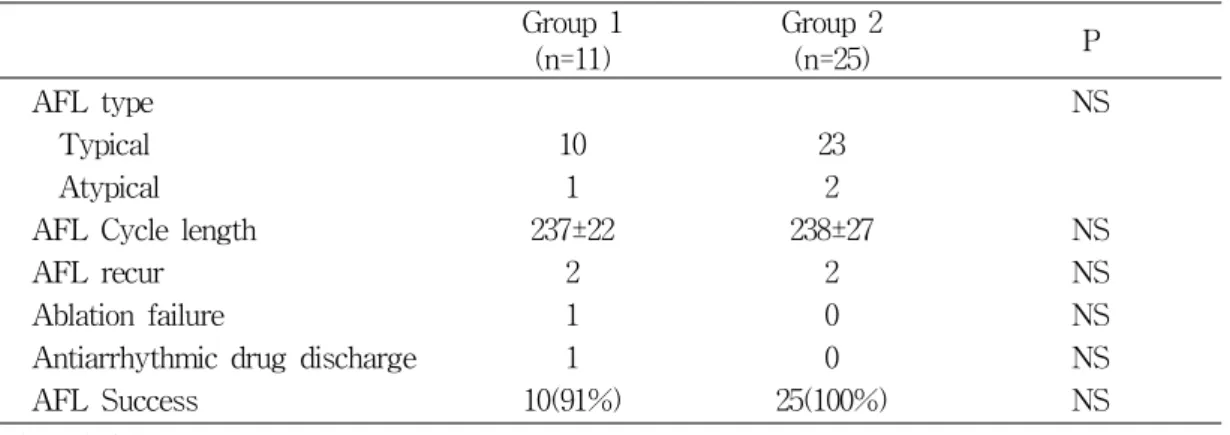
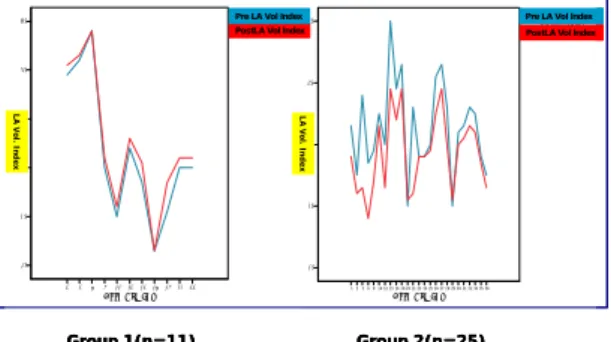
represented in Table 3. Statistical significance was not found in this examination. Table 4 showed echocardiographic differences between two groups. Differences of Left ventricular ejection fraction (LVEF) before and after AFL ablation were not statistically different between two group after 1 year follow-up (p=0.613). The atrial sizes of both groups were increased but, pre-ablational left atrium

(LA) size were significantly increased in

group 1 but, decreased in group 2 after AFL

ablation (p=0.009) and pre-ablational LA

volume index were significantly increased in

group 1 but, decreased in group 2 (p=0.000)

during same follow up period. In summary,

Differences of LA size and LA volume index

were increased or not decreased in case of

patients who had development of AF after

(6)

347911131417192233 Case Number 10

20 30 40 50 60

LA V ol In de x

Pre-LA vol index Post-LA vol index

1 2 5 6 8 10 12 15 16 18 20 21 23 24 25 26 27 28 29 30 31 32 34 35 36 Case Number 10

20 30 40 50

LA Vo l In de x

Pre-LA vol index Post-LA vol index

Group 1(n=11) Group 2(n=25)

LA Vol. Index LA Vol. Index

PostLA Vol Index Pre LA Vol Index

PostLA Vol Index Pre LA Vol Index

347911131417192233

Case Number 10

20 30 40 50 60

LA V ol In de x

Pre-LA vol index Post-LA vol index

1 2 5 6 8 10 12 15 16 18 20 21 23 24 25 26 27 28 29 30 31 32 34 35 36 Case Number 10

20 30 40 50

LA Vo l In de x

Pre-LA vol index Post-LA vol index

Group 1(n=11) Group 2(n=25)

LA Vol. Index LA Vol. Index

PostLA Vol Index Pre LA Vol Index

PostLA Vol Index Pre LA Vol Index

347911131417192233

Case Number 10

20 30 40 50 60

LA V ol In de x

Pre-LA vol index Post-LA vol index

1 2 5 6 8 10 12 15 16 18 20 21 23 24 25 26 27 28 29 30 31 32 34 35 36 Case Number 10

20 30 40 50

LA Vo l In de x

Pre-LA vol index Post-LA vol index

Group 1(n=11) Group 2(n=25)

LA Vol. Index LA Vol. Index

PostLA Vol Index Pre LA Vol Index

PostLA Vol Index Pre LA Vol Index

Fig. 3. Comparison of LA Vol. Index between two groups.

AFL ablation and differences of LA size and LA volume index were decreased in those who had not occurred AF after AFL ablation (Fig 2, Fig 3).

Discussion

Predictors of postablation AF occurrence have been recognized as history of preablation AF, left atrial size, inducibility of AF at the end of the ablation, the presence of structural heart disease, and a reduced left ventricular ejection fraction. Among these, history of preablation AF has emerged as the most significant predictor of postablation AF.

8, 10, 11,

13, 18-20)

But, in clinical setting, we didn’t recognize exactly the history of AF and it is not easy to document AF with AFL. So we started in fact that we already have known previous history of AF that is important in prediction of AF occurrence after AFL ablation but, in case we didn’t have information about AF, we hypothesized that if AF coexists with AFL, AF remains and LA volume does

not decreased or increased after AFL ablation.

This study confirms moderately high incidence of development of symptomatic AF in patients who did not decreased or increased LA volume index by echocardiography after AFL ablation. LA volume index is calculated from LA volume by dividing by body surface area. There are now multiple peer-viewed articles that validate the progressive increase in risk of AF development associated with having LA volumes greater than these normal values.

23, 24)

The left atrium is a thin-walled structure and, in the absence of obstructive mitral valve disease, is directly exposed to LV pressure; its size has been shown to reflect diastolic impairment

25)

and filling pressure.

26)

Diastolic dysfunction is associated with decreased passive LA emptying,

26)

resulting in a larger LA volume at the onset of atrial systole, which helps to maintain LA ejection. With increase in LA filling pressures, atrial stretch and enlargement of the chamber occur, leading to remodeling of the structure, physiologic properties, and electrical milieu of the left atrium, resulting in the development of AF.

The LA size is also important predictors of occurrence of AF after AFL ablation.

However, unidimensional M-mode measurement

does not provide a sensitive assessment of

LA size.

27)

The relationship between M-mode

LA dimension and LA volume is nonlinear.

28)

Because of lack of constant relationship

between the major axes of the left atrium

(7)

and LA volume, smaller increments of M-mode LA dimension are associated with greater changes of LA volume, especially for larger atria. This suggests that LA volume uniquely encompasses physiologic information not captured by clinical data or unidimensional M-mode assessment. The two parameters together provide a more comprehensive assessment of LA geometry. From this study, we studied group of AFL patients without AF history and the differences of LA size and volume index before and after ablation different from previous studies and recognized differences of LA volume index and LA size can be useful tool for predicting of occurrence of AF after AFL ablation.

This study had many limitations. Among them, this is retrospective study, not a prospective. And study population is relatively small, so clinical power may be weak. Study for large population and longer follow up period are needed for AF occurrence after AFL ablation. Asymptomatic atrial arrhythmia is frequent in ablated population but no attempt was made to identify these patients by use of holter monitoring.

Summary

Background:The occurrence of atrial fibrillation (AF) after ablation of atrial flutter (AFL) is clinically important. We demonstrated the gravity of left volume index (LAVi) after ablation of AFL in predicting of

development of AF.

Methods:Thirty six (n=36) who were diagnosed as AFL without previous AF history were enrolled. Group 1 (n=11) defined as those who developed AF after AFL ablation and Group 2 (n=25) was who has not occurred AF. Echocardiographic parameters including left atrial size, left ventricular end diastolic and systolic dimension, ejection fraction and left atrial volume index before and after ablation of AFL were compared.

Results:Baseline characteristics between two groups were not significantly different. Pre and post-ablation left atrial size were not changed before and after AFL ablation. But, LAVi before AFL ablation was significantly reduced in Group 1 than Group 2.

Conclusions:The difference of LAVi is the robust predictor of occurrence of AF after AFL ablation without previous AF.

References

1. Cosio FG, Lopez-Gil M, Giocolea A, Arribas F, Barroso JL. Radiofrequency ablation of the inferior cava-tricuspid valve isthmus in common atrial flutter. Am J Cardiol. 1993 Mar 15;71(8):

705-9.

2. Fischer B, Haissaguerre M, Garrigues S, Poquet F, Gencel L, Clementy J et al.

Radiofrequency catheter ablation of common atrial flutter in 80 patients. J Am Coll Cardiol 1995 May;25(6):1365-72.

3. Natale A, Newby KH, Pisano E, Leonelli F,

Fanelli R, Potenza D et al. Prospective

randomized comparison of antiarrhythmic

(8)

therapy versus first-line radiofrequency ablation in patients with atrial flutter. J Am Coll Cardiol. 2000 Jun;35(7):1898-904.

4. Poty H, Saoudi N, Aziz AA, Nair M, Letac B.

Radiofrequency catheter ablation of type 1 atrial flutter: Prediction of late success by electrophysiological criteria. Circulation 1995 Sep 15;92(6):1389-92.

5. Shah DC, Takahashi A, Jais P, Hocini M, Clementy J, Haissaguerre M. Local electrogram- based criteria of cavotricuspid isthmus block.

J Cardiovasc Electrophysiol 1999 May;10(5):

662-9.

6. Anselme F, Savoure A, Cribier A, Saoudi N.

Catheter ablation of typical atrial flutter. A randomized comparison of 2 methods for determining complete bidirectional isthmus block. Circulation 2001 Mar 13;103(10):1434-9.

7. Kim JJ, Kim YH, Cheong SS, Park SW, Park SJ, Park CH et al. Radiofrequency catheter ablation in patients with atrial flutter. Korean Ciruclation J 1996;26(3):605-13.

8. Philipon F, Plumb VJ, Epstein A, Kay N. The risk of atrial fibrillation following radiofrequency catheter ablation of common atrial flutter.

Circulation 1995;92:430-5.

9. Frey B, Kreiner B, Binder T, Heinz G, Baumgartner H, Gossinger HD. Relation between left atrial size and secondary atrial arrhythmias after successful catheter ablation of common atrial flutter. PACE 1997 Dec;20 (12 Pt 1):2936-42.

10. Tai CT, Chen SA, Chiang CE, Lee SH, Wen ZC, Huang JL et al. Long-term outcome of radiofrequency catheter ablation for typical atrial flutter: Risk prediction of recurrent arrhythmias. J Cardiovasc Electrophysiol 1998 Feb;9(2):115-21.

11. Paydak H, Kall JG, Burke MC, Rubenstein D, Kopp DE, Verdino RJ et al. Atrial fibrillation

after radiofrequency ablation of type I atrial flutter: time to onset, determinants and clinical course. Circulation 1998 Jul 28;98(4):315-22.

12. Nabar A, Rodriguez LM, Timmermans C, van den Dool A, Smeets JL, Wellens HJ. Effect of right atrial isthmus ablation on the occurrence of atrial fibrillation. Observations in four patients groups having type I atrial flutter with or without associated atrial fibrillation.

Circulation 1999 Mar 23;99(11):1441-5.

13. Da costa A, Romeyer C, Mourot S, Messier M, Cerisier A, Faure E et al. Factors associated with early atrial fibrillation after ablation of common atrial flutter. A single-center prospective study. Eur Heart J 2002 Mar;23(6):498-506.

14. Huang DT, Monahan KM, Papageorgiou P, Epstein LM, Josephson ME. Hybrid pharmacologic and ablative therapy: A novel and effective approach for the management of atrial fibrillation. J Cardiovasc Electrophysiol 1998 May;9(5):462-9.

15. Tai C, Chiang C, Lee S, Chen YJ, Yu WC, Feng ANet al. Persistent atrial flutter in patients treated for atrial fibrillation with amiodarone and propafenone: Electrophy- siologic characteristics, radiofrequency catheter ablation, and risk prediction. J Cardiovasc Electrophysiol 1999 Sep;10(9):1180-7.

16. Schumacher B, Jung W, Lewalter T, Vahlhaus C, Wolpert C, Luderitz B. Radiofrequency ablation of atrial flutter due to administration of class IC antiarrhythmic drugs for atrial fibrillation. Am J Cardiol 1999 Mar 1;83(5):

710-3.

17. Reithmann C, Hoffmann E, Spitzberger G, Dorwarth U, Gerth A, Remp T et al. Catheter ablation of atrial flutter due to amiodarone therapy for paroxysmal atrial fibrillation. Eur Heart J 2000 Apr;21(7):565-72.

18. Hsieh MH, Tai CT, Chiang CE, Tsai CF, Yu

(9)

WC, Chen YJ. Recurrent atrial flutter and atrial fibrillation after catheter ablation of the cavotricuspid isthmus: A very long-term follow up of 333 patients. J Interv Card Electrophysiol 2002 Dec;7(3):225-31.

19. Schmieder S, Ndrepepa G, Dong J, Zrenner B, Schreieck J, Schneider MA, et al. Acute and long-term results of radiofrequency ablation of common atrial flutter and the influence of right atrial isthmus ablation on the occurrence of atrial fibrillation. Eur Heart J 2003 May;

24(10):956-62.

20. Bertaglia E, Zoppo F, Bonso A, Proclemer A, Verlato R, Coro L, et al. Long-term follow-up of radiofrequency catheter ablation of atrial flutter:Clinical course and predictors of atrial fibrillation occurrence. Heart 2004 Jan;90(1):

59-63.

21. Poty H, Saoudi N, Nair M, Anselme F, Letac B. Radiofrequency catheter ablation of atrial flutter. Further insights into the various types of isthmus block: application to ablation during sinus rhythm. Circulation 1996 Dec 15;94(12):

3204-13.

22. Lang RM, Bierig M, Devereux RB, Flachskampf FA, Foster E, Pellikka PA, et al. Recommenda- tions for chamber quantification: A report from the American society of echocardiography’s guidelines and standards committee and the chamber quantification writing group, developed in conjunction with the European association of echocardiography, a branch of the European society of cardiology. J Am Soc Echocardiogr 2005 Dec;18(12):1440-63.

23. Tsang TS, Barnes ME, Bailey KR, Leibson CL, Montgomery SC, Takemoto Y, et al. Left atrial volume: important risk marker of incident atrial fibrillation in 1655 older men and women. Mayo Clin Proc 2001 May;76(5):

467-75.

24. Losi MA, Betocchi S, Aversa M, Lombardi R, Miranda M, D’Alcssandro G, et al. Determi- nants of atrial fibrillation development in patients with hypertrophic cardiomyopathy. Am J Cardiol 2004 Oct 1;94(7):895-900.

25. Matsuda M, Matsuda Y. Mechanism of left atrial enlargement related to ventricular diastolic impairment in hypertension. Clin Cardiol 1996 Dec;19(12):954-9.

26. Appleton CP, Galloway JM, Gonzalez MS, Gaballa M, Basnight MA. Estimation of left ventricular filling pressures using two dimen- sional and Doppler echocardiography in adult patients with cardiac disease: additional value of analyzing left atrial size, left atrial ejection fraction and the difference in duration of pulmonary venous and mitral flow velocity at atrial contraction. J Am Coll Cardiol. 1993 Dec;22(7):1972-82.

27. Lester SJ, Ryan EW, Schiller NB, Foster E.

Best method in clinical practice and in research studies to determine left atrial size.

Am J Cardiol. 1999 Oct 1;84(7):829-32.

28. Schabelman S, Schiller NB, Silverman NH,

Ports TA. Left atrial volume estimation by

two-dimensional echocardiography. Cathet

Cardiovasc Diagn. 1981;7(2):165-78.

수치

Table  2.  Echocardiogrphic  findings  between  two  groupspatients  developed  AF  (Group  1,  n=11)  but, eighteen  patients  has  not  occurred  AF  (Group
Table  3.  Electrophisiologic  findings  between  two  groups
Fig. 3. Comparison  of  LA  Vol.  Index  between  two  groups.

참조

관련 문서

• 이명의 치료에 대한 매커니즘과 디지털 음향 기술에 대한 상업적으로의 급속한 발전으로 인해 치료 옵션은 증가했 지만, 선택 가이드 라인은 거의 없음.. •

If both these adjustments are considered, the resulting approach is called a bootstrap-BC a -method (bias- corrected-accelerated). A description of this approach

The proposal of the cell theory as the birth of contemporary cell biology Microscopic studies of plant tissues by Schleiden and of animal tissues by Microscopic studies of

In a statement to Kuwait News Agency (KUNA) on the sidelines of a meeting of the Arab Parliament's Foreign Affairs Political and National Security

The meeting was attended by Assistant Foreign Minister for GCC Affairs, Ambassador, Nasser Al-Muzayyen, and Deputy Assistant Foreign Minister for the Office of the

“ Sheikh Nasser has a written message from HH the Amir, Sheikh Sabah Al-Ahmad Al-Jaber Al-Sabah to the Chinese President, Chi Gen Beng related to enhancing mutual

On his part, CEO of Express Roads Authority, Saud Al-Naqqi said that the heavy rains of the previous day led to clogging parts of the express

Kuwait will celebrate on Sunday the fourth anniversary of the UN honoring and proclamation of His Highness the Amir, Sheikh Sabah Al-Ahmad Al-Jaber Al-Sabah as