http://e-nrp.org
Validation of Dietary Reference Intakes for predicting energy requirements in elementary school-age children
Eun-Kyung Kim
1*, Didace Ndahimana
1*, Kazuko Ishikawa-Takata
2, Sangjik Lee
3, Hyungryul Kim
3, Kiwon Lim
4, In-Sook Lee
5, Shigeho Tanaka
2, Ye-Jin Kim
1, Yeon-Jung Choi
1, Mun-Jeong Ju
1and Jonghoon Park
6§1Department of Food and Nutrition, Gangneung-Wonju National University, Gangneung 25457, Korea
2Department of Nutrition and Metabolism, National Institutes of Biomedical Innovation, Health and Nutrition, Tokyo 162-8636, Japan
3Division of Physical Education, Uiduk University, Gyeongju 38004, Korea
4Department of Physical Education, Konkuk University, Seoul 05029, Korea
5Division of Food Service Industry, Uiduk University, Gyeongju 38004, Korea
6Department of Physical Education, Korea University, 145 Anam-Ro, Seongbuk-Gu, Seoul 02841, Korea
BACKGROUND/OBJECTIVES: Dietary Reference Intakes (DRI) for energy are derived from total energy expenditure (TEE) measured using the doubly labelled water (DLW) method. The objective of this study was to assess the validity of DRI for predicting the energy requirements of elementary school-age children.
SUBJECTS/METHODS: The present study involved 25 elementary school-age children aged between 9 and 11 years. TEE was assessed by the DLW method, and the results were compared with the TEE predicted by the DRI equations in order to evaluate accuracy.
RESULTS: The subjects’ TEE measured by the DLW method was 1,925.2 ± 380.9 kcal/day in boys and 1,930.0 ± 279.4 kcal/day in girls, whereas resting energy expenditure was 1,220.2 ± 176.9 kcal/day in boys and 1,245.9 ± 171.3 kcal/day for girls. The physical activity level was 1.58 ± 0.20 in boys and 1.55 ± 0.13 in girls. The mean bias between the predicted and measured TEE was 12.6% in boys and -1.6% in girls, and the percentage of accurate predictions was 28.6% and 63.6%, respectively.
In boys, the equation resulted in underprediction of TEE among the subjects having low TEE values, whereas there was overprediction among subjects having high TEE values as shown by the Bland-Altman plot. On the contrary, this proportional bias was not observed in girls.
CONCLUSIONS: The findings of this study suggest that the DRI equation for energy could result in the overestimation of energy requirements in elementary school-age boys. In the case of girls, the equations could be accurate at the group level. However, the DRI appears to be invalid for individual girls, as more than one third of girls had their TEE inaccurately predicted. We recommend more studies for confirmation of these results.
Nutrition Research and Practice 2018;12(4):336-341; https://doi.org/10.4162/nrp.2018.12.4.336; pISSN 1976-1457 eISSN 2005-6168
Keywords: Child, nutrition requirements, energy expenditure
INTRODUCTION
*Recently, paediatric obesity has become one of the most important public health concerns worldwide [1-4]. Therefore, it has become increasingly vital to develop a method for accurately measuring the energy requirements of children in the context of obesity prevention and management. In children, energy requirements are estimated by measuring total energy expenditure (TEE) and then adding the energy cost of growth to allow for tissue growth and maturation [5,6]. Currently, the doubly labelled water (DLW) method is the reference for TEE assessment [7]. However, this method is expensive and requires high analytical expertise [7-8]. Therefore, various studies have applied it for the development and validation of other more
affordable methods, including Dietary Reference Intake (DRI) equations for energy estimation [9-13].
The Institute of Medicine (IOM) in its 2002 report published DRIs for Americans and Canadians focusing on energy, carbo- hydrates, fibre, fat, fatty acids, cholesterol, protein, and amino acids [5]. The DRI equations for energy were established based on TEE data measured by the DLW method obtained from previous studies conducted in different age groups such as infants and children up to 2 years of age, children from 3 to 9 years, children from 9 to 18 years, and adults aged 19 years and above. These equations are based on the individual’s gender, age, height, weight, and physical activity level (PAL) [5]. However, these pooled data from large age groups may not be representative of smaller sub-groups, as shown in one study
§Corresponding Author: Jonghoon Park, Tel. 82-2-3290-2315, Fax. 82-2-927-4090, Email. [email protected] Received: February 11, 2018, Revised: July 9, 2018, Accepted: July 10, 2018
* These authors contributed equally to this work.
This is an Open Access article distributed under the terms of the Creative Commons Attribution Non-Commercial License (http://creativecommons.org/licenses/by-nc/3.0/) which permits unrestricted non-commercial use, distribution, and reproduction in any medium, provided the original work is properly cited.
in which the DRI equation was found to be inaccurate in children aged 4-5 years [14]. A study by Harrell et al. [15]
involving children 8-18 years of age found that energy expen- diture (kcal·kg
-1·h
-1) at rest or during exercise was significantly greater in younger children than in those of higher pubertal stage.
Studies on the accuracy of these DRI equations in estimating the energy requirements of elementary school-age children are still limited. To the best of our knowledge, only one study by Bandini et al. [16] was conducted on girls between 8 and 12 years of age. Therefore, a study involving both boys and girls in this age group is required. The objective of this study was to evaluate the validity of the DRI equations in predicting the energy requirements of elementary school-age children.
SUBJECTS AND METHODS Subjects
Twenty-five children (14 boys and 11 girls) between 9 and 11 years of age from Gangneung and Pohang, Korea were included in this study. For the subjects to be included in the study, the following criteria were considered: (a) being in good health, (b) having normal weight, (c) not involved in extreme physical activity such as athletics, (d) living in the study province for at least 2 weeks before and during the study. Initially, 74 subjects (25 girls and 49 boys) were recruited for this study.
After excluding obese subjects and those who had missing or insufficient data, the final number of subjects came to 25 (14 boys and 11 girls). Obese children were excluded from this study because the evaluated DRI equations were developed based on data from normal weight children [5].
Study design
The present study was conducted in two cities in South Korea:
Pohang city (Pohang study) and Gangneung city (Gangneung study). The measurement of TEE was conducted within a period of 8 days for each participant. Before starting the measure- ments, the study was approved by the Ethical Committee of the National Institute of Health and Nutrition in Japan and the Institutional Review Board (IRB) of Gangnwung-Wonju National University (approval number: GWNU-IRB-2013-19).
Anthropometric measurements
Anthropometric measurements included the subjects’ weights and heights, and the body mass index (BMI) was obtained by dividing body weight (kg) by height squared (m
2). During anthropometric measurements, subjects wore the lightest possible clothes to minimise error.
Resting energy expenditure (REE)
In the Pohang study, REE was measured using the Douglas bag, whereas in the Gangneung study, it was measured using a ventilated hood system (TrueOne2400 Parvo Medics, USA).
In their study, Crouter et al. [18] compared these two methods in the measurement of gas exchange variables at rest and during different work rates. The findings showed that there was no significant difference between the two methods concerning the measured VE, VO
2, or VCO
2(P ≥ 0.05). Details on the
principles and procedures of the measurements are given elsewhere [18,19].
Dietary intake assessment
During the 8 days of DLW measurement, the dietary record method was used to measure the children’s dietary intake. For each child, dietary intake data were collected on 3 days (2 weekdays and 1 weekend day), with the assistance of his or her parents. The completed dietary records were checked by well-trained dieticians, and incomplete or unclear records were clarified through an interview with each participant. The nutrient intakes were calculated using a computer-aided nutritional analysis program (CANpro 4.0, Korean Nutrition Society, Seoul, Korea).
Measurement of TEE
The subjects’ TEE was measured for 8 days using the DLW method. After collecting the subjects’ baseline urine samples, their body weight and height were measured. Each participant then ingested a dose made of approximately 0.06 g/kg body weight of
2H
2O at 99.8 atom% (Cambridge Isotope Laboratories, MA, USA) and 1.4 g/kg body weight of H
218O at 10.0 atom%
(Taiyo Nippon Sanso, Tokyo, Japan). After DLW dose consumption, five more urine samples were collected from each participant during the measurement period. In order to minimize risk of bias, the subjects were instructed to collect all samples at a similar time of day. TEE was calculated using the modified Weir’s formula [7,20]: TEE (kcal/day) = 1.1 rCO
2+ 3.9 rCO
2/ FQ, with rCO
2(L/day) as the rate of CO
2production and FQ as the food quotient, which was obtained by using a dietary record method involving the equation of Black et al. [21]. PAL was calculated as the TEE measured by the DLW method (TEE
DLW) divided by the REE.
DRI predictive equations for TEE
To derive estimated energy requirements (EER) for children, the IOM used DLW data to develop predictive equations for TEE based on each child’s gender, age, height, weight, and PAL category and then added 25 kcal/day as an estimate of energy deposition [5]. These equations have also been adopted during the development of Dietary Reference Intakes for Koreans 2015 [22]. The present study assessed the validity of the DRI predictive equations for energy in both boys and girls by comparing predicted TEE (TEE
DRI) with TEE
DLW. The equations are shown below:
TEE for boys 9 through 18 years:
TEE = 88.5 - [61.9 × age (years) + physical activity coefficient (PA)] × [26.7 × weight (kg) + 903 × height (m)]
Where PA is the physical activity coefficient:
PA = 1.00 if it is estimated that 1.0 ≤ PAL < 1.4 (sedentary) PA = 1.13 if it is estimated that 1.4 ≤ PAL < 1.6 (low active) PA = 1.26 if it is estimated that 1.6 ≤ PAL < 1.9 (active) PA = 1.42 if it is estimated that 1.9 ≤ PAL < 2.5 (very active) TEE for girls 9 through 18 years:
TEE = 135.3 - [30.8 × age (years)] + PA × [10.0 × weight (kg) +
934 × height (m)]
Boys (n = 14) Girls (n = 11) P-value1)
Age (yrs) 10.1 ± 0.8 10.7 ± 0.4 0.049b)
Height (m) 1.42 ± 0.1 1.47 ± 0.1 0.131a)
Weight (kg) 36.9 ± 6.8 39.0 ± 6.3 0.451a)
BMI (kg/m2) 18.2 ± 2.1 18.3 ± 1.4 0.831a)
BMI, body mass index
1)P-value obtained by using a)independent t-test or b)Mann-Whitney U test Table 1. Characteristics of the subjects
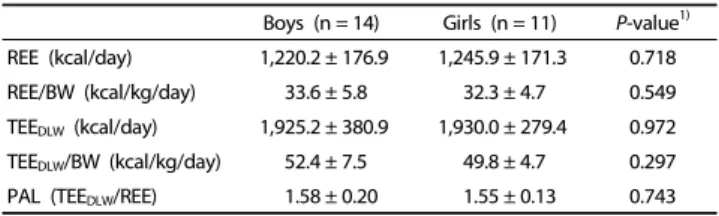
Boys (n = 14) Girls (n = 11) P-value1) REE (kcal/day) 1,220.2 ± 176.9 1,245.9 ± 171.3 0.718
REE/BW (kcal/kg/day) 33.6 ± 5.8 32.3 ± 4.7 0.549
TEEDLW (kcal/day) 1,925.2 ± 380.9 1,930.0 ± 279.4 0.972 TEEDLW/BW (kcal/kg/day) 52.4 ± 7.5 49.8 ± 4.7 0.297
PAL (TEEDLW/REE) 1.58 ± 0.20 1.55 ± 0.13 0.743
REE, resting energy expenditure; REE/BW, resting energy expenditure adjusted for body weight; TEEDLW, total energy expenditure measured by the DLW method;
TEEDLW/BW, total energy expenditure measured by the DLW method, adjusted for body weight; PAL, physical activity level.
1)P-value obtained by using independent t-test Table 2. Subjects’ energy expenditure
(A) (B)
Fig. 1. Correlation between TEEDRI and TEEDLW in boys (A) and girls (B). TEEDLW, total energy expenditure measured by the DLW method; TEEDRI, total energy expenditure calculated by the DRI predictive equation.
N TEEDLW
(kcal/day)
TEEDRI
(kcal/day)
Difference TEEDRI- TEEDLW
(kcal/day)
Bias1) (%)
Maximum negative error2)
(%)
Maximum positive error3)
(%)
RMSE (kcal/day)
Accurate Prediction4)
(%)
Under Prediction5)
(%)
Over Prediction6)
(%)
Boys 14 1,925.2 ± 380.9 2,167.9 ± 510.9 242.7 ± 298.9 12.6 -11.0 43.0 376.7 28.6 7.1 64.3
Girls 11 1,930.0 ± 279.4 1,898.8 ± 241.6 -31.2 ± 225.1 -1.6 -14.8 30.8 216.8 63.6 27.3 9.1
TEEDLW, total energy expenditure measured by the DLW method; TEEDRI, total energy expenditure calculated by the DRI predictive equation.
1)Mean percentage error between predictive equation and measured value
2)The largest underprediction that was found with this predictive equation as a percentage of the measured value.
3)The largest overprediction that was found with this predictive equation as a percentage of the measured value.
4)Percentage of subjects that have TEEDRI predicted by equation within 90% to 110% of TEEDLW measured
5)Percentage of subjects that have TEEDRI predicted by equation within < 90% of TEEDLW measured
6)Percentage of subjects that have TEEDRI predicted by equation within > 110% of TEEDLW measured
Table 3. Evaluation of the DRI predictive equation for TEE in 25 elementary school-age children based on bias, root-mean-square prediction error (RMSE), and percentage accurate prediction
Where PA is the physical activity coefficient:
PA = 1.00 if it is estimated that 1.0 ≤ PAL < 1.4 (sedentary) PA = 1.16 if it is estimated that 1.4 ≤ PAL < 1.6 (low active) PA = 1.31 if it is estimated that 1.6 ≤ PAL < 1.9 (active) PA = 1.56 if it is estimated that 1.9 ≤ PAL < 2.5 (very active) Statistical analysis
Statistical analysis was performed with SPSS software version 23 (IBM Corp., NY, USA), and the data are presented as the means with standard deviations (SD). Normality was assessed by using the Shapiro-Wilk test. For the normally distributed variables, comparison between girls and boys was done using the independent samples t-test. For subjects’ age, which was not normally distributed, gender group comparison was performed using the Mann-Whitney U Test. The mean percentage error between TEE
DRIand TEE
DLW, the root mean squared prediction error (RMSE), and the percentage of accurate predictions were computed to evaluate the accuracy of the DRI equation against the DLW method for assessment of TEE. Pearson’s correlation analysis was used to assess the association between TEE
DLWand TEE
DRI. In all tests, statistical significance was set at P < 0.05.
RESULTS
Characteristics of subjects
Subjects’ characteristics are displayed in Table 1. The study involved 25 children, including 11 girls and 14 boys. The subjects’
mean age was 10.1 ± 0.8 years in boys and 10.7 ± 0.4 years in girls. For the rest of the assessed variables (height, weight and BMI), there was no significant difference between the genders.
Mean height was 1.42 ± 0.1 m in boys and 1.47 ± 0.1 m in girls, and mean weight was 36.9 ± 6.8 kg in boys and 39.0 ± 6.3 kg in girls.
BMI was 18.2 ± 2.1 kg/m
2in boys and 18.3 ± 1.4 kg/m
2in girls.
(A)
(B)
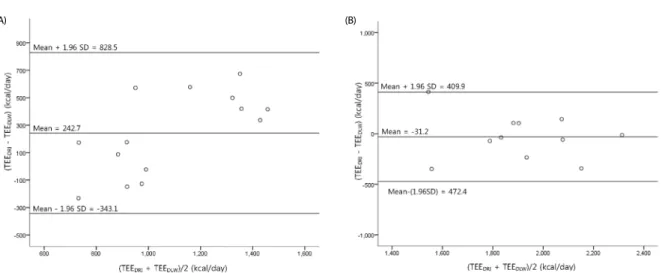
Fig. 2. Bland-Altman plot of differences between TEEDRI andTEEDLW in boys (A) and girls (B). SD, standard deviation; TEEDLW, total energy expenditure measured by the DLW method; TEEDRI, total energy expenditure calculated by the DRI predictive equation.
Subjects’ energy expenditure
Table 2 presents the variables relating to the subjects’ energy expenditure. No significant differences were observed between boys and girls for all measured energy expenditure variables.
The TEE
DLWwas 1,925.2 ± 380.9 kcal/day in boys and 1,930.0 ± 279.4 kcal/day in girls, whereas REE was 1,220.2 ± 176.9 kcal/day in boys and 1,245.9 ± 171.3 kcal/day in girls. PAL was 1.58 ± 0.20 in boys and 1.55 ± 0.13 in girls.
Accuracy of DRI predictive equation for TEE
In boys, TEE
DRIsignificantly overestimated TEE
DLWby 242.7 ± 298.9 kcal/day (P < 0.05), as shown in Table 3. In the case of girls, TEE
DLWwas underestimated by 31.2 ± 225.1 kcal/day, but this difference was not significant. The mean percentage error was 12.6% for boys and -1.6% in girls, whereas RMSE was 376.7 kcal/day and 216.8 kcal/day, respectively. The DRI equation accurately predicted TEE in only 28.6% of boys, whereas the rate of accurate predictions was 63.6% in girls.
A scatter plot assessing the correlation between TEE
DLWand TEE
DRIis presented in Fig. 1. There was a good linear correlation between the two methods in both boys (Pearson’s r = 0.814, P < 0.001) and girls (Pearson’s r = 0.635, P < 0.05).
Fig. 2 presents the Bland-Altman plot of differences between TEE
DRIand TEE
DLW. In the case of boys, the plot shows a proportional bias with a tendency towards underestimation in subjects with low TEE and overestimation in those with high TEE. On the contrary, a proportional bias was not observed in girls. In addition, wider limits of agreements were present in boys than in girls.
DISCUSSION
In the present study, we used the DLW method to evaluate the validity of the DRI predictive equations for TEE in normal- weight elementary school-age children aged 9-11 years. To the best of our knowledge, this was the first study to assess the validity of DRI equations for predicting energy requirements in both school-age boys and girls. There was no significant difference between boys and girls regarding all measured
variables for energy expenditure, namely REE, REE/BW, TEE
DLW, TEE
DLW/BW, and PAL. REE was 1,220.2 ± 176.9 kcal/day in boys and 1,245.9 ± 171.3 kcal/day in girls, whereas TEE
DLWwas 1,925.2
± 380.9 kcal/day and 1,930.0 ± 279.4 kcal/day, respectively.
Our findings on children’s REE and TEE
DLWare comparable to the results from similar studies on energy expenditure in elementary school-age children. In one study, Kaneko et al. [23]
measured REE in 221 Japanese children and adolescents aged 6-17 years by using a ventilated indirect calorimeter. Among the study subjects, 32 (20 boys and 12 girls) were aged between 10 and 11 years, and in this age group, REE was 1,296 ± 184 kcal/day in boys and 1,182 ± 115 kcal/day in girls. In another study conducted by Hoffman et al. [24], the DLW method was used to measure the TEE in Brazilian children of elementary school age. The study included 30 non-stunted children aged 8-11 years, including 15 boys and 15 girls. In their study, REE was 1,244.3 ± 34.2 kcal/day in boys and 1,113.5 ± 38.5 kcal/day in girls, whereas TEE
DLWwas 2,158.0 ± 88.0 kcal/day in boys and 1,930.927 ± 95.8413 kcal/day in girls. The DLW method was also used by Bandini et al. [16] to assess TEE in a large study of 161 American non-obese pre-menarcheal girls aged 8-12 years.
According to their study results, girls’ REE was 1,225 ± 136 kcal/day while TEE
DLWwas 1,959 kcal/ day. To the best of our knowledge, no previous study has assessed TEE in Korean elementary school-age children using DLW or any other method.
The PAL of our study subjects was 1.58 in boys and 1.55 in girls, which corresponds to the low-active category. This confirms the findings of previous studies that have assessed PAL in Koreans using the physical activity diary method [25-30].
Based on these and other similar studies, the Korean population is considered as low-active on average, and corresponding physical activity coefficients (PA) have been applied in the DRI equations for Koreans to predict their energy requirements.
The results of the present study suggest that in elementary
school-age boys, the DRI prediction equation could overestimate
TEE. In this group, the mean percentage error was 12.6%, and
only 28.6% of boys had their TEE accurately predicted. In
addition, the Bland-Altman plot of the differences between
TEE
DRIand TEE
DLWshowed large limits of agreement, and there
was a proportional bias with a tendency towards underpred- iction in boys having a low TEE and overprediction in those having a high TEE. Similar to our findings in elementary school- age boys, a study by Butte et al. [14] involving a sample of 97 normal-weight preschool-age children (mean age = 4.5 years) found that the DRI equations for energy overestimated the energy requirements of preschool-age children. The inaccuracy of the DRI equation for TEE in elementary school-age boys could negatively impact the problem of obesity in this group, given that rates of childhood obesity in Korea have been increasing in recent decades [31,32].
Contrary to the observations in boys, the study findings show that the DRI equation could accurately predict TEE in elementary school-age girls at the group level. The mean percentage error in this group was -1.6%, and 63.6% of the girls had their TEE accurately predicted. The observed negative mean percentage error suggests that the DRI equation may have underestimated the energy requirements in a considerable portion of girls. The Bland-Altman plot demonstrated narrow limits of agreement, and no proportional bias was observed in girls. Our results in girls are in agreement with the findings of a study by Bandini et al. [16], in which the mean percentage error was -5.8% and the percentage of accurate predictions was 70%. Based on these results, they reported that the DRI equation performs well for predicting energy expenditure in girls at the group level, but their application of the DRI equation to individuals may have resulted in the underestimation of energy requirements in a substantial proportion of girls.
To the best of our knowledge, this is the first study to assess the accuracy of DRI equations in estimating energy require- ments in both elementary school boys and girls. A few studies have investigated the validity of DRI predictive equations for energy requirements in other age groups. In the Observing Protein and Energy Nutrition study carried out by Toose et al.
[33], the DRI equations were found to be accurate in a sample of 450 men and women aged 40-69 years, with a mean percentage error of -7.5% in men and -5.9% in women. In addition, 68% of men and 64% of women showed TEE
DRIvalues within 10% of the TEE
DLW. In another study conducted by Kim et al. [34], the accuracy of the DRI equation was assessed in 71 Korean adults (35 men and 36 women) aged between 20-49 years. According to the study findings, the DRI equation was accurate in this group with a bias of -1.3% in men and -4.9 in women as well as an accuracy rate of 77.1% in men and 62.9% in women.
Our study was limited by the small sample size and especially the high cost of the DLW and analytical expenses. In addition, the study focused only on normal-weight elementary school- age children. Therefore, our findings may not be representative of all elementary school-age children. Further studies with larger samples are required to confirm our findings. On the other hand, the strength of our study is that both TEE and REE were measured with highly accurate methods, namely the DLW and indirect calorimetry methods, respectively [7,9].
In conclusion, the findings of this study suggest that the DRI equation for energy could result in the overestimation of energy requirements in elementary school-age boys. In this case, application of this equation could have a negative impact on
achieving energy balance in this group. In the case of girls, the equation could be accurate at the group level. However, caution should be taken while applying the DRI equation for energy to individual girls, as more than one third of girls had their TEE inaccurately predicted. The present study suggests the need to develop new equations to estimate TEE in elementary-school age children using a larger sample.
CONFLICT OF INTEREST
The authors declare no potential conflicts of interests.
ORCID
Eun-Kyung Kim: https://orcid.org/0000-0003-1292-7586 Didace Ndahimana: https://orcid.org/0000-0001-7070-3973 Kazuko Ishikawa-Takata: https://orcid.org/0000-0003-2995-2956 Sangjik Lee: https://orcid.org/0000-0002-0051-4840
Hyungryul Kim: https://orcid.org/0000-0002-6213-2645 Kiwon Lim: https://orcid.org/0000-0003-3222-1783 In Sook Lee: https://orcid.org/0000-0001-8500-3363 Shigeho Tanaka: https://orcid.org/0000-0002-8933-3041 Ye-Jin Kim: https://orcid.org/0000-0003-0678-6297 Yeon-Jung Choi: https://orcid.org/0000-0001-9590-6697 Mun-Jeong Ju: https://orcid.org/0000-0002-5093-4667 Jonghoon Park: https://orcid.org/0000-0002-5994-399X REFERENCES
1. Santaliestra-Pasías AM, Rey-López JP, Moreno Aznar LA. Obesity and sedentarism in children and adolescents: what should be bone?
Nutr Hosp 2013;28 Suppl 5:99-104.
2. Wang Y, Cai L, Wu Y, Wilson RF, Weston C, Fawole O, Bleich SN, Cheskin LJ, Showell NN, Lau BD, Chiu DT, Zhang A, Segal J. What childhood obesity prevention programmes work? A systematic review and meta-analysis. Obes Rev 2015;16:547-65.
3. Brown CL, Halvorson EE, Cohen GM, Lazorick S, Skelton JA. Addressing childhood obesity: opportunities for prevention. Pediatr Clin North Am 2015;62:1241-61.
4. Lobstein T, Jackson-Leach R, Moodie ML, Hall KD, Gortmaker SL, Swinburn BA, James WP, Wang Y, McPherson K. Child and adolescent obesity: part of a bigger picture. Lancet 2015;385:2510-20.
5. Institute of Medicine of the National Academies (US). Dietary Reference Intakes for Energy, Carbohydrate, Fiber, Fat, Fatty Acids, Cholesterol, Protein, and Amino Acids. Washington, D.C.: National Academies Press; 2002.
6. Torun B. Energy requirements of children and adolescents. Public Health Nutr 2005;8:968-93.
7. Park J, Kazuko IT, Kim E, Kim J, Yoon J. Estimating free-living human energy expenditure: practical aspects of the doubly labeled water method and its applications. Nutr Res Pract 2014;8:241-8.
8. Speakman JR. The history and theory of the doubly labeled water technique. Am J Clin Nutr 1998;68:932S-938S.
9. Wong WW, Roberts SB, Racette SB, Das SK, Redman LM, Rochon J, Bhapkar MV, Clarke LL, Kraus WE. The doubly labeled water method produces highly reproducible longitudinal results in nutrition studies. J Nutr 2014;144:777-83.
10. Silva AM, Santos DA, Matias CN, Minderico CS, Schoeller DA,
Sardinha LB. Total energy expenditure assessment in elite junior basketball players: a validation study using doubly labeled water.
J Strength Cond Res 2013;27:1920-7.
11. Trabulsi J, Schoeller DA. Evaluation of dietary assessment instruments against doubly labeled water, a biomarker of habitual energy intake.
Am J Physiol Endocrinol Metab 2001;281:E891-9.
12. Plasqui G, Westerterp KR. Physical activity assessment with accelero- meters: an evaluation against doubly labeled water. Obesity (Silver Spring) 2007;15:2371-9.
13. St-Onge M, Mignault D, Allison DB, Rabasa-Lhoret R. Evaluation of a portable device to measure daily energy expenditure in free-living adults. Am J Clin Nutr 2007;85:742-9.
14. Butte NF, Wong WW, Wilson TA, Adolph AL, Puyau MR, Zakeri IF.
Revision of Dietary Reference Intakes for energy in preschool-age children. Am J Clin Nutr 2014;100:161-7.
15. Harrell JS, McMurray RG, Baggett CD, Pennell ML, Pearce PF, Bangdiwala SI. Energy costs of physical activities in children and adolescents. Med Sci Sports Exerc 2005;37:329-36.
16. Bandini LG, Lividini K, Phillips SM, Must A. Accuracy of dietary reference intakes for determining energy requirements in girls. Am J Clin Nutr 2013;98:700-4.
17. Park JH, Ishikawa-Takata K, Lee SJ, Kim EK, Lim KW, Kim HR, Lee IS, Tanaka S. Association between daily step counts and physical activity level among Korean elementary schoolchildren. J Exerc Nutrition Biochem 2016;20:51-5.
18. Crouter SE, Antczak A, Hudak JR, DellaValle DM, Haas JD. Accuracy and reliability of the ParvoMedics TrueOne 2400 and MedGraphics VO2000 metabolic systems. Eur J Appl Physiol 2006;98:139-51.
19. Kim MH, Kim JH, Kim EK. Accuracy of predictive equations for resting energy expenditure (REE) in non-obese and obese Korean children and adolescents. Nutr Res Pract 2012;6:51-60.
20. Weir JB. New methods for calculating metabolic rate with special reference to protein metabolism. J Physiol 1949;109:1-9.
21. Black AE, Prentice AM, Coward WA. Use of food quotients to predict respiratory quotients for the doubly-labelled water method of measuring energy expenditure. Hum Nutr Clin Nutr 1986;40:381-91.
22. Ministry of Health and Welfare (KR); The Korean Nutrition Society.
Dietary Reference Intakes for Koreans 2015. Sejong: Ministry of Health and Welfare; 2016.
23. Kaneko K, Ito C, Koizumi K, Watanabe S, Umeda Y, Ishikawa-Takata
K. Resting energy expenditure (REE) in six- to seventeen-year-old Japanese children and adolescents. J Nutr Sci Vitaminol (Tokyo) 2013;59:299-309.
24. Hoffman DJ, Sawaya AL, Coward WA, Wright A, Martins PA, de Nascimento C, Tucker KL, Roberts SB. Energy expenditure of stunted and nonstunted boys and girls living in the shantytowns of São Paulo, Brazil. Am J Clin Nutr 2000;72:1025-31.
25. Yoon JS, Kim GJ, Kim JH, Park YS, Gu JO. A Study to Determine the Recommended Dietary Allowance of Energy and to Develop Practical Dietary Education Program for Korean Adults. Seoul:
Ministry of Health and Welfare; 2002.
26. Kim Y, Na HJ. The estimation of the daily energy expenditure of Korean adolescents. Korean J Community Nutr 2003;8:270-9.
27. Choi HJ, Song JM, Kim EK. Assessment of daily steps, activity coefficient, body composition, resting energy expenditure and daily energy expenditure in female university students. J Korean Diet Assoc 2005;11:159-69.
28. Lee HM, Kim EK. Assessment of daily steps, physical activity and activity coefficient of the elementary school children in the rural area. Korean J Community Nutr 2007;12:361-71.
29. Lee JS, Lee GH, Kim EK. Assessment of daily steps, activity coefficient and daily energy expenditures of dieticians in Youngdong area. J Korean Diet Assoc 2006;12:277-88.
30. Lee SH, Park JS, Kim EK. Assessment of daily steps, physical activities and activity coefficient of policemen who do shift-work. Korean J Nutr 2007;40:576-83.
31. Ha KH, Kim DJ. Epidemiology of childhood obesity in Korea.
Endocrinol Metab 2016;31:510-8.
32. Lee G, Ham OK. Factors affecting underweight and obesity among elementary school children in South Korea. Asian Nurs Res 2015;9:
298-304.
33. Tooze JA, Schoeller DA, Subar AF, Kipnis V, Schatzkin A, Troiano RP. Total daily energy expenditure among middle-aged men and women: the OPEN Study. Am J Clin Nutr 2007;86:382-7.
34. Kim EK, Kim JH, Kim MH, Ndahimana D, Yean SE, Yoon JS, Kim JH, Park J, Ishikawa-Takata K. Validation of dietary reference intake equations for estimating energy requirements in Korean adults by using the doubly labeled water method. Nutr Res Pract 2017;11:
300-6.