https://doi.org/10.6111/JKCGCT.2019.29.3.107
Study on simultaneous heat and mass transfer during the physical vapor transport of Hg 2 Br 2 under µg conditions
Geug Tae Kim
†Department of Advanced Materials and Chemical Engineering, Hannam University, Daejeon 34054, Korea (Received May 22, 2019)
(Revised June 3, 2019) (Accepted June 3, 2019)
Abstract A computational analysis has been carried out to get a thorough and full understanding on the effects of convective process parameters on double-diffusive convection during the growth of mercurous bromide (Hg 2 Br 2 ) crystals on earth and under µg conditions. The dimensional maximum magnitude of velocity vector, |U| max decreases much drasticlly near Ar = 1, and, then since Ar = 2, decreases. The µg conditions less than 10
−2 g make the effect of double-diffusion convection much reduced so that adequate advective-diffusion mass transfer could be obtained.
Key words Double diffusion, Physical vapor transport, Vapor growth, Hg 2 Br 2
1. Introduction
During the past 50 years one area of interest in natural convection research has been the study in con- fined geometries-enclosures. Examples of the enclo- sures may be parallelograms, three-dimensional enclo- sures, spheres or concentric annuli. In particular, one of the important topics in material processing is the growth of crystals in a sealed chamber as discussed by Osrtarch [1]. Crystal species was transported inside a closed tube from a source solid material at high temperature region to the growing crystal at low tem- perature region. The driving potential for the trans- port of crystal species was a temperature difference from the source interface at the high temperature region to the crystal interface at the low temperature region, which the equilibrium composition of the gas mixture is moved between the two ends and, thus, generated a concentrated gradient. In gravitational fields the simul- taneous occurrence of temperature and concentration gradients would lead to double diffusion convection [2].
Kim and his coworkers [3-29] have systematically performed numerical studies of natural convection in the vapor phase during physical vapor crystal growth.
Duval [30] reported that there exist four flow structure regions. During the change from one region to another region, three distinct bifurcation phenomena occur. The flow field structure shifts from a unidirectional advec-
tive-diffusion flow to two convection rolls, subsequently to four convection rolls, and finally six convection rolls.
Singh et al. [31, 32] and Amarasinghe et al. [33] have studied the mercurous halide materials have proved to be most promising materials in applications for acousto- optic materials and signal processing optics such as Bragg cells.
In order to control the final quality of crystal affected by convection fields, it is required to study double dif- fusion convection flow structure in the vapor phase.
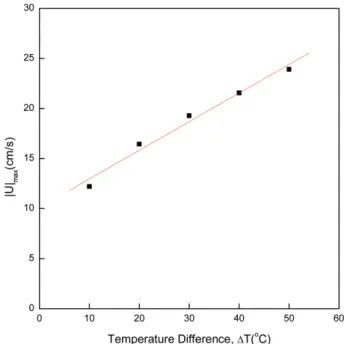
In the author’s previous results [34], the relations of aspect ratio and total molar flux was addressed and as a sequential study, in this paper the maximum magni- tudes of velocity vector in the dimensional unit (cm/s) as a basis of convection intensity would be discussed with (1) aspect ratios, (2) Peclet numbers, (3) the driv- ing potentials of the temperature differences between two ends in closed ampoules. A mixture of Hg
2Br
2and argon is chosen as a systematic model both on earth and under μg environments, and a gravity vec- tor of 10. Therefore, as a sequential study, in this paper one investigates numerically the characteristics of the double diffusion convection flow fields during the PVT processes of Hg
2Br
2crystal growth.
2. Modeling
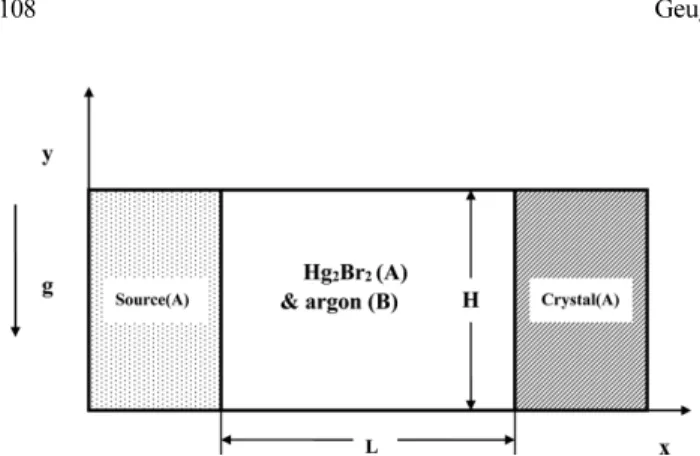
A steady state double diffusion convection in PVT crystal growth enclosure is considered with linear tem- perature profiles at sidewall boundary conditions, as
†
Corresponding author
†