https://doi.org/10.6111/JKCGCT.2020.30.3.117
Double-diffusive convection affected by conductive and insulating side walls during physical vapor transport of Hg 2 Br 2
Geug Tae Kim
†and Moo Hyun Kwon*
Department of Chemical Engineering, Hannam University, Daejeon 34054, Korea
**Department of Energy and Electrical Engineering, Woosuk University, Jincheon 27841, Korea (Received May 25, 2020)
(Revised June 1, 2020) (Accepted June 5, 2020)
Abstract In last few decades, although thermal and/or solutal buoyancy-driven recirculating flows in a closed ampoule have been intensively studies as a model problem, there exist interesting total molar flux of Hg
2Br
2that have been unreported in the literature. It is concluded that the total molar flux of Hg
2Br
2(A) increases linearly and directly as the temperature difference regions in the range of 10
oC T 50
o, 3.5 × 10
3 Gr
t 4.08 × 10
3, 4.94 × 10
4 Gr
s 6.87 × 10
4. For the range of 10 Torr P
B 150 Torr, the total molar flux of Hg
2Br
2(A) decays second order exponentially as the partial pressure of component B (argon as an impurity), P
Bincreases. From the view point of energy transport, the fewer the partial pressure of component B (argon), P
Bis, the more the energy transport is achieved.
Key words Double diffusion, Physical vapor transport, Hg
2Br
21. Introduction
During the past few decades one area of interest in double diffusion has been the study of the physical vapor transport (PVT) processes in a sealed chamber. In recent years, the problems of Cattaneo-Christov double diffusion have been studied for Williamson nanomateri- als slip flow subject to porous medium [1], and bi-direc- tional stretched nanofluid flow with Cattaneo-Christov double diffusion [2]. Muhammad et al. [3] addressed Darcy-Forchheimer flow over an exponentially stretch- ing curved surface with Cattaneo-Christov double diffu- sion. Asha and Sunitha [4] reported thermal radiation and hall effects on peristaltic blood flow with double diffusion in the presence of nanoparticles.
Mercurous halide materials are well known as the most promising materials in applications for acousto- optic materials and signal processing optics, for exam- ple, Bragg cells. Singh and his group investigated sys- tematically the growth and characterization and develop- ment of large single crystals of Hg
2Br
2[5-11]. Many reports of Hg
2Br
2could be found in references [12-16].
Kim and his coworkers [17-19] have performed two- dimensional numerical studies of double diffusion con- vection in the vapor phase during physical vapor crys- tal growth. Duval [20] published that four flow structure
regions appear during the physical vapor transport of mercurous chloride crystal growth.
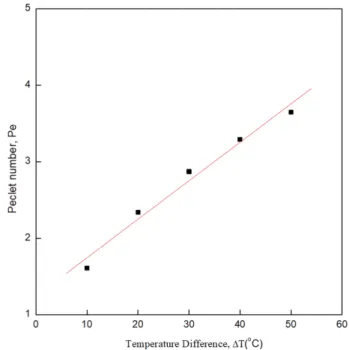
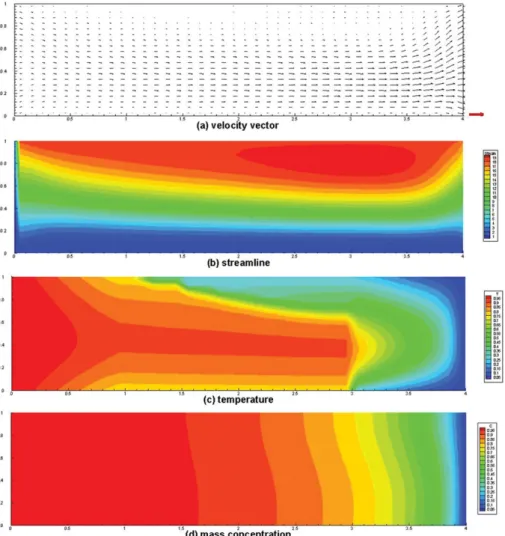
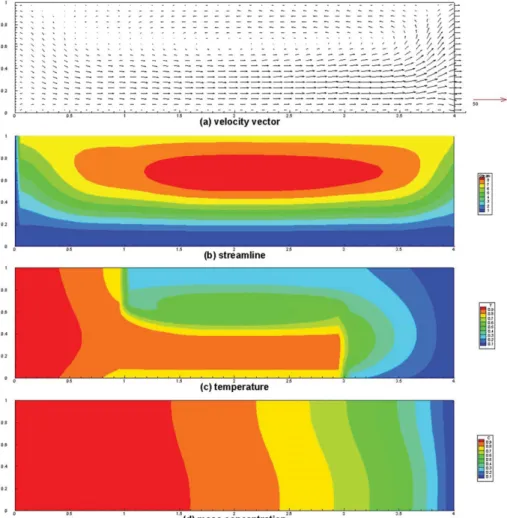
Our numerical simulations are motivated by the desire to study the influences of hybrid thermal boundary con- ditions on the convective flow because the final quality of crystal is affected by convection fields. In this paper, the effects of the temperature differences between the source and crystal, the Peclet number, Pe, and the par- tial pressure of component B (argon as inert gas), P
Bon the total molar flux of Hg
2Br
2and the maximum magni- tudes of velocity vector, |U|
maxin the dimensional unit (cm/sec) shall be addressed.
2. Numerical Simulations
Consider steady state thermal and solutal buoyancy driven recirculating flows of Hg
2Br
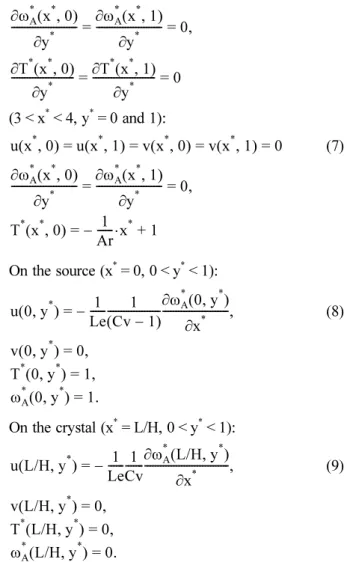
2(A)-argon (B) with thermo-physical properties listed in Table 1, in PVT crystal growth enclosure for hybrid thermal boundary conditions with linear temperature profiles, i.e., conduc- tive walls, and insulating walls, shown in Fig. 1, accom- panied by a 42 × 22 (x × y) grid system. The detailed assumptions and nomenclature can be found in refer- ence [17]. Also, the dimensionless parameters of Prandtl, Lewis, Peclet, Grashof, concentration, aspect ratio are described in reference [20].
In non-dimensional form, continuity, Navier-Stokes momenta, energy transport, and mass transport are gov-
†
Corresponding author
†