https://doi.org/10.6111/JKCGCT.2018.28.1.063
Convective heat and mass transfer affected by aspect ratios for physical vapor transport crystal growth in two dimensional rectangular enclosures
Geug Tae Kim
†and Moo Hyun Kwon*
Department of Advanced Materials and Chemical Engineering, Hannam University, Daejeon 34054, Korea
*Department of Energy and Electrical Engineering, Woosuk University, Jincheon-gun 27841, Korea (Received February 26, 2018)
(Revised March 12, 2018) (Accepted March 22, 2018)
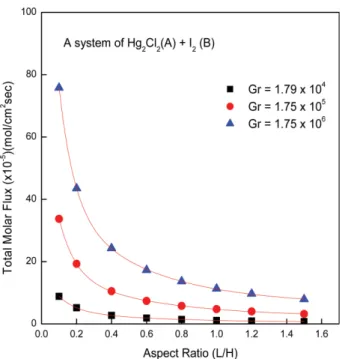
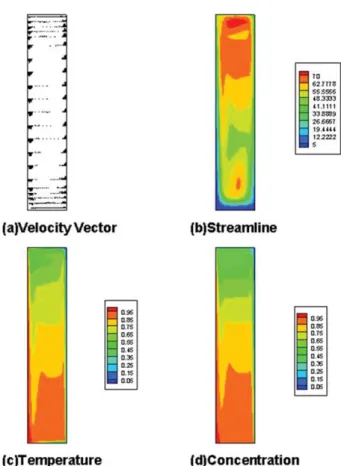
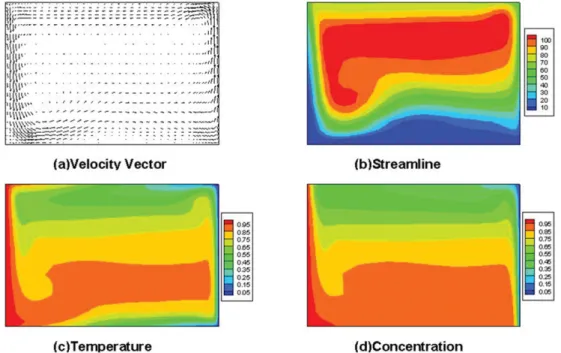
Abstract Natural convection of a two dimensional laminar steady-state incompressible fluid flow in a rectangular enclosure has been investigated numerically for low aspect ratios with the physical vapor transport crystal growth. Results show that for aspect ratio (Ar = L/H) range of 0.1 ≤ Ar ≤ 1.5, with the increase in Grashof number by one order of magnitude, the total mass flux is much augmented, and is exponentially decayed with the aspect ratio. Velocity and temperature profiles are presented at the mid-width of the rectangular enclosure. It is found that the effect of Grashof number on mass transfer is less significant when the enclosure is shallow (Ar = 0.1) and the influence of aspect ratio is stranger when the enclosure is tall and the Grashof number is high. Therefore, the convective phenomena are greatly affected by the variation of aspect ratios.
Key words Aspect ratio, Convection
1. Introduction
In recent years, numerical simulations of the effects of aspect ratios on natural convection in enclosures have been studied extensively in the views of heat transfer [1-20]. In particular, Wang et al. [1] investi- gated natural convection with low aspect ratio (Ar) less than 5, Rayleigh (Ra) numbers ranged from 10
5up to 10
6. They reported the local Nusselt number is affected much by low aspect ratio less than 5, but there is no change for higher aspect ratio of 10. Yigit et al. [3] presented the effects of aspect ratio on nat- ural convection of the Ostwald-Waele model fluids within rectangular enclosures. Choudhary and Sub- udhi [9] performed a systematic investigation of the turbulent natural convection of Al
2O
3/water nanofluids for aspect ratio range of 0.3 ≤ Ar ≤ 2.5, and Rayleigh number range of 10
7≤ Ra ≤ 10
12. Cheong and Siv- asankaran [11] investigated to understand the essence of the natural convection flow and heat transfer in inclined rectangular enclosures with sinusoidal tempera- ture profile on the left wall for aspect ratio range of 0.25 ≤ Ar ≤ 10, and Rayleigh number range of 10
3≤ Ra ≤ 10
6. Bouhalleb and Abbassi [12] addressed the natural convection in inclined cavity filled with CuO-
water nanofluid for aspect ratio range of 0.1 ≤ Ar ≤ 0.5 and Rayleigh number range of 10
4≤ Ra ≤ 10
7, and found that an anticlockwise rotating sing cell exists for all Rayleigh number, a secondary cell for Ar = 0.5 and Ra = 10
7. Kurian et al. [20] reported numerical studies on natural convection inside inclined cylin- ders with a unity aspect ratio, and the flow patterns induced natural convection were three dimensional and sensitive to the inclination angle. Duval [21-24] per- formed a systematical study for a wide range of con- vective parameters of Rayleigh number from 1.80 × 10
1 upto 5.03 × 10
7. Moreover, Duval studied numeri- cally the time dependent problems [21-24].
This paper concerns the two dimensional laminar steady-state thermal and solutal convection problems, which arise from the physical vapor transport pro- cesses of the mixture of Hg
2Cl
2-I
2system. As a model sample, we chose a material of Hg
2Cl
2and consider the physical vapor transport of a mixture of Hg
2Cl
2vapor and impurity of I
2in the vapor phase. The wall effects due to the aspect ratio and convection some- times oppose to each other particularly in certain regimes. Our simulation analyses are motivated by the desire to optimize the enclosure width such that mass transfer is either maximized or minimized as the aspect ratio (Ar) varies. Therefore, the subject of this paper is to study the effect of aspect ratio and Grashof number on convective flow inside the two dimensional enclosure.
†
Corresponding author
†