https://doi.org/10.6111/JKCGCT.2021.31.3.127
Studies on Nusselt and Sherwood number for diffusion-advective convec- tion during physical vapor transport of Hg 2 Br 2
Geug Tae Kim
†and Moo Hyun Kwon*
Department of Chemical Engineering, Hannam University, Daejeon 34054, Korea
*Department of Energy and Electrical Engineering, Woosuk University, Jincheon 27841, Korea (Received May 28, 2021)
(Revised June 14, 2021) (Accepted June 15, 2021)
Abstract This paper is dedicated to numerical simulation for diffusion-advective convection in a square cavity during physical vapor transport of Hg
2Br
2. Flow characteristics of the temperature difference between the source and crystal regions, 50
oC (300
oC 250
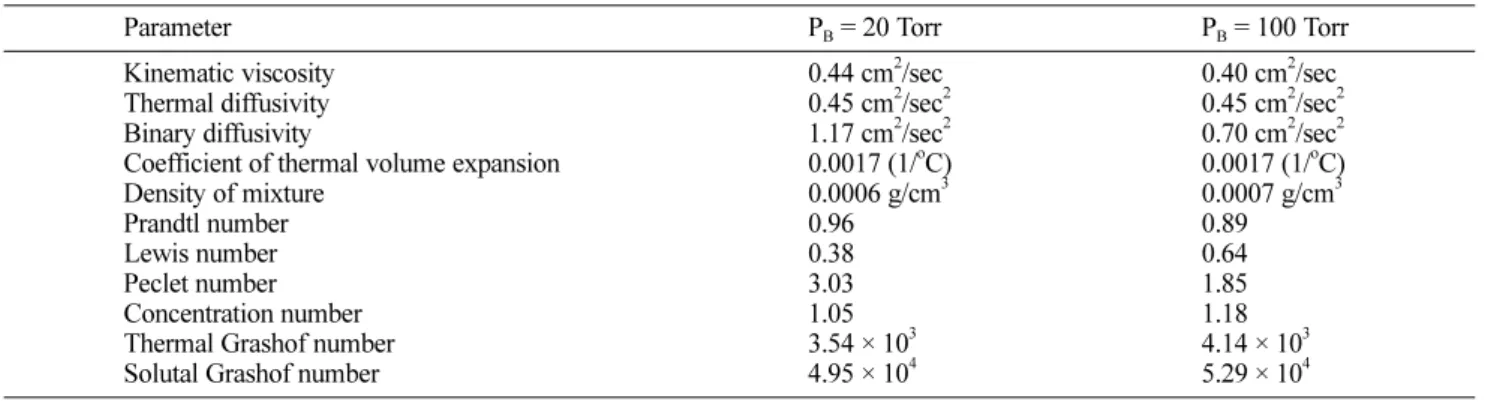
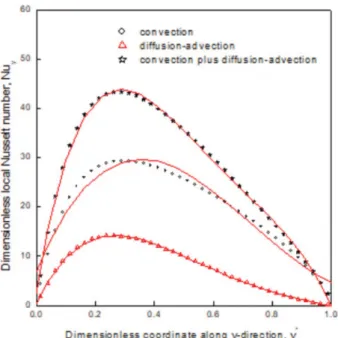
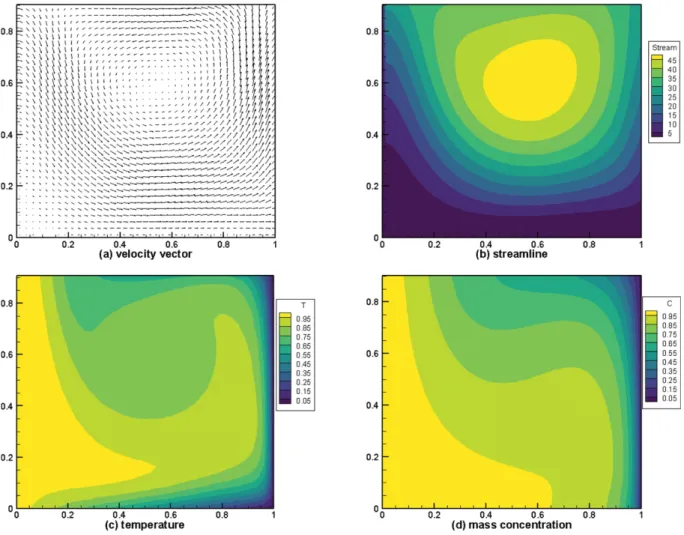
oC), partial pressures of component argon of 20 Torr and 100 Torr are investigated and presented as velocity vectors and streamlines, isotherms and iso-mass concentrations contours. Moreover, alterations of average Nusselt and average Sherwood numbers with (a) the source and crystal regions, (b) the pressures of component argon of 20 Torr and 100 Torr are analyzed and addressed in details. Both average Nusselt and average Sherwood numbers are seen to decrease with the increasing values of the partial pressures of component argon. Also, it is found that for the two different partial pressures of component argon, average Nusselt numbers at the source region are greater than at the crystal region, and inversely, average Sherwood numbers at the crystal region are greater than the source region by a factor of 3.
Key words Diffusion-advection, Nusselt number, Sherwood number, Physical vapor transport, Hg
2Br
21. Introduction
Double diffusive convection is a transport phenome- non associated with a buoyancy driven motion which emerges as a consequence of the gravity and the den- sity variations from both thermal and concentration gra- dients, and is referred to as thermo-solutal convection, or combined natural convection heat and mass transfer.
Yang and Zhao [1] carried out 2D numerical study of double diffusive convection in rectangular cavities with various aspect ratios (height-to-width). In most recent years, extensive researches on double diffusive convec- tion in the porous problems have been performed [2- 10]. The heat and mass transfer in double diffusion nat- ural convection associated nanofluids are investigated [11,12]. Liu et al. [13] reported that the Dufour and Soret effects with double-diffusive convection utilizing multiple-relaxation-time lattice Boltzmann model. Chak- kingal et al. [14] dealt that the heat and mass transfer in a cubical enclosure with adiabatic cylindrical obstacles.
Meften [15] addressed that conditional and unconditional stability for double diffusive convection. Hamimid et al.
[16] investigated the limit of the buoyancy ratio for dou- ble diffusive convection in binary mixture and Chauhan
et al. [17] studied the effect viscous dissipation on dou- ble diffusive convection in a square cavity.
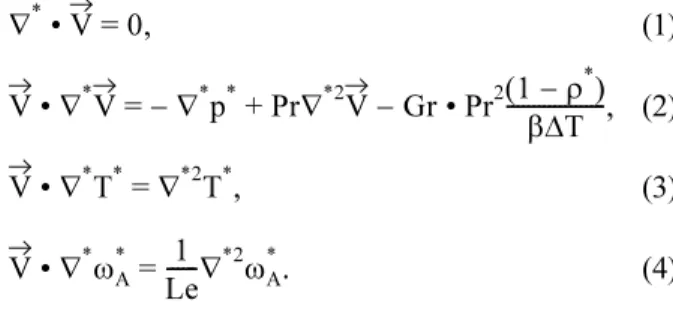
When a mass flux into the enclosure occurs at the hot end wall due to either the sublimation of a solid or evaporation of a liquid (species A), and condensation of species A occurs at the opposite cold wall end wall, combined natural convection by thermal and solutal gra- dients across the enclosure (double diffusive convection) and a mass flux at the surfaces (advection) occur simul- taneously and this mode of transfer is referred as a dif- fusive advection convection. An inert carrier gas (species B) which is not soluble in species A (solid or liquid) is present in the enclosure. For a typical example, the transport phenomena in a crystal growth system by the physical vapor transport (PVT) corresponds to diffusive- advective convection. Kim and his coworkers [18-21]
and Duval [22] have performed numerical simulations of diffusive-advective convection in the vapor crystals of mercurous halides grown by the physical vapor trans- port (PVT). Weaver and Viskanta [23,24] carried out systematically 2D numerical simulations of diffusive- advection convection based on evaporation and conden- sation from an application standpoint.
Mercurous halide materials are well known as the most promising materials in applications for acousto- optic materials and signal processing optics, for exam- ple, Bragg cells. In particular, Hg
2Br
2crystals have drawn
†
Corresponding author
†