27 This is an Open-Access article distributed under the terms of the Creative Commons Attribution Non-Commercial License (http://
creativecommons.org/licenses/by-nc/3.0) which permits unrestricted non-commercial use, distribution, and reproduction in any medium, provided the original work is properly cited.
J. Mushrooms 2016 June, 14(2):27-33 http://dx.doi.org/10.14480/JM.2016.14.2.27 Print ISSN 1738-0294, Online ISSN 2288-8853
© The Korean Society of Mushroom Science
*Corresponding author E-mail : [email protected] Tel : +82-61-862-8877, Fax : + Received May 31, 2016 Revised June 24, 2016 Accepted June 30, 2016
표고 수집종들의 유리당, 아미노산 및 β-glucan 함량
김경제 · 서경순*
(재)장흥군버섯산업연구원
Free sugar, amino acid, and beta-glucan content in Lentinula edodes strains collected from different areas
Kyung-Je Kim and Kyoung-Sun Seo*
Jangheung Research Institute for Mushroom Industry, Jangheung 529-851, Korea
ABSTRACT: In this study, we analyzed the nutrient composition and β-glucan content in Lentinula edodes fruiting bodies from different collection areas. Four types of free sugars were detected by HPLC, and the range of trehalose prevalence was 0.83% to 9%. The highest total amino acid content was observed from sawdust media cultivation of Lentinula edodes fruiting bodies, collected in China (JMI10050)The highest essential amino acid content, assessed by log cultivation of Lentinula edodes fruiting bodies, collected in Jangheung (JMI10059). Sixteen free amino acids were detected in Lentinula edodes fruiting bodies, and the major free amino acids were histidine, glutamic acid, and arginine. The highest essential amino acid including threonine, valine, methionine, isoleucine, leucine, phenylalanine, histidine, and lysine was fromsawdust media cultivation of Lentinula edodes fruiting bodies collected in China(JMI10052). The β-glucan content from log cultivation of Lentinula edodes fruiting bodies collected in Korea (JMI10059 and JMI10066) was higher than that from sawdust media cultivation of Lentinula edodes fruiting bodies collected in China. The highest β-glucan content was observed from log cultivation of Lentinula edodes fruiting bodies collected in Korea (JMI10066).
KEYWORDS: amino acids, collection area, free sugars, β-glucan, Lentinula edodes fruiting body
서 론
표고(Lentinus edodes)는 활엽수에 기생하는 담자균류 느타리과 잣버섯속 혹은 표고속으로 분류되며(Hong, 1980; Ko et al., 1999), 우리나라에서 가장 많이 생산되 는 버섯 중에 하나로 독특한 맛과 향을 지녀 오래전부터 식용으로 이용되어 왔다. 우리나라뿐만 아니라 중국, 일본
에서도 가장 많이 이용되는 버섯중의 하나로써 탄수화물, 단백질, 무기질, 및 각종 필수아미노산을 비롯하여 영양적 인 요소를 골고루 함유하고 있으며 독특한 향과 맛을 가 지고 있다(Hong et al., 1988; Yim et al., 1991). 또한 고 분자 다당체인 β-1,3 glucan인 lentinan에 의한 항암작용 (Park et al., 1998), 혈중 콜레스테롤 함량 감소효과 및 동맥경화 예방, 고혈압 치료 및 예방 등 다양한 약리 작용 이 있다고 보고되었다(Chang et al., 1990; Chang and Miles, 1989). 이러한 표고의 기능성분과 다양한 영양성분 이 있음에도 불구하고 현재 지역별 수집된 표고에 대한 성분분석 연구는 미미하며, 주로 재배특성 및 형질특성 평가에 치우쳐 있다. 우리나라의 경우 표고 품종 특성에 대해 품종별 발생시기, 발생온도, 갓의 형태 및 색상에 따 라 설명하고 있고, 중국, 일본 또한 주로 발생온도, 발생·
재배형, 형태, 색, 사용용도 등에 따라 품종을 소개하고 있다(Park et al., 2008). 상기와 같은 형질에 대한 분석외 에 수집된 표고들의 성분분석을 통해 지역별 수집종들의 차이점을 분석하였으며, 수집된 표고들을 활용한 가공식 품 및 의약품 개발의 기초자료로 활용하고자 본 연구를
수행하였다. 세부적으로, 각 품종별 활용가치를 높이고자 국내외에서 수집한 품종을 대상으로 유리당, 유리아미노 산, 구성아미노산 등 영양학적 특성 및 β-glucan의 함량을 비교 분석하였다.
재료 및 방법
재 료
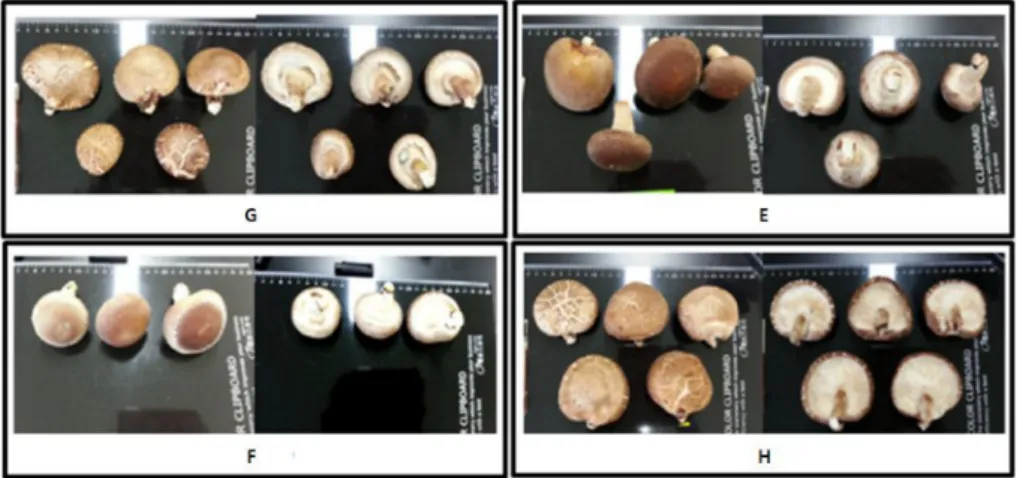
본 시험에 사용된 표고는 장흥군버섯산업연구원에서 수 집 및 분류하여 건조 보관된 자실체를 사용하였다(Table 1, Fig. 1, 2).
시 약
실험에 사용한 추출 및 chromatography용 용매 및 시약 (Sigma-Aldrich Co., USA)은 일급 또는 특급시약을 구입 하여 사용하였다.
유리당 분석
유리당은 시료 20 g에 증류수를 가하여 100 mL로 정용 하여 추출시킨 다음 원심분리(3,000 rpm, 30 min)한 상징 액을 1차 여과(Whatman No.2)한 후, 0.45 µm membrane filter(Millipore Co., U.S.A)로 2차 여과한 여액을 분석시 료로 사용하였다. 전처리된 시료의 분석은 HPLC system Table 1. List of tested Lentinula edodes strains from different collected areas
Sample Strain No. Collected year
Collected
area Remarks
A JMI10050 2013 China Sawdust Cultivation B JMI10052 2013 China Sawdust Cultivation C JMI10054 2013 China Sawdust Cultivation D JMI10056 2013 China Sawdust Cultivation E JMI10064 2013 Korea Sawdust Cultivation F JMI10065 2013 Korea Sawdust Cultivation G JMI10059 2013 Korea Log Cultivation H JMI10066 2013 Korea Log Cultivation
Fig. 2. The pictures of Lentinula edodes colleted from Korea.
Fig. 1. The pictures of Lentinula edodes colleted from China.
(Agilent Technologies 1200 Series, Germany), 검출기는 ELSD(Agilent Technologies 1200 Series, France)를 사용 하였다. Column은 ZORBAX Carbohydrate(4.6 mm × 150 mm, 5 µm, USA)를 사용하였고, Column 온도는 30oC, 이동상은 DW: ACN(25 : 75, v/v)을 제조하여 사 용하였다. 유속은 분당 1.0 mL였으며, 시료 주입량은 5 μL로 하여 분석하였다.
구성아미노산 분석
아미노산은 분해 및 유도체화 과정을 거친 후 HPLC system(Agilent Technologies 1200 Series, Germany), FLD 검출기(Agilent Technologies 1200 Series, France) 를 사용하였다(Daniel and Steven, 1993; Steven and Dennis, 1993). 시료 0.5 g을 시험관에 넣고 6N-HCl 용액 10 mL를 가한 후 시험관을 밀봉 후 110oC에서 24시간 가수분해 시 켰다. 가수분해하여 얻은 여액을 원심분리하고, 상등액을 50oC에서 농축하여 염산과 물을 완전히 증발시킨 후, 20 mM HCl(pH 2.2)을 사용하여 5 mL로 정용하였다. 정용된 액을 0.45 µm membrane filter로 여과한 다음 여액을 취하 여 AccQ-Tag 시약을 사용하여 유도체화 시킨 후 분석 시 료로 사용하였다. 함량은 integrator에 의한 외부표준법으로 계산하였고 분석조건은 Table 2와 같다.
유리아미노산 분석
시료의 유리 아미노산 분석은 유리당 정량과 같은 방법 으로 전처리하여 얻은 여액 10 mL에 sulfosalicylic acid 25 mg을 첨가하여 4oC에서 4시간 동안 방치시킨 후 원심 분리(50,000 rpm, 30분)하여 단백질 등을 제거하였다. 상 등액을 취하여 0.45 µm membrane filter로 여과하여 얻 은 여액을(Ohara and Ariyoshi, 1979) AccQ-Tag 시약으 로 유도체화 시킨 후 HPLC로 분석하였으며 분석조건은 구성아미노산 분석과 같다.
β-glucan 분석
시료의 β-glucan은 Megazyme kit (Mushroom and Yeast β-glucan Assay Procedure K-YBGL, Megazyme, Ireland)을 이용하여 측정하였다.
먼저 total glucan은 100 mesh 체로 거른 분쇄 시료 100 mg 을 tube에 넣어 37% HCl 1,5 mL을 넣고 45분간 30oC water bath에 넣어 분해하였다. 그 후 증류수 10 mL 을 넣어 vortex하고, 100oC에서 2시간 incubation 시켰다.
그 후 실온에서 식히면서 2 N KOH를 10 mL씩 넣고, 200 mM sodium acetate buffer를 첨가하여 100 mL로 정 용 후 충분히 mixing 하였다. 그 후 상등액 0.1 mL 에 200 mM sodium acetate buffer에 녹인 exo-1,3-β- glucanase plus β-glucosidase 0.1 mL을 넣었다. Reagent blank는 acetate buffer 0.2 mL을 넣고, D-glucose standard는 D-glucose standard 0.1 mL과 acetate buffer 0.1 mL을 넣고 mixing 후 40oC에서 60분 동안 incubation 하였다. Glucose oxidase/peroxidase mixture(GOPOD) 3 mL을 넣고 40oC에서 20분 동안 incubation 한 후, 510 nm에서 흡광도를 측정하였다.
α-Glucan은 100 mesh 체로 거른 분쇄 시료 100 mg 을 tube에 넣고 2 M KOH 2 mL씩 넣고 20분간 mixing 하 였다. 1.2 M sodium acetate buffer 8 mL를 넣고 섞은 후 amyloglucosidase plus invertase 0.2 mL을 넣고, 잘 섞어 서 40oC water bath에서 30 분간 incubation 하였다. 상등 액 0.1 mL에 200 mM sodium acetate buffer 0.1 mL, GOPOD 3 mL을 넣고 40oC에서 20분간 incubation 한 후, 510 nm 흡광도에서 측정하였다. 계산은 total glucan 함량에서 α-glucan 함량을 빼서 β-glucan의 함량을 정량 하였다.
결과 및 고찰
유리당 분석
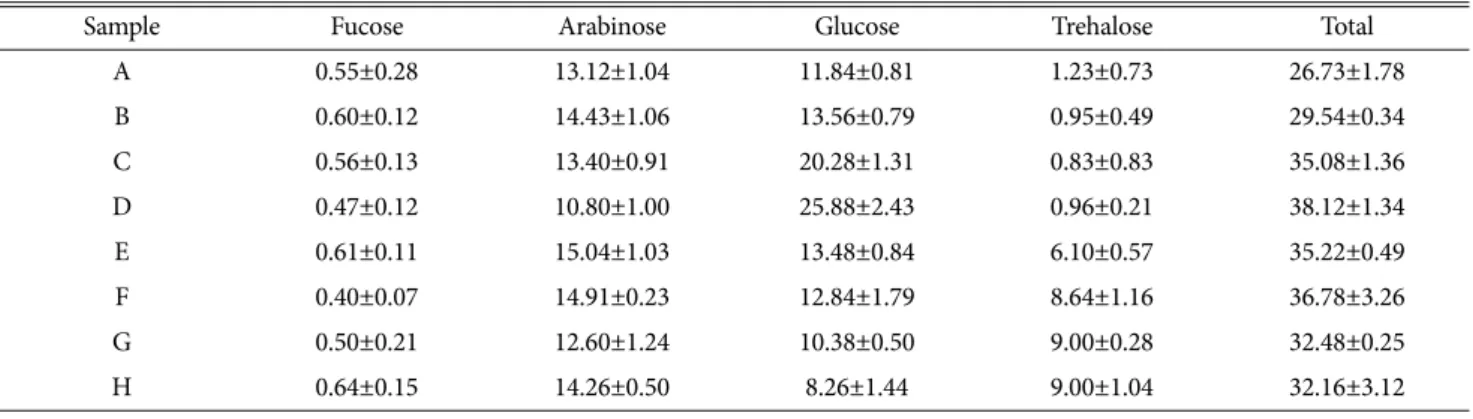
수집한 표고의 유리당 함량을 분석한 결과 총 4종의 유 리당이 검출되었으며, 그 종류로는 fucose, arabinose, glucose 및 trehalose로 나타났다(Table 3).
주요 유리당으로 glucose와 arabinose의 함량이 높게 나 타났다. Trehalose는 0.83~9.00%로 수집한 표고들 간에 Table 2. HPLC condition for the analysis of amino acids
Item Condition
Instrument Agilent Technologies 1200 Series Detector Agilent Technologies 1200 Series FLD
Column AccQ-Tag™
(Waters Co., 150 mm L × 3.9 mm ID)
Column temp
37oC
A : AccQ-Tag Eluent A(acetate-phosphate buffer) B : AccQ-Tag Eluent B(100% acetonitrile)
C : DW
Buffer solution
Flow rate 1.0 mL/min
Injection
volume 10 μL
함량차이가 크게 나타났다. 국내에서 수집한 원목재배 표 고 JMI10059와 JMI10066에서 9.00%로 가장 높은 함량 을 나타냈으며, 중국에서 수집한 표고 JMI10054에서 0.83%로 가장 낮은 함량을 나타냈다. Trehalose는 식품의 건조나 동결에 대한 보호작용, 전분노화 방지, 지방산패 방지, 식품조직의 안정화, 맛과 향 개선 등의 기능을 한다 고 알려져 있다(Kim et al., 2014). 기존연구에서는 표고
의 주요 유리당으로 mannitol, trehalose, arabitol와 glucose라고 보고한 바 있으나(Chen et al., 2015), 본 연 구에서는 mannitol이 검출되지 않은 차이점을 보였다.
Fucose 함량은 0.40~0.64%로 나타났다. 버섯의 항산화 활성에는 유리당이 상당 부분 관여한다는 기존 보고가 있 었으며, fucose는 항산화활성을 나타내는 대표적 유리당 으로 알려져 있다(Liao et al., 2013). 이러한 결과를 기초
Table 3. The contents of free sugars in the Lentinula edodes from different collected areas (%)
Sample Fucose Arabinose Glucose Trehalose Total
A 0.55±0.28 13.12±1.04 11.84±0.81 1.23±0.73 26.73±1.78
B 0.60±0.12 14.43±1.06 13.56±0.79 0.95±0.49 29.54±0.34
C 0.56±0.13 13.40±0.91 20.28±1.31 0.83±0.83 35.08±1.36
D 0.47±0.12 10.80±1.00 25.88±2.43 0.96±0.21 38.12±1.34
E 0.61±0.11 15.04±1.03 13.48±0.84 6.10±0.57 35.22±0.49
F 0.40±0.07 14.91±0.23 12.84±1.79 8.64±1.16 36.78±3.26
G 0.50±0.21 12.60±1.24 10.38±0.50 9.00±0.28 32.48±0.25
H 0.64±0.15 14.26±0.50 8.26±1.44 9.00±1.04 32.16±3.12
*The abbreviation of introductory remarks are the same as in Table 1.
All value are mean±SD of triplication determinations.
Table 4. The contents of total amino acid in the Lentinula edodes from different collected areas (mg%)
Compositions Sample
A B C D E F G H
Aspartic acid 1,427.39±74.20 1,465.55±30.79 658.55±62.85 1,280.36±10.72 1,108.99±21.26 1500.50±11.39 1,622.73±28.89 1,099.52±19.21 Serine 850.38±62.43 814.31±6.00 458.73±35.27 699.77±15.84 686.35±29.26 900.14±12.72 914.17±1.10 612.46±10.31 Glutamic acid 6,002.19±348.645,832.90±137.792,552.02±285.80 3,535.01±20.34 2,871.93±106.94 4515.09±32.72 3,855.76±60.02 1,761.38±7.28 Glycine 881.81±37.63 816.62±33.21 441.75±27.01 768.98±13.66 617.24±7.19 778.10±14.54 805.10±25.24 544.77±1.10 Histidine 490.10±24.71 487.34±12.93 258.26±23.14 377.79±0.66 359.22±26.89 475.35±2.22 647.29±10.25 339.01±1.92 Arginine 1,318.63±65.21 1,449.82±57.96 566.42±57.09 642.24±229.36 833.34±21.92 1222.82±16.03 1,362.87±46.34 727.70±4.47 Threonine 830.17±51.39 774.78±23.02 434.13±28.91 660.35±3.92 610.14±20.99 780.26±0.55 851.45±15.43 537.77±13.66
Alanine 972.15±67.09 911.65±1.47 486.25±39.86 777.40±13.59 717.57±32.10 922.88±14.48 971.74±1.62 710.58±52.97 Proline 759.64±350.23 635.72±100.42 355.62±112.29 486.48±3.33 495.35±15.25 784.74±7.22 686.27±49.70 370.79±32.82 Tyrosine 530.06±29.28 491.26±18.66 288.64±4.46 444.60±12.58 445.96±10.06 515.52±6.63 514.98±16.43 299.10±2.30
Valine 607.52±37.01 599.94±15.81 313.99±30.55 545.85±4.24 479.04±6.54 630.71±4.82 789.94±21.10 475.77±11.46 Methionine 209.24±14.20 179.55±4.71 99.27±13.68 161.50±4.50 162.82±4.21 205.30±1.83 193.79±4.82 113.99±4.04
Lysine 947.59±97.92 1,002.24±34.95 402.41±76.97 896.74±8.67 858.27±8.76 1104.91±36.82 1,248.46±57.46 710.30±12.56 Isoleucine 525.58±40.13 509.52±19.39 273.99±27.25 479.86±8.14 441.73±3.69 574.54±7.63 688.93±23.31 419.83±2.97 Leucine 803.68±11.76 774.53±94.14 414.03±88.41 726.96±71.78 723.73±51.86 942.00±96.37 1,065.46±129.21 673.79±52.40 Phenylalanine 516.46±12.16 508.48±43.70 314.58±35.36 486.37±32.05 464.89±13.67 577.66±32.99 725.93±56.80 431.34±19.15 TAA1) 17,672.59 17,245.19 8,318.66 12,970.25 11,876.59 16,430.51 16,944.87 9,828.10 EAA2) 4,930.34 4,836.37 2,510.67 4,335.41 4,099.85 5,290.71 6,211.26 3,701.81
EAA/TAA(%) 27.92 28.04 30.13 33.43 34.53 32.20 36.64 37.67
1)Total amino acid.
2)Total essential amino acid (Thr.+Val.+Met.+Ile.+Leu.+Phe.+His.+Lys.).
*The abbreviation of introductory remarks are the same as in Table 1.
All value are mean±SD of triplication determinations.
로 유용물질을 이용한 가공상품 개발 등 국내산 표고의 활용가치를 높일 수 있을 것으로 기대된다.
구성아미노산
구성아미노산 함량을 분석한 결과는 Table 4와 같다.
총 16종의 아미노산이 검출되었으며, 주요 구성아미노산 으로는 해독작용, 뇌 진정효과 및 당과 지질대사를 돕는 glutamic acid, 체내 중금속 제거 효과와 식품의 감칠맛 성분인 aspartic acid(Hong et al., 1989), 골다공증 예방, 치료 및 피로회복의 역할을 하는 lysine및 필수아미노산 중 하나이며 면역기능을 향상시키는 arginine으로 나타났 다(Eghianruwa et al., 2011).
총 아미노산함량은 중국 배지 표고 JMI10050에서 17,672 mg%, JMI10052 17,245 mg%, 장흥 원목 표고 JMI10059 16,944 mg%순으로 높게 나타났으며, 필수아 미노산의 함량은 장흥 원목 표고 JMI10059 6,211 mg%, 장흥 배지 표고 JMI10065 5,290 mg%, 중국 배지 표고 JMI10050 4,930 mg% 순으로 높게 나타났다. Kwon et al.
(1987)은 표고버섯의 아미노산을 분석한 결과 tryptophan 을 제외한 16종의 아미노산이 검출되었고 이들 중 glutamic acid, isoleucine, aspartic acid, phenylalanine 순으로 높은 함량을 나타내었다고 보고하여 본 연구결과와 주요아미노
산과 함량에서 약간 다른 결과를 보였다.
유리아미노산
유리아미노산 함량을 분석한 결과, 총 16종의 아미노산 이 검출되었으며, 주요 유리아미노산으로는 histidine, glutamic acid 및 arginine으로 나타났다(Table 5). 총 함량 은 중국 톱밥배지 표고가 899.82 mg%로 가장 높게 나타 났으며, 국내에서 원목 재배한 표고(JMI10066)에서 407.12 mg%로 가장 낮은 함량을 나타내었다. 필수 유리아미노산 인 threonine, valine, methionine, isoleucine, leucine, phenylalanine, histidine 및 lysine의 함량은 중국 톱밥재 배 표고(JMI10052)에서 521.06 mg%로 가장 높게 나타 났으며, 국내 원목재배 표고(JMI10066)에서는 192.06 mg%로 가장 낮은 함량을 나타냈다. 유리 아미노산 중 methionine의 함량은 버섯의 강력한 항산화 성분인 ergothioneine함량과 밀접한 관계가 있는 것으로 알려진 바 있다(Tepwong et al., 2012)
표고의 감칠맛 성분으로 잘 알려진 glutamic acid의 경 우 국내 원목재배 표고(JMI10065)가 302.20 mg%로 가 장 높은 함량을 나타냈고, 국내 원목재배 표고(JMI10059) 는 55.78 mg%로 가장 낮은 함량을 나타냈다. Park and Table 5. The contents of free amino acid in the Lentinula edodes from different collected areas (mg%)
Compositions A B C D E F G H
Aspartic acid 5.72±0.48 6.82±1.43 9.60±1.00 9.18±0.29 0.00±0.00 4.08±1.07 0.00±0.00 4.10±1.07 Serine 22.20±0.22 43.56±2.73 42.19±2.21 44.86±2.35 25.28±2.01 22.24±4.47 26.41±4.31 21.85±7.24 Glutamic acid 61.64±7.19 88.00±60.12 191.36±2.17 138.89±48.26 131.87±27.78 302.20±109.47 55.78±5.042 62.73±35.80 Glycine 11.19±0.38 20.16±0.79 18.84±0.87 33.39±0.52 7.61±0.12 10.03±1.94 6.71±0.89 6.23±1.04 Histidine 200.25±18.71 340.90±9.05 277.14±5.76 244.44±5.80 149.04±3.78 86.65±11.45 194.24±13.86 92.92±10.42 Arginine 51.36±1.25 114.50±6.09 70.88±5.80 61.08±3.70 49.68±4.13 42.32±10.51 59.84±9.46 34.84±7.45 Threonine 16.52±1.28 34.70±1.87 36.81±1.63 34.28±2.69 17.19±1.67 20.75±5.05 12.85±15.51 15.48±3.30 Alanine 22.62±4.31 32.66±8.07 35.59±7.19 46.95±11.37 20.57±5.22 21.90±8.31 30.21±9.69 36.75±12.37
Proline 13.30±14.04 18.61±19.31 20.51±17.95 24.73±21.79 38.23±7.91 30.51±7.89 28.40±23.76 44.90±8.72 Tyrosine 2.83±1.24 3.21±0.18 12.08±0.30 8.44±0.51 5.80±0.53 11.86±2.44 6.95±0.86 3.66±0.28
Valine 11.26±0.85 24.39±3.32 29.67±3.37 36.74±5.42 12.39±2.04 15.74±4.67 23.15±5.27 15.89±3.70 Methionine 6.69±0.13 7.10±0.78 12.86±1.07 12.44±0.88 3.61±0.69 5.97±1.73 3.49±0.71 3.55±0.53
Lysine 8.90±1.33 44.98±16.95 50.63±16.47 73.26±26.41 26.58±12.02 35.77±19.81 47.73±21.99 19.94±8.10 Isoleucine 4.72±5.32 17.85±3.51 24.27±3.09 27.94±4.69 8.80±1.95 13.59±4.48 16.01±3.93 9.56±2.10
Leucine 15.20±1.48 27.53±4.25 37.76±4.82 43.71±7.59 16.58±3.35 22.82±7.12 23.60±5.81 17.83±4.30 Phenylalanine 12.37±1.10 23.60±0.64 29.3±0.50 35.44±0.39 14.86±0.27 22.91±3.70 20.97±1.83 16.89±1.68
TFAA1) 466.78 848.57 899.82 875.78 528.09 669.34 556.36 407.12
EFAA2) 275.91 521.06 498.77 508.26 249.06 224.20 342.05 192.06
EFAA/TFAA(%) 59.08 61.53 55.41 58.08 47.31 33.74 61.59 47.75
1)Total free amino acid.
2)Total essential free amino acid (Thr.+Val.+Met.+Ile.+Leu.+Phe.+His.+Lys.).
*The abbreviation of introductory remarks are the same as in Table 1.
All value are mean±SD of triplication determinations.
Na (2005)의 경우 유리 아미노산 중 가장 많이 함유된 아 미노산은 cystine으로 보고하여 조금씩 다른 결과를 보였 다. 이러한 결과는 수확시기, 시료보관 상태 및 배지의 영 양상태 등에 따라 많은 영향을 받으므로, 추후 지속적인 연구 통해 안정적인 자료를 수집하고자 한다.
β-glucan
일반적으로 담자균류의 자실체는 β(1→3), β(1→4), β(1
→6)결합이 복잡한 구조를 이루고 있다. β-1,3-Glucan을 주쇄로 하여 β-1,6-glucan이 함유된 다당류가 풍부하게 존 재하는 것으로 보고되었다(Nakajima et al., 2002.). 담자 균류 유래의 다당류는 solid tumor에 대한 증식억제효과 가 높은 것으로 밝혀져 있으며, 버섯 100 g 당 β(1→3)D 글루칸 함량은 꽃송이버섯 43.6 g, 잎새버섯 15-20 g, 영 지버섯 8-15 g, 송이버섯 18.1 g에 존재하는 것으로 알려 져 있다(Miura et al., 1997; Kajimura and Suga, 2004;
Um et al., 2010). 수집된 표고의 β-glucan 함량을 분석한 결과는 Table 6과 같다. 중국에서 수집한 표고에 비하여 국내에서 재배된 표고의 β-glucan이 약 10% 가량 높게 나타났고, 그 중 국내 원목재배 표고 JMI10066이 31.74%로 가장 높은 함량을 나타내었다. 기존 연구에서 표고의 β-glucan 함량은 표고 조직의 노화 정도 및 포자 발생여부와 직접적 관련이 있다고 보고한 바 있어 (Sakamoto et al., 2006), 표고 수집 지역에 따른 β-glucan 함량차이는 표고 조직의 노화 정도가 영향을 미친 것으로 생각된다. 따라서 추후 연구에서는 시료수집 후 재배양을 통한 시험구간의 표준화를 시도한 후 추가 분석을 수행하 고자 한다.
적 요
국내외에서 수집한 표고 품종을 대상으로 영양성분 및 β-glucan 함량을 분석한 결과 수집한 표고의 유리당 함량 을 분석한 결과 총 4종의 유리당이 검출되었으며, 그 중 trehalose 함량은 시료별로 0.83 ~9%까지 큰 차이를 보였 다. 구성아미노산 함량을 분석한 결과 총 아미노산함량은 중국 톱밥배지 표고 JMI10050에서 17,672 mg%로 가장 높게 나타났으며, 필수아미노산의 함량은 국내 원목재배 표고 JMI10059에서 6,211 mg% 가장 높게 나타났다. 유 리아미노산 함량을 분석한 결과, 총 16종의 아미노산이 검출되었으며, 주요 유리아미노산으로는 histidine, glutamic acid 및 arginine으로 나타났다. 필수 유리아미노산인 threonine, valine, methionine, isoleucine, leucine, phenylalanine, histidine 및 lysine의 함량은 중국 톱밥배 지 표고 JMI10052에서 521.06 mg%로 가장 높게 나타 났다.
중국에서 수집한 표고에 비하여 국내에서 재배된 표고 의 β-glucan이 약 10% 가량 높게 검출되었고, 그 중 국내 원목재배 표고 JMI10066이 31.74%로 가장 높은 함량을 나타냈다.
감사의 글
본 연구는 Golden Seed 프로젝트 사업(과제번호 : 213003-04-3-WTH12)의 일환으로 수행되었으며 이에 감 사드립니다.
References
Chang ST, Miles PG. 1989. Mushroom science in edible mushrooms and their cultivation. CRC Press, London. p325.
Chang YS, Lee HB, Lee SR, Shin ZI. 1990. Studies on the extracts preparation of Korean shiitake mushroom(Lentinus edodes).
Korean J Food Sci. 22: 828-832.
Chen W, Li W, Yang Y, Yu H, Zhou S, Feng J, Li X, Liu Y. 2015.
Analysis and evaluation of tasty components in the pileus and stipe of Lentinula edodes at different growth stages. J agric food chem. 63: 795-801.
Daniel JS, Steven AC. 1993. Sensitive analysis of cystine/cysteine using 6-aminoquinolyl-N-hydroxysuccinimidy carbamate (AQC) derivatives. Techniques in Protein Chemistry. 4: 299- 306.
Eghianruwa Q, Odekanyin O, Kuku, A. 2011. Physicochemical properties and acute toxicity studies of a lectin from the saline extract of the fruiting bodies of the shiitake mushroom, Lentinula edodes (Berk). International journal of biochemistry and molecular biology. 2:309-317.
Hong JS. 1980. Nutrition value and medicine efficacy of mushroom. Food Industry 53: 79-84.
Hong JS, Lee KR, Kim YH, Kim DH, Kim MK, Kim YS, Yeo KY.
1988. Volatile flavor compounds of Korean shiitake Table 6. β-glucan content in the Lentinula edodes from
different collected areas
Sample Contents(%)
Total glucan α-glucan β-glucan JMI10050 0.24±0.031)c 0.10±0.01d 18.76±0.13c JMI10052 0.20±0.02c2) 0.03±0.00e 15.70±0.702cd JMI10054 0.21±0.02c 0.04±0.00e 16.56±0.27cd JMI10056 0.24±0.03c 0.03±0.00e 24.80±0.06bc JMI10064 0.41±0.05ab 0.96±0.04a 24.05±2.22bc JMI10065 0.37±0.03b 0.35±0.02c 27.15±4.57ab JMI10059 0.36±0.02b 0.06±0.01de 28.46±0.08a JMI10066 0.47±0.04a 0.67±0.05b 31.74±2.94a
*The abbreviation of introductory remarks are the same as in Table 1.
1) All value are mean±SD of triplication determinations.
2) Means separation within columns by Duncan's multiple range test, 5% level(a>b>c>d>e).
mushroom (Lentinus edodes). Korean J Food Sci Technol.
20:606-612.
Hong JS., Kim YH., Kim MK., Kim YS., Sohn HS. 1989. Contents of free amino acids and total amino acids in Agaricus bisporus, Pleurotus ostreatus and Lentinus edodes. Korean J.
Food Sci. Technol. 21:58-62
Kajimura M, Suga T. 2004. Research and development of functional food including superfine BETA-glucan (Lentinan).
Chemical Industry 55:466-475
Kim YJ, Lee JH, Chung KC, Lee SK. 2014. Effect of trehalose on rheological properties of bread flour dough. Korean J Food Sci Technol. 46:341-346.
Ko JW, Lee WY, Lee JH, Ha YS, Choi YH. 1999. Absorption characteristics of dried shiitake mushroom powder using different drying methods. Korean J Food Sci Technol. 31:128- 137.
Kwon JH, Byun MW, Cho HO, Kim YJ. 1987. Effect of chemical fumigant and γ-rays on the physicochemical properties of dried oak mushrooms. Korean J Food Sci Technol. 19:273-278.
Liao, SF, Liang CH, Ho MY, Hsu TL, Tsai TI, Hsieh YSY, Tsai CM, Li ST, Cheng YY, Tsao SM, Lin TY, Lin ZY, Yang WB, Ren CT, Lin KI, Khoo KH, Lin CH, Hsu HY, Wub CY, Wong CH. 2013. Immunization of fucose-containing polysaccharides from Reishi mushroom induces antibodies to tumor- associated Globo H-series epitopes. PNAS. 110:13809-13814.
Miura T, Ohno N, Miura NN, Shimada S, Yadomae T. 1997.
Inactivation of a particle β-glucan by proteins in plasma and serum. Biol. Pharm. Bull. 20:1103-1107.
Nakajima A, Ishida T, Koga M, Takeuchi M. 2002. Effect of hot water extract from Agaricus blazei Murill on antibody producing cells in mice. Int. Immunopharmacol. 2:1205-1211.
Ohara I, Ariyoshi S. 1979. Comparison of protein precipitants for the determination of free amino acid in plasma. Agric. Biol.
Chem. 43: 1473-1476.
Park JS, Na HS. 2005. Quality characteristics of Jocheong containing various level of Letinus edodes extracts. J Korean Soc Food Sci Nutr. 34:1082-1090.
Park MH, Oh KY, Lee BW. 1998. Anticancer activity of Lentinus edodes and Pleurotus ostreatus. Korean J Food Sci Technol.
30:702-708.
Park WC, Yun GH, Kim SC, Hong KS, Sim ST. 2008. A guide for cultivation of special crop; The cultivation of Lentinus edodes.
Ukgo Publishing co Press, Korea forest service, Daejeon, Republic of Korea. pp. 59-90.
Sakamoto Y, Watanabe H, Nagai M, Nakade Keiko, Takahashi M, Sato T. 2006. Lentinula edodes tlg1 encodes a thaumatin-like protein that is involved in lentinan degradation and fruiting body senescence. Plant physiology 141: 793-801.
Steven AC, Dennis PM. 1993. Synthesis of a fluorescent derivatizing, 6-aminoquinoly-N-hydroxysuccinimidyl carbarmate and its application for the analysis of hydrolysate amino acid via high-performance liquid chromatography. Analytical Biochemistry 211:1-9.
Tepwong P, Giri A, Sasaki F, Fukui R, Ohshima T. 2012. Mycobial enhancement of ergothioneine by submerged cultivation of edible mushroom mycelia and its application as an antioxidative compound. Food chemistry. 131: 247-258.
Um SN, Jin GE, Park KW, Yu YB, Park KM. 2010. Physiological Activity and Nutritional Composition of Pleurotus Species.
Korean J Food Sci Technol. 42:90-96.
Yim SB, Kim MO, Koo SJ. 1991. Determination of dietary fiber contents in mushrooms. Korean J Soc Food Sci. 7: 69-76.