I. Introduction
In relation to the construction of scientific know- ledge and concepts, three types of inference play an important role: deduction, induction and abduction (Anderson, 2000; Kwon et al, 2003b; Lawson, 1995;
Newell & Simon, 1972). Among these inferences, researchers consider abduction in particular as being essential in generating hypotheses that are useful in extending scientific knowledge (Aliseda, 2004; Curd, 1980; Fischer, 2001; Hanson, 1961; Thagard, 1988).
Abduction, which was systematically conceptualized by C. S. Peirce (Murphey, 1961; Hanson, 1958), is a kind of creative process to induce a new discovery in science (Magnani, 2004; Paavola, 2004). Abduction has been said to be the only logical operation which introduces any new idea. While induction does no- thing but determine a value, deduction merely evolves the necessary consequences of a pure hypothesis; that is, “all the idea of science comes to it by the way of abduction (Peirce: CP 5.145)”. For instance, Kepler’s explanation of the features of Mars’ orbital and
Galileo’s discovery of constancy of gravitational acceleration are examples of scientific discoveries conducted by abductive inference. These discoveries were made neither by just mathematically evolving the necessary consequence of hypothesis (that is, deductive inference), nor by mechanically extracting a common factor from collected observation (that is, inductive inference). Rather, discoveries resulted through abductive inference that led the scientists to reach to the conclusions beyond the information in the prior data (Hanson, 1958, pp. 85-89).
Very little research exists in context of young children’s knowledge construction in everyday life relating to science while significant research exists concerning the cases where great scientists (e.g., Kepler, Galileo, Newton) used abductive inferences to generate hypotheses then make their great dis- coveries during their inquiries (e.g., Hanson, 1958;
Lawson, 2002; Myrstad, 2004). Many scholars have pointed out that children construct their own know- ledge to interpret natural phenomena and that this knowledge influences how they construct new know-
Cases and Features of Abductive Inference Conducted by a Young Child to Explain Natural Phenomena in Everyday Life
Yong Jae Joung
*Seoul Daeyoung Elementary School
Abstract: The purpose of this study is to explore the cases and features of the abductive inference used by young children when trying to explain natural phenomena in everyday life. From observing a 5-year-old’s daily activities with his family, and analyzing the data according to the criterion extracted from the form of abductive inference described by C. S. Peirce, a few cases where the child used abductive inferences to explain natural phenomena were found. The abductive inferences in the cases were conducted: (a) based on figural resemblance and behavioral resemblance (b) under the influence by individual belief and communal belief, then (c) resulted in new categorization accompanied by over generalization. Such features of the abductive inference showed the
‘double faces’; sometimes encourages and sometimes discourages children’s generating better scientific hypotheses and explanations. These results suggest that even young children use abductive inference to explain doubtful natural phenomena in everyday life, although we need to consider carefully with the double aspects of the features of abductive inference for the practical applications to the fields of science education. Finally, several suggestions and following studies for science education are proposed.
Key words: abductive inference, hypothesis generation, explanation of natural phenomena.
*Corresponding author: Yong Jae Joung ([email protected]) **Received on 7 December 2006, Accepted on 25 March 2007
***This study was developed with a particular focus on abductive inference, based on a part of a paper presented at the International Science Education Conference 2006, Singapore.
simply isolated ideas but rather conceptual structures which provide a coherent understanding of the world (e.g., Gilbert et al., 1982; Osborne & Freyberg, 1985;
French, 2004). That is to say, children, even young children, are “interested in a wide variety of objects and events in the world around them” (Osborne &
Freyberg, 1985, p.1) as like scientists, and attempt to make sense of the world “in an orderly fashion towards the construction of an initial framework theory of physics that allows children to function adequately in the physical environment” (Kaufman et al., 2000, p. 7), since they were born and started to interact with the environments such as pulling their parents’ hair, taking a stick, and pushing away a toys, etc (Andersson, 1986). Children’s effort to explain natural phenomena and then construct scientific knowledge might happen not only at formal school, but also in the home in everyday life. In addition, the extension of scientific knowledge might happen to not only a few great scientists but also even young children as well as students, indicating that abduction might play a certain role in children trying to explain natural phenomena. Thus, it would be worthwhile to explore whether young children actually use abductive inferences to explain natural phenomena in everyday life and, if so, to identify the features of abductive inference conducted by young children. Such a study would give us useful data for devising particular strategies to teach science to young children and encourage elder students to construct their scientific knowledge with generating sound hypotheses.
Within South Korea alone, a significant number of science educational studies related to abduction exist, including studies of the process of hypothesis gene- ration and its practical applications (e.g., Kwon et al., 2003a; Jeong et al., 2005; Joung & Song, 2006a; Oh, 2006; Park & Kang, 2006), the theoretical aspects of abduction (e.g., Kwon et al., 2003b; Joung & Song, 2006b; Oh & Kim, 2005; Park, 2000), and cases of
children while trying to explain natural phenomena in everyday life. For this purpose, data was collected through the observation of a 5-year-old’s daily ac- tivities with his family in order to analyze the data according to the form of abductive inference des- cribed by Peirce, and to illustrate and discuss the features of the abductive inference conducted by the child.
II. Research Design
1. General Settings and Subjects
The focusing questions of this case study are as follows.
(a) Are there cases where a young child uses abductive inference while trying to explain natural phenomena in everyday life?
(b) If so, what are the features of the abductive inference used by the young child?
This study was conducted based on a young child’s daily conversations and activities at home.
Home is the place where young children could have the vast and qualitatively rich conversations related to science in comparison with other formal places such as formal school, kindergarten. They ask nu- merous questions at home such as “What happens to toast?”, “Is it melting?”, “What would happen to the potato if it got really hot?” etc., while children do not ask any questions at the formal center (Fleer, 1996).
This is the reason why the author meant to analyze daily conversations and activities which happened at home relating to science topics. As subjects of the study, the author’s family was adopted under their permission. The reason for this adoption was that it could be possible to observe daily conversations and activities in depth and continuously. The author, therefore, was a participant as well as an observer in this study.
A 5-year-old (exactly 4 years and 10 months at the
beginning of this study), referred as E, is the main participant in the study. At the start of the study, E had been attending a kindergarten for about two years. He could communicate with spoken language and sometimes in writing, and could carry out simple numerical summations and subtractions. He could also play simple games according to the given rules, such as card games. E liked to read children science books and to watch TV programs for children related to science. E’s mother, referred as M, had been teaching pupils at elementary school in Seoul, South Korea, for about 11 years. Although M taught all the subjects of the elementary school curriculum, she was interested in literature and art education rather than science and mathematics E’s father, referred as D, had been teaching pupils at primary school in Seoul for about 13 years, and possessed a PhD degree in science education.
2. Data Collection and Analysis
From the daily conversations and activities of E and his parents during 11 weeks, 29 episodes related to science topics were recorded in written form and sometimes on video. It was very difficult to record these episodes with any technological tools such as cameras, audio, video recorder because most convers- ations and activities happened unexpectedly. In addi- tion, these technological tools attracted E’s attention, and then made the conversation and activity cease or change. As a result, the cases which happened un- expectedly were recorded in written form (i.e., field notes by hand) (Merriam, 1988) during or right after the happening; however, a few cases that could be expected to happen were recorded by video camera.
The data was analyzed according to the form of abductive inference described by Peirce. Peirce highlighted two properties of abductive inference: (1) abductive inference makes it possible to regard the present doubtful/strange phenomena as one case of the prior general rule based on the resemblance between the phenomena and the rule (Peirce: CP 2.621-624); (2) abductive inference makes it possible to change someone’s psychological state from ‘doubt’
to ‘belief’ when this person meets doubtful phenomena (Peirce: CP 5.189, 5.374).
Peirce conceptualized abductive inference comparing
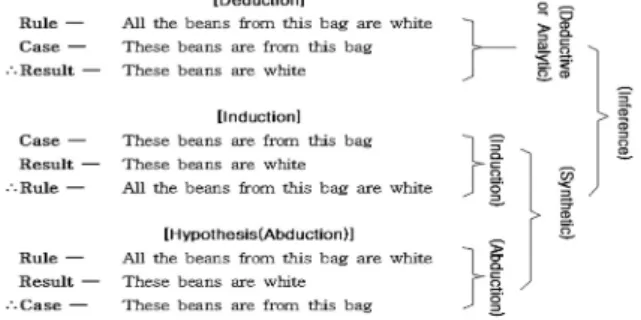
Fig. 1 The types of syllogism and inference categorized by Peirce (Based on CP 2.623)
two other inferences, deduction and induction, as shown in Fig. 1. Deductive inference is merely the application of general rules to particular cases. In deductive inference, for example, major premise lays down general rule (e.g., All the beans from this bag are white), and minor premise states case (e.g., These beans are from this bag), and then result (e.g., These beans are white) is derived by applying the rule to the case. Therefore, deductive inference is often called as analytical inference. Both inductive and abductive inferences are synthetic inference in respect of producing something beyond the information incorporated in the premise, although there are certain differences between them. Inductive inference infers rule from case and result; however, abductive inference infers case (e.g., These beans are from this bag) from rule (e.g., All the beans from this bag are white) and result (e.g., These beans are white) according to resemblance between the result and the rule (e.g., are white) (Peirce: CP 2.621-624). That is, abductive inference is “where we find that in certain respects that two objects have a strong resemblance, and infer that they resemble one another strongly in other respects” (Peirce: CP 2.624).
Eventually, abductive inference makes it possible to regard the present doubtful/strange phenomena as one case of the prior general rule based on the resemblance between the phenomena and the rule.
This feature of abductive inference makes someone feel stable in the ‘belief state’ because the doubtful phenomenon becomes a matter of course under the pre-accepted rule (Peirce: CP 5.189). For instance,
“Fossils are found; say, remains like those of fishes,
but far in the interior of the country. To explain the
phenomenon, we suppose the sea once washed over
this land.” (Peirce: CP 2.625). That is to say, ab- ductive inference is the logic that makes a doubtful/
strange phenomenon believable/ordinary by supposing the phenomenon as one case of more general rule according to the resemblance between the phenomena and the rule.
Concerning as this study, such features of abduc- tive inference could be expressed by the describing model; ‘Model of describing Abduction Process (MAP)’ (see Fig. 2). The MAP was developed by the author on the basis on the Peircean view of abduction that is the process of state transforming from ‘doubt’
to ‘belief’ through the ‘rule result case’ type inference as mentioned above. In Fig. 2, ‘Result’
stands for doubtful phenomenon observed by some- one, and ‘Rule’ for prior gneral rule, and ‘Case’ for explantory hypithesis as a result of abductive inference. The circular arrow stands for the conside- ration with resemblance between the Result and the Rule. The position of each constituent stands for whether it stands at unstabe state (Result) or stable one (Case). The three blankets was designed to help analyizing the data and describing the results of this study.
Considering the features of abductive inference mentioned above, the data was analyzed according to following three criterions:
- Is it the case related to natural phenomena or science topic?
- Is there a process where the child meets a doubtful phenomenon then tries to change his psy- chological state from the one of doubt to belief?
- Can the process of the child’s inference be regarded as the one by comparing resemblance be- tween the present phenomenon and the rule the child
knows (i.e., the logical form described by Peirce, as illustrated in Fig. 1)?
Examining the 29 episodes, the cases that satisfied all of three criterions above were adopted as being representative of instances where abductive inference was conducted in order to explain natural pheno- mena. Additionally, the cases were examined and confirmed whether they satisfy all three of the criterions by two experts, the first a major in science education focused on conceptual learning, and the other a major in philosophy of education focused on Peircean abduction. When it was necessary to examine what the rule the child already had known was, sometimes, supplementary interviewing the participants or exploring the corresponding parts of the other episodes were conducted. As a matter of convenience for the analysis and description, the MAP (see Fig. 2) was used as well. Based on the results of the analysis, the features of the adopted cases were illustrated and their implications for science education were discussed.
III. Results and Discussions
1. The Cases of Abductive Inference
Are there cases where a young child uses ab- ductive inference while trying to explain natural phenomena in everyday life? Analyzing on the daily episodes according to the three criterions, at least, three cases where the child used abductive inferences to explain natural phenomena were found as follows.
Case 1: ‘This rubber band is a keyboard (of a guitar)’
E explained the cause through abductive inference
while he was trying to find out the reason why the
Fig. 2 ‘Model for describing Abduction Process (MAP)’ and its application to this studytightened rubber band made sound. One day, E was playing with a pair of tweezers, a chisel for trimming nails, and yellow rubber bands. He repeated the playing the acts of lifting the rubber bands and releasing them with tweezers and a nail-trimming chisel. After doing it for two or three minutes, he started to fix them onto the drawers’ handles of TV case. After extending the rubber bands with the nail-trimming chisel, he affixed the other ends to the handles of the other drawers. He struck the tightened rubber strings with nail-trimming chisel and started to play. He listened to the sound it makes and struck the rubber strings of both ends by turns and repeated the acts for three or four minutes. As the rubber strings were fixed to the two handles of the drawers, the rubber strings became a shape of long ellipse and the extent of tension between two sides was different.
Dad, who had been watching him, said to him as follows in Excerpt 1.
Excerpt 1
01 D: Do you know why this makes sound?
02 E: .... (E thinks)
03 D: How do you think this makes sound?
04 E: .... (Without any words he keeps on striking strings) 05 M: Pleas think why this produces sound.
06 E: When I do this with only one, I can't find why, but when I do with two, (It means when he plucks strings of both right and left side one) it is like keyboard, like a guitar or violin. (He continued to make sound by plucking the rubber strings) 07 E: This is a low note, that is a high note. A guitar .
Originally this . (He was about to say something, when a rubber string came off flying) Wow! Wow!
It is a rocket. (He again affixes a rubber string and holds the chisel in one hand, the tweezers in other hand.)
08 E: I am going to do it again. Getting two things ready, I can pluck freely. (With the chisel, he plucks the rubber string as if he plays the violin and moving fast from side to side, plucking strings at the same time) It is OK if I strike freely.
09 D: In what way do you think they make sound?
10 M: Why does it make a high sound?
11 E: I don't know.
12 M: What do you think is the cause?
13 E: I think these become keyboards.
(Excerpted from Episode [19])
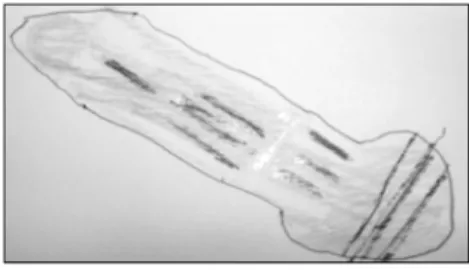
As shown in the above excerpt, E had not known the reason why the tightened rubber band made sound at first. It was too difficult for him to answer immediately to the parents’ question. After thinking for a minute, however, he made an explanation in his own way, “I think these become keyboards”, in turn 13. Why did he think like that? We can find out the reason in turn 06, “… it is a like keyboard, like a guitar or violin.” That is, for E, ‘keyboard’ has a special meaning as a tool of making sound, at least, when the musical instrument having some strings such as a guitar, a violin, and so on. Furthermore, his attention to the superficial similarity between the tightened rubber band and a guitar was shown again in his picture of a guitar drawn during the supple- ment interviewing about the first arising situation in his mind when he hears the word ‘a guitar’ (see Fig.
3)―such a method has been used to examine stu- dents’ ideas of science concepts in several previous researches (e.g., Jung & Song, 2004; Kang, 2006).
He said that “When I do this with only one, I can't find why, but when I do with two … it is a like keyboard like a guitar or violin” (turn 06). Why did he say that the rubber band was like a guitar only when the strings were two, not one? As shown in Fig. 3, his picture of a guitar shows that the numbers of strings were extremely highlighted, although not the same as the real shape of a guitar. Eventually, he paid attention to the similar shape of the rubber band and a guitar, particularly, in respect of having strings above two.
From the perspective of adults who of course know that the word ‘keyboard’ is ‘just the name’ for a part of particular instrument rather than the theory and mechanism for making sound, E’s answer is not an proper explanation of the cause of making sound, but just an expression requiring another question
Fig. 3 E’ picture of a guitar he first thought of when he heard the word ‘guitar’
such as “why does the keyboard make sound?”.
However, this explanation was useful for E to solve his doubtful problem, and even to explain the reason why different sound tone happened, as shown in turn 07, “This is a low note, that is a high note. A guita r…. Originally this…”. In other words, in his own way, he could explain well the doubtful phenomenon, i.e., the rubber band making sound, by regarding the rubber band as a keyboard of a guitar based on the resemblance between them. In summary, E’s in- ference conducted in Excerpt 1 can be described as an abductive inference, as shown in Fig. 4.
Case 2:‘The moving leg in the water is a picture’
Another case of E explaining a doubtful pheno- menon by abductive inference was found while he was trying to find out the reason why the leg in the water (of bath tube) look like the leg was moving by itself freely, as described in Excerpt 2. One day, E was having a bath with Dad in the tub. They sat face to face, having a good time by pushing water to each other. At that time, he asked suddenly, as follows.
Excerpt 2
01 E: Dad, how is it that your leg is so free?
02 D: Sorry?
03 E: Dad, what I mean is how does it happen that your leg moves as water goes by though your leg stays motionless?
04 D: Ah...! (He tries to stir water) when I do like this?
05 E: By the way, I didn't mean that. I just wanted to say it looked like that.
06 D: Did you? Yes, it happens when I do this way.
(Stirring water with his hands) As I do like this, my leg appears to be moving. In fact, I don't move my leg. How come?
07 E: How does it really happen?
08 D: How does it happen? How does it happen?
09 E: Isn't it just like a picture?
10 D: What did you say?
11 E: (sprinkling a cup of water to Dad suddenly) Pshaw! Ha, ha....
12 D: How does it happen?
(The conversation was stopped as E played splashing water all over. They resumed bathing. After five minutes or so of bathing, E had a jolly time playing with cups in the water such as sitting on them and then gave a question to Dad.)
13 E: Dad, by the way, (thrusting a cup into the water) how does the cup look smaller when I do like this?
14 D: Er It is really true. Why does it look smaller?
15 E: Look! It does really become smaller, doesn't it?
16 D: Why is it so? Why does the cup look smaller?
17 E: This is totally unreasonable and a nonsense. It is it is just like a picture, visible only to the eyes.
18 D: You said it is like a picture? What do you mean by it?
19 E: What I mean is it is not real, but it is a picture looking so to the eye.
20 D: Well, how does the picture look so?
21 E: Wow! (He starts again sprinkling water)
(The dialogue was stopped again. No mention came up during the bath concerning the subject mentioned above.)
(Excerpted from Episode [04])
E wondered about the reason why D’s leg moved
freely as water goes by although D’s leg stays
motionless as shown in turn 03. Of course, for a
physicist, this phenomenon should be illustrated with
refraction theory, considering the difference of density
of water and air, movement of water, etc. Although
not appropriate to physics theory, however, E tried to
explain cause of this phenomenon by comparing it
with something he knew already considering with
resemblance between them. The something was a
picture to him. He knew that D’s leg did not move
Fig. 4 MAP of ‘This rubber band is a keyboard (of a guitar)’really though looked like moving, as shown in turn 05; “By the way, I didn’t mean that. I just wanted to say it looked like that”. For him, the thing which is not real though looks real is “… a picture, visible only to the eyes” (turn 17). Therefore, he explained that the phenomenon, i.e., D’s leg is free, was just picture. By explaining like this, he could arrived at a stable state under his prior rule that picture is not real but visible only to the eye. The same explanation and process was found while he was trying to illustrate the reason why a cup in the water became smaller than in the air, as shown in turn 15 19. E’s inference shown in the excerpt 2 can be described by the MAP (see Fig. 5).
Case 3: ‘Electricity is a machine’
The following excerpt is another example of E using an abductive inference. One day, while having a breakfast, the TV showed an advertisement for a detergent used in a dishwashing machine. E’s ques- tions started when he thought that the detergent for a dishwashing machine, not the actual dishwashing machine, washes automatically by itself. He felt strange, and tried to explain it based on the resem- blance between a detergent and a machine, as shown in Excerpt 3.
Excerpt 3
01 E: Mum, we have that at our home, don't we?
02 M: Ha, ha. Yes, you know everything.
03 E: When the detergent is put into the dishwasher and gets mixed around, the washing is done, isn't it?
04 M: Yes, you are right.
05 E: Is that a machine, too?
06 M: Uh?
07 E: Is that also a machine?
08 M: What is a machine?
09 E: It is a thing which is moving and working by itself. Isn't it one of them?
10 M: Yes, you are quite right. However, we have different cases. If I hang the laundries on the line, they dry up by themselves, don't they? It is not because of the machine, but because of the power of the sun.
11 E: Emm. You are right. But isn't a washing-machine a machine?
12 M: Yes, we mean by machine that it has some physical body, like a washing-machine.
13 E: Electricity is a machine, isn’t it?
14 M: Electricity?
15 D: How did you think that electricity is a machine?
16 E: ... (He watches TV without words)
17 M: E, you can tell whatever under no pressure. Don't mind if you are wrong. Why do you think electricity is machine?
18 E: ... (He keeps on watching TV without words) 19 M: Is electricity machine?
20 E: (Suddenly he opens his mouth) Of course, it is.
21 M: Why?
22 E: It moves by itself. When electricity enters, it moves automatically.
23 D: Hmm. Give me an example.
24 E: Hmm. Hmm. (He ponders for about five seconds) 25 D: Er, for an example, is it something like TV set?
26 E: (His eyes are getting round) Therefore, it is some- thing like ‘Intelligence Development Model’. (It is a toy similar to a Science Box) When it is turned on, it moves and gives light as well. I can say something like a radio.
27 D: How about controlled car?
28 E: Yes, it is, too.
29 M: Ah, you mean you come to conclusion that electricity is machine, don't you? You are very clever.
(Excerpted from Episode [15])