http://dx.doi.org/10.7840/kics.2015.40.12.2410
Self-Organized Resource Allocation for Femtocell Network to Mitigate Downlink Interference
Smita Sable, Jinsoo Bae*, Kyung-Geun Lee°
ABSTRACT
In this paper, we consider the femto users and their mutual interference as graph elements, nodes and weighted edges, respectively. The total bandwidth is divided into a number of resource blocks (RBs) and these are assigned to the femto user equipment (FUEs) using a graph coloring algorithm. In addition, resources blocks are assigned to the femto users to avoid inter-cell interference. The proposed scheme is compared with the traditional scheduling schemes in terms of throughput and fairness and performance improvement is achieved by exploiting the graph coloring scheme.
Key Words : Inter-cell and intra-cell interference, graph theory, sub-band allocations, self-management, femtocell
※본 연구는 한국연구재단 기본연구 지원사업 (과제번호: 2015R1D1A1A09059026)의 지원으로 수행되었습니다.
First Author : Sejong University, Department of Information and Communication Engineering, [email protected], 학생회원
° Corresponding author : Sejong University, Department of Information and Communication Engineering, [email protected], 종신회원
* Sejong University, Department of Information and Communication Engineering, [email protected], 종신회원 논문번호:KICS2015-11-364, Received November 13, 2015; Revised December 11, 2015; Accepted December 11, 2015
Ⅰ. Introduction
The mobile world has experienced a technology revolution resulting in a tremendous increase in the number of mobile applications, and significant demands on bandwidth resources. These demands for higher data rates and better performance cannot be satisfied by improving macrocell technology.
Thus, operators have resorted to the fixed mobile convergence (FMC) domain, e.g. femtocells, as a pragmatic solution to support much higher data rates. Since research shows that the majority of the mobile services, especially data services, are initiated by indoor users
[1,2], femtocells are a very promising means of achieving improved transmission rates and quality of service (QoS).
Femtocells have been devised to provide good coverage in indoor environment with stable propagation channel and low mobility. With fixed backhaul such as DSL or coaxial cable
[3], femtocells can utilize the relatively low-loaded fixed network to
provide superior radio access as well as lower the macrocell load and enhance QoS. Femtocells typically provide the plug-and-play feature, which enables flexible installation and cost-effective coverage enhancement. However, this introduces challenges to the traditional paradigm of network planning and management.
Femtocells shares the same frequency band will cause severe interference and which results to degrade the system throughput because of the overlapping coverage area of densely deployed femtocells. Therefore how to reduce the interference is an important issue in the femtocell network. In so doing the dynamic spectrum allocation is an effective way to reduce interference among femtocells, and it also improves the system capacity.
In this study, the minimum interference can be achieved via access control, and resource allocation.
However, we proposed a graph coloring scheme
based on resource allocation to manage the
interference in femtocell environment. According to
the proposed scheme, we calculated the initial average interference for each FUE. In the graph coloring scheme, the RBs are allocated in such a way that it reduces interference by using the centralized self-managed spectrum allocation technique. The self-management begins when the femto base station (FBS) network starts to operate by gathering the parameters from the FBSs under its administration. Those parameters are power configuration and location (distance), thus by employing those parameters the femto spectrum manager (FSM) estimates the average interference for each FUE. The number of resource blocks m is determined to ensure that the total interference is below the maximum tolerable level. This study provides spectrum management architecture for a femtocell network using sub-band allocation based on a graph coloring scheme.
Graph coloring is an important part of many networking algorithm. Traditionally, graph coloring has been used prominently in the context of frequency assignment in networking
[4]. The author proposed the access point selection method, which helps user to obtain the high capacity than other users. It resulting the better performance of the system
[5]. Researchers have investigated femtocell issues such as architecture, access control, interference avoidance and capacity. This attention is due to unique characteristics of femtocells which differ from cellular macrocells, such as distributed system traits. Management of these systems has involved concepts such as self-organized network (SON)
[6]. Self-organizing networks have appeared as a promising solution for improving network management, performance of the network and flexibility, by upgrading the traditional manual network operation and management processes to automated management processes
[7]. A self-organized particle swarm optimization is used to minimize the inter-cell interference, by allocating RBs from the pool of component carriers
[8]. Several researchers have discussed spectrum resource allocation in femtocells-
[9]considered the fairness in serving users, and
[10]used min-max algorithm for spectrum resource allocation, ensuring fairness
between FBSs and reducing complexity by grouping FBSs to reuse spectrum resources. This algorithm tries to meet the need of each FBS without considering the overall performance. We propose the graph coloring algorithm, which considers overall system performance of FBS to manage inter-cell interference without disturbing the performance of the macrocell. The optimization of the resource allocation problem is attractive for the firms that finance the projects, where the optimum policy has to be established within the financial constraints.
Furthermore, resource allocation optimization may be applied in various areas including: management sciences, load distribution, dynamic programming, greedy algorithms, etc.
[11]. Within the context of telecommunication domain, resource allocation has profound importance. For example, meeting the QoS requirement of users in optical and ad hoc networks is a challenging task. This is due to unpredictable environmental effects such as: interference, traffic congestion, noise sources, etc. for mitigating the aforementioned effects, dynamic resource management is viable solution. A survey of the ant colony optimization within the context of resource allocation is presented in
[12]. Also, the optimization of resource allocation within the context of cognitive radios is presented in
[13]. Resource allocation scheme based on graph coloring algorithm for interference avoidance which introduce performance gain using spatial reuse in D2D system which resulting the minimum outage probability
[14].
The rest of this paper is organized as follows. In section 2, the network model and problem formulation is introduced. In section 3, coloring based spectrum allocation and self-organization algorithm is proposed. In section 4, performance results of proposed scheme are presented and finally conclusions are provided in section 5.
Ⅱ. Network Model and Problem Formulation
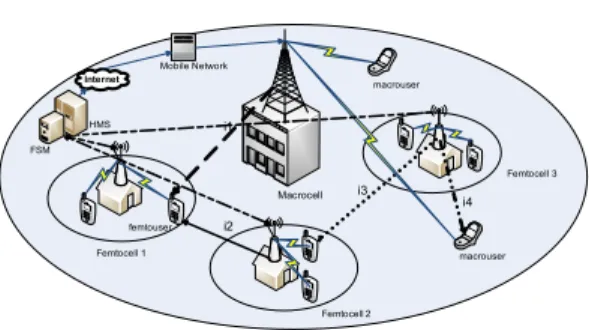
The proposed graph coloring scheme in the
hierarchical macro/femtocell network is shown in
Fig.1. Concerning shared channel environment, the
Femtocell 2
Femtocell 3 Macrocell
i1
i2
i3 i4
macrouser
macrouser femtouser
Femtocell 1 Internet
FSM
Mobile Network
HMS
Fig. 1. The two-tier network model.
two types of interference component such as inter-cell (femto –femto shown in i2 and i3) and intra-cell (femto-macro shown in i1 and i4) are the bottleneck in the performance enhancement. For the sake of their mitigation, a self-organized spectrum allocation based on graph coloring is proposed, where the goal is to maximize the average femtocell capacity while maintaining the QoS requirement of macrocell users. Moreover, self-organization is an optimum choice for this hierarchical macro/femtocell network because of the random deployment of femtocells and lack of coordination with the macrocell. In the proposed graph coloring scheme
, we are specifically considering the downlink transmission where each FBS is termed as the nodes/ vertices V in the graph and E is termed as edges, which connects two given vertices. The edge is generated between two vertices only when the two FBS transmitted on the same channel and which resulting interference, indicating as the edge weight. Furthermore, we assume that the centralize graph coloring scheme, where the resource allocation is carried out centrally by FSM in such a way which mitigate the interference in the system, which we will study in details in this study.
In this study, we consider a downlink transmission of OFDMA operated hierarchical network model. This system contains X number of macrocells, each overlaid with Y number of femtocells. Furthermore, each macrocell and femtocell is serviced by a base station at its center i.e. eNB and FBS. In addition, we assume L macro users (UEs) are randomly deployed in a region of a macrocell. As far as the FUEs are considered, we assume K FUEs always reside in the indoor
environment. Also we assume a close group formation, which means that handoff is not allowed and FUE can only be connected to concerned FBS.
In an OFDMA-based system, total system bandwidth W is divided into m RBs. Concerning to shred channel environment, these m RBs are shared among femtocells and macrocells. Considering the characteristics of the user devices, 3GPP has regulated that location verification, gateway orientation and initial parameter configuration should be provided to femtocells by the Home NodeB Management System (HMS)
[15]. In this paper, the FSM is integrated into the HMS, as shown in Fig.1.
The allocation of the RBs to FUEs is represented as below:
∀ ∈
(1)
∀ ∈
(2)
Equation (1) illustrates that an FUE is at most associated to a unique FBS, and only one channel is allocated to it as in Equation (2). The power assigned to
is represented as
, channel gain as , and
as channel gain between
and
. The thermal noise
corresponds to the noise at
, which acquire m channel. The signal-to-noise and interference-ratio (SINR) that results from association of
and
is given by:
(3)
(4)
where,
is the component that corresponds to
intra-cell interference, and it is acquired by the
coordination of FBS with MBS, whereas the other
, is the inter-cell interference component and evaluated in Equations (5) and (6):
(5)
(6)
The binary variable means the allocation of
to the FUs by
and
is the power assignment to
, and is set to be 1 if both FBSs use the same channel; otherwise it set to be 0. According to Shannon capacity formula, the throughput of
is calculated as below:
(7)
The denominator in Equation (7) corresponds to the number of FUEs associated with the
. Finally, the optimization problem is formulated as,
∀ ∈
(8)
Ⅲ. Graph Coloring Algorithm
3.1 Coloring based resource allocation In this section, the dynamic resource allocation is proposed. Interference mitigation is implemented via channel allocation, which is composed of three parts.
First, the interference is estimated and the threshold for channel division is determined. Second, resource allocation based on graph coloring is employed, followed by self- organization of resource allocation.
Self-organization begins when the femtocell network begins operation. By gathering parameters from the femtocells under its administration, such as power configuration and location of FUEs, the FSM estimates the average interference level that the femtocells bring to the macrocell user nearby
femtocell region. The number of RB m is determined to ensure that the total interference is below the maximum tolerable level. Then a graph coloring scheme is employed to allocate these channels to the operating femtocells to minimize the interference. Then, self-organization is employed to leverage adaption to the changing network environment. This method is discussed in detail below.
The resource allocation problem can be translated into a graph coloring problem, where a node represents a FUE; a weighted edge connecting two nodes represents the interference between them and color of node represents the available RBs in the system. Then, the resource allocation problem is transformed into a vertex coloring algorithm based on a modified greedy coloring scheme.
In the modified greedy coloring scheme
;
the first step is to transform the system model into a directed graph. According to the location of femtocell and macrocell, the FSM maps the FBSs and the FBS region, and then maps the interference between a FUEs and a region into directed edges.
The edge is directed from the interfering BS to the interference region, and the weight on edge is calculated by (5), (6)
with set to 1 if they use the same channel. Hence the higher weight implies more interference. Edges lower than the sensitivity of the receiver (e.g. -70 dBm) are neglected to reduce the complexity of the coloring algorithm.
These low interference levels will cause negligible packet loss, as authors proposed in
[16,17]. In this study we are allocating the small block of resources to each user’s in the system with considering both types of interference exists in the system. We allocate RBs to the users according to their requirement, which helps to dynamic allocation of the resources and also fulfilled the requirement of users. However we also considering the total interference occur to the FUEs, i.e. interference from FBS to FUEs and interference from MBS or UEs to FUEs, which provides more QoS to the user.
The second step is to color the nodes with the
goal to minimize interference. The key is to color
nodes with the most interference from neighbor’s first and then choose the color which will cause the least interference to nodes already colored. The steps of this procedure are given below.
1) Transform the system model into an interference graph with V the set of nodes to be colored, and CL the set of colors representing the RB. There are K FUEs and m RB so V and CL have K and m elements, respectively.
2) Find the node k which is connected to edges with the highest total weight
∀∈ ∀∈
(9)
3) Find the appropriate color by calculating the total interference for each of the m colors, and choosing the one with the least interference
×
∈
(10)
where,
is set to 1, if FUE k and FBS y uses the same RB. If more than one color results in the same minimal interference, the color most frequently used is chosen so that less frequently used colors are left for remaining uncolored nodes.
4) Remove node k from set V and return to step ii). Repeat until V is an empty set.
3.2 proposed self-organization algorithm Based on above scheme, the required RBs are allocated to all operating FUEs and femtocells. The FSM should be aware of changes in the network and adapt the RB allocation accordingly. In day-to-day operation, some of the new FUEs are added in the system and some can be switched on or off by users. These actions can be monitored by the FSM by following way:
1) The interference is analyzed by the FSM for each FUEs and femtocells, and determines the bandwidth requirement for the users.
2) The resource allocation to each user has been
conducted by executing the proposed graph coloring scheme as proposed in above section.
3) If a new user is added to the system or femtocells are switched on/off, the FSM provides an operating RB which causes least interference to neighboring users. But when the interference reaches a certain threshold then return to the step 1), where FSM executes the coloring algorithm and reallocate resources to all users. This is because the system can significantly change the interference map by a significant change in the location of users in the system.
However, implementing the graph coloring scheme each time a FUE is switched on or off is impractical, because real-time management generates signal overhead and increases the probability of dropped calls due to frequency changes. Thus, a threshold should be chosen to provide an appropriate tradeoff between optimal allocation and firm network operation. The FSM should also monitor the number of operating femtocells and FUEs. If this reaches another threshold/limit, the frequency band division to RBs mechanism of the scheme is executed as authors proposed in
[17]. However we considered the self-recursive algorithm or repetitive allocation of RBs to the each user in the system.
Ⅳ. Simulation Results
4.1 Simulation
In this section, performance results are given to show the effectiveness of the proposed scheme. In the proposed scheme, the femtocell network depicted in Fig. 1 is employed. The femtocell employs close subscribed group (CSG) access control for one user per femtocell (only subscribed users can access the femtocells therefore handovers are not considered).
We consider an OFDM based system in an urban
environment operating at 1850 MHz. Furthermore,
we take a singular macro-cellular environment such
as X=1 overlaid with a number of femtocells Y. The
femtocells only reside within a circular coverage
area Z of a 100 m diameter. Other system
Fig. 3. Average system capacity vs number of FUEs Fig. 2 Average system capacity vs iteration
Parameters Units
Macrocell transmission power 46 dBm Femtocell transmission power 20 dBm
Number of colors 25
Number of FUEs in system 50
Sensitivity of FUEs -70 dBm
Distribution Uniform
Threshold 10%
Bandwidth 180 kHz
Table 1. Simulation parameters
parameters are listed in Table 1.
To show the effectiveness of proposed graph coloring scheme, the capacity of each FUEs is evaluated in terms of average system throughput for different RBs/colors and density of FUEs, fairness of the system. We compare the average throughput of the proposed system with the traditional proportional fair, round robin and random allocation schemes.
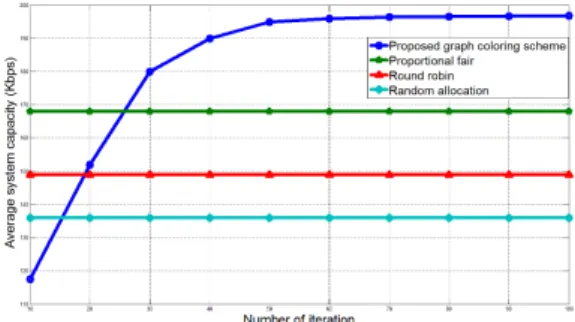
Fig. 2 plots the average system capacity for the proposed graph coloring scheme versus the number of iteration. We are considering the same RBs/
colors in the system. However the comparison is carried out with proposed scheme and traditional scheduling schemes. It can be examined that the proposed scheme shows better performance compared to traditional proportional fair, round robin and random allocation schemes. This is due to the fact that, proposed scheme shows optimized performance, by distributing all resources in uniform manner with considering the inter-cell and intra-cell interference which can deteriorate performance of
the system. This result shows better performance of proposed graph coloring scheme than the traditional proportional fair, round robin and random allocation schemes.
4.2 Impact of FUEs density on capacity Fig. 3 illustrates the average capacity per FUEs with respect to the number of user equipment (UEs).
Four curves are obtained by employing four selection/scheduling algorithms, i.e., proposed graph coloring scheme, proportional fair, round robin, and random. It is shown that with the increase of a number of FUEs, capacity decreases, which is obvious because we have assumed a fixed number of RBs. However, by exploiting the proposed graph coloring scheme, the throughput gap becomes wider as compared to the traditional methods by increasing the number of FUEs. This is due to the fact that for fewer numbers of FUEs, the ample availability of RBs results in a bit good average throughput by proportional fair, round robin, and random. On the other hand, the proportional fair performs better as compared to round robin for fewer numbers of FUEs. This is in accordance to the fact that for users close to eNB, the proportional fair performs well as compared to round robin while its performance deteriorates for users at the cell edge.
Thus, the performance gap between proportional fair and round robin reduces with the increase of FUEs.
However, for the proposed scheme performs well as
compared to all the traditional algorithms. As the
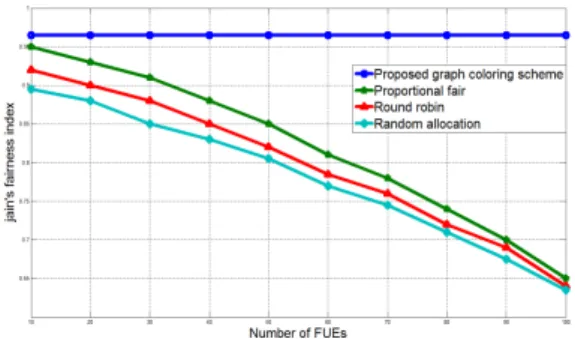
Fig. 4. Fairness comparison
number of FUE increases, the competition among the fixed number of RBs increases and this results in the inferior performance of traditional algorithms compared with our proposed one. This is due to the fact that the graph coloring operates by considering the minimization of the inducted interferences.
4.3 Fairness comparison
The comparison in term of fairness of the proposed graph coloring scheme is plotted in Fig. 4.
The parameter and fairness used to evaluate the performance of the scheme are calculated by the fairness index (F) formula in
[18]. The F is a continuous value in the range between 0 and 1. The largest index value means better system performance and vice-versa.
×
(11)
where K is the total FUEs to be serviced in the cell, and
is the average data rate of the
. Fig. 4 plots the comparison in term of fairness with respect to number of FUEs. As fairness is dependent on throughput per FUE, our proposed algorithm will thus definitely show better performance with respect to fairness as well. With the increasing FUEs, our proposed algorithm shows better performance than the traditional proportional fair, round robin and random allocation schemes. The proposed scheme may reduce the interference in the system which results in better fairness index and performance/QoS
of the system, where traditional proportional fair, round robin and random allocation scheduling schemes show decreasing performance because it may suffer high interference which in turn leads to lower performance/QoS.
Ⅴ. Conclusion
In this study, a graph coloring scheme is exploited for centralized spectrum allocation in self-organized femto/macro networks to minimize inter-cell and intra-cell interference in the femto/macro networks. Interference management is the most critical task which limits the performance of the networks. On the other hand, a centralized graph coloring scheme is exploited as a novel solution for meeting the increased throughput demands of FUEs. Within the context of the centralized graph coloring scheme, RBs allocation and distribution are the most critical tasks and have significant impact on system performance. In order to alleviate these problems, a self-organized centralized graph coloring scheme based on resource allocation is proposed to manage the interference of the downlink system. The comparison of proposed centralized graph coloring scheme with the traditional proportion fair, round robin and random allocation scheduling schemes is carried out regarding average throughput which includes effect of femto users density and fairness index. The results validate the superior performance of the proposed scheme. The benefit of the proposed centralized graph coloring scheme is that the system operates in a self-organizing manner and which ruled out the allocation of the resources with the concern of minimizing the impact of inter-cell interference.
References
[1] G. Mansfield, “Femtocells in the US market-business drivers and consumer propositions,” in Proc. FemtoCells Eur. Conf.
ATT, pp. 1927-1948, London, UK, Jun. 2008.
[2] S. Carlaw, “IPR and the potential effect on
femtocell markets,”
FemtoCells Eur.,ABIresearch, London, UK, Jun. 2008.
[3] V. Chandrasekhar and J. G. Andrews,
“Femtocell network: A survey,”
IEEE Commun. Mag., vol. 46, no. 9, pp. 59-67,Sept. 2008.
[4] W. Hale, “Frequency assignment: Theory and applications,” in Proc. IEEE, vol. 68, no. 12, pp. 1497-1514, Dec. 1980.
[5] J. Jang and I. Sohn, “A novel cell selection technique based on game theory for femtocell system resource optimization,” J. KICS, vol.
39A, no. 11, pp. 652-659, Nov. 2014.
[6] 3rd Generation Partnership Project: 3GPP TS
32.500 Self-Organizing Networks (SON) Concepts and requirements, V10.0.0. no. 6,2010.
[7] K. Tsagkaris, M. Gruder, and B. Sayrac,
“Managing self-organizing radio access networks,” Int. J. Netw. Management., pp.
233-234, 2013.
[8] A. Shahid, S. Aslam, and K. G. Lee, “Particle swarm optimization based CC selection for opportunistic radios,” in Proc. KICS Autumn
Conf., 2012.[9] A. Hatoum, N. Aitsaadi, R. Langar, R.
Boutaba, and G. Pujolle, “FCRA: Femtocell cluster-based resource allocation scheme for OFDMA networks,” in Proc. IEEE ICC, Jun.
2011.
[10] M. C. Erturk, H. Aki, I. Guvenc, and H.
Arslan, “Fair and QoS-oriented spectrum splitting in macrocell-femtocell networks,” in
Proc. IEEE GLOBECOM, pp. 1-6, Miami, FL,Dec. 2010.
[11] T. Ibaraki and N. Katoh, “Resource allocation problems: Algorithms approaches,” MIT Press:
Boston, MA, USA, 1988.
[12] I. Benyahia, “A survey of ant colony optimization algorithms for telecommunication networks,” Int. J. Appl. Metaheuristic Comput., vol. 3, no. 2, pp. 18-32, Apr. 2012.
[13] S. Aslam and K. G. Lee, “CSPA: Channel selection and parameter adaption scheme based on genetic algorithm for cognitive radio
ad hoc networks,” Eurasip J. Wireless Commun.
Netw., Nov. 2012.
[14] C. Lee, S. M. Oh, and A. S. Park,
“Interference avoidance resource allocation for device-to-device communication based on graph coloring,” J. KICS, vol. 39A, no. 12, pp. 729-738, Nov. 2014.
[15] 3GPP TS 25.467 V9.2.0, 3GPP TSG RAN,
Technical Specification Group Radio Access Network; UTRAN Architecture for 3G Home Node B (HNB), Mar. 2010.[16] S. Uygungelen, G. Auer, and Z. Bharucha,
“Graph-Based Dynamic Frequency Reuse in Femtocell Networks,” in Proc. VTC Spring, pp. 1-6, Yokohama, May 2011.
[17] L. Tan, Z. Feng, W. Li, Z. Jing, and T. A.
Gulliver, “Graph-based spectrum allocation for femtocell downlink interference mitigation,” in
Proc. IEEE WCNC, Cancun, Quintana Roo,Mar. 2011.
[18] C. Bae and D.-H. Cho, “Fairness-aware adaption resource allocation scheme in multihop OFDMA systems,” IEEE Commun.
Lett., vol. 11, no. 2, pp. 134-136, Feb. 2007.
스미타 사블레
(Smita Sable)
2009년 6월:Pune University B.Sc in Computer Science 2011년 2월:Pune University,
MBA in Finance
2013년 3월~2016년 : 2월 Sejong University MS in Dept. of Information and Communication Engineering.
<관심분야> Heterogeneous network, LTE wireless
communication, Resource management etc.
배 진 수
(Jinsoo Bae)
1990년 2월 : 경기과학고등학교 조기졸업 (우등) 1993년 2월 : 한국과학기술원 전기및전자공학과 공
학사
1995년 2월 : 한국과학기술원 전기및전자공학과 공 학석사
1998년 2월 : 한국과학기술원 전기및전자공학과 공 학박사
1997년 1월~1997년 12월 : 동경대학 객원연구원 1998년 1월~1998년 10월 : 앤더슨컨설팅 컨설턴트 1998년 11월~1999년 12월 : 일본모토로라 연구원 1999년 9월~2000년 2월 : LG텔레콤 과장
2000년 3월~현재 : 세종대학교 정보통신공학과 전임 강사, 조교수, 부교수,교수
<관심분야> 신호검파이론
이 경 근