ISSN 1225-6552, eISSN 2287-7630 https://doi.org/10.7853/kjvs.2017.40.1.21
< Original Article >
Veterinary Service
Available online at http://kjves.org
*Corresponding author: Jun Hyung Sohn, Tel. +82-54-850-3319, Fax. +82-54-850-3248, E-mail. [email protected]
재래산양의 설사병 병원체 감염률 조사
손준형
1* ㆍ이재봉
2ㆍ황유선
2ㆍ김상윤
2ㆍ김석환
2경상북도동물위생시험소 북부지소1, 경상북도동물위생시험소2
Status of diarrhea pathogens from Korean indigenous goat feces
Jun Hyung Sohn
1*, Jae Bong Lee
2, You Sun Hwang
2, Sang Youn Kim
2, Seok Hwan Kim
21North Branch, Gyeongbuk Veterinary Service Laboratory, Andong 36621, Korea
2Gyeongbuk Veterinary Service Laboratory, Daegu 41405, Korea
(Received 1 February 2017; revised 13 March 2017; accepted 14 March 2017)
Abstract
The purpose of this study was to survey on infection status of pathogens of diarrhea from Korean in- digenous goat. A total of 800 fecal samples was collected from 50 farms from January to November 2016 and was tested by automatic biochemical machine and polymerase chain reaction (PCR). The over- all infection rates of parasitic, bacterial and viral pathogens was 13.0%, 23.0%, 11.3% and the rates of coccidia, Escherichia coli (E. coli), bovine viral diarrhea virus (BVDV), rotavirus and coronavirus were 13.0%, 23.0%, 5.3%, 8.8% and 2.6%, respectively. In the rates of mixed detection, single was 29.8%, double 5.1%, triple 2.8%, quadruple 1.1% in each sample, respectively.
Key words : Korean indigenous goat, E. coli, BVDV, Rotavirus, Coronavirus
서 론
한국의 재래산양은 소과 소목의 초식성 포유동물 로 오랫동안 우리나라에서 식용이나 약용으로 사육 되어 왔으며 산악지형 등 환경에 대한 적응성이 뛰어 나고 질병에 대한 저항력이 강하다. 최근에는 한방에 서 보신제로 이용할 뿐만 아니라 전문 요리점의 증가 등에 따라 사육농장이 늘어나고 있고 이로 인해 여러 가지 질병에 대한 문제점이 드러나고 있어 질병 예방 과 사양관리의 개선이 요구되고 있다(Koh 등, 2005;
Sohn 등, 2016). 그러나 오랜 사육역사에 비하여 재래 산양의 질병에 대한 본격적인 연구는 세균 및 기생충 성 질병에 대한 일부 보고가 있으나, 다른 가축들에 비해 그 수가 상당히 적으며 특히 바이러스성 질병에 대한 조사는 상당히 미흡한 실정이다. 재래산양에서 발생하는 질병 중 약 78%가 소화기와 호흡기 관련
질병이며 이는 사육농장에 큰 손실을 입히고 있으며, 소화기 질병 중 설사는 어린 동물에서 폐사의 주요 원인으로 알려져 있다. 특히 소독시설 등이 미비한 100두 미만의 소규모 농장에서 설사병 병원체 분리 율이 높은 Sohn 등 (2016)의 결과에 따라 이번 연구 에서는 100두 미만 농장에 대하여 조사를 실시하였 다. 설사병은 기생충, 세균, 바이러스 등의 병원성 원 인체와 온도, 습도, 사료 등 환경적인 요인으로 인해 발생하고 있으며 이 중 coccidia, E. coli, Salmonella spp., rotavirus, coronavirus, BVDV 등이 염소의 주요 설사 병 병원체로 알려져 있다(Heo 등, 1999; Kim, 2000;
Cho 등, 2008; Choe 등, 2012).
따라서 이번 연구에서는 경북지역에서 사육중인
재래산양 설사병의 세균성 및 바이러스성 병원체 검
출률과 세균성 병원체에 대한 항생제 내성 양상을 살
펴보고 이를 효과적 방역대책의 기초 자료로 활용하
고자 한다.
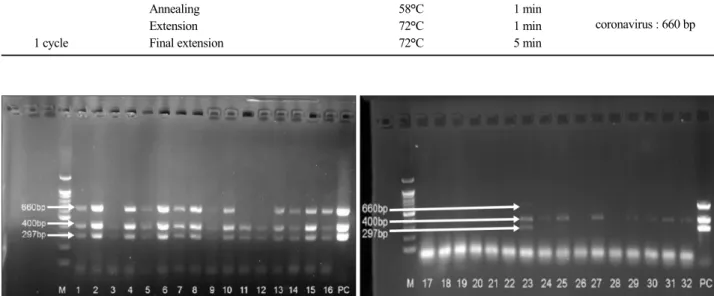
Fig. 1. Gel electrophoresis of viral pathogen-specific gene by PCR. Lane M: 1kb size marker. Lane 1, 2, 4∼10, 13∼16, 23: triple detected (BVDV, rotavirus, coronavirus), Lane 3, 11, 12,: double detected (BVDV, rotavirus), Lane 24, 25, 27, 29∼32: single detected (rotavirus), Lane PC:
positive control strain.
Table 1. PCR program and product size of viral diarrhea pathogens in goat
PCR cycle Temperature Time Product size
1 cycle Reverse transcription reaction 45°C 30 min BVDV : 297 bp
rotavirus : 400 bp
coronavirus : 660 bp Inactivation of reverse transcription 94°C 5 min
40 cycles Denaturation 94°C 30 sec
Annealing 58°C 1 min
Extension 72°C 1 min
1 cycle Final extension 72°C 5 min
재료 및 방법
공시재료
2016년 1월에서 11월까지 11개월 동안 경북지역 17개 시ㆍ군, 50호의 농장에서 농장별 16점의 염소시 료를 채취하였다. 채취한 분변은 24시간이내에 실험 에 사용하였고 실험을 실시할 때까지 4°C에서 냉장ㆍ 보관하였다.
검사방법
기생충성 병원체 동정: 기생충성 설사병 병원체의 동
정은 1 g의 분변을 채취하여 Zajac과 Conboy(2006)의 방법에 따라 포화식염수를 사용하여 부유법을 실시 하고 현미경상으로 확인하였다. 재래산양에서 흡충류 가 전혀 검출되지 않은 Cho 등(2008)의 연구 결과에 따라 흡충류 검사를 위한 침전법은 실시하지 않았다.
세균성 병원체 동정: 분변 시료를 blood agar plate 상
에서 37°C, 24시간 배양한 후 설사병 병원체로 의심 되는 집락을 제조사에서 제공한 매뉴얼에 따라 0.45%
saline에 혼합하여 탁도를 0.6McF로 조절한 후 VITEK2 GN test kit, VITEK2 GP test kit와 Automatic bio- chemical machine인 VITEK2 Compact (Biomerieux, FRANCE) 장비를 사용하여 세균성 설사병의 병원체 를 확인하였다.
바이러스성 병원체 동정: 바이러스성 병원체 동정은
PCR법을 사용하여 확인하였는데 이를 위한 유전자 추출은 Genomic DNA&Viral RNA extraction kit와 자 동화장비(Malcom, JAPAN)를 사용하여 실시하였다.
각 질병에 대한 병원체 동정은 Bovine Coronavirus/ro- tavirus/diarrhea disease virus Detection kit (iNtRON, KOREA)를 사용하여 제조사의 매뉴얼에 따라 Table 1과 같이 PCR을 실시한 후 ethidium bromide (EtBr)가 첨가된 1.5% agarose gel 상에서 BVDV 297 bp, rotavi- rus 400 bp, coronavirus 660 bp에서 각각 특이밴드를 확인하였다(Fig. 1).
결과 및 고찰
경북지역 50개 농장에서 채취한 800점에 대한 검
Table 2. The infection rates of diarrhea pathogens in goats feces
Pathogens Parasite Bacteria Virus
Coccidia E. coli BVDV Rotavirus Coronavirus
No of positive 422 104 184 43 70 21
Positive rate (%) 52.8 13.0 23.0 5.8 8.8 2.6
Table 3. The multiple infected patterns in goats feces
Infected patterns No. of double detected (%) No. of triple detected (%) No. of quadruple detected (%)
Total 41 (5.1) 22 (2.8) 9 (1.1)
CcE CcR CcC CcB ER RB CcER CcEC CcEB CcRB RCB CcERB CcRCB ERCB
No. of positive 18 8 1 5 8 1 2 1 4 3 12 2 4 3
(%) 2.3 1.0 0.1 0.6 1.0 0.1 0.3 0.1 0.5 3.8 1.5 0.3 0.5 0.4
*coccidia (Cc), E.coli (E), rotavirus (R), coronavirus (C), BVDV (B).
사결과는 Table 2와 같다. 45 농장, 310점에서 1개 이 상의 설사병 병원체가 검출되어 검사호수 대비 90.0%, 검사시료 대비 38.8%의 양성률을 나타내었는데 이는 검사호수 대비 86.0% (43/50), 검사시료 대비 28.1%
(225/800)의 양성률을 보인 Sohn 등(2016)의 결과보다 높은 수치를 보였는데 기존 연구에서는 세균성, 바이 러스성 병원체만을 대상으로 한 것으로 본 연구에서 기생충성 병원체가 포함되면서 검출률이 높아진 것 으로 판단된다. 기생충성 질병은 25농장, 104점에서 검 출되어 각각 50.0%, 13.0%의 수치를 보여 99.0% (107/108) 의 기생충 양성률을 보인 Cho 등(2008)의 연구 결과 와는 많은 차이를 보였는데 기생충성 병원체는 모두 coccidia로 확인되었다. 세균성 병원체는 184점의 시 료에서 양성으로 나타나 23.0%의 검출률을 보였고 모두 E. coli로 확인되었다. 바이러스성 병원체는 BVDV, rotavirus, coronavirus 3종이 검출되었는데 각각 5.8%
(43/800), 8.8% (70/800), 2.6% (21/800)의 양성률을 보였 다. 이는 2.4%의 검출률을 나타낸 Bosilevac 등(2015) 의 연구에 비해 E. coli 검출률이 상당히 높게 나왔고, BVDV와 rotavirus는 각각 21.1%, 28.6%의 감염률을 보인 Fulton 등(1982), Kaminjolo 등(1994)의 결과에 비해 낮았으며, coronavirus는 2.6% (21/800)의 검출률 을 보여 1%의 보인 Yang 등(2008)의 연구에 비하여 다소 높게 나타났다. E. coli, salmonella가 각각 21.5%
(172/800), 0.9% (7/800), BVDV, rotavirus, coronavirus는 각각 7.6% (61/800), 5.6% (45/800), 3.0% (24/800)의 양성률을 나타낸 Sohn 등(2016)의 결과와 salmonella 를 제외하고는 매우 유사한 것으로 확인되었다.
설사병 병원체 검출형태로 살펴본 결과 1종의 단 독검출은 29.8% (238/800), 2종 혼합검출 5.1% (41/800), 3종 혼합검출 2.8% (22/800), 4종 혼합검출 농장이 1.1% (9/800)으로 확인되었다. 병원체별로 혼합감염 상황을 살펴보았을 때 먼저 기생충과 세균의 혼합검 출은 coccidia와 E. coli의 2종 혼합검출이 2.3% (18/800) 였다. 기생충과 바이러스성 병원체의 혼합검출은 coc- cidia와 rotavirus의 2종이 1.0% (8/800), coccidia와 co- ronavirus, coccidia와 BVDV 0.1% (1/800), 0.6% (5/800) 로 각각 나타났으며 세균성 병원체와 바이러스성 병 원체 2종의 검출은 E. coli와 rotavirus만이 8건으로 1.0% (8/800)이었으며, 바이러스성 병원체 2종 혼합검 출은 rotavirus와 BVDV 0.1% (1/800)로 확인되었다.
병원체 3종의 혼합검출은 coccidia와 E. coli, rotavirus 가 2건, coccidia와 E. coli, coronavirus 1건, coccidia와
E. coli, BVDV 4건으로 각각 0.3% 0.1%, 0.5%로 나타났고, coccidia, rotavirus, BVDV가 3.8% (3/800), 바이 러스성 병원체 3종의 혼합검출은 12건으로 1.5%의 검출률을 보였다. 마지막으로 설사병 병원체 4종의 혼합감염 상황은 coccidia, E. coli, rotavirus, BVDV 2 건, coccidia, rotavirus, coronavirus, BVDV 4건으로 0.3%, 0.5% 각각 확인되었고 E. coli, rotavirus, corona- virus, BVDV의 4종 혼합검출이 3건으로 0.4%의 검출 률을 보였다(Table 3). 지금까지 재래산양의 다양한 설사병 병원체에 대한 연구는 미진하였으나 Sohn 등 (2016)의 결과와 비교해 보면 이번 연구에서 병원체 2종 혼합검출 5.1% (41/800), 3종 혼합검출 2.8%
(22/800), 4종 혼합검출 1.1% (9/800)로 나타나 유사함
을 알 수 있었다.
특히 coronavirus 양성이 확인된 모든 시료는 적어 도 1종 이상의 병원체와 혼합감염이 되어 있었는데 corinavirus가 다른 설사병 병원체의 혼합감염에 미치 는 영향에 대한 추가적인 조사가 필요할 것으로 판단 된다.
결 론
경북지역 50호의 농장에서 채취한 800점의 분변 시료를 대상으로 실시한 재래산양 설사병 병원체 조 사 결과 전체 90.0% (45/50)의 농장에서 1개 이상의 병원체가 검출되어 대부분의 농장이 설사병에 노출 되어 있음을 확인할 수 있었다. 설사병 병원체의 검 출률은 38.8% (310/800)였으며 병원체별 검출률은 coccidia, E. coli, BVDV, rotavirus, coronavirus가 각각 13.0% (104/800), 23.0% (184/800), 5.8% (43/800), 8.8%
(70/800), 2.6% (21/800)로 확인되었다. 병원체 검출형 태는 1종의 단독검출이 29.8% (238/800), 2종 혼합검 출 5.1% (41/800), 3종 복합검출 2.8% (22/800), 4종 복 합검출 농장이 1.1% (9/800)였다. 이 중 coronavirus가 양성으로 확인된 시료는 모두 2종 이상의 설사병 병 원체에 감염이 되어 혼합감염 형태를 나타내었다.
REFERENCES
Bosilevac JM, Gassem MA, Al Sheddy IA, Almaiman SA, Al-Mohizea IS, Alowaimer A, Koohmaraie M. 2015.
Prevalence of Escherichia coli O157:H7 and Salmonella in camels, cattle, goats, and sheep harvested for meat in Riyadh. J Food Prot 78: 89-96.
Broaddus CC, Holyoak GR, Dawson L, Step DL, Funk RA, Kapil S. 2007. Transmission of bovine viral diarrhea virus to adult goats from persistently infected cattle. J Vet Diagn Invest 19: 545-548.
Cho KH, Lee JH, Kim DJ, Kim SJ, Kwon OD, Kwak DM. 2008.
Infection rate of parasites from feces of Korean in- digenous goats in northern areas of Gyeongbuk province.
Korean J Vet Serv 31: 357-362.
Choe CY, Kang DW, Cho CY, Jung BY, Son JK, Hur TY, Jung YH, Kang SJ, Do YJ, Ryu IS, Kin UH, Park YS, Son DS. 2012. A Survey of disease occurrence in Korean black goats. J Vet Clin 29: 160-164.
Cortés C, de la Fuente R, Contreras A, Sánchez A, Corrales JC, Martínez S, Orden JA. 2006. A survey of Salmonella spp. and Campylobacter spp. in dairy goat faeces and
bulk tank milk in the Murcia region of Spain. Ir Vet J 59: 391-393.
Czopowicz M, Kaba J, Schirrmeier H, Bagnicka E, Szaluś- Jordanow O, Nowicki M, Witkowski L, Frymus T. 2011.
Serological evidence for BVDV-1 infection in goats in Poland. Acta Vet Hung 59: 399-404.
Da Costa Mendes VM, De Beer MC, Els HJ, Goosen GH, Theron J, Steele AD. 1994. Rotavirus in Saanen goats. J S Afr Vet Assoc 65: 132-133.
Duffy L, Barlow R, Fegan N, Vanderlinde P. 2009. Prevalence and serotypes of Salmonella associated with goats at two Australian abattoirs. Lett Appl Microbiol 48: 193-197.
Fulton RW, Downing MM, Hagstad HV. 1982. Prevalence of bo- vine herpesvirus-1, bovine oral diarrhea, parainfluenza-3, bovine adenoviruses-3 and -7, and goat respiratory syn- cytial viral antibodies in goats. Am J Vet Res 43:
1454-1457.
Hariharan H, López A, Conboy G, Coles M, Muirhead T. 2007.
Isolation of Escherichia fergusonii from the feces and internal organs of a goat with diarrhea. 2007. Can Vet J 48: 630-631.
Heo JH, Jung MH, Cho MH, Ahn DW, Lee SS. 1999. A survey on the actual management and the prevalence of interal parasite in the Korean indigenous goats of southern Kyoungnam area. Korean J Vet Serv 22: 71-77.
Hertig C, Pauli U, Zanoni R, Peterhans E. 1991. Detection of bo- vine viral diarrhea (BVD) virus using the polymerase chain reaction. Vet Microbiol 26: 65-76.
Kaminjolo JS, Adesiyun AA. 1994. Rotavirus infection in calves, piglets, lambs and goat kids in Trinidad. Br Vet J 150:
293-299.
Kim TJ. 2000. Study on digestive and respiratory viral pathogens of Korean native black goat:1. Establishment of serum bank for epidemiological study;2. Isolation of viral pa- thogens from digestive and respiratory tracts;3. Develop- ment of vaccine to the isolated virus. Konkuk University press, Seoul.
McAuley CM, McMillan K, Moore SC, Fegan N, Fox EM. 2014.
Prevalence and characterization of foodborne pathogens from Australian dairy farm environments. J Dairy Sci.
97: 7402-7412.
Mishra N, Rajukumar K, Tiwari A, Nema RK, Behera SP, Satav JS, Dubey SC. 2009. Prevalence of Bovine viral diar- rhoea virus (BVDV) antibodies among sheep and goats in India. Trop Anim Health Prod 41: 1231-1239.
Molla W, Molla B, Alemayehu D, Muckle A, Cole L, Wilkie E.
2006. Occurrence and antimicrobial resistance of Salmonella serovars in apparently healthy slaughtered sheep and goats of central Ethiopia. Trop Anim Health Prod 38: 455-462.
Omatsu T, Tsuchiaka S, Hirata T, Shiroma Y, Okazaki S, Katayama Y, Oba M, Nishiura N, Sassa Y, Furuya T, Nagai M, Ochiai H, Tamaki S, Mizutani T. 2014. Detec- tion of enterovirus genome sequence from diarrheal fe- ces of goat. Virus Genes 48: 550-552.
Pao S, Patel D, Kalantari A, Tritschler JP, Wildeus S, Sayre BL.
2005. Detection of Salmonella strains and Escherichia coli O157:H7 in feces of small ruminants and their iso- lation with various media. Appl Environ Microbiol 71:
2158-2161.
Papp H, Malik YS, Farkas SL, Jakab F, Martella V, Bányai K.
2014. Rotavirus strains in neglected animal species in- cluding lambs, goats and camelids. Virusdisease 25:
215-222.
Pratelli A, Martella V, Tempesta M, Buonavoglia C. 1999.
Characterization by polymerase chain reaction of ru- minant rotaviruses isolated in Italy. New Microbiol 22:
105-109.
Roug A, Byrne BA, Conrad PA, Miller WA. 2013. Zoonotic fecal pathogens and antimicrobial resistance in county fair animals. 2013. Comp Immunol Microbiol Infect Dis 36:
303-308.
Sharpee RL, Mebus CA, Bass EP. 1979. Characterization of a calf diarrheal coronavirus. Am J Vet Res 37: 1031-1041.
Sohn JH, Do JC, Cho GJ. 2016. Detection ratio of bacterial and viral pathogens of diarrhea from Korean indigenous goat feces in Gyeongbuk province. Korean J Vet Serv 39:
35-39.
Stadler HP, Strasser M, Meier P, Tontis A, Hofmann M, Ruggli
N, Peterbans E. 1996. PCR: a look behind the scenes at bovine viral diarrhea virus. Schweiz Arch Tierheilkd 138: 63-66.
Stirling J, Griffith M, Dooley JS, Goldsmith CE, Loughrey A, Lowery CJ, McClurg R, McCorry K, McDowell D, McMahon A, Millar BC, Rao J, Rooney PJ, Snelling WJ, Matsuda M, Moore JE. 2008. Zoonoses associated with petting farms and open zoos. Vector Borne Zoonotic Dis 8: 85-92.
Stone GG, Chengappa MM, Oberst RD, Gabbert NH, McVey S, Hennessy KJ, Muenzenberger M, Staats J. 1993.
Application of polymerase chain reaction for the correla- tion of Salmonella serovars recovered from greyhound feces with their diet. J Vet Diagn Invest 5: 378-385.
Verbeek A, Tijssen P. 1991. Sequence analysis of the turkey en- teric coronavirus nucleocapsid and membrane protein genes: a close genomic relationship with bovine coro- navirus. J Gen Virol 72: 1659-1666.
Yang DK, Hwang IJ, Kim BH, Kweon CH, Lee KW, Kang MI, Lee CS, Cho KO. 2008. Serosurveillance of viral dis- eases in Korean native goats (Capra hircus). J Vet Med Sci 70: 977-979.
Zajac AM, Conboy GA. 2006. pp. 4-12. veterinary clinical parasitology. 7th ed. Blackwell, Oxford.