- 440 -
Introduction
Jerusalem artichoke (Helianthus tuberosus L.) is considered one of the important non-traditional vegetable crops. The crops have been used as famine-relief foods for a decade ago in Korea. Recently, its tuber has been also utilized as a folk remedy for diabetes and rheumatism (Duke and DuCellier, 1993). The plant is mostly propagated by seed tuber because it rarely set fertile seed under natural conditions, and several years ago, there was an attempt to produce tubers from the seed (Lim et al., 1990).
Unlike most tubers, but in common with other members of the Asteraceae (including the artichoke), the tubers store the carbohydrate inulin instead of starch (Chabbert et al., 1983;
El-Sharawy, 1998; Palz and Chartier, 1980; Ragab et al., 2003; Toxopeus et al., 1994). For this reason, Jerusalem artichoke tubers are an important source of fructose for industry. The crop yields are high, typically 1.6 2.0 MT/10a– for tubers, and 1.8 2.8 MT/10a green weight for foliage.– Jerusalem artichoke also has a great deal of new potential as a
producer of ethanol for fuel, using inulin-adapted strains of yeast for fermentation. Jerusalem artichoke is considered as one of the for the better production of fructose requires better performing line selections (Klue-Andersen, 1992).
We collected Jerusalem artichoke growing wildly in nationwide and cultured in experimental field to estimate fresh tuber yield for one year with the aim of finding superior line having excellent marketability for tuber shape and weight.
The purpose of this study was to evaluate the carbohydrate accumulation capacity and tuber yield of Jerusalem artichoke collected from seven regions, especially two kinds of tubers.
Materials and Methods
Plant material
Experiments were made at the Institute for Bioresources Research located in Andong, on a sand mixed clay soil in 2006 and 2007. Seed tubers used in this study were collected in four provinces, Gyeongsangbuk-do (Andong, Euisung, and Imdong), Jeollabuk-do (Buan and Muju), Jeollanam-do (Songkwang) and Gyeonggi-do (Ansung) from early March
Changes of Carbohydrate and Tuber Production on Red and White Skinned Tubers of Jerusalem Artichoke (Helianthus tuberosus L.)
Sang-Kuk Kim, Shin-Young Park1, Jae-ha Lim, Hong-Jib Choi2and Sang-Chul Lee3* Institute for Bioresources Research, Gyeongsangbuk-do Provincial Agricultural Technology Administration,
Andong 760-891, Korea
1Dept. of Clinical Pathology, Cheju Halla College, Cheju 690-708, Korea
2Division of FTA Agricultural & Fishery Countermeasure, Gyeongsangbuk-Do Provincial Office, Daegu 702-702, Korea
3College of Agricultural & Life Sciences, Kyungpook National University, Daegu 702-701, Korea
Abstract -This study was aimed to investigate the difference for carbohydrate accumulation in both the red skinned tuber and white skinned tuber of Jerusalem artichoke (Helianthus tuberosus L.), and to evaluate their tuber yield of seven lines collected from Korea. Jerusalem artichoke tubers were divided into two groups regarding to their skinned colors. Red skinned tuber collected from Euisung region showed the lowest tuber yield as 3,100 kg per 10a, otherwise white skinned tuber collected from Imdong region resulted in the highest tuber production as 6,300 kg per 10a among the six kinds of white skinned tubers. Yield of white skinned tuber was higher than that of red skinned tuber. It was inferred from the result that carbohydrate accumulation in white skinned tuber was highly increased compared to red skinned tuber since after early tuber enlargement.
Key words -Tuber yield, Jerusalem artichoke, carbohydrate content, red skinned tuber, white skinned tuber
*Corresponding author. E-mail : [email protected]
Korean J. Plant Res. 21(6) : 440~443(2008)
Changes of Carbohydrates and Tuber Yield in Jerusalem Artichoke
- 441 - to late March in 2006.
Cultural practices
Jerusalem artichoke tubers were named by following their collected region. Fertilizers were applied with 15 kg N, 3 kg P, and 8 kg K per 10a with a 2-time split of the nitrogen application. The experimental design was a randomized complete block with three replicates. Each plot (30 m2) was 1.2 by 25 m with a population of 166 plants per plot. Weeds were only controlled by hand before flowering time. Fresh tubers harvested on 24 November were freeze-dried for carbohydrate analysis.
Carbohydrate analysis
0.5 g of fined tuber powders was made to 5 ml with distilled water and then heated in a double water bath at 90±1 for 1 hour. Finally, proximate solution was filtered. 2 ml of
℃
the filtered extract was taken for hydrolysis of fructan and sucrose to hexose.
0.3 ml of 1N H2SO4added to extract and the mixture was heated for 1 hour at 90±1℃. The contents of glucose and fructose were determined by an enzymatic method (Bergmeyer et al., 1974).
Total carbohydrate was measured by the anthrone (2 g anthrone dissolved in 1ℓof 95% sulphuric acid) reagent, using colormetry at 620 nm, to a calibration curve established under the same conditions with a solution of inulin at 0.1, 0.2, 0.4, 0.6, 1.2 mg・ml-1.
The polymerization of carbohydrates was determined by high performance liquid chromatography. Sample 20㎕ of 10% aqueous solution were eluted on a silica column (Spherisorb, 5 m, 250×4 mm i.d., Knauer, Bad Homburg,μ FRG).
The column was aminified by adding putrescine to the solvent using a Waters 6000 pump. The eluted carbohydrates were monitored with a Waters 401 RI detector and separation was carried out at 35℃with a flow rate of 1 ml/min.
Results and Discussion
Changes of tuber yield on collected Jerusalem artichoke lines
The yield changes of the Jerusalem artichoke tubers collected in the seven regions are shown in Fig. 1.
Collected Jerusalem artichokes were separated by their tuber production with three groups ranging from below 4 MT, 4 MT to 5 MT, and above 5 MT per 10a, respectively. The lowest tuber production was only observed in Euisung line for two years, medium tuber production ranging from 4 to 5 MT per 10a was Andong, Ansung, and Songkwang lines.
The highest tuber was produced in Imdong line. Seven lines could be grouped into three groups by their tuber yield, most of which had white skinned tubers. Line group 1 included only the Euisung with red skinned tuber and somewhat skinny, partially branched tops.
Line group 2 included the four line, Andong, Ansung, Songkwang and Buan having medium tuber yield with typical white skinned tubers. Line group 3 was the both Muju and Imdong line with white skinned tubers. Growth conditions were more favorable in 2006 resulting from an optimal precipitation during tuber enlargement than that in 2007. One of the interesting results were that the tuber yield of red skinned tuber is always lower than that of white skinned tubers for two year experiments. In our opinion, it is inferred from the fact that the carbohydrate content and dry matter in the red skinned tuber compared to white skinned tubers result from steady carbohydrate accumulation at final harvesting time (refers from Fig. 2; Fig. 3).
Chekroun et al. (1996) reported that the Jerusalem artichoke originated from American continent are different from the French origin that Jerusalem artichoke has many colored tubers and their color varies from pink to dark red which is the result of the formation of anthocyanins. Among collected tubers in Korea, Euisung line may not differs from Fig. 1. Changes of tuber yield of Jerusalem artichoke collected from the seven regions in 2006 and 2007. Vertical bars indicate means±SE (n=3).
Korean J. Plant Res. 21(6) : 440 ~ 443(2008)
- 442 - the foreign country, although it was not fully screened nationwide. In this point, it needs further research to understand its origin with detailed biochemical tools.
Changes of tuber sizes on collected Jerusalem artichoke lines
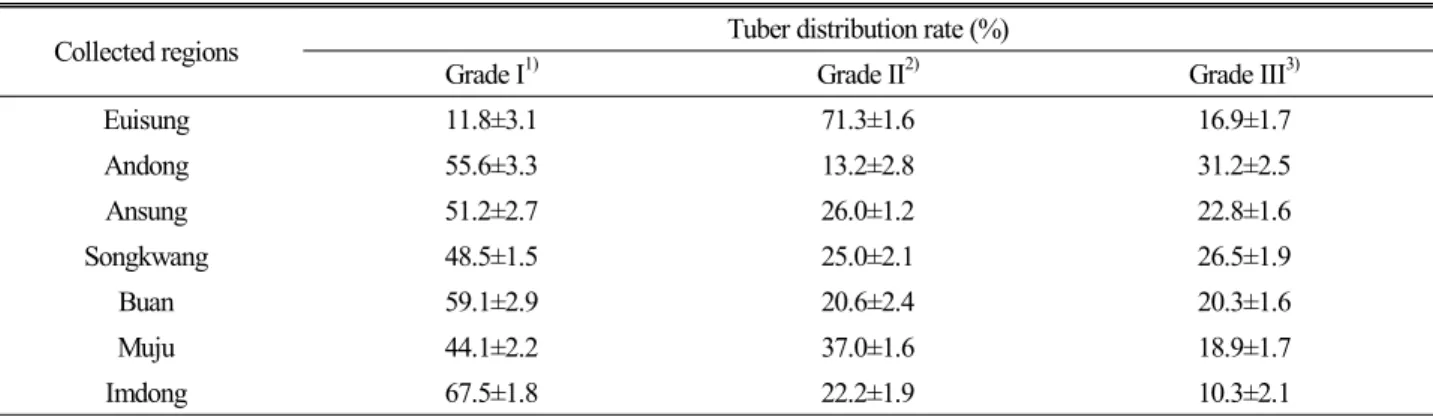
Table 1 shows the tuber distribution rate of Jerusalem artichoke collected from seven regions. For commercial vegetable purposes, the harvested tubers were graded in three groups previously reported by Anderson (1992).
Anderson classified into three groups as follows: grade I included the smooth, rounded, healthy tuber, above 20 g per tuber, grade II included the irregular or branched, healthy tubers, below 15 g per tuber, and grade III included the damaged, diseased, and below 15 g per tuber. Red skinned tuber, Euisung line, showed that the tuber distribution rate of
grade I was lowest as 11.8%, otherwise grade II was highest as 71.3%. Six lines including the group I and group II were always highest in grade I which is classified with smooth, rounded, healthy tuber and above 20 g per tuber. In addition, the highest distribution rate of grade I founded in Imdong line. Among white skinned tuber lines, Muju line had the poorest value in Grade I, although this line produced the second highest yield. Dry matter and carbohydrate content were only determined at the first year (2006) from seven collected lines (Fig. 2).
Changes of carbohydrate content on red- and white Jerusalem artichoke tubers
Plants with carbohydrate reserves are in the form of inulin type polyfructans constitute a source of carbohydrates which would be usable in food industry (Chekroun et al 1996). They Fig. 2. Changes of dry matter (DM) and carbohydrate content of
Jerusalem artichoke tubers collected from the seven regions in Korea. Vertical bars indicate means±SE (n=3).
Table 1. Tuber distribution rate of Jerusalem artichoke collected from seven regions
Collected regions Tuber distribution rate (%)
Grade I1) Grade II2) Grade III3)
Euisung 11.8±3.1 71.3±1.6 16.9±1.7
Andong 55.6±3.3 13.2±2.8 31.2±2.5
Ansung 51.2±2.7 26.0±1.2 22.8±1.6
Songkwang 48.5±1.5 25.0±2.1 26.5±1.9
Buan 59.1±2.9 20.6±2.4 20.3±1.6
Muju 44.1±2.2 37.0±1.6 18.9±1.7
Imdong 67.5±1.8 22.2±1.9 10.3±2.1
1)Grade I: smooth, rounded, healthy tuber, above 20 g per tuber.2)Grade II: Irregular or branched, healthy tubers, below 15 g per tuber.
3)Grade III: below 15 g per tuber, damaged, and diseased tuber. Vertical bars indicate means±SE (n=6).
Fig. 3. Changes of accumulated carbohydrate patterns in Euisung line (red skinned tuber) and Imdong line (white skinned tuber) of Jerusalem artichoke. Vertical bars indicate means±SE (n=5).
Changes of Carbohydrates and Tuber Yield in Jerusalem Artichoke
- 443 - are present in above 3,600 plants species (Carpita et al. 1989).
Both red skinned tuber and white skinned tubers showed remarkably in carbohydrate content. Furthermore the dry matters showed a slight change in Ansung line by about 31%, showing highest content among white skinned tuber lines.
Total carbohydrates in both Euisung and Imdong lines represented to red and white skinned tubers were measured in order to know the accumulating patterns during growth and final harvesting times (Fig. 3).
Carbohydrates were increased slightly from Aug. 10 to Aug. 30. Carbohydrate in Euisung line (red skinned tuber) was more accumulated rapidly than that of Imdong line (white skinned tuber) at Sep. 18, and carbohydrate accumu- lation in Imdong line (white skinned tuber) was linearly elevated from Aug. 30 to Oct. 23, although accumulated carbohydrate contents were relatively low. Otherwise carbohydrate accumulation of Euisung line (red skinned tubers) was increased slightly during the period, Sep. 18 to Oct. 23. At harvesting time, their carbohydrate was higher in Imdong line (white skinned tuber) than in Euisung line (red skinned tuber).
The degree of polymerization from the Euisung line (red skinned tuber) and Imdong line (white skinned tuber) was determined from harvested tubers (Fig. 4). Inulin is a natural food ingredient commonly found in varying percentages in dietary foods. The percentage of degree of polymerization (DP) from 2 to 10 within a DP range in Euisung line (red
skinned tuber) and Imdong line (white skinned tuber) was 51% and 47%, respectively. The DP from 11 to 20 in Euisung line (red skinned tuber) and Imdong line (white skinned tuber) was 23% and 21%, respectively. Other polymerization ranged from 21 to above 30 were low as below 20% in the two Jerusalem artichoke lines.
Literature cited
Bergmeyer, H. U., E. Brent, F. Schmidt and H. Stork. 1974. In Methods of Enzymatic Analysis. Bergmeyer, H. U., ed. 3:
1196-1998. Academic Press.
Carpita, N. C., J. Kanabus and T. L. Housley. 1989. Linkage structure of fructans and fructan oligomers from Triticum aestivum and Festuca arundinacea leaves. J. Plant Physiol.
134:162-168.
Chabbert, N., P. Braun, J.P. Guiraud, M. Arnoux and P. Galzy.
1983. Productivity and fermentability of jerusalem artichoke according to harvesting date. Biomass 3:209 224.–
Chekroun M. B., J. Amzile, N. E. El. Haloui, J. Prevost and R.
Fontanillas. 1996. Comparison of fructose production by 37 cultivars of Jerusalem artichoke (Helianthus tuberosus L.).
New Zealand J. of Crop and Horticultural Science. 24:115-120.
Duke, J. A. and Judith L. DuCellier 1993. CRC Handbook of Alternative Cash Crops. p.269.
El-Sharawy, Z. A. 1998. Physiological studies on jerusalem artichokes. Ph. D. thesis, Faculty of Agric., Cairo University.
p.115.
Klue-Andersen, S. 1992. Jerusalem artichoke: A vegetable crop growth regulation and cultivars. Acta Horticulturae 318:
145-152.
Lim, K. B., H. J. Lee, S. R. Lee, J. I. Lee and S. D. Ahn. 1990.
Seed coat removal and seed germination in Helianthus tuberosus L. J. Oriental Bot. Res. 3(1): 31-40.
Palz, W. and P. Chartier (eds.). 1980. Energy from biomass in Europe. Applied Science Publishers Ltd., London.
Ragab, M. E., K. A. Okasha, E.L. Oksh and N. M. Ibrahim.
2003. Effect of cultivar and location on yield, tuber quality, and storage ability of jerusalem artichoke (Helianthus tuberosus L.) I. Growth, yield and tuber characteristics. Proc.
XXVI IHC-Asian Plants. Acta Hort. 620:103-111.
Toxopeus, H., J. Dieleman, S. Hennink and T. Schiphouwer.
1994. New selections show increased inulin productivity.
Prophyta. 48: 56-57.
(Received 23 June 2008 ; Accepted 18 August 2008) Fig. 4. Changes of DP (degree of polymerization) of inulin in
Euisung collected line (red skinned tuber) and Imdong collected line (white skinned tuber) of Jerusalem artichoke. Vertical bars indicate the means±SE (n=3).