INTRODUCTION
Frozen shoulder (FS) is a common cause of shoulder pain. In addition to pain, it is characterized by a reduc-
tion in the range of motion of the shoulder [1]. The di- agnosis of FS is usually based on history taking, physical examination, and plain radiography. Although the exact pathogenesis of FS is still unclear, temporal evolution
Annals of Rehabilitation Medicine
Ann Rehabil Med 2016;40(3):502-508 pISSN: 2234-0645 • eISSN: 2234-0653 http://dx.doi.org/10.5535/arm.2016.40.3.502
Ultrasonographic Measurement of the Thickness of Axillary Recess Capsule in Healthy Volunteers
Kyoung Tae Kim, MD
1, Dong Gyu Lee, MD
1, Soyoung Lee, MD, PhD
1, Du Hwan Kim, MD
1,2,31
Department of Rehabilitation Medicine,
2Pain Research Center, and
3
Institute for Medical Science, Keimyung University School of Medicine, Daegu, Korea
Objective To evaluate the inter-rater and intra-rater reliability of ultrasonographic measurements of axillary recess (AR) thickness in healthy individuals, and to analyze the factors affecting the thickness of the AR capsule.
Methods We recruited 20 healthy individuals (10 male, 10 female) with a mean age of 37 years (standard deviation
±10). Two physiatrists (an experienced and a novice rater) independently investigated the AR thickness in three rounds. The AR thickness was measured for each individual at three shoulder abduction angles (50
o, 70
o, and 90
o).
Intra-class correlation (ICC) coefficients were used to assess the reproducibility of each measurement.
Results Excellent intra-rater reliability coefficients were observed at the three shoulder abduction angles, in the analysis of both raters. The inter-rater reliability coefficient was also was excellent in both studies. There were significant differences in the AR thickness, according to the angle of shoulder abduction. The AR was thicker at 50
othan at 70
oand 90
o(all p<0.001), and the AR was thicker at 70
othan at 90
o(p<0.001). Height (r=0.62, p=0.003) and body mass index (r=0.52, p=0.019) were positively correlated with AR thickness. Males had a thicker AR capsule than females at all three angles (all p<0.001).
Conclusion Ultrasonographic measurements of AR thickness in healthy individuals demonstrate excellent intra-rater and inter-rater reliability. AR thickness may depend on anthropometric variables and position of the shoulder.
Keywords Reliability and validity, Axillary recess, Ultrasonography
Received May 11, 2015; Accepted October 20, 2015 Corresponding author: Du Hwan Kim
Department of Rehabilitation Medicine, Keimyung University School of Medicine, 56 Dalseong-ro, Jung-gu, Daegu 41931, Korea. Tel: +82-53-250-7477, Fax: +82-53-250-7205, E-mail: [email protected]
ORCID: Kyoung Tae Kim (http://orcid.org/0000-0001-9355-8326); Dong Gyu Lee (http://orcid.org/0000-0002-4787-4448); Soyoung Lee (http://orcid.
org/0000-0002-4713-0713); Du Hwan Kim (http://orcid.org/0000-0002-9980-8549).
This is an open-access article distributed under the terms of the Creative Commons Attribution Non-Commercial License (http://creativecommons.org/
licenses/by-nc/4.0) which permits unrestricted noncommercial use, distribution, and reproduction in any medium, provided the original work is properly cited.
Copyright © 2016 by Korean Academy of Rehabilitation Medicine
from inflammation, to fibrosis of the rotator interval (RI), anterior joint capsule, and axillary recess (AR) seems to be the main pathologic process [2]. Magnetic resonance imaging (MRI) has revealed various changes in patients with FS, such as thickening, signal changes, or enhance- ment of the RI, including the coracohumeral ligament, long biceps tendon, superior glenohumeral ligament, and AR [3-9]. The reliability of AR thickness measure- ments using MRI is high [10]. Few studies that assessed the diagnostic value of ultrasonography (US) in FS have been published, but the region of interest was the RI, and the results were controversial [11,12]. Recently, US examinations of glenohumeral synovitis of the aspect of the AR or posterior capsule have been included in the re- vised diagnostic criteria for polymyalgia rheumatica [13].
However, glenohumeral synovitis is usually investigated from the posterior capsule rather than AR [14]. There have been few reports of US examination of AR in normal subjects or patients with FS.
The objective of the current study was to test the inter- and intra-rater reliability of the US measurements of AR thickness in healthy volunteers, and to analyze the fac- tors affecting the AR thickness. The results of the current study will expand the area of clinical applications of AR measurements in the diagnosis of FS.
MATERIALS AND METHODS
Right-handed healthy adult volunteers were recruited to participate in this study. We used numerical computa- tion to optimize the design configuration. The sample size was calculated so as to detect a difference in the intra-class correlation (ICC) coefficients between 0.95 (exact reliability) and 0.85 (approximate reliability) at the 5% significance level, and with 80% power, assuming that two observers rated each participant three times. From this calculation, the minimal number of participants re- quired was 20 [15]. The exclusion criteria for this study were as follows: (1) previous shoulder or neck pain (high- energy trauma of the shoulder or neck, symptomatic rotator cuff pathology, radicular pain in the interscapular area or upper limb, inflammatory arthropathy—related pain, or limitation of the range of shoulder motion); (2) previous history of shoulder or cervical spine surgery; (3) shoulder instability. Twenty individuals were included in this study (10 male, 10 female). Their mean age was 37
years (range, 21–52 years) and the mean body mass in- dex (BMI) was 22.1 kg/m
2(standard deviation ±2.2). This study protocol was approved by the regional Institutional Review Board (IRB Protocol No. 13-05).
Procedure
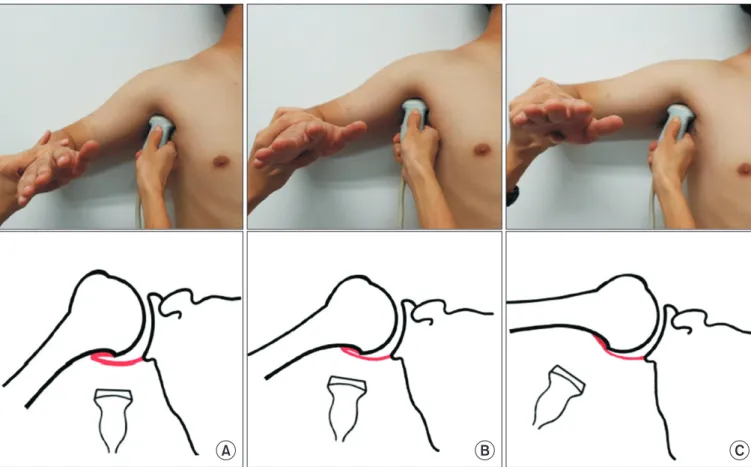
The AR thickness was measured using US in the supine position. The AR thickness was measured from both sides of the shoulder in each individual, at three shoulder ab- duction angles (50
o, 70
o, and 90
o) with neutral rotation (Fig. 1). The shoulder abduction angle is not equal to the angle of true glenohumeral joint abduction but is the angle of the global shoulder joint. Participants’ elbow joints were flexed at 90
oand the forearms were neutral.
US measurements were performed with Accuvix V10 ma- chine (Samsung Medison, Seoul, Korea) with a 5–13 MHz linear transducer. The US probe was placed on the ante- rior pectoral line, which is located between the anterior axillary fold and coracobrachialis muscle, along the long axis of the humeral shaft (Fig. 1). The coronal view of T2- weighted shoulder MRI (50
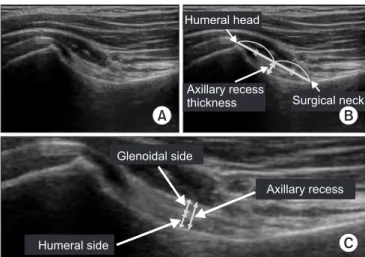
oabduction angle) showing the AR and a schematic illustration of AR were provided to the reader to enhance an understanding of the US measurements of AR thickness (Fig. 2). The frozen image that best visualized the cortical line of the humerus was selected to measure the AR thickness. The AR thickness was measured by the real-time method using the caliper on the ultrasound machine. It was determined as the distance from the bony cortex to the outer margin of the glenoid side capsule perpendicular to an imaginary mid- line between the tip of the humeral head and the surgi- cal neck. Thus, the AR thickness is defined as the total summation of each thickness of the glenoid and humeral capsules (Fig. 3).
Two physiatrists (an experienced and a novice rater)
measured the AR thickness sequentially at each shoulder
abduction angle. The novice rater received 3 hours of
training on AR anatomy, US measurements, and position
of the subject, and practiced on another healthy volun-
teer to become familiar with the procedure before com-
mencing the study. Two raters independently measured
AR thickness in each participant three times with a time
interval of 1 hour to blind to their previous own measure-
ment and to let the participants to move out of the fixed
position. The two raters were blinded to each other’s
measurements.
Data analysis
To assess the inter-rater and intra-rater reliability of US measurements, the two-way random absolute agree- ment method of obtaining ICC with 95% confidence intervals was used. The ICC coefficients for AR thickness measurements between two raters for three trials (ICC
2,2) and across the three trials for each rater (ICC
2,1) were as-
sessed. Paired t-test was used to examine the difference in AR thickness between left and right sides, and the dif- ferences in the average AR thickness at different angles of shoulder abduction. Student t-test was applied to compare the AR thickness in males and females. Pearson correlation was used to evaluate the relationship of AR thickness with height and BMI. Data were analyzed by
A B C
Fig. 1. Evaluation of the axillary recess capsule, using ultrasonography and schematic drawings, at three different posi- tions according to the degrees of shoulder abduction (50
o, 70
o, and 90
o).
A B
Surgical neck Humeral head
Fig. 2. (A) Coronal view of shoul- der magnetic resonance imaging showing the region of interest in the ultrasonographic measure- ment of axillary recess thickness.
(B) Schematic illustration of axil-
lary recess.
using SPSS ver. 21.0 (IBM, Armonk, NY, USA), Microsoft Excel and statistical software R.
RESULTS
Descriptive data for the AR thickness for both raters at the three different angles, averaged across the three trials, is shown in Table 1. There were no significant differences between the left and right sides at any of the three angles (Table 1). The inter-rater reliability coefficient was 0.98 at right side and 0.96 at left side. The agreement between the experienced rater and the novice rater was excellent, according to the criteria of Shrout and Fleiss (excellent reliability ≥0.75; fair to good reliability 0.40–0.74; poor re-
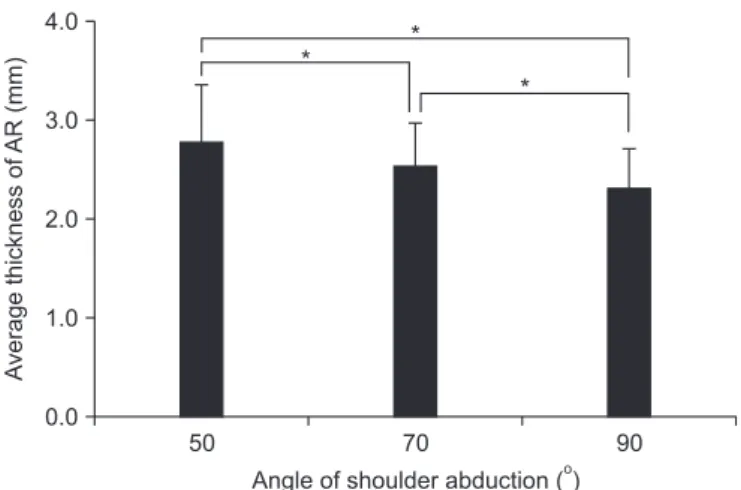
liability <0.40) [16]. The intra-rater reliability coefficients were 0.98, 0.95, and 0.96 at right side and 0.98, 0.97, and 0.96 at left side at each angle for the experienced rater, and 0.97, 0.96, and 0.95 at right side and 0.96, 0.96, and 0.95 at left side for the novice rater (Table 2). There were significant differences in the AR thickness according to the shoulder abduction angles (Fig. 4). The more the shoulder was abducted, the thinner the joint AR cap- sule was: the AR was thicker at 50
othan at 70
oand 90
o(all p<0.001), and the AR was thicker at 70
othan at 90
o(p<0.001). Males had a thicker AR capsule than females (3.22±0.52, 2.89±0.41, and 2.66±0.35 mm in males vs.
2.54±0.23, 2.30±0.18, and 2.06±0.14 mm in females at 50
o, 70
oand 90
o, respectively; all p<0.001). The height (r=0.62, p=0.003) and BMI (r=0.52, p=0.019) were positively cor- related with AR thickness.
DISCUSSION
In this study, we assessed inter- and intra-rater reliabil- ity of US measurements of the AR thickness in healthy subjects and found both parameters to be excellent. It is reassuring that even a relative beginner in diagnostic US showed excellent reliability in the measurements of AR thickness, which may depend on anthropometric vari- ables and position of the shoulder.
In 1934, Codman wrote about FS, “This is a class of cas- es which I find it difficult to define...”; the diagnosis of FS is still challenging [1,17]. There are no definite diagnostic criteria for FS because this disease has a wide spectrum of clinical findings, and the invasive arthroscopic diag- nosis of this relatively self-limiting disease is unethical.
There is no consensus as to the necessary extent of range-
Table 1. The thickness of axillary recess recorded by the two raters, depending on three different angles of shoulder abduction
Raters Angle of shoulder abduction Thickness (mm)
Right Left p-value
a)Experienced 50
o2.79±0.57 2.90±0.66 0.059
70
o2.48±0.47 2.57±0.56 0.061
90
o2.23±0.43 2.32±0.66 0.219
Novice 50
o2.78±0.56 2.92±0.54 0.074
70
o2.55±0.47 2.66±0.54 0.063
90
o2.36±0.41 2.42±0.45 0.236
Values are presented as mean±standard deviation.
a)