INTRODUCTION
The economic burden of depressive disorders, and particu- larly of major depressive disorder (MDD), in Korea, was esti-
mated to exceed 1.5 billion USD in 2004,1 and depression has been identified as the most important mental disorder in the Korean population.2,3 Depression encompasses a wide range of symptoms affecting mood, cognition, and motor functions, causing patients to experience psychosocial problems and im- paired quality of life. In patients with depression, insomnia is often under-detected and under-treated.4 Yet, it is estimated that around three quarters of them experience insomnia symptoms.5
The relationship between insomnia and depressive disorders is reciprocal, as they share fundamental neurobiological un- derpinnings.6 A growing body of evidence suggests that chron-
Prevalence and Clinical Correlates of Insomnia in Depressive Disorders: The CRESCEND Study
Seon-Cheol Park1,2, Jae-Min Kim3, Tae-Youn Jun4, Min-Soo Lee5, Jung-Bum Kim6, Seung-Hee Jeong7, and Yong Chon Park2,8
1Department of Psychiatry, Yong-In Mental Hospital, Yongin, Republic of Korea
2Institute of Mental Health, Hanyang University, Seoul, Republic of Korea
3Department of Psychiatry, School of Medicine, Chonnam National University, Gwangju, Republic of Korea
4Department of Psychiatry, College of Medicine, The Catholic University of Korea, Seoul, Republic of Korea
5Department of Psychiatry, College of Medicine, Korea University, Seoul, Republic of Korea
6Department of Psychiatry, Keimyung University School of Medicine, Daegu, Republic of Korea
7Department of Preventive Medicine, College of Medicine, The Catholic University of Korea, Seoul, Republic of Korea
8Department of Psychiatry, College of Medicine, Hanyang University, Seoul, Republic of Korea
ObjectiveaaTo investigate the prevalence, clinical manifestations, and clinical correlates of insomnia in a large cohort of Korean patients with depressive disorders.
MethodsaaWe recruited 944 patients with depressive disorders from the Clinical Research Center for Depression of South Korea (CRE- SCEND) study. Psychometric scales were used to assess depression (HAMD), anxiety (HAMA), psychotic symptoms (BPRS), global se- verity (CGI-S), and functioning (SOFAS). Insomnia levels were determined by adding the scores for all items on the HAMD insomnia subscale. The clinical characteristics of the patients with ‘low insomnia’ (summed score ≤3 on the HAMD subscale) and ‘high insomnia’
(score ≥4) were compared using statistical analyses. A logistic regression model was constructed to identify factors associated with ‘high insomnia’ status.
ResultsaaSymptoms of insomnia were present in 93% of patients, while simultaneous early, middle, and late insomnia affected 64.1%.
The high insomnia patients were characterized by significantly greater age, higher symptom levels (including core, gastrointestinal so- matic and anxiety symptoms, and suicidal ideation), higher global severity and incidence of physical disorders, and greater insight. Ex- planatory factors of ‘high insomnia’ status were older age, higher gastrointestinal somatic and anxiety symptom levels, higher global se- verity, and greater insight.
ConclusionaaIn clinical psychiatry, insomnia has been significantly underdiagnosed and undertreated. It affects most patients with de- pressive disorders, and is indicative of the global severity of depression. Active efforts to diagnose and treat insomnia in patients with depressive disorders should be strongly encouraged. Further research is needed to improve the diagnosis and treatment of insomnia in
depressive patients. Psychiatry Investig 2013;10:373-381
Key Wordsaa Insomnia, Depressive disorders, Anxiety symptoms, Gastrointestinal somatic symptoms, Global severity.
Received: December 13, 2012 Revised: May 11, 2013 Accepted: May 14, 2013 Available online: December 16, 2013
Correspondence: Yong Chon Park, MD
Department of Psychiatry, Hanyang University Guri Hospital, 153 Gyeong- chun-ro, Guri 471-701, Republic of Korea
Tel: +82-31-560-2273, Fax: +82-31-554-2599, E-mail: [email protected]
cc This is an Open Access article distributed under the terms of the Creative Commons Attribution Non-Commercial License (http://creativecommons.org/licenses/by- nc/3.0) which permits unrestricted non-commercial use, distribution, and reproduc- tion in any medium, provided the original work is properly cited.
ic insomnia is a strong risk factor for the development of de- pression7 as well as a prognostic indicator of clinical course and response to treatment in depressive disorders.8-10 In addi- tion, insomnia is associated with suicidal ideation and behav- ior in depressive patients.11 Although insomnia can manifest in a number of psychiatric illnesses, it has been shown to be a core symptom and an independent risk factor for MDD.12,13
In a recent large epidemiological study of unipolar and non- psychotic MDD patients in the United States (the STAR*D study), 84.7% of depressive participants experienced insom- nia, and insomnia was also correlated with scores reflecting more severe depression.4 In Korea, insomnia is the most com- mon symptom for which depressive patients receive psychiat- ric treatment.14 Although depressive disorders have a consid- erable impact on the mental health of the Korean population, most research in this area has been limited to biological psy- chiatry. The Clinical Research Center for Depression (CRE- SCEND) study was the first large, prospective, observational, clinical study of a nationwide sample of Korean patients with depressive disorders that provided epidemiological data.3
Using the data collected in the CRESCEND study, our aim was to: 1) estimate the prevalence of insomnia in patients with depressive disorders; 2) identify socio-demographic and clini- cal characteristics, and assessment scale scores, associated with
‘low insomnia’ and ‘high insomnia’ status, respectively, in pa- tients with depressive disorders; and 3) identify significant so- cio-demographic and clinical correlates of insomnia in pa- tients with ‘high insomnia’ status.
METHODS Study overview
From January 2006 to August 2008, 1183 patients with de- pressive disorders were enrolled in the CRESCEND study at one or other of 18 study centers across South Korea, including 16 university-affiliated hospitals and two general hospitals. The study was conducted over a period of nine years. During phase I, eligible subjects were assessed at baseline, followed by assess- ments at weeks 1, 2, 4, 8, 12, 24, and 52. In phase II, the sub- jects were assessed annually over the course of eight years. The data management center, which monitored the collection and quality of the data, was situated in the Preventative Medicine Department of the Catholic University College of Medicine in Seoul. All socio-demographic and clinical data were collected by trained and certified clinical research coordinators super- vised by clinical psychiatrists at the regional centers. All patient data were recorded using a preselected clinical report form and stored on the CRESCEND study website (www.smile- again.or.kr).
Study subjects
In order to closely reflect real clinical situations, the study had broad inclusion and minimal exclusion criteria. We en- rolled psychiatric in and outpatients who were beginning new treatment for first-onset or recurrent depression. The inclusion criteria were as follows: 1) age over seven years, and 2) pres- ence of MDD (with or without psychotic features), dysthymia, or depressive disorders not otherwise specified, diagnosed ac- cording to DSM-IV criteria15. The exclusion criteria were: 1) current or lifetime diagnosis of schizophrenia, other psychotic disorders, bipolar disorder, organic psychosis, or dementia, ac- cording to DSM-IV criteria; 2) presence of a medical or neu- rological illness severe enough to interfere with study evalua- tions and interviews; and/or 3) breastfeeding, pregnancy, or intention to become pregnant within nine months of enrol- ment. Out of the 1183 patients enrolled in the CRESCEND study, we selected the records of 944 patients aged 18-75 years with a baseline Hamilton Depression Rating Scale (HAMD) score ≥14 points, for the purpose of statistical analysis.
All relevant university and/or hospital Institutional Review Boards (IRBs) approved the study protocol and consent forms.
All study participants, or their authorized representatives, pro- vided written informed consent prior to participation.
Clinical presentation and levels of insomnia
As the CRESCEND study was designed to provide epidemi- ological data about depression rather than sleep, it did not em- ploy polysomnography. Instead, insomnia symptoms were evaluated using a 3-item insomnia subscale on the 17-item Hamilton Depression Rating Scale (HAMD).16 These three items, scored on a scale of 0-2, address inability to fall asleep (early insomnia), waking during the night (middle insomnia), and waking too early (late insomnia). The substantial agree- ment between scores on the HAMD insomnia subscale and sleep diary data has validated the HAMD subscale as a global measure of insomnia severity in depressive disorders.17 In large-sample-sized studies, sleep-specific evaluation methods that include polysomnography, sleep assessment scales, and sleep diaries are occasionally substituted by the insomnia items of the HAMD. Thus, the insomnia items of the HAMD were defined as the main outcome variables.18-21 The presence of insomnia was indicated by a score of ≥1 on the HAMD in- somnia subscale.18 Insomnia levels were determined by sum- ming the scores for all items on the HAMD insomnia subscale A comparison of the clinical characteristics between patients with high and low levels of insomnia was needed in order to effectively determine the significant clinical correlates of in- somnia. Thus, the 2 subgroups were divided according to an operational cut-off value that has been used in the previous study. According to Montgomery et al.’s conceptualization,22
high insomnia was defined as individual scores that summed to 4 or more, and low insomnia was defined as individual scores that summed to 3 or less.
Assessment scales
The socio-demographic data collected on the clinical report forms included age, sex, length of education, marital status, cohabitation status, religious affiliation, current occupation, and monthly income. Diagnostic evaluations and retrospec- tive reporting of the histories of medical and/or psychiatric ill- nesses and treatments took place at baseline. Diagnoses of de- pressive disorders were made by the attending clinicians using DSM-IV criteria.15 The diagnoses were confirmed in week 2 in a subsample of patients, using a DSM-IV-based Structured Clinical Interview (SCID).23 Depressive disorders were catego- rized as follows: 1) MDD without psychotic features; 2) MDD with psychotic features; 3) dysthymia; and 4) depressive disor- ders not otherwise specified. The clinical data collected in the study included inpatient/outpatient status, first-time or recur- rent disease, number of previous depressive episodes, age at onset, duration of illness, family history of depression, history of suicide attempts, and concurrent physical disorders. The section concerning suicide attempts had additional questions about the method and severity of each attempt. The section concerning concurrent physical disorders had questions about the presence or absence of 33 listed physical disorders, includ- ing hypertension, cancer, diabetes, angina, cerebrovascular disease, thyroid disease, osteoporosis, hyperlipidemia, Cush- ing’s disease, uremia, gastroduodenal ulcer, and inflammatory bowel disease. As the treatment statuses and severities of the physical disorders were also questioned, patients with a con- current medical or neurological illness that was severe enough to interfere with study participation were excluded.
The clinician-administered scales, including the 17-item Hamilton Depression Rating Scale (HAMD),16 the Hamilton Anxiety Rating Scale (HAMA),24 the Brief Psychiatric Rating Scale (BPRS),25 the Clinical Global Impression of Severity scale (CGI-S),26 and the Social and Occupational Functioning As- sessment Scale (SOFAS),27 were used to evaluate the severity of the depressive symptoms, severity of the anxiety symptoms, severity of the psychotic symptoms, global severity, and levels of social and occupational functioning, respectively. All of these scales were formally translated into Korean, and they have been demonstrated to be valid and reliable in Korean populations.28,29 Higher scores on the HAMD, the HAMA, the BPRS, and the CGI-S represent more severe individual scale- specific symptoms, while lower scores on the SOFAS indicate poorer function.
The core symptoms of depression were defined using a 6-item HAMD scale developed by Evans et al.,30 and the sever-
ity of depression was assessed by adding the scores for these items, including depressed mood, guilt, work and activities, psychic anxiety, somatic anxiety, and general somatic symp- toms. The 6-item HAMD had been initially developed to in- crease the signal-to-noise ratio and reduce the failure rate in efficacy trials of antidepressants.31 In the present study, the scale was used to investigate the relationship between insom- nia and the ‘core’, ‘associated’ and ‘co-morbid’ symptoms of de- pressive disorders. The total scores on the HAMD and HAMA scales were calculated by adding the scores for all except the insomnia-related items, in order to control for the effects of insomnia when comparing the scores of low and high insom- nia patients. Moreover, all individual items of the HAMD without the insomnia subscales were used to compare all of the multiple dimensions of the depressive symptoms between patients with high and low insomnia with the same study de- sign as that used in a previous investigation.
Statistical analysis
Descriptive statistics were used to determine the distribu- tion of symptoms and levels of insomnia among the patients.
Accordingly, insomnia was categorized as early, middle, and late, and symptom levels ranged from 0 to 6. Socio-demo- graphic and clinical characteristics and the assessment scale scores were compared in the low and high insomnia groups using an independent t-test for continuous variables and a χ2 test for categorical variables. A logistic regression model was constructed to identify factors associated with ‘high insomnia’
status. In the model, the patients with ‘high insomnia’ status were defined as the dependent variable, while the low insom- nia group was a reference category. Socio-demographic and clinical variables shown to be significantly different between the two groups were used as covariates. Standard methods such as goodness of fit, interaction, and colinearity were used to select and validate the final model. Significance was set at p<0.05 (two-tailed) for all tests. All statistical analyses were performed using SPSS 18.0 for Windows (SPSS Inc., Chicago, IL, USA).
RESULTS
Patient characteristics
Table 1 and 2 summarize the socio-demographic and clini- cal characteristics of the 994 patients. The mean age was 56 (SD=14.6) years, and most of the patients were female (74.7%), married (60.3%), unemployed (59.2%), with a religious affilia- tion (60.2%), diagnosed with MDD without psychotic symp- toms (82.9%), and enrolled as outpatients (78.1%). The mean score on the HAMD scale without insomnia was 17.7 (SD=4.3), followed by 18.1 (SD=7.9) on the HAMA without insomnia,
0.4 (SD=1.1) on the BPRS, 4.8 (SD=1.0) on the CGI-S scale, and 57.2 (SD=10.8) on the SOFAS.
Prevalence of insomnia
The prevalence of insomnia according to the level of symp- toms is shown in Figure 1. A score of 6 on the HAMD scale was reported in 20.9% of patients, and was the most common- ly reported score on the 0-6 scale. ‘High insomnia’ was more frequent (59.1%) than ‘low insomnia’ (40.1%).
The prevalence of insomnia according to its clinical presen- tations is shown in Figure 2. Approximately 92.9% of the 994 patients suffered from some type of insomnia. Remarkably, the simultaneous presence of early, middle, and late insomnias was the most common of all insomnia presentations (64.1%).
Overall, middle insomnia was the most frequent of the three types. However, on their own each of the three types was present in <5% of the patients.
Table 1. Socio-demographic and clinical characteristics of the subjects Total sample
(N=944)
Low insomnia (N=387; 40.9%)
High insomnia (N=557; 59.1%)
Statistical
coefficients p-value Socio-demographic characteristics
Age, mean (SD) years 50.6 (14.6) 48.9 (15.2) 51.8 (14.1) t=-2.991 0.003
Women, N (%) 705 (74.7) 291 (75.2) 414 (74.5) χ2=0.065 0.799
Married, N (%) 570 (60.3) 223 (62.9) 347 (67.8) χ2=5.400 0.369
Religious affiliation, N (%) 569 (60.2) 216 (60.0) 333 (59.8) χ2=3.899 0.564
Education, mean (SD) years 10.5 (4.4) 10.6 (4.4) 10.5 (4.4) t=0.479 0.632
Unemployed, N (%) 559 (59.2) 223 (56.8) 336 (65.6) χ2=4.868 0.978
Monthly income <2000 USD, N (%) 447 (47.4) 175 (65.2) 272 (48.8) χ2=2.317 0.888
Clinical characteristics
Diagnosis, N (%) χ2=9.897 0.019
Major depressive disorder without psychotic features 783 (82.9) 320 (82.7) 463 (83.1) Major depressive disorder with psychotic features 21 (2.2) 7 (1.8) 14 (2.5)
Dysthymia 26 (2.8) 18 (4.7) 8 (1.4)
Depressive disorder not otherwise specified 114 (12.1) 42 (10.9) 72 (12.9)
Previous history of depression, N (%) 395 (41.8) 175 (45.9) 220 (39.6) χ2=3.667 0.056
Outpatient enrollment, N (%) 737 (78.1) 314 (42.6) 423 (57.4) χ2=3.599 0.058
Current suicidal intent, N (%) 502 (53.2) 210 (55.7) 292 (53.6) χ2=3.288 0.193
Previous suicidal attempt, N (%) 216 (22.9) 80 (20.7) 136 (24.4) χ2=1.815 0.182
Comorbid physical disorder, N (%) 313 (33.2) 107 (27.6) 206 (37.0) χ2=8.979 0.003
Family history of depression, N (%) 395 (41.8) 60 (15.5) 76 (13.6) χ2=0.640 0.424 Figure 1. Insomnia levels of the patients with depressive disor-
ders in the CRESCEND study.
Insomnia level N (%)
0 67 (7.1) 1
55 (5.8) 2 118 (12.5)
3 147 (15.6) 4
179 (19.0) 5
181 (19.2) 6 197 (20.9)
Figure 2. Insomnia presentations of the patients with depressive disorders in the CRESCEND study.
Insomnia presentation N (%)
Any insomnia 877 (92.9)
Early insomnia 726 (76.9)
Middle insomnia 809 (85.7)
Late insomnia 738 (78.2) 33
(3.5) 22 (2.3)
13
(1.4) 98
(10.3) 40
(4.2) 66 (7.3) 605 (64.1)
Comparison of socio-demographic and clinical characteristics of the low and high insomnia patients
The socio-demographic and clinical characteristics of the low and high insomnia patients are compared in Table 1. The high insomnia patients were significantly older (t=-2.991, p=0.003), were more frequently diagnosed with MDD (χ2=9.897, p=0.019), and more frequently had physical disor- ders (χ2=8.979, p=0.003). The differences between the 2 groups with respect to gender (χ2=0.065, p=0.799), current suicidal intent (χ2=3.288, p=0.193), previous suicidal attempts (χ2=1.815, p=0.182), outpatient enrollment (χ2=3.599, p=0.058), previous history of depression (χ2=3.667, p=0.056), or family history of depression (χ2=0.640, p=0.424) were not
significant.
Comparison of assessment scale scores of the low and high insomnia patients
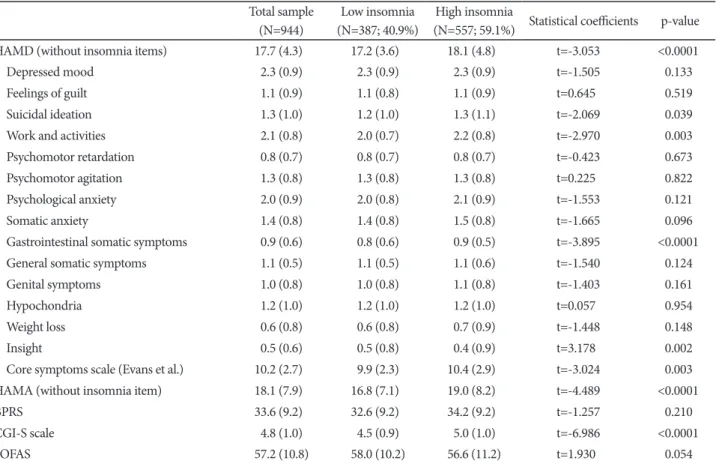
A comparison of the assessment scale scores of the low and high insomnia patients is presented in Table 2. The high in- somnia group had a significantly higher total score on the HAMD scale without insomnia items (t=-3.053, p<0.0001), which included higher individual scores for suicidal ideation (t=-2.068, p=0.039), gastrointestinal somatic symptoms (t=
-3.895, p<0.0001), and core symptoms (t=-3.024, p=0.003).
Conversely, the high-insomnia group had a significantly lower score for insight (t=3.178, p=0.002). The total scores on the
Table 2. Patients’ mean (SD) scores on the assessment scales Total sample
(N=944)
Low insomnia (N=387; 40.9%)
High insomnia
(N=557; 59.1%) Statistical coefficients p-value
HAMD (without insomnia items) 17.7 (4.3) 17.2 (3.6) 18.1 (4.8) t=-3.053 <0.0001
Depressed mood 2.3 (0.9) 2.3 (0.9) 2.3 (0.9) t=-1.505 0.133
Feelings of guilt 1.1 (0.9) 1.1 (0.8) 1.1 (0.9) t=0.645 0.519
Suicidal ideation 1.3 (1.0) 1.2 (1.0) 1.3 (1.1) t=-2.069 0.039
Work and activities 2.1 (0.8) 2.0 (0.7) 2.2 (0.8) t=-2.970 0.003
Psychomotor retardation 0.8 (0.7) 0.8 (0.7) 0.8 (0.7) t=-0.423 0.673
Psychomotor agitation 1.3 (0.8) 1.3 (0.8) 1.3 (0.8) t=0.225 0.822
Psychological anxiety 2.0 (0.9) 2.0 (0.8) 2.1 (0.9) t=-1.553 0.121
Somatic anxiety 1.4 (0.8) 1.4 (0.8) 1.5 (0.8) t=-1.665 0.096
Gastrointestinal somatic symptoms 0.9 (0.6) 0.8 (0.6) 0.9 (0.5) t=-3.895 <0.0001
General somatic symptoms 1.1 (0.5) 1.1 (0.5) 1.1 (0.6) t=-1.540 0.124
Genital symptoms 1.0 (0.8) 1.0 (0.8) 1.1 (0.8) t=-1.403 0.161
Hypochondria 1.2 (1.0) 1.2 (1.0) 1.2 (1.0) t=0.057 0.954
Weight loss 0.6 (0.8) 0.6 (0.8) 0.7 (0.9) t=-1.448 0.148
Insight 0.5 (0.6) 0.5 (0.8) 0.4 (0.9) t=3.178 0.002
Core symptoms scale (Evans et al.) 10.2 (2.7) 9.9 (2.3) 10.4 (2.9) t=-3.024 0.003
HAMA (without insomnia item) 18.1 (7.9) 16.8 (7.1) 19.0 (8.2) t=-4.489 <0.0001
BPRS 33.6 (9.2) 32.6 (9.2) 34.2 (9.2) t=-1.257 0.210
CGI-S scale 4.8 (1.0) 4.5 (0.9) 5.0 (1.0) t=-6.986 <0.0001
SOFAS 57.2 (10.8) 58.0 (10.2) 56.6 (11.2) t=1.930 0.054
HAMD: Hamilton Depression Rating Scale, HAMA: Hamilton Anxiety Rating Scale, BPRS: Brief Psychiatric Rating Scale, CGI-S: Clinical Global Impression of Severity, SOFAS: Social and Occupational Functional Assessment Scale
Table 3. Logistic regression model showing clinical correlates of ‘high insomnia’ status
B Standard error Wald p-value Odds ratio 95% CI
Age, years 0.014 0.005 7.824 0.005 1.014 1.004-1.023
Gastrointestinal somatic symptoms (HAMD) 0.293 0.128 5.200 0.023 1.340 1.042-1.724
Insight (HAMD) -0.357 0.124 8.220 0.004 0.700 0.549-0.893
HAMA (without insomnia items) 0.041 0.009 19.323 <0.0001 1.041 1.023-1.061
CGI-S scale 0.425 0.076 30.952 <0.0001 1.530 1.317-1.777
HAMD: Hamilton Depression Rating Scale, HAMA: Hamilton Anxiety Rating Scale, CGI-S: Clinical Global Impression of Severity
HAMA scale without insomnia items (t=-4.489, p<0.0001) and the CGI-S scale (t=-6.986, p<0.0001) were higher in the high insomnia patients. However, there were no significant differences between the 2 groups with respect to the scores on the BPRS (t=-1.257, p=0.210) and SOFAS (t=1.930, p=0.054).
Factors associated with ‘high insomnia’ status in logistic regression
Table 3 presents the results of a logistic regression analysis to identify factors associated with ‘high insomnia’ status. The Hosmer-Lemeshow goodness-of-fit test confirmed the accu- racy of the logistic model (χ2=4.132, df=8, and p=0.845). The initial covariates selected for the logistic model included age, dichotomized diagnosis, presence of co-morbid physical dis- orders, individual scores (including suicidal ideations, gastro- intestinal somatic symptoms, insight, and core symptoms), overall score on the HAMA scale without insomnia items, and overall score on the CGI-S scale. Because the individual scores on the 17-item HAMD scale without insomnia items were used as covariates, the total score was not.
As a result of forward selection to avoid colinearity, the final model was found to include age (OR=1.014, 95% CI=1.004- 1.023, p=0.005), individual scores for gastrointestinal somatic symptoms (OR=1.340, 95% CI=1.042-1.724, p=0.023) and in- sight (OR=0.700, 95% CI=0.549-0.893, p=0.004), overall score on the HAMA scale without insomnia items (OR=1.041, 95%
CI=1.023-1.061, p<0.0001), and overall score on the CGI-S scale (OR=1.530, 95% CI=1.317-1.777, p<0.0001). By con- trast, dichotomized diagnosis, co-morbid physical disorders, suicidal ideation, and core symptoms were not significantly re- lated to ‘high insomnia’ status.
DISCUSSION
Our analysis revealed that most patients with depressive disorders in the CRESCEND study suffered from some form of insomnia, with simultaneous early, middle, and late insom- nia as the most common presentation. This evidence lends
support to the finding that insomnia is the most common complaint associated with depression, being reported by more than 90% of depressive patients.
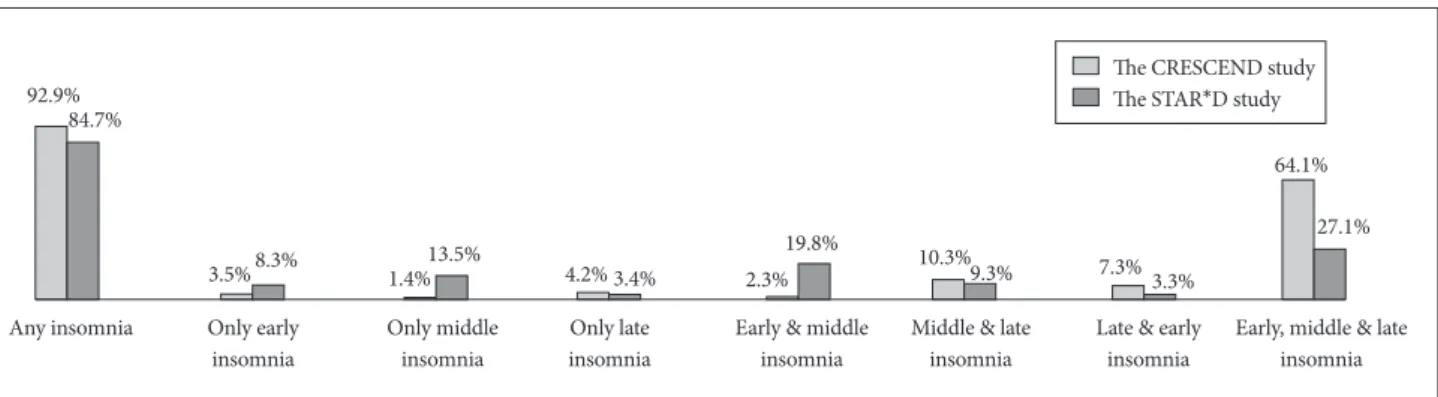
Figure 3 compares our findings with those of the STAR*D study by Sunderajan et al.4 showing the differences in insom- nia prevalence according to clinical presentations. The overall prevalence of insomnia was similar in the two studies, in spite of several differences in study design. For example, due to dif- ferent inclusion/exclusion criteria, the mean age (±SD) in the CRESCEND study (50.6±14.6 years) was higher than in STAR*D (37.3±13.6 years among patients without insomnia, and 41.1±13.1 years among insomniacs). Furthermore, unlike STAR*D, the CRESCEND study recruited inpatients and pa- tients with psychotic MDD. Any discrepancies in insomnia prevalence could also be explained by differences in the psy- chometric instruments and assessment schedules of the two studies. While CRESCEND used the HAMD scale at baseline, the STAR*D study used the 30-item Inventory of Depressive Symptomatology, Clinician-Rated (IDS-C30) scale,33 within 72 hours of baseline. A comparison of the prevalence of insomnia according to its clinical presentations is also shown in Figure 3.
The prevalence of simultaneous early, middle and late insom- nia symptoms was much higher in the CRESCEND than in the STAR*D study (64.1% vs. 27.1%). Conversely, the preva- lence of middle insomnia alone was much lower in the CRE- SCEND study (1.4% vs. 13.5%), as was the prevalence of si- multaneous early and middle insomnia (2.3% vs. 19.8%). It may be that the older age and more severe depression levels of the CRESCEND study patients led to more frequent early- morning insomnia with inability to return to sleep, and more abnormal sleep patterns. It is worth noting, however, that each item on the HAMD insomnia subscale had three possible scores (0, 1, and 2), while those on the IDS-C30 scale had four (0, 1, 2, and 3). Thus, the specificity of the HAMD scale might be lower than that of the IDS-C30.
The high insomnia patients in our study were significantly older than those with low insomnia scores. This agrees with previous reports, which showed that the prevalence and sever-
Figure 3. Comparison of the frequencies of insomnia and insomnia presentations in the CRESCEND and STAR*D surveys.
The CRESCEND study The STAR*D study
Any insomnia Only early insomnia
Only middle insomnia
Only late insomnia
Early & middle insomnia
Middle & late insomnia
Late & early insomnia
Early, middle & late insomnia 92.9%
84.7%
3.5% 8.3% 13.5%
1.4% 4.2% 3.4% 2.3%
19.8% 10.3%9.3% 7.3% 3.3%
64.1%
27.1%
ity of insomnia in depressive patients increased with age.34 Several studies have also associated insomnia with a higher ill- ness burden in depressive disorders, and identified it as a risk factor for severe depression, linked to a higher probability of recurrence or relapse.6,35-37 In line with these findings, our pa- tients with high insomnia scores had a significantly higher fre- quency of MDD diagnoses, and higher total scores on the HAMD scale (without insomnia items) and the CGI-S scale.
Previous reports have identified a close and reciprocal rela- tionship between insomnia, depression, and physical disor- ders.38 In line with these findings, physical co-morbidities were significantly more common in the high insomnia patients in our study. There is considerable evidence that insomnia in de- pressive patients is associated with the severity and number of physical disorders. A cross-sectional primary care study in New Zealand showed that half of the 1517 insomniac patients had depression, and 43% suffered from physical illnesses.39 A lon- gitudinal community study of late life in 909 Koreans revealed that baseline insomnia was associated with incident depression and an increase in reported physical disorders, while the num- ber of physical disorders at baseline was associated with the prevalence, incidence and persistence of insomnia.40
In terms of their performance on the HAMD scale, the high insomnia patients had significantly higher scores relating to the core symptoms identified by Evans et al.30 (including depressed mood, guilt, work and activities, psychic anxiety, somatic anxi- ety and general somatic symptoms) than the low insomnia group. Conversely, their score for insight was significantly lower than that of the low insomniacs. These scores concur with pre- vious research, which suggests that insomnia is closely related to the core symptoms of depression. Taylor et al.41 showed that the number of nocturnal awakenings was associated with de- pression severity, and the frequency of insomnia was associated with both depression and anxiety. Another study found evi- dence of a relationship between severe insomnia in depressive patients, longer duration of the current depressive episode, and higher HAMD scores.42 It has also been reported that sleep dis- turbance and core mood symptoms improve at similar rates in response to pharmacological treatment of late-life depres- sion.35 On the whole, the evidence suggests a link between in- somnia and the core symptoms of depression, and between in- somnia and the development of insight. However, it has been suggested that the association between insomnia and depres- sion is not limited to the core symptoms.43 The high insomnia group in our study also had higher scores for gastrointestinal somatic symptoms on the HAMD scale and on the HAMA scale without insomnia than the low insomnia patients.
Although there were no significant differences in the scores for current suicidal intent and previous suicidal attempts be- tween the low and high insomnia patients, the suicidal ide-
ation score on the HAMD scale was higher in those with ‘high insomnia’ status. Chellappa and Araújo44 demonstrated that, although depressive patients with insomnia had significantly higher scores on the Beck Scale for Suicidal Ideation (SSI), only insomnia remained significantly associated with suicidal ideation in a multivariate analysis. The fact that a suicide-spe- cific scale was not used in our study might explain this differ- ence in results. Overall, the evidence suggests that insomnia in depressive patients is associated with suicidal ideation, rather than with current suicidal intent or past suicidal attempts.
Our final logistic regression model revealed that older age, less-impaired insight, and higher levels of gastrointestinal symptoms, anxiety symptoms and global severity were inde- pendent explanatory factors of ‘high insomnia’ status. Thus, insomnia symptoms in patients with depressive disorders may be an indicator of the global severity of depression. At the same time, the model suggested that insomnia symptoms were more closely related to the associated symptoms of depression (e.g., gastrointestinal somatic and anxiety symptoms) than with its core symptoms (e.g., mood symptoms), which con- tradicts the view that insomnia is an essential constitutive symptom of depressive disorders.12 While the nature of this relationship may require further investigation, our study pro- vides more evidence that insomnia is very closely related to depressive disorders.
Our study has several limitations. Firstly, we did not employ specific methods for measuring insomnia such as polysom- nography, the sleep assessment scale, or sleep diaries. As men- tioned before, measuring insomnia with a tool that has low specificity could result in overestimation of its prevalence. Sec- ondly, we did not investigate the possible impact of co-morbid psychiatric disorders on insomnia symptoms, and hence this could not be ruled out. Thirdly, the clinical significance of the statistical differences between the high and low insomnia groups was small. While this finding could be an effect of the large sample size, or the broad inclusion criteria, it may have important implications for clinical practice. The broad inclu- sion criteria also contributed to the considerable heterogeneity of the patients, suggesting that confounding factors may have influenced some of our findings Finally, we did not perform further statistical analyses, such as Bonferroni corrections, in the comparisons of the clinical characteristics between the pa- tients with high and low insomnia. Thus, this was a limitation in the interpretation of the clinical significance of several sta- tistical values in this study.
Conclusions
Insomnia affects the vast majority of patients with depres- sive disorders in Korea, and the simultaneous presence of ear- ly, middle, and late insomnia symptoms is very common. Our
findings support the thesis that some insomnia cases remain under-diagnosed and under-treated in psychiatric clinical practice. Although the relationship between insomnia and de- pression is not yet fully understood, insomnia could be one of most clinically important symptoms in depressive disorders.
Since it is closely related to global severity and less- impaired insight in depressive patients, insomnia could be used as an indicator of the clinical severity of depression. Active efforts to diagnose and treat insomnia should be strongly encouraged, to improve the management of depressive patients. However, further research is needed to optimize methods of detection and treatment of insomnia in depressive patients.
Acknowledgments
This study was supported by a grant of the Korean Health 21 Care Tech- nology R & D Project, Ministry of Health and Welfare, Republic of Korea (A102065). The Ministry of Health and Welfare had no further role in study design; in the collection, analysis and interpretation of data; in the writing of the report; or in the decision to submit the paper for publication.
REFERENCES
1. Jung SH. The Socioeconomic Burden of Suicide and Depression in Korea. Seoul, Korea: National Center for Mental Health Research and Education; 2005.
2. Jang SH, Park YN, Jae YM, Jun TY, Lee MS, Kim JM, et al. The symp- tom frequency characteristics of the Hamilton Depression Rating Scale and possible symptom clusters of depressive disorders in Korea:
The CRESCEND Study. Psychiatry Investig 2011;8:312-319.
3. Kim TS, Jeong SH, Kim JB, Lee MS, Kim JM, Yim HW, et al. The clini- cal research center for depression study: baseline characteristics of a Korean long-term hospital-based observational collaborative prospec- tive cohort study. Psychiatry Investig 2011;8:1-8.
4. Sunderajan P, Gaynes BN, Wisniewski SR, Miyahara S, Fava M, Ak- ingbala F, et al. Insomnia in patients with depression: a STAR*D re- port. CNS Spectr 2010;15:394-404.
5. Nutt D, Wilson S, Paterson L. Sleep disorders as core symptoms of de- pression. Dialogues Clin Neurosci 2008;10:329-336.
6. Lustberg L, Reynolds CF. Depression and insomnia: question of cause and effect. Sleep Med Rev 2000;4:253-262.
7. Ohayon MM, Roth T. Place of chronic insomnia in the course of de- pressive and anxiety disorders. J Psychiatr Res 2003;37:9-15.
8. Buysse DJ, Reynolds CF 3rd, Hoch CC, Houck PR, Kupfer DJ, Ma- zumdar S, et al. Longitudinal effects of nortriptyline on EEG sleep and the likelihood of recurrence in elderly depressed patients. Neuropsy- chopharmacology 1996;12:243-252.
9. Buysse DJ, Tu XM, Cherry CR, Begley AE, Kowalski J, Kupfer DJ, et al.
Pretreatment REM sleep and subjective quality distinguish depressed psychotherapy remitters and nonremitters. Biol Psychiatry 1999;45:
205-213.
10. Thase ME. Antidepressant treatment of the depressed patients with in- somnia. J Clin Psychiatry 1999;60(Suppl 17):28-31.
11. McCall WV, Blocker JN, D’Agostino R Jr, Kimball J, Boggs N, Lasater B, et al. Insomnia severity is an indicator of suicidal ideation during a depression clinical trial. Sleep Med 2010;11:822-827.
12. Zimmerman M, McGlinchery JB, Young D, Chelminski I. Diagnosing major depressive disorder I: A psychometric evaluation of the DSM- IV symptom criteria. J Nerv Ment Dis 2006;194:158-163.
13. Mendlewicz J. Sleep disturbances: core symptoms of major depressive disorder rather than associated or comorbid disorders. World J Biol Psychiatry 2009;10:269-275.
14. Han CS. Current State of Depression Treatment in Korea. Seoul, Ko- rea: Proceedings of Annual Symposium of the Center for Depression, Korea University Anam Hospital, Feb 23, 2006.
15. American Psychiatric Association. Diagnostic and Statistical Manual of Mental Disorders, 4th Edition. Washington DC: American Psychi- atric Association; 1994.
16. Hamilton MA. A rating scale for depression. J Neurol Neurosurg Psy- chiatry 1960;23:56-62.
17. Manber R, Blasey C, Arnow, B, Markowitz JC, Thase ME, Rush AJ, et al. Assessing insomnia severity in depression: comparison of depres- sion and sleep diaries. J Psychiatr Res 2005;39:481-488.
18. Na HR, Kang EH, Yu BH, Woo JM, Kim YR, Lee SH, et al. Relation- ship between personality and insomnia in panic disorder patients.
Psychiatry Investig 2011;8:102-106.
19. Troxel WM, Kupfer DJ, Reynolds CF 3rd, Frank E, Thase ME, Miewald JM, et al. Insomnia and objectively measured sleep disturbances predict treatment outcome in depressed patients treated with psychotherapy or psychotherapy-pharmacotherapy combinations. J Clin Psychiatry 2012;73:478-485.
20. Carli V, Roy A, Bevilacqua L, Maggi S, Cesaro C, Sarchiapone M. In- somnia and suicidal behaviour in prisoners. Psychiatry Res 2011;185:
141-144.
21. Yang H, Sinicropi-Yao L, Chuzi S, Youn SJ, Clain A, Baer L, et al. Re- sidual sleep disturbance and risk of relapse during the continuation/
maintenance phase treatment of major depressive disorder with the selective serotonin reuptake inhibitor fluoxetine. Ann Gen Psychiatry 2010;9:10.
22. Montgomery SA, Herman BK, Schweizer E, Mandel FS. The efficacy of pregabalin and benzodiazepines in generalized anxiety disorder prescribing with high levels of insomnia. Int Clin Psychopharmacol 2009;24:214-222.
23. First MB, Spitzer RL, Gibbon M, Wiliams JB. Structured Clinical In- terview for DSM-IV Axis I Disorders-Patient Edition. New York: Bio- metrics Research Department, New York State Psychiatric Institute;
1995.
24. Hamilton MA. The assessment of anxiety state by rating. Br J Med Psychol 1959;32:50-55.
25. Overall JE, Gorham DR. The brief psychiatric rating scale. Psychol Rep 1962;10:779-812.
26. Guy W. ECDEU Assessment Manual for Psychopharmacology. US Department of Health, Education, and Welfare publication. Washing- ton DC: National Institute of Mental Health; 1976.
27. Goldman HH, Skodol AE, Lave TR. Revising axis V for DSM-IV: a re- view of measures of social functioning. Am J Psychiatry 1992;149:
1148-1156.
28. Yi JS, Bae SO, Ahn YM, Park DB, Noh KS, Shin HK, et al. Validity and reliability of the Korean version of the Hamilton Depression Rating Scale (K-HDRS). J Korean Neuropsychiatr Assoc 2005;44:456-465.
29. Lee JY, Cho MJ, Kwon JS. Global assessment of functioning scale and social and occupational functioning scale. Korean J Psychopharmacol 2006;17:122-127.
30. Evans KR, Sills T, DeBrota D, Gelwicks S, Engelhardt N, Santor D. An item response analysis of the Hamilton Depression Rating Scale using shared data from two pharmaceutical companies. J Psychiatr Res 2004;
38:275-284.
31. Kennedy SH. Core symptoms of major depressive disorder: relevance to diagnosis and treatment. Dialogues Clin Neurosci 2008;10:271-277.
32. Sung G, Kim BN, Lee EH, Yu BH, Hong KS, Kim JH. Underestimating the severity of bipolar depression: a comparison of the Hamilton de- pression rating scale items. J Affect Disord 2012;136:425-429.
33. Trivedi MH, Rush AJ, Ibrahim HM, Carmody TJ, Biggs MM, Suppes T, et al. The Inventory of Depressive Symptomatology, Clinician Rat- ing (IDS-C) and Self-Report (IDS-SR), and the Quick Inventory of Depressive Symptomatology, Clinician Rating (QIDS-C) and Self-Re- port (QIDS-SR) in public sector patients with mood disorders: a psy-
chometric evaluation. Psychol Med 2004;34:73-82.
34. Stewart R, Besset A, Bebbington P, Brugha T, Lindesay J, Jenkins R, et al. Insomnia comorbidity and impact and hypnotic use by age group in a national survey population aged 16 to 74 years. Sleep 2006;29:
1391-1397.
35. Dombrovski AY, Blaskesley-Ball RE, Mulsant BH, Mazumdar S, Houck PR, Szanto K, et al. Speed of improvement in sleep disturbance and anxiety compared with core mood symptoms during acute treat- ment of depression in old age. Am J Geriatr Psychiatry 2006;14:550- 36. Baglioni C, Battagliese G, Feige B, Spiegelhalder K, Nissen C, Voder-554.
holzer U, et al. Insomnia as a predictor of depression: a meta-analytic evaluation of longitudinal epidemiological studies. J Affect Disord 2011;135:10-19.
37. Szklo-Coxe M, Young T, Peppard PE, Finn LA, Benca RM. Prospective associations of insomnia markers and symptoms with depression. Am J Epidemiol 2010;171:709-720.
38. Langsand LE, Vatten LJ, Platou C, Janszky I. Insomnia and the risk of
acute myocardial infarction: a population study. Circulation 2011;124:
2073-2781.
39. Arroll B, Fernando A 3rd, Falloon K, Goodyear-Smith F, Samaranay- ake C, Warman G. Prevalence of causes of insomnia in primary care: a cross-sectional study. Br J Gen Pract 2012;62:e99-e103.
40. Kim JM, Stewart R, Kim SW, Yang SJ, Shin IS, Yoon JS. Insomnia, de- pression, and physical disorders in late life: a 2-year longitudinal com- munity study in Koreans. Sleep 2009;32:1221-1228.
41. Taylor DJ, Lichstein KL, Durrence HH, Riedel BW, Bush AJ. Epidemi- ology of insomnia, depression, and anxiety. Sleep 2005;28:1457-1464.
42. O’Brien EM, Chelminski I, Young D, Dalrymple K, Hrabosky J, Zim- merman M. Severe insomnia is associated with more severe presenta- tion and greater functional deficits in depression. J Psychiatr Res 2011;
45:1101-1105.
43. Nekelmann D, Mykletun A, Dahl AA. Chronic insomnia as a risk fac- tor for developing anxiety and depression. Sleep 2007;30:873-880.
44. Chellappa SL, Araújo JF. Sleep disorders and suicidal ideation in pa- tients with depressive disordr. Psychiatr Res 2007;153:131-136.