Clinical Significance of the Number of Depressive Symptoms in Major Depressive Disorder: Results from the CRESCEND Study
Our study aimed to establish the relationship between the number of depressive symptoms and the clinical characteristics of major depressive disorder (MDD). This would enable us to predict the clinical significance of the number of depressive symptoms in MDD patients.
Using data from the Clinical Research Center for Depression (CRESCEND) study in Korea, 853 patients with DSM-IV MDD were recruited. The baseline and clinical characteristics of groups with different numbers of depressive symptoms were compared using the χ2 test for discrete variables and covariance (ANCOVA) for continuous variables. In addition, the scores of these groups on the measurement tools were compared by ANCOVA after adjusting the potential effects of confounding variables. After adjusting the effects of monthly income and history of depression, a larger number of depressive symptoms indicated higher overall severity of depression (F [4, 756] = 21.458, P < 0.001) and higher levels of depressive symptoms (F [4, 767] = 19.145, P < 0.001), anxiety symptoms (F [4, 765] = 12.890, P < 0.001), and suicidal ideation (F [4, 653] = 6.970, P < 0.001). It also indicated lower levels of social function (F [4, 760] = 13.343, P < 0.001), and quality of life (F [4, 656] = 11.975, P < 0.001). However, there were no significant differences in alcohol consumption (F [4, 656] = 11.975, P < 0.001). The number of depressive symptoms can be used as an index of greater illness burden in clinical psychiatry.
Keywords: Number; Major Depressive Disorder (MDD); Depressive Symptoms; Anxiety Symptoms; Suicidal Ideation
Seon-Cheol Park,1 Jeongkyu Sakong,2 Bon Hoon Koo,3 Jae-Min Kim,4 Tae-Youn Jun,5 Min-Soo Lee,6 Jung-Bum Kim,7 Hyeon-Woo Yim,8 and Yong Chon Park9
1Department of Psychiatry, Inje University Haeundae Paik Hospital, Busan, Korea; 2Department of Psychiatry, Dongguk University College of Medicine, Gyeongju, Korea; 3Department of Psychiatry, Yeungnam University School of Medicine, Daegu, Korea; 4Department of Psychiatry, Chonnam National University School of Medicine, Gwangju, Korea; 5Department of Psychiatry, The Catholic University of Korea College of Medicine, Seoul, Korea; 6Department of Psychiatry, Korea University College of Medicine, Seoul, Korea; 7Department of Psychiatry, Keimyung University School of Medicine, Daegu, Korea; 8Department of Preventive Medicine, The Catholic University of Korea College of Medicine, Seoul, Korea; 9Department of Psychiatry, Hanyang University Guri Hospital, Guri, Korea Received: 23 October 2015
Accepted: 14 January 2016 Address for Correspondence:
Yong Chon Park, MD
Department of Psychiatry, Hanyang University Guri Hospital, 153 Gyeongchun-ro, Guri 11923, Korea
E-mail: [email protected]
Funding: This study was supported by a grant from the Korea Healthcare Technology R&D Project, Ministry of Health and Welfare, Republic of Korea (HI10C2020). The Ministry of Health and Welfare had no role in the study design; in the collection, analysis, and interpretation of data, in the writing of the report, or the decision to submit the paper for publication.
http://dx.doi.org/10.3346/jkms.2016.31.4.617 • J Korean Med Sci 2016; 31: 617-622
INTRODUCTION
Major depressive disorder (MDD) is a highly prevalent condition with staggering eco- nomic costs and a strong likelihood of recurrence and chronicity (1-4). In the Diagnos- tic and Statistical Manual of Mental Disorders, 4th edition (DSM-IV) (5), MDD is de- fined by the presence of necessary features (depressive mood or marked diminished pleasure) and 5 or more symptoms among 9 characteristic features, namely depressive mood, anhedonia, change in appetite or weight, sleep problems, psychomotor prob- lems, fatigue or loss of energy, excessive self-reproach or guilt, impaired decision-mak- ing and thoughts of death. In terms of fulfilling the diagnostic criteria for MDD in the DSM-IV and Diagnostic and Statistical Manual of Mental Disorders, 5th edition (DSM- 5) (5,6), 227 different combinations of 5 ≥ depressive symptoms are calculated (7). Be- cause of this heterogeneity, the diagnosis of MDD has been seen as equivalent to a lan- guage game whose elements are connected not by an essential process but by family resemblance as viewed in Wittgensteinian philosophy (8). In relation to the complexity of the diagnostic criteria for MDD, it has been proposed that the requirement for either low mood or anhedonia might be omitted, since depressed patients with ≥ 5 depres- sive symptoms without low mood and anhedonia are rare (9). Nonetheless, all 9 symp- toms in the diagnostic criteria of the DSM-IV were retained as independent domains in the DSM-5 (6).
The psychometric properties of the number of depressive symptoms have been ana- lyzed in relation to the operational definition of MDD (9,10). A greater number of de- pressive symptoms were encountered in women with depression than in men with
depression (11). Use of the DSM framework pointed to a higher diagnostic threshold for MDD in Koreans than Americans, since low energy and difficulty in concentrating tended to preponder- ate over depressive mood and thoughts of death among Kore- ans with MDD (12). However, the clinical significance of the num- ber of depressive symptoms as specified by the DSM-IV or DSM- 5 diagnostic criteria for MDD has been little studied. Using data from the Clinical Research Center for Depression (CRESCEND) study in Korea (13,14), we have examined the clinical significance of the number of depressive symptoms in patients for operation- ally defining MDD.
Thus, the specific objectives of our study were (i) to examine the frequencies of different numbers of depressive symptoms in MDD patients and (ii) to determine how this number relates to the clinical characteristics of the patients.
MATERIALS AND METHODS Subjects and procedure
As described elsewhere (13,14), from January 2006 to August 2008, 1,183 patients beginning psychiatric treatment for first- onset or recurrent depressive disorder were recruited from 18 general hospitals (16 university-affiliated general hospitals and 2 general hospitals) to the CRESCEND study, which was the first and largest clinical study of a nationwide sample of depre- ssed patients in Korea. Our inclusion criteria were (i) age ≥ 18 years and ≤ 80 years, (ii) diagnosis of non-psychotic MDD ac- cording to the DSM-IV (5), confirmed by the Structural Clinical Interview based on DSM-IV Axis I Disorders (SCID-I) (15), and (iii) total score on the 17-item HAMD ≥ 8 points, consistent with the severity classification of Zimmerman et al. (16). Our exclusion criteria were (i) age < 18 years or > 80 years and (ii) diagnosis of MDD with psychotic features, dysthymic disorder, or depressive disorder not otherwise specified. Finally, 853 pa- tients with non-psychotic MDD were enrolled in our study.
Baseline characteristics and assessment scales
Baseline data were collected for age (years), gender, marriage, educational attainment (years), occupation, monthly income, health care, religious affiliation, age-at-onset of first depressive episode (years), history of depression, medical comorbidity, family history of depression, previous history of suicidal attempts and outpatient enrollment. Using the SCID-I (15), the presence/
absence of each of 9 depressive symptoms was evaluated based on the diagnostic criteria for MDD in the DSM-IV (4). The levels of depression, anxiety, suicidal ideation, global severity, social function, quality of life, and drinking were evaluated by the 17- item Hamilton Depression Rating Scale (HAMD) (17), Hamil- ton Anxiety Rating Scale (HAMA) (18), Scale for Suicidal Ideation (SSI-Beck) (19), Clinical Global Impression of Severity (CGI-S) (20), Social and Occupation Functional Assessment Scale (SO-
FAS) (21), WHO Quality of Life assessment instrument-abbrevi- ated version (WHOQOL-BREF) (22), and Alcohol Use Disorder Identification Test (AUDIT) (23), respectively. All the scales had been formally translated into Korean, and their psychometric validity had been clearly confirmed in the Korean population (24-29). Higher scores on the HAMD, HAMA, BPRS, SSI-Beck, CGI-S, and AUDIT, and lower scores on the SOFAS and WHO- QOL-BREF indicate more severe symptoms or greater illness burden.
Statistical analysis
The χ2 test was used to compare depressive symptom profiles between men and women. In addition, the study subjects were divided into 5 groups by the number of depressive symptoms:
N = 5, 6, 7, 8, and 9, respectively. Using ANCOVA for continu- ous variables in the baseline characteristics and the χ2 test for discrete variables in these characteristics, differences among the groups were analyzed. After adjustment of the effects of po- tential confounding variables, using the analysis of covariance (ANCOVA), differences in the scores on the measurement scales among the groups were analyzed. In addition, Fisher’s least sig- nificant difference test for the ANCOVA was used to perform post-hoc analyses of the differences in the scores on measure- ment scales. Statistical significance was set at P < 0.01 (two-tailed) in all tests, to reduce the likelihood of familywise error due to multiple comparisons.
Ethics statement
The protocol and consent forms of the CRESCEND study were approved by the relevant institutional review board of The Cath- olic University of Korea, Catholic Medical Center (receipt num- ber: CUMC07U001). Before the initiation of the CRESCEND study, written informed consent was obtained from all the sub- jects. All sociodemographic and clinical data were collected, and scores on the measurement scales were evaluated by certi- fied research coordinators under the supervision of clinical psy- chiatrists in the research centers.
RESULTS
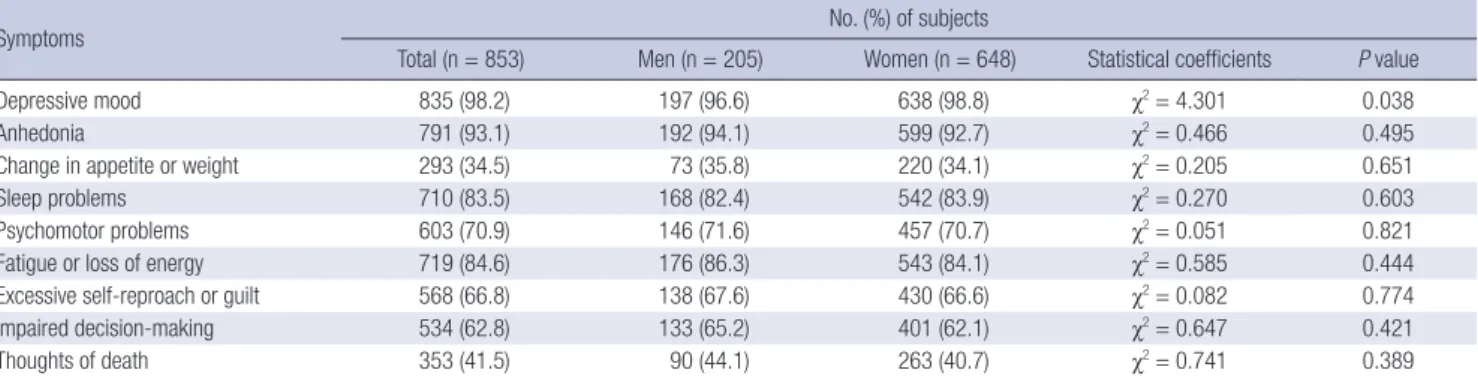
Frequencies of different numbers of depressive symptoms Among the 853 MDD patients, there were 270 (31.7%), 239 (28.0%), 175 (20.5%), 107 (12.5%), and 62 (7.3%) with 5, 6, 7, 8, and 9 de- pressive symptoms, respectively. In addition, 838 (98.2%), 794 (93.1%), 294 (34.5%), 713 (83.6%), 604 (70.8%), 722 (84.6%), 568 (66.6%), 536 (62.8%), and 354 (41.5%) of the patients presented with depressive mood, anhedonia, change in appetite or weight, sleep problems, psychomotor problems, fatigue or loss of ener- gy, excessive self-reproach or guilt, impaired decision-making and thoughts of death, respectively. As shown in Table 1, no sig- nificant differences were found between men and women for
any of the DSM-IV depressive symptoms.
Baseline characteristics of the groups by number of depressive symptoms
As shown in Table 2, monthly income (χ2= 9.805, P = 0.044) and history of depression (χ2= 12.234, P = 0.016) tended to dif- fer according to number of depressive symptoms, although the differences were not statistically significant. However, there were
no significant differences in the other baseline demographic or clinical variables between the 5 groups.
Scores on measurement scales by number of depressive symptoms
As shown in Table 3, after adjustment for the effects of monthly income and history of depression, greater numbers of depres- sive symptoms were associated with higher scores on the HAMD Table 1. Gender differences in the DSM-IV depressive symptom profiles
Symptoms No. (%) of subjects
Total (n = 853) Men (n = 205) Women (n = 648) Statistical coefficients P value
Depressive mood 835 (98.2) 197 (96.6) 638 (98.8) χ2= 4.301 0.038
Anhedonia 791 (93.1) 192 (94.1) 599 (92.7) χ2= 0.466 0.495
Change in appetite or weight 293 (34.5) 73 (35.8) 220 (34.1) χ2= 0.205 0.651
Sleep problems 710 (83.5) 168 (82.4) 542 (83.9) χ2= 0.270 0.603
Psychomotor problems 603 (70.9) 146 (71.6) 457 (70.7) χ2= 0.051 0.821
Fatigue or loss of energy 719 (84.6) 176 (86.3) 543 (84.1) χ2= 0.585 0.444
Excessive self-reproach or guilt 568 (66.8) 138 (67.6) 430 (66.6) χ2= 0.082 0.774
Impaired decision-making 534 (62.8) 133 (65.2) 401 (62.1) χ2= 0.647 0.421
Thoughts of death 353 (41.5) 90 (44.1) 263 (40.7) χ2= 0.741 0.389
Table 2. Comparison of the baseline characteristics of the groups by number of depressive symptoms
Parameters Total samples
(n = 853)
Number of depressive symptom profiles Statistical
coefficients P value 5 (n = 270) 6 (n = 239) 7 (n = 175) 8 (n = 107) 9 (n = 62)
Age, mean (SD) yr 48.4 (15.0) 47.1 (14.9) 48.4 (14.7) 49.8 (15.5) 50.2 (15.7) 46.9 (13.0) F = 1.480 0.206
Women, n (%) 646 (76.0) 206 (76.6) 183 (77.2) 135 (77.1) 78 (72.9) 44 (71.0) χ2= 1.792 0.774
Married, n (%) 533 (68.8) 173 (68.1) 152 (70.4) 108 (70.1) 65 (68.4) 35 (62.5) χ2= 1.472 0.832
Education, mean (SD) yr 10.4 (4.7) 10.8 (4.3) 10.3 (4.4) 10.3 (4.8) 9.9 (4.3) 10.5 (4.6) F = 0.931 0.445
Employed, n (%) 586 (75.6) 197 (77.6) 170 (78.7) 115 (74.7) 67 (70.5) 37 (66.1) χ2= 5.812 0.214
Monthly income < 2,000 USD, n (%) 383 (49.0) 116 (30.3) 117 (30.5) 88 (54.7) 41 (40.6) 21 (37.5) χ2= 9.805 0.044 National health insurance, n (%) 775 (90.9) 249 (92.2) 219 (91.6) 161 (92.0) 94 (87.9) 52 (83.9) χ2= 5.860 0.210 Religious affiliation, n (%) 531 (62.5) 179 (66.3) 142 (59.7) 104 (60.1) 69 (64.5) 37 (59.7) χ2= 3.286 0.511 Age-at-onset*, mean (SD) yr 37.4 (16.0) 36.4 (15.6) 36.5 (15.3) 40.9 (16.3) 37.1 (18.0) 36.6 (15.5) F = 1.094 0.359 History of depression, n (%) 373 (44.2) 115 (43.1) 95 (40.1) 72 (41.6) 52 (49.5) 39 (62.9) χ2= 12.234 0.016 Medical comorbidity, n (%) 269 (31.5) 82 (30.4) 85 (35.6) 50 (28.6) 35 (32.7) 16 (27.4) χ2= 3.234 0.519 Family history of depression, n (%) 117 (13.7) 33 (12.2) 31 (13.0) 24 (13.7) 19 (17.8) 10 (16.1) χ2= 2.403 0.662 Previous suicidal attempt, n (%) 189 (22.2) 52 (19.3) 54 (22.6) 37 (21.1) 26 (24.3) 20 (32.3) χ2= 5.398 0.249 Outpatient enrollment, n (%) 665 (78.0) 203 (75.2) 190 (79.5) 144 (82.3) 84 (78.5) 44 (71.0) χ2= 5.227 0.265
*n = 371. n, number of subjects.
Table 3. Comparison of the scores on the measurement scales in the groups by number of depressive symptoms Measurement scales Total samples
(n = 853)
Number of depressive symptom profiles Statistical
coefficients* Adjusted
P value* Post-hoc analyses† 5 (n = 270) 6 (n = 239) 7 (n = 175) 8 (n = 107) 9 (n = 62)
HAMD, mean (SD) 20.6 (5.7) 18.7 (5.4) 20.6 (5.7) 21.1 (4.9) 22.2 (5.6) 25.1 (6.6) F = 19.145 < 0.001 a < b = c = d < e HAMA, mean (SD) 19.8 (8.6) 17.6 (8.8) 19.0 (7.7) 21.0 (8.6) 22.3 (8.3) 25.6 (9.1) F = 12.890 < 0.001 a = b < c = d < e SSI-Beck, mean (SD) 11.0 (8.7) 9.6 (8.3) 11.0 (8.7) 10.5 (8.8) 13.6 (8.9) 16.5 (8.1) F = 6.970 < 0.001 a = b = c < d = e CGI-S, mean (SD) 4.7 (1.0) 4.4 (1.0) 4.7 (0.9) 5.0 (1.0) 5.0 (0.9) 5.4 (0.9) F = 21.458 < 0.001 a < b = c = d < e SOFAS, mean (SD) 56.6 (10.9) 59.8 (10.0) 56.1 (10.3) 55.9 (10.8) 54.1 (10.9) 50.0 (11.2) F = 13.343 < 0.001 a > b = c = d > e WHOQOL-BREF, mean (SD) 63.6 (10.3) 66.4 (10.3) 61.6 (9.3) 62.9 (9.3) 61.4 (9.3) 57.2 (9.6) F = 11.975 < 0.001 a > b = c = d = e AUDIT‡, mean (SD) 10.5 (9.0) 10.5 (9.4) 11.5 (9.0) 9.8 (8.6) 8.9 (7.7) 10.9 (9.8) F = 0.528 0.715 -
*Adjusted for the effects of monthly income and history of depression; †a, N = 5; b, N = 6; c, N = 7; d, N = 8; e, N = 9, N mean number of depressive symptom profiles; ‡n = 305. N, number of depressive symptoms; n, number of subjects; HAMD, Hamilton Depression Rating Scale; HAMA, Hamilton Anxiety Rating Scale; SSI-Beck, Scale for Suicidal Ideation; CGI-S, Clinical Global Impression of severity; SOFAS, Social and Occupational Functional Assessment Scale; WHOQOL-BREF, WHO Quality of Life assessment instru- ment-abbreviated version; AUDIT, Alcohol Use Disorder Identification Test.
(F [4, 767] = 19.145, P < 0.001), HAMA (F [4, 765] = 12.890, P <
0.001), SSI-Beck (F [4, 653] = 6.970, P < 0.001), and CGI-S (F [4, 756] = 21.458, P < 0.001), and lower scores on the SOFAS (F [4, 760] = 13.343, P < 0.001), and WHOQOL-BREF (F [4, 656] = 11.975, P < 0.001). However, there was no significant difference in scores on the AUDIT (F [4, 267] = 0.528, P = 0.715).
DISCUSSION
In summary, MDD patients with 5 symptoms were the most frequent in terms of number of depressive symptoms. After ad- justment of the effects of monthly income and history of depres- sion, a greater number of depressive symptoms were found to indicate higher levels of depressive symptoms, anxiety symp- toms, suicidal ideation, and global severity, as well as poorer social function and quality of life.
No unique gender-specific patterns of depressive symptoms were identified in our study. Partly contradicting our findings, the Research on Asian Psychotropic Prescription Patterns for Antidepressants (REAP-AD) study of patients with depressive disorders in 10 Asian countries/regions showed that loss of in- terest and fatigue were more prevalent in men than women, and suicidal thoughts/acts were more prevalent in women than men (30). These differences between the two sets of findings may be associated with the high incidence of suicidal behavior in women in rural regions of mainland China (31). Thus, we may speculate that ethno-cultural influences can contribute to gender-specific patterns of depressive symptoms in patients with depressive disorders. Also, in a report on the age-related patterns of depressive symptoms, which was presented sepa- rately from the other findings of the CRESCEND study, the low- er age-groups tended to have higher rates of current suicidal ideation. Hence, specific therapeutic approaches to the enhan- ced suicidal risk in younger persons may be needed in Korea.
In conclusion, age- and gender-related patterns of depressive symptoms have not been clearly established in MDD patients in Korea. In addition, the clinical significance of number of de- pressive symptoms may be greater than that of the presence/
absence of individual symptoms.
To our knowledge, the neurobiological underpinnings of the relationship between number of depressive symptoms and se- verity of depression have been little studied. However, an inverse relationship was found between left orbito-frontal cortex activi- ty in magneto-encephalography and net number of DSM-IV diagnostic criteria for depressive personality disorder (unusual mood, poor self-concept, self-criticism, negativity towards oth- ers, pessimism, and feelings of guilt) in patients with borderline personality disorder. The association can be explained by dys- functional modulation of emotional information in the orbito- frontal cortex and translation to the prefrontal cortex (32). Thus, these may be neural correlates of the positive relationship be-
tween the number of depressive symptoms and the severity of depressive disorders.
Greater number of depressive symptoms was associated with greater severity of anxiety symptoms and suicidal ideation. High- er gray matter volume in the right temporal cortex has been found in MDD patients with anxiety symptoms than in those without anxiety symptoms (33). Thus, the positive relationship between the number of depressive symptoms and severity of anxiety symp- toms has been related to the neural correlates of anxiety symp- toms. Also a significant relationship has been proposed between MDD and anxiety symptoms, based on prospective studies (34).
Hence, comorbid cases in which MDD preceded anxiety symp- toms can be explained by the shared etiology model, whereas comorbid cases in which anxiety symptoms preceded MDD can be explained by the direct causation model (35). Since we observed a relationship between number of depressive symp- toms and severity of anxiety symptoms in a cross-sectional study, our ability to provide specific explanations of the relationship is limited. Moreover, a reduced gray matter density in the fronto- striato-limbic network has been shown in MDD patients with high risk of suicide relative to healthy controls (36). Hence, we may speculate that dysregulations of emotion and motivation contribute to the positive relationship between number of de- pressive symptoms and severity of suicidal ideation. A psycho- logical autopsy study has reported that, among the DSM-IV de- pressive symptoms, not only suicidal ideation but also weight or appetite loss, insomnia, feelings of worthlessness, and inap- propriate guilt are risk factors for suicide completions in the context of MDD (37). Since these depressive symptoms indicat- ing suicidal completion, were not examined in our study, the clinical significance of the positive relationship between the number of depressive symptoms and severity of suicidal ide- ation is unclear. In addition, irritability/impulsivity may be a mediating factor between number of depressive symptoms and severity of anxiety symptom and suicidal ideation, since irrita- bility has been associated with anxiety, and greater severity and impulsivity has been related to suicide outcome in MDD (38).
The lack of a significant relationship between number of de- pressive symptoms and scores on the AUDIT is partly consis- tent with the non-linear relationship between depression se- verity and alcohol consumption in previous studies (39). Great- er number of depressive symptoms reflects more severe depres- sion and lower social function and quality of life. A possible re- lationship has been reported between number of depressive symptoms and increased risk of academic problems in a large cohort of North Carolina college students (40).
Our study has several limitations. Firstly, psychiatric comor- bidity has a potential effect on the relationship between the num- ber of depressive symptoms and scores on the measurement tools. Secondly, no measurement tools covering the cognitive domains were employed. Thirdly, inter-rater reliability for as-
sessing depressive symptoms and using measurement tools was not assessed. Despite these limitations, our study has the virtue of pioneering investigation of the relationship between the number of depressive symptoms and the clinical character- istics of MDD.
In conclusion, a greater number of depressive symptoms in- dicates more serious depression and is associated with more severe anxiety symptoms and suicidal ideation. The relation- ship between number of depressive symptoms and the severity of anxiety symptoms and suicidal ideation may be mediated by irritability/impulsivity.
DISCLOSURE
The authors have no potential conflicts of interest to disclose.
AUTHOR CONTRIBUTION
Conception and design of the study: Park SC, Kim JM, Jun TY, Lee MS, Kim JB, Yim HW, Park YC. Analysis of the data: Park SC, Park YC. Writing the first draft of the manuscript: Park SC, Sakong JK, Koo BH, Park YC. Revision of manuscript: Park SC, Sakong JK, Koo BH, Park YC. Agreement and acceptance of fi- nal manuscript: all authors.
ORCID
Seon-Cheol Park http://orcid.org/0000-0003-3691-4624 Jeongkyu Sakong http://orcid.org/0000-0003-2187-0403 Bon Hoon Koo http://orcid.org/0000-0001-9633-3835 Jae-Min Kim http://orcid.org/0000-0001-7409-6306 Tae-Youn Jun http://orcid.org/0000-0001-9516-0768 Min-Soo Lee http://orcid.org/0000-0002-3483-4375 Jung-Bum Kim http://orcid.org/0000-0001-9444-1437 Hyeon-Woo Yim http://orcid.org/0000-0002-3646-8161 Yong Chon Park http://orcid.org/0000-0002-3019-5748 RERERENCES
1. Park SC, Lee SK, Oh HS, Jun TY, Lee MS, Kim JM, Kim JB, Yim HW, Park YC. Hazardous drinking-related characteristics of depressive disorders in Korea: the CRESCEND study. J Korean Med Sci 2015; 30: 74-81.
2. Park SC, Park YC. Understanding the co-occurrence of hazardous drink- ing and depressive disorders in Korea. J Korean Med Sci 2015; 30: 830-1.
3. Park SC, Lee HY, Lee DW, Hahn SW, Park SH, Kim YJ, Choi JS, Lee HS, Lee SI, Na KS, et al. Knowledge and attitudes of 851 nursing personnel to- ward depression in general hospitals of Korea. J Korean Med Sci 2015; 30:
953-9.
4. Park SC, Lee HY. Detecting depression in collaboration with nursing per- sonnel in general hospitals. J Korean Med Sci 2015; 30: 1209-10.
5. American Psychiatric Association. Diagnostic and Statistical Manual of Mental Disorders, 4th ed. Arlington, VA: American Psychiatric Associa-
tion Publishing, 1994.
6. American Psychiatric Association. Diagnostic and Statistical Manual of Mental Disorders, 5th ed. Arlington, VA: American Psychiatric Associa- tion Publishing, 2013.
7. Østergaard SD, Jensen SO, Bech P. The heterogeneity of the depressive syndrome: when numbers get serious. Acta Psychiatr Scand 2011; 124:
495-6.
8. Rosenman S, Nasti J. Psychiatric diagnoses are not mental processes: Witt- genstein on conceptual confusion. Aust N Z J Psychiatry 2012; 46: 1046- 52.
9. Zimmerman M, McGlinchey JB, Young D, Chelminski I. Diagnosing ma- jor depressive disorder IV: relationship between number of symptoms and the diagnosis of disorder. J Nerv Ment Dis 2006; 194: 450-3.
10. Zimmerman M, McGlinchey JB, Young D, Chelminski I. Diagnosing ma- jor depressive disorder I: a psychometric evaluation of the DSM-IV symp- tom criteria. J Nerv Ment Dis 2006; 194: 158-63.
11. Smith DJ, Kyle S, Forty L, Cooper C, Walters J, Russell E, Caesar S, Farmer A, McGuffin P, Jones I, et al. Differences in depressive symptom profile between males and females. J Affect Disord 2008; 108: 279-84.
12. Chang SM, Hahm BJ, Lee JY, Shin MS, Jeon HJ, Hong JP, Lee HB, Lee DW, Cho MJ. Cross-national difference in the prevalence of depression caused by the diagnostic threshold. J Affect Disord 2008; 106: 159-67.
13. Park SC, Choi J, Kim JM, Jun TY, Lee MS, Kim JB, Yim HW, Park YC. Is the Psychotic Depression Assessment Scale a useful diagnostic tool? The CRESCEND study. J Affect Disord 2014; 166: 79-85.
14. Park SC, Østergaard SD, Choi J, Kim JM, Jun TY, Lee MS, Kim JB, Yim HW, Park YC. Is the BPRS-5 subscale of the psychotic depression assessment scale a reliable screening tool for psychotic depression?: results from the CRESCEND study. J Affect Disord 2015; 174: 188-91.
15. First MB, Spitzer RL, Gibbon M, Williams JB. Structured Clinical Inter- view for DSM-IV Axis I Disorders - Patient Edition: SCID-I/P. New York, NY: New York State Psychiatric Institute, Biometrics Research Depart- ment, 1995.
16. Zimmerman M, Martinez JH, Young D, Chelminski I, Dalrymple K. Se- verity classification on the Hamilton Depression Rating Scale. J Affect Disord 2013; 150: 384-8.
17. Hamilton M. A rating scale for depression. J Neurol Neurosurg Psychiatry 1960; 23: 56-62.
18. Hamilton M. The assessment of anxiety states by rating. Br J Med Psychol 1959; 32: 50-5.
19. Beck AT, Kovacs M, Weissman A. Assessment of suicidal intention: the scale for suicide ideation. J Consult Clin Psychol 1979; 47: 343-52.
20. Guy W. ECDEU Assessment Manual for Psychopharmacology. Revised, 1976. Rockville, MA: U.S. National Institute of Mental Health, Department of Health, Education, and Welfare Public Health Service, 1976.
21. Goldman HH, Skodol AE, Lave TR. Revising axis V for DSM-IV: a review of measures of social functioning. Am J Psychiatry 1992; 149: 1148-56.
22. The WHOQOL Group. Development of the World Health Organization WHOQOL-BREF quality of life assessment. Psychol Med 1998; 28: 551-8.
23. Conigrave KM, Hall WD, Saunders JB. The AUDIT questionnaire: choos- ing a cut-off score. Alcohol Use Disorder Identification Test. Addiction 1995; 90: 1349-56.
24. Min SK, Lee CI, Kim KI, Suh SY, Kim DK. Development of Korean version of WHO Quality of Life Scale Abbreviated Version (WHOQOL-BREF). J Korean Neuropsychiatr Assoc 2000; 39: 571-9.
25. Kim JM, Stewart R, Glozier N, Prince M, Kim SW, Yang SJ, Shin IS, Yoon JS. Physical health, depression and cognitive function as correlates of dis- ability in an older Korean population. Int J Geriatr Psychiatry 2005; 20:
160-7.
26. Yi JS, Bae SO, Ahn YM, Park DB, Noh KS, Shin HK, Woo HW, Lee HS, Han SI, Kim YS. Validity and reliability of the Korean version of the Hamilton Depression Rating Scale (K-HDRS). J Korean Neuropsychiatr Assoc 2005;
44: 456-65.
27. Lee H, Kwon JH. Validation for the Beck Scale for Suicide Ideation with Korean university students. Korean J Clin Psychol 2009; 28: 1155-72.
28. Lee JY, Cho MJ, Kwon JS. Global assessment of functioning scale and so- cial and occupational functioning scale. Korean J Psychopharmacol 2006;
17: 122-7.
29. Joe K, Chai S, Park A, Lee H, Shin I, Min S. Optimum cut-off score for screen- ing of hazardous drinking using the Korean version of alcohol use disor- der identification test (AUDIT-K). J Korean Acad Addict Psychiatry 2009;
13: 34-40.
30. Park SC, Lee MS, Shinfuku N, Sartorius N, Park YC. Gender differences in depressive symptom profiles and patterns of psychotropic drug usage in Asian patients with depression: findings from the Research on Asian Psy- chotropic Prescription Patterns for Antidepressants study. Aust N Z J Psy- chiatry 2015; 49: 833-41.
31. Han CS, Ogrodniczuk JS, Oliffe JL. Qualitative research on suicide in East Asia: a scoping review. J Ment Health 2013; 22: 372-83.
32. Díaz-Marsá M, Carrasco JL, López-Ibor M, Moratti S, Montes A, Ortiz T, López-Ibor JJ. Orbitofrontal dysfunction related to depressive symptom- atology in subjects with borderline personality disorder. J Affect Disord 2011; 134: 410-5.
33. Turner DP, Thompson ME, Huber LR, Arif AA. Depressive symptoms and academic performance of North Carolina college students. N C Med J 2012; 73: 169-75.
34. Inkster B, Rao AW, Ridler K, Nichols TE, Saemann PG, Auer DP, Holsboer F, Tozzi F, Muglia P, Merlo-Pich E, et al. Structural brain changes in patients with recurrent major depressive disorder presenting with anxiety symp- toms. J Neuroimaging 2011; 21: 375-82.
35. Kessler RC, Berglund P, Demler O, Jin R, Koretz D, Merikangas KR, Rush AJ, Walters EE, Wang PS; National Comorbidity Survey Replication. The epidemiology of major depressive disorder: results from the National Co- morbidity Survey Replication (NCS-R). JAMA 2003; 289: 3095-105.
36. Mathew S, Charney D. Anxiety and depression: leading edge of therapy.
Mt Sinai J Med 2008; 75: 171-3.
37. Wagner G, Koch K, Schachtzabel C, Schultz CC, Sauer H, Schlösser RG.
Structural brain alterations in patients with major depressive disorder and high risk for suicide: evidence for a distinct neurobiological entity?
Neuroimage 2011; 54: 1607-14.
38. McGirr A, Renaud J, Seguin M, Alda M, Benkelfat C, Lesage A, Turecki G.
An examination of DSM-IV depressive symptoms and risk for suicide completion in major depressive disorder: a psychological autopsy study.
J Affect Disord 2007; 97: 203-9.
39. Perlis RH, Fava M, Trivedi MH, Alpert J, Luther JF, Wisniewski SR, Rush AJ. Irritability is associated with anxiety and greater severity, but not bi- polar spectrum features, in major depressive disorder. Acta Psychiatr Scand 2009; 119: 282-9.
40. Noh JW, Juon HS, Lee S, Kwon YD. Atypical epidemiologic finding in as- sociation between depression and alcohol use or smoking in Korean male:
Korean longitudinal study of aging. Psychiatry Investig 2014; 11: 272-80.