125
JOURNAL OF KOREAN FOREST SOCIETY
간헐적 침지 방식의 생물반응기 시스템을 이용한 유칼리 선발목 클론 대량증식
김선자
1·박소영
2*·문흥규
2·이위영
21
국립과천과학관,
2국립산림과학원 산림생명공학과
Use of the Temporary Immersion Bioreactor System for Mass Production of Eucalyptus pellita Plus Tree
Seon-Ja Kim
1, So-Young Park
2* , Heung-Kyu Moon2 and Wi-Young Lee
2
1
Gwacheon National Science Musium, Gwacheon, Republic of Korea
2
Forest Biotechnology Division, Korea Forest Research Institute, Suwon 441-847, Korea
요 약: 식물대량증식에서 생물반응기의 이용은 규모를 대량화하고 자동화 할수 있다는 점에서 생산비를 절감할 수 있는 방법 중 하나이다 . 본 연구에서는 유칼리 펠리타 선발목의 대량증식 체계를 확립하기 위해 4 가지의 생물반응
기 배양시스템에서 유칼리의 생장을 비교하였다 . 배양기내에 지지물 (net) 을 설치하고 매 4 시간마다 30 분씩 액체배지 를 공급한 TIN 배양 (Temporary immersion with net) 에서 식물체 생장이 가장 좋았다 . TIN 시스템하에서 자란 식물체 는 동일한 방식에 net 가 없는 TIX 배양 (Temporary immersion without net) 에서 자란 식물체와 비교하여 초장이 3 배 이상 증가하였다 . 게다가 TIN 시스템에서 생산 된 식물체는 총 엽록소 함량 , 엽록소 a/b, 그리고 건물중 등도 증가
하였다 . 위와 같은 결과는 기내 유칼리나무 생장에 중요한 요인이 식물체가 적당한 간격으로 , 그리고 적당한 시간 동안 배지에 노출되어야하고 , net 의 이용이 필수적임을 보여준다 . TIN 시스템은 유칼리 클론묘의 대량생산을 위해 최 적의 시스템으로 산업화를 위한 유칼리나무 대량생산시 유용하게 이용될 수 있을 것으로 생각된다 .
Abstract: The application of bioreactor culture techniques for plant micropropagation is regarded as one of the ways to reduce production cost by scaling-up and automation. In an attempt to optimize mass proliferation systems in Eucalyptus pellita , four types of bioreator systems including temporary immersion system with or without net were tested. Highest growth was achieved with 30-min flushes of medium at every 4-h intervals in TIN (temporary immersion with net) system. Results indicate over three-fold increase in shoot growth with the TIN system when compared with TIX (control: temporary immersion without net) system which is without net in bioreactor.
Furthermore, plants produced from the TIN system increased total chlorophyll content, chlorophyll a/b and dry matter, giving higher yields of acclimatized plants. Our findings suggest that plantlet growth increases with appropriate exposure to media at correct intervals, as well as use of net for maintaining aerobic condition in the vessels. The TIN system thus has great potential for in vitro mass production of Eucalyptus clones commercially.
Key words : eucalyptus pellita, bioreactor, temporary immersion, clonal propagation
서 론
유칼리 펠리타 ( Eucalyptus pellita ) 는 도금양과 (Myrtaceae)
과 , 유칼리속 (Eucalyptus) 의 활엽수로 흉고직경 1 m, 높이
40 m 정도까지 자라는 나무이다 . 이 속의 나무들이 그렇
듯이 이 종도 생장이 빠르고 , 특히 건조에 강해서 열대조
림을 위해 Acacia mangium 과 함께 산업적으로 중요한 수
종으로 여겨진다 (Harwood 등 , 1997; Merchant 등 , 2006).
생장은 대개 나무의 중간 높이까지 곧게 자라 올라가며 상부에는 가지가 많은 수관을 형성한다 . ‘Daintree stringy bark’, ‘red mahogany’, ‘red stringy bark’ 등으로 불리며 ,
특히 목재무역에서는 ‘ 큰 열매 붉은 마호가니 (large-fruited red mahogany)’ 로 알려져 있다 .
최근 기후변화에 따라 탄소배출권을 확보하고 안정적 인 목재생산량을 확보하기위해서 인도네시아를 중심으로 한 열대조림의 중요성이 증가하고 있다 . 그 일환으로 우 수한 형질을 가진 열대 선발목의 클론증식에 대한 관심 또한 날로 증대되고 있다 (Park 등 , 2008). 이를 위해 우수
*Corresponding author
E-mail: [email protected]
한 형질을 가진 선발목의 증식을 통해 원하는 형질을 가
진 개체를 증식하는 것은 중요하다 (Yang 등 , 1995;
Delaporte 와 Sedgley, 2004). 그러나 성숙목의 증식은 생리
적 , 유전적 특성에 의해 그다지 용이하지 않다 (McComb
등 , 1996). 따라서 지금까지 보고 된 대부분의 유칼리 관
련 연구결과가 기관배양을 유도하거나 (Azmi 등 , 1997;
Laine 과 David, A. 1994; Tibok 등 , 1995; Warrang 등 , 1991; Nugent 등 , 2001; Kim 과 Moon, 2004; Kim 등 , 2005; Schwambach 등 , 2005; Hajari 등 , 2006) 혹은 체세 포배 연구 (Bandyophdhyay 등 , 1999) 에 초점이 맞추어져 왔다 . 국립산림과학원에서는 2003 년 기내 미세접목 (in vitro
micrografting) 을 통해 인도네시아에서 선발 된 유칼리나
무 수형목의 기내증식을 성공한 바 있다 (Moon 등 , 2003).
이를 효율적으로 대량증식하고자 2006 년부터 생물반응기 를 이용한 대량배양을 시도하였다 (Park 등 , 2008).
생물반응기를 이용한 액체배양은 기존의 고체배양에 비 해 배양규모를 쉽게 늘릴 수 있다 (scale-up) 는 점에서 무 한한 가능성을 가지고 있다 . 최근 생물반응기를 이용해 수
백 개의 무균 절편체를 일시에 배양하는 대량배양 시스템
(large-scale culture system) 이 보고되었다 (Hahn 과 Paek, 2005; Piao 등 , 2003; Shohael 등 , 2005). 이러한 시스템은 기존 고체배양에 비해 일시에 대량배양 함으로서 배양에 들어가는 인건비를 현저히 낮출 수 있고 기외 순화시 생 존율을 향상시키며 배양과정을 단순화 시킬 수 있다는 점 에서 매력적으로 여겨져 왔다 (Kozai 등 , 2000; Zobayed 등 , 2001; Zobayed 등 , 2004).
우리는 이전 보고에서 생물반응기를 이용한 유칼리나 무 펠리타 선발목의 기내 대량증식을 체계화하고자 1L 규 모로 액체배양을 실시하였고 , 이를 토대로 배양규모를 10L
로 확대하여 대량배양 가능성을 조사하였다 . 그 결과 기 존의 고체배양법에 비해 생물반응기를 이용한 액체배양 에서 유칼리나무 생장이 월등히 증가하였다 (Park 등 , 2008).
또한 그 원인이 액체배양에 의한 원활한 영양염류 공급과 배양기내 환기 일 것이라고 추정하였으나 (Park 등 , 2008),
이를 설명하기 위한 직접적인 증거는 아직 찾기가 어렵다 .
따라서 본 연구는 다양한 배양시스템의 생물반응기를 이용해 유칼리 펠리타를 배양하면서 배양 후 식물체 생장 을 조사하고 , 이와 관련된 여러 지표들을 분석하여 생물 반응기에서 생장촉진에 영향을 미친 요인들을 해석하고 자 하였다 .
재료 및 방법
1. 식물재료
인도네시아 깔리만탄 지역의 코린도 조림지에서 선발 된 유칼리 펠리타 선발목의 삽수를 국립산림과학원 산림
생명공학과 온실에서 삽목 , 재배하였다 . Moon 등 (2003) 의 방법에 따라 재료를 표면살균하여 DKW 배지 (Driver 와
Kuniyuki, 1984) 에 배양한 다음 배양 8 주 후 무균묘를 얻
었다 . 신초를 BA 가 0.1 mg/L 첨가 된 DKW 배지에서 4
주 간격으로 반복적으로 2 년간 계대배양하여 본 실험을 위한 재료로 이용하였다 .
2. 생물반응기 시스템
배양시스템이 생장에 미치는 영향을 구명하고자 Ebb &
Flood 시스템이 가능하도록 7L 규모의 생물반응기를 주
문제작하였다 . 실험을 위해 적용된 배양시스템은 다음의
4 가지이다 : 1) TIX(Temporary immersion without net) -
절편체를 간헐적으로 액체배지에 잠기게 하는 방법 (30 분 /4 시간 , 1 일 4 회 ), 2) TIN(Temporary immersion with net)
- net 위에 치상된 절편체를 간헐적으로 액체배지에 접하
는 방법 (30 분 /4 시간 , 1 일 4 회 ), 3) CIN(Continuous immersion with net) - net 위에 치상 된 절편체를 계속 액체배지에 접 하게 하는 방법 , 4) TINC(Temporary immersion with net following continuous immersion with net) - net 위에 치
상 된 절편체를 간헐적 (30 분 /4 시간 ) 으로 액체배지에 접하 게 한 다음 배양 2 주 후 계속 액체배지를 공급하는 방법 .
처리에 따라 net 설치가 필요한 배양시스템 (TIN, CIN,
TINC) 을 위해서는 절편체가 액체배지에 침지되지 않도록
고압증기멸균이 가능한 플라스틱 net 를 배양기 바닥에서
10 cm 높이로 설치하여 절편체가 net 위에서 자라게 하였
다 . 또한 간헐적으로 배지가 공급되는 배양시스템 (TI, TIN,
TINC) 은 타이머 (24 시간 ) 와 솔레노이드 밸브를 장착하여
4 시에 한번씩 30 분간 (4 회 /1 일 ) 배지를 공급하여 식물체가 배지에 접하도록 하였다 .
또한 모든 처리에서 주입구 (inlet) 를 통해 필터 (Mill-Seal, Millipore, Tokyo; pore size 0.5 µ m) 를 통과한 멸균 공기 가 배양병내로 주입되게 하고 동시에 배출구 (outlet) 로 배 양기내의 공기가 필터를 통해 빠져 나가도록 하였다 . 이 때 공기공급은 flow meter 를 이용해 0.1 vvm 이 되게 유지
하였다 .
배지는 1/2 DKW 배지에 3% sucrose 와 0.3 g/L 의 활성 탄을 첨가하여 기본배지로 이용하였다 . 각 생물반응기에
500 mL 의 액체배지를 분주하고 배양용기 당 60 개의 절편
체 ( 단일마디 ) 를 배양하였다 . 모든 배지는 멸균 전 pH 를 5.7-5.8 로 적정 한 다음 121°C, 108 kPa 기압 하에서 20 분 동안 고압증기멸균 후 사용하였다 . 배양은 광량 35-40 µmol m
−2s
−1PPF(16h 명 /8h 암주기 ) 와 24±1
oC 온도가 유지 되는 배양실에서 이루어졌다 . 배양 5 주 후 배양 시스템에 따라 생산된 식물체의 생체중 , 건중 , 엽록소와 카로티노이
드 함량을 분석하였고 배양기간에 따라 배양기내 CO
2함
량 변화를 분석하였다 .
3. 엽록소와 카로티노이드 함량 분석
식물체의 엽록소 함량 측정을 위해 각 처리에서 자란 유 칼리에서 잎 ( 생체중 0.5 g) 을 채취하여 80% (v/v) 아세톤
에 48 시간 침지하여 엽록소를 추출하였다 . 흡광도는 663.2
와 646.8, 그리고 470 nm 에서 각각 측정한 다음 Lichten- thaler(1987) 의 방법에 따라 계산하였다 .
4. 생물반응기내 CO
2함량분석
CO
2농도는 생물반응기와 연결된 실리콘 튜브를 통해 내부공기를 3 mL 씩 3 반복으로 채취하여 gas chroma- tography(Trace Series, Thermo Electron Co., CA, USA)
를 이용하여 측정하였고 , 이때 column 은 Hayesep Q 80- 100 column(4 m×3.18 mm×31 µm) 을 사용하였고 , detector
는 thermal conductivity detector 를 사용해 230
oC 에서 검 출하였다 . Oven 온도는 80
oC, injector 는 200
oC, 운반기체 는 He 을 사용하였으며 , 유속은 17.8 mL min
−1의 속도로 용출시켜 검출하였다 .
결과 및 고찰
이전의 보고 (Park 등 , 2008) 에서 우리는 생물반응기를
이용한 액체대량배양과 고체배양의 효율을 비교하였고 ,
그 결과 생물반응기에서 고체배양에 비해 생산량과 엽면 적 3.5 배 이상 , 신초생장 약 3 배 증가하는 결과를 가져왔
다 . 본 연구에서는 net 유무 , 배지공급 시간 등으로 생물반 응기 배양방식을 달리하여 유칼리나무의 기내생장을 조 사하였다 .
Net 유무와 배지공급 회수를 달리함에 따라 배양 8 주 후
유칼리나무 생장은 확연한 차이가 있었다 (Table 1). Net 위
에 절편체를 치상하고 1 일 4 회 배지를 공급한 TIN 처리
(Figure 1A) 는 net 를 설치하지 않은 동조건의 TIX 처리
(Figure 1B) 에 비해 초장 , 엽면적 , 뿌리생육에서 3 배 이상 의 월등한 생육차이를 보였고 잎 수 등도 유의성 있게 증
가하였다 . Net 를 동일하게 설치한 다음 배지공급을 달리
한 CIN( 연속공급 )(Figure 1D) 과 TIN(4 회 /1 일 ) 에서 식물체 생육은 역시 간헐적으로 배지를 공급한 TIN 처리가 좋았 다 . 배양 초기에는 배지를 1 일 4 회만 공급하다가 절편체
가 어느 정도 생장하여 발근 된 후 배지를 지속적으로 공 급한 TINC(TIN → CIN)(Figure 1C) 처리는 오히려 TIN 이 나 CIN 처리구보다 생육이 저조하였다 (Table 1).
건전한 조직배양묘를 대량생산하기 위해서 생물반응기 와 같은 배양시스템 개발과 기내 가스교환 등 미세환경 조절은 여러 연구자로부터 중요하게 다뤄져 왔다 (Kozai
등 , 2000; Zobayed 등 , 2001; 2004). 액체배양은 식물의 생장뿐 아니라 재분화에도 긍정적인 영향을 미치는데
(Prasad 와 Gupta, 2006) 이는 배지로부터 식물체로 염류의
흡수가 고체배지 보다 향상되기 때문이다 (Takayama 와
Akita, 1994). 글라디올라스 신초배양시 식물체를 지지물
(net) 에 올려서 액체배양할 경우 (raft culture) 식물증식 및 생장이 고체배지에 비해 25-33% 증가하였는데 이는 지지 물 배양이 절편체가 공기에 많이 접하게 하고 식물생장을
Table 1. The effect of bioreactor system on plantlet growth of E. pellita after 4 weeks of culture.
Bioreactor system Shoot length (cm) No of roots Root length No of leaves Leaf area (cm
2) Survival rate (%)
TIX
z2.7±0.1 4.0±0.9 1.9±0.4 8.2±0.6 0.01±0.0 43.4
TIN
y9.2±0.8 4.8±0.9 10.1±2.7 13.8±0.6 0.48±0.1 81.7
CIN
x7.8±0.3 4.0±0.9 5.3±0.6 14.0±1.0 0.31±0.1 70.0
TINC
w4.7±0.5 4.7±0.9 11.5±3.6 7.6±0.9 0.14±0.0 53.3
z
TIX-Temporary immersion without net
y
TIN-Temporary immersion with net
x
CIN-Continuous immersion with net
w
TINC-Temporary immersion following continuous immersion with net
Figure 1. Plantlet growth in different culture system after
five weeks of culture. A-D. TIN, TIX, TINC, and CIN in
turn, E-F. plantlet growth at different bioreactor system
after five weeks of culture. (TIN-Temporary immersion
with net, CIN-Continuous immersion with net, TINC-
Temporary immersion following continuous immersion with
net, TIX-Temporary immersion without net).
저해하는 페놀물질을 배지내로 확산시켜 주기 때문으로
생각된다 . Net 와 같은 지지물를 사용하지 않고 액체배지
에 절편체를 잠기게 한 다음 시간에 따라 배지 공급을 조 절하는 TIX 방식 (Ebb & flood) 에서 식물체 생장이 공기 를 공급하는 TIN 혹은 CIN(raft culture) 배양방법보다 저 조했던 이유는 두 가지로 생각할 수 있다 . 첫째 , 배지 공 급시 침수에 의한 생장억제 (Phillips, 1964) 가 불가피하며 ,
둘째 , 액체배지가 공급되고 빠져나갈 때 식물체가 shearing
스트레스와 기계적인 상처 등을 받을 수 있다는 점이다
(Prasad 와 Gupta, 2006).
Net 방식 중에서도 식물체가 얼마나 배지에 오랫동안 ,
얼마나 자주 접하는지가 시스템 효율을 결정짓는 가장 중 요한 요인이다 (McAlister 등 , 2005). 이는 식물 종에 따라
다른데 본 실험결과에 따르면 유칼리나무는 지속적으로 배지에 접하게 한 CIN 배양보다는 1 일 4 회 30 분 동안 배
지에 접하게 한 TIN 시스템에서 생육이 가장 좋았다 . 배
양초기에 TIN, 후기에 CIN 으로 변경한 TINC 배양에서도 유칼리 생육은 TIN 보다 다소 저조하였다 . 위의 결과로 미
루어 유칼리 펠리타는 기내배양시 과습에 다소 약한 것으 로 생각되고 따라서 전 배양기간 중 계속 강제환기를 하 면서 간헐적으로 배지에 접하게 하는 것이 최적의 배양방 식으로 판단된다 .
배양시스템에 따라 생산 된 식물체의 생체중과 건중은
TIN>CIN>TINC>TIX 순으로 높았다 (Figure 2). TIN 처리
구에서 식물체는 net 위에서 간헐적으로 배지를 공급한 시 스템에서 생장하였다 .
배양방식에 따라 생장한 식물체로부터 잎을 채취하여 엽록소 a, b 와 카로티노이드 함량을 분석하였다 (Figure 3).
TIN 에서 총 엽록소 함량 (C
a+b) 과 카로티노이드 함량이 가
장 높았을 뿐만 아니라 광합성에 가장 유효한 엽록소 a/b
도 가장 높았다 . 엽록소 함량과 함께 TIN 배양 시스템하
에서 생장한 식물체의 건물율도 가장 높았다는 것은 TIN
시스템하에서 생장한 식물체가 활발한 광합성을 하고 있 다는 간접적인 결과라고 하겠다 .
일반적인 기내배양 환경과 같이 낮은 CO
2농도와 광합 성 유효 광양자속 (photosynthetic photon flux, PPF), 높은 상대습도 , 낮은 공기 유동 등과 같이 불리한 환경 조건에 서 생장한 식물체는 대부분 잎의 두께가 얇고 엽록소 a/b
의 비율이 낮으며 유리 단백질 함량이 낮은 음지성 식물 의 특징을 나타낸다 (Chaves, 1994; Riek, 1995). 그러한
이유로 기외로 식재한 후에도 정상적인 광합성률을 유지 하기 어려워 일반적으로 기외 순화율이 낮다 (Riek, 1995;
Murali 와 Duncan, 1995; Van Huylenbroeck 등 , 2000).
기내배양 중인 식물체는 잎이 작고 과습한 미세환경에 서 생장한 탓에 일반공기중에 노출되면 쉽게 잎이 시들어 광합성을 측정하는 것은 매우 어렵다 . 따라서 본 연구에 서는 그러한 시스템하에서 생장한 식물체와 광합성을 설 명하기 위해 배양기내 CO
2농도를 측정하여 간접적으로 배양기내 식물체의 광합성 정도를 조사하고자 하였다 . 생
물반응기 out-let 부분에 부착된 실리콘 튜브를 통해 배양
기내 공기를 채취하여 배양 1 주 후부터 2 주 간격으로 총
3 회 CO
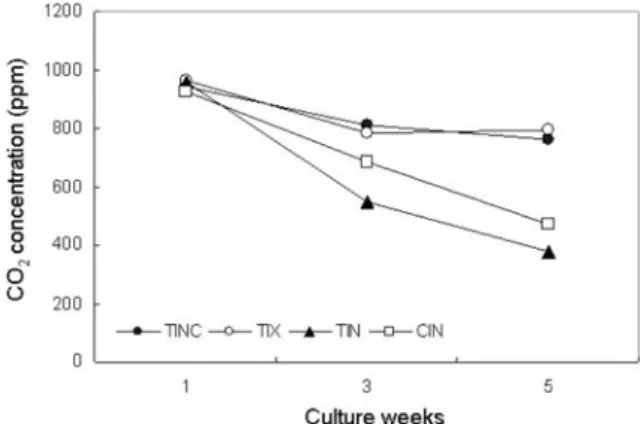
2를 채취 , 분석하였다 (Figure 4). 배양초기 각 배양 기내 CO
2함량은 950~1,000ppm 으로 비슷하였다 . 그러나 배양 2 주 후부터 배양방식에 따라 배양기내 CO
2농도는
Figure 2. Effects of bioreactor system on fresh and dry weight and dry matter of E. pellita plantlets after five weeks of culture (mean±SE). (TIN-Temporary immersion with net, CIN- Continuous immersion with net, TINC-Temporary immersion following continuous immersion with net, TIX-Continuous immersion).
Figure 3. Chlorophyll and carotenoid content of plantlets grown at different bioreactor system.
Figure 4. The changes of CO
2concentration in bioreactor at
different culture system during entire culture period.
급격히 차이가 있었다. 흥미롭게도 TIX와 TINC에 비해 지속적으로CO
2가 풍부한 외부공기가 강제로 유입된 CIN 과 TIN에서 오히려 CO
2농도가 급격히 낮아졌다. 이는 배 양기내에서 생장하는 식물체가 유입되는 CO
2를 이용해 활발한 광합성을 하고 있다는 증거이다. 또한 광합성의 산 물로 얻어지는 물질들이 체내에 축적되어 건물중이 증가 된 것으로 위 Figure 2를 뒷받침하는 결과라고도 하겠다.
배양초기 식물체의 생장이 양호하여도 광합성에 필요한 CO
2의 공급이 원활하지 않으면 생장이 지속적으로 이루 어질 수 없고 그러한 이유로 소형배양기내 고체배지에서 자란 식물체는 생장에 한계가 있다. 그러나 생물반응기의 경우 외부로부터 멸균된 공기가 지속적으로 유입됨으로 인해 과습화 현상이 없고 고체배양에 비해 3~6배 이상 생 장도 촉진된다(McAlister 등, 2005).
Kozai와 Kubota(2001) 역시 일반 기내배양 식물체의 생 육이 저조한 이유가 식물 자체의 광합성 능력이 낮아서가 아니라 배양기내의 CO
2부족 때문이며, 따라서 배양기내 로 충분한 양의 CO
2를 공급함으로서 식물체의 생장이 향 상될 수 있다고 하였다. Cui 등(2000), Eun(1998) 및 Desjardins 등(1987)도 여러 식물의 기내배양에서 CO
2공 급에 의한 식물체 생장 촉진효과를 보고하였다. Avila 등 (1998)은 감자를 고체배양과 액체배양으로 배양했을 때 엽 수는 유의차가 없었고, 초장과 건물중은 액체배양이 고체 배양에 비하여 2배 가량 증가하였으며, 액체배양시 절간 길이가 증가한다고 하여 본 실험과 유사한 경향을 보였다.
그러나 액체배지를 이용한 생물배양기 배양의 단점도 꾸 준히 지적되어 왔다. Paek과 Han(1989)은 고체배양에 비 하여 액체배양에서 식물의 투명화 현상이 빈번하며, 투명 화된 잎이 건전한 잎보다 엽록소 함량은 낮고 수분포텐셜 은 높다고 하였다. Paques와 Boxus(1987)는 정상적으로 자 란 사과 소식물체를 BA가 첨가된 액체 배지로 옮기면 투 명화묘의 발생이 현저하다고 하였으며, Dencso(1987)는 침엽수류를 기내 배양할 때 발생하는 투명화현상을 감소 시키기 위해서는 cytokinin 농도를 낮추어야 한다고 하였 다. 본 실험에서는 배양과정에서 투명화 현상을 발견할 수 없었는데, 그 이유는 그러한 현상을 일으키는 주요인 중 하나인 생장조절제를 사용하지 않았고, 배양기내 공기를 강제주입하여 배양기내 환기횟수를 증가시켰기 때문으로 생각된다.
인용문헌
1. Azmi, A., Noin, M., Landre, P., Prouteau, M., Boudet, A.M., and Chriqui, D. 1997. High frequency plant regeneration from Eucalyptus globulus Labill. hypocotyls: Ontogenesis and ploidy level of the regenerants. Plant Cell, Tissue and Organ Culture 51: 9-16.
2. Avila, A., Pereyra S.M., and Arguello, J.A. 1998. Nitrogen concentration and proportion of NH
4+-N affect potato cul- tivar reaponse in solid and liquid media. HortScience 33:
336-338.
3. Bandyopadhyay, S., Cane, K., Rasmussen, G., and Hamill, J.D. 1999. Efficient plant regeneration from seedling explants of two commercially important temperate Eucalyptus spe- cies- Eucalyptus nitens and E. globulus . Plant Science 140:
189-198.
4. Chaves, M.M. 1994. Environmental constraints to photo- synthesis in ex vitro-90-plants p. 1-18. In: P.J. Lumsden, J.R. Nicholas, and W.J. Davies (eds.). Physiology, growth and development of plants in culture. Kluwer Academic Publishers, Dordrecht, The Netherlands.
5. Cui, Y.Y., Hahn E.J., Kozai, T., and Paek, K.Y. 2000. Num- ber of air exchanges, sucrose concentration, photosynthetic photon flux, and differences in photoperiod and dark period temperatures affect growth of Rehmannia glutinosa plant- lets in vitro. Plant Cell, Tissue and Organ Culture 62: 219- 6. Dencso, I. 1987. Factors influencing vitrification of car- 226.
nation and conifers. Acta Horticulturae 212: 167-176.
7. Delaporte, K. and Sedgley, M. 2004. Selection and breed- ing of eucalyptus for ornamental horticulture. Acta Horti- culturae 630: 77-84.
8. Desjardins, Y., Gosselin, A., and Yelle, S. 1987. Acclima- tization of in vitro strawberry plantlets under CO
2enriched environment and supplemental lighting. Journal of Ameri- can Society of Horticulture Science 112: 846-851.
9. Driver, J.A. and Kuniyuki, A.H. 1984. In vitro propaga- tion of Paradox walnut rootstock. Horticultural Science 19: 507-509.
10. Eun, J.S. 1998. Acclimatization of in vitro plantlets of Wasabia japonica (Miq.) Matsum. derived from the api- cal meristem culture. Korean Journal of Plant Tissue Cul- ture. 25: 257-261.
11. Hahn, E.J. and Paek, K.Y. 2005. Multiplication of Chry- santhemum shoots in bioreactors as affected by culture method and inoculation density of single node stems.
Plant Cell, Tissue and Organ Culture 81: 301-306.
12. Hajari , E., Watt, M.P., Mycock, D.J. , and McAlister, B.
2006. Plant regeneration from induced callus of improved Eucalyptus clones. South African Journal of Botany 72:
195-201.
13. Harwood, C.E., Alloysius D., Pomroy, P., and Robson, K.W. 1997. Early growth and survival of Eucalyptus pell- ita provenances in a range of tropical environments, com- pared with E. grandis, E. urophylla and Acasia mangium . New Forests 14: 203-219.
14. Kim, J.A. and Moon, H.K. 2004. Effect of light-emitting
diodes (LED) and ventilation on the in vitro shoot growth
of Eucalyptus pellita . Journal of Korean Forrest Society
95: 716-722.
15. Kim, J.A., Moon, H.K., and Kang, H.D. 2005. Effect of BA and NAA on adventitious bud induction from in vitro germinant Eucalyptus pellita . Korean Journal of Plant Biotechnology 32: 201-207.
16. Kozai, T., Kubota, C., Zobayed, S.M.A., Nguyen, T.Q., Afreen-Zobayed, F., and Heo, J. 2000. Developing a mass- propagation system of woody plants. In: Watanabe, K., Komamine, A. eds. Challenge of plant and agriculture sci- ences to the crisis of biosphere on the Earth in the 21st century. Georgetown, Landes Biosphere, pp293-306.
17. Kozai, T. and Kubota, C. 2001. Developing a photoau- totrophic micropropagation system for woody plants. Jour- nal of Plant Research 114: 525-537.
18. Laine, E. and David, A. 1994. Regeneration of plants from leaf explants of micropropagated clonal Eucalyptus gran- dis . Plant Cell Reports 13: 473-476.
19. Lichtenthaler, H.K. 1987. Chlorophyll and carotenoids: pig- ments of photosynthetic biomembranes. Meth Enzymol 148:
350-382.
20. McAlister, B., Finnie, J., Watt, M.P., and Blakeway, F. 2005.
Use of the temporary immersion bioreactor system (RITA
®) for production of commercial Eucalyptus clones in Mondi Forests (SA). Plant Cell, Tissue and Organ Culture 81: 347- 21. McComb, J.A., Bennett, I.J., and Tonkin, C. 1996. In vitro 358.
propagation of Eucalyptus species. In: Taji, A.; Williams, R., eds. Tissue culture of Australian plants. Armidale, NSW:
University of New England, 112-156.
22. Merchant, A., Richter, A., Popp, M., and Adams, M. 2006.
Targeted metabolite profiling provides a functional link among Eucalyptus taxonomy, physiology and evolution.
Phytochemistry 67: 403-408.
23. Moon, H.K., Kim, J., Lee, H.S. and Kang H.D. 2003. Micro- propagation via axillary bud induction of Eucalyptus pell- ita . Korean Journal of Plant Biotechnology 30: 269-273.
24. Murali, T.P. and Duncan, E.J. 1995. The effects of in vitro gardening using triazoles on growth and acclimatization of banana. Scientia Horticulturae 64: 243-251.
25. Nugent, G., Chandler, S.F., Phil, W., and Stevenson, T.W.
2001. Adventitious bud induction in Eucalyptus globulus Labill. In Vitro Cellular & Developmental Biology-Plant 37:
388-391.
26. Paques, M. and Boxus, P.H. 1987. Vitrification: A phe- nomenon related to tissue water content. Acta Horticul- turae 212: 245-252.
27. Park, S.Y., Moon, H.K., Kim, Y.W., Kim, S.J., and Lee, J.S. 2008. Application of open-type liquid culture for large- scale production of mature plus tree of Eucalyptus pell- ita . Journal of Korean Forestry Society. 97: 650-655.
28. Paek, K.Y. and Han, B.H. 1989. Physiological, biochemi- cal and morphological characteristics of vitrified shoot regenerated in vitro. Korean Society of Plant Tissue Cul-
ture 18: 151-162.
29. Piao, X.C., Charkrabarty, D., Hahn, E.J., and Paek, K.Y.
2003. A simple method for mass production of potato micro- tubers using a bioreactor system. Current Science 8: 1129- 1232.
30. Phillips, I.D.I. 1964. Root-shoot hormone relation. Annals of Botany 28: 17-35.
31. Prasad, V.S.S. and Gupta, E.S.D. 2006. In vitro shoot regener- ation of gladiolus in semi-solid agar versus liquid cultures with support systems. Plant Cell, Tissue and Organ Cul- ture 87: 263-271.
32. Riek, J.D. 1995. Interaction between sucrose uptake and photosynthesis in micropropagated Rosa multiflora L.
Ph.D. thesis. Gent University, Belgium.
33. Schwambach, J., Fadanelli, C., and Fett-Neto, A.G. 2005.
Mineral nutrition and adventitious rooting in microcut- tings of Eucalyptus globules . Tree Physiology 25: 487-494.
34. Shohael, A.M., Chakrabarty, D., Yu, K.W., Hahn, E.J., and Paek, K.Y. 2005. Application of bioreactor system for large-scale production of Eleutherococcus sessiliflorus somatic embryos in an air-lift bioreactor and production of eleutherosides. Journal of Biotechnology 120: 228-236.
35. Takayama, S. and Akita, M. 1994. The types of bioreac- tors used for shoots and embryos. Plant Cell, Tissue and Organ Culture 39: 147-156.
36. Tibok, A., Blackhall, N.W., Power, J.B., and Davey, M.R.
1995. Optimized plant regeneration from calls derived from seedling hypocotyls of Eucalyptus urophylla. Plant Science 110: 139-145.
37. Van Huylenbroeck, J.M., Piqueras, A., and Debergh, P.C.
2000. The evolution of photosynthetic capacity and the antioxidant enzymatic system during acclimatization of micropropagated Calathea plants. Plant Science 155: 59- 38. Warrang, E., Lesney, M.S., and Rockwood, D.J. 1991. Nod- 66.
ule culture and regeneration of Eucalyptus grandis hybrids.
Plant Cell Reports 9: 586-589.
39. Yang, J.C., Chung, J.D., and Chen, Z.Z. 1995. Vegetative propagation of adult Eucalyptus grandis X urophylla and comparison of growth between micropropagated plantlets and rooted cuttings. Plant Cell Reports 15: 170-173.
40. Zobayed, S.M. A., Afreen F., and Kozai, T. 2001. Physi- ology of Eucalyptus plantlets grown photoautotrophically in a scaled-up vessel. In Vitro Cellular & Developmental Biology-Plant 37: 807-813.
41. Zobayed, S.M.A., Afreen, F., Xiao, Y., and Kozai, T. 2004.
Recent advancement in research on photoautotrophic micropropagation using large culture vessels with forced ventilation. In Vitro Cellular & Developmental Biology- Plant 40: 450-458.
(2010년 1월 25일 접수; 2010년 3월 23일 채택)