527
JOURNALOF KOREAN FOREST SOCIETY ISSN 0445-4650(Print), ISSN 2289-0904(Online) http://e-journal.kfs21.or.kr
국내 산림의 간벌에 따른 직경 생장량 및 탄소 저장량 변화에 관한 메타 분석
이종열1·한승현1·김성준1·이소혜1·손영모2·손요환1*
1고려대학교 환경생태공학과, 2국립산림과학원 산림산업연구과
A Meta-analysis on the Effect of Forest Thinning on Diameter Growth and Carbon Stocks in Korea
Jongyeol Lee
1, Seung Hyun Han
1, Seongjun Kim
1, Sohye Lee
1, Yeong Mo Son
2and Yowhan Son
1*1Department of Environmental Science and Ecological Engineering, Korea University, Seoul 02841, Korea
2Department of Forest Industry Research, National Institute of Forest Science, Seoul 02455, Korea
요 약: 본 연구는 간벌에 따른 국내 산림의 직경 생장량과 탄소 저장량(임목, 고사목, 낙엽층, 토양) 변화를 파악하기 위하여 관련 결과들을 메타 분석한 것이다. 메타 분석 결과 간벌에 의하여 직경 생장량과 토양 탄소 저장량은 각각 39.2% 및 12.8% 증가하였고 임목 탄소 저장량은 30.9% 감소하는 것으로 나타났다. 그러나 고사목과 낙엽층 탄소 저 장량은 간벌에 따른 변화를 보이지 않았다. 한편 직경 생장량과 임목 탄소 저장량은 간벌 강도 및 회복 시간(간벌 후 시간의 경과)과 상관 관계를 보였다. 그리고 낙엽층 탄소 저장량은 회복 시간과 상관 관계를 보였으나, 고사목과 토양 탄소 저장량은 간벌 강도 및 회복 시간과 상관 관계를 보이지 않았다. 또한 간벌 강도와 회복 시간에 따른 직경 생장 량과 임목 탄소 저장량의 회귀식을 개발하였다. 고사목, 낙엽층 그리고 토양 탄소 저장량은 간벌 강도와 회복 시간과 의 상관 관계가 거의 나타나지 않았으므로, 이들의 변화를 정량화하기 위해서는 본 연구에서 개발한 임목 탄소 저장 량 회귀식과 산림 탄소 모델의 연계가 필요할 것으로 판단된다. 간벌에 의한 산림의 변화를 보다 정확하게 파악하기 위하여 연구 대상 수종 확대, 장기 모니터링 및 측정 주기 단축, 그리고 하층 식생 조사 등을 제언하였다.
Abstract: With results from previous Korean studies on forest thinning, we conducted a meta-analysis on the effect of thinning on diameter at breast height (DBH) growth and carbon (C) stocks (tree, litter layer, coarse woody debris (CWD), and soils) in Korean forests. Thinning increased the DBH growth and the C stocks in soils by 39.2% and 12.8%, respectively, while it decreased the C stocks in tree by 30.9%. In contrast, thinning had no significant effect on the C stocks in litter layer and CWD. The DBH growth and the C stocks in tree showed significant correlations with thinning intensity and recovery time. The C stocks in litter layer correlated with recovery time while those in CWD and soils did not show significant correlation neither with thinning intensity nor with recovery time.
Regression models of the DBH growth and the C stocks in tree were developed to quantify the effect of thinning intensity and recovery time. An integration of the regression model of the tree C stock into forest carbon models is expected to be essential to quantify the effect of thinning on the C stocks in litter layer, CWD, and soils. We also suggested expansion of study species, long-term and frequent monitoring, and investigation on understory vegetation in order to elucidate changes in Korean forests following thinning practices.
Key words: forest thinning, meta-analysis, diameter at breast height, carbon stocks
서 론
산림은 임목, 고사목, 낙엽층, 토양에 많은 탄소를 포함 하고 있으며 전지구적으로 중요한 탄소 흡수원이다(Dixon et al., 1994; IPCC, 2003; Pan et al., 2011). 이에 따라
산림 탄소 흡수원 유지 및 증진을 위한 지속가능한 산림 관리의 필요성이 부각되고 있다(IPCC, 2003; UNFCCC, 1997). 특히 간벌(솎아베기)은 인위적 관리를 통하여 산림 의 지속가능성을 영위하게 하는 경영활동 중 하나로서, 일 부 임목을 벌채하여 임목간 광선, 수분, 양분 등에 대한 경 쟁을 완화하여 임목의 생육 조건을 개선하고 산림의 탄소 흡수 기능을 지속시킨다(Nishizono, 2010; Nyland, 2002).
*Corresponding author E-mail: [email protected]
국내에서도 점차 간벌을 통한 산림 관리의 중요성이 강 조되고 있다. 수십 년 전 국내 산림은 일제강점기와 한국 전쟁 등을 거치며 황폐화되었으나, 전국적 조림사업을 통 하여 복구된 이후 주요 탄소 흡수원이 되었다(Lee et al., 2014; Li et al., 2010). 그러나 미래에는 산림이 장령화됨 에 따라 탄소 흡수율이 낮아지고 재해에 취약해질 것으로 예상된다(Lee et al., 2015; Minnich et al., 2000; Shin et al., 2013). 한편 간벌은 장령화된 임분의 생장을 지속시키 고 병충해에 대한 저항성을 증가시키므로(Nyland, 2002) 국내 산림 간벌의 수요는 지속적으로 증가하고 있다(Korea Forest Service, 2003; 2008; 2012).
간벌에 따른 산림의 변화를 파악하는 것은 특히 산림 관 리 방안을 수립하거나 산림 탄소 인벤토리를 구축함에 있 어 중요하다. 간벌 후 잔존 개체목의 직경 생장량이 증가 하여 상업성이 높은 대경목 생산을 용이하게 하고 최종 수확 전 중간 수익을 창출하나(Lu and Gong, 2005;
Nyland, 2002), 간벌 직후 임분의 일부가 벌채됨에 따라 산 림 탄소 저장량이 감소한다. 즉 간벌에 의한 목재 생산과 산림 탄소 저장량 간 상충 관계가 존재한다(David et al., 2015). 따라서 최적의 산림 관리를 위하여 간벌에 따른 직 경 생장량과 탄소 저장량의 변화를 이해하여야 한다.
메타 분석은 간벌의 영향을 파악할 수 있는 연구 방법 중 하나이며, 전세계 연구 결과들을 바탕으로 하여 산림 경영에 따른 산림 변화를 분석한 사례들이 존재한다 (Johnson and Curtis, 2001; Nave et al., 2010; Zhou et al., 2013). 이러한 메타 분석 연구에서 산림경영에 따른 산 림의 변화를 분석한 바 있으나, 수종, 기후, 토양, 시업 방 법에 따라 산림의 상태가 크게 변할 수 있음을 시사하고 있다. 따라서 간벌에 따른 국내 산림의 변화를 파악하기 위해서는 국내 문헌을 중심으로 연구 결과를 종합하는 것 이 필요하다. 본 연구에서는 메타 분석을 통하여 국내 산
림에서 간벌에 따른 직경 생장량과 탄소 저장량 변화 경 향을 파악하였다. 또한 분석 결과를 바탕으로 간벌에 따 른 산림 변화 연구의 방향성을 제언하고자 하였다.
재료 및 방법
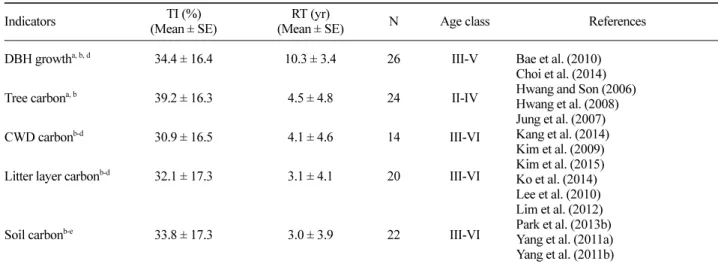
간벌에 의한 산림 탄소 동태 변화를 메타 분석하기 위 하여 총 14건의 국내 간벌 연구 결과들을 수집하였다(Table 1). 본 연구에서는 현지조사 기반 연구 결과만을 대상으로 하였으며, 그 중 간벌 강도 및 간벌 시기가 명시되어 있는 관측값들을 추출하였다. 간벌 관련 연구 대상 수종은 대 부분 잣나무이며, 특히 직경 생장량과 임목 탄소 저장량 관측값 가운데 75% 내외가 잣나무림을 대상으로 수행한 결과이다. 분석 항목은 직경 생장량과 탄소 저장량(임목, 낙엽층, 고사목, 토양)으로 구분하였고, 임목 탄소 저장량 에는 재적 및 지상부 임목 탄소 저장량 관측값들을 포함 시켜 분석하였다. 관련된 국내 연구 사례가 부족하여 관 측값들을 수종 및 임상에 따라 구분하지는 않았다. 한편 국내 연구에서 간벌 강도는 보통 흉고단면적 및 임목 본 수 등을 기준으로 30%에서 40% 수준으로 적용되었으며, 분석 항목별 회복 시기는 직경 생장량은 간벌 후 10년 내 외, 탄소 저장량은 간벌 후 3년에서 5년 이내인 것으로 나 타났다. 이때 회복 시간은 간벌 후 경과된 시간(년)을 의 미한다. 또한 분석 항목별 관측값은 최소 14개(고사목 탄 소 저장량)에서 최대 26개(직경 생장량)로 나타났다.
간벌에 따른 간벌구와 대조구의 직경 생장량 및 탄소 저 장량(고사목, 낙엽층, 토양)의 차이를 분석하기 위하여 관 측값들의 평균과 표준편차를 계산하고 분산 분석을 수행 하였다. 임목 탄소 저장량은 연구 사례별로 제시한 결과 의 형태가 재적, 수간부 생체량, 지상부 생체량 등으로 다 르므로 평균과 표준편차를 계산하지 않았다. 한편 메타 분
Table 1. The mean values for thinning intensity (TI) and recovery time (RT) in the previous studies.
Indicators TI (%)
(Mean ± SE)
RT (yr)
(Mean ± SE) N Age class References
DBH growtha, b, d 34.4 ± 16.4 10.3 ± 3.4 26 III-V Bae et al. (2010) Choi et al. (2014) Hwang and Son (2006) Hwang et al. (2008) Jung et al. (2007) Kang et al. (2014) Kim et al. (2009) Kim et al. (2015) Ko et al. (2014) Lee et al. (2010) Lim et al. (2012) Park et al. (2013b) Yang et al. (2011a) Yang et al. (2011b)
Tree carbona, b 39.2 ± 16.3 4.5 ± 4.8 24 II-IV
CWD carbonb-d 30.9 ± 16.5 4.1 ± 4.6 14 III-VI
Litter layer carbonb-d 32.1 ± 17.3 3.1 ± 4.1 20 III-VI
Soil carbonb-e 33.8 ± 17.3 3.0 ± 3.9 22 III-VI
aPinus koraiensis, bPinus densiflora, cLarix kaempferi, dQuercus spp., ePinus rigida
석을 효과적으로 수행하기 위해서는 관측값들의 표준화 가 필요하므로 Johnson and Curtis(2001)에서 제시한 방법 을 이용하여 효과 크기(Effect size)를 표준화하여 통계 분 석을 수행하였다(식 1).
RR (Response ratio; %) = THINt / CONt × 100 (1) 이때 THINt와 CONt는 각각 간벌 시업 후 t년이 경과한 시점에 측정한 간벌구와 대조구의 직경 생장량 및 탄소 저장량이다. RR이 100% 미만일 때 간벌에 의하여 해당되 는 임분 특성이 감소하고, RR이 100% 이상일 때 간벌에 의하여 해당되는 임분 특성이 증가함을 의미한다. RR이 100%보다 초과 및 미달될 경우, 임분 특성은 초과 및 미 달된 증분만큼 각각 증가 및 감소하게 된다. 분석 항목별 RR의 평균과 표준편차를 추정하였으며, RR이 100%와 유 의한 차이를 보이는지 검정하기 위하여 t-test를 수행하였 다. 한편 간벌 강도와 간벌 후 회복 시간에 따른 직경 생 장량 및 임목, 낙엽층, 고사목, 토양 탄소 저장량의 변화를 파악하기 위하여 상관 분석을 수행하였다. 또한 간벌에 따 른 산림의 변화를 정량화하기 위하여 간벌 강도 및 회복 시간과 유의한 상관 관계를 나타내는 분석 항목(직경 생 장량, 탄소 저장량)에 대하여 간벌 강도과 회복 시간에 의 한 RR의 회귀식을 추정하였다(식 2).
RR (%) = 100 + a × TI (%) + b × RT (yr) (2) 이때 TI는 간벌 강도(Thinning intensity), RT는 회복 시 간(Recovery time), a와 b는 상수이다. 간벌 강도와 회복 시간이 0일 경우 RR은 100%가 되어야 하므로 RR의 절 편을 100으로 가정하였다. 본 연구에서 수행한 모든 통계 분석에 SAS 9.4 프로그램을 사용하였다(SAS Institute Inc., USA). 보다 일반적인 분석 결과를 도출하기 위하여 통계적 유의성은 P = 0.10을 기준으로 판단하였다.
결과 및 고찰
1. 간벌에 따른 직경 생장량 및 탄소 저장량 비교 분산 분석 결과 간벌에 따라 직경 생장량은 증가하나 탄 소 저장량은 차이가 없는 것으로 나타났다(Figure 1). 직 경 생장량(mm·yr−1)은 대조구와 간벌구에서 각각 3.46 ± 1.84와 4.85±2.13로 간벌구에서 더 높았다(P < 0.05). 그러 나 고사목, 낙엽층, 토양 탄소 저장량(Mg·C·ha−1)은 대 조구에서 1.77±1.63, 7.39±1.85, 71.09±50.00, 간벌구에서 6.63±9.75, 6.81±1.81, 66.89±47.26 등으로 나타났으며, 간 벌에 따른 차이를 보이지 않았다(P>0.10).한편 고사목, 낙 엽층, 토양 탄소 저장량은 공간적 변이가 매우 크기 때문 에(KFRI, 2011) 간벌에 따른 이들의 변화가 유의하게 나 타나지 않을 수 있다. 이러한 지역적 변이를 보정하기 위
하여 기존 해외 메타 분석에서는 관측값들을 표준화하여 산림경영에 따른 산림의 변화 경향을 도출하였다(Johnson and Curtis, 2001; Nave et al., 2010; Zhou et al., 2013).
Zhou et al.(2013)은 간벌에 따라 직경 생장량 증가 및 지 상부 임목 탄소 저장량 감소를 보고하였고, Nave et al.(2010)은 벌채에 따라 낙엽층과 토양 탄소 저장량 감소 한다고 보고하였으며, Johnson and Curtis(2001)은 벌채 후 잔재물 존치 시 토양 탄소 저장량이 증가한다고 보고하였 다. 이들 메타 분석들은 전세계 연구 결과들을 종합하여 간벌에 따른 산림의 변화를 보다 명확하게 도출하였다. 따 라서 간벌에 따른 직경 생장량과 탄소 저장량의 변화를 보다 명확하게 구명하기 위해서는 RR 등 관측값들을 표 준화시킬 수 있는 방법이 유용할 것으로 판단된다.
2. 간벌 강도 및 회복 시간에 따른 직경 생장량 및 탄소 저장량 변화
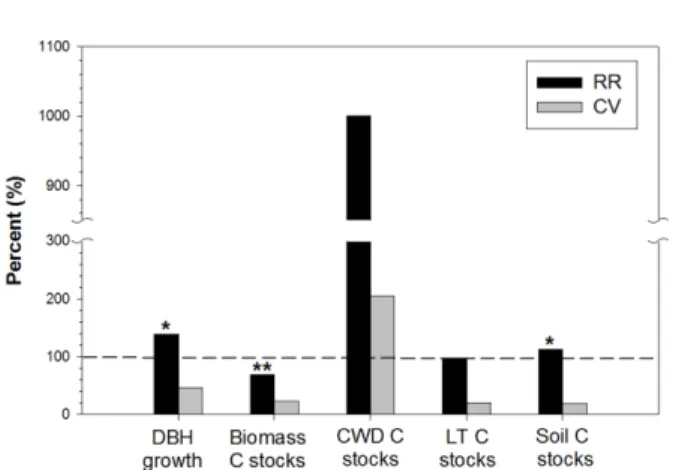
분석 항목들의 관측값들을 표준화하여 분석한 결과, 간 벌이 직경 생장량과 탄소 저장량에 미치는 영향은 관측 항목별로 각각 다르게 나타났다(Figure 2, Figure 3). 직경 생장량의 RR은 평균 139.2±65.7%로 추정되었으며, 간벌 에 의한 직경 생장량의 증가 경향이 유의하게 나타났다(P
< 0.01). 특히 직경 생장량의 RR은 회복 시간과 음의 상관 관계를 보였으며(r = -0.35, P = 0.08), 간벌 강도와는 양의 상관 관계를 보였다(r = 0.39, P = 0.05). 이는 직경 생장량 이 간벌 강도가 증가할수록, 간벌 후 시간의 경과가 적을 수록 증가하는 기존의 연구 결과들과 일치한다(Bae et al., 2010; Choi et al., 2014; Zhou et al., 2013). 임목의 일부 가 벌채되어 임분 밀도가 감소되면 광, 양분, 수분 유효도 가 증가하여 직경 생장량이 증가하게 된다(Bae et al., 2010; Son et al., 2004a; Son et al., 2004b). 반면 간벌 후 시간이 경과함에 따라 간벌구의 임목 밀도가 대조구의 Figure 1. The mean value of diameter at breast height (DBH) growth and carbon (C) stocks in coarse woody debris (CWD), litter layer (LT), and soils. The asterisk indicates significant difference by thinning practices (P < 0.05). The vertical bars indicate the standard deviations.
임목 밀도와 유사해지며, 간벌에 의한 개체목 직경 생장 량 증가 효과가 감소하게 된다(Choi et al., 2014; Hwang et al., 2008).
임목 탄소 저장량의 RR은 69.1±16.1%로 추정되었으며, 간벌에 의하여 임목 탄소 저장량이 유의하게 감소하는 경 향이 나타났다(P < 0.001). 특히 임목 탄소 저장량의 RR
은 간벌 강도와 음의 상관 관계를 보였으나(r = -0.86, P <
0.001), 회복 시간과는 양의 상관 관계를 보였다(r = 0.40, P = 0.05). 일반적으로 간벌 직후 임목 탄소 저장량은 간벌 강도에 비례하여 감소하나, 직경 생장량 촉진에 의하여 임 목 탄소 저장량이 빠르게 회복된다. 따라서 간벌은 단기 적으로 임목 탄소 저장량을 크게 감소시키지만 장기적으 로 임목의 탄소 흡수 기능을 유지시킨다고 할 수 있다 (Zhou et al., 2013).
한편 낙엽층 탄소 저장량의 RR은 97.9±20.0%으로 추정 되었으며, 간벌에 따른 차이를 보이지 않았다(P > 0.10).
낙엽층 탄소 저장량의 RR은 회복 시간과 음의 상관 관계 를 보였으나(r = -0.46, P < 0.05), 간벌 강도와는 상관 관계 를 보이지 않았다(P = 0.91). 따라서 간벌 후 낙엽층 탄소 저장량의 RR은 회복 시간이 증가할수록 감소하고, 간벌 강도는 낙엽층 탄소 저장량에 대하여 일관된 영향을 미치 지 못할 것으로 예상된다. 일반적으로 국내 산림 간벌 시 가지와 잎 등 벌채 부산물이 임분 내에 유입되나, 중장기 적으로 임목으로부터 고사유기물 유입량이 감소하여 시 간의 경과에 따라 낙엽층 탄소 저장량이 감소할 수 있다 (Jandl et al., 2007). 특히 Lee et al.(2010)은 간벌 후 12 년이 경과한 다음 낙엽층 탄소 저장량이 간벌구가 대조구 에 비하여 15-22% 정도 적다고 보고하였다. 또한 간벌 강 Figure 2. The mean response ratios (RRs) and their coefficients
of variation (CVs) in the RRs for diameter at breast height (DBH) growth and carbon (C) stocks in biomass, coarse woody debris (CWD), litter layer (LT), and soils. The asterisks indicate significant differences by thinning practices (*: P < 0.05, **: P < 0.01).
Figure 3. The changes in response ratios of DBH growth and biomass C stocks to thinning intensity (a) and recovery time (b), and those of C stocks in CWD, LT, and soils to thinning intensity (c) and recovery time (d). The DBH, CWD, and LT are abbreviations of diameter at breast height, coarse woody debris, and LT, respectively.
도가 강할수록 벌채 부산물 유입량이 증가하나 임목으로 부터의 유기물 유입이 감소하므로 간벌 강도에 따른 낙엽 층 탄소 저장량의 변화가 유의하지 않은 것으로 판단된다 (Kim et al., 2009).
고사목 탄소 저장량의 RR은 1000.2±2045.9%로 추정되 었으나 간벌에 따른 고사목 탄소 저장량의 증가 경향은 유의하지 않았다(P > 0.10). 또한 고사목 탄소 저장량의 RR 은 간벌 강도와 회복 시간과 상관 관계를 보이지 않았다 (P > 0.10). 단기적으로 간벌 강도에 비례하여 고사목이 발 생량이 증가하나 중장기적으로 임목간 경쟁 완화에 따른 고사목 유입량이 감소한다(Choi et al., 2014; Duvall and Grigal, 1999). 이러한 음의 상관 관계에 의하여 간벌 강도 및 회복 시간과 고사목 탄소 저장량 변화 간 상관 관계가 유의하지 않게 나타난 것으로 판단된다. 또한 고사목은 다 른 고사유기물 탄소 저장고들에 비하여 잔재물 처리 방법 에 의하여 크게 영향을 받으므로(Hytönen and Moilanen, 2014; Rittenhouse et al., 2012), 간벌 시 발생한 고사목 존치 유무 및 수확 방법에 따라 고사목 탄소 저장량이 변 이가 크게 나타날 것으로 예상된다. 국내 연구 대상지에 서는 고사목을 존치하여 고사목 탄소 저장량이 증가한 것 으로 판단되나, 대부분의 국내 연구 사례에서 이와 관련 된 구체적인 자료가 제시되어있지 않아 추가 분석이 어려 웠다. 따라서 향후 연구에서는 시업 방법에 대한 상세한 정보를 제공하는 것이 필요할 것으로 보인다.
토양 탄소 저장량의 RR은 112.8±20.9%로 추정되었으 며, 간벌에 의한 탄소 저장량 증가 경향이 유의하게 나타 났다(P < 0.01). 그러나 간벌 강도 및 회복 시간과는 상관 관계를 보이지 않았다(P > 0.10). 간벌 시 중장비를 이용하 면 토양 층위가 교란되어 토양 탄소 배출이 증가하나 (Concilio et al., 2006), 국내 산림 간벌 시 접근성의 한계 로 인하여 대부분의 작업은 인력으로 이루어진다. 따라서 간벌 과정에서 교란에 의한 토양 탄소 손실이 최소화된다.
또한 간벌 직후 발생한 고사유기물은 낙엽층과 고사목 등 의 형태로 유입된 후 분해되어 토양 유기 탄소로 전환된 다. 그러나 이러한 토양 탄소 저장량 증가 현상은 수 년 이상 지연되어 나타날 수 있으므로 토양 탄소 저장량과 회복 시간 간 상관 관계가 유의하지 않을 수 있다(Kim et al., 2009; Kim et al., 2015; Yang et al., 2011b). 한편 토양 탄소 저장량은 잔재물 처리 방법에 따른 고사유기물 유입량 변화에 영향을 받으므로(Hytönen and Moilanen, 2014; Nave et al., 2010) 간벌 강도와 토양 탄소 저장량 변화 간 상관 관계가 뚜렷하게 나타나지 않은 것으로 판 단된다.
3. 간벌에 따른 직경 생장량 및 임목 탄소 저장량 변화의 회귀식 개발
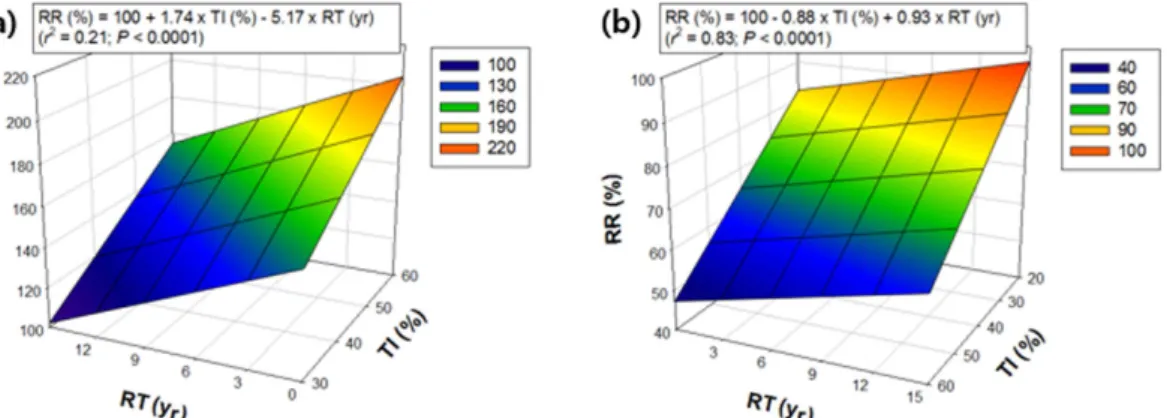
간벌 강도 및 회복 시간과 상관 관계를 보인 직경 생장 량과 임목 탄소 저장량의 RR을 바탕으로 회귀식을 도출 하였다. 직경 생장량의 RR은 간벌 강도가 1% 증가할 때 1.74% 증가하고, 회복 시간이 1년 증가할 때 5.17% 감소 하는 것으로 추정되었다(Figure 4a). 그러나 도출된 회귀 식의 설명력은 약 21%로 낮게 나타났는데, 이는 임목의 직경 생장량이 간벌 강도 및 회복 시간 외에 수종 및 임상, 시업 방법 등에 따라 변이가 크게 나타나기 때문이다(Korea Forest Service, 2013; Zhou et al., 2013). 실제로 Zhou et al.(2013)에서 간벌 강도 및 회복 시간 외에 임황, 기후, 시업 방법 등을 변수로 고려할 때 회귀식의 설명력이 두 배로 향상되었다. 따라서 국내 연구 자료 축적 후 이들 요 인을 회귀식에 추가함으로써 회귀식의 신뢰도를 향상시 킬 수 있을 것으로 판단된다.
임목 탄소 저장량의 RR은 간벌 강도가 1% 증가할 때 0.88% 감소하고, 회복 시간이 1년 증가할 때 0.93% 증가 하는 것으로 나타났다(Figure 4b). 또한 도출된 임목 탄소 저장량의 회귀식은 직경 생장량에 대한 회귀식에 비하여
Figure 4. The response ratios (RRs) of average diameter growth (a) and carbon stocks in tree to thinning intensity (TI) and recovery time (RT) (b) (Bae et al., 2010; Choi et al., 2014; Hwang et al., 2008; Jung et al., 2007; Kang et al., 2014; Kim et al., 2009; Lee et al., 2010; Lim et al., 2012; Park et al., 2013b).
높은 설명력(83%)을 보였는데, 이는 임목 탄소 저장량이 직경 생장량에 비하여 간벌 강도 및 회복 시간 이외 요인 의 영향을 적게 받기 때문인 것으로 판단된다(Zhou et al., 2013). 따라서 추정된 임목 탄소 저장량에 대한 회귀식은 국내 산림시업에 따른 임목 탄소 저장량의 베이스라인 산 정 등에 실질적으로 이용될 수 있을 것으로 기대된다. 그 런데 우리나라에서는 간벌 시업 후 최대 12년까지만 임목 탄소 저장량 변화를 측정하였기 때문에 보다 장기 모니터 링 연구 결과를 바탕으로 임목 탄소 저장량의 변화 경향 을 파악한다면 개발된 회귀식의 신뢰도를 제고할 수 있을 것이다.
고사목, 낙엽층, 토양 탄소 저장량의 RR은 간벌 강도와 회복 시간과 상관 관계가 거의 나타나지 않았으므로 간벌 에 따른 이들 탄소 저장고들의 변화를 파악하기 위하여 다중 회귀 분석 외에 다른 분석 방법이 필요하다. 특히 낙 엽층, 고사목, 토양 탄소 저장량은 총량에 비하여 연간 변 화량이 작고 토양 특성에 따른 변이가 크다(Mohren et al., 2012; Rantakari et al., 2012). 따라서 임목의 변화를 바탕 으로 고사유기물과 토양 탄소 저장량 변화를 모의할 수 있는 산림 탄소 모델을 이용하는 것이 효과적일 것으로 판단된다. CBM-CFS3, KFSC, Yasso 등의 산림 탄소 모 델에서는 임목의 생장곡선 및 고사유기물 유입량을 입력 하면 연간 고사유기물 탄소 동태를 모의할 수 있다(Kurz et al., 2009; Liski et al., 2005; Park et al., 2013a; Yi et al., 2013). 본 연구에서 개발한 임목 탄소 저장량에 대 한 회귀식과 산림 탄소 모델을 연계하여 간벌에 따른 국 내 산림 탄소 저장량 변화를 정량화할 수 있을 것으로 기 대된다.
4. 연구 제언
국내 선행 연구 검토 결과 간벌에 따른 산림의 변화를 보다 명확하게 밝히기 위해서는 연구 대상 수종 확대, 장 기 모니터링 연구 및 측정 주기 단축, 하층 식생 조사가 필요할 것으로 판단된다. 즉 간벌에 의한 직경 생장량과 탄소 저장량 변화 연구는 대부분 잣나무 등 침엽수를 대 상으로 수행한 반면 활엽수에 대한 연구가 부족하다. 특 히 간벌에 따른 활엽수림의 직경 생장량과 임목 탄소 저 장량 변화 연구는 거의 보고된 바 없다. 활엽수림도 국내 산림을 구성하는 주요 임상이고(KFRI, 2011) 기후변화에 따른 국내 산림의 천이가 예상된다(Choi et al., 2012). 따 라서 간벌에 따른 활엽수림의 변화에 대한 연구가 필요한 것으로 판단된다.
한편 장기 모니터링 및 측정 주기 단축도 필요하다. 대 부분의 국내 연구들은 간벌 후 5년 이내에 수행되었으며 측정 주기가 3년 이상이었다. 그런데 직경 생장량 및 임목 탄소 저장량의 연간 변화는 연륜 측정을 통하여 추정할
수 있으나, 고사목, 낙엽층, 토양 탄소 저장량 등은 주기적 으로 변화를 실측하여야 한다. 또한 간벌 후 고사유기물 유입 및 분해량 변화가 복합적으로 나타나고, 변화 지속 시간의 변이가 크기 때문에 위의 탄소 저장고들과 간벌 강도 및 회복 시간 간 상관 관계를 분석하기 어렵다(Cheng et al., 2012; López et al., 2003; Nobles et al., 2009; Selig et al., 2008; Sullivan et al., 2008). 따라서 짧은 주기로 반복하여 측정함으로써 시간의 경과에 따른 고사유기물 탄소 동태를 보다 명확하게 구명하는 것이 중요할 것으로 판단된다.
마지막으로 간벌 후 하층 식생 변화에 대한 연구가 필 요하다. 간벌에 의한 하층 식생의 증가가 임목 탄소 저장 량 감소를 상쇄할 수준으로 높지는 않으나, 하층식생은 시 간의 경과에 따라 생물량이 증가한다(Harrington and Edwards, 1999; Gilliam, 2007; Son et al., 2004a; Sullivan et al., 2008). 특히 침엽수림 간벌 시 활엽수가 하층식생 으로 출현하므로 천이를 촉진시킬 수 있다(Kang et al., 2014; Son et al., 2004a). 그러나 간벌에 따른 하층 식 생의 변화를 연구한 국내 연구 사례는 Son et al.(2004a) 이 거의 유일하다. 따라서 간벌 후 하층 식생의 변화에 대한 연구를 통하여 산림시업에 따른 수종의 천이와 탄 소 저장량 변화를 종합적으로 예측할 수 있을 것으로 판 단된다.
결 론
국내 관련 연구 결과를 바탕으로 메타 분석한 결과, 간 벌에 의하여 직경 생장량과 토양 탄소 저장량은 증가하 고, 임목 탄소 저장량은 감소하며, 고사목과 낙엽층 탄 소 저장량은 변화가 없는 것으로 나타났다. 한편 직경 생 장량과 임목 탄소 저장량은 간벌 강도 및 회복 시간과 상관 관계를 보인 반면 낙엽층, 고사목, 토양 탄소 저장 량 등은 위의 두 요인과 상관 관계를 거의 보이지 않았 다. 또한 간벌에 따른 직경 생장량과 임목 탄소 저장량 의 변화를 정량화하기 위하여 회귀식을 도출하였으며, 간벌에 따른 산림 변화를 보다 명확하게 구명하기 위한 연구 방법들을 제언하였다. 본 연구 결과는 산림 시업에 따른 탄소 베이스라인 산정에 직접적으로 이용될 수 있 고 향후 국내 후속 연구의 방향성을 제시할 수 있을 것 으로 기대된다.
감사의 글
본 연구는 산림청 산림과학특정연구(과제번호:
S111315L100120)와 환경부 CO2저장 환경관리기술개발 사업(2014001810002)의 지원을 받아 수행되었습니다.
References
Bae, S.-W., Hwang, J., Lee, S.-T., Kim, H.-S., and Jeong, J.- M. 2010. Changes in soils temperature, moisture content, light availability and diameter growth after thinning in Korean pine (Pinus koraiensis) plantation. Journal of Korean Forest Society 99(3): 397-403. (In Korean with English abstract)
Cheng, X.-R., Yu, M.-K., Ge, L., Zhang, C.-X., and Wang, W.
2012. Carbon density and its spatial distribution in Quercus acutissima plantations under different thinning intensities.
Chinese Journal of Applied Ecology 23(5): 1175-1180.
(In Chinese with English abstract)
Choi, S., Lee, W.K., Kwak, D.A., Lee, S., Son, Y., Lim, K.H., and Saborowski, J. 2012. Predicting forest cover changes in future climate using hydrological and thermal indices in South Korea. Climate Research 49(3): 229-245.
Choi, J., Lee, B., Lee, D., and Choi, I. 2014. Growth monitoring of Korean white pine (Pinus koraiensis) plantation by thin- ning intensity. Journal of Korean Forest Society 103(3):
422-430. (In Korean with English abstract)
Concilio, A., Ma, S., Ryu, S.-R., North, M., and Chen, J. 2006.
Soil respiration response to experimental disturbances over 3 years. Forest Ecology and Management 228(1-3):
82-90.
David, A.L., Elizabeth, A.B., Mackenzie, B.M., Mark, E.B., Mebecca, M.N., and Richard, B.H. 2015. Tradeoffs between three forest ecosystem services across the state of New Hampshire, USA: timber, carbon, and albedo. Ecological Applications: in press.
Dixon, R.K., Solomon, A.M., Brown, S., Houghton, R.A., Trexier, M.C., and Wisniewski, J. 1994. Carbon pools and flux of global forest ecosystems. Science 263(5144): 185-190.
Duvall, M.D. and Grigal, D.F. 1999. Effects of timber har- vesting on coarse woody debris in red pine forests across the Great Lakes states, USA. Canadian Journal Forest Research 29(12): 1926-1934.
Gilliam, F.S. 2007. The ecological significance of the herba- ceous layer in temperate forest ecosystems. BioScience 57(10): 845-858.
Harrington, T.B. and Edwards, M.B. 1999. Understory vegeta- tion, resource availability, and litterfall responses to pine thinning and woody vegetation control in longleaf pine plantations. Canadian Journal Forest Research 29(7): 1055- 1064.
Hwang, J. and Son, Y. 2006. Short-term effects of thinning and liming on forest soils of pitch pine and Japanese larch plantations in central Korea. Ecological Research 21(5):
671-680.
Hwang, J., Bae, S.-W., Lee, K.J., Lee, K.-S., and Kim, H.-S.
2008. Short-term effect of thinning on aboveground car- bon storage in Korean pine (Pinus koraiensis) plantation.
Journal of Korean Forest Society 97(6): 605-610. (In Korean
with English abstract)
Hytönen, J. and Moilanen, M. 2014. Effect of harvesting method on the amount of logging residues in the thinning of Scots pine stands. Biomass and Bioenergy 67: 347-353.
Intergovernmental Panel on Climate Change (IPCC). 2003.
Good practice guidance for land use, land-use change and forestry. IPCC. Hayama. Japan.
Jandl, R., Linder, M., Vesterdal, L., Bauwens, B., Baritz, R., Hagedorn, F., Johnson, D. W., Minkkinen, K., and Byrne, K.A. 2007. How strongly can forest management influ- ence soil carbon sequestration?. Geoderma 137(3): 253-268.
Johnson, D.W. and Curtis, P.S. 2001. Effects of forest man- agement on soil C and N storage: meta analysis. Forest Ecology and Management 140(2): 227-238.
Jung, S.-E., Choi, H.-S., Lee, S.-S., Kim, J.-M., Im, A-R., Choi, B.-H., Lee, M.-A., Choi, H.-A., Son, C.-C., Son, Y., and Lee, W.-K. 2007. Effects of thinning intensity on growth and structure of Larix leptolepis stand. Korean Journal of Forest Measurement 10: 20-25. (In Korean with English abstract)
Kang, J.-S., Shibuya, M., and Shin, C.-S. 2014. The effect of forest-thinning works on tree growth and forest environ- ment. Forest Science and Technology 10(1): 33-39.
Kim, C., Son, Y., Lee, W.-K., Jeong, J., and Noh, N.J. 2009.
Influences of forest tending works on carbon distribution and cycling in a Pinus densiflora S. et Z. stand in Korea.
Forest Ecology and Management 257(5): 1420-1426.
Kim, S., Yoon, T.K., Han, S., Han, S.H., Lee, J., Kim, C., Lee, S.-T., Seo, K.W., Yang, A-R., and Son, Y. 2015. Ini- tial effects of thinning on soil carbon storage and base cations in a naturally regenerated Quercus spp. forest in Hongcheon, Korea. Forest Science and Technology 11(3):
172-176.
Ko, S., Yoon, T.K., Kim, S., Kim, C., Lee, S.-T., Seo, K.W., and Son, Y. 2014. Thinning intensity effects on carbon storage of soil, forest floor, and coarse woody debris in Pinus densiflora stands. Journal of Korean Forest Soci- ety 103(1): 30-36. (In Korean with English abstract) KFRI (Korea Forest Research Institute). 2011. The 5th national
forest inventory report. Seoul. pp. 166. (In Korean) Korea Forest Service. 2003. Statistical yearbook of forestry.
Korea Forest Service. Daejeon. pp. 411. (In Korean) Korea Forest Service. 2008. Statistical yearbook of forestry.
Korea Forest Service. Daejeon. pp. 495. (In Korean) Korea Forest Service. 2012. Statistical yearbook of forestry.
Korea Forest Service. Daejeon. pp. 488. (In Korean) Korea Forest Service. 2013. Table of tree volume/mass and
yield table. Korea Forest Service. Daejeon. pp. 261. (In Korean) Kurz, W.A., Dymond, C.C., White, T.M., Stinson, G., Shaw,
C.H., Rampley, G.J., Smyth, C., Simpson, B.N., Neilson, E.T., Trofymow, J.A., Metsaranta, J., and Apps, M.J. 2009.
CBM-CFS3: a model of carbon-dynamics in forestry and land-use change implementing IPCC standards. Ecologi-
cal Modelling 220(4): 480-504.
Lee, S.K., Son, Y., Lee, W.K., Yang, A-R., Noh, N.J., and Byun, J.-G. 2010. Influence of thinning on carbon storage in a Japanese larch (Larix Kaempferi) plantation in Yangpyeong, central Korea. Forest Science and Technology 6(1): 35- 40.
Lee, J., Yoon, T.K., Han, S., Kim, S., Yi, M.J., Park, G.S., Kim, C., Son, Y.M., Kim, R., and Son, Y. 2014. Estimating the car- bon dynamics of South Korean forests from 1954 to 2012. Biogeosciences 11(17): 4637-4650.
Lee, J., Han, S.H., Kim, S., Chang, H., Yi, M.J., Park, G.S., Kim, C., Son, Y.M., Kim, R., and Son, Y. 2015. Estimat- ing the changes in forest carbon dynamics of Pinus densi- flora and Quercus variabilis forests in South Korea under the RCP 8.5 climate change scenario. Korean Journal of Agricultural and Forest Meteorology 17(1): 35-44. (In Korean with English abstract)
Li, X., Yi, M.J., Son, Y., Jin, G., and Han, S.S. 2010. Forest biomass carbon accumulation in Korea from 1954 to 2007.
Scandinavian Journal of Forest Research 25(6): 554-563.
Lim, H., Choi, W.-J., Ahn, K., and Lee, K.-H. 2012. Ecosys- tem respiration and tree growth influenced by thinning in a read pine forest in southern Korea. Forest Science and Technology 8(4): 192-204.
Liski, J., Palosuo, T., Peltoniemi, M., and Sievänen, R. 2005.
Carbon and decomposition model Yasso for forest soils.
Ecological Modelling 189(1): 168-182.
López, B.C., Sabate, S., and Gracia, C.A. 2003. Thinning effects on carbon allocation to fine roots in a Quercus ilex for- est. Tree Physiology 23(17): 1217-1224.
Lu, F. and Gong, P. 2005. Adaptive thinning strategies for mixed-species stand management with stochastic prices.
Journal of Forest Economics 11(1): 53-71.
Minnich, R.A., Barbour, M.F., Burk, J.H., and Sosa-Ramíre, J. 2000. Californian mixed-conifer forests under unmanaged fire regimes in the Sierra San Pedro Mártir, Baja Califor- nia, Mexico. Journal of Biogeography 27(1): 105-129.
Mohren, G.M.J., Hasenauer, H., Köhl, M., and Nabuurs, G.-J.
2012. Forest inventories for carbon change assessments.
Current Opinion in Environmental Sustainability 4(6):
686-695.
Nave, L.E., Vance, E.D., Swanston, C.W., and Curtis, P.S. 2010.
Harvest impacts on soil carbon storage in temperate for- ests. Forest Ecology and Management 259(5): 857-866.
Nishizono, T. 2010. Effect of thinning level and site produc- tivity on age-related changes in stand volume growth can be explained by a single rescaled growth curve. Forest Ecology and Management 259(12): 2276-2291.
Nobles, M.M., Dillon, W., and Mbila, M. 2009. Initial response of soil nutrient pools to prescribed burning and thinning in a managed forest ecosystem of northern Alabama. Soil Science Society of American Journal 73(1): 285-292.
Nyland, R.D. 2002. Silviculture. pp. 381-406. In: Thinning and its
effects on stand development. Waveland Press, Illinois.
U.S.A.
Pan, Y., Birdsey, R.A., Fang, J., Houghton, R., Kauppi, P.E., Kurz, W.A., Phillips, O.L., Shvidenko, A., Lewis, S.L., Canadell, J.G., Ciais, P., Jackson, R.B., Pacala, S.W., McGuire, A.D., Piao, S., Rautiainen, A., Sitch, S., and Hayes, D.
2011. A large and persistent carbon sink in the world’s forests. Science 333(6045): 988-993.
Park, C-W., Lee, J., Yi, M., Kim, C., Park, G.S., Kim, R.H., Lee, K.H., and Son, Y. 2013a. Estimation of change in soil carbon stock of Pinus densiflora forests in Korea using KFSC model under RCP 8.5 climate change sce- nario. Climate Change Research 4(2): 77-93. (In Korean with English abstract)
Park, J., Kim, S.K., Lee, S.T., Lee, K., and Kim, H. 2013b.
Thinning effect on vegetation structure and stand charac- teristics of oak stands. Journal of Agriculture and Life Science 47(6): 81-89. (In Korean with English abstract) Rantakari, M., Lehtonen, A., Linkosalo, T., Tuomi, M., Tam-
minen, P., Heikkinen, J., Liski, J., Mäkipää, R., Ilvesni- emi, H., and Sievänen, R. 2012. The Yasso07 soil carbon model—testing against repeated soil carbon inventory.
Forest Ecology and Management 286: 137-147.
Rittenhouse, T.A.G., MacFarland, D.M., Martin, K.J., and Van Deelen T.R. 2012. Downed wood associated with round- wood harvest, whole-tree harvest and unharvested stands of aspen in Wisconsin. Forest Ecology and Management 266: 239-245.
Selig, M.F., Seiler, J.R., and Tyree, M.C. 2008. Soil carbon and CO2 efflux as influenced by the thinning of loblolly pine (Pinus taeda L.) plantations on the Piedmont of Vir- ginia. Forest Science 54(1): 58-66.
Shin, J.Y., Won, M.S., Kim, K., and Shin, M.Y. 2013. Pre- dicting the effect of climate change on forest biomass by different ecoprovinces and forest types in Korea. Korean Journal of Agricultural and Forest Meteorology 15(3):
119-129. (In Korean with English abstract)
Son, Y., Lee, Y.Y., Jun, T.C., and Kim, Z.-S. 2004a. Light availability and understory vegetation four years after thin- ning in a Larix leptolepis plantation of central Korea. Journal of Forest Research 9(2): 133-139.
Son, Y., Jun, Y.C., Lee, Y.Y., Kim, R.H., and Yang, S.Y.
2004b. Soil carbon dioxide evolution, litter decomposi- tion, and nitrogen availability four years after thinning in a Japanese larch plantation. Communications in Soil Sci- ence and Plant Analysis 35(7-8): 1111-1122.
Sullivan, B.W., Kolb, T.E., Hart, S.C., Kaye, J.P., Dore, S., and Montes-Helu, M. 2008. Thinning reduces soil car- bon dioxide but not methane flux from southwestern USA ponderosa pine forests. Forest Ecology and Manage- ment 255(12): 4047-4055.
United Nations Framework Convention on Climate Change (UNFCCC). 1997. Kyoto Protocol to the United Nations
Framework Convention on Climate Change. Available at:
http://www.unfccc.int.
Yang, A-R., Son, Y., Noh, N.J., Lee, S.K., Jo, W., Son, J.-A., Kim, C., Bae, S.-W., Lee, S.-T., Kim, H.-S., and Hwang, J. 2011a. Effect of thinning on carbon storage in soil, for- est floor, and coarse woody debris of Pinus densiflora stands with different stand ages in Gangwon-do, central Korea. Forest Science and Technology 7(1): 30-37.
Yang, A-R., Noh, N.J., Lee, S.K., Yoon, T.K., Kim, C., Bae, S.-W., Hwang, J., Lee, S.-T., Kim, H.-S., and Son, Y. 2011b.
Short-term effect of thinning on carbon storage in soil, forest floor and coarse woody debris of Quercus spp.
stand in Hoengseong, Gangwon-do, Korea. Forest Sci-
ence and Technology 7(4): 168-173.
Yi, K., Park, C.-W., Ryu, S.-R., Lee, K.-H., Yi, M.-J., Kim, C., Park, G.-S., Kim, R., and Son, Y. 2013. Simulating the soil carbon dynamics of Pinus densiflora forests in central Korea. Scandinavian Journal of Forest Research 28(3): 241-256.
Zhou, D., Zhao, S.Q., Liu, S., and Oeding, J. 2013. A meta- analysis on the impacts of partial cutting on forest struc- ture and carbon storage. Biogeosciences 10(6): 3691- 3703.
(Received: July 30, 2015; Accepted: September 8, 2015)