ORIGINAL ARTICLE
충북 청주지역 리기다소나무와 밤나무의 상대 생장률과 기후인자와의 관계
김기대*
한국교원대학교 환경교육과
Relationship between Climate Factors and Relative Growth of Pinus rigida and Castanea crenata in the Cheongju Area of Chungbuk
Kee Dae Kim*
Department of Environmental Education, Korea National University of Education, Cheongju 28173, Korea
Abstract
The Diameter at Breast Height (DBH) provides information about the volume growth of a tree. In this study, we estimated the relative growth rates of Castanea crenata and Pinus rigida as 4.07% and 3.73%, respectively. Although the difference was low, we demonstrated that the growth rate of C. crenata is slightly faster than that of P. rigida. After calculating the relative growth rate for each section, we found that the relative growth of C. crenata decreased with time. However, the relative growth rate of P. rigida showed an overall increase. The gap widths of both species showed an increasing trend. However, the gradient of the two species was different. The gradient of C. crenata was approximately 12.0, but that of P. rigida was approximately 4.7. This means that the volume growth of C. crenata was faster than that of P. rigida during 4 years. However, this was relatively a short period for measuring the volume growth pattern, and we believe that additional useful information can be obtained by conducting long-term ecological monitoring. Results of canonical correspondence analysis showed that among the climate variables, temperature was significantly related to the gap widths for both species.
Key words : Relative growth, Pinus rigida, Castanea crenata, Canonical correspondence analysis, Climate factors
1)1. 서 론
대부분의 생물은 내성범위 내의 환경에서만 서식 이 가능하다. 특히 식물의 경우, 이동이 불가능하기 때 문에 서식지 환경에 영향을 크게 받는다. 따라서 식물 생장의 장기적 모니터링은 환경 변화에 대한 지속적
이고 정확한 정보를 알려준다. 환경변화의 기록이라는 이러한 중요성이 크게 부각되면서 1990년대에 등장한 장기생태모니터링은 전 세계적인 호응을 얻기 시작했 다. 장기생태모니터링(LTER : Long-Term Ecological Research)이란 특정한 생태계에서 10년 내지 수십 년 동안 장기적으로 생태학적인 연구를 수행하는 연구
Received 6 February, 2017; Revised 2 March, 2017;
Accepted 8 March, 2017
*Corresponding author: Kee Dae Kim, Department of Environ -mental Education, Korea National University of Education, Cheongju 28173, Korea
Phone: +82-43-230-3727 E-mail: [email protected]
ⓒ The Korean Environmental Sciences Society. All rights reserved.
This is an Open-Access article distributed under the terms of the Creative Commons Attribution Non-Commercial License (http://
creativecommons.org/licenses/by-nc/3.0) which permits unrestricted non-commercial use, distribution, and reproduction in any medium, provided the original work is properly cited.
방식을 말한다. LTER이라는 용어는 1980년에 미국 국립과학재단(NSF)이 LTER이라는 이름으로 연구지 원을 하기 시작하면서 처음으로 사용되었다(Ministry of Environment, 2004).
Smithsonian Environmental Research Center의 Global treebanding project는 장기생태모니터링인 동 시에 국제적으로 데이터를 수집해 비교한다는 점에서 큰 의미가 있다(Smithsonian Institution, 2016). 특히 최근에는 급변하는 환경 속에서 기후변화가 심각해지 면서 기후변화의 동향을 알아보고, 대책을 마련하는 연구가 더욱 중요해졌다. Global treebanding project 는 나무가 기후에 따라 어떠한 반응을 하는지 지속적 인 자료 수집을 통해 이러한 연구에 도움을 주고 있다.
부피생장에 의한 수목의 직경의 변화를 측정하는 것은 수목 측정에서 가장 흔하게 하는 것이다(Avery and Burkhart, 2002). 또한, 수고와 흉고직경은 수목 지상부의 가지와 침엽의 생체량 사이에 정의 상관관 계가 높다고 보고되었다(Lee, 2004). 이러한 수목의 일차적인 측정은 생체량의 상대생장식을 추정하는 것 으로 발전되었다(Son et al., 2011).
본 연구 목적은 Global treebanding project의 일환 으로 청주시 흥덕구 강내면 학천리 산89번지에 위치 한 한국교원대학교 학천리 부지(이하: 학천리 부지)의 리기다소나무(Pinus rigida MILL.)와 밤나무(Castanea crenata S. et Z.) treebanding의 gap 폭과 흉고직경 (DBH)을 측정하고, 시간 경과에 따라서 생물이 지수 함수적으로 생장한다는 원리를 이용한 생육분석을 이 용해 상대생장률을 비교하는 것이다. 또한, 4년간의 측정치를 바탕으로 두 종간 상대 생장률을 기후인자 와의 관계를 연구하는 것을 목적으로 한다.
2. 연구 방법
본 연구에서 충북 청주시 학천리 부지에서 우점하 고 있는 리기다소나무(Pinus rigida MILL.)와 밤나무 (Castanea crenata S. et Z.)의 생장을 측정하였다. 연 구 대상은 2012년 5월부터 측정해 온 리기다소나무 8 개체와 밤나무 10개체이며 각각 흉고직경(Diameter at Breast Height; DBH)과 Treebanding의 gap width 을 측정한다. 흉고직경 측정치는 생육분석의 상대생
장률을 구하고, gap width는 리기다소나무와 밤나무 의 종간 생장률을 비교하였다(Yeocheon Ecology Research Society, 2005). 밤나무는 유실수이지만 연 구지역이 한국교원대학교 소유의 부지여서 사람의 관 리가 없는 것으로 판단되어 생장 연구 대상으로 선택 되었다.
2.1. 조사지 개황 2.1.1. 청주시 생태환경
2014년 기존 청주시와 청원군이 합쳐진 통합 청주 시는 내륙의 중심부인 충청북도의 시이다. 통합청주 시의 면적은 172,711 km2이고, 임야면적은 91,624 ha 으로 약 53%가 임야이다(Chugcheongbuk-do, 2013).
임야 중 침엽수림이 20,541 ha, 활엽수림이 18,238 ha, 그리고 혼효림이 8,805 ha로서 침엽수림과 활엽수 림이 대부분을 점유하고 있다(Korea Forest Service, 2010).
청주시의 식물상으로 93과 227속 313종 71변종 3 품종 총 387종이 기록되었고, 식물군락은 소나무 군 락, 상수리나무 군락, 굴참나무 군락, 소나무-굴참나 무 군락, 소나무-졸참나무 군락, 소나무-상수리나무 군락과 식재림 군락으로서 일본잎깔나무 군락, 잣나 무 군락 등 8개 군락이 분포하고 있다(Ministry of Environment, 1991).
2.1.2. 학천리 생태환경
환경부의 생태자연도에 따르면 학천리 부지 (36°37'38''N, 127°23'27''E)와 주변은 산지낙엽활수림 으로 굴참나무-상수리나무군락으로 덮여 있으며, 생 태자연도 2등급 지역에 해당한다(National Institute of Ecology, 2015).
학천리 연구 부지의 식생은 밤나무, 리기다소나무, 상수리나무가 우점하고 있다. 산림청에 1996년부터 2005년까지 조사한 자료에 의하면, 학천리 부지를 구 성하는 리기다소나무 군락은 주로 3영급으로서 21에 서 30년생의 수관 점유 비율이 50%이상에 이른다 (Korea Forest Service, 2016). 따라서 조사지역의 리 기다소나무는 2016년 기준으로 수령이 32에서 41년 생에 이른다.
연구지역에서 교목층에는 리기다소나무, 소나무,
물오리나무, 산벚나무, 밤나무, 잣나무, 아까시나무 등 이 있고 관목층에 노간주나무, 진달래, 졸참나무 등이 서식하고, 초본층에 귀화식물인 미국자리공과 토착식 물인 청미래덩굴, 노루발, 여뀌 종류 등이 기록되었다 (Lee et al., 2010).
2.2. Treebanding 설치
2012년 4월에 충북 청주시 흥덕구 학천리 부지에 서 다른 종에 비하여 우점하고, 수령이 유사한 침엽수 인 리기다소나무와 활엽수인 밤나무 각각 8과 10개 체를 선택하여 treebanding을 설치하였다. 8개체와 10개체를 선택한 이유는 treebanding 설치 kit 수의 제한때문이었고 리기다소나무는 초기에 10개체에 설 치하였으나 2개체에서 treebanding이 소실되었다.
Treebanding 설치 kit는 스미소니언 환경연구센터 (Smithsonian Environmental Research Center)에서 제공받은 것을 사용하였다(Smithsonian Institution, 2016).
2.3. 흉고직경 측정을 이용한 상대생장률 비교
2012년부터 2016년까지 충북 청주시 학천리 부지 의 treebanding 표식이 있는 수목(리기다소나무 8개 체, 밤나무 10개체)의 흉고직경 테이프를 이용하여 흉 고직경을 측정하고 기록하였다. 흉고직경의 측정위치 는 나무에 둘러져있는 밴드 바로 밑을 측정하도록 하 여 위치에 의한 오차를 줄였다. 측정한 흉고직경은 기 저면적(Basal area)으로 환산하였다. 생육분석을 위해 서 상대생장률을 계산하고 리기다소나무와 밤나무의 상대생장률을 비교하였다. 2012년부터 2016년까지 수집된 자료 중에서 생장기간을 다르게 하여 분석하 였다.
2.3.1. 흉고직경 측정을 통한 상대생장률 비교
시간경과에 따라 리기다소나무와 밤나무가 지수 함수적 생장을 한다고 가정하면, 이들의 상대생장률 (r)은
log
log
log
으로 나타낼 수 있다. 이때,
∏
이다.
처음 측정(2012.05.18.)한 흉고직경을 a, 가장 최근 (2016.04.06.)에 측정한 흉고직경을 b라고 하면,
,
(Eq. 1)
,
(Eq. 2) 이므로
log
log
log
라고 할 수 있다.
따라서 흉고직경을 이용한 상대생장률(r)은
log
이다. 이러한 방법으로 상대생장률을 계산하고 수종 별 비교를 하였다.
2.4. Treebanding gap 측정과 종간 생장률 비교
디지털 캘리퍼(Digital caliper)로 treebanding이 설 치된 수목의 gap width를 측정하고, 기록한다. 2012년 부터 측정된 리기다소나무와 밤나무의 종간 생장률을 비교하였다.2.5. 기후인자와 종별 생장의 Canonical correspondence analysis
기후인자인 평균기온(AveTemp: Average of Temperature), 운량(CloudCov: Cloud Cover), 일조시 간(DurSun: Duration of Sunshine), 최고기온(HigTemp:
Highest Temperature), 최저기온(LowTemp: Lowest Temparature), 강수량(Precip: Precipitation), 상대습 도(RelHum: Relative Humidity), 신적설(Snow:
snowfall)의 8가지 변량을 기상청에서 상대생장 측정
Species No. Tag #
DBH (cm, 2012.05.18)
a2 (Eq. 1)
DBH (cm, 2014.05.14)
DBH (cm, 2014.11.05)
DBH (cm, 2015.11.11)
DBH (cm, 2016.04.06)
b2 (Eq. 2)
log (b²/a²) 4-1 (year)
Pinus rigida
1 4520 26.3 691.69 27.3 27.25 27.6 29.6 876.16 0.0591
2 4524 31.1 967.21 32.9 33.4 34.35 34.5 1190.3 0.0519
3 4521 26.3 691.69 27.5 27.7 28.35 28 784 0.0313
4 4522 20 400 20.6 21 21.3 24.3 590.49 0.0974
5 4523 25.7 660.49 25.8 26.3 26.3 26.3 691.69 0.0115
6 4525 23.6 556.96 24.1 24.5 24.65 24.4 595.36 0.0167
7 5299 23.4 547.56 24 23.8 24.2 24.2 585.64 0.0168
8 5300 24.6 605.16 25.4 25.7 26.2 26.2 686.44 0.0315
9 4519 24 576 25.8 24.6 - - 605.16 0.0198
Total mean±SD 0.0373±
0.0278
Castanea crenata
1 5301 28.4 806.56 30.43 31.1 31.55 31.6 998.56 0.0534
2 5302 26.5 702.25 27.92 28 28.55 28.6 817.96 0.0381
3 5303 28.9 835.21 29.73 30.18 30.3 30.4 924.16 0.0253
4 5304 20.8 432.64 20.42 20.55 20.65 20.8 432.64 0.0000
5 5305 33.6 1129 37 37.8 38.2 38.2 1459.2 0.0642
6 5306 28.4 806.56 30.68 31.6 32.35 32.3 1043.3 0.0643
7 5307 34.3 1176.5 35.7 36 36.5 36.4 1325 0.0297
8 5308 31.1 967.21 32.2 32.5 33 32.8 1075.8 0.0266
9 5309 21.6 466.56 22.85 23.1 23.7 23.6 556.96 0.0443
10 5310 25.5 650.25 27.33 28 28.8 28.8 829.44 0.0608
Total mean±SD 0.0407±
0.0208
Table 1. Relative growth rate of Pinus rigida and Castanea crenata (- means data missing)
일전 1년간 자료를 수집하였다(Korea Meterological Administration, 2016). 상대생장 측정일의 리기다소 나무와 밤나무의 gap width를 종속변수로 하고 1년간 기후인자를 독립변수로 하고 다변량분석을 위하여 Canonical correspondence analysis (CANOCO ver.
4.55) (ter Braak and Smilauer, 2002)를 수행하였다.
3. 결과 및 고찰
3.1. 흉고직경 측정을 이용한 상대생장률
리기다소나무와 밤나무의 흉고직경의 측정결과는 Table 1과 같다. 이 자료를 토대로 하여 구간별 상대생 장률을 그래프로 나타내면 Fig. 1과 같다. 이때 구간
은 2012.05.18. ~ 2014.05.14., 구간 는 2014.
05.14. ~ 2014.11.05., 구간 은 2014.11.05. ~ 2015.
11.11., 구간 는 2015.11.11. ~ 2016.04.06.을 의미
한다. 리기다소나무는 상대생장률이 줄었다가 증가하 는 경향을 보였으나, 시간이 흐름에 따라 밤나무의 상 대생장률이 지속적으로 줄어들고 있음을 알 수 있다 (Fig. 1).
3.2. Treebanding gap width 측정과 종간 생장률 비교
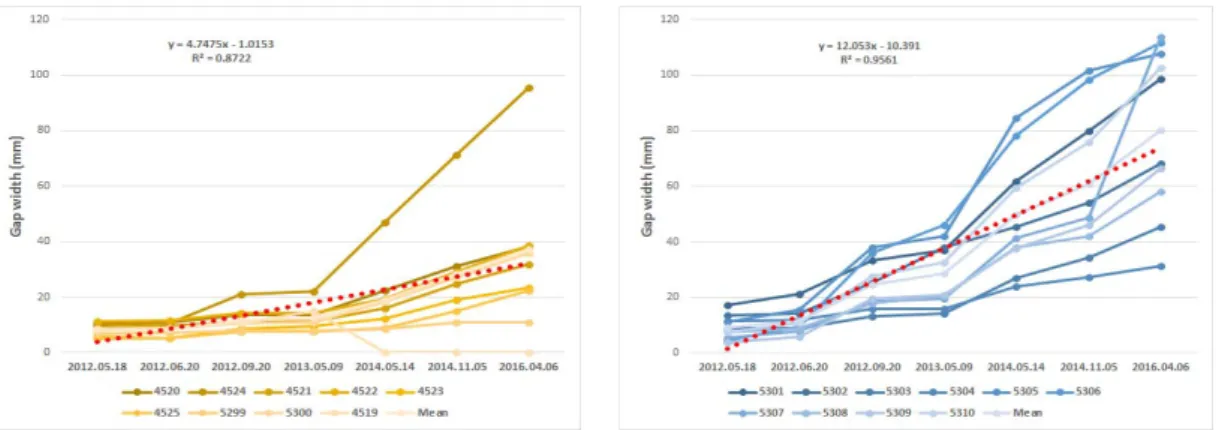
두 종의 시간별 gap width 변화를 그래프로 나타내 면 Fig. 2, 3과 같다. 식물은 살아있는 동안에는 즉, 죽 어서 수분이 빠져나가지 않는 한 생장이 줄지 않는다.따라서 두 교목의 gap width는 시간이 지나면서 크거 나 같아야 한다. gap width 평균값의 추세선 그래프 기울기 비교를 통해 두 종간의 부피생장률을 상대적 으로 비교할 수 있다. 밤나무 추세선 기울기가 약 12.0 인데 비해, 리기다소나무 추세선 기울기는 약 4.7로 밤나무의 부피생장이 더 빠름을 알 수 있다. 리기다소 나무의 경우, 부위별 상대생장을 비교해 보면 줄기
Fig. 2. Annual gap width trends of Pinus rigida along estimating date. The dotted lines represent a regression line of means.
Fig. 3. Annual gap width trends of Castanea crenata along estimating date. The dotted lines represent a regression line of means.
목질부, 가지, 줄기 수피, 잎의 순서로 작아진다고 추 정되었다(Seo and Lee, 2011). 본 연구결과에서는 gap width의 년간 생장을 추정하여 밤나무가 리기다소나 무보다 생장 추세선의 기울기가 컸지만 연륜(core)을 이용한 연간 직경 생장 추정에서는 리기다소나무가 다른 종보다 빠른 생장을 보이기도 하였다(Lee, 1973).
Fig. 1. Relative growth rate of Pinus rigida and Castanea
crenata per specific periods ( : 2012.05.18. -2014.05.14., : 2014.05.14. - 2014.11.05., : 2014.
11.05. - 2015.11.11., : 2015.11.11. - 2016.04.06.).
3.3. Canonical correspondence analysis 결과
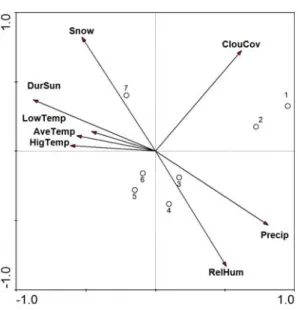
리기다소나무와 밤나무의 gap width와 8가지 기후 인자를 가지고 canonical correspondence analysis를 한 결과, 다른 인자에 비하여 온도관련 인자가 gap width와 상관관계가 높았다(Fig. 4). 최고온도, 평균온도, 최저온도의 순으로 리기다소나무와 밤나무의 gap width와 상관관계가 높았다(p < 0.05). Canonical correspondence analysis의 결과를 볼 때, 이러한 온도 와 관련된 기후인자가 리기다소나무와 밤나무의 부피 생장의 변이를 잘 설명하는 것이라고 추정된다.
4. 결 론
4.1. 흉고직경을 이용한 구간별 상대생장률 비교
흉고직경은 가슴높이의 나무 둘레를 재는 것으로 시간별 흉고직경의 변화는 부피생장에 대한 정보를 제공한다. 연구 결과 밤나무는 4.07%, 리기다소나무 는 3.73% 상대생장률을 추정했다. 미세한 차이지만 밤나무가 리기다소나무보다 생장률이 빠른 것을 알 수 있다.구간별로 상대생장률을 계산한 결과 밤나무의 상 대생장률이 시간이 갈수록 점점 내려가고 있는 것이 발견되었다. 반면 리기다소나무는 전체적으로 증가하 는 추세를 보였다.
4.2. Gap width 변화를 이용한 종간 생장률 상대 비교
리기다소나무와 밤나무는 두 종 모두 gap width가 증가하는 양상을 보인다. 그러나 각 구간의 평균값의 추세선을 분석한 결과 밤나무와 리기다소나무의 그래 프 기울기는 다르게 나타났다. 밤나무는 약 12.0인데 비해, 리기다소나무 추세선 기울기는 약 4.7이었다.이는 4년의 기간 동안 밤나무가 리기다소나무에 비해
Fig. 4. Canonical correspondence analysis of gap width growth of Pinus rigida and Castanea crenata at seven estimation dates with climate data (AveTemp:
Average of Temperature, CloudCov: Cloud Cover, DurSun: Duration of Sunshine, HigTemp: Highest Temperature, LowTemp: Lowest Temparature, Precip: Precipitation, RelHum: Relative Humidity, Snow: Snowfall).
부피생장률의 빠르다는 것을 보여준다.
그러나 4년간의 기간이 수목의 부패생장 패턴을 측정하는 것에 있어서 짧을 수 있으므로 장기적인 모 니터링을 통해 값을 비교하고 생장률을 도출했을 때 더욱 더 유의한 정보를 얻을 수 있을 것이라고 판단되 었다.
4.3. Canonical correspondence analysis 결과
리기다소나무와 밤나무의 gap width와 8가지 기후 인자를 가지고 canonical correspondence analysis를 한 결과, 다른 인자에 비하여 온도관련 인자가 gap width와 상관관계가 높았다. 최고온도, 평균온도, 최 저온도의 순으로 리기다소나무와 밤나무의 gap width 와 상관관계가 높았다.REFERENCES