서 론
왕우럭(Tresus keenae)은 비 부착성 대형 이매패류로 개량조개과 (Mactridae), 왕우럭속(Tresus)에 속하는 대형 패류이다. 우리나라 남해안 거제, 사천, 남해, 여수 연안 및 일본 연안에 서식하며, 굵 고 긴 수관을 가지는 외형적 특징이 있다. 이 수관은 왕우럭의 주 요한 식용부위이다. 왕우럭은 생산량이 많지 않기 때문에 자원조
일반적으로 비 부착성 이매패류 인공종묘생산 과정의 순서는 어 미성숙관리, 산란유발, 유생사육 및 치패사육 순서이다. 본 연구는 왕우럭 인공종묘생산 과정 중 유생사육에 관한 연구로서 환경요 인인 수온, 염분, 사육밀도 및 먹이생물 공급량이 생존 및 발생에 미치는 영향에 관한 연구를 목표로 한다.
해양생물에 있어서 해양환경은 생리대사와 서식분포에 영향을 주는 중요한 요인이다. 수온은 성 성숙, 유생발생 및 성장과 관련
JMLS
수온, 염분, 사육밀도 및 먹이공급이 왕우럭(
Tresus keenae
) 유생의 성장과 생존에 미치는 영향강한승1·김철원2*
1엠에스바이오랩
2한국농수산대학교
Effects of Water Temperature, Salinity, Rearing Density and Food Supply on the Growth and Survival of the
Surf Clam,
Tresus keenaeLarvae
Han Seung Kang1, Chul Won Kim2*
1MS BioLab, Daejeon 34576, Korea
2Department of Aquaculture, Korea National College of Agriculture and Fisheries, Jeonju, Jeollabuk-do 54874, Korea
Corresponding Author Chul Won Kim
Department of Aquaculture, Korea National College of Agriculture and Fisheries, Jeonju, Jeollabuk-do 54874, Korea
E-mail : [email protected]
Received : December 04, 2018 Revised : December 08, 2018 Accepted : December 11, 2018
본 연구는 수온, 염분, 사육밀도 및 혼합 먹이생물 공급량과 같은 환경요인이 왕우럭 Tresus keenae의 유생사육 시 생존 및 발생에 미치는 영향을 조사하기 위하여 수행하였다. 연구 결과, 왕우럭 유생사육의 최적 조건은 수온 20℃에서 24℃, 염분 30 psu, 사육밀도 1 ml당 5개체 및 먹이생물 I. galbana, C. simplex 및 T. suecica 혼합 공급량 10×104 세포/ml이였다. 본 연구 결과 를 통해 밝혀진 왕우럭 유생 최적의 사육 환경요인은 빠른 성장 및 높은 생존을 통해 생산성 향상에 기여하리라 생각된다.
This study was conducted to investigate the influence of environmental factors such as water temperature, salinity, rearing density and feeding amount on the survival and development of larvae in surf clam, Tresus keenae. As a result of this study, the optimum conditions of larval rearing were as follows. The optimum range of water temperature is 20℃ to 24℃, the optimum salinity is 30 psu, the optimum rearing density is 5 ind./ml and the supply of mixed feed organism for larva rearing such as Isochrysis galbana, Chaetoceros simplex and Tetraselmis suecica is 10×104 cells/ml. The results of this study suggest that the optimum conditions of environmental factors in larval rearing of Tresus keenae contribute to productivity improvement through rapid growth and high survival.
Keywords: Tresus keenae(왕우럭), Water temperature(수온), Salinity(염분), Rearing density (사육밀도), Feed organism(먹이생물)
은 환경요인 중에서도 매우 중요하며, 부유기간의 결정도 수온이 관여한다고 알려져 있다(Loosanoff, 1951; Walne, 1974; Kinoshita, 1989). 수정란에서 D형 유생으로의 발생에 소요되는 시간에 있어 서 수온은 중요한 요인으로 수온이 적정 한계까지 높을 때 소요 시간이 짧은 것으로 알려져 있다. 대한민국 서식 이매패류로서 이와 관련 연구로는 가리비(Patinopecten yessoensis) (Park et al., 2001), 개량조개(Mactra chinensis) (Min and Kim, 2010), 고랑가리 비(Chlamys swiftii) (Lee et al., 2013), 대복(Gomphina veneriformis) (Shin et al., 2009), 말백합(Meretrix petechialis) (Kim et al., 2011), 바윗굴(Crassostrea nippona) (Yoo and Kang, 1996), 북방대합 (Spisula sachalinensis) (Lee et al., 1996), 비단가리비(Chlamys farreri) (Park et al., 2005), 새조개(Fulvia mutica) (Kim et al., 2012), 해만가 리비(Argopecten irradians) (Oh et al., 2003), 코끼리조개(Panopea japonica) (Nam et al., 2014) 및 큰가리비(Patinopecten yessoensis) (Kim et al., 2014) 등이 있다. 이와 같은 연구를 통해 각 이매패류 의 수정란, 유생의 생존 및 발생에 필요한 적정수온이 보고되었다.
염분은 생물에게 생태학적으로 중요한 환경요인인 수온과 더불 어 생태적 내성 및 이매패류의 분포를 결정하는 중요한 요인이다 (Dame, 1996). 염분은 대략 33~34 psu를 표준 염분 농도로 한다.
염분의 변화가 나타나면 체내삼투농도 조절 및 체액 농도를 변 화시키는 등의 활동을 하며 산소소비와 같은 대사활동을 감소 시키지만, 염분 변화의 폭이 커서 적응을 못하면 폐사하게 된다 (Hammond, 1983; Matthews and Fairweather, 2004). 이매패류 유 생의 사육에 있어 밀도는 유생의 생존과 성장에 영향을 미쳐 특 히 한계 수용상태를 벗어나면 스트레스를 받아 유의적인 발생의 감소가 나타난다는 보고가 있다(Kim, 2006; Min and Shin, 2010;
Min and Kim, 2010; Kim and Yi, 2017). 먹이생물과 관련한 연구로 는 이매패류 유생사육 시 먹이생물 공급에서 단일 먹이생물의 공 급과 비교하여 혼합 먹이생물의 공급이 빠른 성장과 생존율을 높
인다는 연구 결과가 있다(Enright et al., 1986; Helm and Laing, 1987;
Min and Shin, 2010).
왕우럭의 자원조성 및 양식을 위한 인공종묘생산기술 중에서 유생사육을 위한 최적화된 환경요인의 사육조건 규명은 매우 중 요하다. 이매패류를 대상으로 다수의 연구가 진행되어 왔으나 왕 우럭을 대상으로 한 연구는 매우 미미한 실정이다. 본 연구는 산 업적 가치가 높은 양식대상 품종인 왕우럭의 인공종묘생산기술개 발을 목표로 유생의 사육에 있어서 수온, 염분, 사육밀도 및 먹이 공급 등의 환경요인이 생존 및 성장에 미치는 영향을 조사하여 최적의 환경요인 규명을 목표로 한다.
재료 및 방법 1. 산란유도
산란유도를 위한 왕우럭 모패의 준비는 2016년 10월 전남 여 수시 해역에서 잠수부에 의해 채집된 어미 20마리(각장 168.4±
25.1 mm 평균 전중 764.7±61.3 g)를 이용하여 실시하였다(Fig. 1).
사육 수조는 100 ℓ 아크릴 원형 수조를 사용하였으며 20마리의 왕우럭 모패를 사육하였다. 물리적 자극(수온(temperature)+간출 (air dry))을 이용한 산란유도로서 해수의 염분 농도는 31±1.0 psu 이였고, 자연 수온 14±0.5℃에서 18±0.5℃로 약 4℃ 정도의 수온 을 상승시켜 6시간 자극을 준 후, 수조 밖 음지에서 2시간 간출 자극하였다. 물리적 자극 후 수컷 3마리, 암컷 2마리 산란가능 개 체를 수집하였다.
2. 인공수정
인공수정은 1 ℓ 여과해수가 든 비이커에 알 10,000개씩을 넣어
둔 다음, 정자 50×104 inds./egg을 준비하여 수정시켰다. 수정란은 사육수(수온 21℃, 염분 농도 31 psu)에 100 개체/ml를 수용한 후, multi room incubator(다연실배양기)에 36시간 배양하여 D형 유생 (각장 85.9±7.9 μm)을 준비하였다(Fig. 2).
3. 환경요인에 따른 유생사육
왕우럭 유생사육은 D형 유생을 다연실배양기를 이용하여 사육 하였다. 수온에 따른 유생사육은 5 ℓ 비이커에 10 개체/ml를 수용 한 후 16℃, 20℃, 24℃ 및 28℃의 4구간을 설정하여 실시하였다.
이때 사육수의 염분 농도는 30 psu이였다. 염분에 따른 유생사육 은 5 ℓ 비이커에 10 개체/ml를 수용한 후 24 psu, 27 psu, 30 psu 및 33 psu로 설정하였으며, 사육 수온은 21℃로 유지하였다. 사육 밀도에 따른 유생사육은 5 ℓ 비이커에 5 개체/ml, 10 개체/ml, 20 개체/ml를 수용하고 사육 수온 21℃ 및 염분 농도 30 psu로 유지 하여 실시하였다. 수온, 염분 및 사육밀도 실험구에서의 먹이생물 공급은 Isochrysis galbana, Chaetoceros simplex, Tetraselmis suecica 를 혼합하여 5×10⁴ cells/ml을 1일 2회 공급하였다. 적정 먹이생 물 공급량을 조사하기 위한 유생사육은 5 ℓ 비이커에 10 개체/ml 를 수용한 후 I. galbana, C. simplex, T. suecica를 혼합하여 1×10⁴, 5×10⁴, 10×104 및 20×104 cells/ml의 4구간으로 구분하여 설정하 였으며, 사육 수온 21℃ 및 염분 농도 30 psu로 유지하여 실시하
였다. 모든 실험구의 사육기간은 21일간 이였으며, 유생의 성장은 2일 간격으로 30개체를 광학현미경(Olympus BX-50)을 이용하여 각장과 각고를 측정하였으며, 생존율은 실험종료 시 생존 개체수 를 계수하였다. 사육수는 여과해수를 이용하였으며 2일마다 전량 환수하였다. 모든 실험은 3반복으로 실시하였고, 실험구별 성장과 생존율은 Duncan's multiple range test에 의하여 유의성을 분석하 였다.
결 과 1. 수온에 따른 유생의 성장과 생존
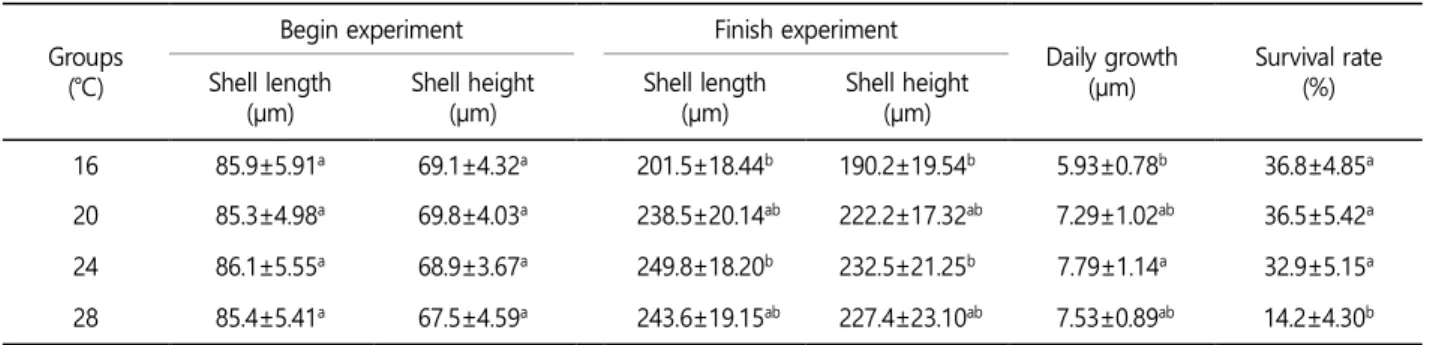
수온에 따른 유생의 성장 및 생존에 관한 연구 결과는 다음과 같이 나타났다(Table 1). 사육 실험 21일 후, 각장의 성장은 16℃
실험구 201.5 μm, 20℃ 실험구 238.5 μm, 24℃ 실험구 249.8 μm 및 28℃ 실험구 243.6 μm로 나타났다. 각고 성장은 16℃ 실험구 190.2 μm, 20℃ 실험구 222.2 μm, 24℃ 실험구 232.5 μm 및 28℃
실험구 227.4 μm로 나타났다. 일간성장은 16℃ 실험구 5.93 μm, 20℃ 실험구 7.29 μm, 24℃ 실험구 7.79 μm 및 28℃ 실험구 7.53 μm로 나타났다. 수온에 따른 유생의 성장은 24℃에서 각장, 각고 및 일간성장이 가장 높게 나타났다. 수온에 따른 유생의 생 존율은 수온 16℃ 실험구 36.8%, 20℃ 실험구 36.5%, 24℃ 실험구
Table 2. Growth and survival rate of larvae of Tresus keenae by salinity
Groups (psu)
Begin experiment Finish experiment
Daily growth
(μm) Survival rate Shell length (%)
(μm) Shell height
(μm) Shell length
(μm) Shell height (μm)
24 85.1±6.01a 69.0±4.55a - - - -
27 84.3±5.47a 68.9±4.53a 207.3±18.35ab 196.3±19.15ab 5.80±0.65ab 30.7±5.49ab 30 85.6±4.36a 67.9±4,98a 229.4±18.20a 205.5±19.4a 6.84±0.71a 34.6±5.41a 33 86.1±5.40a 68.8±5.64a 211.3±19.12ab 198.9±21.31ab 5.96±0.59ab 27.8±4.32ab Table 1. Growth and survival rate of larvae of Tresus keenae by water temperature
Groups (℃)
Begin experiment Finish experiment
Daily growth
(μm) Survival rate Shell length (%)
(μm) Shell height
(μm) Shell length
(μm) Shell height (μm)
16 85.9±5.91a 69.1±4.32a 201.5±18.44b 190.2±19.54b 5.93±0.78b 36.8±4.85a 20 85.3±4.98a 69.8±4.03a 238.5±20.14ab 222.2±17.32ab 7.29±1.02ab 36.5±5.42a 24 86.1±5.55a 68.9±3.67a 249.8±18.20b 232.5±21.25b 7.79±1.14a 32.9±5.15a 28 85.4±5.41a 67.5±4.59a 243.6±19.15ab 227.4±23.10ab 7.53±0.89ab 14.2±4.30b
32.9% 및 28℃ 실험구 14,2%로 나타났다. 수온 및 시간의 경과에 따른 유생의 생존율은 16℃에서 가장 높았으며, 16℃, 20℃, 24℃
및 28℃에서 수온이 높을수록 시간에 비례하여 생존율은 감소하 는 경향이 나타났다. 수온 16℃와 20℃에서 성장은 유의적으로 20℃에서 높았고, 생존율은 2개 실험구간 0.3% 차이를 보였다. 따 라서 수온과 유생의 성장 및 생존의 결과를 토대로 적정 사육 수 온은 20℃에서 24℃ 범위가 적당한 것으로 생각된다.
2. 염분 농도에 따른 유생의 성장과 생존
염분 농도에 따른 유생의 성장 및 생존에 관한 결과는 다음과 같다(Table 2). 염분 농도 24 psu 실험구는 유생사육 6일째 전량 폐사하였다. 사육 실험 21일 후, 각장의 성장은 27 psu 실험구 207.3 μm, 30 psu 실험구 229.4 μm 및 33 psu 실험구 211.3 μm 로 나타났다. 각고 성장은 27 psu 실험구 196.3 μm, 30 psu 실험 구 205.5 μm 및 33 psu 실험구 198.9 μm로 나타났다. 일간성장은 27 psu 실험구 5.80 μm, 30 psu 실험구 6.84 μm 및 33 psu 실험구 5.96 μm로 나타났다. 염분 농도에 따른 유생의 성장은 30 psu에 서 각장, 각고 및 일간성장이 가장 높게 나타났다. 염분 농도에 따른 유생의 생존율은 수온 27 psu 실험구 30.7%, 30 psu 실험구 34.6% 및 33 psu 실험구 27.8%로 나타났다. 염분 농도에 따른 유 생의 생존율은 30 psu에서 가장 높게 나타났다. 염분 농도와 유생 의 성장 및 생존의 결과를 토대로 적정 사육 염분 농도는 30 psu 가 적당한 것으로 생각된다.
3. 사육밀도에 따른 유생의 성장과 생존
사육밀도에 따른 유생의 성장 및 생존에 관한 결과는 다음과 같다(Table 3). 사육 실험 21일 경과 후, 각장의 성장은 5 개체/ml 실험구 221.3 μm, 10 개체/ml 실험구 214.8 μm 및 20 개체/ml 실험구 197.5 μm로 나타났다. 각고 성장은 5 개체/ml 실험구 209.6 μm, 10 개체/ml 실험구 196.5 μm 및 20 개체/ml 실험구 182.5 μm로 나타났다. 일간성장은 5 개체/ml 실험구 6.54 μm, 10 개체/ml 실험구 6.22 μm 및 20 개체/ml 실험구 5.37 μm로 나 타났다. 사육밀도에 따른 유생의 성장은 5 개체/ml에서 각장, 각 고 및 일간성장이 가장 높게 나타났다. 사육밀도에 따른 유생의 생존율은 5 개체/ml 실험구 42.5%, 10 개체/ml 실험구 39.1% 및 20 개체/ml 실험구 12.9%로 나타났다. 사육밀도에 따른 유생의 생존율은 5 개체/ml에서 가장 높게 나타났다. 유생사육에서 최적 사육밀도는 성장 및 생존의 결과를 토대로 5 개체/ml이 적당한 것으로 생각된다.
4. 먹이생물 공급량에 따른 유생의 성장과 생존
먹이생물 I. galbana, C. simplex 및 T. suecica를 21일간 혼합 공 급 후, 공급량에 따른 유생의 성장 및 생존에 관한 결과는 다음 과 같다(Table 4). 각장 성장은 5×10⁴ 세포/ml 실험구 218.3 μm, 10×104 세포/ml 실험구 236.8 μm 및 20×104 세포/ml 실험구 239.3 μm로 나타났다. 각고 성장은 5×10⁴ 세포/ml 실험구 202.2
Table 4. Growth and survival rate of larvae of Tresus keenae by feeding amount
Feeding amount (×104 cell/ml)
Begin experiment Finish experiment
Daily growth
(μm) Survival rate Shell length (%)
(μm) Shell height
(μm) Shell length
(μm) Shell height (μm)
5 86.4±6.20a 68.9±4.21a 218.3±24.33b 202.2±20.82b 6.28±0.95b 40.5±6.21ab 10 85.7±5.48a 69.3±4.55a 236.8±22.15a 216.2±21.33a 7.19±1.02a 43.8±5.92a 20 86.6±6.01a 68.6±5.11a 239.3±24.30a 218.5±21.81a 7.28±1.01a 36.3±3.30b Table 3. Growth and survival rate of larvae of Tresus keenae by rearing density
Groups (ind./ml)
Begin experiment Finish experiment
Daily growth
(μm) Survival rate Shell length (%)
(μm) Shell height
(μm) Shell length
(μm) Shell height (μm)
5 83.9±5.71a 67.9±2.36a 221.3±23.12a 209.6±20.81a 6.54±1.09a 42.5±5.48a 10 84.1±4.12a 68.0±3.41a 214.8±19.51ab 196.5±21.32ab 6.22±0.74ab 39.10±5.12ab 20 84.6±4.95a 67.5±3.10a 197.5±21.40b 182.5±19.52b 5.37±0.38b 12.9±3.35b
μm, 10×104 세포/ml 실험구 216.2 μm 및 20×104 세포/ml 실 험구 218.5 μm로 나타났다. 일간성장은 5×10⁴ 세포/ml 실험구 6.28 μm, 10×104 세포/ml 실험구 7.19 μm 및 20×104 세포/ml 실험구 7.28 μm로 나타났다. 먹이생물 공급량에 따른 유생의 성 장은 20×104 세포/ml에서 각장, 각고 및 일간성장이 가장 높게 나타났다. 생존율은 5×10⁴ 세포/ml 실험구 40.5%, 10×104 세포 /ml 실험구 43.8% 및 20×104 세포/ml 실험구 36.3%를 보였다.
먹이생물 공급량에 따른 유생의 생존율은 10×104 세포/ml에서 가 장 높게 나타났다. 먹이생물 공급량에 따른 유생의 성장과 생존율 은 각각 20×104 세포/ml과 10×104 세포/ml에서 가장 높게 나타 났다. 성장의 경우 10×104 세포/ml에서 차선으로 높았으며, 20×
104 세포/ml과 비교하여 성장의 차이가 크게 나타나지는 않았다.
그러나 생존율의 경우 10×104 세포/ml과 20×104 세포/ml을 비교 하면 약 7.5% 정도의 차이를 보였다. 따라서 유생사육에서 최적 먹이생물 공급량은 10×104 세포/ml이 적당한 것으로 생각된다.
고 찰
우리나라에서는 많은 이매패류의 천해양식이 이루어지고 있으 며, 이러한 천해양식은 이매패류 인공종묘생산의 기술개발을 통 해 이루어지고 있다. 이매패류의 인공종묘생산기술의 개발은 각 이매패류의 서식지의 특성 등 생태학적인 정보, 생식세포 형성 및 수정란 발생 등의 생식 · 생리학적인 지식 등을 토대로 개발 및 발 전되어 왔다. 기술개발 연구를 통하여 이매패류 인공종묘생산을 위해서는 수온, 염분, 사육밀도 및 먹이생물 등이 매우 중요한 요 인이라는 것이 밝혀졌다. 특히 해양생물은 서식지의 특성상 주변 의 환경요인에 직접적이고 민감하게 영향을 받으며 생활하고 있 다. 따라서 환경요인의 작은 변화는 생태계 전반에 영향을 미치 며, 또한 생물의 항상성에 영향을 주어 생물의 성장이나 생존에 영향을 미친다. 환경요인에 의한 이매패류 유생의 생존 및 발생 에 관한 연구로는 수온과 염분의 환경적 요인(Dos Santos and Nascimento, 1985; Chapple et al., 1998; Shin and Wi, 2004; Shin and Yang, 2005; Kim et al., 2010; Kim and Yi, 2017), 먹이생물의 종류(Enright et al., 1986; Laing and Verdugo, 1991; Min and Shin, 2010), 먹이생물 공급량(Nell and Wisely, 1984; Kim and Yi, 2017), 및 사육밀도(Min and Shin, 2010; Kim and Yi 2017) 등이 있다.
우리나라에서 왕우럭 관련 연구는 배우자형성(Kim et al., 2005), 생식주기(Kim et al., 1999), 먹이생물과 영양(Choi et al., 2005) 및 수온과 염분 등의 환경요인에 따른 생존(Shin and Yang, 2005) 등 이 있다. 서식 지역의 특성상 우리나라 연구진의 연구가 대부분이 며, 많은 연구의 필요성이 있는 생물이다.
본 연구는 이매패류 왕우럭 인공종묘생산기술개발 과정 중에서 유생사육에 관한 연구로서 환경요인인 수온, 염분, 사육밀도 및 먹이생물 공급량이 유생사육에 미치는 영향에 관한 연구를 통해 최적의 환경요인 규명을 목표로 한 연구로서 최적 유생사육 조건
의 수온, 염분, 사육밀도 및 먹이생물 공급량 등을 조사하였다.
연구 결과 수온은 20℃에서 24℃ 범위가 성장 및 생존에 있어 서 가장 효율적이며 최적이라는 결과가 나타났다. 또한 염분 농 도는 30 psu에서 성장 및 생존에 최적의 농도로 나타났다. 수온 및 염분 등의 환경요인은 생물의 서식이나 회유경로 변화 등 생 태계 전반에 영향을 주며, 불안정한 수온 및 염분상태는 해양생 물의 대사유지를 위한 에너지 불균형에 의해 생산력이 감소되는 등 생리에 많은 영향을 미친다(Kinne, 1963; Newell and Kofoed, 1977; Loomis et al., 1995; Bailey et al., 1996; Berger and Kharazova, 1997; Chapple et al., 1998; Shin and Wi, 2004). 또한 해양생물에서 수온과 염분은 난 발생에 매우 중요한 영향을 미친다(Sato and Tsuchiya, 1987; Strathmann, 1987; Lee et al., 1997). 염분 농도에 따른 이매패류에서의 유생발생 연구를 살펴보면 말백합은 염분 농도 15 psu, 17.5 psu 및 40 psu에서는 유생발생이 되지 않았고 20 psu에서 32.5 psu까지 농도가 높을수록 발생률이 증가하였다 (Kim et al., 2011). 개량조개도 염분 농도 20 psu에서 35 psu까 지 농도가 높을수록 발생률이 증가하였으나 0 psu, 5 psu, 10 psu, 15 psu 및 40 psu에서는 발생되지 않았다(Min and Kim, 2010). 가 리비에서도 28 psu 이상의 농도에서 발생이 증가하였고, 25 psu 이하에서는 발생률이 낮았다(Park et al., 2001). 이매패류는 종에 따라 차이는 있으나, 일반적으로 유생에서 고수온은 성장 발달이 빠르고, 저수온에서는 생존율이 높았다. 적정 수온 및 염분 농도는 이매패류 유생의 생존 및 발생에 중요한 환경요인이며, 왕우럭도 다른 이매패류와 유사한 적정 수온 및 염분 농도를 필요로 함을 나타내었다. 유생의 사육에 있어 밀도는 수용 개체가 적은 저밀도 에서 발생률이 높다는 보고가 있다(Kim, 2006; Min and Shin, 2010;
Min and Kim, 2010; Kim and Yi, 2017). 이매패류 유생의 사육에 있어 유생의 밀도를 높여 사육을 하면 경제적이나 이매패류의 종 에 따라 사육밀도가 한계 이상으로 높아지면 유생간 충돌에 의 한 성장 저해 및 수질 악화에 따른 폐사 등의 문제점이 알려져 있다(Min and Shin, 2010; Kim and Yi, 2017). Kim (2006)은 백합 (Meretrix lusoria)을 대상으로 한 연구에서 1 ml당 20, 40 및 80개 의 밀도로 수용 후, 발생률을 조사한 결과 50.2%, 52.5% 및 23.0%
을 보고하였다. 개량조개를 대상으로 한 수용밀도에 따른 발생률 의 조사에서 1 ml당 10, 20, 40, 80 및 160개 밀도에 대해 발생률 은 60.3%, 53.8%, 51.1%, 23.5% 및 17.0% 결과를 보여주었다(Min and Kim, 2010). 왕우럭은 1 ml당 5, 10 및 20 개체 유생을 수용한 후, 성장 및 발생률을 살펴본 결과 앞선 이매패류의 연구 결과와 마찬가지로 수용 밀도가 낮은 1 ml당 5개체에서 각장, 각고 및 일 간성장이 가장 우수하였고, 생존율도 다른 실험구에 비해 가장 높 았다. 이매패류에게 먹이생물 공급 시 단일종의 먹이생물을 공급 할 경우 영양적 측면에서 주요 영양요소의 결핍을 초래하여 성장 및 생존율의 저하를 유도한다는 보고가 있다(Enright et al., 1986;
Helm and Laing, 1987; Min and Shin, 2010). 또한 이매패류 종의 종류에 따른 먹이생물 공급에 있어서 먹이생물의 단일 혹은 복합
공급에 따른 성장 및 생존에 관한 연구는 보고되어 있으나, 먹이 생물 공급량에 따른 성장 및 생존에 대한 연구는 미미한 실정이 다(Nell and Wisely, 1984; Delaunary et al., 1992; Marty et al., 1992;
Kim and Yi, 2017). 왕우럭 유생에게 I. galbana, C. simplex 및 T.
suecica 먹이생물을 혼합 공급 시 20×104 세포/ml에서 각장, 각 고 및 일간성장이 가장 좋았으며, 생존율은 10×104 세포/ml에서 가장 높았다. 혼합 공급 10×104 세포/ml과 20×104 세포/ml은 성 장의 차이는 크게 나타나지 않았으나 생존율의 경우 10×104 세 포/ml과 20×104 세포/ml을 비교하면 약 7.5% 정도의 차이를 보 이며 10×104 세포/ml에서 높았다. 따라서 왕우럭 유생사육에서 최적 먹이생물 공급량은 10×104 세포/ml이 적당한 것으로 생각 된다.
이상의 연구 결과를 바탕으로 왕우럭 유생의 사육에 있어서 수 온, 염분 농도, 사육밀도 및 먹이생물 공급량 등의 최적의 조건은 수온 20℃에서 24℃, 염분 농도 30 psu, 사육밀도 1 ml당 5개체 및 먹이생물 I. galbana, C. simplex 및 T. suecica 혼합 공급량 10×
104 세포/ml라고 생각된다. 최적화된 환경요인은 왕우럭의 유생 사육에 있어서 매우 중요하다. 본 연구 결과를 통해 밝혀진 환경 요인의 조건은 왕우럭 유생의 사육에 적용되면 생산성 향상에 기여하리라 생각된다.
참고문헌
Bailey J, Parsons J, Couturier CA. 1996. Salinity tolerance in the blue mussel, Mytilus edulis. Bull Aquacult Assoc Can 96: 74 -76.
Berger VJ, Kharazova AD. 1997. Mechanisms of salinity adaptations in marine molluscs. Hydrobiologia 355: 115-126.
Chapple JP, Smerdon GR, Berry RJ, Hawkins AJS. 1998. Seasonal changes in stress-70 protein levels reflect thermal tolerance in the marine bivalve Mytilus edulis L. J Exp Mar Biol Ecol 229:
53-68.
Choi JH, Shin TS, Ahn CB. 2005. Nutrient components in the siphon of the surf clam Tresus keenae. J Fish Sci Technol 8:
43-50.
Dame RF. 1996. Ecology of marine bivalves: An ecosystem approach.
Pp. 254. CRC marine science series. CRC Press, Boca Raton.
Delaunary F, Marty Y, Moal J, Samain JF. 1992. Growth and lipid class composition of Pecten maximus (L) larvae grown under hatchery conditions. J Exp Mar Biol Ecol 163: 209-219.
Dos Santos AE, Nascimento IA. 1985. Influence of gamete density, salinity and temperature on the normal embryonic develop- ment of the mangrove oyster, Crassostrea rhizophorae Guiling.
Aquaculture 47: 335-352.
Enright CT, Newkirk, Castell JD. 1986. Comparison of phytoplankton
as diets for juvenile Ostrea edulis L. J Exp Mar Biol 96: 1-13.
Hammond LS. 1983. Experimental studies of salinity tolerance, bur- rowing behavior and pedicle regeneration in Lingula anatina (Brachiopoda, Inarticulata). Journal of Paleontology 57: 1311 -1316.
Helm MM, Laing I. 1987. Preliminary observations on the nutri- tional value of Tahiti Isochrysis to bivalve larvae. Aquaculture 62: 281-288.
Kim DH, Lim HK, Min KS, Chang YJ, Kim TI. 1999. Reproductive cycle of surf clam (Tresus keenae) in southern coast of Korea.
J Kor Fish Soc 32: 659-663.
Kim JH, Kim DH, Yoo MS, Yang MH. 2005. Ultrastructure of game- togenesis of the surf clam (Tresus keenae) (Mactridae: Bivalvia).
J Kor Fish Soc 38: 94-99.
Kim BH, Moon YB, Park KY, Jo PG, Kim MC. 2010. Study on spawning induction and larvae breeding of the hard clam, Meretrix petechiails (Lamarck). Korean J Malacol 26: 151-156.
Kim TI, Ko CS, Hur YB, Jin YG, Chang YJ. 2011. Effect of water tem- perature, salinity and rearing density on the egg development of the hard clam, Meretrix petechialis. Korean J Malacol 27:
167-173.
Kim TY. 2006. Studies on the artificial seedling production of the hard clam Meretrix lusoria (Röding). Ph.D. thesis, Pukyong National University, 114 pp.
Kim JM, Kim SC, Hur JW, Lim SM, Kim YH, Seon SC, Kang KH.
2012. Effects of water temperatures on the larval develop- ment and spat growth of the cockle shell, Fulvia mutica.
Korean J Malacol 28: 7-12.
Kim YD, Lee C, Min BH, Kim M, Kim GS, Choi J, An WG, Nam MM.
2014. Early sexual maturation through temperature stimula- tion and development of Patinopecten yessoensis. Korean J Malacol 30: 311-319.
Kim CW, Yi SW. 2017. Effect of Water Temperature, Rearing Density, Salinity, and Food Organisms on The Growth and Survival Rate in Early Juvenile Hard Shelled Mussel, Mytilus coruscus. Korean J Environ Biol 35: 152-159.
Kinne O. 1963. The effects of temperature and salinity on marine and brackish water animals. Ι Temperature Oceanogr Mar Biol Annu Rev 1: 301-340.
Kinoshita H. 1989. Thermal tolerance of eggs and larvae of Japanese surf clam Pseudocardiu sachalinensis (Schrenck).
Japan Aquacult Soc 37: 9-14.
Laing I, Verdugo CG. 1991. Nutritional value of spray-dried Tetra- selmis suecica for juvenile bivalves. Aquaculture 92: 207-218.
Lee C, Kim YC, Kim GS, Nam MM. 2013. Development and growth
in fertilized eggs and larvae of Korea swift's scallop Chlamys swiftii reared in the laboratory. Korean J Malacol 29: 263-272.
Lee JY, Chang YJ, Park YJ. 1996. Spawning induction and egg devel- opment of surf clam, Spisula sachalinensis. J of Aquaculture 9: 419-427.
Lee JY, Kim WK, Chang YJ. 1997. Influence of water temperature and salinity on egg developement of flatfish, Limmanda herzensteini. J Aquacult 10: 357-362.
Loomis SH, Ansell AD, Gibson RN, Barnes M. 1995. Freezing tol- erance of marine invertebrates. Oceanogr Mar Biol Annu Rev 33: 337-350.
Loosanoff VL. 1951. Culturing phytoplankton on a large scale.
Ecology 32: 748-750.
Matthews YTG, Fairweather PG. 2004. Effect of lowered salinity on the survival, condition and reburial of Soletellina alba (Lamarch, 1818) (Bivalvia: Psammobiidae). Austral Ecology 29: 250-257.
Marty Y, Delaunary F, Moal J, Samain JF. 1992. Changes in the fatty acid composition of Pecten maximus (L) during larval devel- opment. J Exp Mar Biol Ecol 163: 221-234.
Min BH, Kim TJ. 2010. Effect of temperature, salinity and density on the egg development of the sunray surf clam, Mactra chinensis. Korean J Malacol 26: 297-302.
Min BH, Shin HJ. 2010. Effects of Rearing Condition and Species of Microalgae on Growth and Survival of Larvae of the Sunray Surf Clam, Mactra chinensis. Korean J Malacol 26: 303-310.
Nam MM, Lee C, Kim M, Kim JW, Kim YD. 2014. Development and growth in fertilized eggs and larvae of the Japanese geoduck, Panopea japonica reared in the laboratory. Korean J Malacol 30: 303-309.
Nell JA, Wisely B. 1984. Experimental feeding of Sydney rock oysters (Saccostrea commercilis) Ⅲ. Food concentration and fattening procedures. Aquaculture 37: 197-208.
Newell RC, Kofoed LH. 1977. Adjustment of the components of
energy balance in the gastropod Crepidula fornicate in re- sponse to thermal acclimation. Mar Boil 44: 275-286.
Oh BS, Jung CG, Kim SY. 2003. Artificial spawning, larval and spat developments of the bay Scallop, Argopecten irradians. Korean J Malacol 19: 19-24.
Park KY, Kim SK, Seo HC, Ma CW. 2005. Spawning and larval devel- opment of the jicon scallop, Chlamys farreri. J of Aquaculture 18: 1-6.
Park YJ, Lee JY, Kim WK, Lee CS. 2001. Egg development and larva growth of the scallop, Patinopecten yessoensis. Korean J Malacol 17: 79-84.
Sato M, Tsuchiya M. 1987. Reproductive behavior and salinity favorable for early development in two type of the brackfis- water polychaete, Neanthes japonica. Benthos Res 31: 29-42.
Shin HC, Lee JH, Jeong HJ, Lee JS, Park JJ, Kim BH. 2009. The in- fluence of water temperature and salinity on filtration rates of the Hard Clam, Gomphina veneriformis (Bivalvia). Korean J Malacol 25: 161-171.
Shin YK, Wi CH. 2004. Effect of temperature and salinity on survival and metabolism of the hard shelled mussel Mytilus coruscus, Bivalve: Mytilidae. J of Aquaculture 17: 103-108.
Shin YK, Yang MH. 2005. Effects of temperature and salinity on the survival and metabolism of Tresus keenae (Mollusca: Bivalvia).
J Fish Sci Technol 8: 161-166.
Strathmann MF. 1987. Reproduction and development of marine invertebrates of the northern Pacific Coast. Univ. Washington Press, 670 pp.
Walne PR. 1974. Shellfish culture. In: Sea fisheries research (ed. By Jones, F.R.H.). pp 379-398. Elek, London.
Yoo SK, Kang KH. 1996. Spawning induction according to stimu- lating treatment and influence of water temperature on egg development and larvae rearing of oyster, Crassostrea nippona. Korean J Malacol 12: 91-97.