Received August 16, 2011 ; Accepted September 26, 2011 Corresponding author: Young Jin Chang
Tel: +82 (51) 629-5915 e-mail: [email protected] 1225-3480/24391
말백합,
Meretrix petechialis
(Lamarck)의 난 발생에 미치는 수온, 염분, 수용밀도의 영향김태익, 고창순1, 허영백2, 진영국, 장영진3
국립수산과학원 남서해수산연구소, 1수산자원사업단, 2남동해수산연구소, 3부경대학교
Effect of Water Temperature, Salinity and Rearing Density on the Egg Development of the Hard Clam, Meretrix petechialis
(Lamarck)
Tae-Ik Kim, Chang Sun Ko1, Young Baek Hur2, Young Guk Jin and Young Jin Chang3 Southwest Sea Fisheries Research Institute, NFRDI, Yeosu 556-823, Korea
1Korea Fisheries Resources Agency, Busan 612-020, Korea
2Southeast Sea Fisheries Research Institute, NFRDI, Tongyeong 619-705, Korea
3Pukyong National University, Busan 608-737, Korea
ABSTRACT
This study was performed to describe the effect of water temperature, salinity and density on the eggs development of the hard clam, Meretrix petechialis. Eggs of Meretrix petechialis were turned out to be demersal isolated eggs of 82.3-86.1 μm in an average diameter after spawning. The hatching rate of D-shaped larvae by elapsed time after spawning was the highest in fertilization immediately after spawning and distinguished decrease from 1 hour of spawning. The optimum water temperature for development of D-shaped larvae from fertilization was ranged between 25℃ to 27℃. However, D-shaped larvae was not developed at 33℃ of water temperature.
The required time from fertilization to D-shaped larvae were 37.3 hours in 20℃, 20.8 hours in 25℃, and 15.3 hours in 30℃. Biological minimum temperature for the egg development was estimated to be 12.4℃ in average.
The range of salinity for the development of eggs were 20.0-37.5 psu, optimum range was estimated to be 27.5-32.5 psu.
Key words : Meretrix petechialis, artificial spawning, egg development, water temperature, salinity, rearing density
서 론
조개류의 인공종묘 생산 시 가장 고려해야 할 사항은 양질 의 어미를 확보하는 것이며, 수정과 발생에 민감한 영향을 미 치는 수온, 염분 및 수용밀도 등의 적정 사육조건을 밝히는 것 이다. 특히 수온, 염분 등 수중환경은 초기 생존율에 있어 결 정적 요인이며, 수정과 부화방법은 인공종묘 생산을 위하여 매 우 중요한 과정이다.
조개류의 수정과 발생에 관한 연구는 굴, Crassostrea
gigas (Staeger and Horton, 1976; Stephano and Gould, 1988), 대서양 북방대합, Spisula solidissima (Clotteau and Dube, 1993), 지중해담치, Mytilus galloprovincialis (Dufresne-Dube et al., 1983), 가리비, Pecten maximus (Gruffydd and Beaumont, 1970), 바윗 굴, Crassostrea nippona (Yoo and Kang, 1996) 등 매우 많다.
조개류의 생식소 발달과 생식에 있어 생물학적영도 (biological minimum temperature) 는 매우 중요하며, 적 산수온의 기준이 된다. 지금까지 생물학적영도는 참전복, Haliotis discus hannai (Kikuchi, 1964), 우렁쉥이, Halocynthia roretzi (Yoo et al., 1990), 코끼리조개, Panope japonica (Lee and Rho, 1997), 진주조개, Pinctada fucata martensii와 굴, Crassostrea gigas (Chang et al., 2000), 북방대합, Spisula sachalinensis
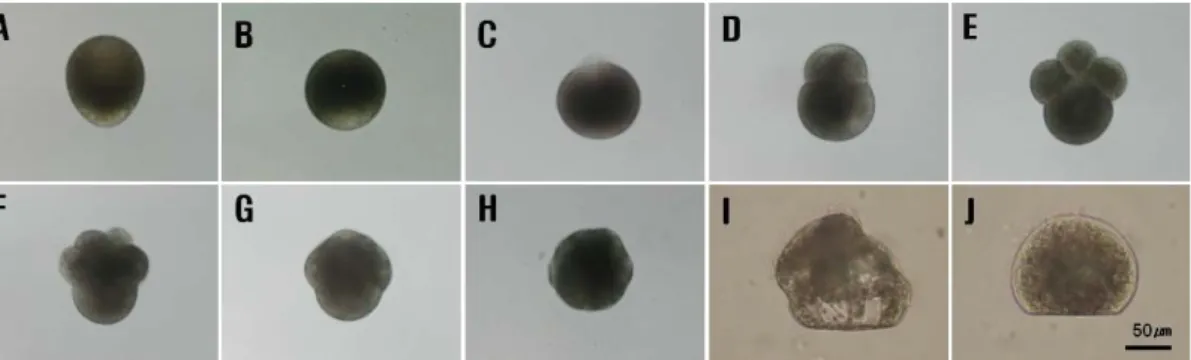
Fig. 1. Early egg developmental stages of Meretrix petechialis. A: unfertilized egg, B: egg just after fertilization, C: polar body stage, D: 2-cell stage, E: 4-cell stage, F: 8-cell stage, G: 16-cell stage, H:
trochophore stage (hatching), I: veliger stage, J: D-shaped larval stage.
(Lee et al., 2002), 바윗굴, Crassostrea nippona (Yoo and Kang, 1996), 흔한가리비, Chlamys nobilis (Won and Han, 2004) 등에서 산정된 바 있다.
백합류의 난 발생에 대한 연구로는 백합 수정란 발생을 위 한 적정 수온과 염분 (Sagara, 1958), Meretrix meretrix의 난 발생 및 유생발달 (Narasimham et al., 1987), 민무늬백 합, Meretrix lamarckii의 발생초기 적정 수온과 염분 및 유 생발달 (相良 等, 1968; Tanaka, 1969) 등의 연구가 있으나 수온, 염분, 수용밀도 등이 말백합의 수정란 발생에 미치는 영 향에 대한 체계적인 연구는 부족한 실정이다.
따라서 본 연구에서는 말백합 수정란의 발생학적인 특징을 밝히고, 수정란의 발생률을 향상시키기 위한 수온, 염분, 수용 밀도에 따른 최적 조건을 파악하였다.
재료 및 방법 1. 실험종
실험에 사용된 말백합은 2003년 전북 김제시 진봉면 심포 리 앞바다에서 생식소 발달단계가 성숙기 및 산란기인 7-9월 에 채집된 각장 58.8±8.2-65.8±8.4 mm, 전중 54.3±29.8- 73.1±28.7 g의 개체들이었다.
2. 채란‧채정 후 경과시간에 따른 수정률 및 발생률
말백합의 채란‧채정 후 경과시간에 따른 수정률과 발생률을 조사하였다. 성숙한 어미를 먼저 공기노출자극 후 1 L beaker에 1개체씩 수용하여 수온상승 자극으로 채란․채정을 하고, 같은 시간에 방란․방정된 알과 정자를 사용하여 채란․채 정 직후, 1시간 후, 2시간 후, 3시간 후 그리고 4시간 후에 인 공수정하여 수정률과 발생률을 조사하였다. 채란‧채정 후 알과 정자는 수온 30℃, 염분 30 psu의 해수 중에 방치하였으며, 발생 동안의 수온은 water bath를 사용하여 30℃로 조절하 였고, 염분은 30 psu였다. 사육수는 1 μm cartridge filter 를 사용하여 여과한 후 자외선을 조사한 해수를 사용하였고,
알의 수용밀도는 20개/mL였다. 수정률은 수정 1시간 30분 경 과 후의 난 분할 단계에서 조사하였으며, 실험은 2반복으로 실 시하였다.
3. 수온, 염분 및 수용밀도에 따른 수정란의 발생
수온, 염분 및 수용밀도에 따른 발생 소요시간 및 발생률을 조사하기 위해 수온의 경우 20, 25, 27, 30 및 33℃ (염분 31 psu) 에서, 염분의 경우 15.0 psu부터 2.5 psu씩 증가시켜 40.0 psu까지 11개 실험구를 설정하였다 (수온 30℃). 사육 수는 1 μm cartridge filter를 사용하여 여과한 후 자외선을 조사한 해수를 사용하였고, 수정란의 수용밀도는 사육수 1 mL당 20개였다. 수정란의 수용밀도 실험은 1 L beaker에 사육수 1 mL당 20, 40, 80, 160개씩 수용하고, 수온과 염분 은 각각 30℃, 31 psu로 조절하였다. 각 발생단계까지 소요시 간은 5분 간격으로 광학현미경으로 확인하였으며, 발생단계별 소요시간은 수정란의 50%가 각 발생단계에 이르는 시간으로 하였다. 발생률 실험은 3반복으로 하였으며, 3회 계수한 평균 치를 사용하였다.
4. 통계처리
각 실험 결과로부터 얻어진 모든 측정값들은 평균±표준편 차 (SD) 로 표시하였으며, 측정값들 사이의 유의차 유무는 SPSS (ver. 12) 통계 package program을 사용하여 95%
신뢰수준에서 ANOVA와 Duncan's multiple range test (Duncan, 1955) 로 검정하였다.
결 과 1. 수정란의 발생과정
말백합 수정란의 발생단계별 형태적 특징은 Fig. 1에 나타 낸 바와 같다. 말백합의 알은 분리침성란이며, 산란 직후 타원 형으로 (Fig. 1, A) 수정이 이루어지면서 구형이 되고 (Fig.
1, B), 수온 25℃에서 수정 20분 후에는 동물극에 투명한 제1
0 20 40 60 80 100
0 1 2 3 4
Time (hour)
Frequency (%)
Fertilization Hatching c
b a
d d
Fig. 2. Fertilization and hatching of Meretrix petechialis eggs by elapsed time to insemination after egg collection.
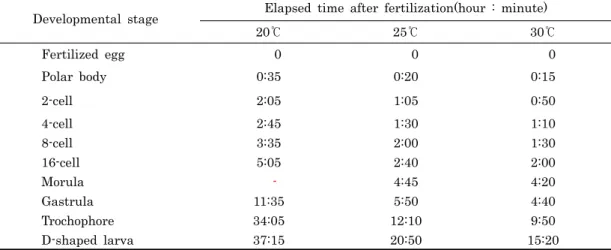
Developmental stage Elapsed time after fertilization(hour : minute)
20℃ 25℃ 30℃
Fertilized egg 0 0 0
Polar body 0:35 0:20 0:15
2-cell 2:05 1:05 0:50
4-cell 2:45 1:30 1:10
8-cell 3:35 2:00 1:30
16-cell 5:05 2:40 2:00
Morula - 4:45 4:20
Gastrula 11:35 5:50 4:40
Trochophore 34:05 12:10 9:50
D-shaped larva 37:15 20:50 15:20
Table 1. Mean required time from fertilization to each developmental stage with three different water temperature regimes in Meretrix petechialis
극체와 제2극체가 방출되었다 (Fig. 1, C). 이후 난할이 시작 되어 부등분열에 의해 2세포, 4세포, 8세포 및 16세포기를 거 쳐 (Fig. 1, D, E, F and G) 시계 반대방향으로 섬모 회전운 동을 시작하는 낭배기로 발달하였다. 이후 소화관이 형성되는 담륜자기 (Fig. 1, H), 면반(velum)이 발달하고 패각이 형성 되는 피면자기 (Fig. 1, I)를 거쳐 D형 유생 (Fig. 1, J) 으로 발달하였다.
2. 채란‧채정 후 경과시간에 따른 수정률과 수정란의 발생 채란․채정 후 경과시간에 따른 수정률은 채란 직후와 1시간 후에는 각각 99.0%와 98.0%로 높았으나, 채란‧채정 2시간 후 86.7%, 3시간 후 80.2%로 감소하였고, 4시간 후의 수정률은 46.8%로 3시간에 비해 큰 차이를 보였다. 채란․채정 직후 수 정한 수정란의 D형 유생까지 발생률은 61.9%였으나, 1시간
후 수정시에는 21.2%로 크게 감소하였고, 2시간 후 수정시 3.8%, 3시간 후 수정시 0.8%로 채란․채정 후 시간이 경과함에 따라 발생률은 급격히 감소하였으며, 4시간 후 수정시에는 발 생이 이루어지지 않았다. 채란․채정 후 수정 경과시간에 따른 수정란의 발생률을 유의성 검정한 결과, 채란․채정 직후, 1시간 후, 2시간 후, 3시간 후 수정시의 발생률은 유의한 차이를 보 였으나 (P<0.05), 3시간과 4시간 후의 발생률은 유의차가 인 정되지 않았다 (P>0.05, Fig. 2).
3. 수온에 따른 수정란의 발생
수정 후 각 발생단계까지의 수온별 소요시간은 Table 1과 같다. 수온 25℃에서는 수정 20분 후에 극체가 방출되었으며, 이후 난할이 시작되어 부등할에 의해 2세포, 4세포, 8세포 및 16세포까지 각각 1시간 5분, 1시간 30분, 2시간 및 2시간 40 분이 소요되었다. 그리고 낭배기까지는 5시간 50분, 섬모로 운동하는 담륜자는 12시간 10분, 패각과 면반이 형성되는 D 형 유생까지는 20시간 50분이 소요되었다. 20℃와 30℃에서 는 D형 유생까지 각각 37시간 15분과 15시간 20분이 소요되 어 수온에 따른 발생단계별 소요시간은 수온이 높을수록 짧았 다.
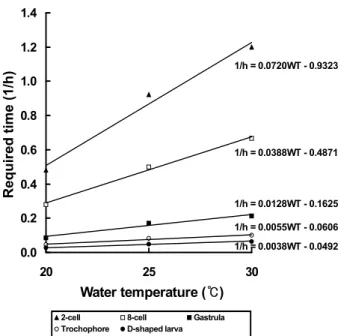
수온과 각 발생단계까지 소요시간을 그림으로 나타내었을 때 수온별 발생속도는 지수함수적 관계를 나타내었다 (Fig.
3). X축은 수온, Y축은 시간의 역수로 나타낼 때 수온 (WT:
℃) 과 발생단계별 소요시간 (h)의 관계식은 다음과 같이 표시 되었다.
2세포기 : 1/h = 0.0720WT-0.9323 8세포기 : 1/h = 0.0388WT-0.4871 낭배기 : 1/h = 0.0128WT-0.1625 담륜자 : 1/h = 0.0055WT-0.0606
0 50 100 150 200 250 300 350 400
0 10 20 30 40
Hours Accumulated water temperature [∑(WT-θ)℃·hour]
Ⅰ
Developmental stage
25℃
30℃
Ⅱ
Ⅲ
Ⅳ
Ⅴ 20℃
Fig. 4. Relationship between required time from fertilization to each developmental stage and accumulated water temperature in Meretrix petechialis. Ⅰ: 2-cell, Ⅱ: 8-cell,
Ⅲ: gastrula Ⅳ: trochophore Ⅴ: D-shaped larva. WT:
water temperature, θ: biological minimum temperature.
1/h = 0.0720WT - 0.9323
1/h = 0.0388WT - 0.4871
1/h = 0.0128WT - 0.1625 1/h = 0.0055WT - 0.0606 1/h = 0.0038WT - 0.0492
0.0 0.2 0.4 0.6 0.8 1.0 1.2 1.4
20 25 30
Water temperature (℃)
Required time (1/h)
2-cell 8-cell Gastrula
Trochophore D-shaped larva
Fig. 3. Relationship between water temperature and required time(1/h) from fertilization to each developmental stage after fertilization in Meretrix petechialis.
0 20 40 60 80 100
20 25 27 30 33
Water temperature (℃)
Hatching (%)
c b b
a
d
Fig. 5. Hatching(%) of Meretrix petechialis eggs in various water temperatures.
D형 유생 : 1/h = 0.0038WT-0.0492
이들 관계식을 기초로 말백합의 초기 발생에 있어 난 발생 이 정지하는 생물학적 영도는 평균 12.4℃로 나타났다. 또한
위의 관계식을 활용하여 각 발생단계에 이르는 소요시간에 대 한 수온․시간적산치의 직선회귀 관계를 발생수온별로 나타내어 말백합의 발생단계별 소요시간과 적산수온을 손쉽게 알아 볼 수 있다 (Fig. 4). 수정 후 D형 유생까지 수온별 발생률은 2 5℃와 27℃에서 각각 68.9%, 80.3%로 20℃의 32.9%, 30℃
의 58.2%에 비해 유의한 차이가 있었다 (P<0.05). 그러나 33℃에서는 담륜자까지 발생이 이루어졌으나 D형 유생까지는 발생되지 않았다 (Fig. 5). 따라서 말백합의 수정란은 D형 유 생까지의 발생률을 고려할 때 발생 적정수온은 25-27℃, 최적 수온은 27℃였다.
4. 염분에 따른 수정란의 발생
수정란에서 D형 유생까지의 염분에 따른 발생률은 염분 20.0 psu에서 32.5 psu까지 염분이 높을수록 증가하였으나, 32.5 psu 이상에서는 다시 낮아지는 경향을 보였다. 특히, 염 분 27.5, 30.0 및 32.5 psu에서 발생률은 다른 염분에 비해 유의한 차이가 있었다 (P<0.05). 염분 32.5 psu에서 발생률 은 23.3%로 가장 높았으나, 염분 15.0, 17.5 및 40.0 psu에 서는 D형 유생으로 발생되지 않았다. 발생된 D형 유생의 각 장은 염분에 따라 차이를 보였다. 염분 22.5-37.5 psu에서 D 형 유생의 평균 각장은 130 μm 이상이었고, 특히 염분 25.0-35.0 psu에서 각장 크기는 다른 염분에 비해 유의한 차 이를 보였다 (P<0.05). 염분 20.0 psu에서 발생된 D형 유생 의 각장은 118.4±9.0 μm로 다른 실험구에 비해 매우 작았 다 (Fig. 6). 따라서 말백합의 수정란이 D형 유생으로 발생 가 능한 염분은 20.0-37.5 psu였으며, 염분에 따른 수정란의 D 형 유생까지 발생률과 크기를 고려할 때 적정염분은 27.5- 32.5 psu로 나타났다.
0 20 40 60 80 100
20 40 80 160
Number of eggs per mL
Hatching (%)
b b
a a
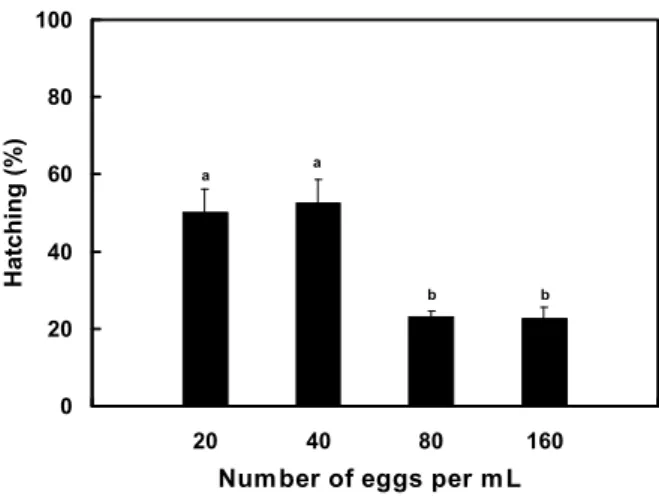
Fig. 7. Hatching (%) of Meretrix petechialis eggs according to number of eggs per mL.
0 10 20 30
15.0 17.5 20.0 22.5 25.0 27.5 30.0 32.5 35.0 37.5 40.0 Salinity
Hatching (%)
b cd
e e
c de
b
a a
a a
100 110 120 130 140 150
15.0 17.5 20.0 22.5 25.0 27.5 30.0 32.5 35.0 37.5 40.0
Salinity Shell length (㎛)
a a a
e e
de e
cd b
e c
Fig. 6. Hatching (%) and shell length of D-shaped larvae of Meretrix petechialis in various salinity (psu).
5. 수용밀도에 따른 수정란의 발생
수정란의 수용밀도에 따른 D형 유생의 발생률은 사육수 1 mL당 40개를 수용한 실험구에서 52.5%로 가장 높았고, 20 개를 수용한 실험구에서는 50.2%로 40개 실험구와는 유의한 차이가 없었다 (P>0.05). 또한 80개와 160개를 수용한 실험 구의 발생률은 각각 23.0%, 22.6%로 이 두 실험구간에는 유 의한 차이가 없었으나 (P>0.05), 20개와 40개 실험구와는 유 의한 차이를 보였다 (P<0.05). 따라서 수정란으로부터 D형 유생까지의 발생률을 높일 수 있는 수정란의 수용밀도는 사육 수 1 mL당 40개 이하로 나타났다(Fig. 7).
고 찰
적출되거나 방출된 알은 해수 중에서 난핵포의 붕괴가 일 어나며, 정자가 없는 해수에 배양할 때는 제1성숙분열 중기에 서 발생이 정지되므로 (Longwell et al., 1967; Osanai, 1985) 정상적인 발생이 이루어지기 위해서는 방출된 알이 일 정 시간 내에 수정이 이루어져야 한다. 이는 본 연구결과인 수정시간의 경과에 따른 수정률 및 D형 유생 발생률 저하에 서도 확인된다.
조개류의 발생에서 수온은 초기 난할기의 세포분열과 유생 의 발생 및 사육에 큰 영향을 미치며, 대사율과 성장률에는 직 접적으로 그리고 영양․환경 측면에서 간접적으로 영향을 미친 다 (Ventilla, 1982). 본 연구에서 수온이 높을수록 각 발생 단계까지의 소요시간이 짧았으며, 수정란에서 D형 유생까지의 부화시간은 20℃에서 37시간 15분, 25℃에서 20시간 50분,
30℃에서 15시간 20분이었다. 이는 수온상승에 따라 생화학 반응 및 생물학적 대사 속도가 빨라진다고 하는 Q10의 법칙 에 부합되는 결과이다.
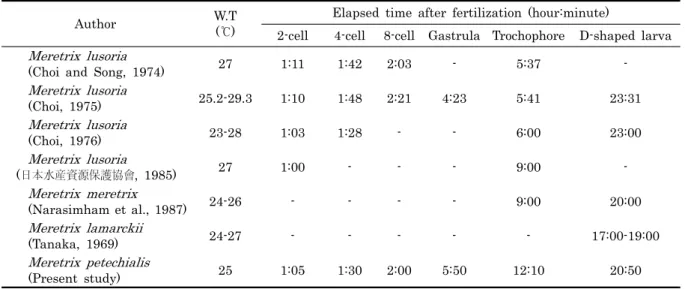
백합류의 각 발생 단계까지의 소요시간은 2세포기까지 1시 간-1시간 11분이 소요되며, 4세포기 1시간 28분-1시간 48분, 8세포기 2시간 3분-2시간 21분, 담륜자기 5시간 37분-9시간 그리고 D형 유생까지는 약 23시간이 소요된 것으로 보고되고 있다 (Table 2). 본 연구에서 나타난 수온 25℃에서 말백합의 각 발생 단계별 소요시간은 2-8세포기까지는 비슷하였으나, 담륜자기까지의 소요시간은 차이를 보였다 (Table 2). 발생 단계별 소요시간은 같은 종일지라도 매우 다양하게 보고되고 있으며, 이는 단계별 기준 및 수온 등의 실험환경에 따른 차이 에서 기인된 것으로 보여진다.
백합류 수정란의 발생 수온에 대하여 Sagara (1958) 는 수 정란의 발생 가능 수온은 19-31℃ (최적수온 21-27℃) 이며, 16℃에서는 정상적으로 발생이 되지 않는다고 보고하였다. 본 연구에서는 정상적인 D형 유생으로 발생한 수온은 20-30℃
(최적수온 27℃) 였고, 33℃에서는 담륜자기까지 발생이 이루 어졌으나 D형 유생까지는 발생되지 않아 Sagara (1958) 의 발생 가능 수온과 최적수온의 결과 범위 내에 있었다.
조개류의 종묘생산에서 어미의 생식소 발달과 발생에 있어 적산온도를 산정할 때 생물학적영도의 적용이 필요하다. 생물 학적영도는 발생이 정지하는 기초수온을 나타내는 것으로 발 생속도에 관한 자료를 얻을 수 있다 (Chang et al., 2000).
생물적인 활동이 모두 정지하는 온도는 종마다 다르며, 이 온 도 이하에서는 발생하기 힘들다. 생물학적 영도를 이용하여 발 생단계별 적산수온을 계산하면, 적산수온은 발생이 진행됨에 따라 지수함수적으로 증가하고 이 적산수온을 이용하면 발생 과정에 있어 온도의 변화에 따르는 발생소요시간을 예측할 수
Author W.T (℃)
Elapsed time after fertilization (hour:minute)
2-cell 4-cell 8-cell Gastrula Trochophore D-shaped larva Meretrix lusoria
(Choi and Song, 1974) 27 1:11 1:42 2:03 - 5:37 -
Meretrix lusoria
(Choi, 1975) 25.2-29.3 1:10 1:48 2:21 4:23 5:41 23:31
Meretrix lusoria
(Choi, 1976) 23-28 1:03 1:28 - - 6:00 23:00
Meretrix lusoria
(日本水産資源保護協會, 1985) 27 1:00 - - - 9:00 -
Meretrix meretrix
(Narasimham et al., 1987) 24-26 - - - - 9:00 20:00
Meretrix lamarckii
(Tanaka, 1969) 24-27 - - - - - 17:00-19:00
Meretrix petechialis
(Present study) 25 1:05 1:30 2:00 5:50 12:10 20:50
Table 2. Comparison of required time from fertilization to each developmental stage in Meretrix species
있다. 지금까지 연구된 조개류의 생물학적영도는 진주조개 12.3℃ (Chang et al., 2000), 바윗굴 10.96℃ (Yoo and Kang, 1996), 흔한가리비 10.44℃ (Won and Han, 2004), 굴 5.7℃ (Chang et al., 2000), 북방대합 5.5℃ (Lee et al., 2002), 코끼리조개 3.82℃ (Lee and Rho, 1997) 였으며, 본 연구의 말백합은 12.4℃로 진주조개와 비슷한 결과를 보였다.
이는 Sagara (1958) 의 수온별 발생실험에서 12.4℃ 이하에 서는 20시간 후 전부 사멸한 결과와 일치하였다.
염분에 따른 난 발생에서 수정란은 염분 41.5 psu 이상과 염분 10.2 psu 이하에서는 발생되지 않고, 발생 가능한 염분은 19.3-36.3 psu로 보고되었다 (Sagara, 1958; Narasimham et al., 1987). 본 연구 결과 역시 수정란이 D형 유생으로 발생 가능한 염분은 20.0-37.5 psu로 유사한 결과를 보였다.
요 약
말백합의 채란․채정 후 경과시간에 따른 수정률과 D형 유생 의 발생률은 채란․채정 직후 수정한 것이 가장 높았으며, 1시 간 이후부터는 수정률과 발생률이 급격히 감소하였다. 수정란 의 적정 발생수온은 25-27℃였으며, 33℃에서는 정상적으로 발생되지 않았다. 수정란에서 D형 유생까지 발생소요시간은 20℃에서 37시간 15분, 25℃에서 20시간 50분, 30℃에서 15 시간 20분이었다. 초기 발생에 있어 난 발생이 정지하는 생물 학적영도는 평균 12.4℃로 나타났다. 수정란이 D형 유생으로 발생 가능한 염분은 20.0-37.5 psu, 적정염분은 27.5-32.5 psu였다. 발생률이 높은 수정란의 수용밀도는 사육수 1 mL당 40개 이하였다.
REFERENCES
Chang, Y.J., Choi, Y.H., Chang, Y.J. and Choi, S.W.
(2000) Effect of water temperature on the egg development of pearl oyster, Pinctada fucata martensii and Pacific oyster, Crassostrea gigas.
Journal of Korean Fisheries Society, 33: 559-564. (in Korean)
Choi, S.S. (1975) Comparative studies on the early embryonic development and growth of Meretrix lusoria and Cyclina sinensis. Bulletin of the Korean Fisheries Society, 8: 185-195. (in Korean)
Choi, S.S. (1976) A study on the artificial discharge and young clam culture of Meretrix lusoria. Korean Journal of Limnology, 9: 7-14. (in Korean)
Choi, S.S. and Song, Y.K. (1974) Studies on the artificial fertilization and development of Meretrix lusoria. Bulletin of the Korean Fisheries Society, 7:
1-6. (in Korean)
Clotteau, G. and Dube, F. (1993) Optimization of fertilization parameters for rearing surf clams, Spisula solidissima. Aquaculture, 114: 339-353.
Dufresne-Dube, L., Dube, F., Guerrier, P. and Couillard, P. (1983) Absence of a complete block to polyspermy after fertilization of Mytilus galloprovincialis (Mollsuca, Pelecypoda) oocytes. Developmental Biology, 97: 27-33.
Gruffydd, L.D. and Beaumont, A.R. (1970) Determination of the optimum concentration of eggs and spermatozoa for the production of normal larvae in Pecten maximus (Mollusca, Lamellibranchia). Helgolander Wiss Meeresunters, 20: 486-497.
Kikuchi, S. (1964) Study on the culture of abalone, Haliotis discus hannai. Contribution at the 1964 Peking symposium, (Gen 041).
Lee, C.S. and Rho, S. (1997) Studies on the artificial
seedling production of geoduck clam, Panope japonica Ⅱ. Development of egg and larvae. Journal of Aquaculture, 10: 25-32. (in Korean)
Lee, J.Y., Chang, Y.J., Kim, Y.S., Choi, Y.H. and Chang, Y.J. (2002) Influence of water temperature on egg development of surf clam, Spisula sachalinensis.
Journal of Aquaculture, 15: 39-42. (in Korean) Longwell, A.C., Stiles, S.S. and Smith, D.G. (1967)
Chromosome complement of the American oyster, Crassostrea virginica, as soon in meiotic and cleaving eggs. Canadian Journal of Genetics and Cytology, 9: 845-856.
Narasimham, K.A., Muthiah, P., Gopinathan, C.P. and Gandhi, A.D. (1987) Larval development of the clam, Meretrix meretrix (Linnaeus). Mahasagar Dona Paula, 20: 115-120.
Osanai, K. (1985) In vitro induction of germinal vesicle breakdown in oyster oocytes. Bulletin of Marine Biological Station of Asamushi, Tohoku University, 18: 1-9. (in Japanese)
Sagara, J. (1958) On the optimum temperature and salinity for the development of hard clam, Meretrix Meretrix lusoria. Bulletin of the Tokai Regional Fisheries Research Laboratory, 22: 27-32. (in Japanese)
Staeger, W.H. and Horton, H.F. (1976) Fertilization method quantifying gamete concentrations and maximizing larvae production in Crassostrea gigas.
United State National Marine Fisheries Service and Fisheries Bulletin, 74: 698-701.
Stephano, J.L. and Gould, M. (1988) Avoiding polyspermy in the oyster, Crassostrea gigas.
Aquaculture, 73: 295-307.
Tanaka, Y. (1969) Studies on propagation of a hard clam, Meretrix lamarckii- 1. Artificial breeding.
Bulletin of Tokai Regional Fisheries Research Laboratory, 58: 163-168.
Ventilla, R.F. (1982) Scallop culture in Japan. Advances in Marine Biology, 20: 309-382.
Won, S.H. and Han, S.J. (2004) Effects of various stimulants on spawning induction and early development at different water temperatures in the noble scallop, Chlamys nobilis. Journal of Aquaculture, 17: 97-102. (in Korean)
Yoo, S.K. and Kang, K.H. (1996) Spawning induction according to stimulating treatment and influence of water temperature on egg development and larvae rearing of oyster, Crassostrea nippona. Korean Journal of Malacology, 12: 91-97. (in Korean)
Yoo, S.K., Kang, K.H. and Chang, Y.J. (1990) Influence of water temperature on spawning induction, egg development and seed collection of sea squirt, Halocynthia roretzi. Journal of Aquaculture, 3:
79-88. (in Korean)
相良順一郞・田中彌太郞・浜田サツ子・二宮直尙. (1968) チョウセ ンハマグリの發生におよぼす環境要因の影響に關する硏究-Ⅰ.
チョウセンハマグリの發生初期における適溫, 適比重, とくに 低溫, 低比重の影響について. 茨城水試, 91-97.
日本水産資源保護協會. (1985) 水産生物生活史生態, 241-251.